You might remember us discussing mesmerism when we spoke about ‘A Tale of the Ragged Mountains’ and in particular the story ‘Mesmeric Revelation’. In the case of the ‘Ragged Mountains’ mesmerism was really merely used as a narrative device to get to the story itself. Mesmeric Revelation by contrast was a story in which what little narrative existed was there purely as a device to discus mesmerism. This third tale of mesmerism owes much to Mesmeric Revelation as it is very much the story that the early work used as a framing narrative.
The short of it is that ‘The Facts in the Case of M. Valdemar’ is the story told by a mesmerist who puts a dying man in a hypnotic trance right at the point of death, to see what happens…
Unlike Mesmeric Revelation which was framed as fiction but was really speculative non-fiction, ‘The Facts in the Case of M. Valdemar’ was fiction framed as a factual non-fiction account of an experiment in mesmerisation.
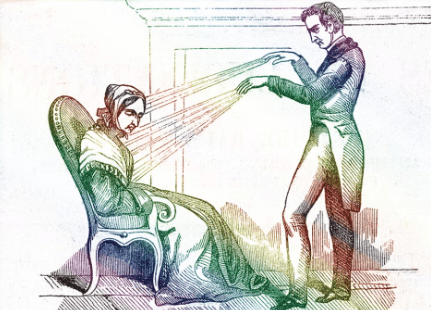
One reason why ‘The Facts in the Case of M. Valdemar’ at the time was often mistaken for a ‘true’ account is quite possible because it is dry to the point of arid. The Kalahari has more moisture in it. I do not mean this is written with a dry wit, as if oft times the case with our Dear Edgar, instead it is the absence of any real wit that makes it so dry. Dry like a mummies husk or a Utah lake bed.
In these, the enlightened days of modernity, hypnotism is a casino act and the other aspects of mesmerism is consigned to long debunked and forgotten corners of pseudoscience. In Edgar’s time however, there was some basis of belief that gave credence to this story. By presenting it in such an arid perfunctory way it seemed like a genuine scientific account. People wanted to believe, and the story offered ‘proof…’
Valdemar is mesmerised at the point of death, dies, and then continues to converse with the mesmerist. But for a man now passed beyond the river he has little to say worth hearing. This, it has to be said adds to the whole Hoax science paper feel of the story. he he given out fantastical revelations the narrative would have been more obviously fictional While the dead man is in his mesmerised state he is both dead and communicating for days then weeks, until he is finally realised at which point the body more or less dissolves into a putrid mess.
That is all the story really has to offer. Unlike ‘Mesmeric Revelation’ there is nothing speculative or intriguing said by the dead Valdemar. There are no great revelations , or even minor ones. In the end it seems like a story trying so hard to seem real that it fails at the most basic of requirements for a story, it neither entertains, informs a perspective or makes you speculate.
The problem is perhaps that this is a story is over one hundred and eighty years old. This is not to claim that modern audiences have become too sophisticated to be taken in by such a story. Instead I would posit we just expect more. In an age where endless reams of pseudoscience is accessible through a device you carry in your pocket. Ghost hunters have TV shows, and Paul McKenna doing 50 date tours making people believe they are chickens on stage. Mesmerism is a long forgotten fringe idea that isn’t anywhere people go looking for answers.
Which leave us with this, a story written as hoax science to enrapture a credulous audience that have long since moved on to other things. Which may be something of a shame as it clearly was entirely successful at the time as it took Poe admitting it was purely fiction months later in letters to put to bed the idea that it was in some way a true accounting.

TWO RAVENS, MOST OUT OF CURIOSITY AS TO WHY ANYONE WAS TAKEN IN BY THIS BACK THEN
Should your read it: Well, after all I have said, I do not dislike the story as such, it is dull and unengaging but it is interesting what could be considered a successful hoax nearly two centuries ago. But that is really the only interesting about it.
Bluffers fact: Rudyard Kipling refenced this story in his own tale, ‘In the House of Suddhoo’ some forty years later, while Kipling knew it was a story, he refenced it in a way that treats it more as science. Using the hoax to give credence to his own tale.







 The Passing Place