“Stay for me there! I will not fail
To meet thee in that hollow vale.”
The pages of popular woman’s periodical of the 1830’s, Godey’s Lady’s Book, would on the face of it seem a strange place for our the first of own Dear Edgar horror stories to find a home. It’s a bit like Stephen King writing a story for Cosmopolitan.
Godey’s has quite a history in American publishing, running for nearly fifty years between 1830 and 1878, which took it right through the civil war. For much of that history it editor was Sarah Josepha Hale who is even more fascinating than the magazine she edited for forty years. She did not retire until 1877 she was 89. Also in that year that Thomas Edison made the first ever human speech recorded on a phonographic* device reciting the opening lines of the poem ‘Mary had a little lamb’ into the crude recording device. A poem you may well of heard of that was written by Sarah Josepha Hale 47 years earlier…
*Aside being a type of early sound recording device The Phonographic is also the legendary Goth club in Leeds where The Mission were founded out of the shattered remains of the original Sisters of Mercy, and I once briefly got chatted up by Marc Almond…
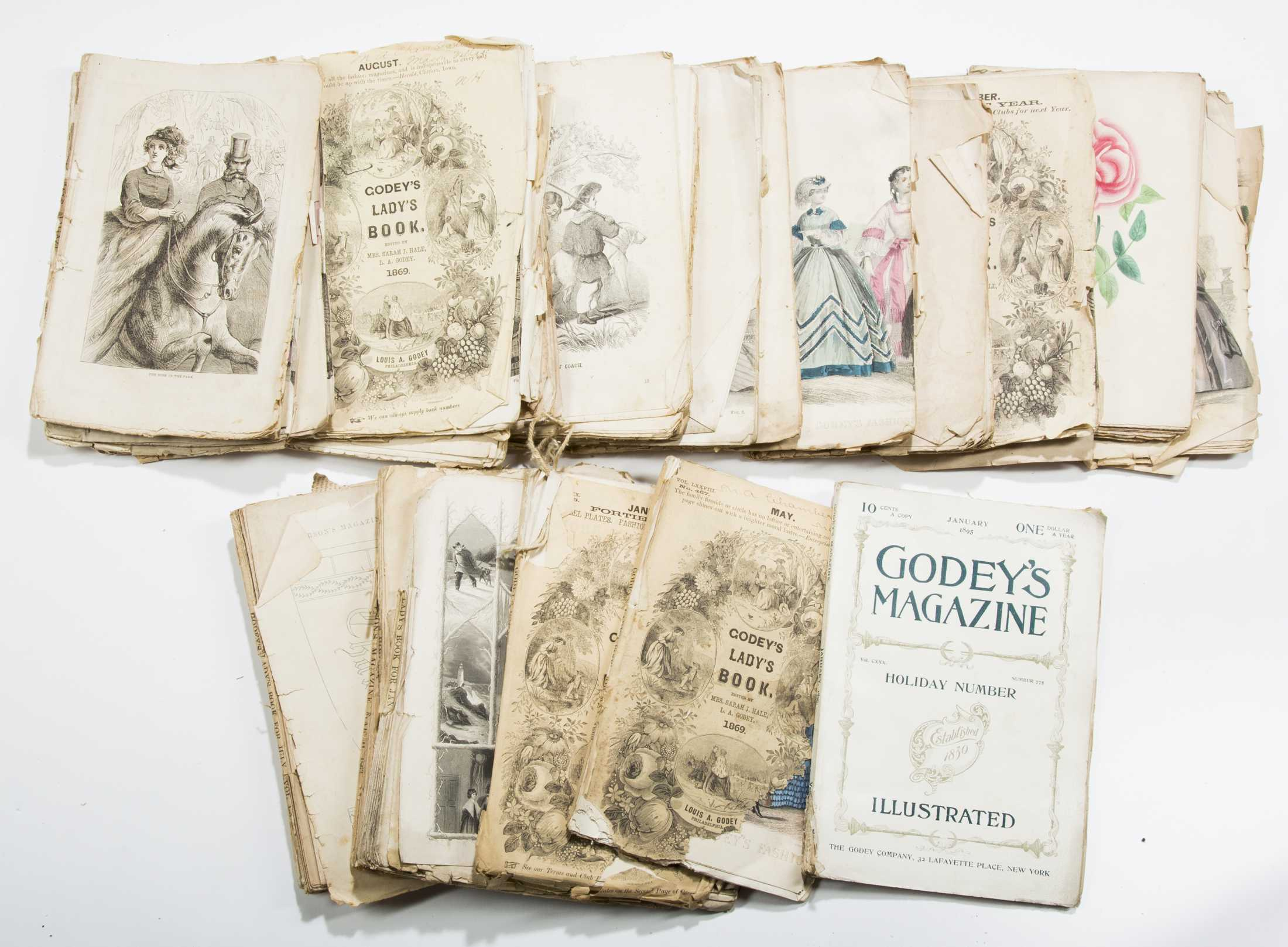
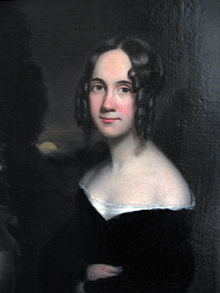
Sarah Hale was not just an editor and poet, She was also a novelist who wrote about the evils of slavery some 30 years before the civil war, a woman’s activist in particular as an advocate for women’s access to higher education, indeed she helped found Vasser Collage in furtherance of that aim. She was also almost signally responsible for Thanksgiving becoming a national Holiday in the USA and as editor of Godey she was also responsible for publishing the famous picture of Queen Victoria’s Christmas tree and help to popularising what became a tradition.
So the deaths of millions of Turkeys and the cutting down of countless premature fir trees can all rest firmly at Sarah Josepha Hale’s feet. Despite this she wasn’t the commissioning editor who decided to published this particular Edgar Alan Poe tale which found its home between the magazines pages in 1834 three years before her tenure as editor began. So this is all a bit of a weird little digression all in all. She was, however, responsible for bring him back to the magazine when he had made more of a name for himself several times over the years, and she is also one of the most fascinating and influential women in American history and celebrated as such with plaques, historical trails and literary prizes named in her honour.
In any regard, famous editor aside Godey’s was a forerunner of the glossy fashion magazine of today, crossed with good house keeping and lifestyle magazines with a little bit of fiction, and in January 1834 it published a horror story that was then entitled ‘The Visionary’ by an anonymous author who later turned out to be our Dear Edgar, who republished the story in later words under the new title The Assignation’. This was his only story publish that year in what was one of the leanest periods of he career. It’s also a trifle odd, even by Poe’s standards…
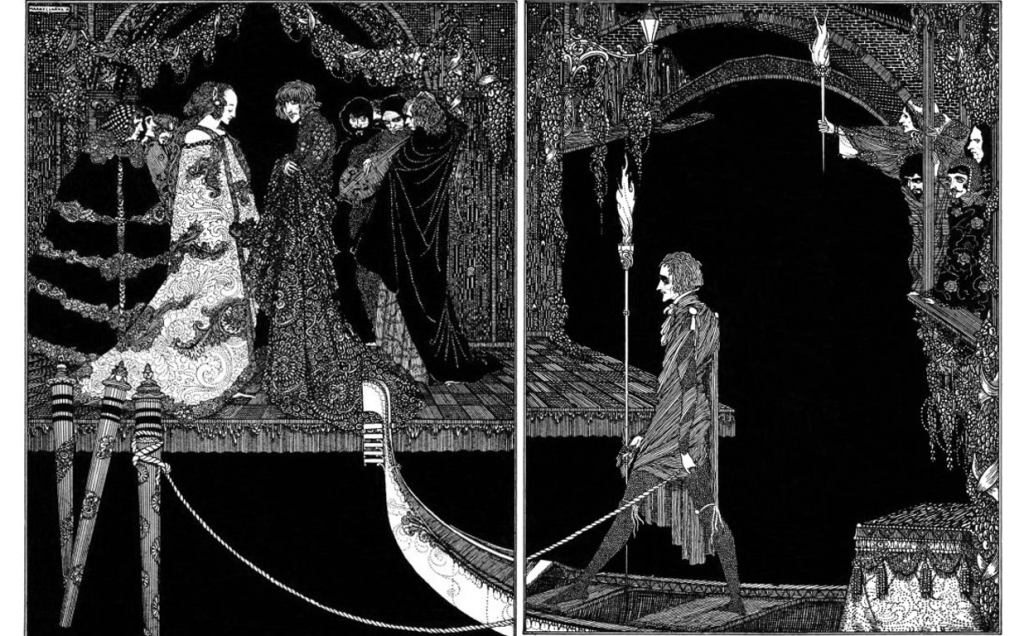
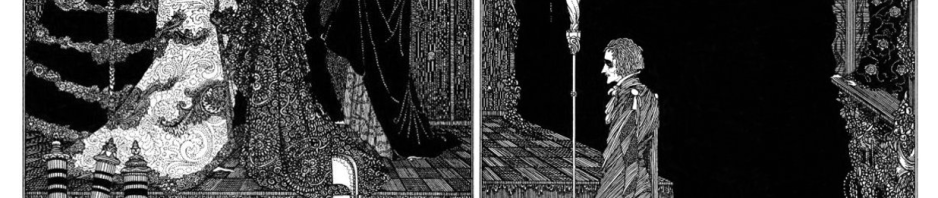
*Original Illustrations of ‘The Assignation’ by Harry Clarke 1926, who illustrated much of Poe’s work in his own very individual, very gothic and frankly beautiful style.
This is a story in two very distinct acts. It is a story of a doomed love, a fools passion, and one mans choice to chase after a lost love that eventually leads to a tragedy. It is very much a gothic tale of forlorn intention. A tale we are told by an unnamed narrator who becomes an innocent bystander and witness to it all.
Rowing his gondola through the grand canal of Venice as evening falls the narrators peace of mind is interrupted by a woman’s scream, he also manages to drop his oar, which is mildly inconvenient as that leaves him somewhat adrift in the middle of the canal moving slowly towards The Bridge of Sighs (which is not on the Grand Canal but we’ll let Poe off on that score).
The scream it turns out was the scream of the Marchesa Aphrodite, reputedly the most beautiful woman in all of Venice. Certainly the narrator is of this opinion, and given his reaction to seeing her is finding himself rooted to the spot and adrift in his gondola, its fair to say this may well be the case. Not that this is the most helpful of things he could be doing as the reason for her scream is that her infant child has fallen into the canal. The child is eventually rescued, but not by the Marchesa’s husband (who just goes back to playing his guitar, without a second thought for the child), or any members of his court more interested in their lords strumming, but by a stranger, or at least someone who the narrator believes is a stranger. The Marchesa however clearly knows him, and appeared to be looking for him in the crowd even while her child was drowning. After the rescue the narrator hears her say to the stranger…
‘Thou has conquered – on hour after sunrise – we shall meet – so let it be!’
And thus her fate, and the fate of the stranger are sealed… Though the narrator doesn’t know this at the time. And that is more or less the end of the first act.
The second act is more than a little odd in comparison. The narrator who ferries the stranger home is invited to visit with him before sunrise, so does just that. He discovers when doing so that the stranger is rich, more than a little eccentric, and without exactly saying so it clear the narrator thinks the stranger has more money than taste, a lot more money than taste. He is, however, certainly highly educated, and if anything he is even more ostentatious in displaying that education than he is with golden rugs and (poorly made) sphinx statues.
Poe then treats us to an array of oddity, poetry and the strangers observations on many subjects much of which Poe clearly made up as he was going along. Such as the claim Sir Thomas Moore died laughing (rather than being beheaded for refusing to recant his Catholicism) Or that Sparta was a city of a thousand temples to a thousand gods, (rather than having Apollo as a patron god, I mean there were other temples, but a dozen or so is hardly thousands). Possibly this was Poe trying to indicate that the stranger was just as full of himself intellectually as he lacked for taste. But I rather doubt it.
Towards the end of this rather long section the narrator begins to suspect the stranger is actually an Englishman, there are clues in his education, his mannerisms, and of course the translations of Italian love poetry he has annotated with English… The narrator then remembers that the Marchesa Aphrodite, before she was the Marchesa lived for some time in London and the court gossips spoke of an affair between her and a rich young noble…
Indulging in a bit of very early in the day, drinking, the stranger takes a moment to quote a long dead bishop with the following passage.
“Stay for me there! I will not fail
To meet thee in that hollow vale.”
Then the stranger collapses on to a chair while the narrator answers a knocking at the door to discover a page arrived from the Ducal palace to bring new that an hour after sunrise the marchesa took her own life with poison. The narrator turns to see the stranger has joined her in this final tryst. In other words it all goes a bit Romeo and Juliette…
Much of the second half of this tale comes off as intellectual posing by Edgar. While that might sound a harsh criticism, I doubt the readership of Godey Lady’s book in the 1830’s would have spotted all the oddities within the strangers preachy monologues, and I am sure Poe knew that. He packed the tale with a certain kind of exotic… Venice the far off city, the beautiful woman uncared for be a husband, the brave stranger.. This is a tale of tragic love, of a kind written to appeal to a female audience. A female audience of bored middle class wife’s who could afford the annual subscriptions for Godey’s Lady’s Book. A magazine you would imagine most of there husbands would never consider leafing through themselves… This was the 1830’s Cosmopolitan after all..
In short, this is not so much horror, as it is often coined to be despite note having any traditional elements of horror within it, but a romance for bored housewives. There is an odd, and somewhat convoluted line but there is a line all the same, between this story and 50 shades of grey.
Now that is horror…

TWO RAVENS OUT OF AN UNKINDNESS
Should your read it: While the score I give this isn’t high it is actual worth a read. I’ve marked it down mostly because I’m not entirely sure what to make of it. it fails as horror, and it doesn’t really succeed as a romance either. But it does have a oddly fascinating quality to it.
Should you avoid it: Well if your offended by poor research you might want to avoid it, but Poe did not have google, Wikipedia, and a pedants mind.
Bluffers fact: Among her many other honours Godey Lady’s Book editor Sarah Josepha Hale was forth in a series of historical bobblehead dolls created by the New Hampshire Historical Society… You know you have really broken the glass ceiling when one hundred and fifty years after your death they make a bobblehead in your honour.
Bluffers fact2: I don’t normally do a second bluffers fact, but the artwork of Henry Clark that litters folio editions of the complete works, is actually in the public domain as all works published before 1928 are in the public domain as of 2023, and in any regard, due to the death +70 years rule all his art is public domain and Harry died in 1930. This isn’t much of a fact, but does mean I can reproduce these gorgeous works of art in these blogs without being sued which delights me…
Oddly enough Henry Clark is actually most famous for stain glass windows of which he did more than 130, the book illustration was just a bit of a side gig between windows .






 The Passing Place
Could count as gothic romance, possibly?
LikeLiked by 1 person
More gothic tragedy, trying to be a romance and sort of flapping at it, the second act goes all over the shop, its very odd in that regard, and not odd in a good way, just odd
LikeLiked by 1 person
I’m not sure old style gothic romance requires a happy ending, but then, I also don’t make the rules. Thinking of Nathaniel Hawthorn’s The Marble Faun.
LikeLiked by 1 person
No romance need a happy ending 🙂 But this is not exactly Wuthering Heights..
LikeLiked by 1 person
Pingback: Dear Edgar #8 Berenice | The Passing Place