“In me didst thou exist—and in my death, see … how utterly thou hast murdered thyself.”
William Wilson is a tale with more than one interpretation, which possibly accounts for the remarkable number of adaptions of a story which is unlikely to be listed by anyone asked to name their favorite Poe stories. Unless the person you were asking was our own Dear Edgar who once wrote Washington Irving asking for a word of indorsement and naming William Wilson as ‘his best effort’.
Washington Irving wrote Sleep Hollow and is by extension therefore responsible for the annual mutilation of all pumpkins, having created the headless horseman myth. He also wrote Rip Van Winkle, but luckily that one did not lead to a random squash being hollowed out and having a face carved into it.
The story of William Wilson is told to us by a narrator using that name to hide his own for proprieties sake as he claims to be ‘of noble descent.’ the presumption being he does not wish to cast shame upon his house, by shedding light on the less than salubrious aspects of his life. He has been something of a wastrel, a gambler, a cheat, and a lecherous con-artist. Thus he has a less than high opinion of himself. This ties in neatly to one interpretation of the story as a whole, but I will come to that.
Obsessively this is the story of a man with a dopplganger. From his early school days, through collage and then adult life his footsteps are dogged by another who no only bares the same name, but in all most all respects is his double. The one difference between them is the other is almost always the better man. In their schools days he is more liked, better on teh sports field, more attentive in the class room. In later life his double interferes and stops him when ever he starts doing things which are dubious or debauched. From cheating at cards to seducing a nobleman’s wife and other things. William it seems is driven by ambition, anger and lust. The other William is driven to reign back his excesses.
In the end this leads to a sword fight in which William kills his double… Or possibly in doing so himself.
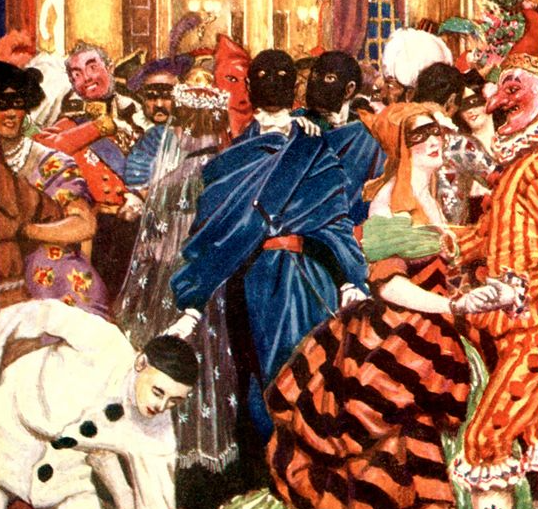
There are many ways to interpret this tale, there is an ambiguity to it that encourages multiplicities in interpretation. My personal interpretation therefore may not match your own or indeed Poe’s intent. Though I am of the opinion this was Poe’s very intent. It is a tale that causes the reader to consider possibilities. One of which is this, the other William Wilson never seems to interact directly with anyone other with Wilson. And it is the interactions between Wilson and his dopplganger which are at the heart of this tale. Through out the dopplganger acts as Wilson’s better angels. Never openly seeking him harm, intervening only when Wilson’s actions becomes dubious. Even in the end when the inevitable sword fight between them is contested the dopplganger does so with no desire, a reluctant participant in his own murder. The dopplganger is the better man William Wilson wishes to be, a personification of his conscience intervening to stop his most heinous actions.
But as I say that is but one of many interpretations and the reason for the strange range of film and novels the story has helped to inspire.
Among the many many adaptations of this story among the strangest in many ways is ‘The Destroying Angel’ a Gay porn horror movie from the mid 70’s attempting to be art house and not quite managing to do so… ‘the destroying angle is also the name of a particularly deadly mushroom… There are however many less obscure adaptations


FOUR RAVENS FOR INSPIRATION ALONE
SHOULD YOU READ IT: I have a somewhat mixed view on this one, it is well written, full of possible interpretations and clearly inspiring, I just found it a tad windy in the beginning
Bluffers fact: William Wilson is believed to have inspired of all things Nabokov’s ‘Lolita’, there are certainly a lot of Poe refences in ‘Lolita’ including the narrators first love Annabel Leigh being named after a Poe Poem of the same name, while the narrator is called Humbert Humbert, and often cites Poe through out. Given Poe’s own marriage to Virginia when she was only 13, the inspiration may go deeper than that.






 The Passing Place