In 1962 Arthur C Clark wrote a story for Playboy about an astronaut locked in an ever decreasing orbit around the moon. The story was titled ‘Maelstrom II’, it is possible that this may have struck observant readers as an odd title considering Mr Clark hadn’t previously written a story called ‘Maelstrom’. Though one suspects while Playboy paid for stories and the magazines readers read them, no one bought the magazine for the short stories, even if they were written by a veritable master of Science Fiction in the middle of his career. So it is quite possible no one ever questioned the oddity of the title, when they read it on a rainy Tuesday lunch time in July, before they went back to looking at pictures of Norwegian model Unne Terjesen who was that months Playmate of the month
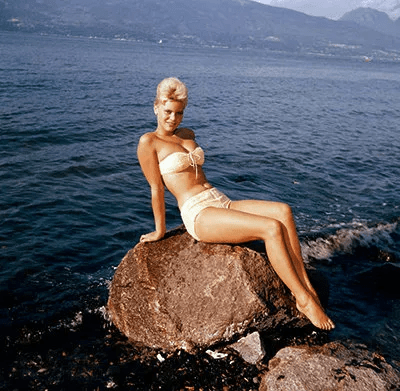
By strange coincidence, Maelstrom II was based on an original short story who’s main character, like Unne Terjesen is Norwegian, though admittedly a less tall, bronzed, blonde and beautiful Norwegian, as he was a fisherman in the story (not that fishermen can’t be tall blonde and beautiful). That original story was of course by our Dear Edgar, otherwise all of this would just be a somewhat tenuous excuse to use a picture of the very pretty Miss Terjesen for this blog post. The story in question being ‘A Descent into the Maelström’ and was the story Arthur C Clark drew upon when he wrote Maelstrom II. Hence the oddity of the title no body questioned.
The original story was first published over a hundred years before Arthur’s 1962 homage, in 1841, and despite been set at sea is considered to be one of the first real science fiction stories, as it bares all the hallmarks of speculative fiction. The fisherman surviving his strange adventure through observation of the nature of currents around a giant whirlpool. The maelstrom of the title. The maelstrom itself is a very real thing, know as the Moskstraumen. It lays in the northern Norwegian sea between the last few islands in a chain that runs out some twenty-five miles from mainland Norway and is a near unique natural wonder caused by the tidal currents, and the shape of an undersea ridge. Whirlpools form and reform as the tides shift and in strong gales can becomes enormous.

The Moskstraumen has been around a long time, as the map below from 1539 illiterates, though where the giant red sea serpents troubling shipping have vanished to is another question.
The narrator in Dear Edgars story is taken by an old fisherman up to the top of a cliff that overlooks the great bore, once there, with the view suitable admired and explained, the old fisherman starts to tell his story. He and his two brothers were, it seems, out fishing, when a gale descended upon them and as they turned for home they were blown northwards until they were caught by the current and the wind pushed them into the edge of the vortex which was all the wilder for the storm. The small ship, despite everything the brothers do to fight against the bore, is drawn further and further in circling the largest of the whirlpools in ever decreasing circles. All hope seems lost…
The old fisherman manages to keep his head, enough to realize the boat is doomed as larger objects are drawn into the heart of the whirlpool faster. Where as smaller less streamlined objects turn slower and descend slower into the watery maw. He pleads with his brothers to abandon the ship, but when they refuse he throws a barrel in the water and himself after it. He clings to the barrel for dear life as the whirlpool takes his small craft and his brothers down to the depths. He continues to cling to that barrel for hours, circling his doom, and sure he has merely delayed the inevitable, but then the storm abates, the whirlpool calms and the man is rescued by a passing fisherman. The last of the three siblings, his brothers long since drown.
He is of course not unmarked by the experience. The old man talking to the narrator is not so old. he went into the sea with lush dark hair a young man in his twenties. He emerged with his hair turned white and seemingly aged beyond recognition by the experience.
Now all this is an interesting enough story, based in a real place and even the science about the way objects react to a whirlpool is not entirely fatuous. It does however suffer a tad from a common affliction of Poe stories at this point in his career, which is to say there is a degree of padding. Were such a tale to be submitted to me wearing my anthology editors hat (a delightful bowler if you must know), I would suggest the writer lost at least 500 – 1000 words at the beginning and tightened it up. The early going is very descriptive of the view from the clifftop, long winded and dull. The real meat of the story starts when the ‘old’ fisherman tells his tale and even then it takes some getting going. That is not to say it is just padding, but it takes some getting through to get to the real story.
It is almost as if Poe was being paid by ‘Grahams magazine’ a fee based on column inches, and boy does the early going show it… Interestingly the same can be said for Arthur C Clarks tale in Playboy which paid for articles and stories by word count…
In any regard this is a strong story, well grounded and fascinating in of itself, even with the laborious opening 3rd. Whether it would girder more interest than the center fold is another matter but one suspects the center folds in an 1841 magazine were somewhat less alluring, and defiantly more ‘suitably’ dressed than the delightful Unne Terjesen in 1962. Though I have it on good authority, they were showing all kinds of ankle…

A TRIO OF SHIFTY LOOKING RAVENS, SLIGHTLY DIZZY FROM LOOKING AT WHIRLPOOLS
Should you read it : It is an interesting tale, I would say skipping the first third is not unreasonable and you don’t lose anything in doing so.
Should you not read it: its a inoffensive little tale, as tales goes
Bluffers fact: For reasons that make little sense, save perhaps the repetitive nature of swirling around a whirlpool clinging to a barrel in a raging storm has some musical merit, there have been several pieces of music ‘inspired’ by this story, including a piece by composer Philp Glass commissioned by the Australian Dance Theater, because that makes perfect sense… An early use of multitracking in 1953 by Pianist Lennie Tritano, which is quite quite odd… And an instrumental track by the Spanish Prog Rock band Crack on their one and only album.
There is something to be said for a story which inspires an obscure Spanish prog rock band with a whole one album to their name. I am not sure what that something is, but still, cool track if you like obscure progressive rock, and who doesn’t…












 The Passing Place