
The glee at my heart was too strong to be restrained. I burned to say if but one word, by way of triumph, and to render doubly sure their assurance of my guiltlessness.
If, as I posited, The Tell-tale Heart is much beloved of English Lit teachers the world over for its use of a corrupt narrator, this tale is its companion piece. Buoyed by the critical success of ‘The Tell-tale Heart’ which had been published in January 1843, in the spring of that year he put pen to paper on a second such tale and wrote ‘The Black Cat’. The similarities between the two stories are easily drawn*…
*hence its popularity with English teachers who like a lesson plan that writes itself…
Both stories have narrators that make claims as to their sanity, and in both cases that sanity is clearly questionable. The central theme in both cases is guilt, and in both their increasingly irrational behavior leads to murder, and there eventual arrest as the guilt drives them over the edge. They are in effect quintessential phycological thrillers, a genre that owes much to these stories.
There are however a few issues with The Black cat when you compare it to Tell-tale heart, one of which is the very nature of a story written to a formular. The success of the first story influenced the structure and telling of the second which leaves it reading a little forced in places. It does not quite have the flow of tell-tale. There is also an added element in which Poe preaches from the pulpit of abstinence. The narrators deteriorating mental state is attributed to his alcoholism.
Edgar’s brother Henry had died some twelve years earlier from complications brought on by alcoholism. Poe had witnessed this decline and had his own problems with the demon drink, he had lost jobs because of it and was at periods in his life a drunk, then tee total, then fell off the wagon. the Black Cat was written due in a period of sobriety and written with all the virtue of an ex-smoker coughing loudly as he passes the smoking shelter. This is to say he was a reborn abstainer and evangelical in his condemnation of those who drink…*
*Till the wagon hit a bump and he bounced off again…
In any regard, The Black Cat is a story told to us by a condemned man awaiting the noose. A man who first makes claim of his sanity before professing a loves of animals. All animals. A man never happier than in the company of a faithful dog, or cuddling a rabbit. A man who marries young to a woman of similar disposition. All is joy in the house hold of many pets, sand would have continued so had not the man found another love, that of the bottle. In his cups he has a temper, in his cups he might kick out at a hound or throw something at a rabbit. The animal come to fear him in his drunken states, as does his wife who he admits to rising a hand to when he is worse for drink.
All this is very candidly told, as is his treatment of the couples large black cat, Pluto. Pluto who unlike the other animals has not becomes afraid of him , but one drunken night, when the cat scratches him, he takes out his pocket knife and blinds his pet cat in one eye. He then becomes oddly resentful that the cat then becomes scared of him. Imagine… developing a fear of the thing that took one of your eyes…
As an aside, as a former cat owner before Boomer died a couple of years back, anyone who has ever owned a cat will tell you getting scratched is something that happens with even the most even tempered of cats. Play with a cat and eventually it will claw you in its own playful way. Gauging out their eyes for doing so is something of an over reaction one feels … But back to the story.
Resentment builds and the narrator end sup hanging Pluto from a tree in another drunken rage. I must admit sympathy for what happens to the cat murdering drunk after this is somewhat lacking in myself and I expect in the average reader… Also, no one seems to spare a thought for the poor tree in all this though. Did the tree ask to have a feline nailed to it? You just know all the other trees are going to mock her now and call her ‘cat-tree’.
“Oh look at her, acorns are good enough, oh no, she was poor defenseless animals hanging form her boughs.”
The woods can be very catty at times…
Having killed one cat, and given a poor oak tree a complex, the narrator comes to won a new cat. One which looks almost exactly like the other cat. He could have bought a ginger tom, or a nice little tabby, but no he obtains another black one, a black cat entirely like the Pluto, even to the extent of only having one eye, except for a white patch on its belly, a white patch that comes to resemble a gallows.
Drunk once more and incensed by that patch of white fur that seems to taught him with his cat murdering crimes he tries to kill the new cat with a hatchet. And when his wife tries to stop him, he kills her instead, and without a great deal of remorse he walls up her body…
The feline has the last laugh though, as when the police come they discover the body because the cat has been walled up with it and is still very much alive, and its howls cause the police to discover the wife’s body. Hence the narrator is now a condemned man
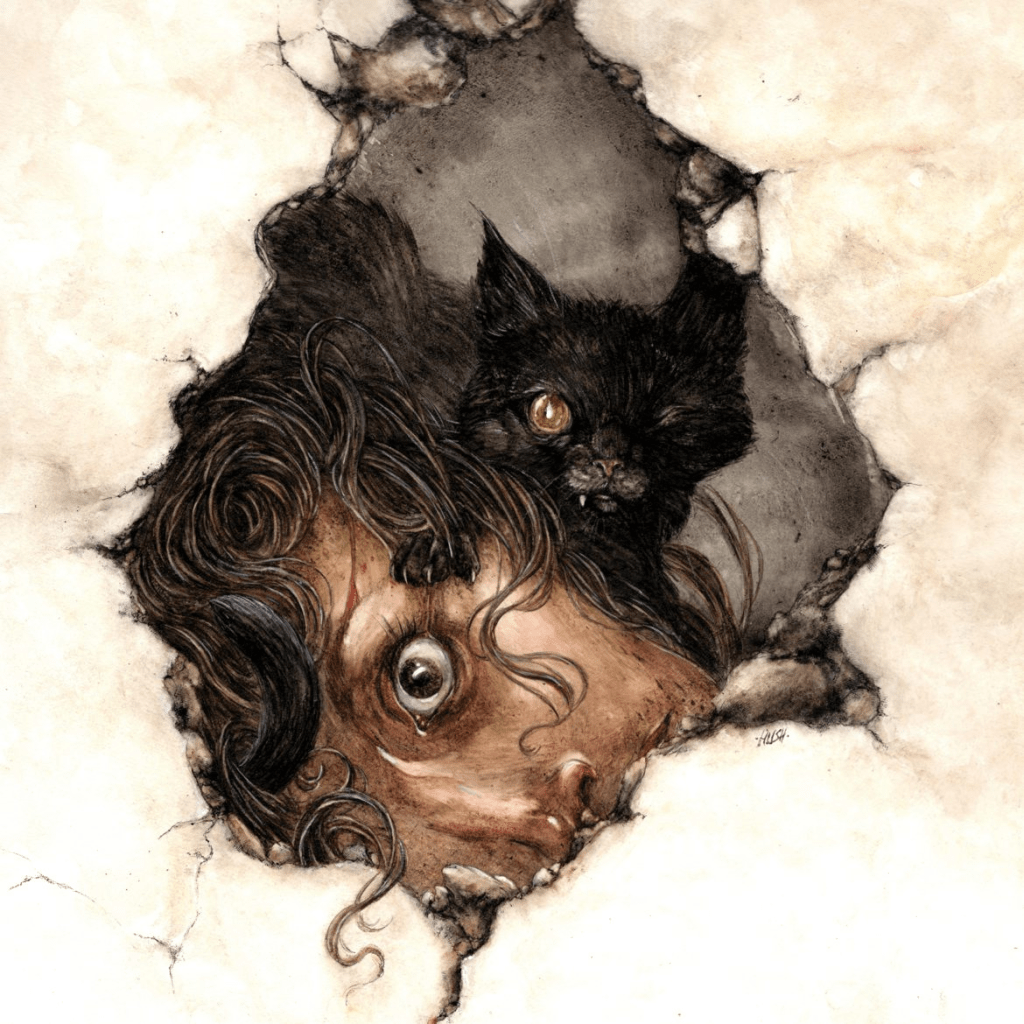
There is a lot going on it this story, and sympathy for the drunkard is minimal all considered. The tale grows ever wilder, and aspects of the supernatural are ascribed to the black cat who the narrator almost in passing remarks are known in folklore to be witches in disguise. The supernatural nature of the second cat is heavily hinted at and guilt plays a part, as does the occult reputation of Black cats.
Where the story falls down however is it is trying to be The Tell-tale Heart, but the narrator is not as obviously insane. A drunk is not as interesting as a mad-man, and though the narrators actions are horrifying, he knows this in his sober state, and does not try to justify them. It is all a little too twee, and a little too preachy. But the biggest problem is perhaps that I was reading The Tell-tale Heart only a couple of blogs ago, had there been more stories between them the unfavorable comparison would be less presented I suspect.
English Literature teachers should take note of this…

FOUR RAVENS, NONE OF HUME ARE HAPPY ABOUT BEEN AROUND A CAT…
Should you read it: Well yes, but perhaps not too soon after The Tell-=Tale Heart
Should you avoid it: Trigger warning abound, domestic violence, animal cruelty etc…
Bluffers fact: Pluto the cat was not named for Pluto the planet. Pluto the planet was not discovered until 1930 (though one suspects it was always there…) which was almost ninety years after this story was written. Instead he was mostly named for the Roman god of the underworld… Pluto was also the Latin root verb for wealthy, hence a plutocracy is governance of a society by the wealthy… As if there has ever been any other form of government.

Unrelated, but worth a mention, I have a story in the Harvey Duckman Anthology, Justice for Pluto. A book which does not take its name from the cat in this Poe story






 The Passing Place
Pingback: Dear Edgar 56 ~ The Imp of the Perverse | The Passing Place