For all the weather-beaten world-worn cynicism that I may occasionally be accused of by those that know me. A weather-beaten world-worn cynicism that our own Dear Edgar could have been said to share. I am at heart a romantic, which is to say while I do not believe there is such a thing as love at first sight, I wish to live in a world where such a thing exists. It has always struck me as somewhat unlikely however.
The Spectacles is not a short story about love at first sight. It is instead a story about love at first myopic blur. As someone who went through the trauma of going short sighted around the age of ten, when I started to realize I could not read the large projection in the school assembly, I have some sympathy with Poe’s protagonist in this tale. I hated discovering that I needed to wear glasses, hated wearing them then and if I am honest still do. So I would avoid doing so whenever I could, while I could get away with it.
And that is the essence of this entire story, which is by way of a long form, somewhat over elaborated, joke. Its the kind of story a standup comedian my tell in a five minute bit with a lot of weaving about. The summery of which really does comes down to love at first myopic blur. Everything that happens in the story is entirely determined by the unwillingness of the protagonist to wear his spectacles.
The protagonist has the somewhat preposterous name Napoleon Buonaparte Simpson, having changed his last name from Froissart in order to inherit a large sum of money for a distant relative. That change in last name is important to the twist in the tale, which is really three twists, the first of which is set up in a potted family history. The second by the little Corsicans namesake falling in love ‘at a distant’ with Madame Lalande who due to his unwillingness to wear his spectacles he confuses for a much younger woman.
And that is that, it is a long winded about a man who for vanities sake will not wear his glasses and ends up marrying an octogenarian, as until they are wed he never sees her properly. Who he then discovers, just to add another twist is also great aunt, her own last name having changed when she wed her deceased husband Mr Lalande, she too was previously a Froissart.
There is one final twist, which is the whole wedding was a fake set up by his friend and Madame Lalande, to teach Napoleon a lesson. One he duly learns and is never seen about without his spectacles again.
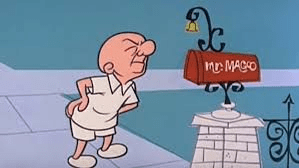
Like many of Poe’s comedies this is partway a farce, but unlike some of them it does hold up as a comedy but it has a predictability about it. This is Mr Magoo gets married, and beyond that central conceit is lacking somewhat in finesse.
In essence then this is not the kind of story for which one reads Poe, its a story anyone could have written and had it not been Poe would have been long forgotten. It has charm but not enough. It is clever in some regards with the set up, but not so much in execution.

TWO MYOPIC RAVENS STARING AT THE SAME CARCASS
Should you read it: there is no reason why you should not, but it is more a question of why you should. Your day will not be particularly better for doing so.
Bluffers fact: Spectacles were invented in northern Italy in the thirteenth century by monks in order to read manuscripts. They were simple things at the time. It wasn’t until Edward Scarlett opened his ‘Old Spectacle Shop’ in 1725, some 500 years later, that anyone thought to puts sides with hooks to go around the ears on them. So for 500 years peoples glasses were constantly falling off. No doubt this was hilarious…






 The Passing Place