Science Fiction is awash with tales of procession or bodily transference, not by satanic forces though they are plenty of those, but stories told by a protagonist who processed for a time the body of another. Often these processions are in an earlier or later time and place, or someone is fully transported to another time and place. There are many variations on the theme but the theme is very much the same each time. It is a stranger in a strange land, not sure of themselves nor the world they find themselves in.
It is not an uncommon device. The other great literary Edgar, Edgar Rice Burroughs who is perhaps best known for Tarzan, wrote the Barsoom series set on Mars, in which John Carter a 19th century American spends a lifetime living on a Mars that may or may not have corresponded to the Mars of his own time period. Lovecraft used the device multiple times but never more so than in his seminal ‘The Shadow out of Time’. Michael Moorcock uses it frequently, perhaps best in his Oswald Barnstable novels, but the Ekerose incarnation of the enteral Champion, was very much a man repeatedly placed out of his time and place. And this is without even saying anything about Stephen Donaldson’s Thomas Covenant novels. When it comes down to it even Freaky Friday uses the same basic device… And there are many many other examples I could spout.
All these stories have something in common, a thread that goes back to this story by Poe. There may be earlier examples that inspired Poe but I struggle to put name to one. So it is not impossible that Poe was the first to use the idea of processing the body and mind of another in another time and place, and did so as the central conceit of this story. Which is something of a shame, as the story itself somewhat lacks luster, is a bit fuzzy in places. This is not to say ‘A Tale of the Ragged Mountains’ is a bad story, it isn’t but as it is somewhat ground breaking in literary terms it is disappointingly a little bland. Possibly this is because of the Mad Max handcuffs paradox*.
*The Mad Max handcuffs paradox In brief…
At the end of the first Mad Max movie, Max handcuffs the Toecutter to a car that is rigged to explode. He gives Mr Cutter a hacksaw and tells him he can either saw through the hardened steel of the cuffs in half and hour, or his hand in a couple of minutes, and it si up to him… This is not the paradox…
The paradox is to do with the movie SAW. I was watching Mad Max at a UNI movie night, (I was there because the film club were showing Mad Max on the big screen, so why wouldn’t I go along, they had done Bladerunner the week before). “Meh,” one of the Media studies students said afterwards. “I saw that handcuff thing in SAW, how unoriginal…” The student in question was missing the salient point. Mad Max predated SAW by over twenty years. He was unimpressed by the ending of Mad Max because he had seen a movie that borrowed the same idea twenty odd years later.
This then is the Mad max paradox, otherwise known as Media Studies students are not always collectively the brightest…
The point here is that ‘A Tale of the Ragged Mountains’ is not in anyway a bad story, it just doesn’t seem awfully original… Not when you are someone who read Edgar Rice Burroughs, Michael Moorcock, and Lovecraft, etc, long before he ever read ‘A Tale of the Ragged Mountains’ a fairly obscure Poe story that doesn’t have the grandeur you would want from something truly original. It isn’t for this particular kind of science fiction what ‘The Murders on the Rue Morgue’ is for detective fiction.
This strikes me as a bit of a shame…
The story itself is, as I said, a little fuzzy, and being told to us second hand by an unnamed narrator, but is mostly the account as told to him of strange events that were experienced by Augustus Bedloe, prior to his death. Augustus a young man of independent wealth but fragile health, had employed an old doctor called Templeton who was a devotee of Mesmerism, which when Poe wrote this was not a forgotten fringe alterative medicine, but a mainstream medical theory. In much the same way the use of leaches would have seemed a perfectly reasonable medical practice to Chaucer. This is to say our dear Edgar did not write this story to poke fun at Mesmerism, rather it was a current medical theory that fit the needs of his story.
Bedloe benefits from the administrations of mesmerism by Dr Templeton and starts to take long walks in the hills and mountains that surround his Charlottesville home. It was on one such walk, that became longer that pervious ones, Bedloe encountered a thick mist in a gorge, just as (tellingly perhaps) his prescription of morphine was kicking in. So he walks into it, as it looks pretty.
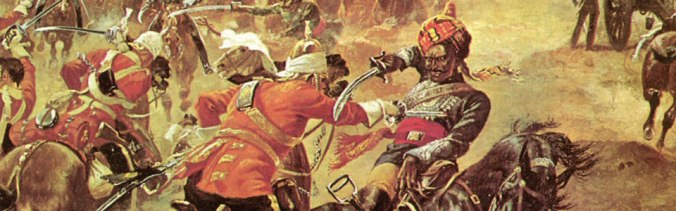
He steps out the other side to find he is no longer in the ragged Carolinian mountains, but is instead somewhere else entirely. Something he realizes when a half naked man of eastern extraction rushes past him pursued by a hyena. Recovering his senses somewhat he discovers he is in what he takes to believe to be the the middle east or perhaps India. Eventually he stumbles across a city of minarets and archways which he makes his way through before finding himself besieged with British officers as a battle rages in the streets. Then he is shot in the head with an arrow and dies. Only to find himself once more in the ragged mountains. Whence he goes home and recounts his story to his friends the doctor and our unnamed narrator.
Dr Templeton is shocked by all this. Not so much by the strange events Bedloe claims to have experienced, but that they are events he knows. Before coming to America as a young man he had served with the British out of Calcutta and was at the siege of Benares, almost forty years before. What Bedloe described as his death was the exact way the Doctors friend Oldeb had died.
Shortly afterwards Bedloe dies and in his obituary someone spells his name without the e at the end. The narrator notices with no small surprise at that point that Bedlo is Oldeb backwards…
This is all fine but the problem is there is a whole lot of implication as to what is actually happening, but it is all very fuzzy. Did the doctors mesmerism awaken the memories of a pervious life perhaps. Was Bedloe his old friend Oldeb reincarnated, perhaps… Does that explain the odd repour between them, or did Bedloe go back in time in spirit then processed Oldeb? The little twist at the end seems tacked on and that just adds to the confused nature of the story.
This is not to say its badly written, It’s Poe, of course it isn’t badly written. Nor is it a poor story, it is more that I am just not sure it has the courage of its convictions. To the mast of the uncanny and rum it was not nailed. Instead Poe left a whole, ‘it was a dream’ possibility open, even with the tacked on twist at the end. It would have worked better had he leant heavily into the strange time travel and procession of another body, or else to mesmeric influence causing him to have delusions that stem from the doctors memories. Or any other explanation come to that, it is all a bit ‘well it could be this, it could be that.’ Which gives it a all a bit ‘meh!’ feel.
I don’t dislike the story, but if a story like this crossed my desk for an anthology today I would send it back to the writer and suggest he give it another pass, sharpen it up and decide what the story really is about. Which seems an arrogant thing to suggest when the writer of this story is Edgar Alan Poe, but this while perfectly ok as a story, is just that, its ok… nothing more.
Where as it could have been The Murders on the Rue Morgue of procession fantasy…

THREE MILDLY CONFUSED RAVENS ALL A FLUSTER
Should you read it: Well yes, perhaps, possibly, I mean sure, why not, but meh!
Bluffers fact: Mesmerism, which also goes by the name Animal Magnetism, is the theory that everything that lives has an energy field around it. This was first proposed by Frank Mesmer in the 18th century, hence the name. His name is also linked with hypnosis which is occasionally referred to as being mesmerized. Louis XVI of France was so taken by Mesmer’s theories that he organized not one but two Royal Commissions into the field, One of these Commissions was with the French Academy of Sciences, an august body that included among its ranks the ageing American Ambassador to France, Benjamin Franklin who served on the commission.
Benjamin Franklin was far from the lone famous name upon the commission, among it ranks there was a middle-aged Scientist and Physician who like Frank Mesmer was to lend his name to something the would out live him in the public mind, and indeed it was to leave quite an impression on Louis XVI . His name was Joseph-Ignace Guillotin






 The Passing Place