There is such a thing as a literary in joke. A private reference within a story that only those in the know will appreciate. Such things are oft times carefully constructed in such as way that the sit in the narrative without breaking its stride. The trick is to make them natural, fit in with the story been told, and perhaps hint at the humor even to someone not in the know.
An example of this, from my own novels, would be the refence to ‘the Crediton badger’ in Lucifer Mandrake: The Esoteric Cricket Ball. To briefly explain, in part of the narrative, Lucifer is explains to the reader the dangers of using glamours, and warning that you can become your disguise if you are not careful, and how folklore is littered with examples of this. There is a certain irony to this warning you would have to read the novel to understand, but to illustrate the point he is making he makes mention of a couple of examples, one of which is the Crediton badger, a man who moves from London to Dorset, becomes reclusive, and is eventually turns into a badger.
The Crediton Badger perfectly illustrates what I needed Lucifer to illustrate and is humorous into the bargain. Many a reader may have smiled at this bit of frippery. One reader however messaged me directly, after laughing loud enough to scare his cat. A reader called Clive, who happens to be a good friend of mine, and a few years earlier had moved to Dorset to the small town of Crediton. Clive who started going grey as a teenager when his hair was otherwise quite dark, has long sported the nickname badger…
Aside Clive, a few friends may also have spotted the reference, but none of them would have laughed as hard as he did. the only person to laugh as hard was me, when I received his text, which I had been waiting for since I wrote that line over a year before. It was a very private joke that sat in the narrative unseen by all but the one it was aimed for. Importantly though, it was a private joke that did not detract from the novel.
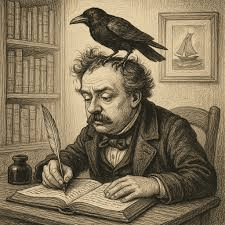
Which is somewhat opposed to everything about The Literary Life of Thingum Bob, Esq. Now I am in no way certain that The Literary Life of Thingum Bob, Esq is littered with our Dear Edgars private jokes. Jokes written at the expense of collogues within the world of 1840’s magazines and periodicals. Jokes that draw a bead upon his fellow editors, writers and publishers. However, the story being a long series of in jokes carefully constructed to lampoon the industry is the only explanation which makes any sense as to why this story exists. Which is something of a problem either way.
If this isn’t a carefully constructed parody of the East Coast American magazine publishing industry in the 1840’s then its a long dull story that, while it has merit in its narrative structure, is not half as funny as it needs to be to be anything other than terminally dull.
Thingum Bob, named for his grandfather, Thingum, rejects the life of a barber, with his dear papa and sets out instead on a career as an editor and poet. At first he tries trickery, coping out an old poem and submitting it to different magazines all of which reject his work venomously. He then tries other means, gets one story published but without recompence. There is a lot about circulations rising and minuscule sums of money been paid to writers. And a whole lot of repetition which if this was humorous would be witty and clever, if that was you were a fellow writer in the 1840’s.
There is also Thingum himself, who is something of a narcist, something more of a pillock, and probably also mean to be a joke. He is entirely unlikable and self-absorbed. I suspect Poe was lancing at those who send magazines contributions he had to deal with in his professional capacity as an editor. Writers’ full of their own sense of worth and surety as to the quality of their prose. Having come across a few of these types of writer as an editor myself this at least did raise a rye smile.
I also have little doubt there are refences to individual editors and the spoof names for the magazines doubtless contain clues to actual magazines. If I was part of the 1840’s magazine reading set, I would probably give the occasional rye smile. If I was an 1840’s writer or editor I may chortle a little at the events described and the parody of the industry. I suspect that in 1843 this was a down right hoot of a story…
It is not 1843. The jokes are dull, the refences long gone, and the story struggles to hold any interest for me. Unlike the Crediton Badger this is not a small in joke within a much longer work. The whole story is the joke and while I am a writer with a fascination for the period and its literature, I don’t really find it all that amusing. Which is the problem
If I don’t find the jokes about 1840’s publishing funny then I suspect no one really will.
ONE LITTLE RAVEN, SITTING IN A TREE, SHRUIGGING ITS SHOULDERS.
Should you read it: No, just don’t. Unless you are a 1840’s publisher and really bored…
Blaggers fact: ThingumBob is a phrase often used when someone has forgotten the name of whom they are talking about. As this tale is best left forgotten its is entirely apt.






 The Passing Place