Trilogies, popular fiction is littered with them. Duologies are a rarer beast and Quadlogies rarer still, but for reasons that may not be wholly apparent trilogies remain ever popular. I have long suspected this has much to do with the heroes journey, the mythical template for mythical story telling Joseph Campbell forged in the blood of the kraken. A trilogy just works if you are using it to tell the hero’s journey. It gives four acts to each book, and the requisite twelve in total to complete Campbell’s arc. There is however a much simpler reason for trilogies, after three stories a writer may have no stories left to tell without an indulgence of repetition.
Yet readers always want more of the characters they love and some writers will write endless stories based around a single central character who does not necessarily change a great deal. The heroes journey is not the story. They are a medium through which the story is told. Some writers though lose their love for a character. Sir Author Conan Doyle famously killed off Sherlock Holmes so he could write other stories, only to bring him back with some reluctance a few years later when he was offered too much money to refuse.
Modern writers will often write seemingly endless series. Take the wheel of time for example, originally planned by Jordan to be a trilogy, Jordan changed the plot half way through the third novel in the series so the ‘big bad’ turned out to be a minion of the real big bad and the series was extended to what became 14 books as well as a prequal and three companion volumes. Books 12 through 14 were finished by Sanderson after Jordans death, based on Jordans notes for book 12 that were stretched out across 3 volumes, because the publishers offered Sanderson a three book deal…
Now I am well aware that The Wheel of Time is a well loved series, but I personally never finished it. The original trilogy was great, up to about the point Jordan got the recites for the first books sales, and the decision was made to ‘extend’ the series, after that for me it felt ever on plot progression even though each book became longer. I gave up after book 8 came out in 98, but many I know persevered to the end and it remains a well loved series. For me though it would have worked better had Jordan just written the trilogy he originally intended.
In any event, the reason I bring up trilogies is because The Purloined Letter is the third installment of that rarest of things a series of stories by our own Dear Edgars This been his third and final story featuring his own ‘great detective’ C. Auguste Dupin. The detective that was to become the inspiration for the aforementioned Sherlock Homes, as well as Hercule Poirit and many others. Unlike the great literary detectives to come after him, there are only three Dupin stories and each of them is unique in that they deal with the detective in very different circumstances. To that degree it is a perfect little trilogy of stories, as it avoids becoming a parody of itself.
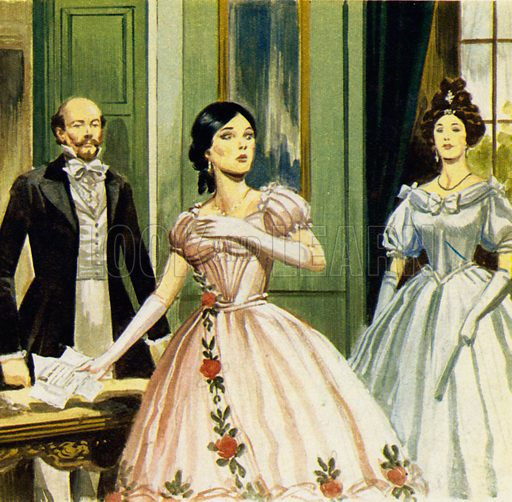
The Purloined Letter is set after the events described in The Murders in the Rue Morgue and The Mystery of Marie Rogêt, but Dupin is still in Paris and still sharing rooms with our unnamed narrator, at this point the six month stay has extended to two years and in that time the amateur sleuth has developed something of a reputation for solving the unsolvable. So when the Prefect of the Parisian police comes up against a vexing conundrum it is to Dupin he turns.
The matter in question is a personal letter that was written to the Queen, that was ‘acquired’ by an unscrupulous minister, which he is now using to blackmail her. The Prefect knows the minister took the letter, and that he is using it to blackmail the queen, but he can not act against him openly without harming the royal house and revealing the letters existence. Nor have they been able to require the letter despite some ‘grey area’ policing. They have staged break ins at the ministers offices and home to search them top to toe. They have also found spurious reasons to search the gentleman himself. All to no avail and as long as the minister holds the letter he has the queen in the palm of his hand.
After a while Dupin is moved to act. He is, as he explains, a supporter of the queen and he also has personal reasons to despise the minister in question. There is also the minor manner of a 50000 franc reward for returning the letter to its rightful owner… This is somewhat out of character for Dupin who has previously refused fiscal rewards, but perhaps two years of living it up in Paris has started to eat into his savings…
Both pervious Dupin stories involved murders, in the first he examines the crime scene to unravel the mystery. In the second he searches for clues in news reports. In this tale however Dupin brings his mind to bare not on physical clues but the phycological make up of the criminal in question. This is something of a shift and makes it a different kind of detective story.
Of the three Dupin stories this is to a degree the least interesting because it lacks the kind of mystery at the heart of the other two. Perhaps it says something about the human condition that we find it harder to engage with a mystery that doesn’t involve a murder, but you would be hard pressed to find any modern detective story that lacks for a corpse. We have a morbid fascination with death, lets us be honest. As such a stollen letter is a tad prosaic in comparison. We even know who stole the letter, the only mystery here is where it is been held. Considering where Dupin finds it, the Parisian Police Prefect should consider firing some of his men for not discovering its whereabouts in their searches, considering the great lengths they went to, unscrewing table legs and checking between floor boards etc.
Dupins great leap of ratiocination (to use Poe’s term for what Dupin does) is based upon his insight into the character of the minister, and his belief he would hide the letter in plain sight, the more to feel superior to those searching for it.
It is the equivalent of hiding a secret file on your computer by putting it in a folder marked ‘documents’ and just changing the files name to something bland and uninteresting.
Dupin guesses this based on the ‘character of the minister’ and retrived the letter which has been turned inside out, and the reverse side written upon, then placed in the letter rack inthe Ministers fount parlor… It is all a tad too neat, as is the self-assured nature in which he asks for the reward in advance, before agreeing to recover it.
In the end it is a bit twee. However that is not entirely a bad way to sum up all three Dupin stories. What makes them memorable is what they inspired, which can be said for Dupin himself. Of the three The Murders in the Rue Morgue is easily the best and this one is a bit too flat for my own tastes. Perhaps it needed a good murder…

TWO RAVENS LOOKING AT THE MANTLEPIECE WONDERING WHY NO ONE THOUGHT TO LOOK THERE IN THE FIRST PLACE
Should your read it: Its not a bad story, it just isn’t one that leap’s off the page and grips me. You may think otherwise.
Blaggers fact: Having aid everything I have said about trilogies, it is worth baring in mind that this was written and published towards the back end of 1844. The love of Edgar’s life, Virginia, was seriously ill for the next two year, and died in January 1847. Poe was devastated, turned back to the bottle. If he intended to write more Dupin, he never did, but this doesn’t mean this was only ever intend to be a trilogy of tales.






 The Passing Place