By July 1845 our Dear Edgar was achieving the level of success he had craved so long, Six months earlier his titular poem ‘The Raven’ had seen its debut in New York’s Evening Mirror, and had made him an over night success. The kind of over night success that had bene publishing his poem’s and story’s for twenty years before he really broke through into the national consciousness. He became the full time editor of the Broadway Journal, a newspaper he would come to own later that year, and which gave him an outlet to publish revised versions of his earlier stories. From a professional point of view things were certainly on the up.
At home, however, the story was different Virginia’s illness was growing more server as the months went buy and Edgar had returned to the bottle, ostensibly to cope with the stress. His bouts of heavy drinking in turn cause a degree of self destruction with his professional life, as his reputation as a literary critic became strained. As the editor of the Journal he had no one above him to reign in his more venomous comments on other writers and this poisoned his reputation among his contemporaries. Perhaps the most well known of these incidents is ‘the Longfellow war’.
Four years before Poe had written to Henry Wadsworth Longfellow expressing his admiration for the poet and writer, and citing him as an inspiration for his own work. Publicly he had called Longfellow ‘unquestionably the best poet in America.’ Yet in the Journal, either to try to cement his reputation as a critic, or in an attempt to boost the Newspapers circulation with controversy, he public accused Longfellow of Plagiarism. At the time Longfellow was by far the most popular American poet. Poes critique of him in the Journal was at best a misjudged publicity stunt, soured Edgars reputation and the reputation of the Journal, rather than boost it.
If this professional self-harm was not enough, Edgar also began a somewhat public flirtation between its pages with Frances Sargent Osgood. Osgood, herself still married though separated from her husband Samuel, was often invited to the Poe’s home. Reputedly Virginia was fond of Frances, for whom Edgar would lay off the drink and saw something of herself in the other woman.
It was against this back drop of self destruction that Poe wrote The Imp of the Perverse, a story about self destructive impulses. Occasionally one wonders just where Poe got his inspiration, this is not one of those times.
Borrowing from the structure of ‘The Premature Burial‘ a year before the story starts more like an essay in which the narrator examines the self-destructive nature of man. The imp of the title not being a literal imp but more the nagging thoughts that drive someone to do thing that are against their own best interests. And here there is a bit of an issue, the structure that worked so well in The Premature Burial doesn’t work quite so well here. In the earlier tale the narrator sites several examples of people being buried alive which work to build towards the actual story in the latter half of the tale. In this story the essay on mans self destructive impulses is much drier and feels like you have to wade through mud flats of heavy verbiage before you get to the story itself.
The story itself, by which I mean the last thousand words or so, is quite brisk and entertaining. The narrator admits he murdered a relative for money, and did so by use of a poisoned candle. A scheme so carefully considered that the candle itself would burn away all evidence of the toxin which would evaporate from the air long before the body was discovered. The murderer goes on to inherit the wealth and live for years on the back of the homicide he committed convinced that he will never be caught due to the brilliance of his plot.
As time goes by the narrator comes to realize that the only way he could ever be caught would be if he was fool enough to tell the world what he had done. He has taken to reminding himself of this with the words “I am safe!” whispered to himself. But having realized only he could be his undoing he starts to get an irrepressible urge to confess his crime. The Imp of the perverse, as he has described the self destructive urge in the frankly tedious essay that forms the bulk of this story, is working upon him, pushing him to betray himself. Which eventually he does, unable to contain himself.
Thus the tale ends, with him facing the noose due to his own self-destructive nature leading to his confession.
Now, the latter half of the story is fascinating, and a theme that is hardly new to Poe, it mirrors The Tell-tale Heart, and The Black Cat among other stories. Self-destructive urges can be found throughout Poe’s work. In that regard the essay portion holds some interest but not as a story, more as an insight into Poe’s own mind. Which is the problem, this is a story with two halves and while one informed the other both are better read with a degree of separation, unlike the premature burial where the essay portion builds right into the story itself, this one doesn’t. The first half is not so much ‘like an essay’ as it is ‘an essay’ and should be treated as such. The latter half is the story and a good story at that, it just does not need the long dull preamble.

THREE RAVENS AS TWO OTHERS FLEW OFF AFTER THE PREAMBLE BORED THEM
Should you read it: the latter half certainly, the first half you can skip unless you find you need an essay on self-destruction
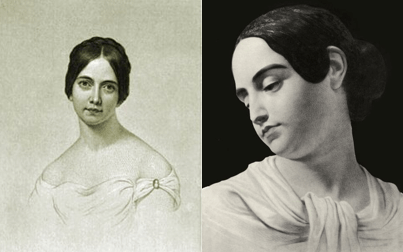
Bluffers fact: The two pictures above are of Virginia and Frances, the two women shared a remarkable resemblance, so much so that they are occasionally mistaken for each other even now. With Frances portrait occasionally mistakenly used for Virginia Clem and vice versa on the internet. They shared other taints as well, a certain child like qualities, raven dark hair, fair skin and tuberculosis…
The latter killed both women…






 The Passing Place