The Sphinx is, as I am almost sure you will be aware, a mythical being with the body of a lion and the head of a beautiful woman. There is a rather large nose-less monument to the Sphinx on the Giza plateau, that sits alongside the great, the not quite as great, and the in comparison somewhat lesser, pyramids of ancient Egypt. This story however is not about that Sphinx.
Nor is this story about the Greek myth of the Sphinx. This pitches the monster as one of the titans. A creature that is an asker of riddles. The old “Answer my riddle and I will grant you a boon , fail and your dinner…” kind of riddle asker, but one who for some reasons always seemed to ask the same riddle…
What has four legs in the morning,
two legs throughout the day,
and three legs come evening?
The answer to which if you ever find yourself in need is ‘a man’.
Why the ancient and wise sphinx who knows all things always asks the same question no one knows? Except perhaps the ancient and wise Sphinx, but I would suggest this is not a question you should ask of a violent tempered ridder…
However, as I said, this is not The Sphinx in the title of this story from our Dear Edgar.
Nor is it related to the character ‘The Sphinx’ in the movie Gone in 60 seconds, played by former football hard man Vinnie Jones. Though in fairness that would have been some what unlikely and remarkable prescient of Poe if that was the case.
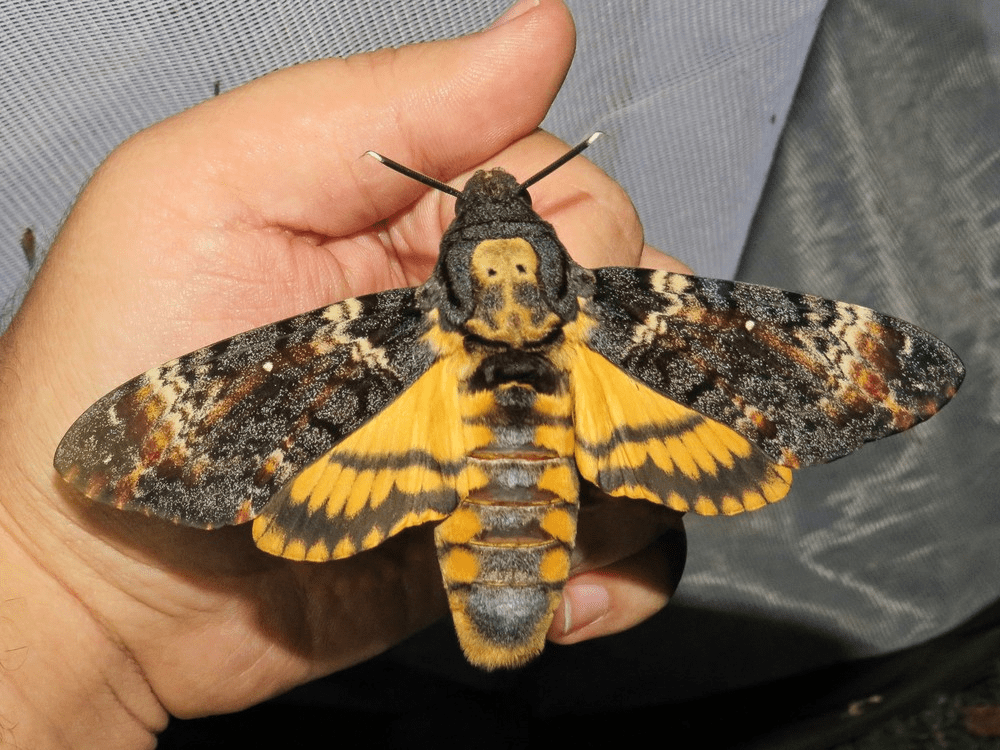
The Sphinx in question is instead the ‘death head sphinx moth’ a comparatively large and admittedly chilling member of the Lepidoptera order of insects. That is to say, its a big moth…
In Poe’s tale the narrator and his friend have escaped a Cholera outbreak in New York and have gone to wait it out in the hills around the Hudson valley. As the days go by news of deaths in the city continue to rise and thus despite the pleasant surroundings the mood of the companions is on the low side. The narrator in particular suffers from a morbidity of temperament, and has to push away depression lest it overwhelm him. So he spends his days reading, sketching and going for the odd ramble through the woods.
The narrator though remains in the grip of morbid thoughts and when one day he dozes while reading a book he wakes to find himself staring at a monster, which he then describes in no short detail, before fainting to the floor.
Some days later he recounts this event with no little embarrassment to his friend and describes the monster he saw, at which point the story very much becomes an inverse case of ‘that joke’ from Father Ted. The Giant moth monster is not giant, its just not far away. He had in essence awoke to fine a death head sphinx moth hovering close to his eyes and lost all sense of perspective, both figuratively and actually.
Now, all this is down to subtext, or lack there of. The narrator is terrified of the Collar epidemic burning through the population of New York. That plus his heightened sense of isolation and morbid depression led him to believe he had seen a portent of death in the form of the death-head on the moths carapace. The moth that just happened to be inches form his eyes and seemed to him enormous. The problem is that this is pretty much all there is to it. Its a short story with some horrific imagery described, and a meh twist at the end.
One can’t help but feel a Poe story about ‘The Sphinx’ in Egypt would be more engaging than this.

TWO RAVENS CONSIDDERING A LIGHT MOTH LIKE SNACK TO BE SMALL FARE
Should you read it: Well its short, and a master piece in description when it comes to the moth but that doesn’t exactly make it worth your time.
Blaggers fact: The Death Head Sphinx moth is commonly referred to as one of the Death’s-head hawkmoths, (there are three of these one of which is the Sphinx). The hawkmoths are perhaps most famous these days as being the moth covering Jodie Fosters lips in the movie posters for Silence of the Lambs… Which always struck me as slightly chilling.