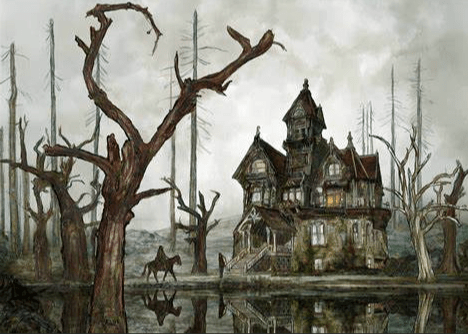
~at length found myself, as the shades of the evening drew on, within view of the melancholy House of Usher.~
1838, the year ‘The Narrative of Arthur Gordan Pym of Nantucket‘ was published was also the year that our dear Edgar moved with his wife Victoria to Philadelphia so he could take up the job of assistant editor of Burtons Gentleman’s Magazine. This also marked the beginning of what was undoubtedly his most prolific and eventually most successful period as an author.
The Philadelphia years were later blighted when Victoria first fell ill, but this was still a few years away when in 1939 ‘The Fall of the House of Usher’ was first published to minor acclaim in Burtons. It is a story many consider not only to be a gothic classic, but as foreshadowing his wife’s decline into consumption that became the very real tragedy in Poe’s life that was to come.
Usher was certainly the most lauded of the stories to be included in Poe’s short story collection ‘Tales of the Grotesque and Arabesque’, published the following year. Most of the stories in the two volumes set released by Lea & Blanchard we have already covered, a few others first saw the light of day in that publication and will be coming up soon, but to focus on ‘The Fall of the House of Usher’ for the moment, it is a tale in which our Dear Edgar returned to some of his favourite themes.
The themes of three earlier stories in particular are echoed in this story, those being Morella, Berenice and Ligeia. Which is not to say that Edgar was obsessed with putting female characters into soporific states that seem death like and letting them decay and wasting away, but it is a theme that comes up time and time again in the early tales. What is odd is that these themes were so prevalent before the wasting disease that took his wife from him not many years later was diagnosed. Equally the male characters in all these stories react to these tragedies with obsession and madness that echoes how the death of Victoria was to plunge him into a deep alcohol fuelled depression and began his own downward spiral to an early grave.
Occasionally life imitates art in dreadful ways.
The story itself is told to us by an unnamed narrator, who tells us he has been drawn to visit his friend Roderick Usher at his families isolated and rundown house. Roderick request this visit due to his melancholy illness, and the soon to be fatal illness of his twin sister Madeline. The narrator who seems somewhat enamoured with Roderick rushes to his side and spends several days in the mans company, seeing Madeline only the once in this time, a strange fae like figure that doesn’t acknowledge his presence.
At this point Poe has Roderick sing a poem called ‘The Haunted Palace’ to the narrator which seems to echo much of the state of The House of Usher. This is not entirely surprising as the poem in question was written by Poe and published separately earlier the same year. As poems go, its not among his best…
Some time later Roderick informs the narrator that his sister has died and takes him to view the corpse, which Roderick has lain in state in the dungeon like cellar. There to lay for two weeks until she can be buried. Of course, she is not actually dead, have you not read Poe before, ‘she’ is never dead… Just like in the earlier stories the woman in question has fallen into a death like coma. Yet Roderick claims he is convinced she is dead and the narrator convinced by him, though he does comment as to the rosy nature of her cheeks.
From this point onwards there is a building of atmosphere, the reading of a medieval romance called The Mad Trist that has some baring on Roderick’s state of mind. All the while strange cracking sounds and the master of the house descends further and further into madness. Roderick admits he has put his sister in her coffin alive. He is convinced of this and yet will do nothing, until his sister breaks out of the coffin, and attack Roderick, killing him with fear and herself as this is her final act, the narrator flees and behind him the house is struck by lightening and falls into the dark dank tarn on whoms shores it resided.
There is of course much more to the story than this brief synopsis, though it is in essence the tale, a tale that is renown for its tell. It is a masterclass of tension and atmosphere. It is gloomy, dark and full of foreboding, and that is exactly what it is meant to be. While it is true there is little new in this tale if you have read earlier Poe tales, specify the three mentioned above., this is the apex of those stories. This is Poe perfecting his own style, it avoids the overblow verbosity of Berenice, reuses the unworldly surrealist nature of Ligeia and mixes it with the darkness of Morella. Taking the best aspects of all three tales and melding them into something close to perfect.
There is a reason that this is both the best known and most critically acclaimed story in the ‘Tales of the Grotesque and Arabesque’ collection. It is Poe at his best, his grim gothic brooding best.

AN FULL UNKINDNESS IN ALL ITS WONDERFUL GRIM GOTHIC BEAUTY
SHOULD YOU READ IT: If you read only one of Poe’s tales from among his early works make it this one. Read it by the light of too few candles and let the motes of dust in the air distract you.
ISSUES: Well, there is an argument to be had, that the poetry was unnecessary. But I am really clutching at straws here.
Bluffers fact: ‘The Fall of the House of Usher’ would have made Poe an utter fortune in rights had he lived in a different century. In 1928 two entirely separate silent movies were made. The first of these is a French movie by Polish born Jean Epstein who is an odd character who aside his ‘Usher’ movie mostly made documentaries about Britany. The second of the 1928 movies, an American made short film is for me far more interesting. Not least because it is like watching a psychedelic trip in black and white, that becomes increasingly strange as it goes along. ‘The last Theatre’ You Tube channel put it to music some years ago, and did a fabulous job doing so
The sheer number of further interpterion’s of ‘Usher’ is testament to its longevity in the zeitgeist.
If your enjoying this steady wander through Poe, you might want to check out the first blog series I did on HP Lovecraft in the paperback edition






 The Passing Place