There is a phase that appears at the beginning of TV shows, movies, and books, which can be loosely taken to mean the entirety of what follows is almost utter fiction. That phrase is ‘Based on true events’. It is a phrase that crops up often at the beginning of mysteries, particularly is the mystery in question remains unsolved. There is a mystic to such things. Unsolved murders in particular, because we all love a good murder mystery and trying to solve it before the reveal. All the better if it is a real murder mystery as we all think we are smart enough to figure out who the real killer was…
Books pertaining to solve cold cases are something of a narrative tool themselves. If a police/detective show runs long enough there will be at least one episode where some author has been killed because he was writing a book about an unsolved murder and his manuscript will have been burnt, or a single copy will exist somewhere that will point to not only the original killer but the authors murder too.
‘Based on true events’ is a cliche, a trope so common we pay it no mind. Writers have been using it for years… In fact it is not unreasonable to say they have been using it since the autumn of 1842 when our own Dear Edgar dipped his toes in that particular well.
The year before had seen the publication of Poe’s ground breaking detective story ‘The Murders in the Rue Morgue’. It had been a somewhat unexpected success, critically lauded, and having created a whole new genre of fiction, Poe discovered he had a public wanting more. While he was relatively successful as a writer by this point in his career, he had never had a story for which a publisher might ask him to write a sequel before. Generally given the kinds of stories he wrote there was no opportunity to do so. But there was money in longer serialized stores, and C. August Dupin was a character that he could bring back again. In what was to become very much the norm for fictional detectives, short of hurling them off a waterfall they could come back to new mysteries again and again and even throwing them off a waterfall was no guarantee they would stay dead…
So with the success of the Rue Morgue to his back Poe started trying to come up with a new mystery for his ratiocination detective to solve. And when he failed to come up with a suitable mystery of his own, he resorted to doing what mystery writers have done ever since, he looked to a real mystery and set about creating a solution. Yes, Poe not only invented the detective story, but he also invented the murder mystery ‘Base on True Events’…
The body of Mary Cecilia Rogers was found floating in the Hudson River on July 28th 1841. The police case to solve her death, which was widely believed to be a murder, reached national new papers. For a time it was a big story, but when her fiancée committed suicide a few months later and left a note full of remorse, many presumed that was the end of the matter. The case however has never been formally closed. Poe took the bones of the true story, which he claimed he was rigorous in researching and relocated the events from New York to Paris, where Dupin and his nameless friend the narrator lived in relative isolation, a year or so after the Rue Morgue murders.
As this was the second Dupin tale it has the advantage over it predecessor in that it doesn’t need a protracted prologue. half the original story was an extend introduction of Dupin the character. A somewhat tiresome over done introduction that grins on the reader until you get to the actual detective story. Poe neatly dispenses with the need for this by just assuming anyone reading the story has read the earlier one, for which we may all be grateful as that first third of The Murders at the Rue Morgue is just heavy going. In this story we drop straight into the mystery. Which si to its credit.
Marie is a perfume counter girl, rather than cigar girl, and end up in the Saine rather than the Hudson, but otherwise the key elements of the real murder are all here. Like Mary, Marie disappeared for a week three years before. Like Mary, Marie disappears again only to turn up dead. her fiancée is a key suspect, despite his denials and the whole things has a whiff of scandal to it (not least because there is some implication of Mary/Marie having a back street abortion in that missing week three years before.) The newspapers both the realm ones in New York and the fictional ones in Poe’s story make much of this and the lurid details of events. Indeed it is this that drives Dupin to investigate himself after complaining that newspapers thrive on sensationalism rather than truth.
Dupin the precedes to investigate, mostly by reading the newspapers and speculating, which is where the story starts to fall down a bit. There is no scene of the crime for Dupin and his chronicler to investigate. No where for him to make deductions based on observation. Everything is very much a case of him reading about the crime and then making some, admittedly astute, guesses in order to solve the crime. There isn’t even a reveal as such at the end, the real murder is apprehended after Dupin directs the police to find the boat in which Marie was carried out into the midst of the river. But the murder is apprehended off screen effectively.
In the end this is a story that disappoints, the constraints of ‘Based on true events’ are in part the issue. Having written the story so soon after the murder of Mary, when the truth was very much unknown is a good hook to pull in contemporary readers. Mary’s death was big news, speculations as to how she died were wide spread, the real murder had more than one fictional accounting, which was not uncommon at the time. Poe’s story is unique only in respect to being told as a detective story, and the way in which he drew parallels with a fictional crime rather than directly related Mary’s death. Poe’s postscript to the story, published with the third installment, makes the connection between the two abundantly clear. But the problem there is the modern reader only knows there was a real crime because of that postscript. The death of Mary Cecilia Rogers is a long forgotten crime almost two centuries old, not the current ongoing newsprint scandal.
Because it speculates on an unresolved murder, the story in itself is unresolved. The murder an unnamed sailor who’s motives remain unclear. And in all it reads much as an exercise in Poe displaying his own cleverness in trying to examine and try to explain a crime. It starts to become dry and lifeless very quickly after the first aspects of the murder are explained. and Dupin feels like nothing more than a dispassionate observer. It has neither the craft of the first Dupin story nor the skill in the telling. But then fiction is always best when it is fiction, and even if inspired by true events the further for the truth the better in most cases.
This second Dupin story is disappointing, a difficult second album with none of the invention of the original. It was not however the last, The Purloined Letter did not come along for three more years, but when it did, it out shone both this tale and arguably the more famous The Murders at the Rue Morgue. But we will come to The Purloined Letter in due course…

A TRIO OF RAVENS, ALL FEELING SLIGHTLY ARKWARD IF THEY ARE HONEST
Should you Read it: There is a certain completism that suggest you should read all three Dupin stories. The character develops little in this one but still noticeably, though the final tale is what pays for this one being underwhelming
Bluffers fact: It is no secret that Poe inspired Sir Arthur Conan Doyle. A fact Sir Arthur made no attempt to hide. In the very first Sherlock Holmes story, A Study in Scarlet, Watson compares Holmes to Dupin. Holmes replies, somewhat untypically
“No doubt you think you are complimenting me … In my opinion, Dupin was a very inferior fellow… He had some analytical genius, no doubt; but he was by no means such a phenomenon as Poe appears to imagine”

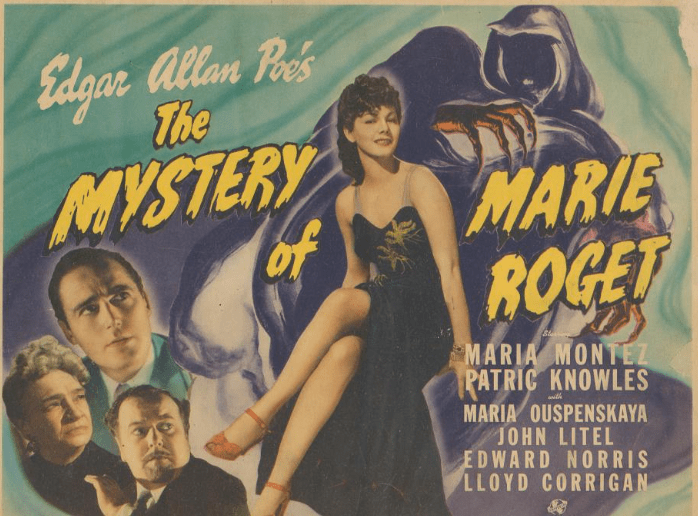
Bonus Fact: Maria Montez who played Marie in the 1942 movie version died a mysterious death herself, when she drown in her bathtub in 1951, reportedly, according to the papers at the age of 31, (she was actually 39). Maria’s daughter Tina Aumont was also an actress with a long career in Italian cinema which included the lead role in the Surrealist classic The Howl, a masterpiece of a movie no one I have spoken to in the last thirty years has seen apart from me… Honestly your all philistines… Despite her extensive filmography Tina did not appear in a single movie I could reliably claim to be inspired by a Poe story, which is frankly irritating as has she done so it would have made for a delightful if tenuous fact…






 The Passing Place
Pingback: Dear Edgar 39 ~ The Pit and the Pendulum | The Passing Place