1844 was one of the most prolific years of our Dear Edgars life, despite this he did not write a great deal of note in that time. This is to say much of what he wrote was fairly average fiction by his own high standards. The previous year of 1843 had brought us high water marks with The Tell-tale Heart, The Goldbug, and The Pit and The Pendulum. the 1844 stories suffer from comparison.
All this was set against the degenerating health of Virginia. His wife had first showed signed of Tuberculosis two years earlier, coughing up blood while singing at the piano. While she recovered somewhat from the initial bout of consumption it was clear her health was never going to fully recover, the next two years were years of steady decline. Our Dear Edgar found solace in the bottle as he had in the years before his marriage. The worse she got, the more he drank and the more he brooded.
Sometime in late 1844 Poe was to pen the poem that was to make him famous, though The Raven was not published in the January of the following year. Nothing else he wrote in 1844 would have much of an impact. Among them was this tale, Mesmeric Revelation, which from the first is not really a story at all.
What Mesmeric Revelation is in terms of story is no more than a framework in which to discus meta-physics, in much the same way he did with the earlier stories The Conversation of Eiros and Charmion, and The Colloquy of Monos and Una. Unlike those two earlier examples Mesmeric Revelation manages to hold the interest even though it is admittedly heavy going at points. However, that said I must declare my own interest here, it is a story that leans heavily into ideologies and concepts that fascinate and inform somewhat my personal belief system. Which I shall not burden you with here.
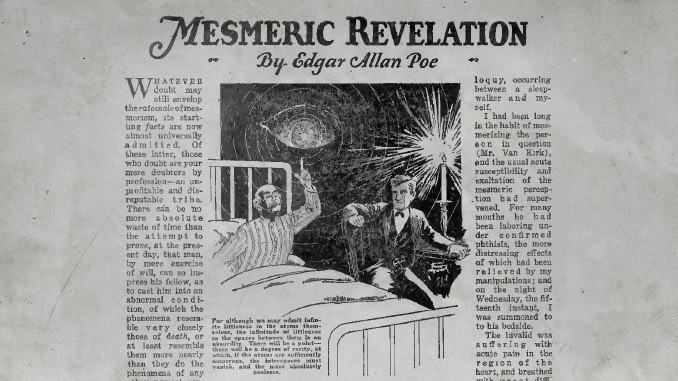
The story, for what part of this is a story, involves a mesmerizer, or hypnotist, putting a subject close to death into a deep hypnotic state, and then asking him questions about exitance and god. The theory been that as the mane is close to death he will have insight into existence, the intellect and the soul. And by extension the divine.
So he puts him under hypnotic suggestion, asks a series of questions, which become increasingly complex, then after a long dialogue between the Mesmer and his subject, the dying man expirees. That in essence is the story. What makes it interesting is the dialogue between the Mesmer and his client.
What is plain is Poe was using this story as a medium to express some complicated philosophical ideas. What is thought, and what is the mind among them. Does the mind exist independent of the body, and if so what is death. The body dies but does the mind continue, is the mind not in essence the soul and if the soul exists then what is its relationship to the divine. And how, can any of that be looked at through the medium of ‘modern’ physical science.
Of course the ‘modern’ Physical Science we are talking about here is modernity as it was in 1844. At the time the smallest possible thing we had conceived of was the atom. It would be over 50 years before Thomson discovered the electron, another 20 until Rutherford identified the proton and 14 more after that before Chadwick discovered the neutron. The point being Poe’s understanding of the physical universe was very much the understanding of the 1840’s and so much of what the Mesmer’s subject reveals is based on our pervious understanding. The theory of Luminiferious Ether was still cutting edge scientific thought. To find the divine in ether, and say it permeated all things was an interesting, some may even say profound, concept in 1844.
The idea of un-particled matter took Luminiferious Ether a step further, effectively saying god exists in the realm of thought, in the infinite littleness between atoms…
To the modern eye, in the era of quantum physics, and string theory, this all seems a tad quaint. I find it interesting because it looks at the divine through the medium of cutting edge science in the 1840’s, because I have sought to look at a pagan divine through the medium of quantum science. It is both inspiring to know Poe did much the same in this tale, and humbling to realize that he was limited by the science of his time. Just as we are by ours.

THREE VERY INTERESED RAVENS… (FOR MYSELF THERE WOULD BE FOUR BUT I AM AWARE THIS IS MY OWN BIAS OF INTERESTS)
SHOULD YOU READ IT: It is not a story, there is no narrative and there is no twist at the end aside a dying man dies. However if you like metaphysical debate, even if the context is dated, then yes you should.
Bluffers fact: The existence of aether, which later became known as ether originated with Sir Issac Newton, and was put forward in his Third Book of Opticks. The final book of the trilogy. It was very well received at the time but lacked the gravitas of some of Newtons other work.







 The Passing Place