Time makes fools of the works of man. When we consider what our ancestors believed we are oft hard pressed to give credence to their strange ideas. Take Aristotle for example. He once counted the legs on a fly and declared they had eight. Such was the high regard in which Aristotle was held, no one questioned this for almost two thousand years. Then when some one bothered to check they discovered flies only have six legs .
Did Aristotle really miscount the number of legs on a fly?
Or was, as seems more likely, his work on the subject mistranslated?
Did it really take two thousand years for someone to check his sums?
Probably not, this is probably apocryphal, but in essence the story is true. The essence of it being the past is imperfectly remembered and more often than not, wilfully so. This have nothing to do with the quote below from Poes story Mellonta Tauta, save the quote demonstrates something about the tone of the piece. It is also somewhat delightful in of itself…
democracy is a very admirable form of government—for dogs.
E.A.Poe ~Mellonta Tauta
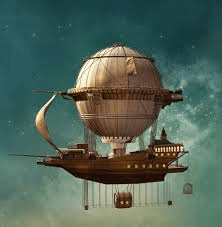
In Mellonta Tauta, our Dear Edgar imagines the world a thousand years in his future and writes a letter from it. All be it a letter not address to us, but sealed in a bottle and thrown into the ocean by its writer just before the balloon, on which they will be traveling, collapses into the sea. This in a future that mocks all the achievements of Poes own age. Putting into stark perspective one salient fact, that in a thousand years, all the works of our current civilization will be for naught… We will be mostly forgotten, our culture misunderstood and things we now consider so important, our art, our beliefs, even our morality, will be no more than dust…
Sobering thought isn’t it…
Importantly, however, Poe writes this letter form our future selves with a joyous ridiculousness that carries the reader though. This is not a dark future in which society is ripped apart by human indifference. It isn’t a dystopian vision, though it is not exactly a utopian one either. The people of the future have different moral beliefs and stand points but that in itself is not dystopian.
It is important to note that this is a projection of a thousand years from Poe’s own time. As such aspects of that projection naturally seem silly to us. Take balloons. For reasons that should be self evident, the idea of traveling by balloon travel was very much the in vogue in the late 1840’s. This was written 30 year before Verne wrote ‘around the world in 80 days’, and the idea did not seem so unlikely then. This was still before the idea of powered ‘lighter than air’ flight, that is to say airships had their brief moment in the sun. More than half a century before the Wright brothers decided the future did not lay in bicycles after all. As such a future containing air travel by balloon must have seemed entirely plausible to our Dear Edgar. Balloons that filled the sky, taking advantage of the different currents at different altitudes in order to navigate their slow passage around the globe.
Giant balloons that carried many passengers in great gonderlas all at once.
The writer of this letter from the future is traveling by one such balloon, and due to the slow but steady nature of this passage finds the time to write of the world and their thoughts upon it. There are many oddities about Poe’s predicted future, the value of a single human life is no longer a matter of great concern. If some one falls overboard the ship sails on. There is no great reason to inconvenience the other passengers due to the misfortune of one. Society as a whole has value, but not the individual.
What makes the story fun however is that in Poe’s imagined future much has forgotten much of the past. Even the names of past cultures and their peoples are either forgotten or misremembered. Just as we don’t really know as much as we profess of dark age society. The cultures of the present-day have long fallen by the way side. Remembered now in abstract, the letters talk about the Kanawdian and Amriccan cultures. The Amriccan culture was, according to the letter, dominated by the churches of Wealth and fashion, and the Knickerbocker tribe that infested the contains when it was first discovered by Recorder Riker, a knight of the Golden Fleece. New York it seems was destroyed in an earthquake in the 2050’s and is remembered by the people of the balloons in abstract like much everything else.
Now the important thing about all this is it is a fun read, the half remembered past and the ‘;strange ways of the ancestor folk’ is well imagined and will bring you a smile. Unfortunately there is a middle section that wonders off from this formular to some abstract cosmology that seems out of place. Not least because its is good cosmology for Poe’s time. It doesn’t spoil the story, but it does detract a little from the ridiculous joy of it all.
Now obviously there are aspects of the story which fail through no fault of their own with the modern audience, written as it was all but two hundred years ago his future runs past our present and, well, a lot has happened in the last couple of centuries. But in essence it is still a fun read, even the slightly broken cosmology, that suffers form the limitations of Poe’s time. That cosmology however reflects the nature of time on a human scale compared to that of the cosmological.
A thousand years making light of our works, is nothing compared to the eons it takes the sun to orbit the century of the galaxy. This long before we knew this was but one of many such galaxies in a universe of cold indifference to the works of man.
Which is another cheery thought…

FOUR RAVENS CONTEMPLATING INFINITY IN REVERSE
Should you read it: Yes, but bare in mind its limitations
Blaggers facts: Mellonta Tauta is actually Greek for ‘these future things’ Alsoi The ‘Knickerbockers’ were the original Dutch settlers of New Amsterdam which later became New York, it is where the New York Knicks get there name from and why the wear orange and blue.