This is a tale of revenge, though to be more exact this is a tale of revenge written out of a desire for revenge. That is to say the tale itself is a vengeance, as well as being a tale of vengeance. So before we speak of the tale itself, the tale of the tale needs to be told. This tale involves another writer, Elizabeth F. Ellet, who is now remembered mostly for ‘The Women of the American Revolution‘ a large tomb of a book in three volumes’ still considered one of the foremost works on the subject. After it was published in 1845 she moved to New York and became embroiled in the literary scene. This was about the same time our own Dear Edgar became suddenly the leading light of the literary scene with the publication of ‘The Raven‘.
The sudden fame granted Poe by ‘The Raven’ was a mixed bless. He had the success he had always sought, but at the same time his the love of his life Virginia was slowly dying of consumption. Virginia for her part encouraged her husband to ‘find happiness elsewhere’ indeed she had a strangely active involvement in his expanding love life. Certainly his interest in Mrs Frances Osgood was very much encouraged by his dying wife. There were others too among the literary circles of New York, including Sarah Whitman and Nancy Richmond, who were close to the couple. Close enough that there were rumours of Poe entertaining a more than platonic relationship with both of them. Such was Poe’s reputation as a bold romantic this in turn led to an involvement with Elizabeth Ellet.
Our dear Edgar, it is noted, had no romantic interest in Elizabeth Ellet. Mrs Ellet, however, on the other hand was very much interested in him, and his affairs. She, like Mrs Osgood, send Poe letters, some of these letters were more than mealy flirtatious in nature, but unlike Mrs Osgood’s letters, Mrs Ellet did not inspire the response she perhaps desired. Poe had become at last a famous poet and writer enjoying the kind of celebrity once enjoyed by Lord Byron and Shelley some thirty years before. Women were known to swoon at his romantic poems. Poe write several specifically for Mrs Osgood including ‘A Valentine’. This rankled with Mrs Ellet, perhaps for no other reason that Mrs Osgood was receiving the attention from Poe that Mrs Ellet wanted, she started indiscrete gossip and harassing Poe’s wife with letters about his indiscretions. Virginia who died less than a year after this began, is said to have claimed on her death bed that ‘Mrs E has been my murderer’. Added to this Edgar borrowed a pistol form a friend because he received death threats from Mrs Ellet’s brother Colonel William Lummis for allegedly refusing to return her letters, though he claimed he had already returned what letters she had sent.
In short, it was all a bit Bridgerton, scandalous and not a little ridiculous, at least if not for the tragedy of Virginia’s death. Our dear Edgar was, perhaps understandably not inclined to be forgiving of Mrs Ellet. Hop Frog then was written as something of a literary revenge on the woman he claimed…
‘revolted’ him, and of whom he said ‘to this day she has never ceased her anonymous persecutions.’
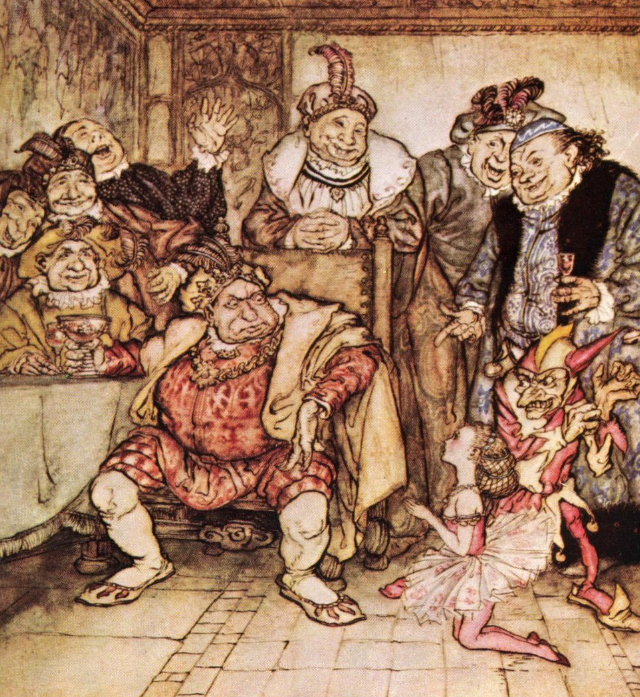
Published in march of 1847 a few short months before he followed his beloved Virginia to the grave. Hop Frog is perhaps his last great story. A bitter jibe in some parts it has a elegance to it that is almost profound.
Hop Frog is a jester to a vile kings court. He is also a cripple and a dwarf, much abused by his master. The jester was enslaved and bound to his master for no other reason that the King find Hop Frog amusing, giving him that name because the jesters deformed spine means he can not walk easily and has to hop about. Forces him to entertain the court often by forcing the little man to drink. Knowing he reacts badly to spirits.
Hop Frog has one true friend in the work, the diminutive but beautiful dancer Trippetta. When the king abuses them both, Hop Frog comes up with a plan to get his revenge on the king and the vilest members of his court. he convinces the King and seven of his most loyal, and horrendous councillors to attend a masquerade dressed as ape’s chained together. And in doing so make the costumes as real as possible in order to scare the kings other guests. The king loves the idea, and so of course do his councillors…
Hop frog helps them into costume, and uses tar over tight fitting cloths and flax to create ‘fur’ before leading them into the great hall. Now the thing about tar is, it burns , and the thing about flax is, it burns, so when he hooks the chain to a pully and pulls king and councillors all into the the air. it doesn’t take much to set them ablaze… Before turning to the crowd and exclaiming..
“I now see distinctly… what manner of people these maskers are. They are a great king and his seven privy-councillors—a king who does not scruple to strike a defenceless girl, and his seven councillors who abet him in the outrage. As for myself, I am simply Hop-Frog, the jester—and this is my last jest.”
It is this line, more than ever that is damning of Mrs Ellet and her New York literary crowd. Poe is clearly Hop Frog, the jester who struggles with drink, as for the diminutive dancer Trippetta, she is most likely Virginia, though there were other women Poe was close to that got caught up in the scandalmongering of Mrs Ellet. In either regard the subtext was plain enough to embarrass Mrs Ellet and her writing sett. But if the motivation to write this story was revenge, that it was a motive that brought the best out of Dear Edgar. The is a striking sharpness to the prose that had been lacking in his later works before this.

A FLOCK OF VENGFUL RAVENS
Should you read it: Yes, for it is a delight and a morality tale of a sort worthy of your time. That said it is best read in the knowledge of its intent, but luckily you now have that.
Blaggers fact: On Lou Reed 2003 album of songs inspired by Poe which Reed called The Raven there is a song called Hop-Frog sung by David Bowie… Which is just, well, its Bowie singing for Lou Reed for oner minute and forty three seconds of epic wonder. In that way that only Lou Reed and Bowie could make such a short ridiculous song epic…