The lady of the Bog does not give out swords, that her sisters job, the one who hangs about in lakes. The lady of the Bog hands out ancient half rotten tree roots, from the long-vanished forests, with which to cudgel enemies of her soggy land.
The Lady of the Bog is a tad grumpy about this as she believes her sister got the whole ‘sword that gives you the right to rule’ gig because she is the pretty one While she got lumbered with handing out half rotten tree roots that give you the right to rule the bogs.
She is wrong of course, under all the blacken peat, rotten twigs, and crawling insects in her hair, The Lady of the Bog is truly beautiful, rather than merely ‘pretty’ like her sister in the lake.
Sadly, manifest incarnations of earth goddesses are just as prone to self-doubt and body dysmorphia as the rest of us So remember people, tell your local peat goddess she is beautiful every day, and smile when you see her.
And beat her enemies to death with rotten tree stumps, obviously…
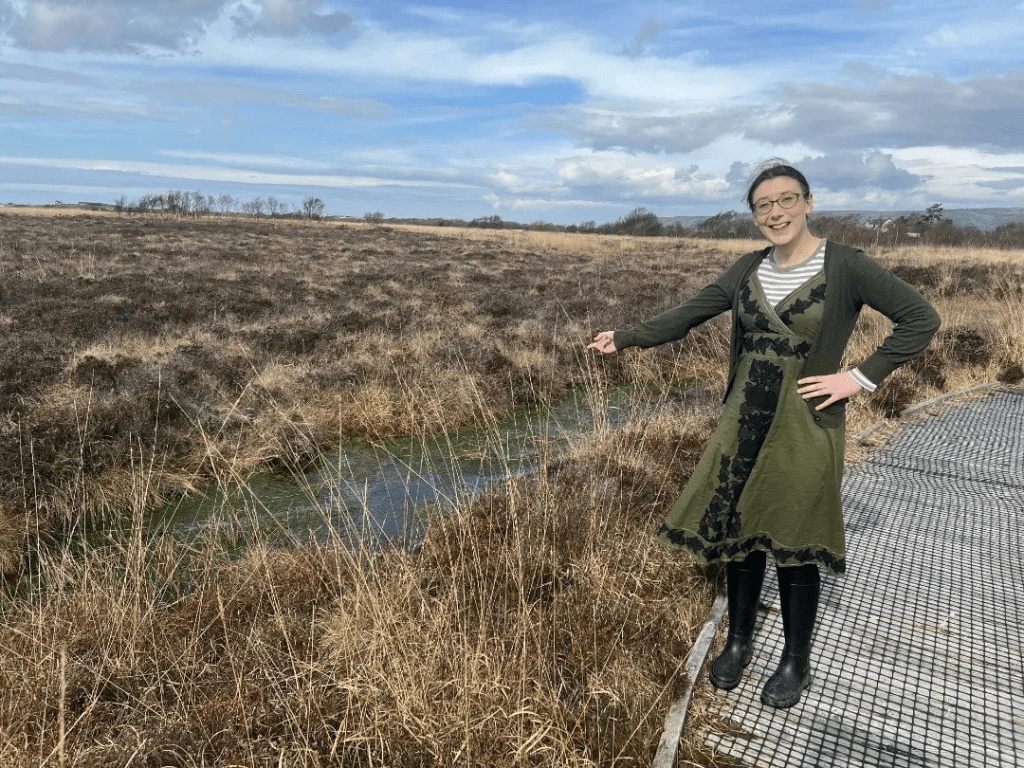
The small piece above is based on a Twitter chain I wrote on a whim in reply to a perfectly sensible post by Author Jessica Law about a peat bog which included this picture of her pointing at a peat bog (for reason I will never understand many of my friends seem to enjoy pointing at things).
I mentioned, as authors who research this kind of thing are apt to do, That peat bogs were excellent places to dispose of bodies and asked whom she was point at… Jessica replied that she was not in fact pointing at the body of a former lover she had thrown in the bog, but she had in fact been hoping a lady of the lake type would appear and give her a sword… A sword struck me as not a weapon a lady of the peat bog would hand out… In my defence, I am weird, what do you expect?
In any regard, hence the short piece above, which was written across a series of short tweets.
To Clarify , Jessica is not in fact the manifest incarnation of a theoretical immortal mythological figure of possibly pre-celt origin known to us now as The lady of the Peat Bogs. She just enjoys pointing at peat bogs, which is perfectly normal and not in any way strange…
Probably…
But if anyone was a immortal mythological figure of possibly pre-celt origin I suspect it would be Jessica Law.
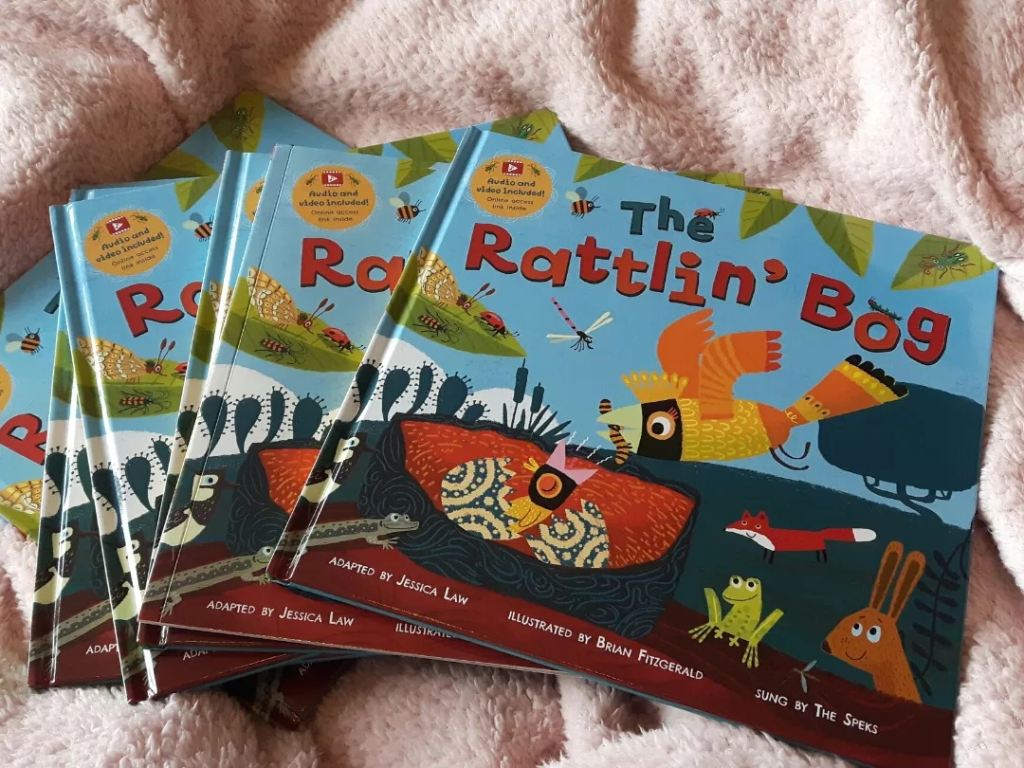
As to why she is pointing at a peat bog on this particular occasion it is because she has a new children’s book coming out, published by Barefoot Books called The Rattlin’ Bog
The Rattlin’ Bog: a rhyming picture book for young children which aims to inspire appreciation for these underrated but vital ecosystems. “Rattlin'” is an Irish word for “brilliant”
You can pre-order it from waterstones with the below link , or at most online booksellers in the UK, US and Canada.
The Men in Dark Tweed were created on a whim while I was working on my current WIP novel, a Victorian Urban Fantasy entitled ’Lucifer Mandrake and the Hanoverian Proxy’ The new, somewhat nefarious Home Secretary sets up a plain clothes division of the young Metropolitan Police Force, reporting directly to him. They are a somewhat sinister group, because basically the main antagonist needed a bunch of shadow thugs…
The Men in Dark Tweed were created on a whim while I was working on my current WIP novel, a Victorian Urban Fantasy entitled ’Lucifer Mandrake and the Hanoverian Proxy’ The new, somewhat nefarious Home Secretary sets up a plain clothes division of the young Metropolitan Police Force, reporting directly to him. They are a somewhat sinister group, because basically the main antagonist needed a bunch of shadow thugs…
‘How to Write a Blackwood Article’ and ‘A Predicament’ are two parody’s written by Poe and published in the same edition of the magazine, American Museum. One serves as an introductory piece for the other and in effect they form a single narrative. So in defiance of normality I am going to treat these two tales as one, as without being cast in the light of ‘How to Write a Blackwood Article’ the second ‘A Predicament’ is all but unreadable. But before we get to the tales a little background.
Blackwood’s , or to give its its full title ‘Blackwood’s Edinburgh Magazine’ was a quarterly magazine that began life in 1817 and by the time Poe wrote these tales in 1838 it had achieved a certain notoriety for the outlandish lurid stories presented as ‘articles’. This was not how the magazine started out, as it was originally conceived as a conservative rival to Whig supporting periodical, ‘The Edinburgh Review’.
For those not conversant with 19th century British political party the Whigs were the progressive left wing of the time, as opposed to the Tory’s who represented much as they do now, the political right. The British Whigs should not be confused with the American Whig party which was one of the proto-republican parties that later merged to formed the GOP. British Whigs and American Whigs were of the opposite political spectrum on almost all counts. Though both were equally pompous as a rule, and tended to spend a lot of time shout the other side down…
So no change there.
In any regard while ‘Blackwood’s’ began as a right wing periodical, before long it moved more towards a populist stance, publishing works of notoriously bohemian poets, Shelly and Coldridge among others. There were even articles by women rights advocates (though this being the early 19th century these were almost all men, because you might publish an article advocating the emancipation of the fairer sex, but not have it taken seriously if you attributed the writing of it to a woman, that would of course be absurd…) In any even while it still pertained to be to the right of politics it became increasing apolitical and sensationalist as the years went by. Which is to say, the publishers sought to make a buck or three and didn’t much care how they did so.
So no change there either…
After its first few years, and at least one dual being fought over ‘libellous’ content which led to the death of a rival magazines editor. (Once again, publishing in the 1800’s was not for the faint hearted) A new editor John Wilson came to the helm and pitched the magazine to an even broader market, publishing more horror stories and increasingly outlandish articles generally of fiction dressed up as fact. From which it developed a reputation somewhat along the lines of modern magazines like ‘The National Enquirer’. Which is to say it never let truth get in the way of a good story . A reputation that left it wide open to parody, a sitting duck at which our Dear Edgar took somewhat gleeful aim…
*see below
‘How to Write a Blackwood Article’
The delightfully named Signora Psyche Zenobia narrates both tales, in the first one she approach’s the editor of Blackwood’s magazine in order to gain his advice on how bets to write an article for them. Her main motivation for this is it seems to establish her name as a writer, and in doing so rid herself of the nickname Suky Snobbs. A nick name foisted upon her by her bitter rival rival Tabitha Turnip. There is much bemoaning of this, which sets the tone…
The editor advises her on how best to write an article, how any article is improved with a quote or three. Better still if the quote is in German, or one of the dead languages. Greek in the original Greek alphabet for example is much desired. He goes on to advise her to take large quantities of pills then report on the sensations, include at least one animal, and a strange acquaintance that you can describe in freakish detail. Indulge in the hedonistic, report not facts so much as sensations, use evocative words and compounded sentences, and more quotes, and is at all possible get yourself drown or choke upon a chicken bone and report on the near death experience. Indeed if at all possible, actually die and then report on your experience….
Eventually she runs for the hills, fleeing his offices in fear for her life as the editor seems to be more than a little deranged, and looking forward to helping her with her article by means of a sharp knife …
‘A Predicament’
When next we meet Signora Psyche Zenobia, she tells us a new story, a story reported in the exact way she was advised to write by the editor in the first tale… Up to and including the death of the narrator , with quotes in German…. ish
‘Unt stubby dukl, so stubby dun duk she! duk she!’
which she translates for us as
‘and if I died at least i died for thee, for thee’
Except of course that is not actually the German for ‘and if I died at least i died for thee for thee’ that would be ‘ Und wenn ich gestorben bin, bin ich zumindest für dich gestorben’. Nor are the quotes in Greek and Latin, actually Greek or Latin. Because everything in ‘A Predicament’ is Signora Psyche Zenobia attempt at writing an article to present to the editor, following his advice. It is over the top and meant to be just that. She has a pet dog that could fit in her handbag, an unfortunate servant (very unfortunate to modern eyes) and she does indeed die in the end, before reporting on the sensations of her death…
‘A Predicament’ follows all the rules laid out by the editor in ‘How to Write a Blackwood Article’. Together they are clever and witty, but only provided you read the two together. Read apart they hold little interest and are just silly without being particularly funny.
That however is a bit of an issue because even together, while they are a clever and witty combination, they are still not particularly funny unless you are in the right frame of mind for the utter absurdity of it all, which most probably you will not be.
It reads not unlike a bad Monty Python sketch, in two parts with a few animations in between. But it is a Monty Python sketch been reiterated to you in a pub by someone drunker than you. Someone who has never seen John Cleese doing the original version. You know it should be funny, it has all the elements of funny, but it just isn’t…
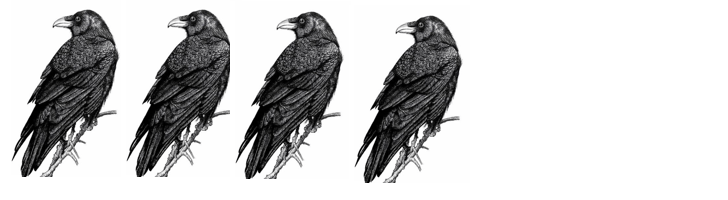
A TRIO OF VAGUELY AMUSED RAVENS WHO CAN AT LEAST ADMIRE THE SKILL IF NOT THE EXECUTION.
SHOULD YOU READ IT: It well written and smart it just misses the mark for me. There is also an issue with Psyche Zenobia servant in the second story. He is short, black and the portrait is very much of the mid 1800’s. While not in a particularly nasty way, it is to modem sentiments a tad racist. Though it is problematic because it is ‘of it’s time’ rather than in the Lovecraft ‘even for its time’ way. So forgivable in context, to a degree at least.
Bluffers fact: Blackwood’s had a declining readership form the 1840’s onwards yet remained in publication until its final edition in 1980. While it never regained its former popularity it did pull off one notable literary Coo in 1899 when over the course of three editions it published,Joseph Conrad’s Heart of Darkness. The novel, which while wonderful in its own right, is best known now as forming the basis for Francis Ford Coppola’s masterpiece, Apocalypse Now.
*still for a delightful little graduation film by Csaba Gellár, well worth an amused watch … see link below
North Africa. This is not the Africa of Sir William Nettleton III infamously lost explorer and drinker of gin. This is another Africa. The Africa of endless desert dunes and the epicentre of French colonialism. You would be mistaken however were you to believe that the ancestors of Will Nett, traveller and occasional author, (some my say itinerant bum) had never walked those dunes. Though Marched would be more accurate, or perhaps stumbled…
in the early 1900’s a Bill Nettlton, otherwise known as Bill Jest, joined the French foreign legion. After a incident where a hand grande was mistaken for a cricket ball, as may did at the time, he joined to forget, or perhaps to be forgotten. In the former he was successful as according to his diary entries for the life of him he could not remember why he had joined, or what had happened one day to teh next due to a combination of sunstroke, barrack room brandy, and multiple venereal diseases including sever thought only to exist in members of the Dromedarius species. In the latter he was also successful as no one remembered him at all after he was killed by a camels kick. Except a few lady’s of negotiable virtue, whom he short changed. And a camel called Matilda whose virtue he paid for with his life, but the less said about which the better
In any regard, as he just won’t get his own blog, Will Nett sent me another guest post. In this one instead of bumming it around eastern Europe he has followed in Bill Jest’s footsteps and headed to North Africa.
Marrakesh Musings by Will Nett
He’s charging me ten dirhams to look at his snake. But I’ve already seen it. I think it’s a cobra. If it is, it’s a very lethargic one. There can’t be much money in the ‘ol snake charming racket these days if this wizened old fiend needs to chase potential audiences through the town square to extract payment, as this sultan of serpents is doing now. It’s not any old town square, although it is old; it’s Jemaa el-Fnaa in Marrakech, on the edge of the maze of the Mouassine medina.
His twisted desert-hardened face comes in close, led by an attendant open palm that I send away empty and closed. The cobra, and its dance partner, a ‘viper’ I’m told, look doped up to the eyeballs. They’re not paying attention to the music; they continue to oscillate wildly even after it stops, so it’s their stimulus is unclear.
The anticipation of night perhaps, as it rolls in on waves of smoke and the snakes are presumably put to bed. I don’t know where the smoke is coming from but there’s so much of it, billowing through the food stalls this Saturday night.
It’s like an episode of Stars in Their Eyes. Maybe the landmark Café Argana- looming over all like a moored cruise ship about to set sail- has exploded again, as it did in 2011.
It is in nightfall that the market comes to life; it’s whole pulsing mass absorbing the surroundings as its tentacles creep out past the restaurants and cafes stretching towards Koutoubia at the southern end, where row upon row of formerly fantasia horses stand hitched to chariots awaiting tourists, marshalled by a stockman with a whispered sideline in ‘hash…women.’
Moody sim cards- for those unlike me whose mobile phone wasn’t lost at sea yesterday; that’s a whole other blog entry- and even moodier football shirts and baseball caps are in heavy surplus amongst the street vendors.
The hypemen on the periphery of the food stalls cajole and corral me into sitting down in front of one of the ready-made khobz of warming bread that are already in place at every table, waiting to be eaten. Chleuh Berber acrobats flip and bounce over a cacophonous riot of gourds, zithers and Eurobeat backing tracks as an upturned cap is passed around for a collection plate. I’m momentarily distracted; first by shouts of ‘BEETLE…BEETLE’ from a boy on a fruit stall. I’m initially confused, he points at my hair, mimics a guitarist and bellows ‘BEATLE…GEORGE.’ In his shirtsleeves and bowtie he’s
impressively well turned out for a fruiterer, but nowhere near as sartorially slick as the Barbary macaque in a two-piece silver lame suit fiddling with the ignition on a nearby moped.
You want it? Jemaa el-Fnaa’s got it. The scene is not so different to the time of it’s 11th century Almoravidian conception, we can suppose; the same aggressive sales techniques, and similar wares but with the added amenities of the modern age; nappies; cigarette lighters and wood carvings sit alongside casks of powdered aphrodisiacs, baklava, Turkish Delight, exotic fruits and nuts, and ceramic tagines. One man throws me a dried fig as an appetizer before unleashing his patois but we’re interrupted by a football bounding past. Two enterprising youngsters have set up a pitch at a dirham-a-pop to topple a pair of empty plastic bottles, one balanced on top of the other. Beside them, a three-card monte merchant looks suitably bored by his own set-up as others queue to kick to win. Cats- the real rulers of Morocco- roam as freely and proudly as any race of people here ever have or will; travelling in packs on orchestrated outings to the butchers and bakers. They’re not interested in candles. Outside of a zoo I don’t think ever seen such a varied proliferation of animals in such close proximity to each other. Another monkey, dressed like some half-baked African dictator in epaulettes, ceremonial jacket and cap, looks on as the cats stride proudly by as though in some feline military parade. I wait eagerly for the monkey to salute, but even he knows there isn’t a cat on the planet that would be impressed by such a gesture. I can tell the monkey is male, because…well, I can tell.
And so, this monkey-marshalled menagerie of Morrocco’s Marrakesh medina, will mesmerize for many more moons.*
Awww; shit. Here come’s the snake bloke, again.
*A Canadian woman at the bar of L’etoile Du Musee has just bet me I can’t fit a tongue twister into this piece. I’ve already thrown in Smiths and B-52 lyrics, so why not?
As part of this year’s Crossing the Tees festival, Will Nett will be taking part in a Q and A at Stockton Library on Thursday 16th June from 6.30pm
Occasionally while happily writing away, you write yourself into unexpected corners. For example, in my current main work in progress ‘Lucifer Mandrake and the Hanoverian Proxy’, the plot requires a hole in the arcane wards protecting Queen Victoria’s court. As plots are want to do…
As the lead character is Victoria’s court magician and was responsible for the wards, there had to be a ‘good’ reason why this hole existed. the hole in question being that the wards do not detect or disable subtle magics like glamours, but are directed at more opaque malfeasance.
There is one very good reason why Lucifer would not set wards that dispelled glamour magic, but his reasons apart he needed a justification for doing so that did not involve him. The simplest explanation I could come up with was crows feet… That been that ‘cosmetic’ glamours are all the rage in Mandrakes magic infused version of the Victorian era. Ladies of the court (and the odd gentleman or three) who are a little older than they are willing to admit might employ bit of jewellery with a glamour spell woven into the metal, making their crows feet ‘vanish’.
Having wards about the palace that would dispel such harmless arcane enhancements might be considered, impolite…
Of course, as is my curse, I could not just stop there. It was a nice, fun, little explanation of how Mandrake justifies there being no wards against glamours in the queens court. Sparing the blushes of Lady Bernice of Montrose, who everyone knows won’t see forty again but looks to be in her twenties. Well its just polite. But it came to me that ageing ladies in waiting and the odd vain courtier who ate too many pies wanting to appear slimmer was one thing. But if Lucifer needed a more solid reason to not ward against glamours I would need to use diplomacy.
Well diplomats…
Diplomats are ever vain creatures. Swift given to offence, and oft to pea-cocking. they were bound to use glamours. But magic had been around in Mandrakes world, so there had to be a few diplomatic incidents over the years to do with glamours been used, or failing, or been dispelled in order to cause another diplomats embarrassment… It more or less had to have happened at some point in the past. Giving mandrake a better reason to not ward against glamours…
So i came up with the Count of Salamanca, and an incident that almost cost Wellington the Peninsular campaign half a century earlier. The Count, for reason best known to himself ‘overly tight trousers were in fashion.’, was given to going about the place sans trousers, with as glamour cast upon him so he appeared fully clothed. This was all very well until a dastardly French spy managed to counter the charm the Count was using, revealing the Counts sartorial gaff… and, reputedly, what little his trousers would be hiding in the crotch department…
The common British soldiery, as is its want, on hearing of the incident made up a marching song ‘the Maggot of Salamanca’. The song was swiftly outlawed by Wellingtons Officer cadre due to the embarrassment it caused a previously firm and reputedly virile ally of the crown. This of course assured it caught on with the ranks and that it had remained a popular rabble rouse in music halls for the last fifty years or so. Memorialising the incident with the common populous, and complains from the Spanish crown on a regular basis.
All this is background justification, and while Mandrake alludes to some of it in his narrative, it is just that, a thing he alludes to and this blog post is much longer than the bits alluding to any off this, court ladies to the Count, in the actual narrative. Which will probably be trimmed back in any case, as its all a bit superfluous to the story, and only I need to know about it in its entirely. But it exists in my notes now and serves as an example of ‘the process’ or at least ‘my process’ of writing Victorian urban fantasy, or indeed anything. Which is to say there is always a lot more in the authors head than ever sees the page…
However, having strung all this together in my head, to figure out a plot point that is of minor importance, I have boxed myself into a corner where I have to write ‘a soldiers marching ballad’ called ‘the maggot of Salamanca’, a fictional song about a fictional Count who while graced with wealth and high birth was not graced in the trouser department… Because at some point Mandrake will probably hum a few bars of it to himself, or quietly sing a line or two at an inappropriate moment.
And yes, I don’t have to write it. It will never appear in the novel, certainly not in full, It just that I do, as it exists as a thing in my head now and sometimes those voices I spoke of last week sing…
So with apologises…
The count of Salamanca, What a fine upstanding gent They say he never wore his trousers, No matter where he went.
Oh… the maggot of Salamanca The Frenchie’s were to blame the maggot of Salamanca It wriggles to his shame
The count he was a pompous man A more than a little vain But want dangled there between his legs Well that’s just a crying shame
Oh… the maggot of Salamanca The Frenchie’s were to blame the maggot of Salamanca It wriggles to his shame
Some men are blessed with looks and charm Some men are born to money Some men are bless with many things But not bless down there now honey
Oh… the maggot of Salamanca The Frenchie’s were to blame the maggot of Salamanca It wriggles to his shame
Oh… the maggot of Salamanca The Frenchie’s were to blame the maggot of Salamanca It wriggles to his shame
The Maggot of Salamanca, A regency marching song popular in The Peninsular War… sort of…
“Did I? How exciting… I look forward to hearing it. I wonder if I already have?”
A female, exuberantly excited if slightly panicked voice in my head
Every character I write, be they a main character, supporting case, or the woman in the shop waiting to get served… has their own voice. This has a lot to do with the way I write, or at least the way I build little frameworks of conversation that are not part of a complex narrative while ideating. Often in the car, or walking somewhere , or laying staring into the all consuming darkness of the bedroom ceiling wondering what the point of it all is. And what the ‘it’ in question is to start with.
I have been waiting for this voice to appear, I didn’t realise I was waiting for it, but I was. I was a little surprised when it popped in for a chat with my subconscious. I was even more surprised I recognised the voice, worryingly so given the context of the character on to whom I have imposed their voice…
(No, I am not even going to begin to explain why its worrying, I am almost certain the original owner is not to be worried about in the same context)
Voices in my head, argue and converse with other voices in my head, and occasionally I remember to write them down.
Its a process. Its my process. I never said it was a good one.
That line got written in the spaces between as I waited for servers to reboot in a data hall. Because that is where I was when the conversation started to form in my head. As each server took about five minutes to reboot and I was doing a bunch I had time to scribble down quite a bit, some of it makes sense… Well all of it makes sense to me, but that’s not the point. This may never make a final draft of the novel I am not working on but want to ( as opposed to the one I am not working on but should be, or the one I am working on but my mind keeps wondering…)
In any regard here is the full bit… because it needed writing by that point
Life happens, but just because you remember it in order doesn’t mean it happened that way, why are some memories so clear, like they happened only yesterday? And yet you can’t always remember what you did an hour ago, let alone last weekend. Or for that matter where you put your keys. “We have met before, Richard, but don’t you normally play piano, not serve bar?” “Usually yes, but on Tuesday afternoons I fill in for Lyal as he has yoga. When did we meet? I’m sure I’d have remembered. Though time here is a bit odd, sometimes. “See you even remember my name.” “I do? “ he asked and she laughed. “Sometimes… That’s me. Well, Scarlet, Scarlet Sometimes…” “That’s an…” “Odd name, yes, I know. Its not my real name obviously.” “Hang about, Scarlet Sometimes, I am sure I know that name. didn’t you have a one hit wonder in the 80’s?” “Did I? How exciting… I look forward to hearing it. I wonder if I already have? They were always playing oldies when I was growing up. Oh, that begs a question doesn’t it , did I write it before I heard it or afterwards. Is it plagiarism if you are plagiarising yourself?”
And the will therein lieth, which dieth not. Who knoweth the mysteries of the will, with its vigor? For God is but a great will pervading all things by nature of its intentness. Man doth not yield himself to the angels, nor unto death utterly, save only through the weakness of his feeble will. ~ Joseph Glanvill
I like a good quote, who doesn’t like a good quote? Authors in particular like a good quote because they add a sense of authority to a piece. A good quote says, ‘I was not the first to put thought into this concept’, it signals the author is actually well read, educated, has spent time researching ideas and is not just making stuff up…
Of course some authors, with somewhat caddish disregard for proprietary, have occasionally been known to make up a suitable quote if they can’t find one. Generally the trick is to ‘quote’ someone who has been dead a while, a couple of centuries is a nice bit of distance between writer and the quoted… It helps to use someone who is vaguely associated with the subject matter, such as ‘quoting’ a writer who was known for his writings on witchcraft and folklore if you want to lend authority to a story involving hints of witchcraft and folklore…
Of course no reputable author would ever do such a thing… (to be clear I have never claimed to be reputable.) Our own dear Edgar would have been the first to chastise another author for doing such a thing in his role as literary critic. As such he would certainly never do such a thing. So this particular quote from Joseph Glanvill, which appears both within and at the beginning of Poe’s short story ‘Ligeia’ certainly would not have been made up… We can be sure of that.
Joseph Glanvill, for point of interest, was an English writer, philosopher, and clergyman. Most notable for Sadducismus Triumphatus, a renowned collection of seventeenth century folklore centring on witchcraft, which was published after his death (1681) by fellow philosopher Henry Moore who edited it and almost certain wrote a fair amount of it himself using the deceased Glanvill to avoid any scandal associated with the book falling back on him, while making as much money out of a controversial subject as he could. Publishing practises in the 17th century were, it seems, much the same as they are now.
Sadducismus Triumphatus’ went on to influence Cotton Mather book ‘Discourse on Witchcraft’ (1689) the book which informed the intellectual basis behind the Salem witch trials… So nothing problematic there, who doesn’t like a good witch burning after all…
Notably, the Joseph Glanvill quote that Poe used here is not from ‘Sadducismus Triumphatus’, nor from any of the other known papers written by Glanvill. In fact the only reference to this quote you are likely to find anywhere is in this particular story. Of course Dear Edgar, been a writer of real moral fortitude, and a fierce critic of such practises in other writers, would never have made up a quote. It is clear therefore that he must have had access to some obscure text by Ganvill that was subsequently destroyed by ill fortune, in a fire or something, probably… Poe certainly didn’t just make it up, to suit the story and attribute it to a notorious, and importantly long dead author known primarily for writing on the subject of witchcraft, in order to add both intellectual and scandalous weight to his tale.
No, he certainly would not have done such a thing, any more than I would ever do such a thing…
The integrity paramount to the integrity of he who would would claim himself to be an author of integrity is in the quotation of others ~ Edgar Alan Poe (honest Gov)
But putting such things to one side, having establish Poe almost certainly didn’t make up quotes anymore than I just did… lets go on to the story of Ligeia, a story that covers some passingly familiar territory for dear Edgar. The narrator, who doesn’t name himself, is obsessed with his dead first wife. A woman who introduced him to mysteries, metaphysics and forbidden knowledge. He was besotted with her, or at least the memory of her, but he is also an opium addict, which leaves him somewhat unreliable as a narrator. Leading to, I must warn you, a lot of long melancholy descriptive passages about his raven haired Rhineland beauty. A lot of them… there is a good page or so on her eyes alone. This is not a bad thing, they are masterfully written descriptive passages, there is just a lot of them.
Ligeia, with which or drug addled besotting narrator remains so utterly enamoured, is both beautiful and learned. Not unlike the title character of Poe’s earlier tale ‘Morella‘. While the monomaniac obsessive quality of his love speaks to that other early story ‘Berenice’. There are also shades of one of the stories he is most famous for but was yet to write at the time ‘ ‘The Fall of the House of Usher’. Beautiful intelligent women that die and return in some way were a common thread in Poes stories and poetry. There is a romantic tragic quality to Poe’s female characters that often gets equated to his wife dying young, but at the time this was written Poe had been married only a couple of years, Virginia was still around for another seven to come, he was however clearly still besotted with his young wife.
In the story the drug addled narrator married again after he moved to England into an old Abbey in the middle of no where but with a surprisingly good opioid connection. He second wife Rowena is the polar opposite of Ligeia, the former a blonde blue eyed Anglo Saxon when the latter was a raven haired dark eyed maiden supposedly from the Rhineland but who clearly had roots in the darker skinned Mediterranean peoples of the near east.
the beauty of the fabulous Houri of the Turk. The hue of the orbs was the most brilliant of black, and, far over them, hung jetty lashes of great length. The brows, slightly irregular in outline, had the same tint. The “strangeness,” however, which I found in the eyes
While never stated directly in the story there are hints a plenty that Ligeia practises some form of witchcraft, and when she dies after a long illness she does so only after first composing a poem about death and possibly resurrection, though its hard to be sure. A poem she makes him learn verbatim, as a strange ritual chant, or perhaps it is actuality a spell. And for all our narrator is an unreliable witness to almost everything else, his recollection of that poem is perfect, has has repeated it so often, even after her death, even without knowing he was doing so.
Rowena’s is an unhappy marriage, she sits in the shadow of the narrators great love and he often rages at her in a drug addled state. A couple of years pass and she falls ill and in turn dies. Then enshrouded in her tome the narrator watches the shroud fall away and the corpse transform into the image of his first and long lost wife Ligeia…
So were does all this, and the repeated Glanvill quote Poe uses throughout that isn’t actually a quote at all, get us. Well it is much of a muchness, The death of beauty, obsession and madness, in this case in the form of the drug fuelled ravings of the narrator. There is both little subtext and so much subtext that it is obscured by itself. What it is though, in all its heavy Gothic velvet lined smoking jacket wearing opium fiends splendour is beautifully written. It’s a bit like wading through chocolate. It is undoubtedly over-written, but it is over-written in such a way as to as to seem luxuriant. It should be too much, yet somehow manages not to be. It manages to be just about right despite itself.
It remains as mad as a box of day-glow frogs in a refectory, but just right all the same.
I don’t love it, but I can’t hate it. I would not chose to read it again, but I have no regrets about reading it the first time ( or the several times since for this blog). It has a odd quality about it, something that is hard to define. I suspect most people will take different thing from this story. In the end that may be all that needs be said about it.
Also, don’t trust Poe when he starts quoting people, the mans an utter cad…
ALMOST A FULL FLOCK OF RAVENS LOOKING IN YOUR DIRECTION
Should you read it: Dark tragic gothic insanity and love. So yes , of course.
Bluffers fact: The strangest fact about this story is that it gets cited as Alfred Hitchcock’s inspiration for his film Noir classic Vertigo. Except it wasn’t. French novel D’entre les morts (the living and the dead) by Boileau-Narcejac was actually Hitchcock’s inspiration. Which could vaguely be said to be based on Ligeia, in the same way that 1980’s Battle beyond the stars, was based on The Seven Samurai via The Magnificent Seven, which is to say by a vague kind of osmosis, or not.
The Men in Dark Tweed were created on a wimp while I was working on my current WIP novel, a Victorian Urban Fantasy entitled ’Lucifer Mandrake and the Hanoverian Proxy’ The new, somewhat nefarious Home Secretary sets up a plain clothes division of the young Metropolitan Police Force, reporting directly to him. They are a somewhat sinister group, because basically the main antagonist needed a bunch of shadow thugs…
I felt the sting of remorse. This face I had stollen for my own, now looked haunted and here I was to pay witness to its end. An end I had brought him to. Oh, I could rationalise it all I wished. Claim that I had never asked him to pretend to be me. Never ask that he take my stead and keep my honour… But it was I who had stolen his face. It was in the end that act and that act alone that had brought him to the noose. More so than any of his, for none of this would have happened had not I first committed my larceny of countenance.
From the as yet unfinished ‘Lucifer Mandrake and the Hanoverian Proxy
I don’t as a rule publish excerpts, even single paragraphs form the first draft of an unfinished novel. There are good reasons for this, of which the ‘three drafts’ rule is the most pertinent. That being I don’t let anyone read a new work until at least the third draft. This exert however I am using to illustrate the point behind this post, as it is just about the perfect example of my point of view when it comes to people ‘authoring’ books with AI. A subject that has brokered much discussion of late, and one such discussion on face book lead to this post.
Here in essence is my subjective point of view on novels, short stories and anything else for that matter, ‘authored’ using AI. It is in essence this, no AI would ever use the phase ‘larceny of countenance.’
The algorithms of AI, which sample huge amounts of fiction (seldom, if ever, with the actual authors consent) would not have written the last five words in that paragraph, to wit ‘committed my larceny of countenance’. An AI would have written ‘stolen his face’ instead. Both turns of phase mean the same thing and the latter is by far the more likely to crop up in the endless sampling of written work the programmers of AI’s use for their algorithms. How common, why I use those three words in the same context myself earlier in that same paragraph… Where as ‘Larceny of countenance’ probably doesn’t crop up anywhere.
I am reasonably sure this is the case simply because to the best of my knowledge no one has ever used the phase ‘larceny of countenance.’ before and I only wrote it this morning. In the context of this paragraph it’s a perfect phrase. Given the context is the first person narration of an occasionally pretentious Victorian mage who says things like ‘larceny of countenance’. It is a phraseology unique to that character, and unique within the as yet incomplete manuscript of my current work in progress. It is highly probably that the phase will never be used again by anyone… Myself included. Unless Lucifer Mandrake uses it again at some point in the story, because none of my other characters in other novels , nor myself in a third person narrative, are ever likely to use such a phase. Hannibal Smyth doesn’t talk like that, nor do I on account of my not being a Victorian trans man, who uses magic to present as the gender of their choice, and uses pretension to deflect from their insecurity… Lucifer Mandrake is a unique character with his own voice*.
*Mostly his voice, on occasion her voice as Luci Drake is still in there and the magic being employed by Lucifer is a complicated way to assume the gender of your choice. Occasionally Lucifer reverts to Luci. This is problematic and challenging for me as a writer, because gender, identity and importantly, hormones switching about, in your main character makes things complex. But that is also in part why I wanted to write this character, easy characters are dull…
My point here is that AI can only write, and will only write, by mimicry. AI is not actually intelligent, its an algorithm regurgitating word soup. If you tell an AI to ‘Write a story in the style of Mark Hayes’ its going to struggle, as I don’t have a style… Not as such. I write in many styles, and none. Often I write in 1st person narration, but the style then is the style of the narrator not myself, even if the narrator is a mere self aware consciousness observing events. 3rd person tends to have more of me in it, but even then it is the me that is telling the story. I guess you could tell an AI to write a Hannibal Smyth story, and feed it first with all the Hannibal novels and short stories. But it still would not write Hannibal, it could not affect his self-loathing or the lies he tells himself before he even begins to tell the reader. His inner Id is just as complex as Lucifer’s.
No AI would ever use the phase ‘larceny of countenance.’ Because until this morning, when I wrote that paragraph, neither would I. This doesn’t mean what I have written is some form of higher literature. Its a line in a fairly pulpy Victorian urban fantasy novel that explores some complex issues of gender, identity, between trips to dark fairylands and mocking cricket. All it means is no AI would write what I have written, because I am widely unreliable and tend towards the intuitive in my writing.
But I write the kind of things I want to read. And what I want is to read are books by other people who make up things as ridiculous as the phrase ‘larceny of countenance.’ and agonise about doing so because getting such a phase just right is what they feel the universe needs to happen, despite it being three words in what is currently a 57k manuscript that will almost certainly never be read by the vast majority of humanity. And even the infinitesimal percentage of humanity who read the finished novel will probably never remember reading those three words.
The point is ‘larceny of countenance’ over ‘stole his face’ is where the blood is. Which is why I have no interest in AI written novels. I want the blood, the viscera , the truth of another author, when I read. Not some watered down facsimile of humanity regurgitated without soul or consequence. I’d sooner read a James Paterson novel than anything written by an AI… This is not to say I care only about turns of phase, my point is not that my rather pretentious narrator chooses strange phasing. It is that I want honest stories, discovered by writers as they wrote them. Because the art of writing is just that a fucking art. And are requires a soul.
Not some AI’s attempt at a larceny of countenance…

















 The Passing Place