Esqwith’s Passing Place is a bar that sits on the edge of many realities and is part of none. It is a place people stumble into some times and tell stories.
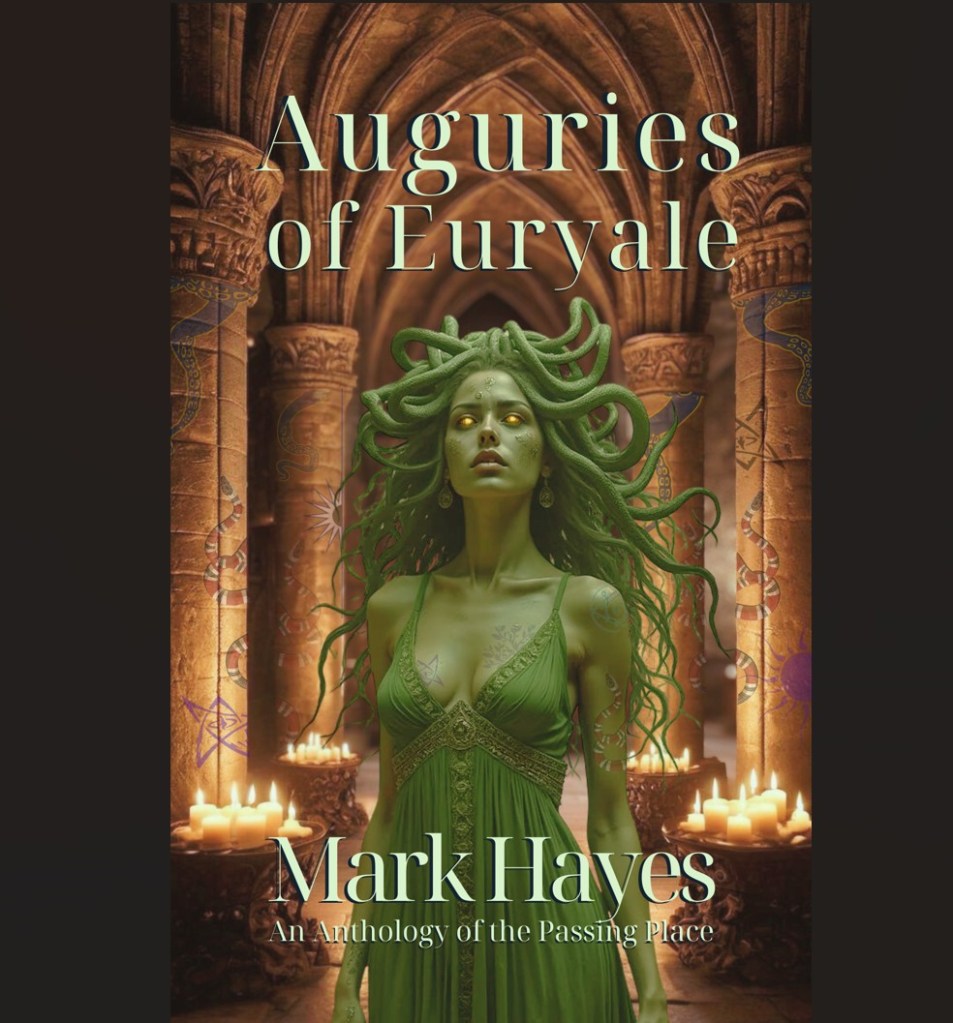
Stories of auguries cast in kitchens by Victorian arcanists. The last survivor of an end of the world. The sister of Medusa, in a charity shop in Cheem. A herder of books who was once someone else. The final proof of god on a world of endless sunlight. Men in Dark Tweed and strange things in the Thames. The divine Sibel in a goth club in Streatham. The infatuating Miss Maybe, Quizzels and how to Quiddle them. As well as other tales of nothing, hungry things and a tale that no man knows.
So anyway, that’s it, my new anthology is out there in the world. I can put it to bed, it is done, all that’s left is marketing to try and get people to consider reading a copy. In terms of being the writer this is now a finished project, cast out into the cold uncaring world.
I hate the marketing part. I never dreamed of been a marketer. Writing is my passion , my dream, my desire. Spending my time trying to convince people to buy books isn’t and never has been.
So why should you buy a copy of Auguries of Euryale, because it is full of good stories, stories that will make you laugh, cry, think, smile, wonder and hurt a little in that good way books can make you hurt a little. If you read this blog from time to time you know how I tell stories. If this is your first timer reading my blog , hello…
You should buy a copy of this anthology, I promise it will not break you, though I can’t promise it will not try. There are more than a few very personal stories in the collection, though I am not about to tell you which ones they are. Any book is am open window, if the writer has done their job right. There is always a little blood on the page, a slither or two of the authors soul between the bindings. If your not leaving the odd open wound out there then are you even trying to say something real.
There is a lot of fantasy, Urban and otherwise, in this anthology. There is also a lot of darkness and humanity, which is often the same thing. As well as life and death, as the two are linked. Bits of me inhabit every story, sometime mere slithers, in some though, aspects of my souls are laid bare, if you care to look closely.
Not all the stories are personal in that way, but in all of them the red on the page isn’t ink.
In the very first story in the anthology Lucifer Mandrake, my Victorian arcanist, casts an augury, and in doing so explains why the only thing that matters is the casting is blood.
Shed blood for an augury, shed blood for the page.
I have other stories to write, other tales to tell, more blood to shed. These are now told and the blood is ingrained in the pages. Euryale guards her temple, the last survivor climbs the hill, the Men in Dark Tweed are waiting, the final proof of god sits between the light of four stars on a planet called midnight, the book herder waits for the rustle of pages, the Sibel calls her coven to dance around the stone, and Miss Maybe has a most unsuitable suitor. All the while no man waits for the daughter of the sea.
I don’t do marketing, there is no blood in marketing, the blood is already shed on the page.
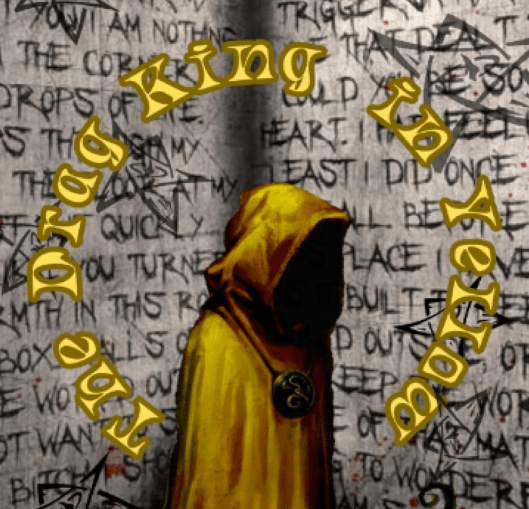
A few years ago now A steampunk group in Gloucester decided to do a themed event, with the mildly preposterous title, Steampunks vs Cthulhu. As their, not exactly, local expert I was asked for suggestions for things they could do and if I would volunteer to do anything for the event. And so I agreed to do a talk on the life and work of HP Lovecraft, having recently finished a book on old tentacle hugger’s works. I also suggesting, in an entirely off hand way, that they could put on the second act of ‘The King in Yellow’.
This was of course a joke on my part. However, if you are unaware of why it was a joke, let me explain. The King in Yellow is the fictional play, in the novella The King in Yellow by Robert W Chambers. The second act of which is cursed in that it send any one watching it, or performing it, insane.
Matt, who was planning the event, and I knew full well had a copy of The King in Yellow, and very much was aware of the joke said. “Great idea, write it…”
I gave him ‘the look’. The look that says, ‘sure I’ll get right on that sometime never…’ But then Nimue Brown, who normally wrote silly little plays for such events said. “I don’t know about The King in Yellow, but I would be up for being a Drag King in Yellow’… At which point Jessica Law piped up, ‘oh can I be a Drag King in Yellow too…’
This left me somewhat boxed into a corner by my ‘cleverness’.
Several months later, a small Gloucester amateur dramatics group did indeed put on a one act, twenty minute, play called ‘The Drag King in Yellow’* . As far as I am aware no one was sent mad, or at least madder…
*There is a video of the play being performed available here on You Tube, consider yourself prewarned. It is also available as a manuscript Here , but you would be mad to buy it. It only exists in paperback because I wanted to gift the cast with them.
The Drag King in Yellow is my only foray into the world of amateur Dramatics, for which the world of amateur dramatics is most grateful one suspects. Theater is not my world. I may like to take in a play every now and again but my knowledge of the theater is far form encyclopedic, this last is unfortunate only in that having just read The Masque of The Mummers I can’t help but feel I missed a few theatrical jokes. However, that in no way detracted from the joy of the novel.
Ben Sawyer is a writer well versed in theater, the love of theater, and I suspect some experience of amateur dramatics, informed one of the two main branches of the plot of this, his third Holly Trinity Novel. In the midst of York’s medieval festival A local Am-Dam is staging an old, and reputedly cursed play. The curse is real and enacted by ‘the mummers’ strange ghosts in period theater wear and blank featureless faces. Somehow more terrifyingly they communicate exclusively with lines from the plays of Pinter, Greene, Bennet and others.
There are other threats to the old city as well, the big bad is stirring, and the truths behind Holly herself are waiting to be revealed, while the supporting cast is as ever deeply entwined. Mira’s ex is back in town with his spirited wheelchair bound sister. His best mate is getting he band back together, which is good because the current lead singer thinks he is a Viking. Meanwhile a reporter has got his hands on an arcane artifact that gives him the powers he shouldn’t have.
Holly Trinity is awake, which never bodes well for the old city. Armageddon may be round the corner. But at least she gets to go to the theater.
This is a joyous romp of a novel as all Bens novels tend to be. As ever the city of York is as much a character in the novel as a setting. Ben writes of the city with a vibrancy that gives it life. Much like his other characters, which have the same depth and layers as his plots.
If you haven’t read his previous novels you should. If you have you will not need me to convince you to read this one.
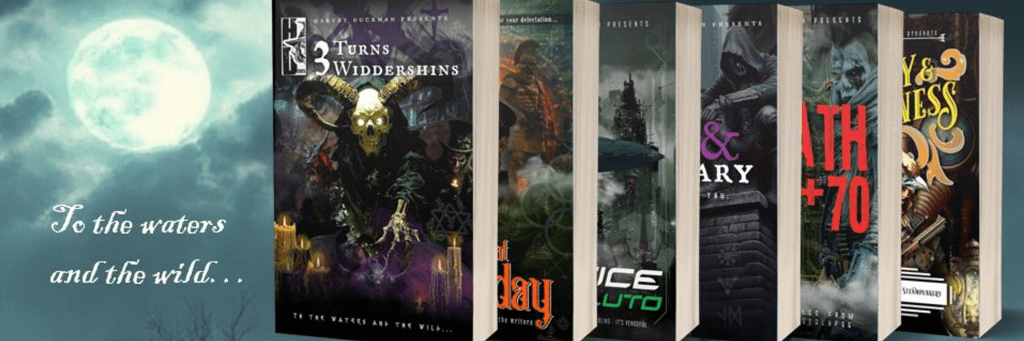
Aside the Holly books Ben also writes stories for the Harvey Duckman Anthologies, which as you may be aware I am also associated with. they have a new book of dark pagan stories available for preorder on kindle, that will be out in paperback and hardback from the 23rd of January It joins the six pervious ones below in the ever expanding range of Harvey anthologies.
While talking books, my own new anthology, which I should also mention is out on the 16th…
Our Dear Edgar, as you know, to an extent invented detective fiction with his August Dupin stories, The Murders on the Rue Morgue, The Mystery of Marie Roget and The Purloined letter. He created the literary conceit of the genius detective solving crimes with an everyman sidekick who takes the position of narrator, cheer leader, and tells us of their astoundment when the detective reveals how he solved the crime.
Without Poe’s Dupin there is no Sherlock Holmes, at least not in the form we are familiar with. Poe invented the Sherlock architype, but also the Doctor Watson type everyman who tells us the stories. Holmes and Watson in turn inspired Agatha Christie’s Poirot and inspector Japp among many others.
As a archetype for detective stories the three Dupin’s are hard to dismiss. They were not however the only detective stories Poe wrote, this story ‘Thou Art the Man’ is another example. It is however something of a failed experiment of a story if you compared to his other detective stories, or as he termed them, tales of ratiocination, because this tale is told to us by the detective himself, and loses the mystery element in the process.
This is not to dismiss the story, which is in its own way inventive and well constructed. It is quite a fun little read as well, with more humour on display than Poe’s other detective tales. This is not to say the tale is told for laughs but it has a certain baroqueness to the names and characters that brings a rye smile. It centers around the murder of Barnabas Shuttleworthy, a fellow of some wealth in the town on Rattlebrough. While no one can find the corpse Shuttleworthys nephew is accused of his murder, the narrator, who is also the detective, however believes there is another villain afoot. Charles Goodfellow, the dead mans best friend.
A elaborate ploy is used by our detective to unmask the villain involving the corpse of Shuttleworthy a case of win and ventriloquism. But here in lays the problem, because we are told the tale by the detective themselves the tension is lacking. the big reveal is more of an ‘I told you so’ and it all falls a bit flat in the end.
There are of course plenty of detective stories told rom the point of view of the detective, Raymond Chandlers, Philp Marlowe stories, for example. But those employ a very different way of telling a story. . . generally with a touch of down at the heel alcoholism and ‘then she walked in, the dame that done me wrong…’ With twists and turns, betrayals and backstabbing , that the detective fails to anticipate. Such stories work because it involves a flawed detective struggling against the machinations of others. There is none of that in Poe’s story, instead this is a tale of a clever detective using his cleverness to unmask a villain and that is essence is why it is something of a meh of a story. There is no suspense, no reveal beyond how the culprit is revealed.
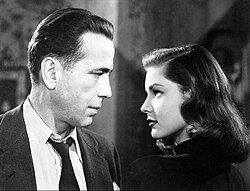
Marlowe (Bogart) and the Dame who done him wrong…
Clever detectives need flaws, and those flaws need someone who will reveal them , it why Holmes needs Watson to tell his story. Holmes would be a terrible narrator, and that is exactly what we have in this tale. A clever detective just being clever, without any real charm. Its not a bad story, it has fun within itself and its not a bad read, it just feels flat, or perhaps just too one dimensional to really inspire the reader. And experiment with the detective genre that doesn’t work.
THREE RAVENS THAT ARE NOT ALL THAT SURE THERE SHOULD NOT BE LESS OF THEM.
Should you read it: There is no reason not to, but there isn’t really a reason to do so either…
Blaggers fact: The line the corpse speaks, ‘Thou art the Man’ is most likely refences Samuel 12:7, in which King David is accused of laying the way for his marriage to Bathsheba by arranging for the death of her first husband Uriah.
Or alternatively it may be based on a line in ‘the Great Moon Hoax’ articles, of 1835, which claimed Sir John Herschel had discovered a civilization of Vespertilio-homo on the moon, or for those without a working knowledge of Latin… Batmen. Yes Batmen on the moon…
Hello and welcome to what will eventually become the year of the Rusty Hobbyhorse in mid February. While we are now in 2026 it is still the year of the Distressed Snakeskin Belt for a little longer. However, weary travelers, I bring you news of some import before the celestial cladder turns once more. To wit, to help you through the cold darkness of winter there are two new releases coming your way in which to feast this eyes and feed you imagination.
The first comes to you my friends at Harvey Duckman’s holdfast, where they hide form the frost trolls and ice giants of winter in the fjord’s, waiting for the suns return while swapping tale and drinking mead before they can venture once more across the whale road…
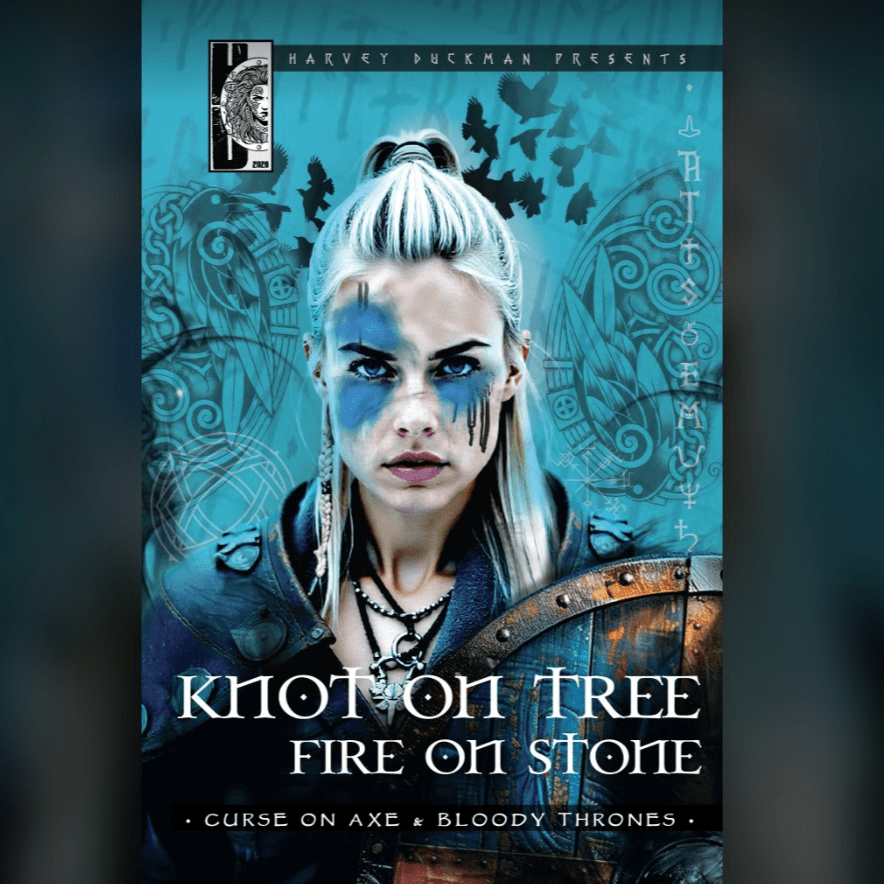
Yes , Harvey Duckman is back with a deliciously dark collection of stories from our wonderful Dark Ages Pagan Mythos basket. Dark and violent, embracing the elements, feeling the earth beneath your bleeding fingertips, riding the storm, bracing the shield and drawing back the bow strings…
Our Harvey writers have let the Ban Sidhe howl, the Dark Fey play… they have danced with the devil, let the spirits rise… crossed the seas with nowt but belief and stubborn determination… raised their tankards and let the mead flow…
In the darkest of times, we have let the old powers return and have had fun in the driving rain amidst the rumble of thunder. Looking for original, wonderfully imaginative stories from a bunch of fantastic writers?
Featuring stories from Mary F Carr, Liam Nicholl, Laura Liptrot, Anna Atkinson-Dunn, Keith Errington and Nimue Brown, John Holmes-Carrington, Kate Baucherel, Steven C. Davis, Mark Hayes, Ben Sawyer, Christine King, Allison Kotzigova, Hunter Ricci, James Waite and M Stern.
It is available for preorder on kindle, and will be out in paperback and hardback from the 23rd of January
But that is not all, Steampowered Books also have a new release in January. This one written by their own Mark Hayes, who as your reading this blog you may have heard of…
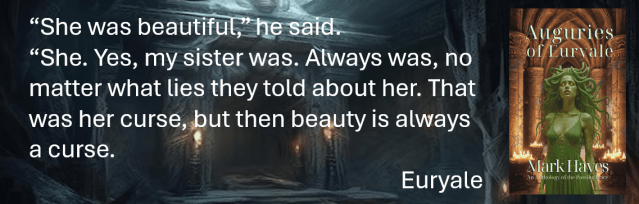
This is my latest anthology of short stories and a couple of poems (One apologies for the poems…)
Esqwith’s Passing Place is a bar that sits on the edge of many realities and is part of none. It is a place people stumble into some times and tell stories. These are some of those stories.
Stories of auguries cast in kitchens by Victorian arcanists. The last survivor of an end of the world. The sister of Medusa, in a charity shop in Cheem. A herder of books who was once someone else. The final proof of god on a world of endless sunlight. Men in Dark Tweed and strange things in the Thames. The divine Sibel in a goth club in Streatham. The infatuating Miss Maybe, Quizzels and how to Quiddle them. As well as other tales of nothing, hungry things and a tale that no man knows.
The game of darts, as we know it today was, as many such things are, invented in a British pub. The first ever darts tournament took place in 1926 in ‘The Red Lion’ in Wandsworth. In fairness, while that was the inaugural toury on the modern game, this iteration of the drinking mans sport of choice was hardly the first. The French had there own version, which being French is a bit flighty (its called fletchette’s and involved feathered ‘darts’) Various other iterations exist date back as far as the 13th century. Some however might argue that the game reached it true peak in the 1800’s when there was a popular version of the game that involve tiny darts and a blow pipe.
The game was called Puff and Blow, those were simpler times…
Puff and Blow was not a game that one might expect to require a tad of trepidation, but more than one unlucky ‘puffer’ was known to suck in an errant dart, at least according to a new article read by the narrator of this ‘comic’ tale by our own Dear Edgar. The report states a sporting chap, a tad worse for wear and deep in his cups, sucked when he should have blown, swallowed the needle which impaled itself into his throat and this caused him to expire. In the narrators opinion this must clearly be false news. ‘Such odd events could never happen.’ he says. going on top pontificate that ‘No one has ever died from sucking a needle into their throat’ while playing a pub game, and that this was ‘too ridiculous for words’.
It is then he is visited by an Angel, a odd angel to be sure, indeed one might say the angel of the odd. An angel that has a body made up of a beer barrel, and several bottom of wine for arms and legs…
There may be a metaphor here, but its very subtle…
The Angel of the odd goes on to tells our narrator that strange things do indeed happen all the time. When the narrator dismisses this he learns the error of this opinion when strange increasingly unlikely events start to happen to him. Firstly as he is a tad worse for ware due to drink he takes a nap, sleeps too long and misses an appointment to renew his fire insurance, and his house has caught fire. Luckily he escapes down a ladder his neighbors provide, but it gets knocked over by a runaway hog and he falls and breaks his arm. Events get worse and more bizarre from there on in.
It is all a bit silly, but then that is the intent. This is literary slapstick and as such its fun enough, even funny if you want literary slapstick. That is if you wish to laugh at the misfortune of the clown, while knowing he is a clown. A drunken clown at that which may be a moral, though its not exactly a moralistic tale. It also lacks something, laughing at a clown is all very well but the clown needs to be more than just a clown. It why Buster Keaton is still been watched today and so many of his imitators are not. Keaton had the ability to make you care, even with a kitten perched on his head. Where as Poe narrator is just a fool to whom things happen. You don’t even care when he decided to kill himself, or that he is reprieved when a crow steals his clothes and he cases after it. It just done for laughs and not all that funny.
In summery, drunk or sober, strange things happen. At least if you drink you can blame the drink… Or the Angel of the odd at any rate…
TWO RAVENS LOOKING FOR AMUSMENT
Should you read it. Well the reason it gets only two ravens is I found it dull, but then I find slapstick without pathos dull. Comedy is always hit or miss, and this one misses me. That doesn’t mean it will miss you, some people like, The Office, while I have never cared for any of it iterations.
Blaggers note: Our Dear Edgar lived before the internet, thus his narrator not believing that anyone could die by sucking in a dart is reasonable enough. Even if the entire story is based on the premise of there being an angel specifically tasked with creating odd, unlikely events… Had Poe lived now he would almost certainly have read the annual Darwin Awards. He would have known therefore that humanity has an unbelievable capacity to find new and ever more ridiculous ways to depart this moral coil.
Frankly sucking in a needle playing a game of puff and blow would not even get a honoree mention.
The majority of my work, though not all, is self published, there are reasons I chose to publish this way, I have discussed them many times on different posts so I am not going to waffle on about the whys in this one. Instead I am going to give a little insight into the iceberg of self publishing, and how the one major downfall of doing this all in house as it were, is doing it all in ones own house, as opposed to working with a publishing house.
For perspective, I have recently finished writing a commissioned book on old tentacle hugger and his work. The experience of working with a traditional publisher has been a great one. As has been just being responsible for the writing, and checking proofs etc. As it was commissioned work with a one off payment none royalty deal, I have no further responsibility to the book, I don’t need to do promotion work and help to sell it. I have no skin in the game, beyond my name on the cover.
Now of course I will do some promotion stuff for the book, I’ll talk of it here when it is released and/or I have a publication date. I’ll do all the normal posting on social media, and general background publicity, because it does have my name on the cover and I would like it to be successful. But my relationship with the book as far as its publication is concerned came to an end with the final proofs. And to an extent that is the one major advantage of doing a book for a traditional publishing house.
In the world of self-publishing on the other hand, your relationship with your publisher and the books they publish ends only in death… A terminal end to the contract that is pest avoided as long as possible. This is not to say you can’t just publish a book then leave it alone for ever, you certainly can do that. You can just publish a book and never touch it again, just send it out into the world with nothing but hopes and prayers to the divinity of your choice. But you won’t…
There are endless reasons you may go back to a published book and change something, the list below is just a few of them…
Fixing that typo
A new imprint name
A new cover
New books in the also by list
New editions
So to take them one at a time, and I will keep this brief
Fixing that typo… Even traditional publishers books have typos, despite all the additional resources they have at their disposal. If you have spent anytime proof reading for yourself or others, then pick up a mainstream book, you will start to notice them. Despite the several stages each of my books has gone though the odd typo still slips through. I keep a list for each book and fix them in blocks once I have a long enough list (more than 1 per 10000 words)
A new Imprint name… My imprint is my publishing house. Literally my publishing house as it is the ‘publisher’ of my self-published books. Why have an imprint, why not just list yourself as publisher? Because self-publishing has certain stigma’s attached. An imprint reduces some of that, by giving the perception of a small independent publishing house, which is what you are i any regard.
When I published Cider Lane over ten years ago I used the name of the nature reserve behind my house and street I live on, and created an imprint called Saltholme Books. It served me well enough for the next several years but a few years back I changed the imprint to Steampowered Books, because it worked better for a writer who spends much of his writing time in the 19th century. Also it worked better for the publishing house website/blog which I own. Don’t bother looking up the Steampowered Books website as there is just a holding page right now , but I have owned the name a few years and it is one of the things I will get around to sorting it all out at some point.
Long term, the imprint may include a book or two by other people. There is one in particular I want to publish under the Steampowered Books banner but that will be a while I suspect.
In any regard when I revisit the files for an old saltholme book I change the imprint and publisher details.
A new cover… No matter how much you love your cover, at some point you might decide to change it. In the case of Paperbacks and hardback you might want to include the new logo for the publishing house on the back as well…. There may be other reasons too…
New Books in the also by list... You keep writing books, you want to add them to the ‘also by’ list. Otherwise why have an also by list if it is missing half your books.
New Editions… Back in around 2023 Amazon started printing hardbacks. I like Amazon hardbacks editions, they are very nice books. Novels previous to 2023 did not have Hardback editions, every book I have published since has. So when I have the time I and working through the back catalogue.
Hardbacks are bigger books , they require different dimensions in the covers, this requires some paid software to resolve… As for audio…. Here in lays a tale.
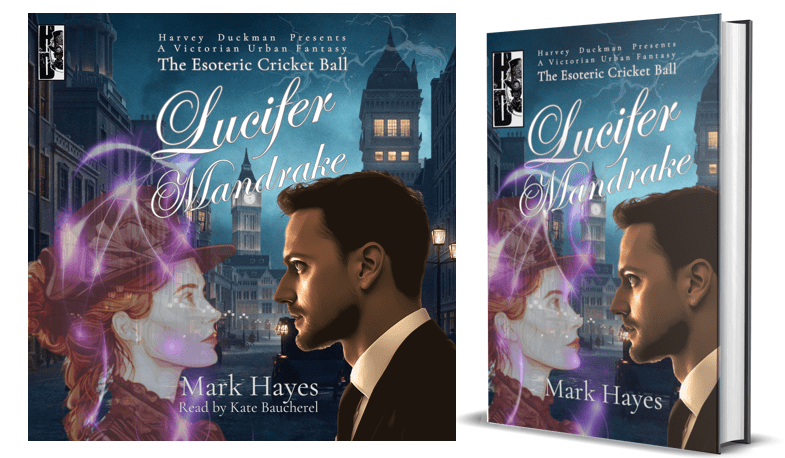
My fellow author and friend Kate Baucherel recently surprised me with a full set of audio files for the Lucifer Mandrake novel. I had not asked her to record 10 hours worth of audio book, and she didn’t tell me she was doing so. I am very very grateful and sent her a lot of expensive designer rum (from Villains of York , whom’s rum I can highly recommend)
She did however cause me some unexpected work. I needed to make an audio cover which as you may know is square rather than the tradition vertical oblong of book covers. the easy way to do this is with Canva, which I use to design covers and has the original Mandrake cover with all the various aspects that went together to make it. Resizing the kindle/paperback cover requires the professional version which I rent whenever I need to do a fair bit of work of this kind. I am quite pleased with the results…
Audio square, original
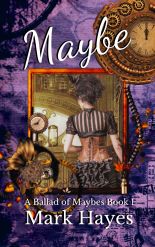
Now as I have Canva pro for a while it made since to do some other work, which took me to Maybe, the last of my major works to not have a hardback edition ( aside the three Hannibal Smyth novels but the compendium edition is in hardback so they are not high on the list of jobs). Hardbacks need bigger cover, increasing the size means the relative places for titles change, its a whole thing… But Canva does it just fine with the pro edition so good time to sort that out.
However, here is an odd thing. Maybe is arguably my most successful book on line, but on the table at events it merges into the background. The cover, which works fine on line, is too dark on a black table cloth. It does not ‘pop’, to use a terrible phrase. So if I was making a hardback cover I may as well go the whole hog and try to ‘brighten’ it a little. Canva has the perfect tools for this, it was just a case of faffing about till I got it right. But if I was changing the cover for the Hardback, I needed to redo the Paperback and kindle edition overs too. So I played with the original, then resized for hardback. So new covers all round…
Original (dark) , New (bright), Hardback
Okay, now HB internals are different too, at the very least you need to change the ISBN number in the legal bit at the front, but it occurred to me if I was fiddling with HD internals I may as well do the PB internals as well at the same time and update the ‘also by’ pages and the imprint page. Which mean is need to do that withe the kindle too…
Okay… and if I am changing the imprint I should really get around to making the imprint logo I keep telling myself to do for Steampowered books, and if I do that I can put the logo on the back cover as well as the internal cover. So I should make them… Luckily I have Canva right now so now is a good time to do so…
Soi I did that… Colour and monochrome , cover and internals. Don’t they look great…
This all ended up as two days work, more or less, at which point, after all the new files were sent and done I realized the following, I had spelt Steampowered Books in the logo ‘Steampowereded’ So now I have to wait on amazon approving the files which take 24 hours as a rule, so I can go back in, fix a frankly ridiculous typo, and submit them again….
Yes, I managed to make a typo while making in my imprint logo. This is so ridiculously on point I can not help but laugh… And incase your wondering when I spotted that, well after typing the words Don’t that look great about six lines ago and wondering where to wrap this post up…
Self-publishing is an iceberg, there is much the reader never sees, and always more of it below the waterline, ho hum, off to Canva to fix those logo files.
In September 1841 John C Colt, the brother of renown gunsmith and industrialist Samuel, found himself in the unenviable position of being choked to death with his own cravat. In fairness to the elegant neck wear it was not responsible for the attempt on its wearers life, rather Samuel Adams, a printer of text books who had been employed by Colt, was using the cravat as an improvised garrote. This was over the matter of $1.35, an inconsiderable sum even in 1841 to motivate an attempted murder by neckwear, one would think.
In fear for his life, John began reaching out for anything he could use to fend off his attacker and his hand came to rest on what he assumed was the handle of a hammer. In the event it proved to be a small hatchet, and after he struck Adams several times with it the textbook printer fell to the floor and bled out. Luckily once the cravat was readjusted it proved none the worse for the experience, though it did sorely need an ironing, but even with sartorial elegance repaired Colt was faced with as problem. There was a body on the printing room floor, and he was still owed $1.35.
Luckily a ship somewhat perversely named for the land locked Michigan city of Kalamazoo was due to sail for New Orleans on the morning tide, a large shipping crate was in the print works, and several hundred weight of salt. So Colt clean up the blood, packed Adams in the crate, covered him in salt and got a cart driver called Barstow to drop the crate off at the docks. But not before Colt helped himself to the printers engraved gold watch. He was owed $1.35 after all…
It was then events conspired against the gunsmiths brother, a storm blew down the coast from Maine and what started out as little more than a squall built into a full blown gale. The Captain of the Kalamazoo, a cautious man, kept her in port an extra day, and the body was discovered due to an unfortunate smell, just before the Police arrived with a search warrant. Armed with little more than circumstantial evidence, and a few witness statements that placed Colt in proximity of the crime the police arrested him, and found he still had the gold watch he had taken in leu of the debt owe him.
While in prison awaiting either a retrial of his execution Colt dined expensive meals brought in from high end hotels in New York. These included quail on toast, game pates, and ortolans… If you are remember ortolans from way back when we discussed The Duc de L’Omelette and how they are traditionally prepared for the table, any semblance of sympathy you may have held for John C Colt has probably flown out the window…
The woeful tale of John C Colt, who killed himself in prison before his execution* inspired our own Dear Edgar to write The Oblong Box, a story about a man shipping his dead wife’s corpse north to New York so she could be buried in the family plot, in a wooden crate, which his friend, our narrator, mistakenly assumes contains a copy of Leonardo De Vinci’s last supper…
*or possibly did not as at least one conspiracy theory, and there are several, suggests he escapes, having killed another prisoner of similar bult to himself, and started a fire to disguise the body before hightailing it to California where he lived large on accountancy text book money for another fourteen years with the wife he wed in prison…
The box in question is been shipped not in the hold but in a third stateroom. This is a ploy we, the reader, is unaware of until the end. The ships captain, to ally superstitions, does not want the body in the hold, and neither does the widower. So the captain agree to placing it in a stateroom, for a price no doubt, and to avoid suspicion a homely maid agrees to pretend to be the wife for the extent of the journey. Hence the narrators initial confusing, having never previously met ‘the wife’ but having been told she is a renown beauty.
The widower, due to the lack of context for the narrator, seems to be acting strangely, and spends time weeping by the, obviously coffin shaped, box, which the narrator puts down to his love of art… Then there is a storm the ship is going to capsize and the captain orders everyone to abandon ship. The widower refuses to leave the box and is washed out to sea never to be seen again. The narrator then learns the truth some time after on a chance meeting with the captain of the lost ship.
Poe’s story is a good story, it is well written, because of course it is, the suspense is well handled and the strangeness of the narrators friends actions hold your interest. Even the pay off at the end is well weighted if slightly mundane after all the strangeness that precedes it. But that’s all it is. It doesn’t hold the attention and take root in your mind the way stories like The Pit and the Pendulum, or The Fall of the House of Usher do, or indeed the story of John C Colt that inspired it.
Now, of course, the story of John C Colt was mainly of interest and captured the public mind at the time because of the legend of big brother Samuel and the gun that won the west… John was an accountant who made his living with speaking engagements of double entry book keeping, and text-books on the same. If it wasn’t for Samuel Colt’s revolver, the New York public would not have cared less about the case. Instead, because of Samuels fame, it filled column inches, and hence came to our Dear Edgars attention and the Oblong Box was written a year or two after it had all been forgotten.
Here though is the crux, Poe’s story is perfectly fine, but I would argue that it is the story of John C Colt’s oblong box that remain easily the most compelling of the two.
THREE RAVENS WHO ALL FIND THE STORY OF JOHN C COLT MORE COMPELLING.
Should you read it: Despite all I have said… probably.
Bluffers fact: To go back to John C Colt, it is interesting to note that the police could only identify the body of Adams because of his gold ring, which Colt did not take but cause the watch covered the $1.35 he was owed. Had he taken the ring, identifying Adams would have been impossible and had the state been unable to prove the body was Adams could have caused the case to collapse. So if only the debt had been $2.35 Colt might have been spared the guilty verdict…
1844 was one of the most prolific years of our Dear Edgars life, despite this he did not write a great deal of note in that time. This is to say much of what he wrote was fairly average fiction by his own high standards. The previous year of 1843 had brought us high water marks with The Tell-tale Heart, The Goldbug, and The Pit and The Pendulum. the 1844 stories suffer from comparison.
All this was set against the degenerating health of Virginia. His wife had first showed signed of Tuberculosis two years earlier, coughing up blood while singing at the piano. While she recovered somewhat from the initial bout of consumption it was clear her health was never going to fully recover, the next two years were years of steady decline. Our Dear Edgar found solace in the bottle as he had in the years before his marriage. The worse she got, the more he drank and the more he brooded.
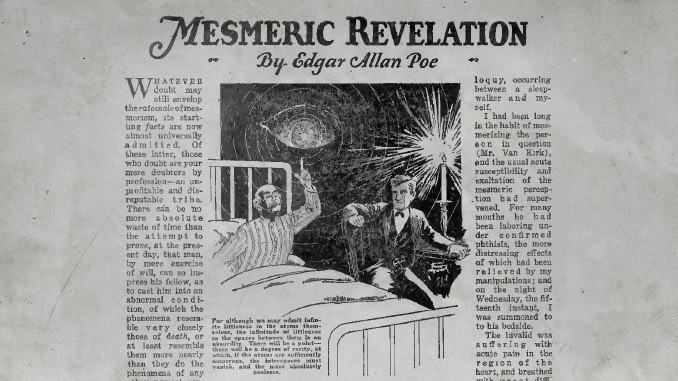
Sometime in late 1844 Poe was to pen the poem that was to make him famous, though The Raven was not published in the January of the following year. Nothing else he wrote in 1844 would have much of an impact. Among them was this tale, Mesmeric Revelation, which from the first is not really a story at all.
What Mesmeric Revelation is in terms of story is no more than a framework in which to discus meta-physics, in much the same way he did with the earlier stories The Conversation of Eiros and Charmion, and The Colloquy of Monos and Una. Unlike those two earlier examples Mesmeric Revelation manages to hold the interest even though it is admittedly heavy going at points. However, that said I must declare my own interest here, it is a story that leans heavily into ideologies and concepts that fascinate and inform somewhat my personal belief system. Which I shall not burden you with here.
The story, for what part of this is a story, involves a mesmerizer, or hypnotist, putting a subject close to death into a deep hypnotic state, and then asking him questions about exitance and god. The theory been that as the mane is close to death he will have insight into existence, the intellect and the soul. And by extension the divine.
So he puts him under hypnotic suggestion, asks a series of questions, which become increasingly complex, then after a long dialogue between the Mesmer and his subject, the dying man expirees. That in essence is the story. What makes it interesting is the dialogue between the Mesmer and his client.
What is plain is Poe was using this story as a medium to express some complicated philosophical ideas. What is thought, and what is the mind among them. Does the mind exist independent of the body, and if so what is death. The body dies but does the mind continue, is the mind not in essence the soul and if the soul exists then what is its relationship to the divine. And how, can any of that be looked at through the medium of ‘modern’ physical science.
Of course the ‘modern’ Physical Science we are talking about here is modernity as it was in 1844. At the time the smallest possible thing we had conceived of was the atom. It would be over 50 years before Thomson discovered the electron, another 20 until Rutherford identified the proton and 14 more after that before Chadwick discovered the neutron. The point being Poe’s understanding of the physical universe was very much the understanding of the 1840’s and so much of what the Mesmer’s subject reveals is based on our pervious understanding. The theory of Luminiferious Ether was still cutting edge scientific thought. To find the divine in ether, and say it permeated all things was an interesting, some may even say profound, concept in 1844.
The idea of un-particled matter took Luminiferious Ether a step further, effectively saying god exists in the realm of thought, in the infinite littleness between atoms…
To the modern eye, in the era of quantum physics, and string theory, this all seems a tad quaint. I find it interesting because it looks at the divine through the medium of cutting edge science in the 1840’s, because I have sought to look at a pagan divine through the medium of quantum science. It is both inspiring to know Poe did much the same in this tale, and humbling to realize that he was limited by the science of his time. Just as we are by ours.
THREE VERY INTERESED RAVENS… (FOR MYSELF THERE WOULD BE FOUR BUT I AM AWARE THIS IS MY OWN BIAS OF INTERESTS)
SHOULD YOU READ IT: It is not a story, there is no narrative and there is no twist at the end aside a dying man dies. However if you like metaphysical debate, even if the context is dated, then yes you should.
Bluffers fact: The existence of aether, which later became known as ether originated with Sir Issac Newton, and was put forward in his Third Book of Opticks. The final book of the trilogy. It was very well received at the time but lacked the gravitas of some of Newtons other work.
The shallow blue Aegean sea between Greece and Modern Turkey is a basin of ancient civilizations, where east meets west and the cultures that first sprang from ancient Mesopotamia mix. To the south of that sea, when the Aegean borders the deeper waters of the Mediterranean lays an island that birthed a culture older than Greek legends. A thousand years older than the Greece of Aristotle and Plato. Older even than the Mycenaean Greeks who predated the Classical culture and inform so many Greek myths. The island is Crete, but once more than 3500 years ago, it was home to the Minoans, arguably the first great European culture.
In actuality to call the Minoans themselves Europeans is something of a stretch, the best guess historians can offer is the people that first settled Minos migrated there from Anatolia, either due to drought, or population pressures. Coming to Crete they brought much of their culture with them but once isolated on the island that culture quickly evolved. Their myths and stories evolved too, from those of the upper reached of Mesopotamia, into something distinct, different and culturally based around the islands climate, as well as their own journey to become Minoans.
Now I could write a lot more about the Minoans and their culture, history and ascendance but frankly if I did I would probably get a lot of it wrong, there is every chance some of the above is wrong, so if you want to know more about it you should go and read Labrys & Horns: An Introduction to Modern Minoan Paganism By Laura Perry, which I reviewed back in June as is all the primer you will ever need, and has a great list of other books you can go on to read if you fall in love with the Minoan culture.
The reason I am talking about the Minoans today is because of one of Laura’s other books, one which came out in may this year, and is just a special kind of wonderful.
Tales from the Labyrinth: Modern Minoan Myths
Examples of the art within Laura’s book
Tales from the labyrinth derives it name, to an extent, from one of the most well-known myths about the island culture. A myth that comes down to us through the Greeks, the myth of the labyrinth of King Minos and the creature that dwelled within it it, the Minotaur. Though that myth is just one of the many fragments of Minoan mythology that comes to us through the Aegean cultures that came after. The problem is that many of them are just that mere fragments form a culture who had writing but not in a from we can now interpret, there has never been a Rosetta Stone for the Minoan language. Linear A as it is called, is similar in some to early cruciform script but only to a degree, and is unique to Crete.
What Laura has done is take the foundations of what is known about Minoan mythology and built upon it to create a modern interpretation of those myths and the mythology as a whole. Given them structure and a thread, tied them as all mythology is, to the culture itself, the island of Crete and the seasons of the eastern Mediterranean. In Crete the growing seasons is the winter of northern Europe, You plant around Halloween and harvest around easter. The summers are hot and dry, a dead time when nothing grows.
The fragments of mythology you might recognize from later cultures where the growing season is summer are turned on the head a little. Also Laura is entirely open about much of her work been educated guesses. Highly researched, well informed, guesses. But none of that matters. What she has put together is a beautifully complex interweaving of the known and the unknow to produce what is as close as we can get to a mythological cycle for a culture so distant from our own. But it is a culture that may be distant but one that informs our own even across the chasm of years between us.
This cycle of myths has also been beautifully illustrated by Laura in her own Minion inspired style, based on the art of the island found in mosaic, on pottery and else where. The art is just that, beautiful, which is why while it would be worth buying this book on kindle for the words alone, the art makes it worth buying in paperback, or hardback even. This book is just a beautiful thing, I am sorely tempted to by a second copy, just to cut out a few examples of the full page art and frame it for the walls in my study*
*no of course I don’t really have a study, I just call my front room my study. One of the advantages of bachelorhood in later life is you can choose what your rooms are for…
The complex mythology is a wonder, a walk through our collective cultural past. The art is beautiful in both simplicity of complexity. In all this is a joy to read, and reread, and to just look at.
But, there is also more to it than simply that, it is a window on humanity soul, our pagan past, and the mythology that is the seed from which we grew. Yes these are modern interpretations and yes the are based on mere fragments, but even so these stories remind us of who we once were, of a common past. Something we all need once in a while.
In 1844, the second great cholera pandemic (1826 – 1837) had been over for seven years, fear of the disease had not lessoned and minor outbreaks had continued to occur. More importantly perhaps than the minor out breaks that the authorities had learned to contain were the lasting phycological scars the pandemic created within society. One of which was a tendency to isolate sick communities entirely if cholera was suspected, which was not unbeneficial as long as you were not one of the healthy barricaded in with the sick. The other was an increase in Taphophobia, the fear of been buried alive.
The reason Taphophobia increased dramatically in the aftermath of the cholera pandemic’s was simple enough, the authorities often mandated that the dead be buried as soon as possible. In the case of the poor, who due to lack of sanitation tended were far more likely to be caught up in a major outbreak this often meant mass graves for whole districts, with the bodies of the dead wrapped in shrouds and thrown in, like the plague pits of old. Grim stories abounded of people wrongly pronounced dead, awaking to find themselves buried under the bodies and weakened by illness struggling to exhume themselves before the pit was filled in. Wealthier victims too were said to awaken within their coffins, and in some rare cases fight their way free, or be heard by loved ones visiting the grave site and rescued. Which lead to the popularity of ‘grave bells’ like the design below.
Of course much of these cases were urban myths that spread the way such things do. That said one notable doctor of the time Henry Jacques Garrigues known mostly for the introduction of anesthetic to America once said…
“out of every 200 coffins put under ground in this country the occupant of at least one of them is simply in a lethargic state and is buried alive”
It was against this background that our own Dear Edgar wrote The Premature Burial. Though in no way was this his first delve into the subject. Back in 1835 at the height of the second cholera pandemic Poe wrote Berenice, the name sake of which was mistakenly buried alive, in 1839 Madeline Usher was entombed alive before the house fell and while those are obvious examples they are not alone. Poe knew the the fear of been buried alive was a very real fear commonly held within the populous. If anything it would be surprising if he had not written about it. What he wrote is something of a masterpiece of phycological horror…
The story begins with the narrator talking about the ghastly fates of many, relating several famous examples of people being presumed dead, or buried alive either by accident or design. Most of these I can only assume were Poe made up, or took from reports of a dubious nature, but all of them hold the germ of possibility and are described in detail. A couple of these would be gripping stories in of themselves, in particular the wonderful tale of Mademoiselle Victorine Lafourcade which could almost be an outline for a decades spanning novel that could have rivaled Wuthering Heights as a gothic romance.
The narrator, it is fair to say, is a tad obsessed with stories of those who are inhumed before their time, and obsession that starts to affect him directly when he develops catalepsy, and fears he will fall into a stupor and himself be buried alive. Because of this he has left complex instructions to avoid such a fate, such as he is not to be buried until his body begins visibly putrefying. That a safety catch be fitted to the family tomb so it can be opened form the inside, and slotted vents be fitted so sunlight will always reach through into the tomb.
This story is all about the build up, which is slow and deliberate in nature. Poe takes great pains with the small stories full of gruesome details to explore the reasons behind his narrators fear of been buried alive. It is a tad long winded, which make me suspect he was again been paid by the word as the main story is really the second half of the tale, in which the narrator focus on himself. Unlike some of the other times when Poe was clearly ‘being paid by the word’ the story as a whole does not suffer from feeling bloated, the early part which may be filler is still wonderfully written and engaging. Where the story does go astray a little is for a section towards the back end which becomes very esoteric for a short while which doesn’t seem to fit with the rest of the tale.
There is nothing wrong with the esoteric sequence, it is beautiful in its own strange way, but it just doesn’t need to be there, and feels odder for it, but that perhaps was Poe’s intention. His narrator believes he is in a casket below the ground and his worst fears have come true, so a little esoteric sequence talking to death is not entirely out of place, just at odds with the more prosaic nature of the tale as a whole. Yet again, like the long introduction section it just works with a dark beauty all its own just the same.
The ending is something of a stretch, but this is a story for the telling not the pay off at the end. Suffice to say the narrator is not actually in a coffin and it is his own fear that convinced him that this was to be his fate. But not every story is about the end and this one is truly a story about the telling.
A GREATER FLOCK OF RAVENS GATHERED AROUND A FRESH GRAVE
Should you read it: It is one of those perfect stories that hits every note, a Ballard of beautiful wonder that is perfect because it is perfect. So yes, yes you should…
Bluffers fact: Before this story, as I mentioned earlier, Poe wrote several stories including Berenice, The Fall of the House of Usher, Morella, Ligeia, with the exception of this one and the later story The Cask of Amontillado the victims of these premature burials were all women, and all of them come back to haunt the men telling the story.
We are not sure what this says about our Dear Edgar, but he certainly was something of a taphophile, but then so are we all at Halloween.



















 The Passing Place