And the will therein lieth, which dieth not. Who knoweth the mysteries of the will, with its vigor? For God is but a great will pervading all things by nature of its intentness. Man doth not yield himself to the angels, nor unto death utterly, save only through the weakness of his feeble will. ~ Joseph Glanvill
I like a good quote, who doesn’t like a good quote? Authors in particular like a good quote because they add a sense of authority to a piece. A good quote says, ‘I was not the first to put thought into this concept’, it signals the author is actually well read, educated, has spent time researching ideas and is not just making stuff up…
Of course some authors, with somewhat caddish disregard for proprietary, have occasionally been known to make up a suitable quote if they can’t find one. Generally the trick is to ‘quote’ someone who has been dead a while, a couple of centuries is a nice bit of distance between writer and the quoted… It helps to use someone who is vaguely associated with the subject matter, such as ‘quoting’ a writer who was known for his writings on witchcraft and folklore if you want to lend authority to a story involving hints of witchcraft and folklore…
Of course no reputable author would ever do such a thing… (to be clear I have never claimed to be reputable.) Our own dear Edgar would have been the first to chastise another author for doing such a thing in his role as literary critic. As such he would certainly never do such a thing. So this particular quote from Joseph Glanvill, which appears both within and at the beginning of Poe’s short story ‘Ligeia’ certainly would not have been made up… We can be sure of that.
Joseph Glanvill, for point of interest, was an English writer, philosopher, and clergyman. Most notable for Sadducismus Triumphatus, a renowned collection of seventeenth century folklore centring on witchcraft, which was published after his death (1681) by fellow philosopher Henry Moore who edited it and almost certain wrote a fair amount of it himself using the deceased Glanvill to avoid any scandal associated with the book falling back on him, while making as much money out of a controversial subject as he could. Publishing practises in the 17th century were, it seems, much the same as they are now.
Sadducismus Triumphatus’ went on to influence Cotton Mather book ‘Discourse on Witchcraft’ (1689) the book which informed the intellectual basis behind the Salem witch trials… So nothing problematic there, who doesn’t like a good witch burning after all…
Notably, the Joseph Glanvill quote that Poe used here is not from ‘Sadducismus Triumphatus’, nor from any of the other known papers written by Glanvill. In fact the only reference to this quote you are likely to find anywhere is in this particular story. Of course Dear Edgar, been a writer of real moral fortitude, and a fierce critic of such practises in other writers, would never have made up a quote. It is clear therefore that he must have had access to some obscure text by Ganvill that was subsequently destroyed by ill fortune, in a fire or something, probably… Poe certainly didn’t just make it up, to suit the story and attribute it to a notorious, and importantly long dead author known primarily for writing on the subject of witchcraft, in order to add both intellectual and scandalous weight to his tale.
No, he certainly would not have done such a thing, any more than I would ever do such a thing…
The integrity paramount to the integrity of he who would would claim himself to be an author of integrity is in the quotation of others ~ Edgar Alan Poe (honest Gov)
But putting such things to one side, having establish Poe almost certainly didn’t make up quotes anymore than I just did… lets go on to the story of Ligeia, a story that covers some passingly familiar territory for dear Edgar. The narrator, who doesn’t name himself, is obsessed with his dead first wife. A woman who introduced him to mysteries, metaphysics and forbidden knowledge. He was besotted with her, or at least the memory of her, but he is also an opium addict, which leaves him somewhat unreliable as a narrator. Leading to, I must warn you, a lot of long melancholy descriptive passages about his raven haired Rhineland beauty. A lot of them… there is a good page or so on her eyes alone. This is not a bad thing, they are masterfully written descriptive passages, there is just a lot of them.
Ligeia, with which or drug addled besotting narrator remains so utterly enamoured, is both beautiful and learned. Not unlike the title character of Poe’s earlier tale ‘Morella‘. While the monomaniac obsessive quality of his love speaks to that other early story ‘Berenice’. There are also shades of one of the stories he is most famous for but was yet to write at the time ‘ ‘The Fall of the House of Usher’. Beautiful intelligent women that die and return in some way were a common thread in Poes stories and poetry. There is a romantic tragic quality to Poe’s female characters that often gets equated to his wife dying young, but at the time this was written Poe had been married only a couple of years, Virginia was still around for another seven to come, he was however clearly still besotted with his young wife.
In the story the drug addled narrator married again after he moved to England into an old Abbey in the middle of no where but with a surprisingly good opioid connection. He second wife Rowena is the polar opposite of Ligeia, the former a blonde blue eyed Anglo Saxon when the latter was a raven haired dark eyed maiden supposedly from the Rhineland but who clearly had roots in the darker skinned Mediterranean peoples of the near east.

the beauty of the fabulous Houri of the Turk. The hue of the orbs was the most brilliant of black, and, far over them, hung jetty lashes of great length. The brows, slightly irregular in outline, had the same tint. The “strangeness,” however, which I found in the eyes
While never stated directly in the story there are hints a plenty that Ligeia practises some form of witchcraft, and when she dies after a long illness she does so only after first composing a poem about death and possibly resurrection, though its hard to be sure. A poem she makes him learn verbatim, as a strange ritual chant, or perhaps it is actuality a spell. And for all our narrator is an unreliable witness to almost everything else, his recollection of that poem is perfect, has has repeated it so often, even after her death, even without knowing he was doing so.
Rowena’s is an unhappy marriage, she sits in the shadow of the narrators great love and he often rages at her in a drug addled state. A couple of years pass and she falls ill and in turn dies. Then enshrouded in her tome the narrator watches the shroud fall away and the corpse transform into the image of his first and long lost wife Ligeia…
So were does all this, and the repeated Glanvill quote Poe uses throughout that isn’t actually a quote at all, get us. Well it is much of a muchness, The death of beauty, obsession and madness, in this case in the form of the drug fuelled ravings of the narrator. There is both little subtext and so much subtext that it is obscured by itself. What it is though, in all its heavy Gothic velvet lined smoking jacket wearing opium fiends splendour is beautifully written. It’s a bit like wading through chocolate. It is undoubtedly over-written, but it is over-written in such a way as to as to seem luxuriant. It should be too much, yet somehow manages not to be. It manages to be just about right despite itself.
It remains as mad as a box of day-glow frogs in a refectory, but just right all the same.
I don’t love it, but I can’t hate it. I would not chose to read it again, but I have no regrets about reading it the first time ( or the several times since for this blog). It has a odd quality about it, something that is hard to define. I suspect most people will take different thing from this story. In the end that may be all that needs be said about it.
Also, don’t trust Poe when he starts quoting people, the mans an utter cad…
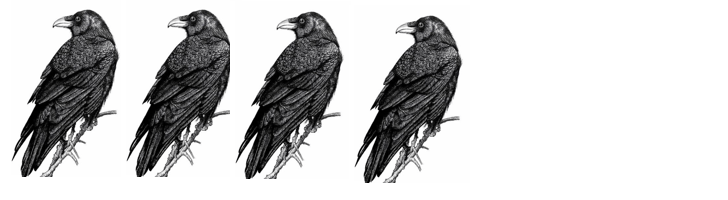
ALMOST A FULL FLOCK OF RAVENS LOOKING IN YOUR DIRECTION
Should you read it: Dark tragic gothic insanity and love. So yes , of course.
Bluffers fact: The strangest fact about this story is that it gets cited as Alfred Hitchcock’s inspiration for his film Noir classic Vertigo. Except it wasn’t. French novel D’entre les morts (the living and the dead) by Boileau-Narcejac was actually Hitchcock’s inspiration. Which could vaguely be said to be based on Ligeia, in the same way that 1980’s Battle beyond the stars, was based on The Seven Samurai via The Magnificent Seven, which is to say by a vague kind of osmosis, or not.


















 The Passing Place