A Brush with the Law A Guest post by Will Nett

To the Black Maisonette the Childe Nettleton came

This line is of course from the infamous fragment of the lost narrative poem by Bob Brown, found written on the back of a fag packet in 1992. Many have since claimed it was inspired by Robert Browning’s ‘Childe Roland to the Dark Tower Came’. There is some question of whether the ‘e’ on Childe is just a smudge and the line should actually read ‘To the black maisonette the child Nettleton came.’ That ‘e’ making all the difference, as was often the case in the early 1990’s.

That line then is either the title and opening line to a lost epic narrative poem about a Frankish Carolingian knight called Nettleton in the time of Charlemagne. Or notes made by notable racist and Neighbour Hood Watch member Bob Brown about the activities in and around the maisonette’s at the end of his street and the local louts buying weed and ‘E’s from the dealer who live there.

In any regard, as he just won’t get his own blog, Will Nett sent me another guest post. It is possible he is the ‘childe’ in question from the back of the fag packet. If so it is not because he is a Frankish Knight from the Matter of France, but a disreputable travel author from Teesside who has spent much of his life hanging around with villains in grotty public houses, before taking repeated short trips to Eastern Europe and back.

A Brush With The Law By Will Nett

Could you spot a fake? The folks at Vienna’s Museum of Fake Art certainly can. The building, on Lowengasse, is a tribute to artistic fakery in all its nefarious forms. The airy one room display is home to some of the most provocative paintwork ever committed to canvas, but not for reasons you might expect. It suggests that a ‘copy’ of a piece of art, much like a musical cover version, is perfectly acceptable. The illegality of the process comes to the fore when a piece of work, according to the Museum’s guidebook, is ‘sold on condition or agreement to be traded, without informing the buyer.’ A period of seventy years is to have passed, however, before a ‘copy’ can be painted. Naturally, within this grey area, there’s a lucrative market for knowingly fake art, and artists like Eric Hebbron, author of ‘The Art Forger’s Handbook’ whose quote, ‘the world wants to be fooled’ are displayed prominently.

It is within these vague parameters that I find myself, surrounded by the works of Elmyr de Hory, and that of the genial ‘Han’ van Meegeren, who famously duped Herman Goering to the tune of 1.6,000,000 gilders with his forgery of Vermeer’s Christ with the Adultress. van Meegeren stuck it so metaphorically far up the art establishment that, engulfed by their usual vanity and hubris, they simply doubled-down and claimed that the fakes were indeed real Vermeers. It was a twice as sweet outcome for the Dutchman as an artist who’s work had been previously rejected by his contemporaries; now he was a wealthy man off the back of it.

The museum is not restricted to paintings. Staying with the theme of poor artistic judgement by the Nazis, Konrad Kujan’s faked Hitler diaries are also displayed, along with one of 8,965,080 counterfeit UK banknotes recovered from Lake Toplitz that were intended by the Germans to weaken the British monetary system during World War II. Eighty years later and the UK has proven that it needs no help from anyone when it comes to destabilizing the economy.

Other represented replicators include songwriter-turned forger John Myatt, who’s fakery extends to his claim to have written Janet Kay’s 1979 Top Ten hit, ‘Silly Games.’

Aside from his chart aspirations, he knocked off canvas after canvas of Giacomettis, Matisses and Chagalls, that were then supplanted carefully into the art world by his associate fraudster John Drewe. Both men met the same fate as van Meegeren, going on to serve prison sentences as the price of their deceptions.

I’m minded to think of the artistic merit- if any- of other artistic fields. Songs are routinely covered; films remade or ‘reimagined’ but there’s no demand for ‘cover’ versions of books for example, or great paintings.

What then, are these ‘genuine fakes’ – as Myatt called them- worth, now that they are as famous as their originals; and who is to say which is which?

As we have seen in the UK over the last decade, the general public simply love to be conned; charlatans elected to the most senior public office, and their donors embroiled in corporate fraud; TV presenters indulging in illicit affairs; sportsmen- it’s almost always men- claiming life-threatening injuries.

Be it art, or something other, people can’t get enough of it.

Be real.

Fake it ‘til you make it.

Posted in amreading, humour, indie writers, reads | Tagged , , , , | Leave a comment

Creating books

This is an updated article that I originally wrote in 2020 because the subject keeps coming back around, one way or another. Please bear in mind this is written with some humorous intent, but the advice contained within is meant seriously.

An occasionally wise man once said,

It’s one thing to write a novel, and quite another to make a book.

This is true, as far as it goes. A novel is a long series of words placed one in front of another in order to tell a story, or several stories that link to tell one meta story, or a long winding memoir of someone who never existed in a version of the world that never existed, or a exploration of a psyche fighting for a way to come to terms with a trauma so shattering that their mind has splintered to hide the truth from itself… Or as you might otherwise think of them, a long series of words..

A book on the other hand is sheets of paper with words upon them, carefully laid out in order, bound in thicker paper to form a cover with pictures and words upon it, a blurb , a bit about the author, chapter heads, contents pages,  an also by page, copyrights , fonts and choices of style, presentation, layout, typesetting’s and a whole bundle of other stuff. Or to put it simply, more than just a bunch of words placed one in fount of the other that form a narrative…

To put it bluntly, to be a writer takes one skill set, which you may call ‘word herding’, making a book, however, takes a whole different skill-set, and this is a very important point for the independent writer to realise. They have a few choices about how they approach the task of creating a book but for me there is one very important thing they have to remember when making decisions on how they approach that task. No matter how skilfully they have crafted their words, no matter how fine their writing, regardless of the intricacy of their plots, the depth of their characterisations, and all the blood they have spilled on the pages, or little bits of their soul they have unleashed. How those words are ultimately presented is just as important as the words themselves.

A wise author, one must say, is one who seeks help and guidance, knows the limitations of his or her skills, and unless they have the skillset to typeset a book they seeks out those who do, be they friends, colleagues or professionals offering a service…
I should point out here, I am not talking about proof-reading and editing, that is a whole different kettle of fish. A damn important kettle, indeed as important a kettle as it is possible to have, but a different kettle all the same.* This, however, is about the skills of  typesetting, designing covers, presentation and has more than a little to do with graphic design. A whole different skill set from writing as I say, but one that when it comes to books is just as important, and a skill set that no one should be afraid to buy in if they need to.

*has anyone ever put fish in a kettle? Who knows, its just one of those sayings… **

** Actually a kettle in this case is a large pot used for boiling water in which fish were often cooked in the grim past before microwaves were invented, I know this and I am just being obtuse.***

***yes I know you know I was just being obtuse…

Frankly unless you are utterly confident in your own abilities, and even if you are, buying in those skills is probably exactly what you should do, and a wise man would know this… But lets assume you don’t wish to do so… Here in lays a basic guide to typesetting…

Marks basic guide to typesetting

Pick up a book, one of the papery things full of words, if you are a writer I am going to assume you have one to hand. No writer should ever be more than three feet from a book… Now hold the book for a moment and feel the weight of it. If its a professional book, and by that I don’t necessarily mean one from a big publishing house, just a book that has been professionally produced, it will have a cover that looks inviting in some way, that tells you something about the words within. It will also have a cover that could sit next to any other book on your book shelf. It will be the same size and shape as other books on your bookshelf as well. It will, in essence be the same as any book you might find in a bookshop.

Now open the book up, at any random page. Notice the fonts, they will be of the right size, pleasing in a none offensive way, easy to read for hours without eye strain. (Garamond 12 point as a rule) There be a small indent at the start of each paragraph, but only a small one, possibly a slightly larger one at the start of a separate passage or chapter. There will not be an extra space between paragraphs like you might find in a word document. Paragraphs will be justified right and left, the last sentence of a paragraph will never be at the top of the next page, there will be a header with the title, or the chapter title on the odd pages and the authors name even pages, page numbers. Chapters will usually start on odd page numbers to the left, and when a chapter ends on an odd page there will be a blank even page to the next starts on an odd again…

Not all of this will be true for every book, but even when it isn’t there will be an internal logic to how it is typeset. ( and it will never consist of having an extra space between paragraphs, I have lost count of the times I have come across indie books that do and it’s like nails raking down a blackboard when ever I see it… It will also always have justified text, dear gods why do people not justify text in a book , are you trying to hurt me?)

The point is however the book is laid out it will have been laid out by someone who has put a degree of thought into doing so and applied experience into the typesetting. Its a skill all of its own, as is deciding how to present chapter names, numbers, contents, also by pages and everything else. And all of this is just as important as a cover. Many indie authors are more than willing to pay for a cover because they are not graphic designers or artists, they should likewise be willing to pay for typesetting if need be, because even if you could not tell me what the inside of a book should look like, I almost guarantee if you open one that is badly typeset you will notice straight away, even if your not sure what it is your noticing, you will notice and you’ll put the book back down on the authors table because even though the cover was enough to make you pick it up the typesetting has made it less inviting once you have opened the book up.

Of course, you can learn to do all this yourself, but is it really something you want to learn through trail and error?  A wise writer would ask for help or find professionals to help them.

I of course am not a wise man… I learned how to do it all myself and did so the hard way… But unless you have the right kind of skill set to learn how to do this, don’t just go with ‘it will do’ get some advice, and remember , first and foremost your a writer, so write.

And then of course strip out every bit of typesetting you have done for the paperback edition and build the ebook versions from scratch…

Posted in books, editing, indie writers, indiewriter, self-publishing, writing | Tagged , , , , , | Leave a comment

Books of the year 2023 Edition

As with last year this may be slightly early, as there is a fair chance I’ll read a couple more before the end of the year. (in fact I know I will as there are a couple I am reading at the moment), but building on the tradition started way back in 2021 it is time for my annual Passing Place Blog Books Of The Year Awards. An with last year this award ceremony carries very little prestige, and no prize money… It also doesn’t have a particular order, but does include all the books I have reviewed on the blog ‘this year…’ for a given quantity of twelve months since the last rewards so includes books read in December last year…

The award for best single line in a book, ‘The local unicorns is a pervert’ and the award for best book inexplicably just given away by its creator so you have no real excuse for not reading it, goes to Spells for a Second Sister by the wonder that is Nimue Brown

The Award for unexpectedly fun read randomly picked up off the author at a scifi convention that involves witches, the faye, McDonald’s and a character called Alyssa: goes to Maggie Browns ‘Of Magic and Lies

The award for, the second, third and forth books of a quadrilogy published in a single year which is frankly just showing off now and making the rest of us feel like we aren’t trying hard enough but I’ll let her off because the books are so good, goes to writer and work of fiction, Lilian Brooks Whitby Witches series (link to book 1 review from last year)

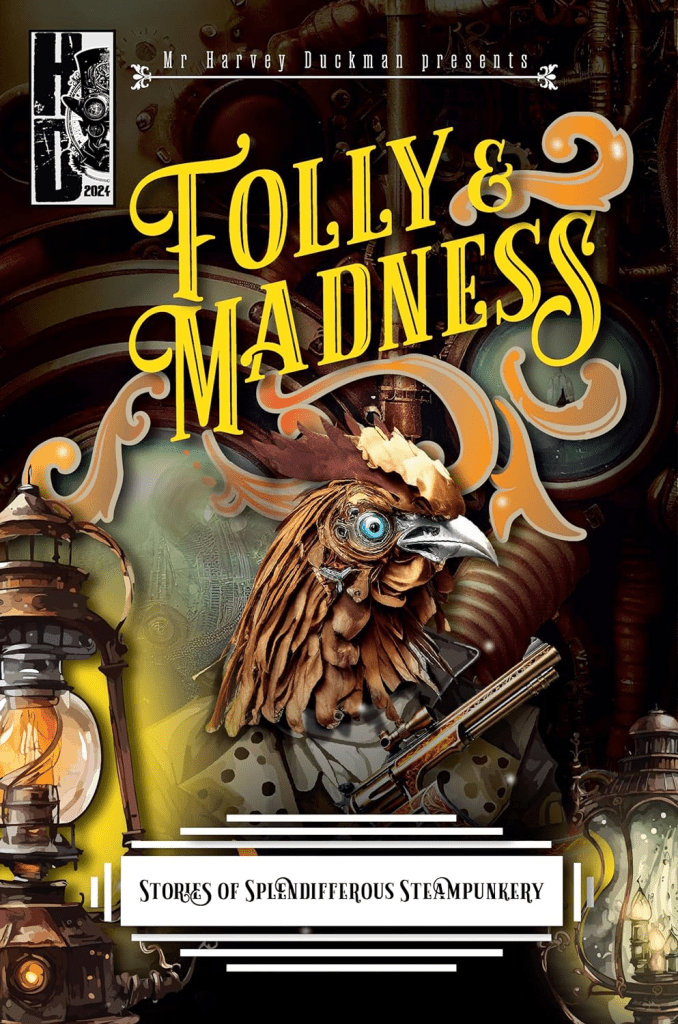
The award for Anthology featuring 14 wonderful authors ruining happy childhood memories of teddy bears and some thing about a potted plant and a policeman’s helmet goes to book 13 in the Harvey Duckman anthology series, the Teddy Bear edition

The award for most hotly anticipated finally to a trilogy that lives up to the hype because damn it was good goes to Grave Purpose by Craig Hallam, the third and final Alan Shaw novel, if for no other reason than it had Merry in it…

The award for book exploring the concepts of social exclusion, identity politics, bigotry, genre and sexuality through the medium of were-squirrels goes to Less than Human by the joyous entity that is Steven C Davis

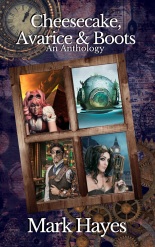
The ‘it’s not Nepotism when its your own book’ award this year goes to The Strange and the Wonderful by Mark Hayes, which is both strange and wonderful and the only book that wasn’t a play I released this year, and I can include it if I want to its my blog…

The Award for most interesting, if odd first book in a series I’ve read this year goes to The Forging of Lady Ghast by Roz White

The Award for book the author did not even want to admit existed, that really needs to be made into a paperback so please let me typeset it for you Jessica , goes to Jack the Re-animator by Jessica Law. with bonus award for best song based on the book

The award for best graphic novel, final book in a series and most wonderful thing in the entirety of everything goes to Hopeless Maine: Survivors written and coloured by Nimue Brown Illustrated by Tom Brown

The award for creepy horror novella I was looking forward to all year and was utterly delighted by by goes to Owl Eyes Motel : Lovers Retreat by Barbara Avon

Not a children’s book children book of the year goes ‘Once Upon a Hopeless Maine’ by Kieth Errington, because tentacles… need we say more.

The first award in the non-fiction category is for the book that could actually save us all if only everyone read it and goes to Beyond Sustainability By Nimue Brown

The second award in the non fiction category goes to Facing the Darkness by Cat Tredwell , for book about depression that is not depression but uplifting in its honesty

The third and final reward in the non-fiction category goes to The Witches Feast by Lilian Brooks mostly for the cocktails…

Special mention award for the manuscript for a Play that is terrible and you really shouldn’t bother to buy a copy but you can if your mad enough to want one, and boy did we have fun doing it (though if the audience enjoyed it is another matter entirely) Goes to The Drag King in Yellow by Mark Hayes

And there we are, that the full list, I don’t really have an overall book of the year. I recommend them all or they would not be on this list, but if you twisted my arm to chose just one then this years book of the year is Grave Purpose by Craig Hallam. Because that’s how you finish off a series, with melancholy joys and resolution ( also it had Merry in it ).

Posted in amreading, book reviews, books, indie novels | Tagged , , , , , | 1 Comment

Monkeys! a guest post by Will Nett

Sir William Nettleton IV, once married a monkey called Kevin. He was drunk at the time (Kevin, not Sir William) which was the only reason he agreed to the marriage, which it is believed was never consummated. At least, as far as court records are concerned this Sir William was never arrested for ‘lewd behaviour involving an Monkey’. Though he was excommunicated, and there were rumours about the Vatican ‘visit’ that lead to his expulsion from the mother church that involved a cassock, a mitre and an original sketch of the Mona Lisa called the Mona Leon which the church has been hushing up for four centuries now.

Kevin died shortly after the wedding ceremony, and Sir William arranged a full burial service with the Church of England as well as paying for a stain glass window in St Micheal’s on the Tees that featured an image of Kevin the monkey entering the pearly gates. This in turn inspired American band The Pixies to write their most successful single form the Dolittle album.

Sir William reputedly died shortly after Kevin’s death of a broken heart, and server alcoholism… Sadly of course he will not have joined Kevin in the afterlife as while his monkey went to heaven, as he was excommunicated Sir William almost certainly went to hell, or Stockton on Tees*…

*As a Teesside resident, not a pathetic Tory wanker and currently home secretory, I can say mean things about Stockton on Tees (which actually is quite nice).

The current Willian Nettleton who writes as Will Nett because he thinks it makes him sound cooler, hipper, but mostly to distance himself from the vast array of previous William Nettleton’s in the family line. Most of which have been a tad disreputable, and almost all entirely fictional…

Occasionally he send me guest blog posts, because he can’t be bothered to start his own blog. They are generally entertaining so I make up another distantly related Nettleton and put them out. They tend to be a mix bunch but well received, as Will is a tad elliptic at the best of times but seldom less than engaging. This one is about monkeys and his native Teesside and doesn’t mention Kevin once…

Monkeys by Will Nett

When I was kid my Dad told me that as a boy he had a pet monkey. Given that he grew up in post-war Middlesbrough, this seems unlikely, but he explained how they kept it chained up for the most part in the living room of the house on North Ormesby Road, where it spent its time eating coal and scowling and screeching at my Dad, uncles and aunts while they tried to watch the Jimmy Wheeler Show- ask your parents; or their parents; or their parents. One Bonfire Night it was apparently spooked by some sort of explosion and escaped. Knowing what I know of my Dad’s relationship with his wider family, if I’d have been their pet I’d have took my chances on the streets at the earliest opportunity. I’d forgotten about the absurdity of all this until recently when over the course of several days I encountered various other people who had stories about monkeys kept as pets across the wider Teesside area, though the hospitality does not appear to have extended as far north as Hartlepool for obvious historical reasons. Our monkey-hanging friends notwithstanding, it was perhaps a coastal trend; some cursory research suggests there was once a branch of Boyes department store in Scarborough in the 60s that sold monkeys, one of which held down a weekend summer job as an organ grinder’s mechanical fitter at South Bay. At a party this summer a neighbour pointed out that they had once kept a pet monkey, but didn’t elaborate any further on the matter, and their intoxicated state left me unable to press them for further details.

A few days ago someone visited my office and casually remarked that their father had kept a pet marmoset, probably around the same time of my Dad’s own simian houseguest. Again, no-one could remember what happened to it. Later that night I went to see alt/industrial folkie Frazer Lambert perform. Explaining the origins of his song ‘Chicken Bones in the Teapot’ he told the story of how his grandfather returned from a posting in West Africa with a monkey by the name of ‘Jimmy.’ It lived comfortably in the back yard of Frazer’s grandparents’ house in Stockton- where it once snaffled Frazer’s grandmother’s roast chicken and stashed the ossuary evidence in her best teapot- thus inspiring the song. Jimmy eventually outgrew his new surroundings and took it upon himself to join a passing menagerie. That this story was recounted in a venue called the Brass Monkey is not lost on me.

When Frazer finished his song, I turned to a friend of mine and said “Our Dad had a pet monkey, y’know.”

He thought for a moment, then went onto explain that around thirty years ago he was knocking around our old stamping ground, Spencerbeck, when he noticed a small child waving at him and his mates from the window of a flat near St. Gabriel’s school. As my friend was smoking his customary joint at the time, perhaps his vision was unfocused, but as he drew the attention of his friends to the window, and squinted, he realised that it was indeed a monkey knocking on the glass. Throwing child safety concerns to the early 90s winds, he and his friends, at the instance of the owner, then embarked upon a petting session with the preening primate.

As regular readers will know, I’ve been around a bit- I was approached by a wild cassowary, once- and yet I’ve never seen a domesticated monkey anywhere around my hometown. There are approximately 5,000 primates currently kept as pets in the UK ahead of forthcoming legislation that will rightly or wrongly make it more difficult for people to own monkeys as pets. I would have expected a higher figure when taking into consideration the English obsession with servitude and misguided sense of lording it over their supposed inferiors. No word yet on the legality of monkeys owning humans as pets, but I guess it’s only a matter of time.

Posted in amreading, indie writers, pointless things of wonderfulness, reads | Tagged , , , , | Leave a comment

Important Facts Friday

Once in a while we need to take a few moments to examine life seriously and spend some time contemplating the great questions about it, the universe and , well stuff…

This may not be one of those times…

Important facts

1/ The human body is 90% water, so you are basically cucumbers with anxiety.

2/ There are 62000 miles of blood vessels in the human body, if you laid them someones out end to end, that would be murder.

3/ You should never trust an atom, because they literally make up everything

4/ Entropy, it just isn’t want is used to be

and finally on a more serious note…

5/The basis of Quantum Paganism

We all all one and the same, as is everything, for we are all part of the greater universe and one with the universe.

Posted in big questions, Uncategorized | Tagged | Leave a comment

Love, Death and Witchcraft

A couple of short reviews for sequels to books I have previously reviewed. That is the brief here. No waffling on about anything, just do the reviews…

Have I ever mentioned I hate sequels. As a writer that is, not as a reader. As a reader I love them, usually, depending on the book. But I hate writing them. The reason being that if you write something that for some god-only-knows reason people love and value, writing a sequel can only go one of two ways.

It can be as good or better, taking the story and the characters forward in new and interesting ways your readers don’t expect. Or its a desperate attempt to recapture the essence of the original that made people love it in the first place that fails on all levels to do so.

The more the original is loved, the hard it is to write a good sequel and the longer a series is the more you are faced with the law of diminishing returns. the first book in a series will always outsell the second, while will out sell the third and so on. It doesn’t matter how good the third book is, as the writer you see less sales and logic goes out of the window. It has nothing to do with the quality of the book, the writing the plot or anything. it is all down to diminishing returned.

Ten people buy a book, nine people love it, one sort of likes it but not enough to by the sequel. Nine people buy the sequel, either love it, once doesn’t feel that for them it works as well as the original did… So eight people buy the third.. and so on. But writers don’t think like that, writers see a book that doesn’t sell as well as they hoped and feel they are failed. Because writers are, well, the kind of people who hang out with imaginary friends and make there imaginary friends suffer.

Writers are weird. Some of them however do write really good sequels.

Now what was I saying, oh yes, no waffling on just do the reviews….

Barbara Avon is a Canadian author who writes across quite a few genres, some of which aren’t really my wheel house, some of which are. We follow each other on twitter, I am not sure who followed who first or why, but I do recall seeing a tweet from her about a shitty review someone had given her without bothering to read the book in question. Because such things irritate me I decided to try and redress the balance by buying one of her books and if I liked it leaving a review to say so. If not, well at least a crappy review from an arsehole that upset her led to a sale which redressed the balance of karma in the world a little.

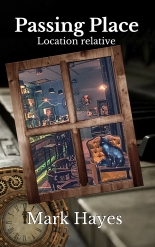
The book I chose was Owl Eyes Motel as the premise appealed to me. Horror fiction based in a motel, and every room has its own story, so every chapter is another room number and a short story entwined around a broader narrative… Anyone who has read Passing place will have an incline why this appealed to me. When it arrived, I was just hoping it would prove to be a nice read in order to leave a nice review. As it happened I read it in a day, adored it and was blown away by Barbara’s wonderful writing style and prose. Giving her a good review was no chore.. You can read that review here XXXXXX, my one criticism was that there was so much scope in the premise that rather than a novella it should have been a novel. I wanted more… Which leads me to her latest novella.

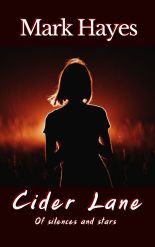
Owl Eyes Motel: Lovers Retreat by Barbara Avon

This is a sequel that stands on its own two feet and could be read on its own. The premise is the same, every chapter is a room, ever room has its own story. While there is an obvious theme of doomed love to this novella the main premise of a strange kind of purgatory in the from of a motel is as delightful and intriguing as ever.

If you do read this having never read the original novella I suspect the first thing you will do after you finish is get a copy of the original.

If you have read the original, what is held within is the same brilliant story telling, visceral physiological horror, nasty little twists and unexpected turns. Writing with the same flare and a love of the medium that runs through Owl Eyes Motel. Its a treat for any horror fan or indeed just fans of good writing and beautiful prose.

Added to this there is further delve into the background of the proprietor, which adds more depth to what is already a strong well conceived and written premise

And remember, there is always room for the dead at the Owl Eyes Motel. So hopefully this is not the last visit to owl eyes as I still want top read more.

Lillian Brooks is a writer from the north east of England who has been known to dance around fires (in sturdy boots to avoid the hedgehog issue) at various times of the year. She also has a thing about making cocktails. I approve of cocktails, though I tend to avoid the hedgehog issue by sitting calmly by the fire, in sturdy boots and watching the flames. None of this is strictly relevant of course, but I need to write something by way of introduction and as this is the fifth book and forth in this series of Lilian’s I have reviewed making up some waffling by way of introduction is required.

She also collects wooden mice which she is determined to figure out a way of animating with magic so they can act like the organ mice in Bagpus and make things for her and her own Bagpus which is either her cat or husband John.

Some of the above may be a lie, indeed Lilian herself may be just the pen name of another author , and probably is but if people want to find small wooden mice and send them to her it will amuse me if no one else, so do that. But anyway on to the book review…

Burning Magic by Lilian Brooks

This is the forth book in the series and as its title suggests rounds out the four major arcane, or the four corners which are a central theme running through the series. Unusually, fire came last after water, earth and air, but it was worth the wait. Also while this is not the last in the series it does feel like it is rounding out the first four books as a single sequence. Loose ends are tied, stories lines resolved, the whole book moves towards a resolution which the characters need.

This is not to say it is smooth sailing for Alyssa Bright and her friends. The road is long, rough and challenging. Though by the old gods Alyssa doesn’t make it easy on her self…

This is however a third sequel that is as strong in the last chapter as the first chapter of the original. The pace is beautifully judged, the writing carefully crafted and the characters just fun to spend time with. I loved it as I did the first novel, despite it not being entirely in my normal wheel house. Sometimes you just need a book that takes you along for the ride.

If you love all things that you could describe as urban fantasy, or urban pagan this is a series you’ll enjoy, so I really can’t recommend it enough.

Now about those wooden mice…
Posted in amreading, book reviews, fantasy, horror, pagan, reads | Tagged , , , , | 1 Comment

Caves

I am stood in the mouth of a cave. The cave is behind me. The cave is always behind me. I am not always stood in the mouth of the cave. It is my cave. Sometimes I take a step backwards into the darkness.

The cave is a metaphor. In many regards it is a perfect metaphor. Or at least I have never come up with a better one.

Beyond the cave are the sunlit lands a place of life, of joy, of happiness. The sunlit lands are the place where all things are connected. The bright place. Stood in the mouth of the cave you can feel the warmth of the sun and to step forward, out of the cave, is to embrace the world. But to embrace the world, you must embrace it all, so you hesitate, or at least I hesitate. I always hesitate. So I stand in the mouth of the cave, feeling the warmth of the sun, but I have never quite stepped out into the brightness.

This is a metaphor I have used before. I used a version of it in a novel as a way to describe a traumatised mind. That was a simplified version of this metaphor, used for the purpose of narrative. But it was based on the complex metaphor I have used for many years to explain my mental and emotional states to myself. Not to others. I have never used it to explain myself to others, I have never expressed it directly. It is my metaphor, it was not acquired from others and I have never felt the need to share it, previously.

I am stood inside my cave. I have stepped back into the darkness, the brightness of the entrance is but a few feet away. I can see the brightness, and here, close to the entrance, there is enough light to see the walls around me. I know a few steps would take me out into the brightness again. But i feel safer here, hidden form the bright place, cocooned in the dark. Its cooler in the shade. I like the shade. I can still think, I still desire the brightness of the sun. I know how to get back to it. To do so just takes an act of will, if I can find the will. I’m still sure I can find the will. But for the moment I feel safer here, in the twilight just beyond the cave mouth.

This metaphor does a lot of heavy lifting. It helps me check myself, it helps me know how I am. In this regard it works for me. I have no idea if it works for anyone else. Or how anyone else might apply it. That I used it to describe and explain what was going on in the traumatised mind of a young woman who had gone through a truly horrific experience doesn’t mean that is why I apply it to myself. A novel is after all fiction, but all fiction draws upon reality. My cave is real for me, and a metaphor.

I am kneeling deep within my cave. The brightness of the entrance is little more than a glimmer. It is cold here, but I am numb. Numb to everything, an automaton, I move, I eat, I sleep, I exist, but all form within the darkness of the cave. Numb to everything, and choosing the numbness over feeling, for feeling hurts too much. I weep in the darkness of my cave and don’t know why I am weeping. I am weeping because this is the place where I weep. I am numb, withdrawn from the world, alone in the darkness. I can barely move, barely function. This is the place for existing without needing to exist. For being without needing to be. I am cold, I am numb, I am safe because safe is not being. I am not. and in being not, nothing matters. So why do I weep.

This is my metaphor. No one else’s. I did not read it in a book. No one told me it. It is mine. I have used it to explain myself to myself. I have used a version of it in a novel once. But I have never explained the metaphor to anyone. I have never told this truth, my truth, which is what this metaphor is.

I am kneeling deep within my cave. Behind me is only darkness. the walls are close, the roof is close, this is why I kneel. It is cold, I am numb, I am nothing. Behind me is only darkness. Ahead a glimmer of light so distant I can not recognise it for what It is. I do not weep here. I have retreated from the place of weeping. I feel nothing, I am nothing, this existence is nothing, and the darkness behind me is oblivion. Oblivion calls…

This is a metaphor. My metaphor. I have never chosen to share it in this way before. I am not sure I will share it now. If you are reading this then I chose to share it. Perhaps that is good, perhaps not. For the last few weeks, I have been in the place of weeping, or close to it. Last weekend I realised how far into the cave I had retreated. There was a local event I should have attended. A steampunk event, as it happens. I could have gone to it, if only just for an hour or so, wandered around the market , chatted to people I might know. But I couldn’t.

I could not make myself leave the house. I could not make myself go out into the world. I was tired, so I told myself. I’d had a hard week, I said. I just need to chill a little, i would go latter, I told myself. And sat, and wept for no reason. Numb to everything, cold and numb and weeping for no reason. Deep in the cave, knelling on the damp stone.

I realised then I have been deep in the cave for a while. Numb for a while. Kneeling in darkness staring towards a light so far away I have forgotten what it is for a while. And this is a metaphor, my metaphor.

This is not a cry for help, it is just me explaining a metaphor, not even explaining it to myself.

I think I am going to post this, despite myself, as this is also me taking a step forwards towards the entrance. I am fine before you ask, I have been deeper than this into my cave, and I shall do so again. I have also stood in the entrance and felt the sunlight on my face. That is where I hope to be, but the first step is to remember you need to take a step.

Posted in depression | Tagged , | 1 Comment

Dear Edgar 16: Silence, a fable

“It was night, and the rain fell; and falling, it was rain, but, having fallen, it was blood.”

It is not unreasonable to say that a good half of our Dear Edgar’s out put over the years was poetry. As such an examination of his work that ignores the poetry is clearly a tad half-arsed. So to redress this glaring imbalance, ‘The Raven’ is quite good, though his lesser known poem ‘The penguin’ is better.

Okay, that’s poetry out of the way, back to prose… Almost.

While I’m not the worlds greatest lover of poetry, and certainly don’t profess to be a poet, I am much enamoured of poetic prose or as it is perhaps more correctly described, prose poetry. I delight in the use of certain repetitions and patterns in short prose. A good descriptive short story is often just that, poetry in prose form. When do well, a prose poem grips the reader and holds their attention in ways that a story in normal narrative prose could only dream.

There are reasons for this, not least that narrative poetry, with repetitions and rhythms is amongst the most ancient form of story telling. It is how our ancestors learnt and remembered the stories of their ancestors through the generations long before the words were written down. The epic tales of antiquity are all prose poems, to one extent or another. Something we remember in our souls, in our human memory, the crackle of the camp fire, the telling of the old tales. Repetition and rhythm, a beat to match the blood in our veins.

Earlier this year I was privileged to witnessed the first performance of ‘Mother Hode’ performed by the astounding Joanna Swan (written by the equally astounding Steven C Davis) which is a modern play of carefully crafted with those same repetitions and rhythm that hearkens back to those ancient campfires. The campfire around which the likes of Beowulf, Gilgamesh and bits of the Illiad would have been told. Prose poetry at its most profound, visceral and beautiful.

The same kind of prose poetry that HP Lovecraft should have written more often as its its some of his best. Certainly Memory and Nyarlathotep are among my favourites individual pieces of his work. When it came to his prose poetry ‘Old Tentacle Hugger’ wrote that it was Poe in particular that inspired him. Among the stories he referenced was the one we come to now. Silence: A fable.

This is the first story Dear Edgar wrote that I would describe as prose poetry. While there is the odd bit of poetic description in some of the other early stories, this is they first to use rhythm and repetition as a device, and he uses it to great effect. This is a story written to be told. It would not be out of place around the ancient campfires. It is also a story about fear, and what it is to fear. Which is apt considering it is a story told to use by a deamon.

The is a flow to it, a slightly dreamlike quality, and it makes no attempt to be anything but a fable. A story about fear as the daemon tells it. He seeks to find what most scares man and in the end that is silence in a place where silence could never be.

The tale is actually quite simple, and the moral, if there is one, is at tad opaque. That there should be a moral is perhaps only considered because Poe called this ‘a fable’ and fables by tradition should have morals. This causes some debate as to what the moral may be. To which your guess is as good as mine, and I am not inclined to speculate, as what I like about the story is not the story itself, but how it is told. Compared to the occasionally torrid descriptive passages that seem so laboured among Poes other early stores, this one has life and breath to it and left me thoughtful in a way that only his ‘Shadow: A parable’ previously managed.

This is not to say that the tale is profound. Humanity fears silence about all else, may seem a profound idea but I am not entirely convinced it is. But the telling of the tale will leave you believing it is a profound thought for a moment or two.

Till the silence of your own thoughts drives you to speak a word to break it…

A SILENT FLOCK OF RAVENS WATCHING YOU…

Should you read it: With only the ticking of the clock to disturb the silence… What you don’t have a clock? Well the almost imperceptible low hum of the wifi then…
Bluffers fact: The story takes place along the River Zaire, for no other reason I suspect than Zaire worked for the prose. The Zaire is the former name of the Congo. Dispite the Nile getting all the plaudits because it is the longest, the Congo is actually Africa’s most powerful river and the second most voluminous river in the world (after the Amazon) with a discharge of 1,500,000 cubic feet of water per second.

The Nile isn’t even in the top ten…

Posted in opinion, Poe, reads, retro book reviews | Tagged , , , , | 1 Comment

Bye Bye Birdy

I’ll keep this short.

X, or twitter as was, has become a cesspit of all that is vile. There are still little islands of charm and goodness that keep above the waves of effulgence but even if you land on one of those islands take a step in any direction and your standing in shit once more.

I have met lots of great people through twitter over the years. I had plenty of interesting conversations, actual discussions with people who may oppose my views but could express themselves with coherent arguments and intelligent points, while been willing to listen to another viewpoint. I’ve also had a lot of laughs, found reasons to smile on days that seemed dismal and full of dismay. And kept connected with a world and an audience, that was larger and more vivid, because of twitter.

This is no longer the case.

X is the home of the politics of lies, mis-truths and fake news about fake news. Its active users, or at least those the algorithms are driving onto my threads, are increasingly right wing, crypto-fascist, with views that are frankly abhorrent. It is no longer a nice place to hang out. It is no longer a place a rational human can exchange views with another rational human. It is an angry horrid space.

I am not leaving twitter, because I have followers there, and follow people there who I would miss. But I am taking an active decision to spend much lest time there. I’m not going to have it open in a tab on my desktop as is my habit. I’m not going to go from a stroll through the threads as often. Basically I just don’t want to spend any significant portion of my life in a place I just don’t like any more, getting angry about vile people saying vile things.

However, the sky is not all grey laden doom. In fact its blue. Bluesky in fact. A twitter alliterative that isn’t infuriating as I found mastodon, or tied to Facebook and Instagram like threads. It’s invite only that keeps the bots and clones away, and users adhere to a simple policy of none-engagement with trolls, they just block and ignore, rather than feed them.

I’ve been using blue sky for a couple of months. Its a pleasant place to hang out, and I mostly just see things from creatives or chatty people, and very little if any vile nonsense. It feels freeing and just nice. It is more of a community, much like twitter once was.

It is however still a relatively small space, and needs to grow.

If you are on blue sky you can find me there on @markhayes.bsky.social

If your not, and we know each other to some degree, even if only though the occasional like on a blog post, I do have a few invite codes, so drop me a line.

Posted in Uncategorized | Tagged | Leave a comment

Verne: A guess post by Will Nett

Sir William Nettleton VII, was once arrested for ‘lewd behaviour involving an elephant’ in his short stay in what was at the time refereed to as Eastern India, later became Burma and is now Myanmar one of only three nations in the world that still used British Imperial measurements for preference. None of which are Britain. Sir William was ejected from the state, and later died somewhere in the south china sea, of a previously unknown sexually transmitted disease called ‘trunk rot’ . No one is sure what happened to the elephant, though rumours it had to be put down persist.

The current Willian Nettleton who writes as Will Nett because he thinks it makes him sound cooler, hipper, but mostly to distance himself from the vast array of previous William Nettleton’s in the family line. Most of which have been a tad disreputable, and almost all entirely fictional…

Occasionally he send me guest blog posts, because he can’t be bothered to start his own blog. They are generally entertaining so I make up another distantly related Nettleton and put them out. They tend to be a mix bunch but well received, as Will is a tad elliptic at the best of times but seldom less than engaging.

This time he is wandering across my own wheel house to an extent with a post about Jules Verne, inspired by a visit to the authors birthplace, Nantes. But that’s enough form me, what follows is pure Will Nett, and also contains an elephant, consider that fair warning…

Verne : by Will Nett

Few authors have left their mark on literature as indelibly as Nantes’ most famous son, Jules Verne, but it is the impression left upon him, as a child, as he sat in his boarding school classroom at rue de Bouffay, that occupies me now. I consider this as I sit outside l’Épicerie de Ginette, the restaurant that was once Verne’s school building. It was here, 186 years ago that Verne’s teacher told him that her husband had not yet returned from a Naval crusade he’d undertaken during the Napoleonic wars, but she fully expected his imminent return, all those years later once he grew tired of sunning himself on some desert island. The theme of this unconfirmed tale permeated Verne’s work and eventually led to one of the most remarkable periods of work in the life of any writer. In the space of less than a decade he published Journey to the Centre of the Earth, 20,000 Leagues Under the Sea, and, perhaps most famously of all, Around the World in 80 Days. These form part of a broader collection of lesser-known works from the Voyages Extraordinaires series that includes Mysterious Island and Master of the World. The series effectively created the modern template for adventure fiction that has influenced as a diverse a group of contemporaries as Hergé, the Beatles and Jacques Cousteau, and is the nascent steampunk springboard that permeates many a present-day fantasy novel.

Even Verne’s minor titles conjure up wonderment; Keraban the Inflexible; Off on a Comet; The Archipelago on Fire. It’s difficult to overestimate his contribution to the canon, but the little museum named for him, that sits high over the city on rue de l’Hermitage, appropriately enough beside the planetarium, doesn’t do his influence justice.

The inspiration for his most famous character, Phileas Fogg, is unknown but it is this writer’s conviction that he was a well-thought-out pop at the Establishment. One of the most recognisable travelers in fiction, Fogg was anything but a good nomad. He was in fact the antithesis of travel. A pompous braggart and Reform Club member who was too entitled to even cook for himself, Fogg famously rushed through towns and cities without so much as a cursory acknowledgment of his surroundings, in order that he collect on his famous bet of £20,000. The modern touristic equivalent would be a ‘foreign muck’ avoiding Daily Mail reader in Union flag underpants sunburnt to within an inch of his life and powered entirely by his own inflated sense of entitlement.

Fogg was facilitated in his hubristic endeavor by his put-upon manservant, Passepartout. I fancy that even though he represented many a bourgeois Frenchman of the time, Verne made him English to distance him from his homeland. It is Passepartout, former gymnast and ex-fireman who does the dirty work and gets the job done. His nationality? French, ironically, as the French are the least servile people you could ever meet, and the ones that are- I’m thinking of waiters like the one now collecting the remnants of a late breakfast from my table looking absolutely appalled that I’ve ordered a croissant after 10am in the morning- affect an air of inflated superiority so great that you can do nothing more than admire it.

In his hometown, Verne is better represented by the incredible phenomenon that is the Machines of the Island of Nantes, a visceral realization of Verne’s imagination, brought to life by François Delarozière and Pierre Orefice in the form of giant mechanical versions of a whole array of steampunkian creatures and creations. The centerpiece of the collection is the magisterial Great Elephant, or Sultan’s Elephant, after its basis on Delaroziere’s creation for the Royal de Luxe world tour. The forty-six-tonne beast- topping out at fifty when carrying its full capacity of amazed tourists- is concocted from metal and tulip wood and operated by a pilot in a cabin behind the water-spraying trunk. I feel like I’m tripping just looking at it.

I am tripping, but that’s another story.

A supporting ground crew of marionette operators busy themselves around the Underwater Carousel, an equally impressive contraption that occupies the carpark beside the Machines workshop, L’inusable. Invincible. Nothing conjures up the same sense of magic and intrepidation of the undersea world created by Verne like the carousel, bedecked as it is with serpents, bobbing trawlersand bronze bird-powered airships. The only thing missing is the sea mist on your face. The contraption clatters and farts like all the best Victorian automata as it twirls on the banks of the Loire, the river that first convinced Verne he could create these wonderful worlds. Children ride giant seahorses pursued by a giant grouper fish decked out like an early wooden submarine prototype. The red velvet curtains, tied back today, add to the stage show grandeur of the whole apparatus; beneath the main deck, l’abysse and its piranhas, cosmic langoustines and astro crabs. The elephant is scheduled for an afternoon stroll later so I occupy myself in the meantime with a walk around the industrial wonder that is the Machines’ workshop. A peek behind the curtain you might call it, where light is let in on magic as welders, fitters and angle-grinders work in tandem with design students and artists. I enter via a greenhouse that’s home to mechanical dragonflies and brass and bronze bees, poking out from beneath the real fauna as I follow the designated path through the exhibits. Eventually I’m greeted with a demonstration of a giant spider, all eight legs flailing independently at flying ants hung from the ceiling; nature recreated in steel and paint. Tourists armed with cameras duck and recoil as the operator playfully stalks them. The infectious amazement is childlike. A staircase leads to a balcony that overlooks the workshop, clear from its design that some parts of the projects are top secret, to obtain maximum effect when eventually unveiled to the public. Occasional spark-accompanied squawks spit from the angle grinders as they carve out wings, skulls, and various other avian automata. It’s a long way from the Industrial Revolution but it is there, in Verne’s time, that it has its roots, this culmination of art, literature and scientific engineering.

Posted in amreading, amwriting, humour, indie writers, reads, sci-fi, steampunk, writing | Tagged , , , , | Leave a comment