Love, Death and Witchcraft

A couple of short reviews for sequels to books I have previously reviewed. That is the brief here. No waffling on about anything, just do the reviews…

Have I ever mentioned I hate sequels. As a writer that is, not as a reader. As a reader I love them, usually, depending on the book. But I hate writing them. The reason being that if you write something that for some god-only-knows reason people love and value, writing a sequel can only go one of two ways.

It can be as good or better, taking the story and the characters forward in new and interesting ways your readers don’t expect. Or its a desperate attempt to recapture the essence of the original that made people love it in the first place that fails on all levels to do so.

The more the original is loved, the hard it is to write a good sequel and the longer a series is the more you are faced with the law of diminishing returns. the first book in a series will always outsell the second, while will out sell the third and so on. It doesn’t matter how good the third book is, as the writer you see less sales and logic goes out of the window. It has nothing to do with the quality of the book, the writing the plot or anything. it is all down to diminishing returned.

Ten people buy a book, nine people love it, one sort of likes it but not enough to by the sequel. Nine people buy the sequel, either love it, once doesn’t feel that for them it works as well as the original did… So eight people buy the third.. and so on. But writers don’t think like that, writers see a book that doesn’t sell as well as they hoped and feel they are failed. Because writers are, well, the kind of people who hang out with imaginary friends and make there imaginary friends suffer.

Writers are weird. Some of them however do write really good sequels.

Now what was I saying, oh yes, no waffling on just do the reviews….

Barbara Avon is a Canadian author who writes across quite a few genres, some of which aren’t really my wheel house, some of which are. We follow each other on twitter, I am not sure who followed who first or why, but I do recall seeing a tweet from her about a shitty review someone had given her without bothering to read the book in question. Because such things irritate me I decided to try and redress the balance by buying one of her books and if I liked it leaving a review to say so. If not, well at least a crappy review from an arsehole that upset her led to a sale which redressed the balance of karma in the world a little.

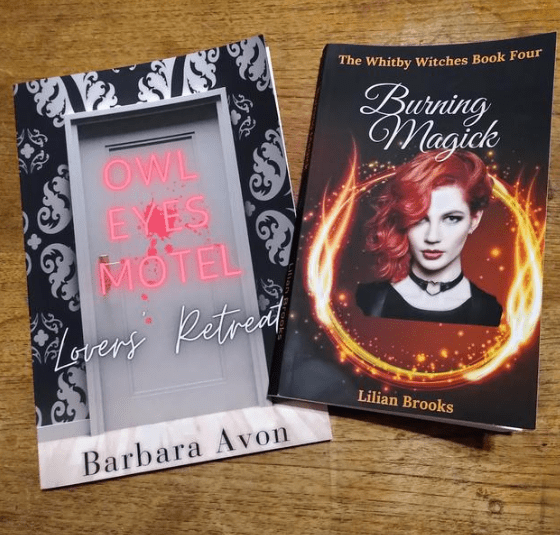
The book I chose was Owl Eyes Motel as the premise appealed to me. Horror fiction based in a motel, and every room has its own story, so every chapter is another room number and a short story entwined around a broader narrative… Anyone who has read Passing place will have an incline why this appealed to me. When it arrived, I was just hoping it would prove to be a nice read in order to leave a nice review. As it happened I read it in a day, adored it and was blown away by Barbara’s wonderful writing style and prose. Giving her a good review was no chore.. You can read that review here XXXXXX, my one criticism was that there was so much scope in the premise that rather than a novella it should have been a novel. I wanted more… Which leads me to her latest novella.

Owl Eyes Motel: Lovers Retreat by Barbara Avon

This is a sequel that stands on its own two feet and could be read on its own. The premise is the same, every chapter is a room, ever room has its own story. While there is an obvious theme of doomed love to this novella the main premise of a strange kind of purgatory in the from of a motel is as delightful and intriguing as ever.

If you do read this having never read the original novella I suspect the first thing you will do after you finish is get a copy of the original.

If you have read the original, what is held within is the same brilliant story telling, visceral physiological horror, nasty little twists and unexpected turns. Writing with the same flare and a love of the medium that runs through Owl Eyes Motel. Its a treat for any horror fan or indeed just fans of good writing and beautiful prose.

Added to this there is further delve into the background of the proprietor, which adds more depth to what is already a strong well conceived and written premise

And remember, there is always room for the dead at the Owl Eyes Motel. So hopefully this is not the last visit to owl eyes as I still want top read more.

Lillian Brooks is a writer from the north east of England who has been known to dance around fires (in sturdy boots to avoid the hedgehog issue) at various times of the year. She also has a thing about making cocktails. I approve of cocktails, though I tend to avoid the hedgehog issue by sitting calmly by the fire, in sturdy boots and watching the flames. None of this is strictly relevant of course, but I need to write something by way of introduction and as this is the fifth book and forth in this series of Lilian’s I have reviewed making up some waffling by way of introduction is required.

She also collects wooden mice which she is determined to figure out a way of animating with magic so they can act like the organ mice in Bagpus and make things for her and her own Bagpus which is either her cat or husband John.

Some of the above may be a lie, indeed Lilian herself may be just the pen name of another author , and probably is but if people want to find small wooden mice and send them to her it will amuse me if no one else, so do that. But anyway on to the book review…

Burning Magic by Lilian Brooks

This is the forth book in the series and as its title suggests rounds out the four major arcane, or the four corners which are a central theme running through the series. Unusually, fire came last after water, earth and air, but it was worth the wait. Also while this is not the last in the series it does feel like it is rounding out the first four books as a single sequence. Loose ends are tied, stories lines resolved, the whole book moves towards a resolution which the characters need.

This is not to say it is smooth sailing for Alyssa Bright and her friends. The road is long, rough and challenging. Though by the old gods Alyssa doesn’t make it easy on her self…

This is however a third sequel that is as strong in the last chapter as the first chapter of the original. The pace is beautifully judged, the writing carefully crafted and the characters just fun to spend time with. I loved it as I did the first novel, despite it not being entirely in my normal wheel house. Sometimes you just need a book that takes you along for the ride.

If you love all things that you could describe as urban fantasy, or urban pagan this is a series you’ll enjoy, so I really can’t recommend it enough.

Now about those wooden mice…

Posted in amreading, book reviews, fantasy, horror, pagan, reads | Tagged , , , , | 1 Comment

Caves

I am stood in the mouth of a cave. The cave is behind me. The cave is always behind me. I am not always stood in the mouth of the cave. It is my cave. Sometimes I take a step backwards into the darkness.

The cave is a metaphor. In many regards it is a perfect metaphor. Or at least I have never come up with a better one.

Beyond the cave are the sunlit lands a place of life, of joy, of happiness. The sunlit lands are the place where all things are connected. The bright place. Stood in the mouth of the cave you can feel the warmth of the sun and to step forward, out of the cave, is to embrace the world. But to embrace the world, you must embrace it all, so you hesitate, or at least I hesitate. I always hesitate. So I stand in the mouth of the cave, feeling the warmth of the sun, but I have never quite stepped out into the brightness.

This is a metaphor I have used before. I used a version of it in a novel as a way to describe a traumatised mind. That was a simplified version of this metaphor, used for the purpose of narrative. But it was based on the complex metaphor I have used for many years to explain my mental and emotional states to myself. Not to others. I have never used it to explain myself to others, I have never expressed it directly. It is my metaphor, it was not acquired from others and I have never felt the need to share it, previously.

I am stood inside my cave. I have stepped back into the darkness, the brightness of the entrance is but a few feet away. I can see the brightness, and here, close to the entrance, there is enough light to see the walls around me. I know a few steps would take me out into the brightness again. But i feel safer here, hidden form the bright place, cocooned in the dark. Its cooler in the shade. I like the shade. I can still think, I still desire the brightness of the sun. I know how to get back to it. To do so just takes an act of will, if I can find the will. I’m still sure I can find the will. But for the moment I feel safer here, in the twilight just beyond the cave mouth.

This metaphor does a lot of heavy lifting. It helps me check myself, it helps me know how I am. In this regard it works for me. I have no idea if it works for anyone else. Or how anyone else might apply it. That I used it to describe and explain what was going on in the traumatised mind of a young woman who had gone through a truly horrific experience doesn’t mean that is why I apply it to myself. A novel is after all fiction, but all fiction draws upon reality. My cave is real for me, and a metaphor.

I am kneeling deep within my cave. The brightness of the entrance is little more than a glimmer. It is cold here, but I am numb. Numb to everything, an automaton, I move, I eat, I sleep, I exist, but all form within the darkness of the cave. Numb to everything, and choosing the numbness over feeling, for feeling hurts too much. I weep in the darkness of my cave and don’t know why I am weeping. I am weeping because this is the place where I weep. I am numb, withdrawn from the world, alone in the darkness. I can barely move, barely function. This is the place for existing without needing to exist. For being without needing to be. I am cold, I am numb, I am safe because safe is not being. I am not. and in being not, nothing matters. So why do I weep.

This is my metaphor. No one else’s. I did not read it in a book. No one told me it. It is mine. I have used it to explain myself to myself. I have used a version of it in a novel once. But I have never explained the metaphor to anyone. I have never told this truth, my truth, which is what this metaphor is.

I am kneeling deep within my cave. Behind me is only darkness. the walls are close, the roof is close, this is why I kneel. It is cold, I am numb, I am nothing. Behind me is only darkness. Ahead a glimmer of light so distant I can not recognise it for what It is. I do not weep here. I have retreated from the place of weeping. I feel nothing, I am nothing, this existence is nothing, and the darkness behind me is oblivion. Oblivion calls…

This is a metaphor. My metaphor. I have never chosen to share it in this way before. I am not sure I will share it now. If you are reading this then I chose to share it. Perhaps that is good, perhaps not. For the last few weeks, I have been in the place of weeping, or close to it. Last weekend I realised how far into the cave I had retreated. There was a local event I should have attended. A steampunk event, as it happens. I could have gone to it, if only just for an hour or so, wandered around the market , chatted to people I might know. But I couldn’t.

I could not make myself leave the house. I could not make myself go out into the world. I was tired, so I told myself. I’d had a hard week, I said. I just need to chill a little, i would go latter, I told myself. And sat, and wept for no reason. Numb to everything, cold and numb and weeping for no reason. Deep in the cave, knelling on the damp stone.

I realised then I have been deep in the cave for a while. Numb for a while. Kneeling in darkness staring towards a light so far away I have forgotten what it is for a while. And this is a metaphor, my metaphor.

This is not a cry for help, it is just me explaining a metaphor, not even explaining it to myself.

I think I am going to post this, despite myself, as this is also me taking a step forwards towards the entrance. I am fine before you ask, I have been deeper than this into my cave, and I shall do so again. I have also stood in the entrance and felt the sunlight on my face. That is where I hope to be, but the first step is to remember you need to take a step.

Posted in depression | Tagged , | 1 Comment

Dear Edgar 16: Silence, a fable

“It was night, and the rain fell; and falling, it was rain, but, having fallen, it was blood.”

It is not unreasonable to say that a good half of our Dear Edgar’s out put over the years was poetry. As such an examination of his work that ignores the poetry is clearly a tad half-arsed. So to redress this glaring imbalance, ‘The Raven’ is quite good, though his lesser known poem ‘The penguin’ is better.

Okay, that’s poetry out of the way, back to prose… Almost.

While I’m not the worlds greatest lover of poetry, and certainly don’t profess to be a poet, I am much enamoured of poetic prose or as it is perhaps more correctly described, prose poetry. I delight in the use of certain repetitions and patterns in short prose. A good descriptive short story is often just that, poetry in prose form. When do well, a prose poem grips the reader and holds their attention in ways that a story in normal narrative prose could only dream.

There are reasons for this, not least that narrative poetry, with repetitions and rhythms is amongst the most ancient form of story telling. It is how our ancestors learnt and remembered the stories of their ancestors through the generations long before the words were written down. The epic tales of antiquity are all prose poems, to one extent or another. Something we remember in our souls, in our human memory, the crackle of the camp fire, the telling of the old tales. Repetition and rhythm, a beat to match the blood in our veins.

Earlier this year I was privileged to witnessed the first performance of ‘Mother Hode’ performed by the astounding Joanna Swan (written by the equally astounding Steven C Davis) which is a modern play of carefully crafted with those same repetitions and rhythm that hearkens back to those ancient campfires. The campfire around which the likes of Beowulf, Gilgamesh and bits of the Illiad would have been told. Prose poetry at its most profound, visceral and beautiful.

The same kind of prose poetry that HP Lovecraft should have written more often as its its some of his best. Certainly Memory and Nyarlathotep are among my favourites individual pieces of his work. When it came to his prose poetry ‘Old Tentacle Hugger’ wrote that it was Poe in particular that inspired him. Among the stories he referenced was the one we come to now. Silence: A fable.

This is the first story Dear Edgar wrote that I would describe as prose poetry. While there is the odd bit of poetic description in some of the other early stories, this is they first to use rhythm and repetition as a device, and he uses it to great effect. This is a story written to be told. It would not be out of place around the ancient campfires. It is also a story about fear, and what it is to fear. Which is apt considering it is a story told to use by a deamon.

The is a flow to it, a slightly dreamlike quality, and it makes no attempt to be anything but a fable. A story about fear as the daemon tells it. He seeks to find what most scares man and in the end that is silence in a place where silence could never be.

The tale is actually quite simple, and the moral, if there is one, is at tad opaque. That there should be a moral is perhaps only considered because Poe called this ‘a fable’ and fables by tradition should have morals. This causes some debate as to what the moral may be. To which your guess is as good as mine, and I am not inclined to speculate, as what I like about the story is not the story itself, but how it is told. Compared to the occasionally torrid descriptive passages that seem so laboured among Poes other early stores, this one has life and breath to it and left me thoughtful in a way that only his ‘Shadow: A parable’ previously managed.

This is not to say that the tale is profound. Humanity fears silence about all else, may seem a profound idea but I am not entirely convinced it is. But the telling of the tale will leave you believing it is a profound thought for a moment or two.

Till the silence of your own thoughts drives you to speak a word to break it…

A SILENT FLOCK OF RAVENS WATCHING YOU…

Should you read it: With only the ticking of the clock to disturb the silence… What you don’t have a clock? Well the almost imperceptible low hum of the wifi then…

Bluffers fact: The story takes place along the River Zaire, for no other reason I suspect than Zaire worked for the prose. The Zaire is the former name of the Congo. Dispite the Nile getting all the plaudits because it is the longest, the Congo is actually Africa’s most powerful river and the second most voluminous river in the world (after the Amazon) with a discharge of 1,500,000 cubic feet of water per second.

The Nile isn’t even in the top ten…

Posted in opinion, Poe, reads, retro book reviews | Tagged , , , , | 1 Comment

Bye Bye Birdy

I’ll keep this short.

X, or twitter as was, has become a cesspit of all that is vile. There are still little islands of charm and goodness that keep above the waves of effulgence but even if you land on one of those islands take a step in any direction and your standing in shit once more.

I have met lots of great people through twitter over the years. I had plenty of interesting conversations, actual discussions with people who may oppose my views but could express themselves with coherent arguments and intelligent points, while been willing to listen to another viewpoint. I’ve also had a lot of laughs, found reasons to smile on days that seemed dismal and full of dismay. And kept connected with a world and an audience, that was larger and more vivid, because of twitter.

This is no longer the case.

X is the home of the politics of lies, mis-truths and fake news about fake news. Its active users, or at least those the algorithms are driving onto my threads, are increasingly right wing, crypto-fascist, with views that are frankly abhorrent. It is no longer a nice place to hang out. It is no longer a place a rational human can exchange views with another rational human. It is an angry horrid space.

I am not leaving twitter, because I have followers there, and follow people there who I would miss. But I am taking an active decision to spend much lest time there. I’m not going to have it open in a tab on my desktop as is my habit. I’m not going to go from a stroll through the threads as often. Basically I just don’t want to spend any significant portion of my life in a place I just don’t like any more, getting angry about vile people saying vile things.

However, the sky is not all grey laden doom. In fact its blue. Bluesky in fact. A twitter alliterative that isn’t infuriating as I found mastodon, or tied to Facebook and Instagram like threads. It’s invite only that keeps the bots and clones away, and users adhere to a simple policy of none-engagement with trolls, they just block and ignore, rather than feed them.

I’ve been using blue sky for a couple of months. Its a pleasant place to hang out, and I mostly just see things from creatives or chatty people, and very little if any vile nonsense. It feels freeing and just nice. It is more of a community, much like twitter once was.

It is however still a relatively small space, and needs to grow.

If you are on blue sky you can find me there on @markhayes.bsky.social

If your not, and we know each other to some degree, even if only though the occasional like on a blog post, I do have a few invite codes, so drop me a line.

Posted in Uncategorized | Tagged | Leave a comment

Verne: A guess post by Will Nett

Sir William Nettleton VII, was once arrested for ‘lewd behaviour involving an elephant’ in his short stay in what was at the time refereed to as Eastern India, later became Burma and is now Myanmar one of only three nations in the world that still used British Imperial measurements for preference. None of which are Britain. Sir William was ejected from the state, and later died somewhere in the south china sea, of a previously unknown sexually transmitted disease called ‘trunk rot’ . No one is sure what happened to the elephant, though rumours it had to be put down persist.

The current Willian Nettleton who writes as Will Nett because he thinks it makes him sound cooler, hipper, but mostly to distance himself from the vast array of previous William Nettleton’s in the family line. Most of which have been a tad disreputable, and almost all entirely fictional…

Occasionally he send me guest blog posts, because he can’t be bothered to start his own blog. They are generally entertaining so I make up another distantly related Nettleton and put them out. They tend to be a mix bunch but well received, as Will is a tad elliptic at the best of times but seldom less than engaging.

This time he is wandering across my own wheel house to an extent with a post about Jules Verne, inspired by a visit to the authors birthplace, Nantes. But that’s enough form me, what follows is pure Will Nett, and also contains an elephant, consider that fair warning…

Verne : by Will Nett

Few authors have left their mark on literature as indelibly as Nantes’ most famous son, Jules Verne, but it is the impression left upon him, as a child, as he sat in his boarding school classroom at rue de Bouffay, that occupies me now. I consider this as I sit outside l’Épicerie de Ginette, the restaurant that was once Verne’s school building. It was here, 186 years ago that Verne’s teacher told him that her husband had not yet returned from a Naval crusade he’d undertaken during the Napoleonic wars, but she fully expected his imminent return, all those years later once he grew tired of sunning himself on some desert island. The theme of this unconfirmed tale permeated Verne’s work and eventually led to one of the most remarkable periods of work in the life of any writer. In the space of less than a decade he published Journey to the Centre of the Earth, 20,000 Leagues Under the Sea, and, perhaps most famously of all, Around the World in 80 Days. These form part of a broader collection of lesser-known works from the Voyages Extraordinaires series that includes Mysterious Island and Master of the World. The series effectively created the modern template for adventure fiction that has influenced as a diverse a group of contemporaries as Hergé, the Beatles and Jacques Cousteau, and is the nascent steampunk springboard that permeates many a present-day fantasy novel.

Even Verne’s minor titles conjure up wonderment; Keraban the Inflexible; Off on a Comet; The Archipelago on Fire. It’s difficult to overestimate his contribution to the canon, but the little museum named for him, that sits high over the city on rue de l’Hermitage, appropriately enough beside the planetarium, doesn’t do his influence justice.

The inspiration for his most famous character, Phileas Fogg, is unknown but it is this writer’s conviction that he was a well-thought-out pop at the Establishment. One of the most recognisable travelers in fiction, Fogg was anything but a good nomad. He was in fact the antithesis of travel. A pompous braggart and Reform Club member who was too entitled to even cook for himself, Fogg famously rushed through towns and cities without so much as a cursory acknowledgment of his surroundings, in order that he collect on his famous bet of £20,000. The modern touristic equivalent would be a ‘foreign muck’ avoiding Daily Mail reader in Union flag underpants sunburnt to within an inch of his life and powered entirely by his own inflated sense of entitlement.

Fogg was facilitated in his hubristic endeavor by his put-upon manservant, Passepartout. I fancy that even though he represented many a bourgeois Frenchman of the time, Verne made him English to distance him from his homeland. It is Passepartout, former gymnast and ex-fireman who does the dirty work and gets the job done. His nationality? French, ironically, as the French are the least servile people you could ever meet, and the ones that are- I’m thinking of waiters like the one now collecting the remnants of a late breakfast from my table looking absolutely appalled that I’ve ordered a croissant after 10am in the morning- affect an air of inflated superiority so great that you can do nothing more than admire it.

In his hometown, Verne is better represented by the incredible phenomenon that is the Machines of the Island of Nantes, a visceral realization of Verne’s imagination, brought to life by François Delarozière and Pierre Orefice in the form of giant mechanical versions of a whole array of steampunkian creatures and creations. The centerpiece of the collection is the magisterial Great Elephant, or Sultan’s Elephant, after its basis on Delaroziere’s creation for the Royal de Luxe world tour. The forty-six-tonne beast- topping out at fifty when carrying its full capacity of amazed tourists- is concocted from metal and tulip wood and operated by a pilot in a cabin behind the water-spraying trunk. I feel like I’m tripping just looking at it.

I am tripping, but that’s another story.

A supporting ground crew of marionette operators busy themselves around the Underwater Carousel, an equally impressive contraption that occupies the carpark beside the Machines workshop, L’inusable. Invincible. Nothing conjures up the same sense of magic and intrepidation of the undersea world created by Verne like the carousel, bedecked as it is with serpents, bobbing trawlersand bronze bird-powered airships. The only thing missing is the sea mist on your face. The contraption clatters and farts like all the best Victorian automata as it twirls on the banks of the Loire, the river that first convinced Verne he could create these wonderful worlds. Children ride giant seahorses pursued by a giant grouper fish decked out like an early wooden submarine prototype. The red velvet curtains, tied back today, add to the stage show grandeur of the whole apparatus; beneath the main deck, l’abysse and its piranhas, cosmic langoustines and astro crabs. The elephant is scheduled for an afternoon stroll later so I occupy myself in the meantime with a walk around the industrial wonder that is the Machines’ workshop. A peek behind the curtain you might call it, where light is let in on magic as welders, fitters and angle-grinders work in tandem with design students and artists. I enter via a greenhouse that’s home to mechanical dragonflies and brass and bronze bees, poking out from beneath the real fauna as I follow the designated path through the exhibits. Eventually I’m greeted with a demonstration of a giant spider, all eight legs flailing independently at flying ants hung from the ceiling; nature recreated in steel and paint. Tourists armed with cameras duck and recoil as the operator playfully stalks them. The infectious amazement is childlike. A staircase leads to a balcony that overlooks the workshop, clear from its design that some parts of the projects are top secret, to obtain maximum effect when eventually unveiled to the public. Occasional spark-accompanied squawks spit from the angle grinders as they carve out wings, skulls, and various other avian automata. It’s a long way from the Industrial Revolution but it is there, in Verne’s time, that it has its roots, this culmination of art, literature and scientific engineering.

Posted in amreading, amwriting, humour, indie writers, reads, sci-fi, steampunk, writing | Tagged , , , , | Leave a comment

Blood on the Page

Blood, they say, is thicker than water, this is true. It’s also why it makes for better ink.

Mark Hayes 2023

Once in a while one quotes oneself. That particular quote is from a short story I started a while back and have never quite finished. Mainly because that quote is about the only worthwhile couple of sentences in the whole story. At least in the opinion of the person who wrote it.

As a quote it stemmed from a somewhat recurring theme in recent correspondence when I’ve talked about writing in general, and my own work specifically. That being, that to make any piece of writing worthwhile requires a little shedding of blood on the page. If the words don’t cost you a little blood, if your not leaving something of yourself within them, then what’s the point? I say this in full knowledge that some for my books contain more blood than others. The Hannibal stories are supposed to be mostly fun, light, and silly. There is blood in them, but its often disguised and hidden, and on occasion no more than a pricked fingers worth, here and there. Maybe took a little more blood, and some of the short stories too. But Passing Place and Cider Lane, well…

Just to be clear, this is almost certainly an analogy and I don’t recommend actually trying to write a novel in your own blood. You just end up anaemic at best or if you write too much plain passing out through blood loss. Neither of which is very productive, though that said you can have some truly inspiring fever dreams while you hang on the edge of consciousness, but there are better ways to get in such a state, which are a tad less dangerous.

Of course, using the blood of others to write has always been an option, but of late (in the last half dozen centuries or so) this has been frowned upon, even in cultures dominated by the followers doctrines that engage in ritualised deity cabbalism and sanguinity. The Church of England, Catholicism and what have you.

So, to be clear, its best to stick to shedding metaphorical blood on the page. But make sure you bleed once in a while, for in blood there is truth, and every fantasy need a little truth within it.

Occasionally… One bleeds anyway because as we all know paper cuts are the worst…

PS. Don’t look at me like that. Yes I know that even by my standards that’s a bit of an odd blog post, but I had no idea where this was going when I started and it just kind of ended up going no where. It happens, it can’t all be wonderfully insightful stuff you know, I just liked the quote…

Posted in #amwriting, amwriting, writes, writing | Tagged , , , | 3 Comments

Dear Edgar~15: Mystification

The editorship of the Richmond Examiner in the 19th century was something of a dangerous occupation. When someone took exception to an editorial they often expressed there views in pointed fashion. Thomas Ritchie, who founded the paper in 1804 witnessed his founding editor, the delightfully named Meriwether Jones, died in a duel two years later, Skelton Jones, Meriwethers brother, took over the editorship, then died in a duel, as did John Daly Burk, another editor of the Richmond Examiner a couple of years later. Ritchie himself died forty years later. in a duel…

Somehow writings a strongly worded email to the Daily Mail seems a tad meek in comparison to challenging the editor to pistols at dawn…

Half a century or so later this kind of thing was still going on and Richmond Examiner editor at the time John Moncure Daniel challenged an inebriated Edgar Allen Poe to a duel, possibly in response to the latter’s excessive verbiage in short stories.

To be fair this is an impulse I understand…

This was in 1848 and was Daniel’s first brush with duelling. He was still quite young at the time. One legend about this says our dear Edgar reputedly sobered up quite rapidly when he saw the two large duelling pistols on Daniel’s desk. This would have been wise as among other things gains Daniel’s was to go on to earn a certain level of fame as a duellist, going on to fight and survive at least ten over the course of his life. Though give just how inaccurate duelling pistols tended to be, the usual result was honour being satisfied by a draw or the odd flesh wound at best. Surviving pistols duels was not unusual, or at least until rifling pistol barrels became more common place after the civil war, which led to the practise being outlawed.

The other legend has it that Edgar did actually showed up for the duel, but was too drunk to shoot, and Daniel’s missed on purpose, so honour was satisfied. I prefer this version, but in all likelihood Poe didn’t show up at all. He had a rather low opinion of duels and duellists in general. A low opinion that informed ‘Von Jung, the Mystific’ which was published a good 11 year prior to the incident with John Moncure Daniel, in the American Monthly magazine in 1837. Later editions of the story renamed the story ‘Mystification’, which is the name under which the story is commonly recognised.

‘Mystification’ is partly a foe-biographical piece about larger than life character Baron Von Jung’s time at university. Which seems to mostly have been spent, drinking, taking drugs , and lording over every other student. The narrator who is serving as biographer, clearly has a high opinion of Von Jung, one not entirely shared by Poe I suspect, but it doesn’t quite work as the satire it was meant to be, in part because the narrator (Barry Littleton) is too fawning and earnest with his praise.

The first half of this story is just that, Littleton fawning over the baron, and its one of those Poe story’s that’s just a whole lot of words being used to say very little. One gets the feeling Poe was being paid by the word and padding the story accordingly. Nothing really happens until the second half of the story and even then there is no shortage of padding.

That said in the second half Von Jung does at least prove to be witty, cunning and processed of and intellectual intelligence that he used to both belittle an opponent and neatly avoid a duel, the twist at the end being exactly how he avoids the duel. The second half of this tale is acctually a neat little story. While the ending is not entirely a surprise it is carefully crafted. But by the souls of the black winged ravens it goes the longest and wordiest way around to getting there. Though in the latter half this is more forgivable because it is Von Jung use of language that mystifies friend and foe alike.

It is also though Baron Von Jung that Poe pours a little scorn on duels and duellists. This is smartly done and reading the story with this in mind it becomes a cleverer tale. Certainly you can see that Poe intended it to mock the kind of ‘gentleman’ who responds to perceived insults by application of the ‘Irish code Duello’ the accepted code for duelling with pistols from the 18th century onwards. As a mockery of duellists in general the story works quite well. The trouble is that adherents to the ‘Irish code Duello’ are few and far between in this day and age. While this does explain why no one has shot the editorial staff of the Daily Mail, it does make the satirical elements of this story some what dated.

The satire is unfortunately the whole and only point of the story. As that is somewhat redundant it make the tale more of a chore to read than a joy. Which is in essence my issue with it. So unless we bring back duels as a valid form of journalistic criticism some time soon*, this story is one to avoid.

*To be clear I am not advocating for duels as journalistic criticism. there is far too much chance you would miss any attempt to shoot the editor of the Daily Mail in the heart. It way too small a target.

A PAIR OF DUELLING RAVENS

Should you read it: Its not terrible, its just dated overly wordy satire.

Bluffers fact: The Irish code Duello banned the custom of deloping, or deliberately discharging one’s firearm into the ground (usually well away from the opponent). This custom was used when one or both duelists wished to end a dispute without inflicting bodily harm or appearing cowardly. The Irish code specifically forbade the practice because it often resulted in accidental injury because no one wants to accidentally injury an opponent in a duel…
Posted in amreading, book reviews, Dear Edgar, opinion, Poe, reads | Tagged , , , , , | Leave a comment

The Toads of Hull

If you walk around Hull today you can find nineteen colourful giant toads. The toads have been there since 2010 when they were installed along with twenty one of there brethren (which were removed) to celebrate the life and work of Philip Larkin on the 25th anniversary of his dead, and took their inspired from two Larkin poems , Toads and Toad revisited.

While looking for toads, you will also find forty two giant colourful moths. The Moths have been there since 2016 and were installed to celebrate the life of aviator Amy Johnson, who was born in the city, and among many other achievements was the first woman to fly from London to Australia (in her Gypsy Moth, hence moths).

Why am I telling you this. Well firstly I am all in favour of public art of this kind. There is the cat trail around York I am a big fan of for example, which goes back many years . But the second reason is one of pure amusement, to do with the local hull accent which tends to replace the ‘OA’ in toads with ‘UR’. Accents are a funny thing but I am not making this up. And whomever approved this delightful public art either made a huge error, or ( and I prefer this to be the case) did this entirely deliberately knowing what was going to happen…

Thus the children of Hull have for over a decade now, been tugging at their parents arms and asking loudly “Can we go see the turds?” or even “Can I sit on a Turd mum?”

Posted in humour, pointless things of wonderfulness | Tagged | Leave a comment

Hope is not eternal

All things end, some with a whimper, some with a bang, some too early, some too late, but all things end. The default state of the universe is entropy, and no story is complete until the final line. And so we have come to this, the final instalment of Hopeless:Maine, Survivors…

Ardent readers of this blog may have noticed over the years I have something of a thing for Hopeless Maine and its creators. I have rather a lot of Hopeless artwork on my walls at home. I have all the sloth comics editions and large hardback Outland (US) edition. I have multiple copies of the prose work as well. Including an american edition writers had never seen until I took my copy to show them. All of which adds up to a certain amount of emotional investment in a series of graphic novels I originally bought the first of on a whim because I liked some art work that kept popping up on my twitter feed because Craig Hallam kept liking it.

Yes, its all Craig Hallam’s fault, but I am sure we have all long suspect this to be the case… But back to emotional investments…

Starting with Personnel Demons I have followed the lives of Salamadra O’Stoat and Owen Davis on the fog haunted island of Hopeless through five novels. At some point along the way I fell a little in love with Miss O’Stoat, and then a little in love with Owen. And then at some point I cease to be a little in love with the pair of them… A little had become a lot… I cared deeply for the pair of them and I was a little angry with them both at times…. And don’t get me started on Percy, manipulative, conniving, controlling, arsehole, I’m glad he…

I said don’t get me started.

At some point along the way I met and, I think it not unreasonable to say, have become friends with the creators of Hopeless, but I had read the first three books, backed kick starters and had interviewed them for the blog a long long time before I ever met them. When I finally did I did so in my usual, slightly bewildered, a tad confused, way. Probably made a bit of a fool of myself. And then ran away at the first opportunity. Suffice to say, it did not go well… Luckily I am not sure they noticed it not going well, or even figured out who I was.

Subsequent meetings have gone better…

The point here is, I came to Hopeless originally, not through my friendship with its creators, but purely through the artwork and then the writing. To judge its the final novel then on anything other that the art, the writing and the story as a whole, would seem foolish and to an extent just wrong. This final book is the culmination of years of work by its creators. It is the final chapter in an epic tale. This is where everything has to pay off, where the answers need to lay. This is where the journey has led us and what everything has built to. This is Roland entering the dark tower as the Ka-Tet of nineteen laying sacrificed in his wake. This is Frodo and Sam coming at last to mount doom. This is Avon’s last stand before the federation. This is The Doors playing that long D cord at the end of ‘The End’…

So, is this the final chapter Hopeless deserves? Is this the final act it needs to be? Does this complete the journey that began in personal demons? Yes.

Does it answer all the questions, what is the thing in the fog? What, when it comes down to it, is Salamadra? Is Owen ever going to stop being moody and actually tell her how he feels? Well, Yes, no, sort of. You expected all the answers? You never get all the answers, nothing would be worse than getting all the answers…

This is about the journey, it is also about power and the dynamics of power. Real power verses the perception of power, and the wiliness to be the sacrifice that is needed, while never sacrificing your inner-self. Submission as a choice, is more powerful than being forced to submit and dictates the true power in a relationship… Or perhaps its just pretty pictures and words…

They are moments that will delight the reader, moments which might cause some to punch the air with delight and loudly whisper “YES!” to the unrelenting gods. There are dark moments , funny moments and joy. And a final resolution that just feels right. The one you knew was coming the moment after it arrived because its the only end there could be.

All things end, some with a whimper, some with a bang, some too early, some too late, but all things end. The default state of the universe is entropy, and no story is complete until the final line. And so we have come to this, the final instalment of Hopeless:Maine.

And it is perfect…

Posted in amreading, book reviews, books, fantasy, fiction, horror, novels, reads | Tagged , , , , | 1 Comment

Monomania et le gothique

If a Gothic tale needs one thing to make it a truly Gothic tale, it needs an antagonist in the grip of a profound monomania. Obsessions and obsessional manias are among of the principle building blocks of gothic literature. Be those obsessions with an individual, an object, a grand desire, or the impossible. Obsessions and often guilt.

Take Bernice, Poe’s the most gothic of his early stories, it centres around a man obsessed with the perfect teeth of his dying wife. Obsessed to the extent he must have them so breaks into her coffin after she is buried to remove them each with some basic dentistry. That he discovers she is not actually dead despite been buried doesn’t stop him. His obsession all consuming and placing him beyond reason. It is only to the end of the tale as he realises what he has done that the guilt drives him over the precipice.

Shelly’s Doctor Frankenstein is obsessed with creating life. Renfield’s madness in Dracula. Doctor Jekyll and his alter-ego. Absolutely everyone one way or another in A Picture of Dorien Grey. Heathcliff in Wuthering Heights… Me and my obsession with trying to get everyone to read Wuthering Heights…

Laurence Olivier and Merle Oberon , in the sublime 1939 version of Wuthering Heights

It also does modern gothic writers no harm at all to do their reading on such things, a tad obsessively… A little madness is a good thing. As is spending some time in the fictions of the 19th century in general I find, if you can survive the archaic nature of the writing at times. But if you want to write interesting, involving, and great modern Gothic fiction, while knowing the roots of the genre is import, being willing to grow from those roots and sprout in strange directions is just as important. Which brings me neatly to Jack the Re-animator By Jessica Law. A book I only discovered existed when Jessica wrote a blog post for me a couple of weeks ago. The one about snail telepathy

Jack the Re-animator is a delightfully gothic tale set, given the many cultural references within the novel, in the last decade of the 19th century. It’s intricacies of plot, with multiple threads, multitude of characters, and occasionally sinister overtones make for an enthralling read. It has all the drama, complexity and darkness of classic gothic literature, yet a cast of ‘modern’ characters that feel realistic to our modern sensibilities.

Issac, the junior detective is tasked (in mysterious fashion) with discovering why some dead people are not staying dead the traditional, and far more legally convenient fashion, but instead turning up and wanting their old lives back. A threat most dire to the realm.

You spend a fortune on probate lawyers, funerals, ordering a wardrobes worth of morning black, read the will, divide everything up, and everyone has a good weep by the grave side, then the blaggard turns up right as nine-pence, no longer suffering form the goat that killed him… It really is insufferable…

Then to add insult to injury the grave robbers supplying ‘Jack’ the re-animator, dig up a recently executed serial killer and don’t bother to mention this detail of the corpses providence to the monomaniacal re-animator of the dead. A serial killer who was caught originally caught by Issac (which is how he became a junior detective, despite the societal hindered of having a father who was ‘of the commonwealth’ as his inspector would put it…)

Luckily for Issac he has some help in the form of Adeline Earnshaw a former nurse and medium who was ostracised by her wealthy family for neither of these things but rather for having a sapphic outlook. Adeline is also formally alive, as she is one of Jack’s ‘victims’ having been returned to life after her successful suicide.

Unfortunately Adeline remembers everything about the painful process of being returned to life, except who Jack is, and how to find him. Something she shares with his other victims.

Just want is ‘Jack’ as they have christened him, re-animating people for? Do the resurrection men hold the key? Who else is formerly dead? And when with the Angel-maker strike again?

Its a witty fast moving read, that’s a little mad in places, but a little madness is always required, it is a little gothic masterpiece. More of this please…

<<<<< slight spoilers ahead>>>>>>

Jack is not really called jack. It is just a name given to him by the detectives. Jack is an interesting character in his own right and another novel telling his perspective would have been just as, if not more, interesting. Though more darkly psychological and monomania based… Jack as a character is not alone either. There are several of Jessica’s characters here could make make for fascinating novels all on their own. She has a talent for portraying darkness and those on the edge of things with a tone and feeling that draws them upon you. None of her character are as straight-forward as they seem.

The plot is far from simple either, it isn’t so opaque that you don’t see things coming, in the little clues scattered here and there, if you pay attention, but not so transparent as to make it unsatisfying to discover you had figured right about this thing, or that thing and there will be clue that escape you until after the reveal. There is a lot of care and a lot of craft to this story.

Its a great read, and I only have one real complain about it,that being that it is only available in ebook. Cnsidering even the utter garbage that is The Drag King in Yellow (note. I can say this, you can’t) is available in paperback, and this isn’t , it strikes me the universe lacks balance..

That said, however, it being Jessica law while there is no paperback there is a song of the same name that is drawn directly from the novel, which includes a short reading from the book and as well as mentioning character from the novel. Like all of Jessica’s music it is fabulous…

Luckily for everyone, I have no intent on write and performing songs based on my own novels , I will leave that to Jessica…

Posted in amreading, books, fantasy, Goth, horror, indie, indie novels, indie writers, novels, opinion, Poe, reads | Tagged , , , , , , | 4 Comments