If you walk around Hull today you can find nineteen colourful giant toads. The toads have been there since 2010 when they were installed along with twenty one of there brethren (which were removed) to celebrate the life and work of Philip Larkin on the 25th anniversary of his dead, and took their inspired from two Larkin poems , Toads and Toad revisited.
While looking for toads, you will also find forty two giant colourful moths. The Moths have been there since 2016 and were installed to celebrate the life of aviator Amy Johnson, who was born in the city, and among many other achievements was the first woman to fly from London to Australia (in her Gypsy Moth, hence moths).
Why am I telling you this. Well firstly I am all in favour of public art of this kind. There is the cat trail around York I am a big fan of for example, which goes back many years . But the second reason is one of pure amusement, to do with the local hull accent which tends to replace the ‘OA’ in toads with ‘UR’. Accents are a funny thing but I am not making this up. And whomever approved this delightful public art either made a huge error, or ( and I prefer this to be the case) did this entirely deliberately knowing what was going to happen…
Thus the children of Hull have for over a decade now, been tugging at their parents arms and asking loudly “Can we go see the turds?” or even “Can I sit on a Turd mum?”
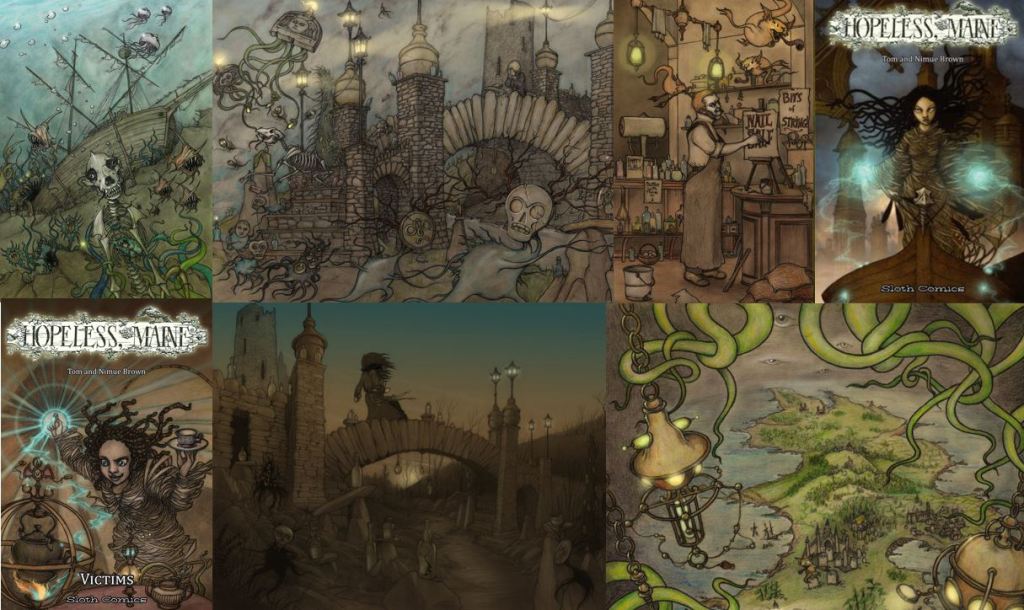
All things end, some with a whimper, some with a bang, some too early, some too late, but all things end. The default state of the universe is entropy, and no story is complete until the final line. And so we have come to this, the final instalment of Hopeless:Maine, Survivors…
Ardent readers of this blog may have noticed over the years I have something of a thing for Hopeless Maine and its creators. I have rather a lot of Hopeless artwork on my walls at home. I have all the sloth comics editions and large hardback Outland (US) edition. I have multiple copies of the prose work as well. Including an american edition writers had never seen until I took my copy to show them. All of which adds up to a certain amount of emotional investment in a series of graphic novels I originally bought the first of on a whim because I liked some art work that kept popping up on my twitter feed because Craig Hallam kept liking it.
Yes, its all Craig Hallam’s fault, but I am sure we have all long suspect this to be the case… But back to emotional investments…
Starting with Personnel Demons I have followed the lives of Salamadra O’Stoat and Owen Davis on the fog haunted island of Hopeless through five novels. At some point along the way I fell a little in love with Miss O’Stoat, and then a little in love with Owen. And then at some point I cease to be a little in love with the pair of them… A little had become a lot… I cared deeply for the pair of them and I was a little angry with them both at times…. And don’t get me started on Percy, manipulative, conniving, controlling, arsehole, I’m glad he…
I said don’t get me started.
At some point along the way I met and, I think it not unreasonable to say, have become friends with the creators of Hopeless, but I had read the first three books, backed kick starters and had interviewed them for the blog a long long time before I ever met them. When I finally did I did so in my usual, slightly bewildered, a tad confused, way. Probably made a bit of a fool of myself. And then ran away at the first opportunity. Suffice to say, it did not go well… Luckily I am not sure they noticed it not going well, or even figured out who I was.
Subsequent meetings have gone better…
The point here is, I came to Hopeless originally, not through my friendship with its creators, but purely through the artwork and then the writing. To judge its the final novel then on anything other that the art, the writing and the story as a whole, would seem foolish and to an extent just wrong. This final book is the culmination of years of work by its creators. It is the final chapter in an epic tale. This is where everything has to pay off, where the answers need to lay. This is where the journey has led us and what everything has built to. This is Roland entering the dark tower as the Ka-Tet of nineteen laying sacrificed in his wake. This is Frodo and Sam coming at last to mount doom. This is Avon’s last stand before the federation. This is The Doors playing that long D cord at the end of ‘The End’…
So, is this the final chapter Hopeless deserves? Is this the final act it needs to be? Does this complete the journey that began in personal demons? Yes.
Does it answer all the questions, what is the thing in the fog? What, when it comes down to it, is Salamadra? Is Owen ever going to stop being moody and actually tell her how he feels? Well, Yes, no, sort of. You expected all the answers? You never get all the answers, nothing would be worse than getting all the answers…
This is about the journey, it is also about power and the dynamics of power. Real power verses the perception of power, and the wiliness to be the sacrifice that is needed, while never sacrificing your inner-self. Submission as a choice, is more powerful than being forced to submit and dictates the true power in a relationship… Or perhaps its just pretty pictures and words…
They are moments that will delight the reader, moments which might cause some to punch the air with delight and loudly whisper “YES!” to the unrelenting gods. There are dark moments , funny moments and joy. And a final resolution that just feels right. The one you knew was coming the moment after it arrived because its the only end there could be.
All things end, some with a whimper, some with a bang, some too early, some too late, but all things end. The default state of the universe is entropy, and no story is complete until the final line. And so we have come to this, the final instalment of Hopeless:Maine.
If a Gothic tale needs one thing to make it a truly Gothic tale, it needs an antagonist in the grip of a profound monomania. Obsessions and obsessional manias are among of the principle building blocks of gothic literature. Be those obsessions with an individual, an object, a grand desire, or the impossible. Obsessions and often guilt.
Take Bernice, Poe’s the most gothic of his early stories, it centres around a man obsessed with the perfect teeth of his dying wife. Obsessed to the extent he must have them so breaks into her coffin after she is buried to remove them each with some basic dentistry. That he discovers she is not actually dead despite been buried doesn’t stop him. His obsession all consuming and placing him beyond reason. It is only to the end of the tale as he realises what he has done that the guilt drives him over the precipice.
Shelly’s Doctor Frankenstein is obsessed with creating life. Renfield’s madness in Dracula. Doctor Jekyll and his alter-ego. Absolutely everyone one way or another in A Picture of Dorien Grey. Heathcliff in Wuthering Heights… Me and my obsession with trying to get everyone to read Wuthering Heights…
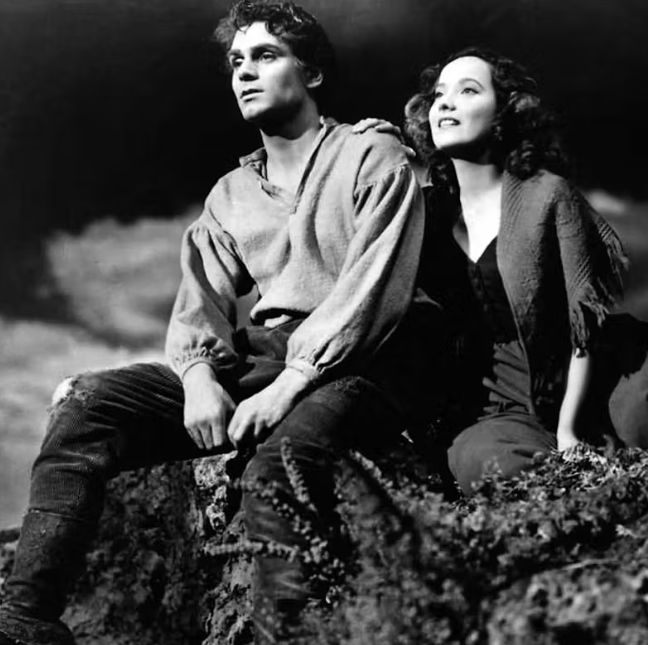
Laurence Olivier and Merle Oberon , in the sublime 1939 version of Wuthering Heights
It also does modern gothic writers no harm at all to do their reading on such things, a tad obsessively… A little madness is a good thing. As is spending some time in the fictions of the 19th century in general I find, if you can survive the archaic nature of the writing at times. But if you want to write interesting, involving, and great modern Gothic fiction, while knowing the roots of the genre is import, being willing to grow from those roots and sprout in strange directions is just as important. Which brings me neatly to Jack the Re-animator By Jessica Law. A book I only discovered existed when Jessica wrote a blog post for me a couple of weeks ago. The one about snail telepathy…
Jack the Re-animator is a delightfully gothic tale set, given the many cultural references within the novel, in the last decade of the 19th century. It’s intricacies of plot, with multiple threads, multitude of characters, and occasionally sinister overtones make for an enthralling read. It has all the drama, complexity and darkness of classic gothic literature, yet a cast of ‘modern’ characters that feel realistic to our modern sensibilities.
Issac, the junior detective is tasked (in mysterious fashion) with discovering why some dead people are not staying dead the traditional, and far more legally convenient fashion, but instead turning up and wanting their old lives back. A threat most dire to the realm.
You spend a fortune on probate lawyers, funerals, ordering a wardrobes worth of morning black, read the will, divide everything up, and everyone has a good weep by the grave side, then the blaggard turns up right as nine-pence, no longer suffering form the goat that killed him… It really is insufferable…
Then to add insult to injury the grave robbers supplying ‘Jack’ the re-animator, dig up a recently executed serial killer and don’t bother to mention this detail of the corpses providence to the monomaniacal re-animator of the dead. A serial killer who was caught originally caught by Issac (which is how he became a junior detective, despite the societal hindered of having a father who was ‘of the commonwealth’ as his inspector would put it…)
Luckily for Issac he has some help in the form of Adeline Earnshaw a former nurse and medium who was ostracised by her wealthy family for neither of these things but rather for having a sapphic outlook. Adeline is also formally alive, as she is one of Jack’s ‘victims’ having been returned to life after her successful suicide.
Unfortunately Adeline remembers everything about the painful process of being returned to life, except who Jack is, and how to find him. Something she shares with his other victims.
Just want is ‘Jack’ as they have christened him, re-animating people for? Do the resurrection men hold the key? Who else is formerly dead? And when with the Angel-maker strike again?
Its a witty fast moving read, that’s a little mad in places, but a little madness is always required, it is a little gothic masterpiece. More of this please…
<<<<< slight spoilers ahead>>>>>>
Jack is not really called jack. It is just a name given to him by the detectives. Jack is an interesting character in his own right and another novel telling his perspective would have been just as, if not more, interesting. Though more darkly psychological and monomania based… Jack as a character is not alone either. There are several of Jessica’s characters here could make make for fascinating novels all on their own. She has a talent for portraying darkness and those on the edge of things with a tone and feeling that draws them upon you. None of her character are as straight-forward as they seem.
The plot is far from simple either, it isn’t so opaque that you don’t see things coming, in the little clues scattered here and there, if you pay attention, but not so transparent as to make it unsatisfying to discover you had figured right about this thing, or that thing and there will be clue that escape you until after the reveal. There is a lot of care and a lot of craft to this story.
Its a great read, and I only have one real complain about it,that being that it is only available in ebook. Cnsidering even the utter garbage that is The Drag King in Yellow (note. I can say this, you can’t) is available in paperback, and this isn’t , it strikes me the universe lacks balance..
That said, however, it being Jessica law while there is no paperback there is a song of the same name that is drawn directly from the novel, which includes a short reading from the book and as well as mentioning character from the novel. Like all of Jessica’s music it is fabulous…
Luckily for everyone, I have no intent on write and performing songs based on my own novels , I will leave that to Jessica…
There have been many Sir William Nettleton’s, the most infamous had his knighthood rescinded by the late queen in 1963 after the incident with the catholic call girls, the CoE bishop of Angleside and Elizabeth II cup final tickets the previous year. It is perhaps to his credit however that unlike modern politicians he was happy to admit and own his indiscretions. Though revelling in them may be been a better description. Certainly he was the one who told the press about the meerkat he let loose in the Tottenham Hotspurs dressing room after partaking of way too much Columbia nose powder .
The current Willam Nettleton claims he shortens his professional name to appear cooler and writes as Will Nett… But many suspect it is merely to escape the notoriety of the Nettleton name…
Occasionally Will Nett sends me blog posts , they tend to be entertaining, well received and deceptively intelligent reads… he normally does this when he has a new book coming out. If he has a new one out he hasn’t bothered to tell me this time. He has never lost a knighthood due to hookers, clergymen and purloined tickets for a cup final.
Guy Forks by Will Nett
You don’t get may ‘Guidos’ these days, do you? In Spain, maybe; but I’m not in Spain. I’m in the UK; God’s Own- Yorkshire. On Stonegate, in York, at Guy Fawkes’ house. It’s amazing to think that England’s most recognised rebel lived within walking distance of a branch of Jo Malone. Given that he is, in my opinion, the first hipster, he would more likely have occupied the nearby eco shop, instead. His credentials all check out.
The son of landed gentry, living off Daddy’s property empire. Takes a gap year in Spain, sidling up to senoras: ‘I’m Guy, but close friends call me Guido’ adopting the Italian version of his name whilst there, safe in the knowledge that it would be difficult to take the piss out of as hardly anything rhymes with ‘Guido.’
He goes on to grow his hair and cultivate Dartagnanesque facial hair- that I can’t mock too much here because I’ve done almost the same and embraced the 19th century Shanghai river pirate look- before returning home with a headful of revolutionary ideas, and presumably a load of wristbands, a fair dose of the clap and a suitcase full of novelty Sangria bottles from Duty Free. The ones with the little sombreros on.
Then he falls in with the Gunpowder gang, using a spectacularly mundane pseudonym- John Johnson- to carry out his nefarious deeds. In fairness, if it was your intent to collectively maim the nation’s entire political elite in a one’r, you’d aim to keep your new identity as incongruous as possible.
On his return to England, he frequents the Duck and Drake pub in The Strand with a bunch of insufferable edgelords; penny farthing repairmen, baristas and chilli farmers, I guess. I say ‘I guess’ are there is still much conjecture around Fawkes lore. When I was at school someone put it around that he ‘invented forks.’ He didn’t invent the ‘fork’ it was explained; he invented ‘forks’ which I took to mean that at his first attempt he invented multiple forks.
But back to the boom boom boys, who between them hatched the ingenious plan of stockpiling cartloads of fly-tipped mattresses and wildly flammable leftover Halloween merchandise beneath Parliament. Amidst this potential bombfire* of slutty kitten outfits, plastic Devil tridents, and that shitty cobweb stuff that’s draped all over people’s houses, a fuse- not the much-missed chocolate bar- would be lit, and the whole lot would be blasted to the four winds, raining down tricorn hats, powdered wigs and crown jewels, right across the city.
He was of course rumbled by some absolute grass, at which our hirsute hero gave the name ‘John Johnson’ as if in some comedic way that was the first
name that came into his head. I like to think there were previous attempts to give a false name.
“Name?”
*short pause* as he looks around and plays for time: “Err….Parliament….Barrels, at your service.”
He was subsequently tortured into a signed confession, and hung, thus giving birth to the multi-million-pound animal-scaring industry of daft fireworks, with even dafter names; we once discharged something called ‘Satanic Desecration’ in the carpark of the Pied Piper. The hole in the ground is still there, almost twenty-five years later. Perhaps the most striking irony of Fawkes’ legacy is that modern Royalists love fireworks- don’t you, Nunthorpe?- but the tradition stems from an attempt to spectacularly curtail the Establishment.
Whatever it is, it’s all very English, as the French will remind you.In the words of a cross-Channel chum of mine:
“We, as French people, cannot understand a nation that would celebrate a failed attempt to kill it’s King.”
*Yeah, you heard; ‘bombfire.’ That’s what we call it round ‘ere. And it’s turnips**, NOT pumpkins for Halloween.
** The most unmarketable vegetable of them all. No supermarket ad campaign could make hollowing out a turnip a fun way to spend time.
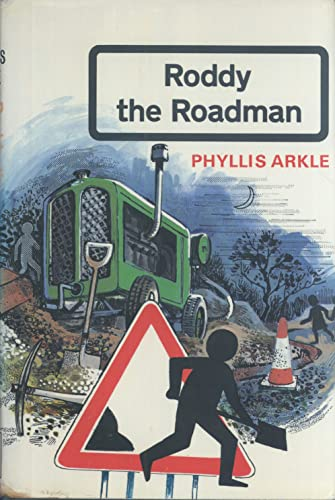
Not everyone will be influenced by the same books. There are probably people in the world who don’t appreciate Wuthering Heights. There are people who fail to be drawn in to Fahrenheit 451. There may even be people in the world, strange wrong people, who have never read Roddy the Roadman.
Actually given that last one is an obscure children’s novel written by the wonderfully named Phyliss Arkle and first published in 1970 and I was forced to read to my mother for half an hour each night when I was about eight or nine, I am fairly sure that few people have read and been deeply influenced by that book, and its sequels, because they have been out of print for many years. That I was forced to read to my mother was not, I should note, any form of cruelty on her part. I struggled with English, more specifically reading, due to being dyslexic (which was not diagnosed till I was about twelve). Teacher couldn’t get me to read, mum could, so she did,. every night for several years.
The Roddy the Roadman series had a central conceit that fascinated me as a child and that in turn encouraged me to read them. Which is to say I’d only complain to the minimal required amount about having to read them to mum. This conceit was that the figures in road signs could come alive in the early hours when the people of the town were abed. Roddy himself was a men at work sign. The one oft confused, by the human boy who discovers the road-signs are coming alive, as the man opening an umbrella in a strong wind…
I have not read these books for over forty years. Tempting through it would be to track down a copies of them now for nostalgia sake I suspect they would fail to live up to my vague but glorious recollections. That said, they are out of print and so go for upwards of £100 a book in ‘library’ condition. So some bibliophiles out there have long memories for forgotten childhood treasures. I am not therefore alone in my affection for this somewhat forgotten series.
Whats my point, you may ask. Well simply this, every book, by every author, has the potential to have a profound effect on a reader, may be not many readers, maybe not always for the good (E L James for example was responsible for a upswing in light bondage sales, all the while being an utterly dreadful representation of sub/dom relationships. As well as just being so badly written.)
Yes I have gone from talking about a beloved children’s took to slating 50 Shades of Grey, whats your point?
In any regard, Phyllis Arkle manged to be an extraordinary influence on the young me. Mum didn’t buy these books, I got them out on my library card, I picked them because of a central and frankly ridiculous conceit. I read them, to my mum, because I wanted to read them. Because they fired my imagination and made me want to read more.
Despite dyslexia. Despite a morbid fear of reading aloud (to anyone but my mum). Despite it being a slow process that took years to really come to grips with . I read Roddy the Roadman and I’ve never really stopped reading since then and inspire my love of books, reading and of course writing…
So if you are ever looking for someone to blame for everything I have ever written, her names Phyllis Arkle… Bless her cotton socks.
Regular readers will be aware I have a workaday interest in quantum theory. In particular what fascinates me are ‘spooky’ particles as they can be interpreted to explain a spiritual connection to, well, everything. Having a degree that is partially in philosophy and being drawn to the pagan helps with this. It is why I have come to consider myself to be a Quantum Pagan. As this all more or less fits together as a personnel belief system. Which is to say, it just kind of makes sense to me.
As I read today’s guest blog by the eclectic energetic entity that is Jessica Law, (yes I do read them before I publish them) I was reminded of spooky particles, and this got me thinking of how in essence modern quantum theory could actually be applied to the concept of the snail telegraph, or as it is also known pasilalinic-sympathetic compass, but then I am a romantic…
The Snail Telegraph by Jessica Law
The snail telegraph: why on earth did people think it would work?
There’s a live-action adaptation of the Japanese manga “One Piece” out at the moment, in which the characters use living “Transponder Snails” – molluscs with a telepathic connection – as telephones to communicate with each other. What viewers may not know is that this whimsical bit of surrealism is based on a real-life experiment even more bizarre than fiction.
Like a lot of strange things, it all started in the 1850s. The electric telegraph had recently been invented and was revolutionising long-distance communication. However, the system was still unreliable and expensive to maintain, so inventors across the world were striving to develop a cheaper and more efficient means of communication. Into the fray walked French occultist Jacques-Toussaint Benoît with an idea that was greeted with a surprising amount of acceptance, given how utterly ridiculous it was.
His idea was that, when snails mated, they formed a permanent psychic connection maintained by a special fluid that created an invisible thread between them, no matter the distance or the obstacles in between. Each mated pair was allotted to a letter of the alphabet, then separated and glued to conductive metal plates at opposite ends of the room (poor snails!). Benoît’s theory was that if you poked one of the pair, for example the letter “f” snail, it would produce a corresponding “Escargotic Commotion” in its partner, the other letter “f” snail, allowing the user to spell out words over long distances.
This idea took him surprisingly far. The manager of a Paris gymnasium gave him rooms and funding to build a prototype of his telegraph, totally taken with the idea. Within a year, members of the press attended a demonstration of the contraption. Despite Benoît walking back and forth between the two devices throughout, and the machine spelling out “gymoate” instead of “gymnase”, reporter Jules Allix was utterly convinced and gave it a shining review in French newspaper La Presse, suggesting ladies could carry the snails like a watch on their waist-chains.
Sadly, Benoît fled the scene before a second, more thorough test could be carried out, and was later seen wandering the streets of Paris, before dying in obscurity in 1852.
Benoît’s bubble might have burst in the end, but what surprises me is how far his idea did get. Even if Benoît was deliberately deceiving people, the fact remains that a good portion of them believed him. Which made me wonder: was the idea that snails were telepathic unique to Benoît, or was it a widely-held belief at that time? And if so, why?
First, we need to view it in the context of some of the other ideas floating about during that period. One popular theory was Animal Magnetism – or you might have heard it called Mesmerism, after its inventor Franz Mesmer, an 18th-century German doctor. Mesmer theorised that all living things had an invisible life force with which they could physically affect other organisms from afar. This theory was a big inspiration for Benoît. But if the telegraph was based on Animal Magnetism alone, surely Benoît could have used any animal – including humans. What made snails so good at being psychic? And why on earth did they have to mate first?
As a Biology graduate and longtime pet snail owner, I have a few personal theories. The first is that snail sex is weird…
To start out with, snails kiss by joining mouthparts – but that’s where the cuteness ends. To avoid clashing shells, snails’ reproductive organs reside in their necks, and it’s from this location that the snails shoot calcareous “love darts” (basically limestone harpoons) into each other’s bodies. This might have led people to believe that a part of one snail was permanently embedded in the other snail after separation.
This is significant: in some circles, flesh transplantation was already thought to create a telepathic connection between the donor and the recipient. 17th-century esoteric cultists the Rosicrucians even exchanged skin grafts tattooed with the alphabet, in a style very similar to the snail telegraph. Indeed, it was this idea that Benoît based his experiment on.
But that’s not all. The snail’s love dart also evokes the myth of Cupid’s arrow: the strongest and most lasting romantic bond that could exist between two beings. Originally, it was probably the other way round: the snail’s courtship routine probably inspired the Ancient Greeks to dream up the tale of Cupid and his amorous ammunition. But what’s accuracy in the face of a great story?
These love darts contain a pheromone which stimulates reproduction, prompting the snails to join at the neck and exchange sperm. When they do, their necks appear to merge and they secrete a huge amount of foamy mucus, almost as if they are dissolving into one animal – or forming the invisible fluid that Benoît was convinced connected the snails forever more. Garden snails are hermaphrodites, so both snails go away fertilised and able to lay eggs, and the overall courtship routine takes hours and hours.
All of these factors probably contributed to the genuine and fairly common 19th-century belief that snail romance was a higher, more noble form of lovemaking than the comparatively cursory human process. One that could form an eternal bond that surpassed time and space. What a romantic way to view our common garden gastropods!
And really, was the concept any weirder than some of the ideas knocking around today? At this very moment, 3% of British people believe a single molecule of arsenic dissolved in water can cure their illness, and 12 million USA citizens think we are secretly ruled over by alien lizards. Only history can be the judge.
About the author ( by mark )
Jessica Law is a musician, singer, writer, children’s author, blogger, quite possibly a ghost inhabiting an anatomical dolls body, a roller of mini cheese, the morally ambiguous queen of the fay realm, obsessed with obscure Italian mythic poetry and is occasionally exhausted but still manages to have more energy than anyone else.
She also like snails…
You can find her music, which is both unique and wonderful in equal measure on Bandcamp.
Alternatively you can just shout at your smart speaker, tell it to play Jessica Law and it will. I have surprisingly never tried this, I will be rectifying this later… Apparently this doesn’t actually make Jessica sing to you, just recordings of her songs, but maybe there are some spooky particles involved and she will find herself compelled by unseen forces connecting us all to suddenly start singing if enough people shout play Jessica Law at their smart speakers at the same time. We should definitely try that all together at midnight on Saturday…
Jessica’s own blog, which see updates at least once every 2 years can be found here. And you can follow her on Instagram here. So why would you not want to read more and follow her…
Apparently she has also written and published a novel that she tells no one about. That I was utterly unaware of until she mentioned it in passing when she emailed me this blog. Honestly I despair sometimes… Its only available in eBook… but is on amazon , or smashwords .
It may become available in paperback after someone offers ( with tenacious Yorkshire determination) to typeset it for paperback as they, and at least one outlaw want to hold the book in their hands.
Nimue Brown is one of my favourite authors and one of my favourite people. Despite this I invariably mispronounce her name, I’m a bit useless like that, I read a word and how it sounds in my head is how it is pronounced, and once a pronunciation takes root in my head its hard to shift. As penance for this terrible crime, a year ago I offered to typeset a novel for her*.
*most of this is true, apart from the penance bit, I enjoy typesetting…
The Novel in question was Spells for the Second Sister, which was a particular delight to work on. It’s a wonderfully weird, yet insightful, and entirely strange novel about the life of the Kathleen. We start with her as a fourteen year old angry teenager and then each progressive chapter is set set at intervals of seven years, so twenty-one, twenty-eight, Thirty-five etc. As you can see from the contents page graphic below I put together for the paperback edition…
Isn’t that lovely, the weird titles of each chapter are Nimue’s obviously but the lay out an snazzy graphics and layout are mine. As is the glaring error.
Now, if you’re observant you might spot the grievous error I made with the contents page. The contents page that is in the final book and is part of every paperback copy of the novel, that I didn’t; spot until I had a copy of the paperback in my hand. The novel I typeset for a friend… The novel where, and this is important, every chapter is set seven years after the previous one… So fourteen, twenty-one, twenty-eight, Thirty-five and so on…
If you spot the glaring error on my part, don’t tell Nimue… I’m hoping she doesn’t notice I’m a blithering idiot. Luckily she is very unlikely to read the introduction to a guest blog by whoever is the guest blogger today…
Breaking Reality in Gloucester By Nimue Brown
Spells for the Second Sister is a madcap alternate realities kind of story set around Gloucester. This is the Gloucester that lives in my head, although to more steampunk shenanigans we get into the mix, the more real my version becomes. Frankly, the Drag King in Yellow would not have felt out of place in this story.
Here’s a little bit of it.
So I went to the sinister mouse circus. For the escapism. “Existential crisis guaranteed,” said the Dormouse. Door Mouse. Whatever. “Personal unease, mild disaffection, the kind of apathy you can have before lunch without ruining your appetite entirely.”
Inside the circus, it was dark. There were noises; some giggling, and shuffling sounds. I detected a lingering smell of sawdust and wee. Or popcorn. Hard to be sure. Uncomfortable wooden seats. Every now and then, someone played a single note on what sounded like a badly tuned triangle. I got up to leave, but there were no exit signs. I blundered about in the dark, banging into things. None of them felt like people but some of them complained anyway. I slipped in something and bashed my knee on something else and the stitches went in my stomach and I could feel the blood and entrails coming out.
The lights came up then, revealing a lone mouse in a pink tutu, wobbling on a unicycle, and me, doing a one woman impression of a zombie apocalypse. The actual people in the audience started screaming and running away – I guess they got their money’s worth. The circus mice offered me thread, and a contract to work full time with them.
Mugged by Neo-Neolithics. It has been a day. I’d assumed they were from one of the other Gloucesters, having seen a few of them from afar before now. Close up is a whole other experience. They smelled rank enough to seem authentic, but some of them were distinctly wearing fur fabric and those who had skins clearly didn’t know much about skin preparation and even less about how to use flint tools.
They mugged me for my shopping. I tried telling them bread was exactly the thing people on paleo diets don’t eat and that my processed cheese was certainly not going to do them any good. This is when I learned that they call themselves Neo-Neolithics.
“It’s not the fucking paleo diet, right? It’s not a dairy free, gluten free lifestyle.”
“So, what is it then?” I asked, still clinging to my proto-lunch.
“Hunter gatherer, living off the land, off our wits. Fuck industry. Fuck work. Fuck capitalism. Fuck contemporary western civilization.”
I admit to having had a hard time taking them seriously. “So you’re what, foraging me?
“No, we’re mugging you,” one of them helpfully explained, and then they grabbed my bag and ran off with it, leaving a trail of moulting animal fur behind them.
Here’s me reading a bit (not this bit)
If you’re interested in reading the whole thing, you can grab the *free ebook version over here – *(throw money at me if you feel so moved, but it’s totally ok to have a free one. It’s a bit like a gateway drug, in theory).
There’s also a print version over here –
Complicated barter arrangements are also an option, but you’ll have to talk to me about that. *
Final note by Mark,
*Nimue is on Bluesky , Twitter , has two blogs here and here and can be found on other bits of the internet is you look hard enough, or just make a small amount of effort to be honest because she is everywhere and marvellous… But if you do reach out, don’t tell her about the twenty-eight error. I think I have got away with it…
One final, final note. I am going to fix the error, so the current paperbacks out there in the world will be the valuable rare first editions with the glaring typesetting error that turn up at auctions in twenty years time. Clearly you should buy a copy while you can still get the rare first edition versions, and this was clearly my plan all along…*
*Also, its brilliant and you should read it, did i mention that?
As is my want in October I have opened up the blog to guest posts, in part to encourage those shy retiring beasts writers to leave there shells and case a little light on the thoughts that pass for what we shall laughingly called sanity, in there minds. Sometimes this leads to strange and wonderful places as authors are a strange lot as a whole… Occasionally they just write a piece of fiction but we let them off as its an entertaining bit of fiction. Also I do this all the time so who am I to argue…
What follows therefore is a story by Roz White, from the perspective of one of her creations Professor Prudence Weatherpenny, whom is the principal character of one Roz’s series. And not entire true to her name as she does seem a little imprudent at times*
*yes you have heard that joke before, its in my Play ‘The Drag king in Yellow’ and no it wasn’t particularly funny then either…
Observations on the Potential Arising of Demons or other Apparitions in Unexpected Places such as Food: (by Roz White)
From the Notebooks and Journals of Professor Prudence Weatherpenny
A knife can be a very dangerous thing, it appears. Now, I appreciate that this might appear to be a totally obvious and indeed superfluous statement: knives on the whole are intended to be dangerous, it is the very point of them (forgive the pun).
But on this occasion, the knives and other implements I and some of my associates carry on a day-to-day basis are not the subject of my musings, oh no. This time, it has been brought home to me rather forcefully that even allowing for its serrations, a bread-knife can be a bringer of doom, destruction and danger.
I had better explain, perhaps. It was a fairly ordinary day – well, actually, given that I began it in my own bed, in my own house, it was really not that ordinary; being a Professor of the Arcane, the Peculiar and the plain, downright Weird, a night in one’s own bed – a night unassailed by demons, ghosts or other supernatural denizens of the night, to boot! – is a rare and wondrous thing indeed. I actually awoke refreshed and bright-eyed – relishing the feeling of a soft mattress and a warm blanket over me, if I am being frank. There have been too many instances just lately of attempting to sleep on park-benches, railway-platforms, the floors of various hostelries…
But to resume: I awoke, I rose from my bed and, clad in a dressing-gown over my night-wear and a warm pair of slippers, proceeded downstairs. Sadly the marvel of a regular night’s sleep had not extended to the roiling Realm of Chaos that is my kitchen, and the mess of the last… er… well, as I have explained already, I am not often at home these days. I really should advertise for a housekeeper, except that I doubt I could persuade any of quality to suffer the surprises and peculiarities my house tends to extend to visitors. For similar reasons, I rather think getting a maid is also out of the question.
I eventually found the kettle, however, and after a little further exploration discovered the range to be lit and ready for me. The tea-caddy appears largely immune to the insanity that often surrounds it, thankfully, and my cups are kept (usually) in a securely locked cupboard in an attempt to curb their more adventurous natures. So there was every likelihood of tea in due course; what, I wondered, did I wish to have with it? Another look towards the range suggested that attempting to fry anything might not be appreciated just then, and there was no guarantee that the bacon was still edible, nor that any leftover eggs had not hatched into… something. Perhaps some toast-and-honey?
My honey generally comes from a reliable source, and after a thousand or two years in a dry, underground environment does not appear to have suffered unduly. But did I have bread? I made a cautious way through the kitchen, around the table and the laundry-rack (which has a habit of lying in ambush for me if I am unwary), towards the pantry where the bread-bin resides. Yes, there was bread! It wasn’t even showing signs of changing colour or growing a fur-coat yet, so toast could well be on the menu.
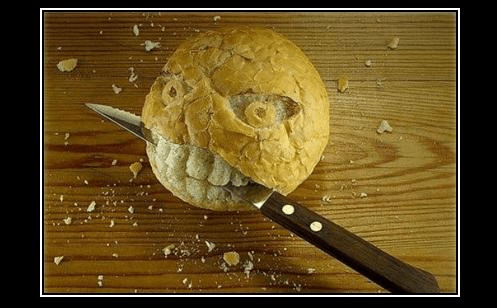
And now, Esteemed Colleagues, we come back to the bread-knife, with my apologies for what might appear to be interminable rambling – but I do feel it important to set the scene, as it were. I took up the aforementioned implement – it acquiesced readily enough – and cut into the bread; but! Imagine my shock and surprise when, instead of the well-baked and even-coloured image of bread I might have expected, I found holes – holes in the form of a face!
Not a very happy face, either, I have to say: two apertures resided just below the crust, as if using it as eyebrows, and a larger one where a mouth might be imagined, its corners turned down as if howling, or perhaps simply enraged at being disturbed. In fairness, I do wonder how I might react if my own head were suddenly cut into; conversely, I had spent good pennies on this loaf and I wanted toast! So I made another cut, thereby isolating this potentially demonic slice, skewered it with my toasting-fork and proceeded back to the range in order to brown it sufficiently for my honey to melt. I rather hastily put the rest of the loaf back into the bread-bin, and I have not found the fortitude to examine it since.
That is also a matter of some concern, if I am being totally honest. I ate the toast, it was very good, and I am not aware of any after-effects in my physiology. But what of the loaf from which it came? Is it still angry with me? Is it, even now, hatching plans for some worrying and demonic form of vengeance? Just whose face have I eaten?
Moreover, what if mine was not the only such loaf? What if the very Bakery itself was the target of this otherworldly infestation and we now face an attack from the very hearts of all our kitchens and pantries? I think what concerns me most of all about such an occurrence is that in all probability I will have to venture out from my fireside to unearth and then deal with such an event, and I was already rather getting fond of sleeping in my own soft bed!
This is a post about masks derived from an old posts about masks from 2017. In 2017 I was still writing the first Hannibal Smyth novel, COVID was yet to be a thing and I was not the same person I am now… I reread that original post for reasons… and the middle section stood out. This is a reworking of that original post based on how much I have changed, six years and a lifetime later…
Everyone wears masks…
I know that this is a cynical viewpoint to hold but it doesn’t make it any less true. Some of us, however, wear more masks than others. Some of us wear masks over our mask because woe betides we let one slip then at least we have another mask to hide behind. That is the point of masks after all. They are there to hide behind, to obscure our true selves from those who might seek to know us.
It is, and always remains, a truism that the more insecure we feel, the more insular we become, and thus the more masks we wear. Masks of confidence to hide those insecurities. Masks of bluster to hide our lack of confidence, masks of cynicism to excuse the bluster…. and so on.
Then of course there are always those most pernicious of masks, masks of humour.
Oh but it’s so much easier to make a joke out of something than face a problem head on. We build masks of smiles designed to hide our depression from the world. We grin , we laugh, we make a joke of it all and never let the world see we are broken inside. Cracked porcelain facades just waiting to shatter.
We all wear masks even if don’t know we do. Masks protect us from what we fear by obscuring our true selves from all, an all that includes ourselves. For our darkest fear of all, is the fear of letting all the masks slip, just once, not in front of anyone else, but in front of a mirror so that we can seeing ourselves for who we truly are are.
I have always found it hard to let my guard down, to let a few, just a few, of those masks fall away because I really, really, don’t do people. From my perspective everyone else seems to know how to interact with people. Everyone seems so much better at being a person that I am, and if they are hiding behind masks, they are seamless disguises… Yet I know this isn’t true either.
Don’t misunderstand me when I say ‘I don’t do people’. I don’t mean I cannot deal with people, can’t interact with them, or can’t seem to be one of them. It’s just I’m one of those people you meet in the kitchen at parties, the one who sits on the edge of everything talking quietly to those who might listen or just to himself. And I am not unhappy about this, this is not one of the causes of my occasional bouts of depression. On the edge of things is where I prefer to be. I wear black a lot, its suitable for all occasions. It lets you merge into the shadows just a little if you keep to the edge. (And yes I also have every Sister’s of Mercy album, what of it?)
Basically, I am not good with people, I have found I don’t like them as a rule, people in general that is, I like individuals. Which is why I have a few really good friends and very few casual acquaintances. Small talk has never been a skill I really managed to learn, and its why I have a mortal dread of actually talking to people about my novels. I have never found a way to reply to that most awkward of questions ‘what’s it about…?’ not least because I expect I will look like a bumbling fool when I do.
Six years ago I really needed to find a ‘confident writer guy’ mask to wear, but I was not even sure I know how to make one… Yet somehow I have cobbled one together of the intervening time. I have grown as an individual, I am older, wiser and in many ways happier. I have a larger circle of people I would call friends, if i was the kind of person who would call people who’s continued existence I cherish ‘friend’, I may have even done so…
I have fewer bouts of darkness and the masks, well some have slipped a little…
Occasionally, just once in a while, but occasionally all the same, I can stand before the mirror and take off the last mask.
Elizabeth Tuckwell is a fellow Harvey Duckman writer and the aunt of an old friend of mine. These two things are not connected and we were unaware of the second connection till the old friend read a Harvey that contained stories by both of us and pointed this out. the world is small and full of coincidences…
Elizabeth is also in all likelihood not a distant decedent of Frier Tuckwell of Kirklees Priory cira 1107. Neither was he that Frier Tuckwell, who is entirely fictional, but was played brilliantly by Phil Rose in Robin and Sherwood between 1984 and 1986. Frier tuck was also played with some gusto by Mike McShane in 1991 Robin Hood: Prince of Thieves, a movie that featured a great scene in which from a tree in Northumberland you can see Nottinghamshire. Some one recently cut down that tree in an act of vandalism which quite rightly made everyone angry.
However, I would posit that the fate of a single ‘famous’ tree that was once in a movie with Kevin Costner, pales in comparison to the felling of the rain forests of Brazil for palm oil plantations, and perhaps, just perhaps, having the same amount of rage about Palm oil as we do about the felling of a sycamore tree beside a wall some roman order built 1800 years ago would be more likely to help avert the common end of civilisation… Which brings me to the question Liz asked herself when writing the guest blog below… *
*wow that was convoluted even for me wasn’t it…
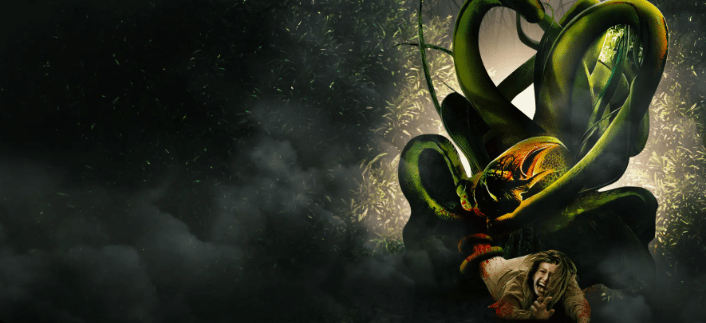
Are you ready for the apocalypse? I’m not.
I recently watched an episode of the TV series of The Day of the Triffids with my niece. She loves the book and told me she’s read it at least eleven time after I gave her a copy of the original Penguin Paperback with the cute line drawing of a triffid. The Day of the Triffids is a cosy catastrophe. It’s also relevant today as one of the two main causes of the the catastrophe is Man’s greed.
It has one of the best openings of any novel ever.
“When a day that happen to know is Wednesday starts off by sounding like Sunday there is something seriously wrong somewhere.”
Anyway, it struck me while watching it, that electric cars would be pretty useless after an apocalypse. Where are you going to be able to charge up your car? I have an electric car.
It then got me thinking about apocalypses generally and I realised how useless I would be. I don’t have food or even more importantly, water, hoarded. I’m not an expert in any martial art. I can’t shoot and don’t have any stockpile of weapons, which I usually think is a Good Thing. I’ve never read a book or watched any YouTube videos about survivalist tactics.
And even worse, I live in London and even I know that when the apocalypse comes, you really don’t want to be in a large urban area.
And then there’s the Zombie Apocalypse. I really would be even more useless because I don’t like looking at zombies. They turn my stomach. I’m assuming this wouldn’t help while you’re trying to bash their brains out. The only three Zombie films I’ve watched to the end are Shaun of the Dead, World War Z and 28 Days Later. I started watching the sequel to 28 Days, 28 Weeks Later. I’ve never watched The Walking Dead or Fear The Walking Dead or any of the classic zombie films such as Night of the Living Dead. I have therefore gleaned no useful tips.
So, I’ve come to the conclusion that come the apocalypse, zombie or otherwise, I’m doomed. Are you?
Liz Tuckwell is a regular contributor to the Harvey Duckman Presents anthologies and the author of Moonsleep and Other Stories, a collection of darkish fantasy and horror short stories.

















 The Passing Place