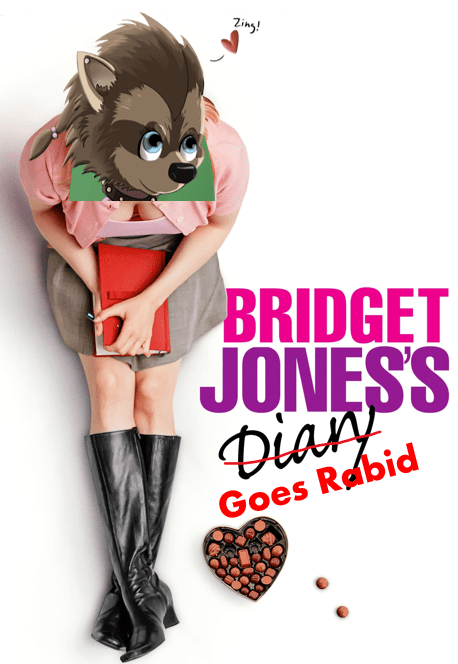
Bridget Jones is a Werewolf

Okay, now I have your attention with a blog title that even by my standards is a little left field I should almost certainly put out a disclaimer. Let me state for the record that I have never read any of the Bridget Jones books, and have only a vague recollection of the first movie. I had a girlfriend who wanted to see it and I wanted to see her knickers no matter if they were big comfy pants or a lacey thong.

I will say this though a Bridget Jones Werewolf movie would be a far better date movie, particularly if Hugh Grant got ripped apart by a rabid Bridget in he middle of the third act. Renée Zellweger would make for a cute werewolf I am sure, and she could pull it off, that woman has range…

Oddly enough, Hellen Feilding’s the original novel was based, loosely, on Pride and Prejudiced, which I think proved my point as while movie versions of Pride and Prejudiced also make for popular date movies, Pride and Prejudiced with Zombies is easily the best of these IMO. All the romance of the Jane Austin original, with sword fights and zombie beheading. So just saying Bridget Jones Goes Rabid is a movie idea with legs…

Unfortunately, I suspect that movie will never get made, but on the off chance that it does, Warner Brothers can contact me here with the bankers draft for my ideating. When they do I will of course be morally obligated to admit my idea was inspired by another authors novel, once the money is in the bank… So until then I’ll not tell anyone, you included dear reader which novel inspired me to think Bridget Jones Goes Rabid was a great idea for a movie… So lets just move on and put this whole Renée Zellweger goes furry on the back burner for now… Instead I’ll review some random book that is in no way connected to the opening section of this blog post…

I should also point out I don’t read a lot of chick-lit. I suspect one of the reasons I don’t read much Chick-lit is generally it lacks shapeshifters. Having said that I am sure someone will want to point out a long list of werewolf erotic romances that are available… The kind of books aimed at a female readership that have a man on the cover with his shirt off.

‘He was the alpha of his pack but could she tame his wild heart..?’

There is nothing wrong with that kind of book, they tend to be set in mid-west America and the werewolves all drive pickups. Except for the Lone-wolf who will have a Harley… They are a popular subgenre of urban fantasy, but like the majority of Urban Fantasy its all set in the US and its appeal to me which is somewhat limited to start with, falls away entirely when we start talking about ‘good old wolf boys’ down on the farm. Also, and this has to be said, the were’s in American books of this type are all werewolves, or on the odd occasion werebears.

The best book I read last year involved a shape shifter, that was Hunting the Egret by Nimue Brown and the shapeshifter in question was a were-otter. You would not get a were-otter in the average shape shifter chick-lit I mentioned above.

That would be as likely a book having a were-guineapig in it or a were-hedgehog for that matter. Or a social worker, blundering around the urban decay of a British council estates, while having Bridget Jones style relationship issues which are amplified by being a werefox in a society were the others are ‘shifters’, force to live on the fringe of society. Now I find a book like that far more interesting than Chick lit ‘good old boy’ werewolves… But where can you find a book like that?
A review of Less Than Human by Steven C Davis

Thirty-something Natalayiana has a problem, actually she had a lot of problems. Her best friend doesn’t like her fiancée, though in fairness Nat isn’t massively fond of him either. He is however the safe steady option who understands Nat’s body re-morphic issues .

Her best friend who happens to be heavily pregnant, is also in lust with Nat, but like Nat’s book group, work colleagues and most everyone else Nat interacts with, she doesn’t trust ‘shifters’. This is a tad problematic for Nat because she could probably do with someone other than ‘safe steady’ Gerald to whom she could talk about her issues. Specifically that she is on of the ‘shifters’ he best friend doesn’t trust…

Being a Werefox and having a dull fiancée is not Nat’s only issue either. There is her bosses obsession with obtaining funding for the charity she works for, who’s happy to exploit his workers to get such funding. The rich father of her ex uni boyfriend who has an odd obsession with her. Her ex boyfriend himself who was a creep back then and seems just as creepy now. Her clients who need her help but mostly seem to resent her. Mal, the American who wanted to bring Homes’s4 Were’s to the UK, and organisation that seeks to ‘manage’ the were problem, in the ways not dissimilar to how some evangelical churches try to ‘manage’ homosexuality.

Then there is the mysterious Robert who makes her lament having a fiancée.

Nat just wants to be safe, she just wants to be left alone to get on with living a quite helpful life trying to do good , except of course being safe and being left alone is the last thing she actually wants…
So there you go, Bridget Jones the werewolf years…
Except, it not. Underneath that fluffy fun idea, which I suspect is not how the author would chose to describe his novel, there is something poignant about living on the edge of society and having to hide your true nature because society neither understand it nor is libel to accept it. Its analogous to the experience of gay people in the 80’s and trying hard hide it from everyone. The general fear and distrust of ‘shifters’ is equally analogous to society’s reaction to the AID’s virus.

Natalayiana is a social worker, doing her bit to right societies ills, she volunteers on her weekends with the national trust, she’s in a book group, she’s agreed to be her single friends Birthing partner. She is a good person doing her best to make society better for everyone… A society that would reject her in a moment if it knew she got really really bad PMT around the full-moon… Because all the good works in the world will not change her from being the ‘other’ that ‘normal’ people are constantly encouraged to distrust by the status quo.

Nat’s experience as a ‘shifter’ is also Analogous to the experience of the trans community, certainly from some quarters of the media and the public at large. So this is very much not Bridget Jones the werewolf years, this is not just a book about thirty-something handwringing and emotional frustrations. Also, it has to be said that while I have never read Bridget Jones, I suspect Bridget Jones novels are much less visceral in nature.

This is a very visceral novel, with a lot of visceral sexuality within it, and indeed a lot of equally visceral sex. But there is, and should be, something very primal about shapeshifters. That primal visceral sexuality of her nature is what Natalayiana seeks most to deny in order to fit in. Much of this novel is about the futility of the struggle to deny, even to yourself, who you truly are. You can suppress your nature, bottle it up, hide it beneath layers of banality and fitting in, but unless you can be yourself, can embrace you true nature, how can you ever be happy?

So, there are layer to this novel, layers that make it something very defiantly not Bridget Jones Goes Rabid (the werewolf years). But then if that had been all it was I would not have enjoyed it and would not be writing this review. It is fun, interesting and thought provoking. It is visceral both sexually and in terms of its reflection of society.

It was also a joyously diverting novel to read on every level, just plain fun, but equally thought provoking at the same time.

Posted in amreading, big questions, book reviews, humour, indie novels, indie writers, novels, reads, rights | Tagged , , , , , | 3 Comments

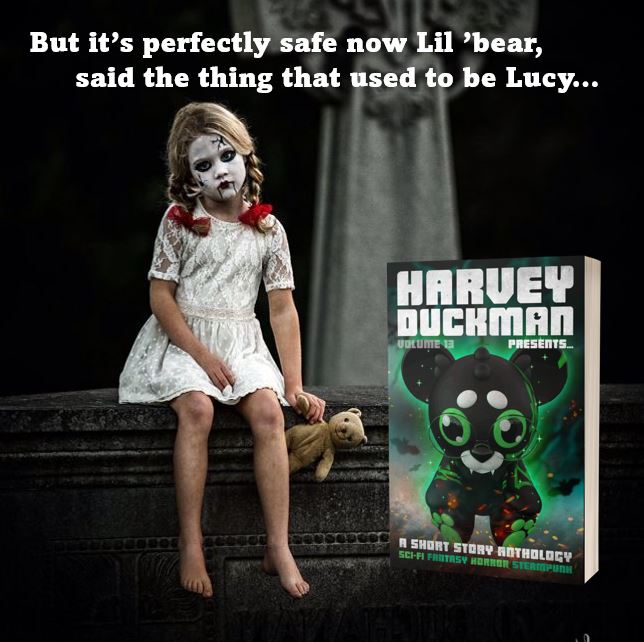
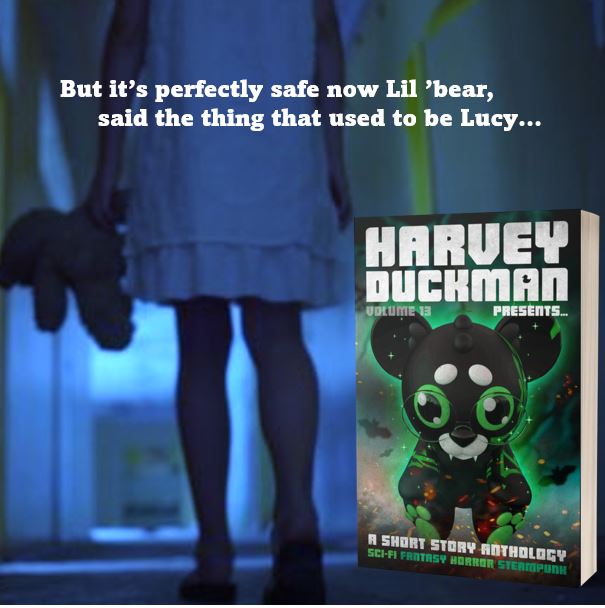
Lucy and the bear…

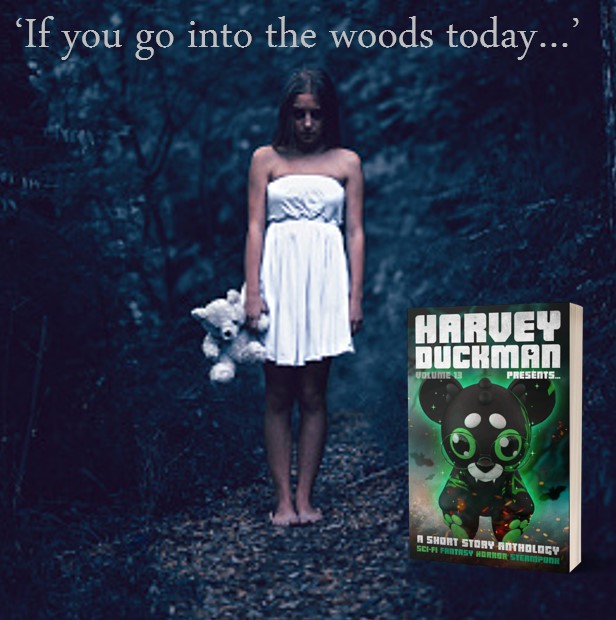
Occasionally, I am required to do a little publicity work for various books, I tend to have most fun doing this when it is not one of my own books. Which is to say when its a Harvey Duckman, as I don’t worry quite so much about getting the tone right. I also can go a tad wilder thank normal…

Which brought me to Lucy (who is not based on my niece Lucy, on the off chance any family read this…)

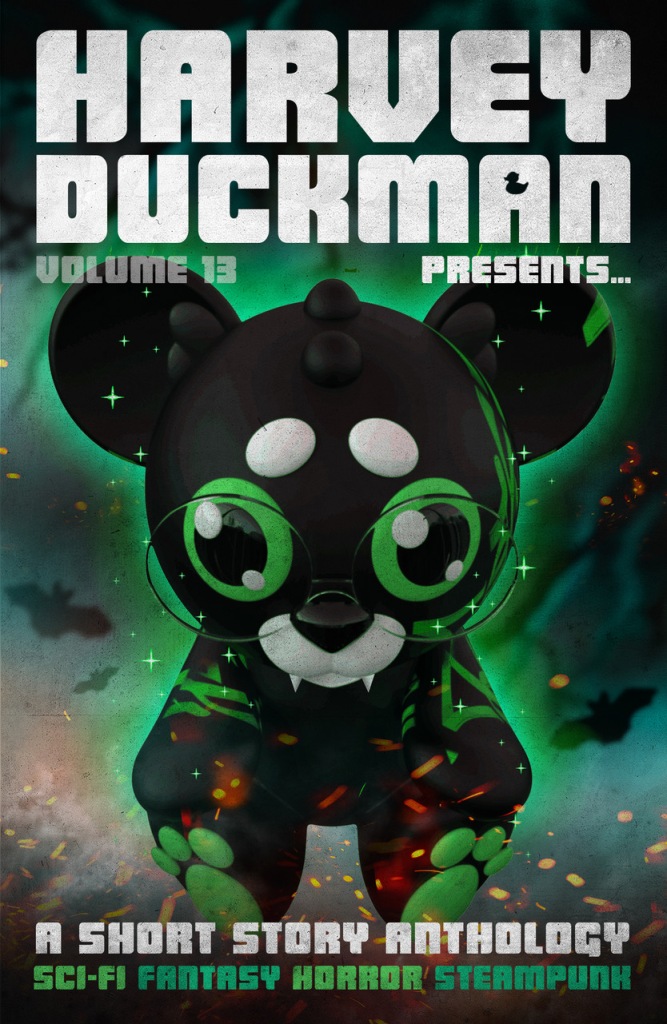
I don’t know what Lucy is, not any more, I do find her slightly creepy I must admit, but that was more or less the point. The Latest Harvey Duckman , volume 13 of all things , which has seemed cursed while we were putting it together as it has taken about nine month longer than planned, has a lot of stories with teddy bears in them…

None of these stories involve a character called Lucy, or a thing that used to be called Lucy… Or if this is an older version of Lucy…

I’m not sure why Lucy exists, or they thing that used to be Lucy exists, or what it has to do with a book that doesn’t have a character called Lucy in it. But the idea formed in my mind and I ended up makes several little memes based upon it…

Anyway the 134th Harvey Duckman collection is out now, a lot of the stories are dark , many of them creepy and most have Teddy Bears in them. One has a pot plant, which is to say a plant in a pot. Not that the pot is a pot but that’s beside the point… And no Lucy…

Anyway I have to go now, there is someone at the door, a small figure in a white dress holding a bear. I am not worried by this, not at all…

Posted in amreading, books, fantasy, Hannibal Smyth, Harvey Duckman, horror, indie novels, indie writers, steampunk | Tagged , , , , , , , , | 1 Comment

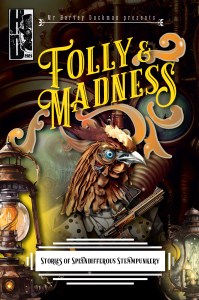
Harvey Duckman Presents Volume 13 Released Today

Among the many wonderful stories in this volume there is a new Hannibal Smyth story from me that unlike almost every other story in this book doesn’t involve a teddy bear at all… It does involve a potted plant in an odd pot, and an in-depth commentary of the class system in a pseudo Victorian age that hasn’t end and how it pertains to ripped trousers down in the tube station at midnight…

Ben Sawyer's avatarBen Sawyer

Beneath the trees, where nobody sees, we hide and seek as long as we please

Cover art for Harvey Duckman Presents Volume 13 featuring a sinister Teddy bear

The latest volume in the Harvey Duckman Presents series of anthologies is available today. Brace yourself for the unexpected as you enter the dark and twisted world of… The Teddy Bear Special, an extraordinary volumethat ventures into the realms of darkness and horror lurking beneath the innocent facade of our cuddly companions.

Dive into a realm where the line between childhood comfort and spine-tingling terror blurs in the most sinister of ways. Within these pages, seemingly innocent Teddy Bears reveal their true nature, unleashing tales of horror that will plunge you into a world of the grotesque and the familiar.

There is also respite from the bear-infested nightmares with some nuggets of the unusual, tales that diverge from our furry friends, providing a momentary reprieve and a refreshing change of palate between these…

View original post 69 more words

Posted in Uncategorized | Tagged , , , , | 1 Comment

Music to write to, Blood on the page

The music changes, depending on mood, and what I am writing. But in this case this is a post about music with a theme… I’ve taken to over using the analogy that good writing requires a little of the writers blood be left on the page. This is not a new analogy for me, neither is saying that my books have slithers of my soul in them. I use these analogies all the time when I talk about my favourite writers, or the difference between the writing of an AI chat bot and words crafted and cared for by living breathing humans. I stick by it.

Because, as I have also been known to state of late, in the words of Ian Astbury. ‘you have to bleed a little while you sing, least the words don’t mean nothing.‘ And you can’t argue with that, or with any Billy Duffy guitar riff…

As we are on about blood and writing, here’s New Jerseys finest, asking the what happens if you shed too much blood on the page… Lyrics to live by… or not.

Now, does anyone have a cow bell? Because She Wants Revenge need it to play Written in Blood which is surprisingly not a mid 80’s goth track… But certainly channels the 80’s goth of my youth. I stumbled across them a coupe of years ago on a play list wedged between Bauhaus and The Sisters as if they had always been there…

And finally speaking of the 80’s goth music, and because any excuse for a relatively obscure Sisters track, from First and Last and Always Bloody Money (yes okay I was running out of blood and writing songs, its not a huge field)…

Anyway, I’m off to shed a little blood on the pages of a novel I’m not writing, rather than on the one I am and possibly think of a new metaphor while I am at it.

Posted in music, rites, writing, writing music | Tagged , , , | Leave a comment

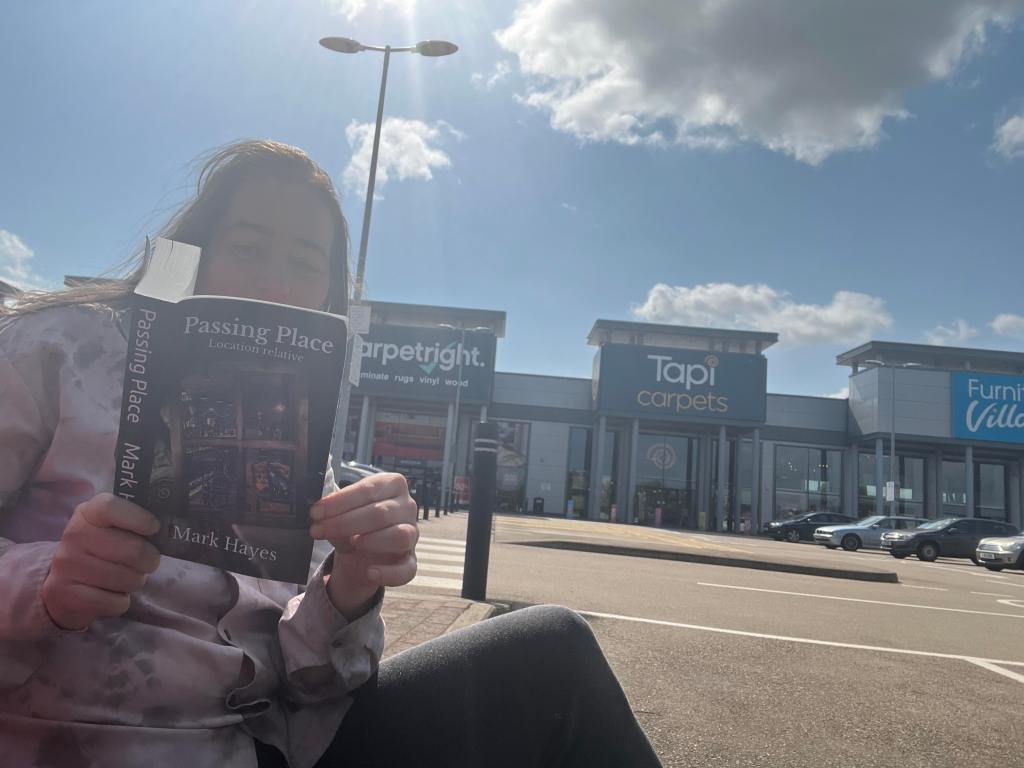
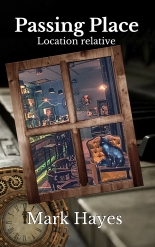
Passing Place – a review

It is terrifying when you know someone, who’s good opinion matters to you, is reading that book. The book in which you left so much blood between the pages…
I’m aware I am overly fond of that analogy, but as Ian Astbury once sang, ‘You have to bleed a little while you sing, lest the words don’t mean nothing!”

Then, of course, they’ll have read the book and if they are nice enough to do so they will write some form of review…. Now it’s always nice to get a review. Nicer still when it is a review of what you know to be the best thing you are ever likely to write. Even nicer when the reviewer is a writer who’s work you greatly admire.

Of course, then you have to read the review, which is a whole new form of terrifying…

So anyway Nimue Brown, amazingly talented writer, bard, and High-Priestess of Blogging steampunk druids has read Passing Place… I am perfectly calm about this…

Nimue Brown's avatarDruid Life

(Nimue)

Passing Place, by Mark Hayes is a beautiful, bonkers sort of a book. This is speculative fiction, with a story that isn’t easily explained at all without spoilers. What I can say with some confidence is that if you like the kind of bonkers and speculative fiction I write then the odds are you’re going to also enjoy what Mark does. I feel that we may have been cut from the same cloth. (I think it was a pair of intergalactic trousers, with a print design it might be safest not to examine too closely.)

I’m not claiming objectivity here. Mark is a friend, I know him through steampunk events. To all intents and purposes, Mark is on of the Gloucestershire steampunks, despite the small technical detail of his currently living a rather long way from Gloucestershire. He’s a fine chap, has piled in to help me with book…

View original post 315 more words

Posted in amreading, amwriting, book reviews, books, fantasy, fiction, indie novels, indie writers, novels, opinion, reads, sci-fi, steampunk, writes, writing | Tagged , , , , , , , | Leave a comment

Dear Edgar #7 The Assignation

“Stay for me there! I will not fail
To meet thee in that hollow vale.”

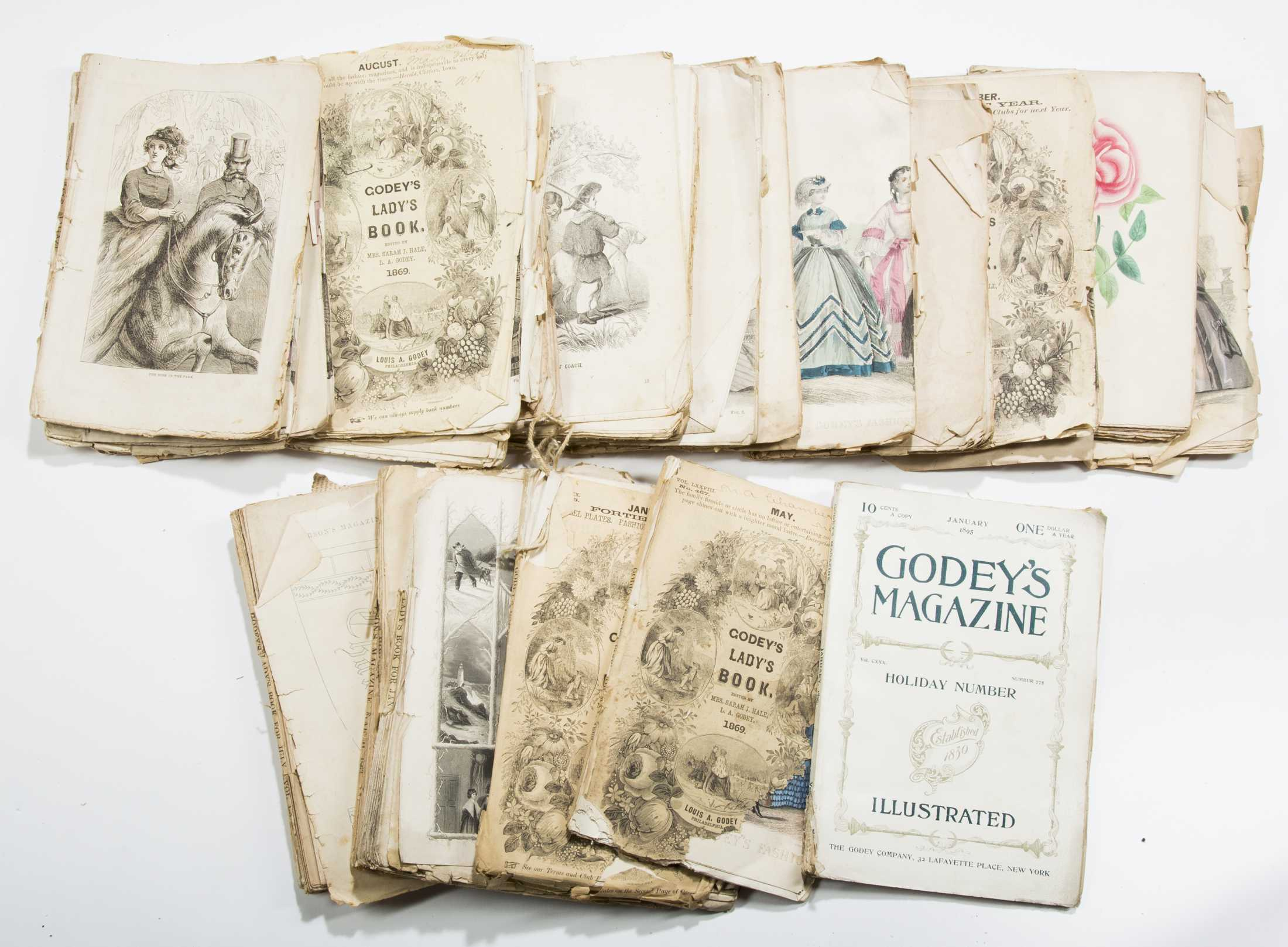
The pages of popular woman’s periodical of the 1830’s, Godey’s Lady’s Book, would on the face of it seem a strange place for our the first of own Dear Edgar horror stories to find a home. It’s a bit like Stephen King writing a story for Cosmopolitan.

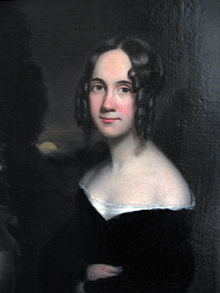
Godey’s has quite a history in American publishing, running for nearly fifty years between 1830 and 1878, which took it right through the civil war. For much of that history it editor was Sarah Josepha Hale who is even more fascinating than the magazine she edited for forty years. She did not retire until 1877 she was 89. Also in that year that Thomas Edison made the first ever human speech recorded on a phonographic* device reciting the opening lines of the poem ‘Mary had a little lamb’ into the crude recording device. A poem you may well of heard of that was written by Sarah Josepha Hale 47 years earlier…

*Aside being a type of early sound recording device The Phonographic is also the legendary Goth club in Leeds where The Mission were founded out of the shattered remains of the original Sisters of Mercy, and I once briefly got chatted up by Marc Almond…

Sarah Hale was not just an editor and poet, She was also a novelist who wrote about the evils of slavery some 30 years before the civil war, a woman’s activist in particular as an advocate for women’s access to higher education, indeed she helped found Vasser Collage in furtherance of that aim. She was also almost signally responsible for Thanksgiving becoming a national Holiday in the USA and as editor of Godey she was also responsible for publishing the famous picture of Queen Victoria’s Christmas tree and help to popularising what became a tradition.

So the deaths of millions of Turkeys and the cutting down of countless premature fir trees can all rest firmly at Sarah Josepha Hale’s feet. Despite this she wasn’t the commissioning editor who decided to published this particular Edgar Alan Poe tale which found its home between the magazines pages in 1834 three years before her tenure as editor began. So this is all a bit of a weird little digression all in all. She was, however, responsible for bring him back to the magazine when he had made more of a name for himself several times over the years, and she is also one of the most fascinating and influential women in American history and celebrated as such with plaques, historical trails and literary prizes named in her honour.

In any regard, famous editor aside Godey’s was a forerunner of the glossy fashion magazine of today, crossed with good house keeping and lifestyle magazines with a little bit of fiction, and in January 1834 it published a horror story that was then entitled ‘The Visionary’ by an anonymous author who later turned out to be our Dear Edgar, who republished the story in later words under the new title The Assignation’. This was his only story publish that year in what was one of the leanest periods of he career. It’s also a trifle odd, even by Poe’s standards…

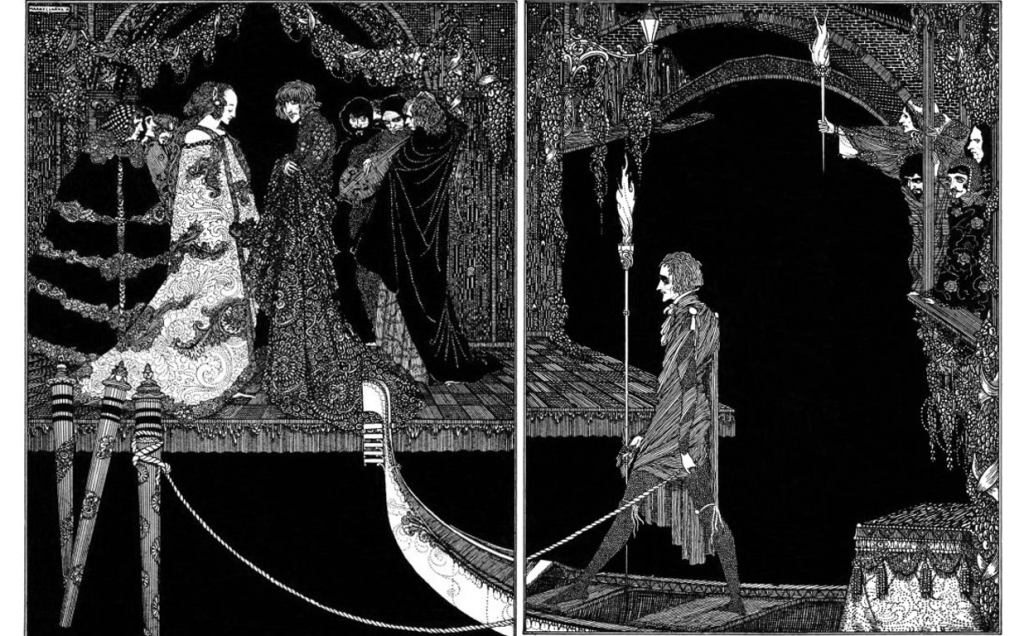
*Original Illustrations of ‘The Assignation’ by Harry Clarke 1926, who illustrated much of Poe’s work in his own very individual, very gothic and frankly beautiful style.

This is a story in two very distinct acts. It is a story of a doomed love, a fools passion, and one mans choice to chase after a lost love that eventually leads to a tragedy. It is very much a gothic tale of forlorn intention. A tale we are told by an unnamed narrator who becomes an innocent bystander and witness to it all.

Rowing his gondola through the grand canal of Venice as evening falls the narrators peace of mind is interrupted by a woman’s scream, he also manages to drop his oar, which is mildly inconvenient as that leaves him somewhat adrift in the middle of the canal moving slowly towards The Bridge of Sighs (which is not on the Grand Canal but we’ll let Poe off on that score).

The scream it turns out was the scream of the Marchesa Aphrodite, reputedly the most beautiful woman in all of Venice. Certainly the narrator is of this opinion, and given his reaction to seeing her is finding himself rooted to the spot and adrift in his gondola, its fair to say this may well be the case. Not that this is the most helpful of things he could be doing as the reason for her scream is that her infant child has fallen into the canal. The child is eventually rescued, but not by the Marchesa’s husband (who just goes back to playing his guitar, without a second thought for the child), or any members of his court more interested in their lords strumming, but by a stranger, or at least someone who the narrator believes is a stranger. The Marchesa however clearly knows him, and appeared to be looking for him in the crowd even while her child was drowning. After the rescue the narrator hears her say to the stranger…

‘Thou has conquered – on hour after sunrise – we shall meet – so let it be!’

And thus her fate, and the fate of the stranger are sealed… Though the narrator doesn’t know this at the time. And that is more or less the end of the first act.

The second act is more than a little odd in comparison. The narrator who ferries the stranger home is invited to visit with him before sunrise, so does just that. He discovers when doing so that the stranger is rich, more than a little eccentric, and without exactly saying so it clear the narrator thinks the stranger has more money than taste, a lot more money than taste. He is, however, certainly highly educated, and if anything he is even more ostentatious in displaying that education than he is with golden rugs and (poorly made) sphinx statues.

Poe then treats us to an array of oddity, poetry and the strangers observations on many subjects much of which Poe clearly made up as he was going along. Such as the claim Sir Thomas Moore died laughing (rather than being beheaded for refusing to recant his Catholicism) Or that Sparta was a city of a thousand temples to a thousand gods, (rather than having Apollo as a patron god, I mean there were other temples, but a dozen or so is hardly thousands). Possibly this was Poe trying to indicate that the stranger was just as full of himself intellectually as he lacked for taste. But I rather doubt it.

Towards the end of this rather long section the narrator begins to suspect the stranger is actually an Englishman, there are clues in his education, his mannerisms, and of course the translations of Italian love poetry he has annotated with English… The narrator then remembers that the Marchesa Aphrodite, before she was the Marchesa lived for some time in London and the court gossips spoke of an affair between her and a rich young noble…

Indulging in a bit of very early in the day, drinking, the stranger takes a moment to quote a long dead bishop with the following passage.

“Stay for me there! I will not fail
To meet thee in that hollow vale.”

Then the stranger collapses on to a chair while the narrator answers a knocking at the door to discover a page arrived from the Ducal palace to bring new that an hour after sunrise the marchesa took her own life with poison. The narrator turns to see the stranger has joined her in this final tryst. In other words it all goes a bit Romeo and Juliette…

Much of the second half of this tale comes off as intellectual posing by Edgar. While that might sound a harsh criticism, I doubt the readership of Godey Lady’s book in the 1830’s would have spotted all the oddities within the strangers preachy monologues, and I am sure Poe knew that. He packed the tale with a certain kind of exotic… Venice the far off city, the beautiful woman uncared for be a husband, the brave stranger.. This is a tale of tragic love, of a kind written to appeal to a female audience. A female audience of bored middle class wife’s who could afford the annual subscriptions for Godey’s Lady’s Book. A magazine you would imagine most of there husbands would never consider leafing through themselves… This was the 1830’s Cosmopolitan after all..

In short, this is not so much horror, as it is often coined to be despite note having any traditional elements of horror within it, but a romance for bored housewives. There is an odd, and somewhat convoluted line but there is a line all the same, between this story and 50 shades of grey.

Now that is horror…

TWO RAVENS OUT OF AN UNKINDNESS

Should your read it: While the score I give this isn’t high it is actual worth a read. I’ve marked it down mostly because I’m not entirely sure what to make of it. it fails as horror, and it doesn’t really succeed as a romance either. But it does have a oddly fascinating quality to it.

Should you avoid it: Well if your offended by poor research you might want to avoid it, but Poe did not have google, Wikipedia, and a pedants mind.

Bluffers fact: Among her many other honours Godey Lady’s Book editor Sarah Josepha Hale was forth in a series of historical bobblehead dolls created by the New Hampshire Historical Society… You know you have really broken the glass ceiling when one hundred and fifty years after your death they make a bobblehead in your honour.

Bluffers fact2: I don’t normally do a second bluffers fact, but the artwork of Henry Clark that litters folio editions of the complete works, is actually in the public domain as all works published before 1928 are in the public domain as of 2023, and in any regard, due to the death +70 years rule all his art is public domain and Harry died in 1930. This isn’t much of a fact, but does mean I can reproduce these gorgeous works of art in these blogs without being sued which delights me…

Oddly enough Henry Clark is actually most famous for stain glass windows of which he did more than 130, the book illustration was just a bit of a side gig between windows .

Posted in amreading, book reviews, Dear Edgar, goodreads, horror, Poe, reads | Tagged , , , , , , , , | 5 Comments

And then the ride is over…

‘I didn’t come from the gutters of London, where I came from we looked up with envious eyes and aspired to the gutters…’

Hannibal Smyth ~ A Spider in the Eye

Trilogies are becoming something of a lost art. Which is not to say people don’t write trilogies any more, they just don’t tend to write a complete beginning to end trilogies. For this I blame Robert Jordan and The Wheel Of Time… This is unreasonable of me, Robert Jordan can’t be blamed for everything…

Back in 1990 before the second Wheel of Time novel was published, Jordan was about half way through the writing the third when he had a conversation with his publisher about how well the first novel The Eye of the World was selling and they discussed whether the trilogy Jordan had originally planned could be stretch to six books. With a deal to do this on the table by the time The great hunt came out in November 1990, Jordan had changed the direction of the original final novel by dint of making its climax the defeat of one of the big bad’s minions rather than the big bad himself. If you read that third novel closely you can spot the exact point where that decision was made… Publishing history has been rewritten to claim that the original plan was for six novels all along, but I read a rather too honest interview with Jordan back in the early 90’s in which he didn’t follow the party line and he admitted he only originally planned a trilogy.

The Wheel of Time is much beloved by its fans, and became a victim of it own success as the publisher kept going back to Jordan with suggestion such as six books could become nine… maybe nine could become twelve. Personally I gave up about the middle book eight as the books got thicker, with more and more POV character while never getting any closer to any kind of climax… I am not alone in this, many readers fell away, but many didn’t… Robert Jordan was not really to blame for this. He was a writer with a publishing deal and a publisher who kept throwing money at him to extend his series. He had a living to make, and many people love those books. If he hadn’t died he would still be writing them now I suspect.

The fall out of The wheel of Time is however felt else where. Its the reason the same reason GRR Martin’s as yet incomplete Game of Throne novels extend over so many books following the same pattern. The early (pre TV) success of the first novel led to his publishers saying “About this trilogy you have planned George, could it be a bit longer?” But again, you can’t blame publishers, they are trying to make money out of books, by giving readers what they want and these days what readers want is to go on a near endless journey with a character. When a group of readers find a character they love they want to keep reading about them, they want a book every six months for half a decade or more. We know this because publishers have told us this is what readers want…

And so writing a beginning to end trilogy has become something of a lost art, because only an idiot plans and writes a three novel arc telling the complete story of a much beloved, popular, fan favourite main character. What kind of fool writes a trilogy, with a distinct beginning , middle and very definite end. Killing off a series, never to return as the lynch pin of the series has reached the end of their journey…

A glorious, wonderful, talented fool like Craig Hallam that’s who, and thank the elder god of your choice such fools still exist…

A review of Grave Purpose, The Adventures of Alan Shaw: Volume Three By Craig Hallam

If you have not read the previous Alan Shaw novels, do not read this book… Not because this book does stand alone as a novel about an aging hero, long past his prime, still trying to be the man he was, despite infirmity and a hundred old scars catching up with him. It would stand alone perfectly fine on it own two feet, with the help of a cane, I assure you… You should not read this if you haven’t read the previous two novels for one reason and one reason only. They are brilliant.

And so is this one…

In the first novel Alan Shaw was a guttersnipe orphan, who through luck more than judgement got out of the gutters of London and vowed as he got older to get as far away from them as he could. The second novel was Alan Shaw in his prime, adventurer, privateer, swashbuckling hero who doesn’t always know what’s going on but is sure if he punches back hard enough he will win through. Until the death of his step father drags him back to old haunts. This final novel takes place a decade or so after the events in Old Haunts, with Alans past adventures and the fame it brought him haunting a man well past his prime, with a lame leg, haunted by the spectre of Mister Slay.

As in the pervious two novels this novel comprises of a number of episodes, each given titles that would fit nicely between the pages of weird tales. Alan Shaw and the Spectres of Sutton Hall, Alan Shaw and the Shattered Soul, Alan Shaw and the… You get the idea. This is very much in the Doc Savage style pulp tradition. Which is very much the way in which Alan’s stories read. This is proper abashedly pulp fiction, everything moves along with pace and purpose. Alan punches, shoots, and leans heavily on his cane to catch his breath for a moment before limping off again, he may not be broken down but his is breaking, but he isn’t giving up, no yet, not until… Well everything ends.

And that’s what this is, a swan song, a final throw of the dice, the last bullet is in the chamber and who knowns is the hammer will spark, or the pistol misfire. And through it all Mister Slay laughs a sardonic little laugh.

There are old friends, and new enemies, but as the novel goes on there is a sense of ominousness about it. We all know where this is going, we all know how this ends. It ends in a graveyard, because that’s where old heroes always end up, one way or another. The only real question is who’s in the grave and who’s staring down at it, and that I’ll not spoil. I will only say this. The ending is bittersweet and glorious in equal measure. The ending this trilogy deserved.

Bravo, Mr Hallam. Bravo.

There is no reason Craig could not write more Alan Shaw novels, and set them before the final story in this novel, but I sort of hope he doesn’t. This is a complete trilogy, as I said it is something of a lost art in an age of ten book series. Sure he could write the odd short story here and there set in Alans world, there is plenty of scope to do that. But this is in of itself a complete thing. As beautiful and fragile as it is grim and gripping. Craig will also go off and write other things equally inspired I am sure. In fact having read most everything he has published I know he will.

He asked me to tell him what I thought of the ending, in that nervous not entirely sure of himself manner of his. The answer to that is simple, I loved it. It is what I expected it would be at the time, masterful. The ending his hero deserved.

Posted in amreading, book reviews, books, fiction, indie, indie novels, indie writers, indiewriter, novels, reads, steampunk | Tagged , , , , , , , | 1 Comment

The place I write from…

I stumbled over the below in an old note book, and later an old blog post, its probably fifteen years or more since I originally scribbled down these words. Words written to myself, six novels ago, and at a very different time in my life. Its an old habit, writing notes to myself in any attempt to explain whats on my own mind. To explain myself to my self. I still do so from time to time.

I’m not sure where I picked up the habit. Certainly no one ever suggested I did so. I’d say its a form of self-inspired therapy but I suspect I read of it in a book somewhere and clung to the idea. I have always collected ideas and habits from books. This is one of the more constructive ones I think because taking the time to write yourself a note explaining yourself to yourself forces you to consider your demons, your actions, and on occasion consider how best to deal with them.

The place I write from is not a happy place.
This was a lesson learn the hard way, but a lesson learned hard, is a lesson learned well.
But all the same it is a bitter kind of lesson.
Writing is not one of the things that take me away from the unhappy place. That too was a hard lesson to learn.
But the hardest lesson to learn was perhaps that in order to write I need that well of anger, that core of rage, that distrust of the world, that unrepentant cynicism with which I find I view the world, when I reside in my unhappy place.
If that all sound a tad dark, that is only because you need the dark to make sense of the light, and writing is how I make sense of the darkness.
It is a strange dichotomy, writing is my light. My beacon. Yet for it to exist I must first be in the dark, for it is there I find whatever it is that drives me to write, the hunger and need to express my thoughts and ideas all stem from there.
There is, I hope, humour, hope, and humanity in my writing, and when its good I know it is good. When it works it flows like water, ideas become babbling brooks and serpentine streams rivers ever flowing into oceans the wash on other shores.
But it all starts in the dark unhappy places of my soul, the dark well spring, and my struggles to make sense of everything that life is…

I maintain no preconceptions that these words are in anyway profound, least not to anyone but me. They do however remain true, writing holds the dark at bay, for which I am ever grateful, and so while the world is not the world in which I wrote them, nor my life the life I was living when I did, the words ring as true to me now as when I first scribbled them down.

Often these days I scribble things down in other ways than tatty old note books, though I have many tatty old notebooks and if anyone tries to take them from me there will be tears… Sometimes I do so and I don’t even realise I am in effect still writing notes to myself. Notes to explain who I am. I scribbled the below as a comment on a friends blog, it wasn’t till stumbling across the notes in an old blog post a few days later above that I realised what I had done…

I like my anger, without it I am not sure who I am
I bottle it up in tight little jars. Seal it within myself.
Turn it, mould it, hammer it and temper it.
Then, when it can not be held down any more. When it has been refined to a glowing edge. I use it, and poor it into words.
My anger becomes creation, focused it becomes a positive force

Still writing notes to myself to explain my inner demons. As self-therapy’s go its less destructive than throwing Molotov cocktails.

Posted in amwriting, big questions, depression, mental-health, opinion, writes, writing | Tagged , , , , , , | 1 Comment

A Duckman’s Odyssey

An odd thing happened as I was writing a twitter post… I need to know which Hannibal Smyth short stories had been published in the Harvey Duckman anthology series and for the life of me I couldn’t remember if it was two stories or three. Its an odd thing to realise, and even odder to admit, but if someone asked me which or my stories are in which Harvey Duckman Editions I couldn’t give you a definitive list of the top of my head.

I couldn’t even tell you the titles of all the Harvey stories I’ve had published without looking it up. Particularly if they were standalone stories. But not remembering if the three previous Hannibal Prequal stories had been published in the Harvey Duckman Anthologies or just two of them… Well that’s just a little odd.

Partly this is a case of becoming a victim of the success of the series. We are about to publish our 13th anthology and I have stories in each of the previous twelve. Indeed I have two in the 11th edition due to reasons… Partly this may also be because my memory is dreadful, which worried me for other reasons. However in order to solve this problem I actually had to get the books off the shelf and look up the each of my stories in the contents page of each book.

Vol1 The Cheesecake Dichotomy (Hannibal Smyth early years)
Vol2 The Strontium Thing
Vol3 Narrative Particles
Vol4 ‘The Elves’ and the bootmaker (Hannibal Smyth early years)
Vol5 The Salmon Swim Both Ways
Vol6 The Tower
Vol7 The Strange and the Wonderful: A tale of the Passing Place
Vol8 Mandrake
Vol9 Twenty-seven
Vol10 The Ballard of Johnny Two Bones
Vol11 Pirotherapy
Vol11b Black Hearted Jack (as Mark Seyah)
Vol12 Little Plastic Santa’s

Its quite a list, as I said I didn’t remember them all. Thankfully I am not so far gone I could not remember them once I looked them up. Its also a list I am quite proud of. There are a lot of different types of stories among them, different voices, different worlds. Some serious, some not so much, in fairness it is hard to write an intensely serious ‘feelings’ story full of strong emotions and a deep internal monologue when your writing a story about a radioactive penis. Some what easier to do so in a long Lovecraft-esque prose poem of a story about a man becoming a hybrid deep one and returning to the sea. (please note this is not actual poetry… I would never write such a thing)

Other stories have lives beyond the text. Mandrake for instance started as this one short story and is now becoming a novel (possibly more than one) of Victorian Urban fantasy. The Strange and the Wonderful is probably part of another novel (the sequel to Passing Place) though not so much in it current form. Other stories begin and end in the pages of Harvey Duckman, though one day i will have to write the second of The Tower stories, because it infuriates people that so much was left hanging for their imagination to sort out at the end. It’s almost as if i did that on purpose…

The reason I was looking at Hannibal stories in particular was two fold, firstly because I don’t have enough projects on to keep me busy, I’m only writing five books , I clearly need to think about writing something else as well… Yes, alright fine , no need to point out the flawed logic there…

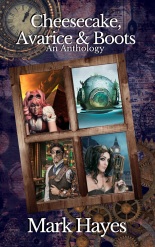
As it happens I enjoy writing the Hannibal Early years short stories, and they are well liked by a small but chirpy collective of readers, they also collectively form a complex but coherent narrative, that I am writing somewhat out of order, possibly backwards. I even know where the last of those stories would take us. There are more than the three stories currently in print and a forth is about to join them in Harvey 13. Hence i wondered if all three of the others in print (in Cheesecake, Avarice and Boots) had originally been printed in Harvey or just two of them. As it happens is just the two. At some-point the ones in the Harvey and else where may find there way into a definitive novel covering Hannibal Smyth’s early life up to the point he is sitting in the New Bailey waiting for a noose round his neck and a short drop into oblivion…

I have personally been far more involved with Harvey 13 than any Harvey previously. the bulk of the work is still being done by the ever wonderful Gillie Hatton of 6E publishing, but I am one of a triumvirate of submissions editors curating the collection to an extent… So I have a degree of pride wrapped up in this one and more skin in the game. It is however a great collection of stories.

My own, as I said is a new Early year Hannibal story, The Aspidistra Of Social Inequality. Which is a Hannibal title if ever there was one… It is joined by some fabulous tales and story’s by some new writers and some old hands …

Jake Matthew Carpenter – The Midnight Coach
Tamara Clelford – The Adventures Of Little Bear
R. Bruce Connelly – COPS: FTD
Eloign deBrohn – No Picnic For Bears
John Holmes-Carrington – Vaihtava Karhu
Christine King – Jolly Jack Tar
Peter James Martin – The Teddy Bear In The Loft
Jon Pentire – Avery
David Medina – Hell Is Other People
Will Nett – The Teddy Bears’ Quick Nick
J.B. Rockwell – A Cricket in Hell’s Acre
Davia Sacks – Mama’s Bear
Ben Sawyer – Everything’s Fine in the Mushroom House
Liz Tuckwell – The Collector
Ross Young – Igor and the Abandoned

Harvey 13 will be out soon, I’ll probably mention it when it is… Hannibal Smyth The Early Years, well that may be a while in coming… Just five other novels to finish first.

Posted in amreading, amwriting, books, fantasy, fiction, Hannibal Smyth, Harvey Duckman, horror, indie novels, indie writers, indiewriter, Lovecraft, novels, Passing Place, pointless things of wonderfulness, reads, sci-fi, steampunk, supernatural, writes, writing | Tagged , , , , , , , , , | 2 Comments

Books of magic and the magic of books

I had never been able to walk past a bookshelf without having a look at the contents

Lilian Brooks

I like a good quote, if your a regular reader of this blog you are probably aware of this fact. I like the one above because, well… I’ve never been able to walk past a bookshelf without looking in my life. This is because books, as Stephen King put it ‘are a uniquely portable magic’. They transport us to different places, different times, different sets of rules and inside different minds, both the minds of characters and the minds of the authors themselves.

Books are powerful because perhaps more than any other medium they offer us a window into the souls of others. Movies and tv shows offer up a vision, but it is the directors vision. Music is at its best a shared experience between musician and listener. Books on the other hand are something the reader experiences alone. Every voice is a voice you ascribe to the speaker, be it the authors literary voice or the characters within. And how you experience the reading a book says as much about you as it does about the author.

Some books need to be wallowed in, read slowly, a chapter or two at a time in those stolen minutes between heading to bed and sleeping. Some books need to read all at once, because their magic is in the turn of each page, the pace of the story, a story tripping over itself to be told. These books are travel books, that is not to say they are books about traveling, there are plenty of them, but they are books you read while traveling. Books that can be measured in a plane ride, or three hours on a train. Stories that are best read all at once, with short chapters that spur you on to the next…

Sometimes such books are written to be just that, a joyous fun read that wiles away the passage through the clouds, or the click clack of rails. Books you can not take your time with because there is a unurgency to them that wants to be read all at once.

Which brings me back to the quote I started with, or to be exact the book it came from, which is the second in a series. In the back of this book there is another quote, a quote from a review of the first book in this series, Dormant Magick By Lilian Brooks

The joy is in the reading, it has a splendid pace to it, well written and well structured… Everything keeps moving along, both in terms of plot and the relationships of the various characters within the coven. It doesn’t allow itself to become too predictable.

That’s a good quote, I should know as its quoting me. There is another odd bit of book magic for you. When you a ‘Praise for xxxxxx’ or ‘Also by’ and find yourself being quoted it always lends itself to a rye smile, particularly if you know they have cut something out of the quote… But it does beg the question does the second book live up to the first or does it instead wallow in the kind of saccharin over-sweetness that plagues many novels in this sort of genre, which the original didn’t, as I took pains to point out…?*

* I actually love the fact that authors occasionally quote my reviews, and if they want to do so they can chop them up anyway they wish. It just amuses me when they miss out the bits I considered important.

Rising MagicK By Lilian Brooks

I read this book in a morning, on the sofa, after songbird woke me one early dawn on a Saturday a hour before I would normally have gotten up for work through the week. Not really wanting to start the day, but wide awake, I made myself a good coffee with one of the last of my coffee pods, opened the curtains to take advantage of the day light, and proped myself up on the sofa arm to read for half hour or so before I started the day properly and got on with stuff.

Three hours and two more cups of coffee later, I put the book down having finished it. Its that kind of read. The kind you start and actually can’t put down. The kind ideal for lazy Saturdays on the sofa in the morning sunlight,. or long train journeys or flights to foreign climes.

The story picks up where book one left off, and follows a similar pattern. Short sharp chapters, that invite you on to the next one. Alyssa Bright and her little cavern of twenty-somethings living a less quiet life than it should be in the most haunted and haunting town on the Yorkshire coast. There’s a big reveal I saw coming in the first book but somehow was still surprised by when it was finally revealed. There are real locations transplanted into the story that if you know Whitby at all will delight you. There is also a sense of brooding ominousness to the story. An ominousness that leave you reading for the next book in the series ( which luckily for me happens to be on my coffee table as I write this).

It is very obviously a part of a longer series, and you should start with book one which I reviewed last year. If you read that and enjoyed it read this one. If you didn’t read the first book, do so.

One final aside, the main charter is called Alyssa, as discussed previously there is now apparently a rule that states all lead female characters in urban fantasies must be called Alyssa . No one knows why this is…

Posted in amreading, book reviews, books, fantasy, indie novels, indie writers, reads, writes | Tagged , , , , , , , | 2 Comments