Dear Edgar #12 King Pest

Between the publication of the previous story in this series ‘The Unparalleled Adventure of One Hans Pfaall’ in June 1835 and the publication of this one ‘King Pest’ in September of the same year our Dear Edgar managed to get fired as assistant editor and critic for the Southern Literary Messenger, in which both stories were published.

For a short period he was unemployed, moved back to Richmond, obtain a marriage licence so he could wed Virginia Clemm, and for a few months until he was reinstated on a promise to his good and importantly, sober behaviour in October, he struggled by on his savings.

However despite his strained relations with Thomas White the proprietor for the Messenger both ‘King Pest’ and the next story in this series ‘Shadow—A Parable’ were published together in the September issue of the magazine, though both originally were published without the author being named. Anonymous publication was unusual, though not so rare as to draw comment. In the case of these stories however it was a choice made because of Poe’s unflattering reviews and sharp whit had not made him many friends amongst his fellow writers…

To put Poe’s name to the stories would be to invite derision.

King Pest is also a bit of an odd ball, even amongst other Poe stories. It reveals in description and the grotesque to a far greater extent than even Poe’s usual work. While the story is something akin to a nightmarish romp through a plague ridden London. Think of it as the literary equivalent of a Hieronymus Bosch painting. Bosch would certainly be Poe’s illustrator of choice for this tale had he still been around.

The story it self is not overly complex. Two sailors on shore leave are drunk in a tavern and short on the funds required to pay their bill they leg it, with the landlady in pursuit. To escape punishment they jump a barrier that takes them into a part of London barricaded off from the rest due to an outbreak of plague.

Drunk enough to make there way further into horrors of the plagued streets they happen upon an undertakers shop in side which they hear the sounds of a party, and in the manner of drunkards everywhere who still thirst for drink, they decide to invite themselves inside. Whence they come upon a collection of grotesque individuals celebrating all the horrors of the diseased borough. This is the court of ‘King Pest’ who may or may not be a bunch of actors driving mad by events.

An argument at the ‘rude interruption’ of the drunken sailors, there is a lot of accusations and shouting followed by a fight, the flooding of the shop and a kidnapping while the sailors flee back to their ship, anchored in the Thames…

All of this is much of a muchness, story wise, there is nothing particularly clever or interesting going on with it. A couple of drunks causing chaos, and some strange revellers… What make the story interesting and worth reading is the descriptive nature of the telling. From the off this story is all about the grotesque nature of the characters. ‘Legs’ and ‘Tarpaulin’ the two sailors are every bit as grotesque as the members of ‘King Pest’s’ court. As is the description of Plague ridden streets

Each member of King Pest’s court is vividly described too take this description of King Pest himself…

His stature was gaunt and tall, and Legs was confounded to behold in him a figure more emaciated than himself. His face was as yellow as saffron –but no feature excepting one alone, was sufficiently marked to merit a particular description. This one consisted in a forehead so unusually and hideously lofty, as to have the appearance of a bonnet or crown of flesh superadded upon the natural head. His mouth was puckered and dimpled into an expression of ghastly affability, and his eyes, as indeed the eyes of all at table, were glazed over with the fumes of intoxication. 

It is these descriptions that elevate the tale from a nothingness to something else. But what that something else is beyond something of a master class at grotesque description is debatable. It is certainly evocative and in a strange way fascinating, but is it fun to read? Robert Louis Stevenson, who wrote both ‘Treasure Island’ and ‘Jekyll and Hyde’ said of Poe after reading this story…

“He who could write ‘King Pest’ has ceased to be a human being.”

Which is somewhat damning but is not entire with out merit as a summing up of the tale. It is an exercise in grotesque description, at which it excels, but beyond that it has little to much recommend it and there isn’t a single character with which you will feel affinity or wish to.

TWO BLACK WINGED AVIAN’S WITH EYES LIKE DARK SIGNETS OF JET THAT OF A NATURE ARE LESS THAN KIND

Should your read it: If you seek to learn the art of descriptive text certainly, and if you like the grotesque aesthetic there are things to love here, but such love is as thin and reedy as ‘Legs’

Bluffers fact: There is a theory, and nothing more than that as Poe never confirmed or indeed denied it, that King Pest court was meant as a parody of Andrew Jackson, his friends, relatives and cabinet. Certainly America’s 7th president who was in residence at the white house when the story was first published was ripe for satire. Some of his political enemies referred to him as ‘King Jackson the first’ due to his autocratic style. While the description of King Pest, as tall and gaunt, describes Jackson to a tee. While other members of the court could be stretched to fit members of Jackson’s inner circle.

Before Dear Edgar I wrote a whole series of blogs on Lovecraft’s stories, which later became a book
Posted in amreading, Dear Edgar, horror, humour, opinion, Poe, reads, retro book reviews | Tagged , , , , , | Leave a comment

An old beautiful thing and a terrible one

Last weekend I was in Stroud attending their annual steampunk event, doing the author thing and a certain amount of prating about. It was a lot of fun, as such events always are. On this occasion I took with me an old beautiful thing and a terrible one. Well a stack of terrible ones, but lets talk about the old beautiful thing first… And no I don’t mean Matt McCall the other person in the picture below…

The old and beautiful thing is the Banjolele I’m holding in the picture. It is probably my favourite instrument in my large and occasionally ridiculous collection of things with strings from which the talented can perhaps get a tune. The reason it is a ridiculous collection is of course because while I own a couple of electric guitars, an Epiphone semi, a twelve string semi, an electric bass, a battered old acoustic, and a cigar box guitar ( oh and a lyre ) I can’t really play any of them. Unlike the rest however I didn’t buy the Banjolele, that was inherited.

My Banjolele was made by John Grey & Sons (London) Limited, some time around 1900, what I do know for sure is it was bought by my great great uncle Fields through my maternal family line in 1905, and it has been in the family ever since passed down the family line from my grandma Edna Herrington (Fields), through my mum Pat Hayes (Herrington) to me eventually. Over the years since the death of my Great Great uncle in the war it has been play with by generations of Fields, Herrington and Hayes children, right down to my own, with all the reverence and respect you would expect. Which is to say it has been battered bruised by us all and on occasion has been used to batter and bruise one or two of us by our siblings.

The varnish is somewhat chipped, as you can imagine, and when I finally rescued it from my parents house a couple of years back it had only a couple of drum hocks left, was missing a couple of strings, tuning pegs were loose or locked solid, the neck bridge was snapped. It as basically in need of a little love an attention, but then it is at least 118 years old, and it not exactly been kept in a glass case. In fact it is in its original compressed card case which is also something of a thing of battered beauty.

I spent time and a little money rebuilding it, sourcing parts and oiling the ones that could be saved. It is still battered, I have not re-vanished it, as that would mean stripping back to the wood and frankly that chipped and battered frame is what makes it beautiful. It still sounds wonderful when in tune, it has a strangely oriental tone when plucked. I’ve been playing the old thing since I was a child and first found it hiding in the bottom of my parents wardrobe. I have never learned to play it properly but then I don’t have the thin aquiline fingers needed for such a delicate neck. But it still brings me joy. Like old battered beautiful things often do. As it has for generations of my family and in time I’ll pass it down the line to the next keeper.

As I mentioned at the start last weekend I also took with me a terrible thing, or a stack of them. The terrible thing in question was another new book. One I have not advertised or spoken about until now because I made it specifically as keepsakes for those wonderful, mad and put upon souls who had agreed to put on a terrible if fun play with me at a couple of events earlier in the year. Because, well, the minimum size a book must be to make a paperback on POD is all of 24 pages and putting the play into paperback form appealed to me.

It actually ran out at 36 pages in the end and I intended to just order the copies I needed to give the cast one each, but in the end I ordered a few extra ones because I could. I originally planned to then un-publish the book, but terrible thing though it is I feel it’s earned its existence.

To be clear at 36 pages long its really not much more than a pamphlet, it has the full script, some notes on putting it on, a cast list and and introduction and that’s about all. It is also expensive for such a tiny book as the minimum I can charge for it is set by amazon. So, to be clear here, it isn’t worth buying… I am not going to attempt to sell it. And this is probably the only time I will mention it. But on the off chance anyone does want a frankly terrible (if fun) play, it will remain available.

If anyone ever does put on their own production of The Drag King in Yellow, please get in touch and send me pictures 🙂

Posted in Uncategorized | Tagged , , | 1 Comment

It…

What follows is in some regards a prose poem, it has existed in many forms for several years, this is merely its latest incarnation. It exists because it was originally written in it’s original formed to explain a concept to myself involving a book I have not yet written and one which I have. It has existed for longer than the latter and there is no guarantee the former will ever come to pass. But a switch went off in my head yesterday which has made it more likely it will. This lead me to spend some time going though extensive notes and files. Which brought me to this, once more.

Some of you may find it interesting, or intriguing, or possibly maddening. I really could not say which is more likely. For those who do , enjoy, for those to whom this may all mean nothing, well I could explain more but I won’t.

It…

It watches…
It would be wrong to say it is waiting.
Waiting would imply it was waiting for something. That it desired something. Desire is an emotion, want is an emotion. Emotions are not something it experiences. To have emotions requires a frame of reference for emotion is a reaction.
It does not react.
It does not desire.
It does not want…
It does however hunger, though what it hungers for it could not describe, not by any frame of reference you could understand.
How could you understand. You, a child of the universe. How could you understand what it hungers for.
How could you relate to a thing that lays beyond your universe.
Beyond any universe.
A thing of the void that was there before the universe was born. The void that will be left when the universe collapses in on itself into the endless frozen heat death that awaits it. How could you even envision such a thing.
How could such a thing envision you…
Yet it watches…
As it has always watched. Since the vital spark of existence gave birth to the very universe in which you exist. It watches from beyond infinity. An infinity expanding ever outwards, but never growing closer… Distance, is a thing of the universe, not that which lays beyond its bounds.
It is as close as a whisper and as far as darkness.
It watches even now, watches in the eternity between seconds, for time too has no meaning, for time too is of the universe. A function of gravity, of matter, of existence…
It watches, and it hungers…
It hungers not to be an abstraction, a thing of the void, a thing outside of time, outside of space, outside reality.
It hungers as another did once.
And pulses
Red.

Posted in amreading, amwriting, big questions, fiction, Passing Place, reads, sci-fi, supernatural, writes, writing | Tagged , , , , , , , | Leave a comment

Hopeless Recordings

Probably because there was no one competent available I was asked to record the Ominous Folk of Hopeless Maine performance at Rising Steam 2023. So I did…

The first song is about demonic devices, which is to say it is a song form the perspective of a demon forced to power a device. Possibly a steam roller, may be a kettle, or possibly a really over engineers rotary washing line. Please remember not to try this kind of thing at home unless you have a 5th level summoning circle and an emergency banishing spell to hand…

Next we have a song about sea monsters, that is perfectly rehearsed and the mistake at the beginning is pure theatre…

And finally ( though I have a couple more recordings that I’ll try to get done at some point ) Shapeshifters, which is hauntingly beautiful and deserves a better recording than I managed

So if that doesn’t encourage them to get into a recording studio and record things properly I don’t know what will.

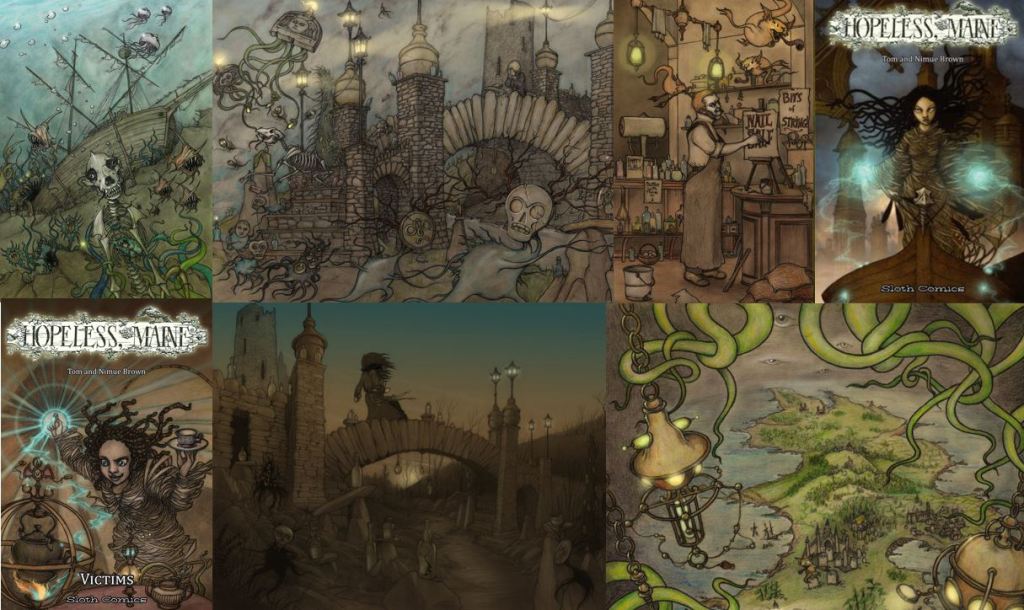
The Ominous Folk of Hopeless Maine are a musical off shoot of the Hopeless Maine graphic novels drawn by Tom Brown and written Nimue Brown which if you have encountered you really should seek them out. Start HERE at the Hopeless Maine website. I may have mentioned them before…

Posted in music, pagan, steampunk | Tagged , | 2 Comments

Strange wonders

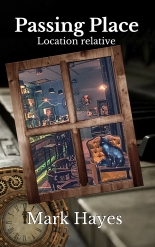
For reasons I’m unable to go into at this point I found myself recently in the odd situation of having a bunch of completed, fully edited, fully proofread stories which were about to become orphans. Each of these stories, ecliptic mix though they are, are stories that fall within a certain paradigm. Stories that could be told in Esqwith’s Passing Place, my fictional bar on the edge of reality. This is to say they were all a certain kind of story, stories with hidden messages or some deep emotive questions within them.

In fairness, this could describe most any story I’ve written, but while the definition is a shifting thing, as real as sunlight through gossamer spider webs and just as hard to grasp in your hand. I could not give you a definitive answer as to what make a tale a Passing Place tale. Though mostly they are first person narrative’s, a story being told to a listener by the one to whom the events happened. The listener is of course by proxy the reader. While the stories are those that could be told by a stranger in a bar to whomever is there to listen.

For those who have never read my 2016 (my god has it been that long) novel Passing Place, some explanation may be needed as to why this is important. Passing Place is a long narrative novel about loss, guilt, grief and the bitterness of lost love. It tells the story of a Piano Player searching for the answer to that most hateful of questions, why? His why, being wrapped up in the death of his wife by her own hand. In the novel he ends up in a strange bar, and people tell him stories. Passing Place stories… The kind of stories I found myself unexpectedly awash with a week ago, and decided I really wanted to do something with them. As they were not stories that should remain orphans, they were stories I loved, stories I was proud of, stories I feel needed to remain told.

So I decided to make them a new home.

As books go its a small one, just 160 pages, containing nine short stories.

Tales of Sanctimonious cults, another of a strange tower that do not want to be seen. A story of madness and elder gods returning in the Tees valley, a tale of a magician appointed to the court of Victoria Sax-Coberg. The strange statement of a life repeating in waves of twenty-seven, a tale of a wyrd in the western deserts cira 1850, a story with Sigmond Freud in a rowing boat and finally Hannibal Smyth, who is his as reliably honest as ever, while carrying and aspidistra.

But we’ll begin with a story of the inhabitants of the bar itself, a tale called The Strange and The Wonderful… Hence the title of the collection, as the name seemed right. I am also ridiculously pleased with the cover and the little bits of internal art. In the hardback edition in particular, it is a very pretty, and very pleasing little book.

It also has one more thing between its covers, a single poem by way of a dedication, to the best man I have ever known. I have never published a poem I have written before, and more than likely never will again, but I think my father would have been pleased to be associated with this little book, I hope so anyway.

Posted in amreading, amwriting, books, cthulhu, fantasy, fiction, Hannibal Smyth, horror, indie, indie novels, indie writers, indiewriter, Passing Place, reads, sci-fi, steampunk, supernatural | Tagged , , , , , , , | 1 Comment

Dear Edgar #11 The Unparalleled Adventure of One Hans Pfaall

Edgar Allen Poe remains one to the most influential writers of the western cannon. His Horror stories inspired many writers, not least those of HP Lovecraft’s generation a hundred years later and by extension Steven King generation were inspired by both Poe and the previous generations he had inspired. Without Poe there may never have been a Cthulhu or a Pennywise the clown.

It’s not just Poe’s tales of Horror that inspired those who came after him. Sir Arthur Conan Doyle attributes the innovation of the detective story to Poe’s, Auguste Dupin stories beginning with Murder on the Rue Morgue. Inspired by the Dupin tales Doyle came up with his own detective, Sherlock Holmes, to no small success, and Doyle in turn inspired Agatha Christie and a whole host of modern writers who have made the genre their own. Poe’s ability to inspire in these cases is well known and well documented as is the influence of his humorous tales to the likes of PG Wodehouse and others though to a lesser extent than his horror and detective fiction.

There is, however, one genre of stories for which Poe influence gains less acclaim, that of science fiction. Few of his stories really lent themselves to the genre. And yet, his influence when they do remains just as profound, as is the case with the cumbersomely titled ‘The Unparalleled Adventure of One Hans Pfaall’ first published in 1835. A story that led to none other than Captain Nemo’s creator, Jules Verne, to proclaim Poe to be

‘le créateur du roman merveilleux scientifique’

and when the father of science fiction called someone the creator of the scientific novel, I think we science fiction writers have to tip our hats to our own Dear Edgar too.

Verne said this in the original introduction to his 1865 novel ‘From the Earth to the Moon’ a novel which also directly references ‘The Unparalleled Adventure of One Hans Pfaall’ in it’s text, and was clearly inspired in part by this particular story. So as with the other genre’s Poe inspired some of the greatest writers of the western cannon. Writers that went on inspire future generations of writers up to and including today, myself included.

Verne’s ‘From the Earth to the Moon’ centres around the building of an enormous cannon to literally shoot for the moon, carrying three people in a shell. Verne referred to the shell as a ‘space ship’, believed to be the first ever use of that term. This is of course a ridiculous idea, the G forces alone experienced in such a shot would massively exceed those astronauts experience in modern rockets which are already on the cusp of what a human being can experience without expiring. But it is a splendidly ridiculous idea all the same and why let facts get in the way of a good story… Which is why I nicked it and had a ‘mad scientist’ called Elonis Musk building a similar gun on a volcano on a tiny pacific island in my third Hannibal Smyth novel, which was great fun to write.

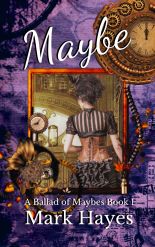
When I wrote that novel I had no idea that Verne’s original novel had been influenced by this particular Poe story, as I’d no idea this particular story even existed. But the point here is that no ‘The Unparalleled Adventure of One Hans Pfaall’ then no ‘From the Earth to the Moon’, and by extension no ‘A Squid on the Shoulder’.. So once I’d done my research and discovered the admittedly tenuous connection to my own work, I was rather looking forward to reading the story itself… However there is a big problem with the story.

The problem is of course that ‘The Unparalleled Adventure of One Hans Pfaall’ is a precursor to science fiction. It has the same issue as with the main problem with Verne when you read his stories now, the technology that was innovation when written is so very dated now. Verne made calculations for his gun that from a technical point of view were not far off the mark, but we know now it would never have worked. But Verne, perhaps due to the habits of his translators tends not to be ‘tech’ heavy in his stories, they tend towards the adventurous and remain readable (unless you read the unabridged versions like the unabridged 20000 Leagues Under the Sea I read a few years ago, which has many many lists of fish among it’s pages.)

Verne’s novels are defining novels of the genre so their idiosyncrasies are oft forgiven. ‘The Unparalleled Adventure of One Hans Pfaall’ however is not a defining novel, its a little known short story by an author known for his gothic horror, about a man traveling to the moon in a balloon of his own design. Something harder to suspend your disbelief about than giant moon-shot cannons. Hot air balloons were the pinnacle of aeronautics in the 1830’s. Poe’s character, a bellow maker by trade, makes on and fills it using a special gas acquired from a French chemist, this gives him the altitude to escape gravities grasp. Then by compressing the void of space through another device to make breathable air he travels to the moon.

He does all this because the bottom has fallen out of the bellows market because people can fan the flames of the house hold fire place with newspapers. Again, this is not actually comedy, broadsheets with multiple pages had recently become a thing as paper and ink became cheaper and print presses more advanced, bellows really were old tech when a cheaper option to repairing them could be bought for a halfpenny… Also a bellows maker is skilled with metal and leather as well processing as a basic level of mechanics so strange though it may seem there is some logic here.

The moon too is not the moon that Neil Armstrong walked upon. It is a fiery volcanic satellite inhabited by small humanish people… One of which takes Pfaall’s craft back to earth to drop off a letter explaining where Pfaall vanished to five years before, and the fate of the three others who vanished the same night, creditors he murdered in order to escape as they came upon him just as he was preparing to launch his craft. Indeed the only reason we know any of this is his letter is a begging post asking that the Berger’s of his home town grant him a pardon for the murders as it was an act committed under duress… The town council grant his pardon after reading the full details of his adventures, however the moon man Pfaall sent as his envoy had not stuck around so they have no way to let him his plea for clemency had been granted…

Lets just say the whole tale is ‘a lot’.

All of which could be smiled away had it been written as humour, but while there is some humour in this story, much of it is po-faced. This was written as a serious story and meant to be believable on some level, which in the 1830’s was not inconceivable. Poe originally wrote the story to be published in a newspaper as a hoax letter claiming all this to be real. While he added more elements of the fantastical in later drafts that original core of believable for the times science remained. The trouble is, what was a believable if farfetched science base tale in 1835, is in this later age merely ridiculous. The required suspension of disbelief is just too much for the faux-factual story it pertains to be. If Poe had filled this with humour and written for rye smiles it would possibly still work but as it is it just doesn’t any more.

Don’t get me wrong, this is a well written tale. Written with all Poe’s eloquence and mastery of the language, but its a toil to read and lacks any real spark. It could read as a plain fantasy, but it wasn’t never written to be one. Its a tale that has lost its audience to time and lacks the charm to get past its failings.

A SINGLE RAVEN DYING ON ITS BACK…

Show you read it: As a story it is only really of interest to scholars of science fiction as one of the progenitors of the genre. Even then it is more progenitor of a progenitor, and hard going.
Redeeming feature: While I would not recommend it as a story to read it deserves its plaudits for what it inspired, if nothing else.

Bluffers fact: Po-faced is British slang meaning someone has a humourless, disdainful or sour-faced demeanour. Surprisingly then this has nothing to do with Edgar Allen Poe. The origin of the term is instead believed to be derived from the word ‘po’, an abbreviated slang based on the French for chamber pot, ‘pot de chambre’ due to the distasteful expression anyone would adopt upon being presented with a full one.

And yes, I looked that up when I stated this story was po-faced and realised I wasn’t 100% sure it wasn’t a reference to our own Dear Edgar’s oft depicted demeanour.

Posted in amreading, Dear Edgar, fiction, Poe, reads, sci-fi, steampunk | Tagged , , , , , , , , | Leave a comment

Book reviews beyond the paradigm

Hello, how you doing?

Yes I know that is an odd way to start a blog post but its the most important question we can ask each other, even if its the one that normally elicits gentle lies rather than uncomfortable truths. Also I am not the greatest at small talk, but I am trying to get better at it. Or at least less awkward. And sure there is probably a point to me asking beyond that which may becomes clear, or not as the case my be, but enough of that…

Regular readers of the book reviews I post will be aware of two things. The first being that I never give bad reviews, if I don’t like a book I just don’t review it, as I may not like it but that may just mean its not for me. The second thing regular readers will be aware of is that I tend to witter on aimlessly on a topic for anything up to two thirds of the post before I even mention the book I’m reviewing. Some might find this annoying, but one has a paradigm and one sticks to it. Besides the wittering is generally at least an attempt to get across something vaguely profound or relatable I found within the pages of the book I am reviewing.

This is my paradigm with almost every blog post I ever writer to be honest so if you don’t like my paradigm, your probably reading the wrong blog, and what I consider profound or important to say about a book is probably of little or no value to you. I’ll assume therefore if you are still reading past this you like what we might laughably refer to as my literary style at least when it comes to blog posts. The paradigm must be preserved, my readers, that’s you lot, like it that way…
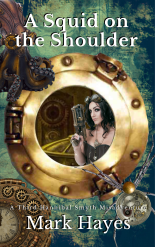
So anyway. What follows are the reviews for four books that each for different reasons, I cannot, or at least will not review within the normal rules of my paradigm. They are four equally excellent, but very different books. And the reasons each of them don’t get their own blogs with long wittering introductions are different as well. They are instead getting this shared introduction which is, you may have noticed, a bit weird. All of them are in this group because if I was to write a long introduction piece for each it would be the type of witter that would likely reveal far more about myself, my objective reality and how I doing right now, than I am comfortable revealing to any one.

“I am fine,” he says, with the gentlest of lies… (see I told there was probably a point…)

Or of course I am just being lazy, and trying to do a bunch quick of reviews all in one go… But there are some other links between these books if you pay attention you might spot them…

(amazon links for all four books are at the end)

Stolen Magick by Lilian Brooks

Speaking of objective reality, Lilian Brooks is a totally real person and not a pen name used by Amy Wilson a fellow founding Harvey writer I’ve know for years.

This is the third of Lilian’s ‘The Whitby Witches’ series featuring water witch Alyssa Bright, a modern pagan woman in her late twenty’s dealing with… Well the second book ended on a cliff edge, and this one jumps off that cliff and does some serious screwing around with Alyssa’s objective reality, and the readers who have to adjust to a new paradigm fairly sharpish to keep up with the plot…

It’s a brave novel, because its brave for any writer to throw their readers such a curve ball in an established series. A lesser writer might struggle to pull it off, but luckily Lilian is not a lesser writer. My reviews of the first two books in the series were some what longer, but to review further than say this is a great read would involve spoilers for this book and the series as a whole. So start at the beginning, the journey is worth it, trust me…

review of book 1 review of book 2

Beyond Sustainability by Nimue Brown

Climate change is swiftly moving the world into a new paradigm. A new way of thinking about, well just about everything, is needed, a new focus, a gentler more sustainable approach to life, but more so we need a more authentic relationship with each other and the planet, as individuals, as a society and a species.

What do we really want from life? How do we find happiness, health, purpose and comfort? Humans are increasingly a miserable species, caught in ways of behaving that give us very little and will cost the earth…

What it it was easy to change our lives? What if happiness wasn’t an impossible dream to chase after? What if we could have nice things?

This is the core question and message of this remarkable book by Nimue Brown, I could talk about it for hours, and write many many blog posts inspired by this book and the soul searching it inspired. But I won’t, instead I will suggest you read it yourself as the journey it takes you on may differ to mine. All I will suggest is that you allow yourself to be open to the possibilities of a more authentic approach to life, happiness and the world as you read.

Facing The Darkness by Cat Treadwell

I have in the past spoken of my occasional struggles with ‘the old black dog’. I believe talking about such things is important, indeed as I am a man I consider it even more important I do so because ‘a chap doesn’t talk about such things.‘ Some people are however far better at talking about depression, they are also far better at given practical, loving, thoughtful advice on ways to face it, fight it, and survive it.

This is a remarkable book in many ways, it is remarkably honest in its writing, remarkably open about all forms of depression, remarkable in coming at the issue from the perspective of a practising pagan, but also remarkable for the depth of advice and wisdom granted to the reader to help guide them through those dark hours and days when the world seems too much and going on too hard.

It is also a beautiful book in both in Cat writing, as well as the authentic voices of contributors, the structure of the book and some frankly heart wrenchingly beautiful and poignant art work by Emma Hotchkin between the covers.

I can not claim this book has helped me face the old black dog, yet, as I have read it at a time when the old dog is in his kennel and not troubling me. Also while I lean towards a form of personal paganism my roots do not lay in druidism so some of the practical suggestions don’t resonate with me as well as they may with those of a more orthodox pagan faith. But that ‘yet’ is doing some heavy lifting and this book is going on the shelf so I know where it is should I find myself feeling the need for the guidance and advice held within it.

And I would certainly recommended it to anyone, pagan or otherwise, for what it contains is the kind of hope you need when the darkness comes a calling.

Once Upon a Hopeless, Maine by Keith Errington

This is not a children’s books, don’t let your children read it, it will give them idea’s and they will enjoy it far too much… This is the kind of book your child wants you to read to them. You should not. It is the kind of children’s book you would have loved as a child, and will love now, and would love to read to your child, even though you know you shouldn’t.

Look it very defiantly says ‘A not for children, children’s story’ on the cover… I think that is as clear as it needs to be. Do not buy this book to read to your child…

Buy it to read to yourself, enjoy the art work, laugh, smile and remember just how much this was exactly the story you wanted your parents to read to you when you were a child…

But don’t read it to your child…

Unless of course you want to, because your the kind of bad parent every child actually wants , you know , the cool one who doesn’t make them tie their laces before they run off, because you want to see if they learn by tripping over them…

The Links

And there we have it, all caught up, normal wittering will resume when I review a book I am sure. Enough of the paradigm nonsense that’s for sure.

Much love

Mark x

Posted in amreading, big questions, depression, fiction, indie writers, pagan, reads | Tagged , , , , , | 3 Comments

Dear Edgar #10 Lionizing

Lionize, transitive verb: to treat as an object of great interest or importance…

We live in the age which lionises celebrities of stage and screens both big and small, sporting stars of team sports and individuals who sell us products splashed across the shirts they wear, and while we are at it we also as oft as not lionize the vacuous for no reason other than the vogue of their existence… Much is made of celebrity culture and how it damages society. The views of a musicians, actors, footballers, or even just a football pundits are both lorded or derided in equal measure depending entirely on the cause celeb on which they have chosen to express their opinion and the opinion of the zeitgeist, or at least those who make it their role to steer the public in the direction they chose. It was, however, ever thus.

In this micro media age of Instagram influencer’s, tiktok dancers and you tube stars, the lionised have become whomever shouts the loudest for our increasingly minimal attention spans. Today you can become a star in your own lunchtime, be a has-been by tea and a never-was by supper time. You don’t have to put much in the way of consideration or indeed apply your intellect to what you say or do, you don’t have to think about it for a moment, just record your opinion and put it out to the world. Demand likes and retweets, and with those you measure your fame. The more vacuous the better frankly if that is your aim. Or perhaps just dance like no one is watching them post it to the internet and hope everyone does. Or film yourself commenting on the artistic merits of a movie without take a moment to consider what that movie may mean…

We are eight billion lost souls, seeking to be celebrated for our celebrity, rather than our achievements. All seeking to be lionised, to become the in thing, that which is, rather than that which never will be or never was…

What, you may be thinking, has this mildly extended rant have to do with the stories of Edgar Allan Poe. Poe’s stories are after all some what at odds to the disposable culture of the twenty-first century. They and their writer, have stood the test of time. Well, for the most part not a great deal, but in the case of this particular story, ‘Lionizing’, everything, because this tale is a satire on the vacuous nature of celebrity, and its all in the nose…

‘Lionizing’ is a tale told to us by Thomas Smith a man born in the city of Fum-Fudge with a remarkable nose, and an even more remarkable interest in noses. He also claims to be the foremost expert on the study of Nosology which he explains is the study of noses. Which is a handy coincidence as his is a particularly fine example.

After a youth spent studying nosology and everything the great and good have ever said on the subject he is kicked out of the family home by a father whom, reading between the lines, is less than taken with his sons obsession. Thomas then goes on to write a pamphlet on the study of noses which, he tells us, he is divinely inspired to do, and takes great pleasure in telling us just how well it was received by. Well by whoever had an interest in noses presumably. Then he goes to visit an artist and displays his nose for all to see and sells the rights to the image of his nose to the artist for a small fortune before becoming a celebrity on the salon circuit where the great and the self important, talk about things of weight and the things that they think should be of weight. While Thomas of course talks about his nose, to various reactions…

‘O beautiful!’ — sighed the Duchess of Bless-my-soul.

‘O pretty!’ — lisped the Marchioness of So-and-so.

‘Horrible!’ — groaned the Earl of This-and-that.

‘Abominable!’ — growled his Highness of Touch-me-not.

In a whirlwind Thomas rises in society, until of course he gets so high on his own self-importance that he reacts to a minor insult by challenging a respected noble to a dual, which he wins by shooting off the others nose… At which point his short period of fame becomes infamy and he is driven out of society.

There is not a great deal of subtly in Dear Edgar’s humour in this tale. He goes for the satirical throat from the off. What he is satirising is not of course the TikTok generation, rather the intelligentsia of the salon circuit and the value and importance that those who moved in such circles ascribed to their own opinions. Opinions that seem quite vacuous from the outside, our nose obsessed narrator Thomas Smith among them. But it is easy to transpose the satire onto the micro media/celebrity age. While Poe is not subtle and this is all a very in your face kind of satire he lands it perfectly. Sure the intelligentsia of the salon circuit isn’t the target it was, but think of it as a satire of social-media stardom and it works just as well as it ever did.

Also I must admit that for me the pair of lines below in it when Thomas is describing one of the many attenders of a salon makes it worth the read alone, As, as a former student of philosophy I can only smile and agree…

There was Sir Positive Paradox. He said that all fools were philosophers, and all philosophers were fools.

What this tale shows once again is that for all he is mostly thought of as a morose writer of gothic horror and murder Poe wrote compelling satire and humour that sits there with the best of them. Subtle as a brick through a window perhaps, but if this short story doesn’t raise a smile and a merry chortle along the way then frankly you’re doing reading wrong…

Of course all that said I’m just a man who spouts vacuous opinions on the internet in the age of micro media so what would I know…

A NOT UNKIND FOUR RAVENS WITH ONE RYE EYE CLOSED EACH, AS IF WINKING AT YOU

Should your read it: With a smile, for the few minutes it will take you…

Should you avoid it: Just read it.

Bluffers facts:  Nosology is a real science, it is not however the study of noses, but in actuality the branch of medical science dealing with the classification of diseases. Nosos being the ancient Greek for disease, something Poe would have been aware of, so doubtless delighted in misusing the term for the purpose of humour. The scamp.

Posted in amreading, Dear Edgar, goodreads, Goth, humour, opinion, Poe, rant | Tagged , , , , , , , , | 1 Comment

Quote the darkness, Evermore

‘Hello darkness, my old friend, I’ve come to quote of you again…’

We are in the midst of summer, darkness is hard to find when the nights are short and the days are long. Sleep is hard to come by, the rhythms of the body match the seasons. Now is not the time to sleep, now is the time to hunt, to gather, to partake of the rich bounty of the summer and prepare for the what will inevitably come once more.. This is not a time to think of darkness, this is the time to celebrate the light… So here are some quotes about darkness, in all its many forms.

The woods are lovely, dark and deep. But I have promises to keep, and miles to go before I sleep. ~ Robert Frost

Reality is merely an illusion, albeit a very persistent one ~ Albert Einstein

The cruellest lies are often told in silence ~ Robert Louis Stevenson

The most common way people give up their power is by thinking they don’t have any ~ Alice Walker

Stars, hide your fires; Let not light see my black and deep desires. ~ William Shakespeare, Macbeth

When you light a candle, you also cast a shadow. ~ Ursula K. Le Guin

Long is the way and hard, that out of Hell leads up to light. ~ John Milton, Paradise Lost

I’m not afraid of the darkness outside. It’s the darkness inside houses I don’t like. ~ Shelagh Delaney

Now, turn go out in the sun and enjoy its warm glow, while it lasts…

Posted in 2020 quotes, amreading, humour, mental-health, opinion, quotes, reads | Tagged , , , , | Leave a comment

Playwriting

I am a novelist, and short story writer, these are my mediums. Occasionally, on a dark night when the wind if form the north and the whispering of ravens is at it worst I may even write poetry, but I will almost certainly deny this… What I am not is a playwright or performer. the former is not a skill set I have ever pursued.

As for the latter, well life is oft said to be a performance, though who or what forms the audience for that performance is a matter of some debate. What callow gods do watch us without interest nor care?

I did however spent a great many years of my life performing for one audience or other. Boyfriend, lover, father, husband, sports fan, music fan, son, jester, reader, drinker, goth, posser, and many other roles along the way. Unconvincing performances all, because I am all these things and none. But we perform for those we wish like us, love us, or occasionally just need us. Some perform these roles without seeming effort, perhaps because they inhabit the roles in a way I never have. I was never good at inhabiting these roles that others may wish me to be, or indeed the roles I wish to inhabit. Yet perform them I did, wearing masks of my own making, masks I learned to see in the mirror, masks I learned to forget were masks, until the cracks began to show…

I made a decision a few years ago to stop wearing masks. to just be myself and let the bones fall where they may. And for the most point I have managed to do that, oddly I feel happier trying to be no one but myself.

So this is me, a writer of novels and short stories who doesn’t perform…

Then for reasons to do with the strange people of Gloucestershire, I wrote a play and even more weirdly I performed in it. I’d deny everything, but it was filmed and someone put it on You tube. So enjoy the one and only time I will be caught performing, and my sole and last venture in to Play writing.

The manuscript is available in book form on Amazon though why you would want a copy is beyond me

https://www.amazon.co.uk/Drag-King-Yellow-Play-One/dp/B0CCXP3D5M

Posted in amwriting, Lovecraft, mental-health, rites, steampunk | Tagged , , , , | 2 Comments