Rambling through a full edit…

Stephen King explains in On Writing that his approach to second drafts and editing involves reducing the word count of a novel by a good ten per cent. Having read my fair share of Mr Kings novels, one hates to think how long they were to start with, but I can see his point. There is a natural desire as a writer to be wordy. At least I find that to be the case for me. (regular readers of this blog are shocked by this revelation I am sure…) So If I do not watch myself, I have a tendency to ramble in early drafts.

With previous novels, that tendency to ramble has perhaps been less checked that it should have been in final edits. Though I do make a conscious effort to avoid rambling too much, and no one has yet accused my novels of being too verbose, so I’ve hopefully got away with it. People generally like them for a start…

But with ‘A Spider In The Eye’ I have a different problem. Unlike my previous novels, this one is narrated by the main character. It is in effect first person, but at the same time because of where and when he is telling his story it has a degree of the memoir about it. All of which is fine, it is a stylistic choice I made after I originally wrote the first few chapters as a third person narrative. While it worked in the third person, the first person just suits the story I am telling more. Hannibal’s own insights into events are what makes the story work for me as a writer.

But therein lays a problem. For a while I tend to ramble a little if left unchecked, Hannibal is far more inclined to ramble than I am, and finding that sweet spot between what is Hannibal’s voice and what is my own rambling is somewhat challenging. Not that I am complaining, the challenge of bringing a fictional character own voice to life was the reason I decided on writing this particular novel this way. If it were easy, well it would be no fun at all…

There is a touch of the masochist in every writer. If we did not secretly enjoy the struggle, I suspect none of us would do it. Though that could be just me.

So here I am, editing away my rambling, while not editing away Hannibal’s rambling, and trying to cut away the chaff… Which begs the question, as I am consciously trying to cut more than I add, of how a mere 76 pages into a 416-page document, the word count has grown by another 1000 words.

Still, I know that the 75 pages I have done are far more polished and cleaner than they were when I started this edit, So I guess, as Hannibal would say “small victories and all that…”


Posted in #amwriting, Hannibal Smyth, indie, indie novels, opinion, pointless things of wonderfulness, rant, writes, writing | Tagged , , , , , , | Leave a comment

The Call Of Cthulhu: TCL #47 Part 2 The Tale of Inspector Legrasse…

“Ph’nglui mglw’nafh Cthulhu R’lyeh wgah’nagl fhtagn.”
“In his house at R’lyeh dead Cthulhu waits dreaming.”

The above is from the second part of Call of Cthulhu, Lovecraft’s most well-known work, and one of his best. I’m not going to make any bones out of this, Call of Cthulhu is something of a masterpiece as far as Lovecraft’s stories go. It’s a sea change in his stories, moving from smaller personal tales to a wider perspective. This is a tale of events that span years, aeons in some respects, and are global in scope. It doesn’t tell of horrific events in one location happening to a single narrator. Instead, it instils a sense of dark wonder, at a horror that encompasses all human and the world. Importantly, however, tries to do so in such a way that the reader’s disbelief can be utterly suspended, and make them envision that menacing darkness that lays beyond this pool of light we call the rational world…  Which is a neat trick, if a writer can pull it off.

The Tale of Inspector Legrasse…

This part of the tale explains why the erstwhile Professor Angell was so interested in the bas-relief that gave the first part of the story, ‘The Horror In Clay’ it name. As opposed to dismissing the sculptor of the foul piece of art as a madman for his talk strange haunting dreams and driving urge to create the image of the being we know of as Cthulhu… the simplest explanation of which is, it was not the first time the professor had come across such a figure. The first time was some seventeen years prior at a meeting of the American Archaeological Society when an inspector of the New Orleans police came before the gathered alumni of that organisation bearing an ancient statue of an unfortunate province…

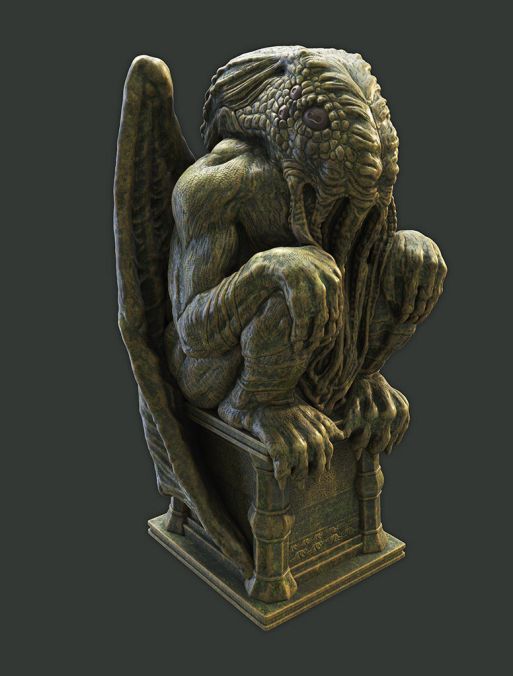
cthulhu-statuette-3d-model-obj-fbx-stl-mtl-3b

That statue, perhaps unsurprisingly, is one of the most popular Lovecraft collectable’s, or at least the several hundred different versions of it that have been created over the last few decades by various artists. Which is a wonderfully odd fact when you think about it. The Statue in the story had been in the possession of an ancient cult practising foul rites in the worship of the great old one represented in this strange piece of cunningly carved soapstone. Now representations of this fictional statue of a fictional god-like being reside on mantle pieces and in display cabinets around the world. The fictional cult of Cthulhu has far and away been surpassed by the cult the fiction created…

What’s that old chestnut about the power of belief shaping the gods, and the power of gods stemming from belief… In moments of whimsy, it is a strangely worrying thought that so many Cthulhu ‘worshipers’ look up at the craven image of the one who awaits the stars being right…

But idle speculation of the nature of belief on one side lets get back to the story. Inspector Legrasse tells the assembled great and good of American archaeology how he came by the statue, in the depths of the swamps below New Orleans, breaking up a strange ritual gathering where ten people were murdered to be the beat of tom-tom drums. A tale dark enough in the telling but what adds to its credence are the observations of Professor Webb one of Angell colleagues who came across a similar cult in Greenland years before, also practising dark rites. One which chanted in a strange dead language the words…

“Ph’nglui mglw’nafh Cthulhu R’lyeh wgah’nagl fhtagn.”

Words which he could not translate at the time. Legrasse, however, heard that same chant in the swampland of Louisiana and managed to ‘persuade’ one of the members of the cult he arrested to translate it as much as it could be into English…

“In his house at R’lyeh dead Cthulhu waits dreaming.”

So now we have events in New England, Greenland and Louisiana swamps all tied to this strange image. But more than this as the narrator begins to investigate his uncle’s papers and beyond. He also begins to suspect that his uncle’s death was not entirely as innocent as it first appeared. Was his uncle killed by this strange cult that seems to have tendrils everywhere? What secrets lay behind all this…

It is the secrets that lay behind it all that really make this tale what it is, and it is this second part that the reader really starts to get a greater view of it all. Its disjointed in places, and suffers the fate of any tale that tries to encompass something so huge in scale so quickly. The further the narrator’s story goes into his own journey, the more he discovers, the more profound the mystery… the more horrifying the possibilities… It would be an easy thing to fail in this story, yet it doesn’t, all it does is draw you further in. A certain level of awe is inspired along the way.

I’m not going to talk much more about it, or all the lays upon lays of story here. Because at the end of the day I would not wish to spoil this tale for anyone who has not read it. But this is myth building at its finest, the growth of the mythos and the darker history of the world before humanities rise feels real, for all it is just a story, which is the real trick here, this is not just a suggestion of a time before human histories narrow scope but something darker and more fleshed out than in any earlier tale by old tentacle hugger…

The middle third of a tale is normally a tough cookie, but this builds on the first and sets up the third masterfully. So another five tentacles reaching out of the depths of the ocean… which is where we will be going next come to think of it…

5out 6

Further Lovecraftian witterings as ever can be found here

The first part of this three-part post is The Horror in Clay …

Next, the final part, ‘The Madness from the Sea...

Until then I am off to move my statue to a more respectful part of the mantle place because you never know…

“That is not dead which can eternal lie,
And with strange aeons even death may die.”


Posted in amreading, cthulhu, goodreads, Lovecraft, mythos, Nyarlathotep, opinion, rites, sci-fi | Tagged , , , , , , , | 2 Comments

Advice for writers in a slump

A facebook friend struggling with their first novel was asking for advice or more accurately was bemoaning the struggle they are having getting words on paper. So after telling them not to be so hard on themselves. I wrote out a quick set of tidbit advice for those aspiring to write in the hope, vain though it may be, that it would help them a little. So I thought I would share it here, as I had written it anyway. There is probably nothing new in this I have not mentioned before, and as ever I don’t always follow my own advice, but for what it’s worth …

  1. Change your writing routine, if you write on an evening, get up early and write, if you write on a morning try a late night writing
  2. If you normally write with music on, turn off the music
  3. Turn off all social media, just close down your browser and stop all alerts coming through
  4. Change where you write. Its a laptop, you can move to another room, sit on the bed, slouch on the sofa, writing at the kitchen table
  5. Avoid distractions by not let the distractions access to you (leave your phone in another room)
  6. Change your chair (this actually works really well for me,)
  7. If you normally write in silence, turn on some music, but something that can sit in the background
  8. Pick a time to be your writing time and stick to it
  9. If you edit as you go, stop, no first draft is perfect, Hemingway was right on that score
  10. If you never edit as you go, read back the last two chapters and edit them
  11. Write, just write,, don’t worry about it being good, or right, or perfect, just write,
  12. Set your self a target, remember 300 words a day every day for a year is 109200 words, that’s a novel, just 300 words, make yourself write that many because really 300 words a day, of course, you can do that, and if you do more some days… Well then…
  13. Did I mention write?
Posted in #amwriting, nanowrimo, rant, writes, writing | Tagged , , , , , | 1 Comment

The Call Of Cthulhu: TCL #47 Part 1 The Horror in Clay…

“That is not dead which can eternal lie,
And with strange aeons even death may die.”

No story by H.P. Lovecraft has had a more pervasive impact on popular culture or done more to establish ‘old tentacle hugger’ as a major literary influence than ‘The call of Cthulhu’. As for the old star spawn itself, Cthulhu is without a doubt the most widely known of all Lovecraft’s creations. Cthulhu is simply everywhere in modern popular culture.

Just how widespread Old Tentacle Face is can be demonstrated by a quick look around my front room at home, which for the sake of pretentiousness I’ll call my study. I have in there a Cthulhu POP figure, a crocheted Cthulhu made by my friend Cal, a Cthulhu inspired piece of wall art (technically a page of the Necromonicon made by a Canadian artist), several Cthulhu T-shirts occasionally hang on the radiators to dry, any number of Cthulhu inspired books, Cthulhu inspired comic books, the Call of Cthulhu B/W movie on the shelf with other DVD’s, Cthulhu inspired board games, Cthulhu inspired card games, Cthulhu Dice, Cthulhu badges, and several  RGP game books for everything from The Call of Cthulhu, Cthulhu Dark Ages, Cthulhu Romans, Cthulhu in Space. And remember this is just in my study, I did not bother looking for my Cthulhu cufflinks  …
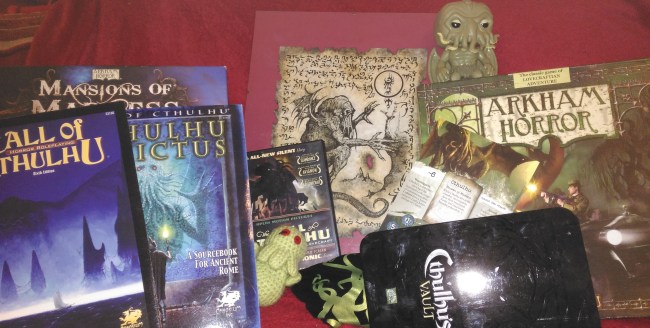
stuff

Old Tentacle Face is frankly everywhere in my house. Which is surprising because when it comes down to it, I am not actually a collector of  Cthulhu memorabilia, this is just stuff that has accumulated over the years… Even if you bear in mind that I am a habitual geek who has a fascination with such things, it is safe to say that beyond just Geekdom itself, Cthulhu is everywhere in the modern cultural zeitgeist of western civilisation… So with that in mind, this is a tale with a reputation to live up to.

The story itself is told in three parts, which begin with our narrator, one of the endless unnamed, Not-Randolph’s who inherits the papers of a deceased wise old uncle… Stop me if you have heard that little nugget of plot before… Yes indeed, we are back in Not-Randolph’s discovering strange rites and mysteries, through the medium of an old uncle… I guess after reading ‘Cool Air‘ last week I should not be surprised by this, but let’s not get bogged down in that old trope once more. I covered it well enough last time out.

The three parts of this tale are titled The Horror in Clay, The Tale of Inspector Legrasse, and  The Madness from the Sea. In many ways, you could treat them as three different tales all closely linked by a central thread. Unlike other episodic tales by Lovecraft, Herbert West being the example that springs to mind, this central thread really holds it all together and makes it the complete tale it is, and the threads left hanging by the first two parts are all sewn together in the final one. It is this that sets it apart for me over some of Lovecraft’s other long tales, for while he had tried to do this before in the likes of ‘The Lurking Fear’ he never really managed to hold the reader’s interest (mine at least) or build upon the foundations he had laid in the earlier parts of the story.

But ‘The Call of Cthulhu’ is built on stronger foundations than anything he had tried before. Not only does it build on the foundations it lays for itself as you read it. It builds on the foundations of the best of his earlier tales and sits astride them, going all the way back to Dagon one of his earliest tales of all. Threads upon threads are in here. Cyclopean columns from the depths of the ocean, the ravings of everyone’s favourite mad Arabian, the Necronomicon itself, all that otherwise tedious wondering about in the dreamlands he is so fond of, all the mythos stories that came before this have all been building irrevocable towards ‘The Call of Cthulhu’. In some respects, this is where Lovecraft really starts to come together, and while I am aware I have said similar things with other tales, this really is the point Lovecraft starts to put all the pieces of his mythological jigsaw together.

As I said this is a tale in three parts, and while I have kept these witterings on Lovecraftian lunacy to one post a story in the past. With the occasional small diversion off topic. In the case of this one seminal tale, I am going to wonder a little further than normal, as its a tale in three parts I am going to review it, if what I do with these stories could be accused of being reviews, in three parts also. You may have figured that out from the title…

The Horror in Clay

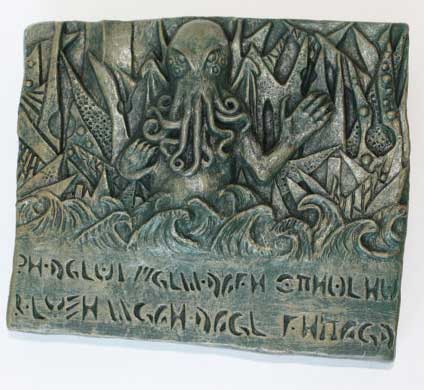
So it begins, and our narrator another ‘Not-Randolph Carter’ sorting through the effects and papers of his deceased  Grand-uncle George Gammell Angell, Professor Emeritus of Semitic Languages in Brown University, Providence. The Uncle died in mildly strange circumstances, though nothing seemed to be untoward as such about his death, and the sorting of his old papers should have been relatively dull is studious activity. That is save for one box of papers, a set of papers filed under the strange heading “CTHULHU CULT”. Within these papers are documented evidence that centres firstly around a young sculpture who was suffering from strange dreams and making an even stranger object. A Bas-relief of a strange, impossible nightmarish creature. A creature with the head of an octopus, the wings of a dragon and the body of a man, with the script of an unknown language upon it.
horror-in-clay

The young artist who crafted this had been beset with strange dreams in the last week of March and the first of April. Which lead to him to the Professor and to make the Bas-relief. The professor for reasons which come to light later in this tale takes a great interest in this rather than kicking the young fool out the door. More so when he connects it to other events around the world at the same period of time. The young artist is not alone in suffering from strange dreams and odd compulsions.

This first part, as is the nature of first parts, spends a lot of time laying down the land and this part of the tale most closely matches the opinion expressed by Lovecraft’s himself of the story as a whole, which was:

“rather middling—not as bad as the worst, but full of cheap and cumbrous touches”.

While I’m no more inclined to agree with Lovecraft’s opinion than I normally am, it does sum up this first part rather succinctly. It is a bit of a trawl, interesting certainly, but hard going in places. But it does cover an impressive scope. While it tells the story of the artist and his compulsion to create the hateful little tablet, it also is full of hints and portents of something much bigger, indeed, global in its scope, linked to what would otherwise seem nothing more than a man being driven to near insanity by bad dreams. It is the scope of the uncanny that is going on which sets this story apart. For our artist is not alone, others around the world are taken be a strange madness, driven to create strange art and other oddities. Obscure little religious cults are oddly active. the inmates of asylums are restless causing concern among the medical community. All of this is played out in a collection of strange and otherwise unrelated cuts discovered among the professor’s papers by our Not-Randolph. Even then this seems a strange obsession for an academic who specialises in ancient languages… But this is not the first time he has comes across that strange ominous name, Cthulhu…

Call-of-Cthulhu-preview-Could-this-be-the-PS4-and-Xbox-One-s-next-cult-hit-horror-game-681400

As a read goes, this first part is slow and it only really starts to build towards the back end of it all. But it does give a sense that something big has happened, something beyond the normal ken, and far beyond a simple ghost story. Which is the key, for me, to this story, both in this first part and as a whole. The idea that humanity is as nothing in the greater scheme of the cosmos, and there are things hidden from us that we should be grateful lay hidden. In the end, the opening paragraph of this story betrays the scope of it all, and with it the scope of what Lovecraft was attempting to convey in this story. And it is among the best opening paragraphs of anything Lovecraft ever wrote in my opinion…  I defy anyone not to want to read on after reading it…

The most merciful thing in the world, I think, is the inability of the human mind to correlate all its contents. We live on a placid island of ignorance in the midst of black seas of infinity, and it was not meant that we should voyage far. The sciences, each straining in its own direction, have hitherto harmed us little; but some day the piecing together of dissociated knowledge will open up such terrifying vistas of reality, and of our frightful position therein, that we shall either go mad from the revelation or flee from the deadly light into the peace and safety of a new dark age.

So to the score, for this the first part of ‘The Call of Cthulhu’. It’s not the best part, its weaker than the other two, but it lays the groundwork so well, I was tempted just to give it six and be done with it, but I have dropped a mark for trawl it feels in the middle…  So five it is…

5out 6


Next,

Part two, The Tale of Inspector Legrasse.’ 

Part three, The Madness from the Sea

Further Lovecraftian witterings as ever can be found here
Posted in amreading, books, cthulhu, dreamlands, fiction, goodreads, horror, Lovecraft, mythos, Nyarlathotep, rights, sci-fi | Tagged , , , , , , , , | 4 Comments

Rage against the reviews…

It’s been a while since I had a really good rant. Which is probably a symptom of relative happiness, so the lack of me having a good old-fashioned rant about something is probably a good sign. All the same, there are on occasions things that you just need to have a good rant about, if only to get it out of your system for a while. So as I stumbled over something which to many of you may seem like a minor irritation I felt the need to have a good old-fashioned rant. So, consider that a minor warning for small children and the easily offended.

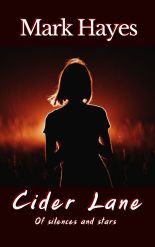
My first novel, Cider Lane, has 17 reviews on Amazon.co.uk. A week ago it had 18. I have lost a review, just as it seemed I was making some headway. Oh for the love of the imaginary deity of your choice… And why has this grave injustice occurred? Because the reviewer in question was a writer. Fan-bloody-tastic, well done Amazon, three cheers for your bloody ridiculous review policies. Yes, the review has been withdrawn, despite the book having been purchased from Amazon and verified as such because the review in question is a fellow author.

About this point the non-writers reading this are probably wondering why this bothers me so much, it is only one review after all…

Well firstly because reviews on Amazon are extremely important to writers. Once you pass a certain threshold, which changes every now and again whenever Amazon’s review policies change, Amazon will make your novel more visible. It will, after around 20 reviews start appearing in the ‘books you may also like’ recommendations they send out and that pop up when you finish a book on Kindle. After the 50-65 threshold, they will actually recommend your book. So getting as many reviews as you can is important to a writer. Wherein lays a trap, the cause of this angst-ridden post and general disgruntlement on both my part and the part of other writers. It is also a system ripe for exploit, Amazon knows the system is exploited, so Amazon patrol book reviews with the veracity of the republic party and Hilary’s emails… And about as much validity…

review picture

What rankles me most is not that this review has been removed from Cider Lane ( and it was a bloody lovely review into the bargain… ) But the reasoning behind it and my own ethical approach to book reviews. I did not ask for the review in question, not even in a polite’if you like it, please review it’ kind of way. I did not even ask the writer to read my book, she just decided to buy it, give it a go and enjoyed it so left me a review. I did not do a reciprocal review, this was no bargain or deal between us. I don’t do or offer to do, reciprocal reviews. Not least because I know, Amazon will in all likely-hood rescind both reviews, but also because there is something basically dishonest about reviewing someone’s novel because they have agreed to review yours. I will read people’s books if they ask me to, if it appeals to me, and I will review them if I do.

Amazon’s review system is rank with abuse, paid reviews, reciprocal reviews, more paid reviews. General cheating of the system as much as possible. What is worse is that a lot of people do get away with it, the argument for doing so goes something like this. If you can pay for 50 reviews in a short time, and it takes Amazon a couple of months to redact them then you get the benefits of being a highly reviewed book for a short time, hopefully, sell a lot more books that way and thus get genuine reviews in the mix… So every time Amazon clamp down the people abusing the system move on to another way to cheat it… I don’t try to cheat the system, I play by the rules. Indeed I play by my own rules which are somewhat more ethical than those of Amazon…

As such one of the things Amazon have started to do is remove reviews by authors. Often quite randomly, because of the unethical authors out there trying to cheat the system. I seriously doubt that the writer who reviewed my novel falls into the category of ‘unethical authors out there trying to cheat the system’. Yet her honest ( and loverly) review of Cider Lane has been removed because she is a writer. Which is insulting to her even more than it is an irritation to me. Indeed that is what has pissed me off the most about this.

The world is full of people who are willing and quite able to cheat the system. I wish it weren’t, because I wish the world were full of honest people, for all I am a realist. But I am bloody annoyed, and utterly frustrated when honest reviews from honest people are removed in the name of Amazon’s war on fake reviews.

What is the point of playing by the rules and being honest, when you get hammered for it, indeed because you’re honest and play by the rules that hammer is far more damaging to you than it ever is to the cheats of the world?

Clearly, honesty is not its own reward and given my insomnia it doesn’t help you sleep at night.


EDIT:  everything above in this little rant is still relevant, however, in their wisdom, and because the review complained, the review has suddenly come back a couple of months later. Which I did not expect, and I would like to thank the reviewer for complaining to Amazon about there unfair treatment.

Thanks, Lynne 🙂   I hope all the other reviews you have kindly done for other people have come back too

Posted in books, goodreads, indie, indie novels, opinion, rant, self-publishing, writing | Tagged , , , , | 9 Comments

The wisdom of the edit…

Having written ‘The End’ on the completed main draft of ‘A Spider In The Eye’ a week or so ago, I have the daunting task of doing a full edit of the manuscript. I both love and loathe editing in equal measure, but as such, I find myself in need of a little inspiration form the worthy and the wise. (And I haven’t put together a post of quotes from writers for a while, and they always seem popular for some reason.)   Here then are a few snippets of wisdom for anyone setting out on that strange journey of self-flagellation that is a final edit…

So the writer who breeds more words than he needs, is making a chore for the reader who reads.  ~ Dr. Seuss

I edit my own stories to death. They eventually run and hide from me.   ~  Jeanne Voelker

Verbose is not a synonym for literary. ~ Constance Hale

No words are too good for the cutting-room floor, no idea so fine that it cannot be phrased more succinctly.  ~ Merilyn Simonds

Related image

Whatever in a work of art is not used, is doing harm.  ~ C.S. Lewis

You should edit before and after editing.  ~ Dwayne Fry

Writing is like shadow boxing. Editing is when the shadows fight back.  ~ Adam Copeland

I have rewritten — often several times — every word I have ever published. My pencils outlast their erasers. ~ Vladimir Nabokov

WiseWordsWriters1

Editing fiction is like using your fingers to untangle the hair of someone you love.
~ Stephanie Roberts

Editing is like pruning the rose bush you thought was so perfect and beautiful until it overgrew the garden.  ~ Larry Enright

Substitute ‘damn’ every time you’re inclined to write ‘very’; your editor will delete it and the writing will be just as it should be.  ~ Mark Twain

When I split an infinitive, God damn it, I split it so it will stay split…. ~ Raymond Chandler

And finally, what could and indeed probably is my personal mantra on the subject…

There is no great writing, only great rewriting. ~ Justice Louis Brandeis


Previous posts on writing, publish, editing, anything else to do with the craft and a whole lot of quotes…


Posted in Uncategorized | Leave a comment

Writing The End…

Back in March, I wrote a post called ‘Searching for an ending’  about the struggles I was having with my latest novel ‘A Spider in the Eye, a Hannibal Smyth Adventure. Since then I have spent a lot of time doing just that, searching for the right ending and not quite knowing where it was hiding.

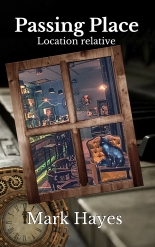
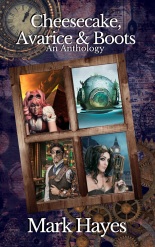
In the course of that search, a couple things happened. The first of them is ‘A Scar Of Avarice’ a novella which is currently sat with my proofreaders because I discovered there was a whole section I needed to take out of ‘Spider’ but did not want to go to waste because while it did not need to be in the novel, and if anything it was part of the problem I had with the flow of the novel, I still really liked the little story that was being told in those chapters and built a novella out of them set in both Hannibal Smyths twisted little steam punk universe , and the Passing Place . So, in essence, I have ended up with two books, not one, out of this whole enterprise.

The second thing the happened is having finally sorted out the ending I managed in the course of doing so to completely change several aspects of the greater plot, because one twit led to another, as these things have a want to do, and a character who I thought was one thing turned out, as much to my surprise as any readers will have, to be something else entirely. While the final climactic events for the last several chapters changed the plot of the sequel which I had nicely mapped out. I have always intended this to be the first of three books set in Hannibal’s world. A world of steam and airships, that is built on the foundations of 19th-century sci-fi but brought forward to a modern setting in a world where Queen Victoria never died and the British Empire has never seen the sunset upon it. Yet here I am with my vague plottings for the second and third novels just got completely twisted in on themselves, and all the better for it I may add.

Nothing does more to change a story that the writing of it, but there is also no better feeling than finding that twist you never saw coming. You can plan your story all you wish, but the moment you start to write it, characters will do things you don’t expect. It isn’t till you write about a character that you really get under their skin so it should come as no surprise. Yet they never cease to surprise me, and in the closing chapters of this novel, they threw me more curveballs than I had any right to expect.

But all that’s on one side, last night I finally wrote THE END… and yes there is the whole redrafting, editing, re-editing, first proofing et all to go through yet. But beyond that moment when you type the first word of a novel all full of expectation and desire, nothing beats the moment when you type in those last two words and know you have created something. Even if you’re not 100% sure what it is…

This is not in anyway the cover the novel will have, but still, its sort of a cover reveal …

ASITE

A Scar of Avarice’ will be out in the next couple of months, and hopefully, now I have a full draft ‘A Spider in the Eye‘ will follow before the year is out.


Posted in books, fiction, goodreads, indie novels, novels, Passing Place, self-publishing, steampunk, writes, writing | Tagged , , , , , , | 1 Comment

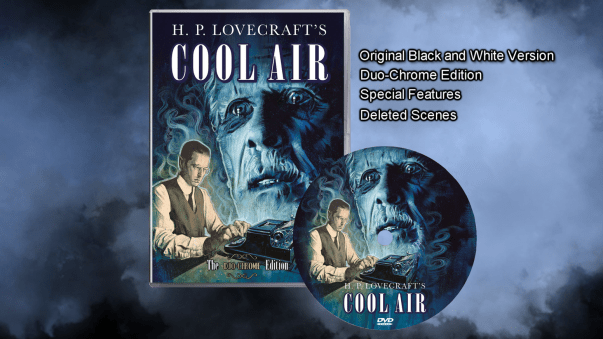
Cool Air: The Complete Lovecraftian #46

Some hold the belief that this macabre little tale is the best of Lovecraft’s New York stories… They are of course, in my opinion, wrong, which is probably not all that surprising to anyone who has read many of these blogs. If there is one thing I have learned in my time on this little project, it is that I almost always disagree with the commonly held opinions of both Lovecraft aficionados and his critics… For that matter, I often seem to disagree with the old tentacle hugger’s own opinion of his various tales.  ‘Cool Air’ holds that wonderful middle ground of being reasonably good, alright, not half bad, and whatever other slightly damning faint praise you might happen to throw at it. It’s not the mildly loathsome ‘He, that most critics seem to like, but it’s not the wonderful ‘Horror at Red Hook that everyone but me seems to despise.

When it comes to the ‘New York Tales‘ I am very much at odds with everyone. So exactly how much my opinion is worth you will have to decide for yourself. But if you want a nasty little macabre story that a little bit too predictable and while perfectly well written doesn’t really get under your skin some much as vaguely waft over it. Then ‘Cool Air‘ is just what you’re looking for. Other than that its a bit, mehFor But let me discuss the plot for a moment…

cool air 1

And there you have the plot, more or less… Thanks to Issue #62 of Warren Publishing’s ‘Eerie’  this comic-book adaptation of the tale that was created by Berni Wrightson. Which is one of a great many adaptations of ‘Cool Air’ Several short films, at least one (arguably two) full-length movies, radio plays, several comic book versions, a prog rock song by Glass Hammer, and it even managed to make the pages of Batman, in ‘The  Doom That Came to Gotham’, with staple Bat-villain Mr Freeze more or less being portrayed as Dr Muñoz the gentleman wearing the shades in the panel above. So what does that tell you, apart from the tale is far more popular than my ‘Meh’ would suggest, and that my opinion is not shared by everyone…

cool air 2

Back to discussing the plot, which has a degree of predictability about it. The narrator never offers us his name and is in New York doing in his words ‘some dreary and unprofitable magazine work’, he isn’t overly enamoured of the city and it’s populous, and ends up living in a boarding house that, again in his words, ‘disgusted much less than the others he had sampled‘. Which, given Lovecraft’s oft-mentioned distaste for the big city life of New York, suggests old tentacle hugger did not look far for inspiration regarding his narrator. Nothing awfully new about that, he may as well have called the narrator Randolph Carter and had done with it…

Considering this Not-Randolph ends up meeting his upstairs neighbour because of a strange chemical leak that starts dripping into his room, you have to wonder just how bad the other boarding houses were. Certainly once noxious chemicals start dripping through the ceiling it’s probably a good idea to look elsewhere. Yet even the landlady is strangely accepting of the upstairs tenant and his strange industrial cooling equipment, and through her the Not-Randolph meets Dr Munoz, a Spaniard who Not-Randolph describes as ‘short but exquisitely proportioned, with a high-bred face of masterful though not arrogant expression’ bearing ‘a short iron-grey full beard, full, dark eyes, and an aquiline nose‘ as well as having a ‘striking intelligence, superior blood and breeding.’ and lets stop there for a moment…

Not for the first time, or I suspect the last, I found myself wondering when I read this particular section of this tale about a subtext which has occurred to me before. This Not-Randolph, like all the other Not-Randolph narrators, and indeed the ones he actually names (so often called Randolph…) seem to have a few traits in common. for example, they all seem drawn to older more experienced men, so many of them happen to be the Not-Randolph’s uncles. These older experienced men from the Not-Randolph’s are drawn often because the can initiate them into dark often forbidden rites and mysteries… It is a theme that is almost a cliche in Lovecraft’s tales. Lovecraft, who’s writing is famously misogynistic, also suffered through a short ill-fated marriage, and had a long close friendship with a younger man called Robert Barlow in the later years of his life, among other close relationships with other young men at other points in his life. I’m not saying Lovecraft was Gay… But there is a whole lot of repressed sexuality that could be read into his stories.. and if he wasn’t gay then he almost certainly lent a little in that direction…

Old tentacle hugger has a bad reputation, quite rightly, for his right-wing views, xenophobia, racism and misogyny. I have made no bones about my own distaste for the influence those views have on his writing. However, if he was indeed repressing aspects of his sexuality it would, if not excuse, certainly explain some of those darker trait’s. He would not be the first, and I suspect not the last, to use deflection as a form of repression in this way. When you hate something about yourself or society has impressed upon you that you should, projecting that hate elsewhere is a common human trait. Perhaps in these more enlightened times when we look back on themes in his writing with distaste, we should also try to look back on it with a little understanding as well, not that it forgives the more abhorrent influences on Lovecraft’s fiction, or his political belief’s. But it is still worth remembering 1920/30’s America was a far more closeted time.

But back to ‘Cool Air’ and the lastest of the Not-Randolph’s old wise uncles who were able to initiate the Randolph into strange rites and mysteries. In this case, the strange rites involve industral coolants, bags of ice, bathtubs and strange hints and dark whisperings of prolonging life despite the lack of a few vital functions. Which drives us to an ending which is somewhat predictable, after all the plot is all about what will happen when the ice melts, and Munoz’s efforts to preserve himself finally fail. Something which is rather too obvious from the first and the friendship that develops between the two men is somewhat stilted, one-sided and not remarkably unlike the relationships the Not-Randolph’s always seems to have with their various ‘uncles’ in so many of Lovecraft’s tales. The junior partner fetches, carries and generally ends up doing everything the elder tells them to do, in an effort to please their ‘uncle’ and perhaps in doing so learn more about the great mysteries that they wish to partake of and observe…

So again, I’m not saying there is a sub-text here… but… sub-text…

Perhaps this is why this falls a little too flat for me. It’s too much of a muchness with so many others, or perhaps because it just drew all those sub-textual lines which highlighted just how much this follows one of Lovecraft’s more well-trodden paths. But it lacks anything particularly new or different about it, it also seemed oddly passionless in places, despite the sub-text, it’s all a bit of a cold fish, which has a certain irony about it… Anyway, it gets a mere three frosty tentacles from me, not because its bad but just because its well, in this case, I find the sub-text is more interesting than the text itself…

3out 6

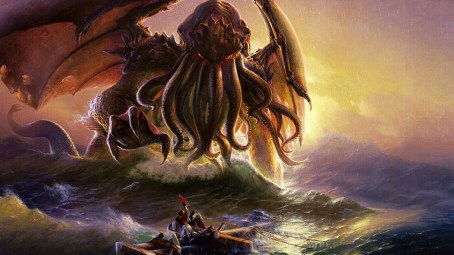
Next up… The big Kahuna himself, old tentacle face lets out his call…

cthulhu_and_the_ninth_wave_by_fantasio-d9nw88r

Further Lovecraftian witterings as ever can be found here

Posted in amreading, book reviews, cthulhu, horror, Lovecraft, mythos, Nyarlathotep, opinion, reads, retro book reviews, sci-fi, Uncategorized | Tagged , , , , , , | 1 Comment

Well that was odd…

Occasionally, something unexpected happens that strikes you as odd. Or at the very least utterly unexpected. One of those strange little moments of wonderfulness, that take you completely off guard. Particularly if your a tad neurotic, and struggle to see any real value in anything you do. I am, in case regular readers have not guessed this yet, a tad neurotic. As for those ‘lucky’ individuals who just stumble across my occasional rambling, I suspect most of them could figure that out fairly quickly, as I don’t go to any lengths to hide it. Quite the opposite, in fact, I try to an extent at least to be fairly open about my obsessive personality, anxiety, and occasional bouts of depression when writing this blog. So when something genuinely nice but unexpected happens it does take me by surprise and is occasionally something I find difficult to process straight away, and so my initial reaction tends to be a bit on the awkward side. Or to be more exact I tend to think, well that’s odd…

The case in point and the reason for this particular blog post was a message I received on Twitter from fellow author C.G.Hatton, asking if I would write a foreword for a kindle box set of her Novels. (several of which I have reviewed previously the latest only last week.) To which my neurotic self-kicked in with a fairly neurotic response of ‘Are you mad, what on earth are you asking me to do that for, there must be someone better than I whom you could ask…’ or words to that effect. My personal reaction was more ‘wow… surely she can’t be serious, why not ask someone better qualified to do so?’ How the hell do I write a foreword? and surely she has better candidates she could ask. Her books are so much better than my inane wafflings…

Then I had third thoughts, ( I always have third thoughts, and fourth and fifth, and so on, as I over think everything.) my third thoughts, which came just after, ‘how the hell do I write a Foreword?’ can be best expressed outside the confines of my usual expressed vernacular when writing these pages…

Bloody Hell, I’m been asked to write a foreword, How fucking cool is that…

I, of course, was happy to write a foreword. Mildly terrified and did not know where to start but very happy to do so. I am also aware that most people probably never read a foreword, but I always do, and I wanted to do a good job…

I also, while writing it, and afterwards, and still now, wonder why in the hell she asked me to do it, because I am utterly convinced that there are a raft of great sci-fi writers out there who would do a better job and frankly should be writing the foreword to what is one of the best sci-fi series I have ever read. Admitably it helps that I have read them and reviewed them previously, but still they should be read by better writers than I.

(Note for Neil Gaiman, Stephen Baxter, Peter Hamilton, Charles Stross, Alister Reynolds, David Langford, Rob Grant, Jane Fenn, Tricia Sullivan et al… on the extremely unlikely event of you reading this blog at any point ever. You should be writing a foreword for C.G Hatton’s novels, not I, and you could do far worse than to read them…)

Anyway, so I wrote a foreword, while still be utterly amazed to be asked, and considering it a privilege and an honour to do so. I was further surprised when C.G. thanked me for the first draft of a foreword I sent her and ran with it. I still think someone better could have done this, and someone better should have done it. But what the hell, I still think it was bloody cool to be asked to do so.

Here, along with a link to the books themselves if the foreword I wrote ( which she then edited and polished a little) I actually intended it only as a first draft and was going to work on it, but she must have liked the rough cut so whom am I to argue…


‘Residual Belligerence’ is a title that grabs your eye. It grabbed my eye at KAPOW sci-fi fair on hot sunny afternoon in June 2014, stacked up against two other novels with equally eye catching titles; ‘Blatant Disregard’, ‘Harsh Realities’ on a stall in the corner of the main marquee. Stood behind the stall were a perky diminutive woman with a broad smile, and a tall skinny bloke with a face like begrudging thunder. As a bibliophile and hobbyist writer myself, my first novel still a year in the future at this point, I loved then, as I do now, talking to writers about their novels. Almost as much as I like discovering new authors to read, and eye-catching titles with equally eye-catching covers draw me like a bear to honey. So I stood over to say hi, buy the books and chat with the author C.G. Hatton, who given the nature of the titles and the ‘face like begrudging thunder’ was obviously the tall bloke…

So that was my introduction to C.G. Hatton’s novels. C.G. who, if you haven’t guess already, is not a tall skinny bloke with a face like begrudging thunder. She is however one of the most brilliant writers of fast paced, character driven, immersive sci-fi thrillers it has ever been my privilege to meet or indeed read. She also has never held my glaring misplaced assumption back in 2014 against me. Indeed, she even to pretended to remember the odd bearded bloke in the top hat who made such a facile error the following year when I gleefully picked up a copy of the forth novel set in her Thieves Guild universe, ‘Wilful defiance’, and after a short chat where I enthusiastically told her that our chat the year before had inspired me to actually finish writing my first novel, which I was about to publish.

Remarkably no one has yet thought to blame C.G. for inspiring me to finish my first novel, but if you ever feel to need to complain about my novels it’s all her fault…

After picking up ‘Wilful defiance’, that year I drove home and lost a couple of evenings, enraptured and enthralled in her vividly drawn universe. A Universe where the human race stands teetering on the brink of all-out war between the two great power blocks of the galaxy the old power of Earth and the younger but no less powerful faction based around the corporate world of Winter. Between them a demilitarised zone of systems who hold a fragile independence only because they keep the two sides apart, and striving to maintain the balance between them is the Thieves Guild. Which isn’t an easy balance to hold, as the principals of both sides will do anything to get the upper hand. So the Guild, under the shadowy guidance of its founder, must walk a fine line. A line that would be easier to walk if its best two operators Hilar and L.C. Anderson were not AWOL, top of the galaxies ‘Most Wanted’ list, hunted by the power blocks of Winter, Earth, as well as every bounty hunter with a ship and a gun, after there last tab. Because they are in procession of something that could tip the balance between Earth and Winter either way, and that isn’t even what makes it so dangerous…

By the end of the first four books I was hooked, a fanboy and come the following June desperate for book 5. Which proved to be a problem because book five wasn’t written yet. The Galaxy would have to stay poised on the brink of disaster, and cliff hanger that was the end of ‘Wilful Defiance’ would have to stay hanging on by it’s finger tips a little while longer. What there was however was book one of the Thieves Guild origins books ‘Kheris Burning’, A novel set on one of the lost little world in the great divide between Earth and Winter and telling a tale of the early life of one of the Guilds top field agents L.C. Anderson, As told by L.C. while hiding out in a sewer somewhere in the midst of the elusive book 5.

It was hard to stay disappointed that book five was still unwritten when your appetite is sated by a novel as extradinary and enthralling as ‘Kheris Burning’, a tale of a street kid caught up in events beyond his understanding, just trying to survive and find enough to feed himself and his friends, torn between the occupying forces of Winter and resistance leaders who use the street kids as a recruits and cannon fodder, with oh so many echoes of places in our own much begotten present.

A year later and book 5 was as elusive as ever, but L.C. was in another fox hole somewhere in a universe gone to hell telling the story of his first tab for the guild and how he first met another character for the main series Hilar. ‘Beyond Redemption’ the second Origins novel pulls on threads that you have read in the first four novels and ties them in new knots. Making the Thieves Guild Universe all the more complex and real. Giving you, the reader, a deeper understanding of the characters at the heart of everything. Which is what makes these novels stand out so much, the characters are so vividly realised, while the pace never lets up.

Then finally after waiting so long along came book 5, ‘Darkest Fears’ and the war that’s was always coming arrives in its full horrifying spender. Though it’s not perhaps the war you were expecting way back in book 1, and book 5 is really book 1 of the new series, or book 7 of the series as a whole, and if you thought the first six books were full of pace, action, adventure and wonder, you haven’t read anything yet…

Which leave two questions to my mind, when is book 6 (or 8 or possible 2 of series 2) going to arrive and why of all the people who could be writing this foreword C.G. asked me to do it. Possibly its an act of residual belligerence on her part for my mistaking thinking one hot day in June in 2014 that the author of these wonderful novels was the tall thin bloke with a face like begrudging thunder.


If you have never read C.G.hattons novels I can (you probably guessed by now) highly recommend them so here is a link for the seven books of the series in the intended order for the ridiculously low price of £6.99.

You should read them even if you’re not a famous Sci-Fi writer yourself, or even a not remotely famous scribbler of words like myself who for no reason that makes any sense at all even now got asked to write the foreword…


Earlier reviews of C.G.Hattons novels …

Residual Belligerence (the first novel in the series)

Kheris Burning

Beyond Redemption

Darkest Fears 


Posted in amreading, blogging, book reviews, books, depression, goodreads, indie, indie novels, kindlesale, novels, opinion, pointless things of wonderfulness, reads, sci-fi | Tagged , , , , , , , , , | 4 Comments

The Descendent: The Complete Lovecraftian #45

One of the problems with a writer dying young, apart from the whole dying thing which let’s face it probably puts a bit of a crimp in your day, is what happens to your legacy after you die.  By legacy, I am talking specifically here about all those scraps and scrawls of half-finished works which are crammed into draws and dusty box files around your study. Because a young writer, the young in general, never really consider the possibility of departing this mortal plain…

Well okay, yes they do, quite often in fact, it’s the subject of a vast raft of youth culture, and sub-cultures, it’s one of the reasons black eyeliner is always popular among youths of a certain mindset… But unless you actively contemplating taking the exit ramp, are ill in the terminal kind of way or find yourself shipped off to a war zone, most of us under fifty never really contemplate the idea of actually just dying…

Why and I talking about this, well its because personally, as a writer myself, I wouldn’t want the unfinished products of my fevered mind to survive me, because they were unfinished, quite often they are unfinished for a reason. I have hard drives full of unfinished novels and scraps of this that and the other, half-baked idea’s, random thoughts which amounted to nothing, little side alleys of description which never led out to the main road. But just because I have never really considered what would happen to it when I die, and because I suspect there would be little interest in it anyway, I have never really put any thought into what to do with it. Though as its all up on my cloud, it will probably just dissipate away when someone stops paying the bill. I suspect I won’t need to have the hard drives run over by a tractor to avoid anyone releasing my half-written works, unlike Terry Pratchett who had his hard drives destroyed publicly in this way after his death.

In the case of H.P.Lovecraft, who died young as well know, his old box files and folders were raided by those who wished to preserve his legacy and let’s be honest here, make money off it, for every scrap and half written extract they could scrape together into something printable. If this was in line with Lovecraft’s wishes, we will never know. Certainly, he gifted his papers away, but if he intended these small abstracts to find print is somewhat questionable.

As for my own view on them, well for a start Azathoth is one such abstract, which I gave a solitary tentacle as it is just 500 words of something which was intended to be much more, than lay abandoned for years until Lovecraft died. I don’t consider it worth reading because it was never intended to be read by the author. And this is not in an ‘it was the last thing he was writing when he died,‘ unfinished work. Azathoth is just a scrap of an idea, which may have become his greatest work later in life had he lived, but it was a long forgotten scrap he had not gone back to, and probably never intended to. So I don’t feel they have much business been out in the world.

The Descendant‘ then is another Azathoth, all be it a longer extract. (three times longer at 1500 words) It is still only an extract, a possible idea, a fragment of a narrative that will never be complete. Written a good ten years before he died… So I think it is safe to assume he never intended to return to it. He may have reused some ideas from it, ideas we can’t see because wherever he was going with this narrative, we have no incline. But at a guess, he went there in a later tale, if his idea was worth pursuing because nothing lays fallow in a writers mind for ten years without being used.

It’s a shame we don’t know more as its an interesting fragment, and as a Yorkshireman myself I would have been interested to see where Lovecraft went with this tale of a noble house of my homeland, certainly, the little extract below is enticing, (right up to the word tittered, tittered, no Yorkshireman ever tittered, I mean really, tittered….)

 Lord Northam, of whose ancient hereditary castle on the Yorkshire coast so many odd things were told; but when Williams tried to talk of the castle, and of its reputed Roman origin, he refused to admit that there was anything unusual about it. He even tittered shrilly when the subject of the supposed under crypts, hewn out of the solid crag that frowns on the North Sea, was brought up.


scb3

Scarbrough castle on the Yorkshire coast… (which is not very Lovecraftian, but quite nice and has a gift shop…) 


But that just it, its interesting in a vague kind of way, but its interesting to me as a writer, not to me as a reader. It’s a scrap of unpolished prose, even if you ignore ‘tittered’, Lovecraft would have polished this within an inch of its life before he published it, and I suspect ‘tittered shrilly’ would be one of the first things to go as it just sounds wrong. But hey, we will never know. Which is kind of my point, why would Lovecraft want anyone to read a scrap of a first draft that was never fully realised?

So, to sum up, ‘The Descendant’ is of interest to only completists who want to read those small and incomplete twigs that reach out to Lovecraft’s greater mythology (there are a couple tiny things that you could argue do that but its really not worth the bother for a vague mention of someone looking for a nameless city in Araby…), those who write themselves in an abstract academic kind of way and, well that about it. What is isn’t of any real interest to, is to readers and in my opinion, it probably should never have been published at all. I suspect you can guess how many tentacles it gets… and I am been generous…

1out 6

Next up.. Cool Air, a frigid little tale of undying interest…

Further Lovecraftian witterings as ever can be found here


Posted in amreading, book reviews, cthulhu, goodreads, Goth, horror, Lovecraft, mythos, Nyarlathotep, opinion, reads | Tagged , , , , , , , | 1 Comment