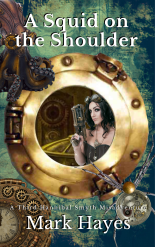
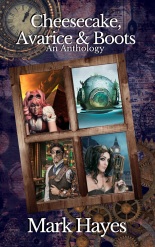
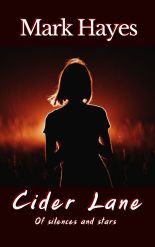
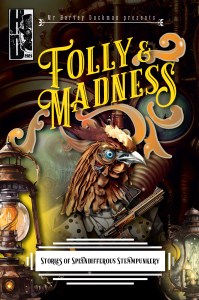
When writing fantasy, be it high, low, grim dark, romantic, steampunk, urban or whatever, a writer can’t just throw words at a page and see what sticks. Well, that is not entirely true, that is in fact quite often the writing process, and I as tend to start out on any story or novel flying by the seat of my pants, throwing words at a page is exactly what I do. But after the throwing has calmed down and we can see what stuck, a little world building is generally in order. If only to create an internal logic to your sandbox.
Way back in 2021, when I took a short dialogue between two unknown participants and turned it into a short story for a Harvey Duckman Anthology the world building involved was minimal. This is not to say there wasn’t a lot of research done for that short story (mostly into Cricket in the 1900’s), but there is a difference between research and world building. In terms of a short story you may need to research all kinds of things , and you almost certainly will if you set about writing a novel. I posted here about research at the time when the short story was published in one of the original Harvey Duckman Anthologies.
Unlike research, world building for a short story is generally a some what minimalist affair. This is to say you that if you only construct the world to tell that one short story the internal logic of the world only needs to hold together for maybe 5000 words at the most. Thus you can throw in a few random things without really fleshing them out. The world is but a stage, the stage decorations can be made of papier-mâché and wireframes because no one is going to be looking behind them any time soon. The same doesn’t hold for a novel however. For a novel, stage decorations don’t quite do it.
In that original short story the narrating character, Mandrake, tells you he is a arcanist by royal appointment to the court of St James, and the subtext is that he resides in a mid Victorian period where magic exists. As I wanted a little structure to that magic, rather than just ‘wriggling of fingers’ I called the magic he practiced ‘post-Newtonian’. It was a single line idea that expanded a little in the short story but only in regards to things I needed Mandrake to be able to do to tell that story, and to add depth to the stage dressing… Such as Newtons laws of magic.
Sir Isaac Newton, as you are doubtless aware, was one of the great minds of the 1600’s, indeed one of the greatest minds of human history. The polymath most famous for his laws of motion and gravitation, was also a mathematician, astronomer, theologian physicist and to somewhat lesser acclaim now, was also considered at the time to be the last great Alchemist and the successor to Dr John Dee. It is this last bit that fascinates me most, because if magic were real, Newton would almost certainly have been the royal arcanist of his time. More to the point if magic was real, Newton would almost certainly of tried to codify it.
I threw Newton at that original short story for this reason. Using ‘Newton’s Laws of Magic’ gave Mandrake’s magic a basis that felt ‘real’ at least in terms of the story. It also allowed for the idea of ‘gentlemen magicians’. Which is to say members of the landed, old money, classes as dabblers in the arcane, in much the way that they dabbled in science. While Newton was clearly a gifted genius, many of his fellow ‘scientist’ in his day were little more than privately wealth individuals faffing about. Often employing those lower in the social orders to write papers for them to put there name to. It gave me the tension between the upstart court magician of no breeding and ‘the gentlemen magicians’ of his day.
The short story held together well. The world of papier-mâché and wireframes stage dressing did its job. the only problem was it did that job too well. I liked the characters and the ideas behind the stage dressing. I decided to play with the idea of a novel with the same characters, taking on that story and seeing where it led. So the short story became rewritten as the first couple of chapters of a novel the world expanded in depth and feeling over the course of three years of writing.
A novel however needs more than papier-mâché and wireframes. A novel needs a much more fleshed out world, even if the reader doesn’t need to see it as such.
Fantasy land: some assembly required…
In Mandrake’s world, magic had to have always always existed. IT made no sense for it suddenly to appear out of thin air like…. yes okay but you see my point. Newton did not invent it, he merely codified aspects of it. This gave me Post-Newtonian magic, or arcana. A structured kind of magic, that can be studied by gentlemen of independent means and of course practiced by journey men arcanists who are probably the ones with most of the innate talent…
But that ‘post’ implies the existence of ‘Pre-Newtonian Magic’, less structured wilder magic, held in forgotten grimoires, or the ‘folk’ magic of witches. Pre-Newtonian magic was persecuted by the church, books and witches were burned, most of those witches being women because sadly some things you don’t need to envision… But ritualized magic and religion are two sides of the same coin which allowed me to build more parallel history into the mix.
Newtonian magic gave Mandrake’s world structure, it also gave me Gottfried Leibniz , Newton’s bitter rival to play with. The German polymath who had incidental links to the House of Hanover which were handy, he also wrote extensively which allowed me to throw an interest in the fae realms into the mix by making it Leibniz ‘hobby’. Also a certain Germanic attitude to the arcane, with which to invest Prince Albert. But i needed more.
The history of magic in Mandrake’s world needed to progress, so I had British arcanists becoming more accepted after they help win the battle of waterloo in a day. No need for the Prussians to arrive on the third day, old Boney was already on his way back to St’Hellan. Magic meets Victorian inventiveness and also Victorian values. The struggle between the Whig’s and the Tory’s, the great reformers and the great conservatives, was rife in the 1800’s. A witchcraft bill being put before the house made sense. As unfortunately did the continued oppression of female magic, though that is somewhat intrinsic to Mandrake’s personal story.
Mandrake live in a world where the Fae realms exist, magic in many forms, glamours, rituals, covens and necromancy. But it is still the mid-Victorian world of steam and cogs. The world building is layers on top of real history. There are plots against the crown, but there were plenty of those in real history too. There are those who seek to bring Ernest of Hanover to the throne rather than ‘that doxy at Buckingham palace’ and they are not made up either. Most of Mandrake’s world is based on research, what makes it a fun place to play with is where real history and people meet the invention.
So welcome to the world of Lucifer Mandrake. A world of magic and steam power, betrayal, plots, necromancy, fairies, secrets, transformation and the unexpected. I did not know what I was writing until I got going, it didn’t end up where I expected it to either. But then the really good stories never do.
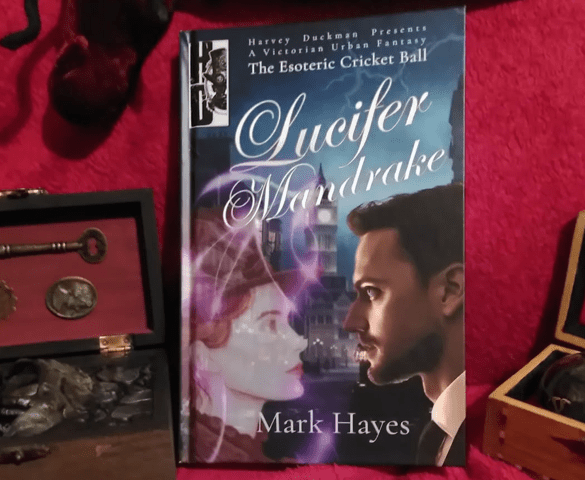
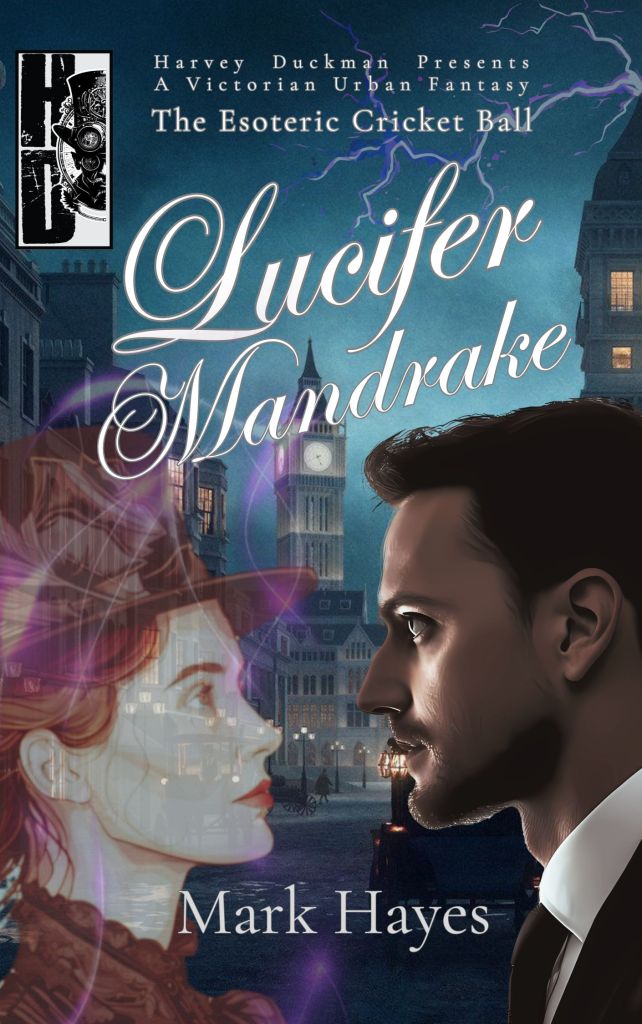
Well its finally here, 3 years after the original short story, The esoteric Cricket Ball is pitching down the leg side… The novel started out as half page of dialogue between two unknown participants written about ten years ago. It became a short story in a Harvey Duckman Anthology when I stumbled back across it three years ago and while writing the short story I fell in love with the two main characters Lucifer Mandrake and Sir William Forshaw, and the interplay between them.
That drove me to take the short story and create the novel. A novel set in a Victorian England where magic exists. Both characters go on something of a journey in the novel. A journey that takes both of them to places I never really expected to them to go when I started all this.
Other things sprang form the pages as I wrote the novel, The Men in Dark Tweed where born within its pages, a marvelous ditty about ‘The maggot of Salamanca, the basis of other projects yet to begin and much more, but its started with a forgotten piece of dialing and now we have this…
Lucifer Mandrake, Arcanist to the court of St James, by appointment of Queen Victoria Saxe-Coburg, is not having his best day. Someone has been resurrecting dead peers of the realm. The House of Lords is now inhabited by the undead. Sooner or later, someone is bound to notice. Well probably. Is this just a plot to derail The Witchcraft Bill? Or is it something more insidious, such as a plan to remove Victoria as head of state and replace her with the King of Hanover? Mandrake must brave the Fae realm and its denizens, doppelgangers, necromancy, a prison of amber, conspirators in the highest level of government, malevolent men in dark tweed, and worst of all, the cricket, in order to save the crown. All the while Lucifer must keep a secret of his own, the secret of Luci Drake, she who dwells within.
Magic, mayhem and impeccable manners, in a Victorian world where magic is real.
As I have written the novel I have on more than one occasion blogged about it, so regular readers of these uttering will be aware of it i am sure. But as I say, finally it is here…
All I need now is for some people to buy a copy and read it..
In 1831, some 8 years before dear Edgar put pen to paper to scribe this tale, Reverend William Miller predicted the world would end with the second coming of Christ within thirteen years, and thus founded his own religious movement Millerism. As the date of what he termed ‘The Second Advent’ approached his movement grew from a small obscure movement in the early 1830’s to becomes a large national movement of up to half a million people. While Miller himself refused to nail down the actual date most became convinced its would be mid April 1844.
Eventually, if you will forgive the spoiler, the world did not end on the 18th of April 1844. This anticlimactic end to Millerism was pronounced to be, and is remembered today as, ‘The Great Disappointment’. Christ failed to show up, the world did not end, and so many Millerites simply wondered off and rejoined their former churches.
Some of course believed the prophecy was valid and that Miller just had the incorrect date, splintered off and formed two distinct new churches, ‘The Advent Christian Church’ and perhaps more well known ‘the Jehovah’s Witnesses’. Others believed the second advent had occurred and Christ walked among us, forming a short lived group called ‘Holy Flesh’ before joining a splitter sect of the Quakers, called ‘the Shakers’. While a further group chose to believe that the date and prophecy were correct but just not about the second coming and they formed the Seventh-day Adventists which is now the largest single post-miller church with over 15 million members. adding in the Jehovah’s Witnesses at around 9 million and the other smaller groups there are around 25 million members of post-Millerism churches still following aspects of William Millers teachings despite ‘The Great Disappointment’ of 1844.
If nothing else, this speaks of the resilience of religion and the legacy of Reverend William Miller, but what you may be thinking, does this have to do with our Dear Edgar, a somewhat lapsed Episcopalian (Anglican protestant). In short he saw an opportunity to cash in on the end of the world hysteria and so wrote a story set after it had occurred. Which brings us, somewhat convolutedly to ‘The Conversation of Eiros and Charmion’.
Eiros and Charmion, who adopt these names after the end of the world. Who they were before is dismissed as unimportant, these are there new names in the afterlife. Charmion passed into the beyond some ten years before the end of the world, asks Eiros to tell him of it. After some initial conversation which could best be described as waffling on somewhat inanely, Erios tell Charmion how the world ended.
This final part is the story itself, though calling it a story is a stretch. It is more of a monologue that tells us of a comet that crashes into the earth , engulfing it in flames. The idea of a comet goes back to Millerism as there was a comet predicted to cross earths orbit in April of 1844 and wide, if somewhat wild, speculation that this would be the form the end of the world would take. So for this tale Poe tried to envision how this would take place. Which is more or less it, there is not twist at the end, no surprise to come, no real revelation.
There was this comet, it hit the earth, everyone died in a fire storm, why are you calling me Eiros again?
That latter is never explained, Charmion has taken the name Charmion after he passed over and gives Erios his new name when he does. there is little else to this, and while it was successful enough when Poe wrote it, successful enough to be translated into French at least. Much of that success was down to the renowned of Millerism and the general ‘the end of the world is coming’ vibe of the times. This is not to say it doesn’t have value now, it just isn’t exactly what anyone might call riveting. At best its an intriguing bit of fluff, but more for the history that inspired it than the tale itself.
A LONE RAVEN
SHOULD YOU READ IT: I don’t recommend it, but don’t let that stop you
Bluffers fact: Poe came up with the names Eiros and Charmion based on Iras and Charmion a pair of servants and advisors to Cleopatra that feature in Shakespeare ‘Anthony and Cleopatra’ They are quite probably acctual historica figures as Shakespear likely came across the names in Plutarch 2nd century biography of Mark Anthony.
(Amanda Barrie as Cleopatra
Erios and Charmion are notably absent from the clearly superior work ‘Carry On Cleo’ I mention this for no reason but it is a good excuse to put up this picture of Amanda Barrie in a bath of asses milk, because I am a child of the 1970’s and its Amanda Barrie…
“In me didst thou exist—and in my death, see … how utterly thou hast murdered thyself.”
William Wilson is a tale with more than one interpretation, which possibly accounts for the remarkable number of adaptions of a story which is unlikely to be listed by anyone asked to name their favorite Poe stories. Unless the person you were asking was our own Dear Edgar who once wrote Washington Irving asking for a word of indorsement and naming William Wilson as ‘his best effort’.
Washington Irving wrote Sleep Hollow and is by extension therefore responsible for the annual mutilation of all pumpkins, having created the headless horseman myth. He also wrote Rip Van Winkle, but luckily that one did not lead to a random squash being hollowed out and having a face carved into it.
The story of William Wilson is told to us by a narrator using that name to hide his own for proprieties sake as he claims to be ‘of noble descent.’ the presumption being he does not wish to cast shame upon his house, by shedding light on the less than salubrious aspects of his life. He has been something of a wastrel, a gambler, a cheat, and a lecherous con-artist. Thus he has a less than high opinion of himself. This ties in neatly to one interpretation of the story as a whole, but I will come to that.
Obsessively this is the story of a man with a dopplganger. From his early school days, through collage and then adult life his footsteps are dogged by another who no only bares the same name, but in all most all respects is his double. The one difference between them is the other is almost always the better man. In their schools days he is more liked, better on teh sports field, more attentive in the class room. In later life his double interferes and stops him when ever he starts doing things which are dubious or debauched. From cheating at cards to seducing a nobleman’s wife and other things. William it seems is driven by ambition, anger and lust. The other William is driven to reign back his excesses.
In the end this leads to a sword fight in which William kills his double… Or possibly in doing so himself.
There are many ways to interpret this tale, there is an ambiguity to it that encourages multiplicities in interpretation. My personal interpretation therefore may not match your own or indeed Poe’s intent. Though I am of the opinion this was Poe’s very intent. It is a tale that causes the reader to consider possibilities. One of which is this, the other William Wilson never seems to interact directly with anyone other with Wilson. And it is the interactions between Wilson and his dopplganger which are at the heart of this tale. Through out the dopplganger acts as Wilson’s better angels. Never openly seeking him harm, intervening only when Wilson’s actions becomes dubious. Even in the end when the inevitable sword fight between them is contested the dopplganger does so with no desire, a reluctant participant in his own murder. The dopplganger is the better man William Wilson wishes to be, a personification of his conscience intervening to stop his most heinous actions.
But as I say that is but one of many interpretations and the reason for the strange range of film and novels the story has helped to inspire.
Among the many many adaptations of this story among the strangest in many ways is ‘The Destroying Angel’ a Gay porn horror movie from the mid 70’s attempting to be art house and not quite managing to do so… ‘the destroying angle is also the name of a particularly deadly mushroom… There are however many less obscure adaptations
Dear Edgar as featured in a still in The Destroying Angel 1976
FOUR RAVENS FOR INSPIRATION ALONE
SHOULD YOU READ IT: I have a somewhat mixed view on this one, it is well written, full of possible interpretations and clearly inspiring, I just found it a tad windy in the beginning
Bluffers fact: William Wilson is believed to have inspired of all things Nabokov’s ‘Lolita’, there are certainly a lot of Poe refences in ‘Lolita’ including the narrators first love Annabel Leigh being named after a Poe Poem of the same name, while the narrator is called Humbert Humbert, and often cites Poe through out. Given Poe’s own marriage to Virginia when she was only 13, the inspiration may go deeper than that.
‘Jack and Jill went up the hill to fetch a pail of water’
This begs the important question, to wit, which idiot built a well at the top of the hill? The water table is reasonably consistent meaning the best place to dig a well in any given geographic area is always at the bottom of a hill, as you don’t need to dig down as far. Digging a well at the top of the hill would require you to did down the full height of the hill and then sink down to the water table.
Arguably of course there is one reason to dig a well at the top of a hill, that being if the hill houses some form of fortification, say a small castle or fortified monastery. Then sinking a well at the top of the hill makes perfect sense. A supply of clean drinking water in a siege situation being important after all, not to mention just the daily convenience of a water supply.
However no mention is made in the nursery rhyme of this being the case. ‘Jack and Jill do not go up the hill and ask permission of a guard to enter the fortress in order to fetch a pail of water’ They would certainly need to enter the fortress because a well outside the walls would defeat the objective of having a well at the top of the hill in the first place. As such this scenario seems unlikely.
Now admittedly, were Jack and Jill to go up the hill to the fortress and ask for permission to enter, and that permission be refused by some over zealous guard who then shoved Jack down the hill. Thus explaining Jacks clumsiness as he ‘fell down’ the hill in the manner in which men of Irish decent often ‘fell down the steps’ of Bow street Police station on there way to the cells in the 1970’s, cells located on the ground floor of a single story building.
Were Jill to offer entirely deserved protestations to the guard after they shoved Jack down the hill, this would explain why she too went ‘tumbling’ after. While it is clearly abhorrent to the right thinking that such an action be undertaken by a guardsman, they had just shoved Jack, so the shoving of Jill is hardly something they would shy away from one suspects.
Could this nursey rhyme in fact be a hidden warning about the perfidy of the lackies of authority in a feudal regimen? Well if so it could have made it a lot clearer, at least mention the castle, it is just lazy writing otherwise.
Jack and Jill went up the hill to fetch a pail of water
then knocked upon the castle gate, and ask the guard to facilitate
The guard said no, because he was a cog in the feudal power structure and liked to exert his power
He shoved jack down, and broke his crown and then sent Jill tumbling after.
I will admit not of this scans very well.
In essence though this seems unlikely all round. If the guards on the castle gate were unfriendly to the locals this would suggest an occupying power, such as the early Normans. The castle likely a wooden construction of a standard mote and baily design, and that Jack and Jill were of local Saxon descent. But this is just not mentioned in the nursery rhyme either. Nor indeed does a Jack and Jill appear in the doomsday book. Jack and Jill were not common Anglo Saxon names. Unless the names were originally Atheljack and Ethejill
Atheljack and Ethejill went up the hill to the castle to fetch a pail of water
This also doesn’t scan, but it does bring up another question, why were two of them going up the hill to fetch a single pail (or bucket) of water. Realistically could they not carry two buckets each. So if two of them are going why are they not fetching four pails?
Maybe the family only had one bucket? Well sure but why send both of them in that case? And are we not assuming they are related at this point? How do we know? At no point does the rhyme say they are. Let us allow for the moment that the castle is perhaps long ruined and abandoned. Which would explain why it is Jack and Jill not Atheljack and Ethejill. Why are these two going up to the old ruins with a single bucket between them?
Is it really to ‘fetch a pail of water’ or is there something more going on here. Let us consider for a moment that Jill might be naive enough to agree to accompany Jack to the ruins at the top of the hill to get water. We can perhaps assume these are country folk, and perhaps not overly educated, Jack has convinced Jill to go looking for water at the top of a hill amidst an old ruined castle after all. This does however suggest that the most likely reason Jack fell down the hill is that Jill resisted his amour, and she came tumbling after because she lost her footing in the melee between them.
In any regard, for Jill the lesson here is do not go looking for wells at the top of hills, no matter how much Jack tries to convince you that you should. I mean its an old well in an abandoned castle, its unlikely to be clean water fit for drinking in any regard. As for Jack, consent is an absolute you utter swine, I have zero sympathy. So I am not going to send for the doctor, even though it obvious you probably have concussion.
I’ll just patch you up with vinegar and brown paper.
Occasionally the long dark winter nights are lonely and my mine wonders while I stare at the shadows unable to sleep.
There is an oft expressed view within both independent and traditional publishing circles, whence writers are encouraged to ‘fake it till they make it’. Or at least believe it is something they should do. The argument being something along the lines of ‘if you want to be successful you must first be considered successful or no one will take you seriously. It is a view I have on more than once occasion spoken in opposition of, because it creates a false concept of what success is, and what making it entails.
This leads to some authors thinking they are failures and there work has no value because everyone around them is telling them how successful they are being. People on occasion share sales figures on twitter, generally just after they have done a ‘free book ‘ promotion. Because ‘Look I sold all these books…’ that they gave away for free, makes them look more successful.
As an aside, because it is a subject I have spoken about before, free book promotions are the worst idea anyone has ever come up with. they devalue your work and the work of others. They also do not achieve the aim of getting more readers, or even more reviews. If anything it just makes the market for your books smaller, because readers who might of bought one of your books just got dozens of books for free. They tend to ascribe them little value and often just collect free books because they are available free, not because they have great intent of reading them.
In any regard, the main problem is one of expectation. New writers ‘expect’ to sell loads of books, this is often not the case. More often than not in fact. Less than 1% of authors could make a moderate living out of writing. and of those that do perhaps only the top 1% make a sizable living. Or about 1 in 10000. I may be being overly conservative with this estimate, but not by much.
In a bid for some kind of transparence I occasionally put up real figures of my own sales. And as the year has turned the figures for the last calendar year are available to me fully so it seems like a good time to do so.
Some notes by way of reference.
I released no new books last year.
The last book I released was a small anthology (the strange and the wonderful) two years ago.
the last novel was over three years ago.
I have 11 books in print
That is all to say this years sales are not bolstered by new releases this is all back catalogue only.
KENP
KENP is amazons kindle unlimited market, you have to opt into this as a writer and agree to exclusively publishing through kindle with a given book. All my books are listed for kindle unlimited simply because I have tried going wide to other markets (apple B&N etc) and it just doesn’t work, there is a reason apple has the kindle app on their phones despite it being in direct opposition to their own service and that is simply market share.
Unfortunately KENP is, and has always been, rife with scam merchants. There is a reason for all those annoying adverts on You Tube about making money via amazon by ‘writing books’ and it is all to do with how KENP is set up. However not to go off on another rant about KENP, here is the short version of how it works.
Kindle unlimited subscribers read books
Authors are paid by the number of pages read
Kindle unlimited is a great way to find readers as kindle unlimited subscribers are naturally readers.
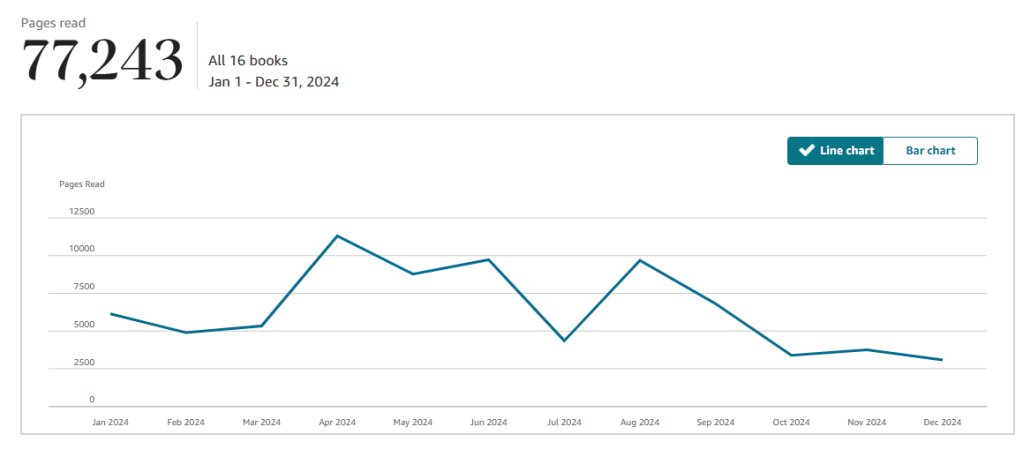
Unfortunately the ebook market in general has been swamped. It was swamped before AI now everything is far worse. Amazon to there credit are trying to manage AI books away from their platform but it is a bailing bucket in a storm. Despite this however my page reads for the last year are actually up despite the lack of new releases, Jan 1 – Dec 31 in 2023 they were 64,460
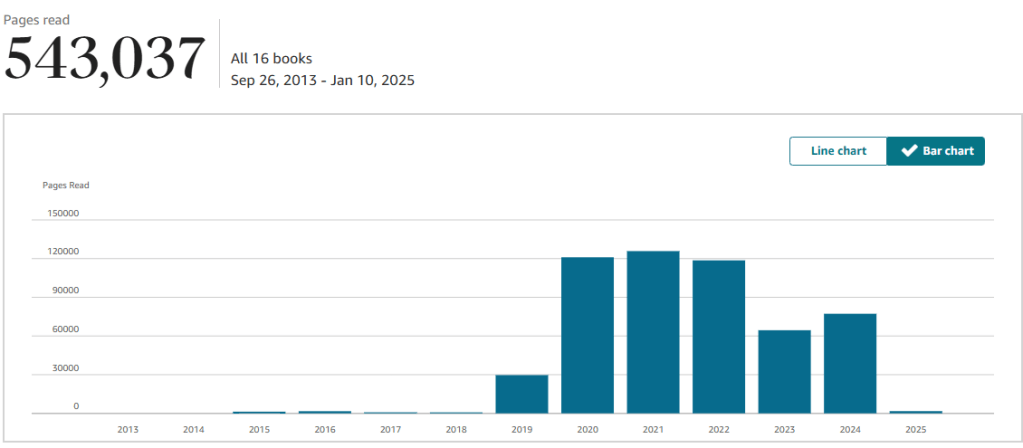
But as you can see in the lower graph it is still about half what KENP reads were before AI started to rear its hydra like head.
Total reads for 2024All time total reads
77,243 page reads in a year with no new releases is however not bad going, but you need to bare in mind I have a reasonable back catalogue of 6 novels, a compendium of the Hannibal novels, 2 anthologies and a nonfiction book on Lovecraft so while these are not bad figures this is not to say they couldn’t be better but it is actually better than expected. I would hazard a guess it has improved mainly because Amazon have been weeding out AI books from there kindle platform and actual authors are getting in fount of readers more often. Time will tell however how true this may be.
If you take the mean number of KENP ‘pages’ in my books as being about 400 (which is probably about right, but KENP page counts do not match print page counts) then I have sold around 193 worth of books through Kindle Unlimited
Books
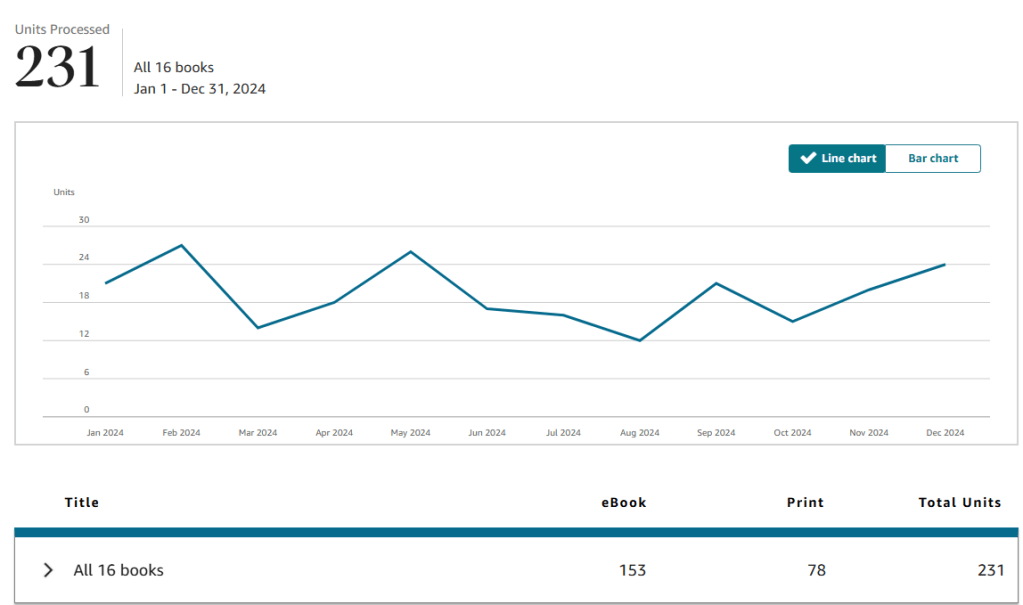
print and ebooks 2024
In total, purely through amazon and not including direct sales at events, I sold 231 books last year, only 78 of which were print. The graph is also slightly misleading where it says ‘all 16 books’ as it is count from a list that includes two books that no longer exist, and a play I never expect to sell and only existed in print as I wanted print copies. It also double counts a couple of books as the kindle and paper versions list separately, in actuality I only have 10 books on the market and again, in a year of no new releases these are reasonably good numbers.
In total, KENP, kindle and paper if you add them together I sold around 424 books on amazon last year. Which is the figure I care about, it is also despite no new releases, up from last year.
What that equates to in money you can see below
Add to that direct sales at events ( I did not do many last year) and I probably made about £1000 last year in book sales. Clearly I am not packing in the day job any time soon… However this was a quiet year without any new releases. I sold books, I had nice feed back from readers, I am happy enough .
Of course to sell that number of books on amazon I did paid amazon marketing. On which I spent a little bit more than that £881.50 in sales, events all cost more to be at than I make in sales generally And if i wanted to figure out the actual figures I probably made a loss of around £500 minimum if not more in order to sell a few books and find a few readers. Had I done more events, baring local ones, that loss figure would of been a much bigger number.
To be clear, when it comes to my vocation as an author I do not care about money. I do events because I enjoy them, enjoy meeting readers, and enjoy getting out there among them. I do not care about losing money on what some might consider my hobby ( I do not consider it a hobby, I am not a hobbyist writer, I am a novelist, it is a vocation, it is who I am) I am lucky in that I have a day job that pays the bills, heats the house, buys gin, and allows me to invest in my joy.
Also to be clear, I am successful as a writer, at least within my own terms. The point of putting this blog post together is to be open and honest about what those terms are, what ‘success’ for me looks like. The only figure in all this I care about is readers found, the only aspect of this which is important is did those readers enjoy the books. And for the most part in a year without new releases I found a goodly number of new readers and as far as I know most of them enjoyed the books.
My advise to any author, be they starting out or a old hack like me, is write what you love and decide what success looks like on your own terms. Do not get drawn into the fake it till you make it culture so prevalent on social media, and don’t try to measure your success against others.
If you can write something, something that touches a persons soul, that makes them think, wonder, or consider the world anew, that makes them weep in that good way, or laugh , or frightened, chilled, or more importantly brings them a little joy, then you are a success. Even if you manage to do that with just one book sold to one person.
I am passing the time working through an old WIP that stilted at 15k, but which I keep coming back to. Its a couple of years since I worked on it, and I have got to a section in which a bookshop owner, who may or may not in actuality be a wizard, and has not really been introduced into the story yet so this is generally in flux, is contemplating the bookshelves… I have absolutely no idea if this passage will survive should I ever write the whole of this novel. It was however joyous to rediscover this bit of fanciful nonsense, because I can not remember writing it (this happens more often than you might think…)
This is somewhat rough and ready as its part of an incomplete first draft…
A Question of books
Books, he had determined years ago, develop personalities if left unread for too long. They gather a sense of self in much the same way they gather dust, sunlight turns pages yellow and slowly bleaches cover if left exposed. The cosmetic changes were, admittedly, more obvious but the personalities books developed were more subtle and harder to define. Nevertheless, he remained convinced this was the case.
Autobiographies, for one thing, tended to develop a high opinion of their own importance, while Biographies tend towards servility. Romance novels wilt as time passes, losing their passion to be read. Histories on the other hand become stuffier as they gather dust and assume a greater veracity upon themselves in direct corelation to how out of touch they become. Novels, meanwhile, have a habit of becoming steadily more fanciful and acquiring unrealistic aspirations.
The variation in personality was never more pronounced that between the fiction and non-fiction shelves, which tended to leer at each other. One considering the other to be lacking in true worth. The others considered there opposite numbers knew the measure of everything but lacked the imagination to raise the human spirit.
He considered both sides to be equally wrong on all counts.
One thing he had noted was that all books, with the possible exception of wilting romances, have in common a desire to be read, with the singular other exception being books of magic.
Books of magic, perhaps as a by-product of their nature, are secretive. They hide away their words in jealous guardianship. They do everything they can to dissuade the causal browser from opening them and perusing their pages. He had witnessed them actively shrink into the recesses of the bookshelves and gather motes of dust upon themselves like a protective shroud. The last thing a book of magic wanted was to be read, for with the act of reading the magic within them was released.
Romances on the other hand just did not know when to let go.
‘If you are looking for the spell books, look for the books trying hardest to be inconspicuous’ he would tell you, if you were to ask. If he was inclined to impart such knowledge at least, which as a rule he was not.
In truth he as happiest if he spent the day in the bookshop, saw no one, and no one came in asking him to impart knowledge.
A good day was a day spent with a pot of tea under the cosy, a plate of fondant fancies beside the tea pot, lounging in a comfy chair, while perusing a random book from his stock. Particularly, if he was of a mind, reading a certain kind of fantasy novel. The kind that often featured him.
We have past into winter, and the sun has begun its return and the writer within me is excited for the new year to come. My literary year of 2025 is going to begin early with a new Harvey Duckman Anthology due out on the 10th of January. It is an anthology of dark and urban fantasy which we have entitled Rum and Rosemary. Gillie ultimately came up with the title and left some debate on the ‘Rum ‘ part, as rum has more than one meaning. In this case it almost certainly mean ‘strange and uncanny’, but Gillie it has to be said, is a pirate at heart…
In any case, with a brief of ‘urban or dark fantasy’ I naturally chose to invent a new genre instead, because that just not broad enough. Thus I wrote ‘Euryale’ which would more correctly be described as a Suburban fantasy. Any classical scholars among you may recognize the name, but for those that do not Euryale is one of Medusa two half sisters. Unlike, medusa who was a mortal woman ravaged by one god then cursed by another for being ravaged (the moral compass of Greek gods was ever deeply questionable), the two other gorgons Euryale and Stheno were wholly divine in nature and thus immortal. Of course the real problem with immortality is what do you do with all the time?
It is partly for this reason that my version of Euryale is working in a charity shop in Cheam. The one with the odd name, next door to the Acropolis Kabab shop run by Mr Popodolpois, who like many a Greek father, made many sacrifices to put his not overly gifted soon through medical school. Just don’t ask him to elaborate on those sacrifices…
Aside from my own story Rum and Rosemary will contain another thirteen thought-provoking, edgy, atmospheric, oft times darkly funny and always entertaining short stories from Anna Atkinson-Dunn, Kate Baucherel, John Holmes-Carrington, Liz Tuckwell, Christine King, CK Roebuck, Laura Buckley, Keith Errington, Davia Sacks, Nimue Brown, Angela Smith, Ben Sawyer and JA Wood.
And is available for preorder on kindle, there will of course be hardback and paperback editions from the 10th of January.
The next Harvey anthology will be Science Fiction Which is another broad church of course. We are always looking for submissions, if you are interested in writing something for us click on the image below.
In 2025 we will also be doing three more Harvey collections, in order after Scifi they will be the expanded ‘Alterative history/steampunk’ then once more ‘Post apocalypse/Dystopian’ before we come back to ‘Urban/dark fantasy’. There is also always just generally weird stuff which we will find home for. And if we get several stories that fit together in ways we have not yet thought of then we might open another.
In other exciting news I can absolutely, positively confirm I will have a new novel out in 2025. The long awaited Lucifer Mandrake novel is finally with my editor and The Esoteric Cricket Ball will defiantly be out this coming year. Which will be the first new novel I have released since February 2022. Which seems a very long time between novels for a novelist. I did release The Strange and the Wonderful anthology , and The Complete Hannibal Smyth in the mean time and my book about HP Lovecraft, but 3 years between novels seems like an ice age. But finally the Mandrake novel is almost ready to be unleashed.
Exactly when is another matter, I have a self imposed deadline for all final edits, typesets et all by the ide’s of March for reasons of symmetry, but that really depends on how much redrafting it needs once I get it back from my editor. But still, exciting times afoot…
I did not spend all those three years have been spent in the company of Queen Victoria’s Personal Arcanist. There are other novels I am also working on , one of which is the second of the Maybe trilogy which is now four years over due.. I am hoping to have that written by autumn. there is also the urban fantasy with the working title ‘The Elf Kings Thingy’ which keeps dragging me back in. And a couple of other projects.
However I have one more project, which I will tempt fate by mentioning (the contract is not yet signed), which is that I have been asked to author a non-fiction book. If that happens, which I am reasonably sure at this point it will, it will have a very definite deadline. Thus Mandrake must be complete because if it isn’t, the non-fiction takes priority from the ide’s onwards. I will illuminated more on this subject when I am in a position to do so…
In any regard, a new year is dawning and I will will be writing for at least four anthologies, have at least one new novel coming out and hopefully more non-fiction and another new novel before the end of the year.
And finally, a happy new year to all my regular readers. the blogs stats for the year just eclipsed 2020 (lockdown was a busy year for blog posts) making this the most visited year in the blogs history. So I guess I will have to keep this going too
Earlier this week the wisest of all muses asked a deep and meaningful question upon her blog to which I responded with somewhat frivolous delight or at least that was my intent.
This is to say her question was both interesting and asked in seriousness on the subject of a thoughtful post on meditation and thoughts. Not least on how her own thought processes worked and asking if others experienced thoughts the same way. My response was written in an off the cuff manner expressing an idealized metaphor for how I think my own mind works. Of course this is me thinking about how my mind thinks.
Thinking about, and trying to understand, how you think is a bit like trying to understand the universe from within it standing on a small blue green planet on an unremarkable spiral arm of a not very remarkable galaxy only able to perceive the visible expanse of a universe, the mass of which our calculations show we can not detect 90% of.
Here is another analogy of which I am fond, when it comes to mankind’s understanding of divinity and the true extent of the cosmos is the ant in the rain forest. Which is to say an ant can not comprehend the truth of forest due to it been insignificantly tiny in comparison to the forest and only able to perceive the merest fraction of the branch of a single tree. Though when it comes to true understanding of the cosmos, we are but a microbe on the back of the ant trying to perceive the ant on which we reside, we have no concept of the forest, thus we can not comprehend in truth that this may be but one of many forests.
Thinking about how we think is both at the heart of the human condition and imposable to truly grasp at the same time. Not least because we are doing so from within our own thoughts. We can not stand outside the universe and look upon it, we can not truly understand the mind from within it. We do not even know what the mind is.
Before you point to the contents of your skull, yes, we know what the brain is. It is an incredibly complex organic interface that processes information fed to it both consciously and unconsciously. If it is damaged it becomes harder to interact with the world, process information, and express thoughts. But none of this means it is where you mind resides. It is merely the interface between mind and body. Science can not more point at the mind than it can the soul. The mind may lay within the chemical, hormonal soup of the brain. It may hover in an undetected dimension of existence a foot and a half in front and slightly to your left, connected to you by a silvery line of thought, unlikely? Possibly but the simple truth is we do not know where the mind resides, so unlikely doesn’t mean impossible and the hovering mind in another dimension theory wonderfully explains many a thing…
Also, when thinking about thinking, I have no idea how anyone else thinks, no one does. Literally on the most basic level none of us have any idea if how we experience the universe bares any true resemblance to how anyone else does. We do not know if everyone sees the colour blue the same way, or indeed if anyone sees the colour blue the same way you do. Our eyes may mostly see wave lengths of light the same way, but this doesn’t mean our brains interpret those wavelengths in the same fashion as anyone else. No one can say, how they think, just as no one can truly say where the mind is. And if we can not say how we think, then we can not know we thinkin similar ways to any one else.
My reply to the question posed by Nimue’s post was to compare my thoughts to the ocean. Some may consider that pretentious of me. But i was not trying to claim my thoughts are deep and mysterious. Often they are shallow and obvious. Show me a goth girl in a tight skirt, corset n boots and my thoughts will almost undoubtedly be shallow and obvious, for a moment at least or two. The metaphor of the ocean has little to do with depth. This though is what I said.
The ocean is never calm, even when the surface seems calm the currents beneath are ever moving changing and washing up against strange shores. So the ocean is never calm, even when it might seem so to others and to be calm is an athame to the ocean. The waters must move, ever change, be they the depths or the shallows, crashing upon the shore, or out passed all horizon. Fed by rivers and seas, pulled by the moon in tides of gravity, while in the deepest places the heat of the earth pushes through mountains.
Then the storms come. The wind, the rain, the great surges, the tempests of chaotic rage that churn and boil the waters, sending them crashing against the land. A deluge of uncontrolled ferocious nature, implacable, untamable, undeniable in its existence.
The ocean is never calm…
Occasionally I think of the ocean, mostly I think like it.
While I like the metaphor the truth is it is only that, a metaphor. In truth I am not sure it truly answers the question, but then I don’t know the answer, I merely know the experience of thinking and how my thoughts shape and turn.
At this moment ‘Hersham boys’ by Sham69 is bouncing around in my head, because its the last song my alarm music played this morning before I got out of bed. Its not really a favorite song of mine but until something dislodges it , it has taken up residence, with its ‘Lace up boots and corduroys’.
Also a this moment there is a conversation going on and leaning towards a conversation edging towards an argument between Kenton West, who sounds like Stephen Fry for some reason, and Eliza Tu-Pa-Ka , who doesn’t, over the qualifications of Captain Wilberforce to serve as Chief officer of the Air ship Maybe’s daughter. Kenton is carefully not answering questions by asking other questions and Eliza is on the verge of a tirade, just as Benjamin Kenton’s grandson, is running up the muddy field to intervene. That particular conversation has been going on for three days. And the word document it has not been written into is sat open on my desktop.
Also at the moment I am annoyed about the people who live next door whom’s teenage son need a clip round his ear to stop him throwing stuff into my back garden. This is low level anger that will explode at some point, or not.
Also, I am getting flashing of scenes from the web series I was watching last night, made by a bunch of New Zealanders 7 years ago, based on PUBG a game I have never played but have developed a deep understanding of. All hail pan man… And thinking I must message my adult son and mention it to him as he will love it.
Also Nimue just sent a message about her plans to do terrible things to me at Christmas, which I am assuming she means in her murder village novel in which I am cast as villain and victim. So I am thinking of replying.
Also at this moment thinking while writing this blog , and at work watching emails , trying to understand what the guy in the office on the sub-continent wants me to do with a server given his very vague instructions. Thinking about the face of my ex-wife for some reason, possibly because my son came to mind and thus my daughter.
Also I want coffee. While I contemplate the greater essence of human consciousness, and the contact I need to sign but am oddly scared to, to write a book about Lovecraft. the worry about the current edit of the Mandrake novel I am waiting back on. Why wearing lace up boots and corduroys would make people call you ‘the Cockney Cowboys?’. Is the second maybe book narrative two slow. Do I really need Kenton West in the novel at all. Why am I writing this blog post, what is it actually about. Is the universe finite. What colour is blue if its not blue. Why does WordPress insist on spell checking to American spellings. ‘Hersham boys’ ‘Hersham boys’ Cute goth girls in tight skirts n corsets. Is there a point to any of this? What point was I making again ? erm… oh yes…
The Wonderful Nimue Brown has a new book out. one I originally reviewed when I was sent a first draft copy about three and a half years ago. I reposted that review in August this year expecting it to be out soon after and yet such are the strangeness of the fogbanks surrounding Hopeless Maine it finally was published… today. So here is my review, again, for anyone who missed it the first couple of times
Semblance of Truth : A Hopeless Maine Novella
Now as it is quite possible you are aware, I am a bit of a fan boy when it comes to the work of Nimue and the esoteric creation Hopeless Maine (and Nimue’s writing in general). So when I was given the chance to read a early copy of Semblance of Truth I jumped at the chance.
The narrative is in effect Frampton Jones journal, written by him, for him and him alone, as he tries to catalogue events on the island as a whole, as well as those events that only effect him personally. Things he could never put in the paper, because even in a place as strange as Hopeless Maine certain things would strain the credence of belief among his readers. The are are also somethings he just wants to keep to himself, like the worrying way his cutlery keeps disappearing and the notes someone keeps leaving him, that are written through the medium of fish…
As the islands journalist Frampton also keeps track of births, deaths, and has to report on (these attended with various levels of willingness) various civic events like founders day, the annual church picnic, the fossilized bones of one of the islanders ancestors walking around the shore. The grand enterprise of building a bridge to the mainland. The not so grand failure to build a bridge to the mainland…
Because the narrative is told in journal entries, some long, some short, some of significance Frampton is unaware of, some that seem unimportant yet which he worries at… the narrative slowly unwinds in the present tense in the respect of how he writes it, while it is all in a very immediate past tense. Things he has just done, or witness, or seen , or not seen, or at least he hoped he did not see, but has a horrible suspension he did see, and what’s making that noise in the kitchen? As well as important advise on the rearing and care of meeps, as well as the importance of not going mad and forgetting to harvest your meeps, and why you should not feed your meeps off cuts of meat.
It also means when he starts top go a little mad for a while his descent in to insanity, and climb back from the brink are equally chronicled… Unless of course in his mad periods he is actually seeing the world of Hopeless as it truly is, and why is no one reply to his fish writing? And what really happened at the O’Stoat house? Who’s that orphan who disappeared the night Miss Chambers was killed by…. by what killed her…? then turned up again! Oh why am I thinking about the orphan? She’s clearly not important… Now! Where did all the spoons come from? Should I ask Gerald? Is Gerald real…?
Poor Frampton, a minor character in a world where events are happening he isn’t equipped to understand. Yet he strives, with a certain ineptitude, to make the island a better place, or at least understand it better. As a journalist he is a man who seeks the truth and to illuminate that truth for the betterment of all.. (and there lay proof that Hopeless is a very strange place, me thinks.)
As you now have the chance, you should invest and read this delight, Also think well of Gerald … I went to order it myself and discovered I have pre-orded the paperback in august and forgotten I had done so. Yay! I now await its arrival