Dear Edgar #11 The Unparalleled Adventure of One Hans Pfaall

Edgar Allen Poe remains one to the most influential writers of the western cannon. His Horror stories inspired many writers, not least those of HP Lovecraft’s generation a hundred years later and by extension Steven King generation were inspired by both Poe and the previous generations he had inspired. Without Poe there may never have been a Cthulhu or a Pennywise the clown.

It’s not just Poe’s tales of Horror that inspired those who came after him. Sir Arthur Conan Doyle attributes the innovation of the detective story to Poe’s, Auguste Dupin stories beginning with Murder on the Rue Morgue. Inspired by the Dupin tales Doyle came up with his own detective, Sherlock Holmes, to no small success, and Doyle in turn inspired Agatha Christie and a whole host of modern writers who have made the genre their own. Poe’s ability to inspire in these cases is well known and well documented as is the influence of his humorous tales to the likes of PG Wodehouse and others though to a lesser extent than his horror and detective fiction.

There is, however, one genre of stories for which Poe influence gains less acclaim, that of science fiction. Few of his stories really lent themselves to the genre. And yet, his influence when they do remains just as profound, as is the case with the cumbersomely titled ‘The Unparalleled Adventure of One Hans Pfaall’ first published in 1835. A story that led to none other than Captain Nemo’s creator, Jules Verne, to proclaim Poe to be

‘le créateur du roman merveilleux scientifique’

and when the father of science fiction called someone the creator of the scientific novel, I think we science fiction writers have to tip our hats to our own Dear Edgar too.

Verne said this in the original introduction to his 1865 novel ‘From the Earth to the Moon’ a novel which also directly references ‘The Unparalleled Adventure of One Hans Pfaall’ in it’s text, and was clearly inspired in part by this particular story. So as with the other genre’s Poe inspired some of the greatest writers of the western cannon. Writers that went on inspire future generations of writers up to and including today, myself included.

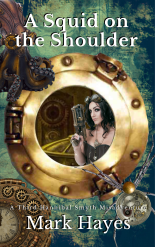
Verne’s ‘From the Earth to the Moon’ centres around the building of an enormous cannon to literally shoot for the moon, carrying three people in a shell. Verne referred to the shell as a ‘space ship’, believed to be the first ever use of that term. This is of course a ridiculous idea, the G forces alone experienced in such a shot would massively exceed those astronauts experience in modern rockets which are already on the cusp of what a human being can experience without expiring. But it is a splendidly ridiculous idea all the same and why let facts get in the way of a good story… Which is why I nicked it and had a ‘mad scientist’ called Elonis Musk building a similar gun on a volcano on a tiny pacific island in my third Hannibal Smyth novel, which was great fun to write.

When I wrote that novel I had no idea that Verne’s original novel had been influenced by this particular Poe story, as I’d no idea this particular story even existed. But the point here is that no ‘The Unparalleled Adventure of One Hans Pfaall’ then no ‘From the Earth to the Moon’, and by extension no ‘A Squid on the Shoulder’.. So once I’d done my research and discovered the admittedly tenuous connection to my own work, I was rather looking forward to reading the story itself… However there is a big problem with the story.

The problem is of course that ‘The Unparalleled Adventure of One Hans Pfaall’ is a precursor to science fiction. It has the same issue as with the main problem with Verne when you read his stories now, the technology that was innovation when written is so very dated now. Verne made calculations for his gun that from a technical point of view were not far off the mark, but we know now it would never have worked. But Verne, perhaps due to the habits of his translators tends not to be ‘tech’ heavy in his stories, they tend towards the adventurous and remain readable (unless you read the unabridged versions like the unabridged 20000 Leagues Under the Sea I read a few years ago, which has many many lists of fish among it’s pages.)

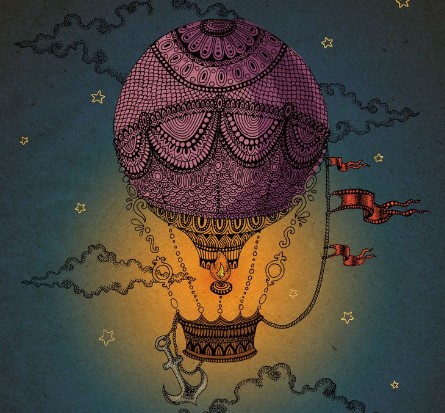
Verne’s novels are defining novels of the genre so their idiosyncrasies are oft forgiven. ‘The Unparalleled Adventure of One Hans Pfaall’ however is not a defining novel, its a little known short story by an author known for his gothic horror, about a man traveling to the moon in a balloon of his own design. Something harder to suspend your disbelief about than giant moon-shot cannons. Hot air balloons were the pinnacle of aeronautics in the 1830’s. Poe’s character, a bellow maker by trade, makes on and fills it using a special gas acquired from a French chemist, this gives him the altitude to escape gravities grasp. Then by compressing the void of space through another device to make breathable air he travels to the moon.
He does all this because the bottom has fallen out of the bellows market because people can fan the flames of the house hold fire place with newspapers. Again, this is not actually comedy, broadsheets with multiple pages had recently become a thing as paper and ink became cheaper and print presses more advanced, bellows really were old tech when a cheaper option to repairing them could be bought for a halfpenny… Also a bellows maker is skilled with metal and leather as well processing as a basic level of mechanics so strange though it may seem there is some logic here.

The moon too is not the moon that Neil Armstrong walked upon. It is a fiery volcanic satellite inhabited by small humanish people… One of which takes Pfaall’s craft back to earth to drop off a letter explaining where Pfaall vanished to five years before, and the fate of the three others who vanished the same night, creditors he murdered in order to escape as they came upon him just as he was preparing to launch his craft. Indeed the only reason we know any of this is his letter is a begging post asking that the Berger’s of his home town grant him a pardon for the murders as it was an act committed under duress… The town council grant his pardon after reading the full details of his adventures, however the moon man Pfaall sent as his envoy had not stuck around so they have no way to let him his plea for clemency had been granted…

Lets just say the whole tale is ‘a lot’.

All of which could be smiled away had it been written as humour, but while there is some humour in this story, much of it is po-faced. This was written as a serious story and meant to be believable on some level, which in the 1830’s was not inconceivable. Poe originally wrote the story to be published in a newspaper as a hoax letter claiming all this to be real. While he added more elements of the fantastical in later drafts that original core of believable for the times science remained. The trouble is, what was a believable if farfetched science base tale in 1835, is in this later age merely ridiculous. The required suspension of disbelief is just too much for the faux-factual story it pertains to be. If Poe had filled this with humour and written for rye smiles it would possibly still work but as it is it just doesn’t any more.

Don’t get me wrong, this is a well written tale. Written with all Poe’s eloquence and mastery of the language, but its a toil to read and lacks any real spark. It could read as a plain fantasy, but it wasn’t never written to be one. Its a tale that has lost its audience to time and lacks the charm to get past its failings.

A SINGLE RAVEN DYING ON ITS BACK…

Show you read it: As a story it is only really of interest to scholars of science fiction as one of the progenitors of the genre. Even then it is more progenitor of a progenitor, and hard going.

Redeeming feature: While I would not recommend it as a story to read it deserves its plaudits for what it inspired, if nothing else.

Bluffers fact: Po-faced is British slang meaning someone has a humourless, disdainful or sour-faced demeanour. Surprisingly then this has nothing to do with Edgar Allen Poe. The origin of the term is instead believed to be derived from the word ‘po’, an abbreviated slang based on the French for chamber pot, ‘pot de chambre’ due to the distasteful expression anyone would adopt upon being presented with a full one.

And yes, I looked that up when I stated this story was po-faced and realised I wasn’t 100% sure it wasn’t a reference to our own Dear Edgar’s oft depicted demeanour.

Posted in amreading, Dear Edgar, fiction, Poe, reads, sci-fi, steampunk | Tagged , , , , , , , , | Leave a comment

Book reviews beyond the paradigm

Hello, how you doing?

Yes I know that is an odd way to start a blog post but its the most important question we can ask each other, even if its the one that normally elicits gentle lies rather than uncomfortable truths. Also I am not the greatest at small talk, but I am trying to get better at it. Or at least less awkward. And sure there is probably a point to me asking beyond that which may becomes clear, or not as the case my be, but enough of that…

Regular readers of the book reviews I post will be aware of two things. The first being that I never give bad reviews, if I don’t like a book I just don’t review it, as I may not like it but that may just mean its not for me. The second thing regular readers will be aware of is that I tend to witter on aimlessly on a topic for anything up to two thirds of the post before I even mention the book I’m reviewing. Some might find this annoying, but one has a paradigm and one sticks to it. Besides the wittering is generally at least an attempt to get across something vaguely profound or relatable I found within the pages of the book I am reviewing.

This is my paradigm with almost every blog post I ever writer to be honest so if you don’t like my paradigm, your probably reading the wrong blog, and what I consider profound or important to say about a book is probably of little or no value to you. I’ll assume therefore if you are still reading past this you like what we might laughably refer to as my literary style at least when it comes to blog posts. The paradigm must be preserved, my readers, that’s you lot, like it that way…

So anyway. What follows are the reviews for four books that each for different reasons, I cannot, or at least will not review within the normal rules of my paradigm. They are four equally excellent, but very different books. And the reasons each of them don’t get their own blogs with long wittering introductions are different as well. They are instead getting this shared introduction which is, you may have noticed, a bit weird. All of them are in this group because if I was to write a long introduction piece for each it would be the type of witter that would likely reveal far more about myself, my objective reality and how I doing right now, than I am comfortable revealing to any one.

“I am fine,” he says, with the gentlest of lies… (see I told there was probably a point…)

Or of course I am just being lazy, and trying to do a bunch quick of reviews all in one go… But there are some other links between these books if you pay attention you might spot them…

(amazon links for all four books are at the end)

Stolen Magick by Lilian Brooks

Speaking of objective reality, Lilian Brooks is a totally real person and not a pen name used by Amy Wilson a fellow founding Harvey writer I’ve know for years.

This is the third of Lilian’s ‘The Whitby Witches’ series featuring water witch Alyssa Bright, a modern pagan woman in her late twenty’s dealing with… Well the second book ended on a cliff edge, and this one jumps off that cliff and does some serious screwing around with Alyssa’s objective reality, and the readers who have to adjust to a new paradigm fairly sharpish to keep up with the plot…

It’s a brave novel, because its brave for any writer to throw their readers such a curve ball in an established series. A lesser writer might struggle to pull it off, but luckily Lilian is not a lesser writer. My reviews of the first two books in the series were some what longer, but to review further than say this is a great read would involve spoilers for this book and the series as a whole. So start at the beginning, the journey is worth it, trust me…

review of book 1 review of book 2

Beyond Sustainability by Nimue Brown

Climate change is swiftly moving the world into a new paradigm. A new way of thinking about, well just about everything, is needed, a new focus, a gentler more sustainable approach to life, but more so we need a more authentic relationship with each other and the planet, as individuals, as a society and a species.

What do we really want from life? How do we find happiness, health, purpose and comfort? Humans are increasingly a miserable species, caught in ways of behaving that give us very little and will cost the earth…

What it it was easy to change our lives? What if happiness wasn’t an impossible dream to chase after? What if we could have nice things?

This is the core question and message of this remarkable book by Nimue Brown, I could talk about it for hours, and write many many blog posts inspired by this book and the soul searching it inspired. But I won’t, instead I will suggest you read it yourself as the journey it takes you on may differ to mine. All I will suggest is that you allow yourself to be open to the possibilities of a more authentic approach to life, happiness and the world as you read.

Facing The Darkness by Cat Treadwell

I have in the past spoken of my occasional struggles with ‘the old black dog’. I believe talking about such things is important, indeed as I am a man I consider it even more important I do so because ‘a chap doesn’t talk about such things.‘ Some people are however far better at talking about depression, they are also far better at given practical, loving, thoughtful advice on ways to face it, fight it, and survive it.

This is a remarkable book in many ways, it is remarkably honest in its writing, remarkably open about all forms of depression, remarkable in coming at the issue from the perspective of a practising pagan, but also remarkable for the depth of advice and wisdom granted to the reader to help guide them through those dark hours and days when the world seems too much and going on too hard.

It is also a beautiful book in both in Cat writing, as well as the authentic voices of contributors, the structure of the book and some frankly heart wrenchingly beautiful and poignant art work by Emma Hotchkin between the covers.

I can not claim this book has helped me face the old black dog, yet, as I have read it at a time when the old dog is in his kennel and not troubling me. Also while I lean towards a form of personal paganism my roots do not lay in druidism so some of the practical suggestions don’t resonate with me as well as they may with those of a more orthodox pagan faith. But that ‘yet’ is doing some heavy lifting and this book is going on the shelf so I know where it is should I find myself feeling the need for the guidance and advice held within it.

And I would certainly recommended it to anyone, pagan or otherwise, for what it contains is the kind of hope you need when the darkness comes a calling.

Once Upon a Hopeless, Maine by Keith Errington

This is not a children’s books, don’t let your children read it, it will give them idea’s and they will enjoy it far too much… This is the kind of book your child wants you to read to them. You should not. It is the kind of children’s book you would have loved as a child, and will love now, and would love to read to your child, even though you know you shouldn’t.

Look it very defiantly says ‘A not for children, children’s story’ on the cover… I think that is as clear as it needs to be. Do not buy this book to read to your child…

Buy it to read to yourself, enjoy the art work, laugh, smile and remember just how much this was exactly the story you wanted your parents to read to you when you were a child…

But don’t read it to your child…

Unless of course you want to, because your the kind of bad parent every child actually wants , you know , the cool one who doesn’t make them tie their laces before they run off, because you want to see if they learn by tripping over them…

The Links

And there we have it, all caught up, normal wittering will resume when I review a book I am sure. Enough of the paradigm nonsense that’s for sure.

Much love

Mark x

Posted in amreading, big questions, depression, fiction, indie writers, pagan, reads | Tagged , , , , , | 3 Comments

Dear Edgar #10 Lionizing

Lionize, transitive verb: to treat as an object of great interest or importance…

We live in the age which lionises celebrities of stage and screens both big and small, sporting stars of team sports and individuals who sell us products splashed across the shirts they wear, and while we are at it we also as oft as not lionize the vacuous for no reason other than the vogue of their existence… Much is made of celebrity culture and how it damages society. The views of a musicians, actors, footballers, or even just a football pundits are both lorded or derided in equal measure depending entirely on the cause celeb on which they have chosen to express their opinion and the opinion of the zeitgeist, or at least those who make it their role to steer the public in the direction they chose. It was, however, ever thus.

In this micro media age of Instagram influencer’s, tiktok dancers and you tube stars, the lionised have become whomever shouts the loudest for our increasingly minimal attention spans. Today you can become a star in your own lunchtime, be a has-been by tea and a never-was by supper time. You don’t have to put much in the way of consideration or indeed apply your intellect to what you say or do, you don’t have to think about it for a moment, just record your opinion and put it out to the world. Demand likes and retweets, and with those you measure your fame. The more vacuous the better frankly if that is your aim. Or perhaps just dance like no one is watching them post it to the internet and hope everyone does. Or film yourself commenting on the artistic merits of a movie without take a moment to consider what that movie may mean…

We are eight billion lost souls, seeking to be celebrated for our celebrity, rather than our achievements. All seeking to be lionised, to become the in thing, that which is, rather than that which never will be or never was…

What, you may be thinking, has this mildly extended rant have to do with the stories of Edgar Allan Poe. Poe’s stories are after all some what at odds to the disposable culture of the twenty-first century. They and their writer, have stood the test of time. Well, for the most part not a great deal, but in the case of this particular story, ‘Lionizing’, everything, because this tale is a satire on the vacuous nature of celebrity, and its all in the nose…

‘Lionizing’ is a tale told to us by Thomas Smith a man born in the city of Fum-Fudge with a remarkable nose, and an even more remarkable interest in noses. He also claims to be the foremost expert on the study of Nosology which he explains is the study of noses. Which is a handy coincidence as his is a particularly fine example.

After a youth spent studying nosology and everything the great and good have ever said on the subject he is kicked out of the family home by a father whom, reading between the lines, is less than taken with his sons obsession. Thomas then goes on to write a pamphlet on the study of noses which, he tells us, he is divinely inspired to do, and takes great pleasure in telling us just how well it was received by. Well by whoever had an interest in noses presumably. Then he goes to visit an artist and displays his nose for all to see and sells the rights to the image of his nose to the artist for a small fortune before becoming a celebrity on the salon circuit where the great and the self important, talk about things of weight and the things that they think should be of weight. While Thomas of course talks about his nose, to various reactions…

‘O beautiful!’ — sighed the Duchess of Bless-my-soul.

‘O pretty!’ — lisped the Marchioness of So-and-so.

‘Horrible!’ — groaned the Earl of This-and-that.

‘Abominable!’ — growled his Highness of Touch-me-not.

In a whirlwind Thomas rises in society, until of course he gets so high on his own self-importance that he reacts to a minor insult by challenging a respected noble to a dual, which he wins by shooting off the others nose… At which point his short period of fame becomes infamy and he is driven out of society.

There is not a great deal of subtly in Dear Edgar’s humour in this tale. He goes for the satirical throat from the off. What he is satirising is not of course the TikTok generation, rather the intelligentsia of the salon circuit and the value and importance that those who moved in such circles ascribed to their own opinions. Opinions that seem quite vacuous from the outside, our nose obsessed narrator Thomas Smith among them. But it is easy to transpose the satire onto the micro media/celebrity age. While Poe is not subtle and this is all a very in your face kind of satire he lands it perfectly. Sure the intelligentsia of the salon circuit isn’t the target it was, but think of it as a satire of social-media stardom and it works just as well as it ever did.

Also I must admit that for me the pair of lines below in it when Thomas is describing one of the many attenders of a salon makes it worth the read alone, As, as a former student of philosophy I can only smile and agree…

There was Sir Positive Paradox. He said that all fools were philosophers, and all philosophers were fools.

What this tale shows once again is that for all he is mostly thought of as a morose writer of gothic horror and murder Poe wrote compelling satire and humour that sits there with the best of them. Subtle as a brick through a window perhaps, but if this short story doesn’t raise a smile and a merry chortle along the way then frankly you’re doing reading wrong…

Of course all that said I’m just a man who spouts vacuous opinions on the internet in the age of micro media so what would I know…

A NOT UNKIND FOUR RAVENS WITH ONE RYE EYE CLOSED EACH, AS IF WINKING AT YOU

Should your read it: With a smile, for the few minutes it will take you…

Should you avoid it: Just read it.

Bluffers facts:  Nosology is a real science, it is not however the study of noses, but in actuality the branch of medical science dealing with the classification of diseases. Nosos being the ancient Greek for disease, something Poe would have been aware of, so doubtless delighted in misusing the term for the purpose of humour. The scamp.
Posted in amreading, Dear Edgar, goodreads, Goth, humour, opinion, Poe, rant | Tagged , , , , , , , , | 1 Comment

Quote the darkness, Evermore

‘Hello darkness, my old friend, I’ve come to quote of you again…’

We are in the midst of summer, darkness is hard to find when the nights are short and the days are long. Sleep is hard to come by, the rhythms of the body match the seasons. Now is not the time to sleep, now is the time to hunt, to gather, to partake of the rich bounty of the summer and prepare for the what will inevitably come once more.. This is not a time to think of darkness, this is the time to celebrate the light… So here are some quotes about darkness, in all its many forms.

The woods are lovely, dark and deep. But I have promises to keep, and miles to go before I sleep. ~ Robert Frost

Reality is merely an illusion, albeit a very persistent one ~ Albert Einstein

The cruellest lies are often told in silence ~ Robert Louis Stevenson

The most common way people give up their power is by thinking they don’t have any ~ Alice Walker

Stars, hide your fires; Let not light see my black and deep desires. ~ William Shakespeare, Macbeth

When you light a candle, you also cast a shadow. ~ Ursula K. Le Guin

Long is the way and hard, that out of Hell leads up to light. ~ John Milton, Paradise Lost

I’m not afraid of the darkness outside. It’s the darkness inside houses I don’t like. ~ Shelagh Delaney

Now, turn go out in the sun and enjoy its warm glow, while it lasts…

Posted in 2020 quotes, amreading, humour, mental-health, opinion, quotes, reads | Tagged , , , , | Leave a comment

Playwriting

I am a novelist, and short story writer, these are my mediums. Occasionally, on a dark night when the wind if form the north and the whispering of ravens is at it worst I may even write poetry, but I will almost certainly deny this… What I am not is a playwright or performer. the former is not a skill set I have ever pursued.
As for the latter, well life is oft said to be a performance, though who or what forms the audience for that performance is a matter of some debate. What callow gods do watch us without interest nor care?

I did however spent a great many years of my life performing for one audience or other. Boyfriend, lover, father, husband, sports fan, music fan, son, jester, reader, drinker, goth, posser, and many other roles along the way. Unconvincing performances all, because I am all these things and none. But we perform for those we wish like us, love us, or occasionally just need us. Some perform these roles without seeming effort, perhaps because they inhabit the roles in a way I never have. I was never good at inhabiting these roles that others may wish me to be, or indeed the roles I wish to inhabit. Yet perform them I did, wearing masks of my own making, masks I learned to see in the mirror, masks I learned to forget were masks, until the cracks began to show…

I made a decision a few years ago to stop wearing masks. to just be myself and let the bones fall where they may. And for the most point I have managed to do that, oddly I feel happier trying to be no one but myself.

So this is me, a writer of novels and short stories who doesn’t perform…

Then for reasons to do with the strange people of Gloucestershire, I wrote a play and even more weirdly I performed in it. I’d deny everything, but it was filmed and someone put it on You tube. So enjoy the one and only time I will be caught performing, and my sole and last venture in to Play writing.

The manuscript is available in book form on Amazon though why you would want a copy is beyond me

https://www.amazon.co.uk/Drag-King-Yellow-Play-One/dp/B0CCXP3D5M

Posted in amwriting, Lovecraft, mental-health, rites, steampunk | Tagged , , , , | 2 Comments

Dear Edgar #9 Morella

“It is a day of days,” she said, as I approached: “a day of all days either to live or die. It is a fair day for the sons of earth and life – ah, more fair for the daughters of heaven and death!”

Our own Dear Edgar is, as you are probably aware, much beloved by those who favour clothing themselves in black, wearing dark eye-shadow and catching moon moths while they dance to ‘This Corrosion’. Some might say this is because he and his story’s have a reputation for more than a fleeting obsession with tragedy, love and death. That and his poetry, obsessed with tragedy, love and death…

This is of course an unfair summing up of Poe’s body of work, in some stories no one comes to a tragic appalling end…

There is however something of a theme to many of these early stories, linking love and death, and ‘Morella’ is no different in this regard. There is also however a subtle undercurrent that runs through this tale and the previous one ‘Berenice‘ linking love to decay and revulsion, which is, lets be honest here, a tad odd… More so when you consider that this was the time Poe’s life when he was on the cusp of marrying to the woman that was undoubtedly the great love of his life, who at this point was still half his age.

There is a certain tragic portent to this passing obsession with decay as his soon to be wife Virginia Eliza Clemm would go on to contract tuberculosis in 1842 and the wasting affliction that took her life within a few years at the tender age of 24. But as her loss was still a decade in his future Poe’s minor obsession with wasting diseases at this point probably had more to do with his brothers death a few years earlier.

The Morella of the title is the highly respected by not exactly loved wife of the narrator. A woman of terrifying intellect obsessed with German philosophy. In particular Fiche and Schelling both of whom had some interesting idea’s about identity and intellect, though the former mostly just borrowed from Kant and the latter from the former, but that’s philosophers for you. Ever do they regurgitate the statements of there fore-bearers and add little of worth… (my philosophy degree may be biasing my opinion here…) In any regard, both gentlemen expound the theory that intellect and identity are part of the soul and thus capable in theory of transcending death, at least if there is some suitable vessel for them to inhabit…

This is somewhat at the heart of this particular story…

The narrator also makes ominous mention of his wife education in Presberg, the old name for Bratislava, now the capital of Slovakia, a place linked with witch craft and dark magic in Poe’s time ( because virtually all the Slavic states were, old magic from the old countries of eastern Europe…) Which suggests she is of old Slavic/Czech/Romani stock, therefore clearly dabbles in dark arts…

Morella’s husband, our narrator, admits while fond of her, he does not love her, but he does respect her greatly and considers her to be his teacher of sorts. It is a strange relationship but a happy one after a fashion. But As time goes on Morella steadily becomes more bed bound and absorbed in her books, she always starts to waste away of some unspecified aliment, before finally, she dies in child birth, but not before making some ominous predictions…

“The days have never been when thou couldst love me – but her whom in life thou didst abhor, in death though shall adore.”

The moment she dies is also the moment her daughter takes her first breath and thus the narrators life changes. He dotes upon the child, yet makes the strange choice not to give her a name. In his daughter he finds the love he never held for his wife and despite her dire predictions he finds joy in the child. But as she grows he begins to notice just how much like her mother the child is becoming, both in looks and mannerisms. the older she gets the more the child seems to be becoming the mother and the more the narrator begins to fear some dark pact or foul magic is at play…

As the years pass and he starts to see more and more of his dead wife in their child his fears grow until he determines the only thing he can do is have her baptised, and give her a name. But what name should he give her…

Well… Of course… There is only one name, fear it as he might, that the child could have. So he wishers it to the priest as he performs the baptism, and hears his wife’s voice once more as it is uttered…

“I am here.”

‘Morella’ is a truly gothic tale of dark romanticism and horror, and unlike ‘Berenice’ before it, it doesn’t suffer from the same overly verbose, overly written problems of the earlier story. ‘Morella’ is shorter, more accessible and yet somehow darker for it. Instead of forcing you to wade through his intellect, Poe just tells the story and it hooks you in and drags you with it far more for that. The twist at the end I shall not, for this is a tale to be read, it is possibly the best of the early stories and yet one of the briefest. So trust me in this, it is worth your time.

A TRUE UNKINDNESS OF RAVENS

Should your read it: Clearly you should, in a room full of cobwebs and spluttering candles (or a well lit airy room , your choice)

Should you avoid it: Unlike Lovecraft, Poe has no issue with giving female characters real agency, and while the Eastern European black magic trope, and witchcraft is somewhat passe it is far from offensive.

Bluffers facts: While there are other possibilities it seems likely that Poe derived the name of his female antagonist from ‘Morel’ a common name for black Nightshade a poisonous weed related to Deadly Nightshade or as that is otherwise known Belladonna. If this is as seems likely true, well that’s just the most Goth name ever, isn’t it…

It’s also the name of a pretty little medieval walled town near Valencia in Spain, but I prefer the former theory… What do you expect, I wear a lot of black.

Posted in amreading, Dear Edgar, Goth, horror, humour, Poe, reads | Tagged , , , , , , , , | 4 Comments

The Rabbit Hole

Occasionally most writers, I suspect, find themselves down the research rabbit hole. The research rabbit hole is oft times far more vast than a reader would ever imagine and in much the same was as most writers tend to write far more than ever makes it to the page. Veritable warrens in fact, that stretches ever deeper, drawing the writer down amid twisting turning tunnels that gleam with promised wonders, in amongst the dirt…

To use another analogy, research is an iceberg, and your readers may only ever see the tip that lays above the water line, but you need the whole iceberg if your story is going peak even that much out above the waves…

As I said, most writers do this. Most however are probably less than inclined to hurl themselves down a research rabbit hole with only a vague idea of why they are doing so. Most writers probably do not feel the itch at the back of there skull in the same way. An undefinable urge to go chasing down a story for no other reason than the sudden pronounced conviction based on little more than conjecture. A conviction built on effectively nothing. A conviction caused by little more than a couple of neutrons firing at the same time, causing the vaguest of ideas to form. That was almost certainly not related to the rum…

Or may be they do… Maybe I’m not alone in this.

In any regard, thanks to the human incarnate of effervescence, queen of the mad clockwork pixie-girl’s and eclectically talented, Jessica Law*, introducing and singing an excellent, entertaining song based in part on a 17th century Italian poem called ‘Orlando Furioso,’ rooted in some of the wilder interpretations of ‘The Matter of France’… And so, down the rabbit hole I went.

African Knight on the original Hippogriff rescues Chinese Princess from an Orc (a kind of sea serpent) an Italian renascence artists interpretation of an aspect of The Matter of France which is a tad bonkers. One may be kind and suspect he’d never seen anyone from China, or indeed North Africa… But at least he got the hippogriff’s feathers right

In fairness, this is not a new rabbit hole. I’ve been down here before, which was why to no ones surprise I suspect, I was previously aware of the epic Italian poem in question. The Orlando in the title is the Italian name for Roland. The Roland who was cousin to Charlemagne and most famous of the emperors Paladin knights and the central hero of the French national epic ‘The Song of Roland’. By coincidence he is also ‘The Childe Roland’ of whom Robert Browning wrote ‘To the Dark Tower Came’ and by extension is also the inspiration for that other Roland of epic fiction, The Gunslinger in Stephen Kings ‘The Dark Tower’ series…

I may have these words tattooed upon my body… I’m not telling you if this is true.

It was due to the one who on occasion ‘Forgets the face of his father.’ that I originally wandered down this rabbit hole, via this other entrance, which had led me to an awareness of epic Italian poems as well as the general madness that is ‘the Matter of France’. This previous foray down the rabbit hole of Charlemagne’s knights also seeded an idea at the time that I played about with then put to one side over a decade ago. It was at the time a half baked idea that didn’t pan out, not least because another idea took hold which became Passing Place. But I have always thought there is a story waiting to be told down this rabbit hole.

Unlike ‘The Matter of Britain’, the name given to the cycle of myths surrounding King Arthur and the knights of the round table, ‘The Matter of France’ contains verifiable historical figures, Roland and Charlemagne included. But just because there is some actual real history here doesn’t make the fantastical nature of the story’s any less mythic. If anything Arthurian legends are far more prosaic than their Gaelic equivalents. The rabbit hole is deep and full of madness… I mean there is a tangled web of wondrously bonkers stuff down there, magicians, heirs, prophecy’s, sea serpents, magic islands, hippogriff’s, Princesses from far off Cathey, wars, lovers, romance, magical fountains, rage fuelled murderous rampages, magic rings, magic swords, an elephant tusk horn, unrequited love, religious wars, jealousy, more madness… As well as a bleed in of Germanic and Spanish myths, a little North African, Mediterranean and near east while we are at it, oh and the catholic church of the first holy roman emperor himself. I’ve been down there a few days , I have a lot of notes…

I started back down this rabbit hole with the seed of an idea. An idea born of an unrelated short story I wrote about Sigmund Freud adrift in a pedalo asking a man who just appeared dressed as a pirate about his dreams and, because it was Freud, how this related to his feelings about his mother. This was an absurdity, clearly, and written as such, which made it fun to write. It was also playing around with an idea, the core of which I have danced with a while….

So I am down the rabbit hole, admit The Matter of France, Italian Epic Poems, adrift in the pedalo of an idea, that may become a thing… Currently its just a loose collection of notes for the most part, oh, and this dialogue…

“So Roland…”

“Orlando!”

“Orlando then, if you prefer. You were telling me of this battle you witnessed. What do you think it all means?”

“Isn’t that what you’re supposed to tell me?”

“Well, yes, in essence, but my process is complicated, I do not merely interpret dreams… “

“They’re not dreams…”

“Are they not? Well let me ask you this, what year did this battle you speak of take place, Orlando?”

“The year of our Lord Seven Ninety-Three.”

“And today’s date is?”

Bitter laughter, “It matters not?”

“Matters not? I see. But we sit here amidst the dawn of the third millennium and you are speaking of a battle that by your own admission took place towards the end of the first.”

“It is still no dream Herr Doctor.”

“What prey tell then, Orlando, is it?”

“A memory…”

This then is what happens when you listen to Jessica Law* singing her songs, or maybe that’s just me…

*As I have taken her name in vain , click on her name and it will take you to her Bandcamp, enjoy.

https://jessicalaw.bandcamp.com/album/lovers-and-fighters

Posted in amreading, amwriting, big questions, books, dreamlands, fiction, humour, indie, indie novels, indie writers, indiewriter, music, rant, reads, writes, writing | Tagged , , , , , , , , , , | 1 Comment

Dear Edgar #8 Berenice

There are many ways to enjoy a story. In almost ever regard, and on almost every occasion, I will always say the best way is to read it yourself. Like all rules however, there is always an exception. But lets not get ahead of ourselves, there are other matters to attend to first.

All writers go through the occasional fallow period. this doesn’t mean they are not writing of course, and if you are going purely on publication dates (which in Dear Edgar’s case the only option I have) there can be a lot of deceiving factors involved. Lovecraft had his faults, many of them, but he did clearly date everything… Poe on the other hand was less fastidious with dating his work, this and his inclination to tinker with it even after publication makes knowing when something was written and where his fallow periods might be, harder to identify.

However, there is a gap of some fifteen month between the previous story ‘The Assignation’ and this next story Berenice, which was published in the Southern Literary Messenger in March 1835. This represents one of the longest fallow periods in terms of publication in Poe’s career. It was also a period that saw him shift from those earliest humourist works that occasionally paddled around the edges of Lake Horror, to diving into that lake with wilful abandon. Berenice is very defiantly Dear Edgar’s first out and out horror story, and much more the Poe you expect to encounter. It is not unreasonable to say therefore, it was in this fallow period that Poe found himself as a writer… He was to go on to publish six more story in the same magazine over the next few months in a period of frantic activity.

That said, there were other things going on in the life of our Dear Edgar at the time. He had started to drink heavily, something which became a problem quite quickly. He was both hired and fired (for turning up to work drunk) as subeditor of the Southern Literary Messenger in the space of a month in summer of 1835. This was the same year in which he obtained a marriage licence to marry his cousin Virginia Clemm, who aside being his cousin was also thirteen years his junior, though they were not actually married until May the following year when a witness false attested to Virginia being twenty one… She was actually at the time only fourteen, while this was not entirely unusual in the 1830’s, Edgar was twice her age.

By all accounts Virginia was the great love of Edgar’s life, and her early death at twenty four broken him for some time and inspired much of his later works.

Between his emerging alcoholism, unstable employment (he was rehired by the same magazine a month later having sworn to his sobriety) and his complicated romantic entanglements, Poe life was far from settled. He was however finding the inspiration to become the writer he was destined to be, though there was a road to traverse before this transformation was fully realised. But everything you might expect to find in a tale by Poe can be found within this story…

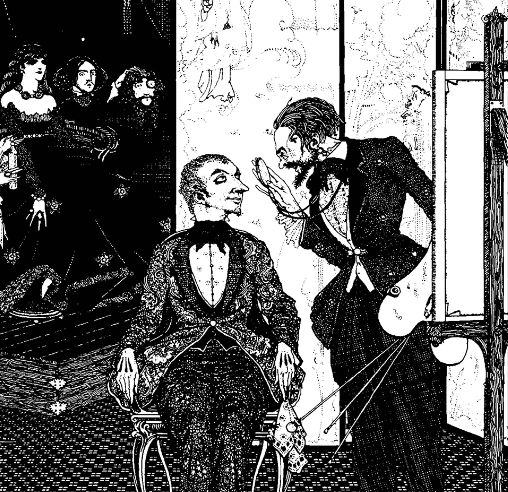
*Original Illustrations of ‘Bernice’ by Harry Clarke 1926.

Bernice is a tale of obsession, a monomania in a grandiose Gothic style. Egaeus, the narrator of the tale, is a studious young man given to hanging around in the ancestorial library and brooding a lot. The last male heir of a noble line, he grows up with the an affliction where by he easily becomes obsessed with objects, going into a trance like fixation for minutes , hours or even days.

The Bernice of the title is his cousin, with whom he spent his childhood, and whom is his polar opposite. Where he is serious, studious and like hanging around with dusty books, she like the open air, sunshine and generally larking about in the grass having a good time. In short they have next to nothing in common, until Berenice is struck down by a disease, and in a short time haunts the dusty halls of the mansion in those few hours she is not abed. It is at this point, his cousin dying before his eyes, be proposes to her… because that’s what you do when you flighty fun frolicsome cousin is slowly wasting away of some incurable affliction, you suggest marriage. After all, she can’t run away into the sunlight any more…

Strangely and perhaps as a mark of just how ill she is, she agrees, and the two become engaged, just in time for Egaeus to start regretting his decision. Then some time, her beauty and youth burned away by her illness, Berenice smiles at him one day and he becomes obsessed with her teeth. The only part of her untouched by corruption…

And when Egaeus becomes obsessed, he really becomes obsessed…

Some time late he is aroused from his mania by a servant who tells him Berenice has died. At which point his mania for her teeth really goes a tad over the edge… This involves a shovel, a visit to the grave yard and a hammer , chisel and pliers. As well as the unfortunate revelation that Berenice was not actually dead when they buried her, just in a deep stupor, deep enough to appear dead. Considering what Egaeus’s obsession drives him to do, that is somewhat unfortunate…

This is a very dark tale, in fact it is so dark that Poe himself editing it in later publications to tone down some of the brutality in the original version. Stripping out a lengthy section, it is an interesting act of comparison to read both. While the first is certainly more graphic, I would argue the later edits are an improvement in terms of horror for what they don’t say.

All that said the prose of this story is dense even by Poe’s standards, which make it an awkward read in some respects. Poe is generally a tad more restrained with his prose than he is in this tale, he leans so heavily into the atmosphere of ruinous gothic excess that it edges into the territory of prose poetry more than story telling, there are some wonderful lines. Like the ones below…

 …she roaming carelessly through life with no thought of the shadows in her path, or the silent flight of the raven-winged hours. Berenice! — I call upon her name — Berenice! — and from the grey ruins of memory a thousand tumultuous recollections are startled at the sound! Ah! vividly is her image before me now, as in the early days of her light-heartedness and joy! Oh! gorgeous yet fantastic beauty! Oh! Sylph amid the shrubberies of Arnheim!

But here in lays a problem , the lines are wonderful, the use of language exquisite, the descriptions rich and layered until its like wading thorough the literary equivalent of a sickly sweet syrup which makes the actual story hard to follow. This is a dark Gothic beauty of a story but it is intoxicating over written. It is, for me at least, so love with its own Gothic grandeur that it fails to be an engaging story.

Take this sentence…

My books, at this epoch, if they did not actually serve to irritate the disorder, partook, it will be perceived, largely, in their imaginative, and inconsequential nature, of the characteristic qualities of the disorder itself.

Its splendid isn’t it… But no sentence should need eight comma’s… And what does it actually mean… Well ‘My books feed into my obsessional nature.’ is perhaps the best interpenetration. Yes this is Poe and yes Poe prose always lent towards being a tad overwritten. This is not even the worse example, (see the bottom of this page) But even for Poe some of this story is excessive. Which is perhaps partly on purpose, with a obsessive narrator, but still makes it a tough read to follow, and that is without some fairly oblique classical references and the smattering of Latin and french that crop up along the way. As with earlier stories Poe loves to through a little french about…

However, there other ways to take in this tale other than reading it yourself. There is a wonderful reading of this story by one of the crown princes of Gothic horror. Vincent Price. And frankly I would listen to Vincent Price read the back of a cornflakes packet, so finding this unabridged version was a real treat.

If however you are more taken by the power of visuals over just the sound of Mr Price’s unforgettable voice there is an much abridged version of the same reading used as the narration of a short film of the same name by Vlad Latosh that leans heavily into the Gothic nature of story and is a delight.

But Vincent Price and Eastern European film-makers aside in terms of the story itself while it has plenty of fabulously descriptive prose, and is wonderfully Gothic in splendider, as a story its just difficult to get to grips with… So it gets less ravens than I really wanted to give it…

THREE RAVENS OUT OF AN UNKINDNESS, THE FORTH GOT MIRED DOWN AMIDST A SENTENCE THAT NEVER ENDED.

Should your read it: Sure, but listen to Vincent Price tell it first, you will enjoy it more as when you read it you will hear his voice narrating the story to you in your head ever more…

Should you avoid it: There is no reason to avoid it, save perhaps a desire to avoid getting lost in sentences like this one…

Thus awaking, as it were, from the long night of what seemed, but was not, nonentity at once into the very regions of fairy land — into a palace of imagination — into the wild dominions of monastic thought and erudition — it is not singular that I gazed around me with a startled and ardent eye — that I loitered away my boyhood in books, and dissipated my youth in reverie — but it is singular that as years rolled away, and the noon of manhood found me still in the mansion of my fathers — it is wonderful what stagnation there fell upon the springs of my life — wonderful how total an inversion took place in the character of my common thoughts.

Yes that’s one sentence…

Bluffers facts: As mentioned earlier Poe rewrote the tale in later editions this was after publisher of the Southern Literary Messenger, Thomas W White, received several complaints about the ‘shocking violence’ in the tale.

Poe disagreed with the complaints at the time but later said “I allow that it approaches the very verge of bad taste – but I will not sin quite so egregiously again.” before going on to write a story about a gorilla murdering Parisians by ripping them to pieces…

Posted in amreading, Goth, horror, Poe, reads | Tagged , , , , , , , , , | 6 Comments

The battle of the bottle bridge

For reasons best known to them, the ‘good’ folks of Hopeless Maine ‘invited’ me to write a story for their blog. They did this by repeatedly blaming me for things, all of which I was completely blameless for…
Sure I looked at a map of the island and saw a spoon-walker depicted in one small corner of it and joked it was clearly to scale and was therefore Spoon-Kong.
And sure this passing aside of mine may have inspired Nimue to write a story featuring Spoon-zilla… But how is that my fault?
And sure I may have suggested to the folks of Hopeless that Spoon-zilla and Spoon-Kong clearly therefore should have an epic battle somewhere on the island, in jest…
“Yes, you should write that.” they said…
“Oh what the hell, sure…” I replied thinking that I could days out a few hundred words of silly monster combat and that would be that…
It was a this point things go out of hand… Because I love Hopeless Maine and if I am invited to write for them then I could not possibly just hack something together. I had to try and make something worthy of being placed on the island… Which is why this is just part one and doesn’t really involve spoon-walkers for the most part.

Nimue Brown's avatarThe Hopeless Vendetta

By Mark Hayes

In the aftermath of broken bottles and stamped on night potatoes no one was entirely sure what had happened. No one even admitted to having been there. The most anyone would admit was knowing someone who knew someone who had been there. There were no witnesses because no one was willing to admit to having been there and witnessing the event and by mutual unspoken agreement those who had seen others in attendance and been seen themselves never spoke of it directly.

Everyone one was however more than happy to apportion blame, as ever.

In this case though that blame was easy enough apportioned. It was the fault of the newcomer. The man in the red-tailed jacket who had washed up on the shores of the island less than a month before in most unlikely circumstances. Barham P Bingley. Just how he had washed up in a…

View original post 1,327 more words

Posted in amreading, fantasy, fiction, reads, steampunk, writes, writing | Tagged , , , , , , | Leave a comment

Notebooks and Scribblings

Most writers, I suspect, keep a few note books… Some more than others. Some may scribble down the odd idea once in a while, if they remember. Others may carry a note book pretty much all the time. Or have merry little notebooks scattered about their home or work places. Of course in the modern age many will make verbal notes on there phones, or type them out into a notepad file of some description on one hand held device or another.

The there are the mad ones, the ones that are a tad obsessive and keep note books by the bed, the sofa, there desk, on the kitchen table, in the car, in the smallest room…. And keep voices notes shouted at ‘Alex’ at 3am, and in notes files on every conceivable device backed up to the cloud on something like one note , and folders full of word documents and transcriptions of the diseased uttering of an incoherent mind… And have been doing so for so many years now that they frankly have no idea where all the notes are or what inspired most of them or whey they were noted at all…

Occasionally these mad individuals find themselves stumbling through the notes, trying to make sense of often incoherent gibbering.

Hello. My name is Mark, I am a note-a-holic… Here’s some very random short scriblings (bare in mind these are not even first drafts, they are at best the equivalent of an artists sketch, trying to get an idea out for a first draft to follow, they are rough and ill-formed. Welcome to some of the odder bits of my mind…

In the space between universes, the emptiness of nothing, there is something all the same. If only the possibility of something. Islands of potensality for want of another word. Think of them as the soft places. The places in between. No more real that a dream, except they are real none the less, and there are those who dwell within them. 

But there are other things too.Things that come from elsewhere, from places that could be described as here, or there. Bleedings out of reality, if you will. Bleeding out into the soft places. To a place where nothing can be, from the place where everything is.  

One such soft place is the garden of the lantern maker. Don’t ask me his name, if he ever had one it was forgotten before your universe was born. That may seem impossible to you,  not that it matters, but you are thinking in the terms set by what you call reality. You need to step beyond them, the soft places exist between. Beyond if that is the better word. Time does not exist there in any sense you understand. Time and its passing is a product of reality after all.  

He is known by his actions only, he is the lantern maker, that is enough. It is not what he does that matters so much of how he does it. His lanterns you see are weaved from human souls. Well not just human souls, the souls of those things which inhabit what you call the universe. I only said human souls to grab your attention, but all that which exists has souls, humans, elephants, lions , the smallest of ants, a blade of grass. Though the lanterns of ants are dull lights at best. Even the souls of your dead, human, make for only the tiniest lanterns in his garden.  

The souls of of the living though, they shine brighter than stars. Thus the lantern maker coverts those more than any other. 

I have no idea, so don’t ask, a note with the file says PP2 which would imply this was part of my early plotting for the sequel to Passing Place I may eventually write one day. If so it bears no relation to the actual plot notes for the sequel to Passing Place I may write one day… Its also not entirely coherent even within itself…

Its odd ,the little details you remember. Like the book I was reading when Lorne came into the cafe. Perhaps it was because it wasn’t my usual fair. A crappy sub-errotic detective thriller called Blindsided By Beauty, it was trying its best to be 30’s noir updated to a more modern setting with sexscene just the right side of the censors knife. It was trying to be classy, while wrapped in a brown paper bag.  

It was failing on all counts. I vaguely remember enjoying it, though beyond that carefully alliterated title I can’t remember a thing about it.  

Lorne looked strung out again. But there was little new there, she had been working for Frankie at the eleves until her habit got too firm a grip on her. Now she plied her trade in less surlobrious establishments . Frankie had warned me she was a shitshow but she was also another old friend from back in the day. Back when we were kids shopping up west with a fine fingers discount. I knew her mum who had known my mum both of whom would not be happy with the turn her life had taken. But what are you gonna do , and when she was sober she was fine company  

 Not in the way you are no doubt assuming 

 Well not after a couple of drunken tumbles . but let’s not go there. She was good to talk to. 

Anyway, she had been tying to straighten out and I had thrown a little work her way of the none horizontal kind. I had clients that didn’t like to meet men in uniform and she was a good go between .  

But right now Lorne was strung out about something  

Fairly sure this was a sketch for a Hannibal short story, though not sure how Hannibal works with 30’s noir. Technically there was still a 30’s in Hannibal’s universe so its kind of works, I have a vague recollection (and some more plotted notes) of where this one was going which was very much followed the noir type plot of the ‘woman gonna do me wrong’…. But still.

Sometimes I wander into the hidden valleys of the mind  

And there , between mountains of improbably size and beneath improbably blue sky I walk 

At the heart of these hidden valleys there is always a temple  

Small but imacilate in concept  

And on the steps of the temple sits an old monk , who always has something to tell me , but speaks only in words whom meanings are beyond comprehension 

And that one is literally in a folder called Plotting, and I have no idea what I was jibbering on about. That folder contains many small bits including this last little aside which which also contains the last of these notes, a short one but one that made me smile… I have no idea why I wrote it down.

Clearly, they were both swinging at the same piñata  

Posted in amwriting, opinion, reads, writes, writing | Tagged , , , , , , | Leave a comment