I stumbled over the below in an old note book, and later an old blog post, its probably fifteen years or more since I originally scribbled down these words. Words written to myself, six novels ago, and at a very different time in my life. Its an old habit, writing notes to myself in any attempt to explain whats on my own mind. To explain myself to my self. I still do so from time to time.
I’m not sure where I picked up the habit. Certainly no one ever suggested I did so. I’d say its a form of self-inspired therapy but I suspect I read of it in a book somewhere and clung to the idea. I have always collected ideas and habits from books. This is one of the more constructive ones I think because taking the time to write yourself a note explaining yourself to yourself forces you to consider your demons, your actions, and on occasion consider how best to deal with them.
The place I write from is not a happy place. This was a lesson learn the hard way, but a lesson learned hard, is a lesson learned well. But all the same it is a bitter kind of lesson. Writing is not one of the things that take me away from the unhappy place. That too was a hard lesson to learn. But the hardest lesson to learn was perhaps that in order to write I need that well of anger, that core of rage, that distrust of the world, that unrepentant cynicism with which I find I view the world, when I reside in my unhappy place. If that all sound a tad dark, that is only because you need the dark to make sense of the light, and writing is how I make sense of the darkness. It is a strange dichotomy, writing is my light. My beacon. Yet for it to exist I must first be in the dark, for it is there I find whatever it is that drives me to write, the hunger and need to express my thoughts and ideas all stem from there. There is, I hope, humour, hope, and humanity in my writing, and when its good I know it is good. When it works it flows like water, ideas become babbling brooks and serpentine streams rivers ever flowing into oceans the wash on other shores. But it all starts in the dark unhappy places of my soul, the dark well spring, and my struggles to make sense of everything that life is…
I maintain no preconceptions that these words are in anyway profound, least not to anyone but me. They do however remain true, writing holds the dark at bay, for which I am ever grateful, and so while the world is not the world in which I wrote them, nor my life the life I was living when I did, the words ring as true to me now as when I first scribbled them down.
Often these days I scribble things down in other ways than tatty old note books, though I have many tatty old notebooks and if anyone tries to take them from me there will be tears… Sometimes I do so and I don’t even realise I am in effect still writing notes to myself. Notes to explain who I am. I scribbled the below as a comment on a friends blog, it wasn’t till stumbling across the notes in an old blog post a few days later above that I realised what I had done…
I like my anger, without it I am not sure who I am I bottle it up in tight little jars. Seal it within myself. Turn it, mould it, hammer it and temper it. Then, when it can not be held down any more. When it has been refined to a glowing edge. I use it, and poor it into words. My anger becomes creation, focused it becomes a positive force
Still writing notes to myself to explain my inner demons. As self-therapy’s go its less destructive than throwing Molotov cocktails.
An odd thing happened as I was writing a twitter post… I need to know which Hannibal Smyth short stories had been published in the Harvey Duckman anthology series and for the life of me I couldn’t remember if it was two stories or three. Its an odd thing to realise, and even odder to admit, but if someone asked me which or my stories are in which Harvey Duckman Editions I couldn’t give you a definitive list of the top of my head.
I couldn’t even tell you the titles of all the Harvey stories I’ve had published without looking it up. Particularly if they were standalone stories. But not remembering if the three previous Hannibal Prequal stories had been published in the Harvey Duckman Anthologies or just two of them… Well that’s just a little odd.
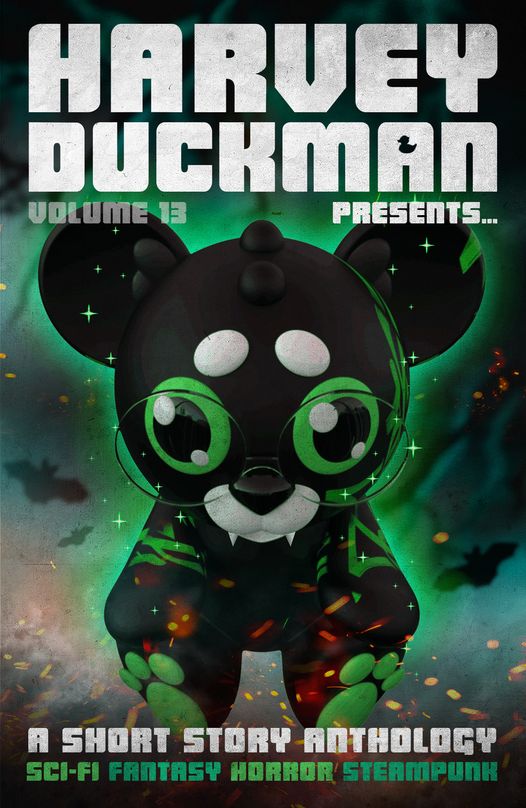
Partly this is a case of becoming a victim of the success of the series. We are about to publish our 13th anthology and I have stories in each of the previous twelve. Indeed I have two in the 11th edition due to reasons… Partly this may also be because my memory is dreadful, which worried me for other reasons. However in order to solve this problem I actually had to get the books off the shelf and look up the each of my stories in the contents page of each book.
Vol1 The Cheesecake Dichotomy (Hannibal Smyth early years) Vol2 The Strontium Thing Vol3 Narrative Particles Vol4 ‘The Elves’ and the bootmaker (Hannibal Smyth early years) Vol5 The Salmon Swim Both Ways Vol6 The Tower Vol7 The Strange and the Wonderful: A tale of the Passing Place Vol8 Mandrake Vol9 Twenty-seven Vol10 The Ballard of Johnny Two Bones Vol11 Pirotherapy Vol11b Black Hearted Jack (as Mark Seyah) Vol12 Little Plastic Santa’s
Its quite a list, as I said I didn’t remember them all. Thankfully I am not so far gone I could not remember them once I looked them up. Its also a list I am quite proud of. There are a lot of different types of stories among them, different voices, different worlds. Some serious, some not so much, in fairness it is hard to write an intensely serious ‘feelings’ story full of strong emotions and a deep internal monologue when your writing a story about a radioactive penis. Some what easier to do so in a long Lovecraft-esque prose poem of a story about a man becoming a hybrid deep one and returning to the sea. (please note this is not actual poetry… I would never write such a thing)
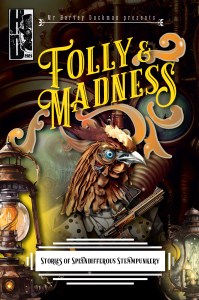
Other stories have lives beyond the text. Mandrake for instance started as this one short story and is now becoming a novel (possibly more than one) of Victorian Urban fantasy. The Strange and the Wonderful is probably part of another novel (the sequel to Passing Place) though not so much in it current form. Other stories begin and end in the pages of Harvey Duckman, though one day i will have to write the second of The Tower stories, because it infuriates people that so much was left hanging for their imagination to sort out at the end. It’s almost as if i did that on purpose…
The reason I was looking at Hannibal stories in particular was two fold, firstly because I don’t have enough projects on to keep me busy, I’m only writing five books , I clearly need to think about writing something else as well… Yes, alright fine , no need to point out the flawed logic there…
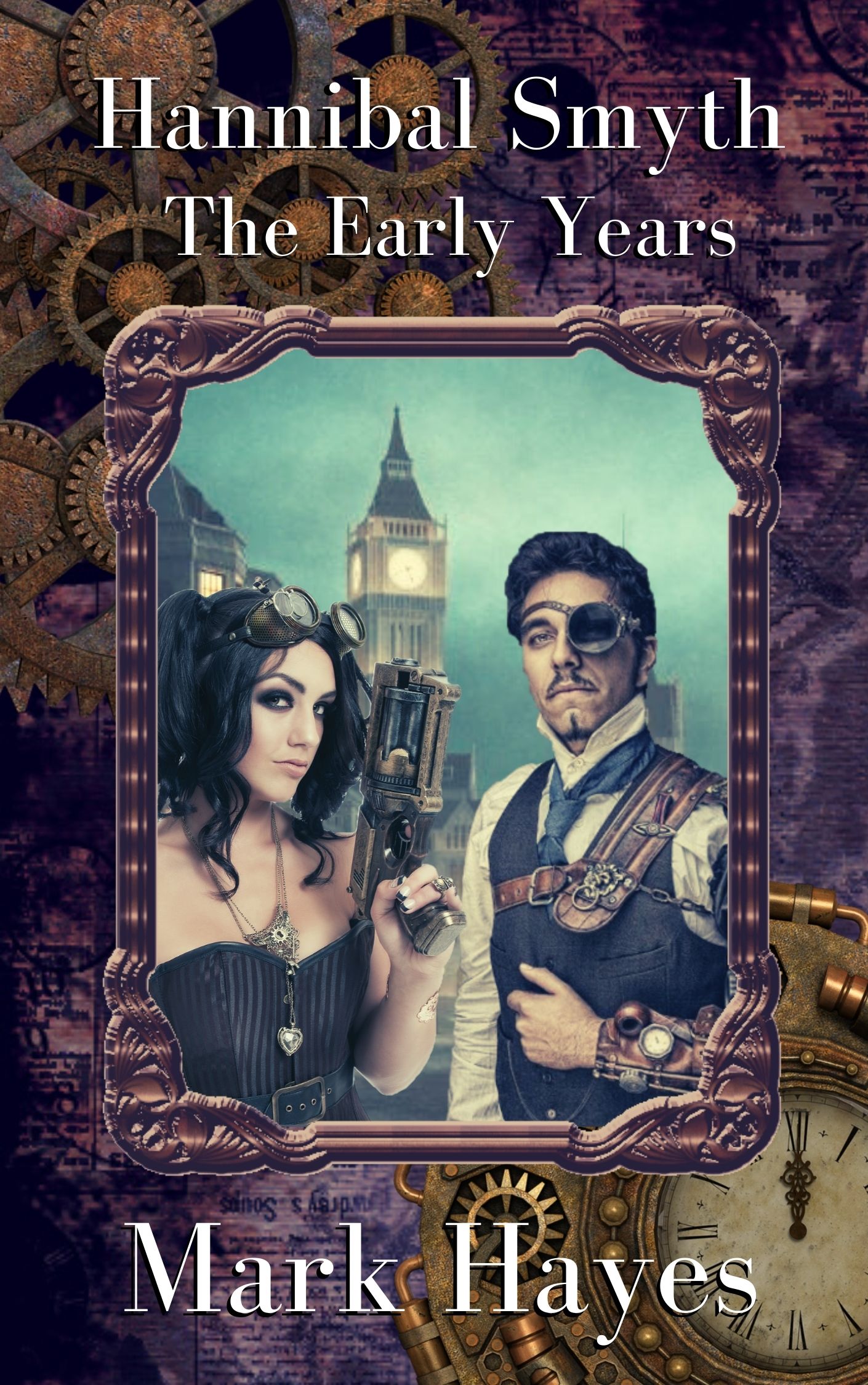
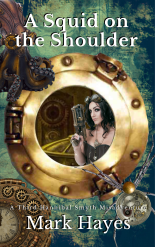
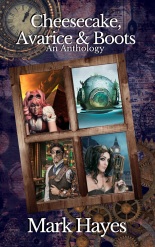
As it happens I enjoy writing the Hannibal Early years short stories, and they are well liked by a small but chirpy collective of readers, they also collectively form a complex but coherent narrative, that I am writing somewhat out of order, possibly backwards. I even know where the last of those stories would take us. There are more than the three stories currently in print and a forth is about to join them in Harvey 13. Hence i wondered if all three of the others in print (in Cheesecake, Avarice and Boots) had originally been printed in Harvey or just two of them. As it happens is just the two. At some-point the ones in the Harvey and else where may find there way into a definitive novel covering Hannibal Smyth’s early life up to the point he is sitting in the New Bailey waiting for a noose round his neck and a short drop into oblivion…
I have personally been far more involved with Harvey 13 than any Harvey previously. the bulk of the work is still being done by the ever wonderful Gillie Hatton of 6E publishing, but I am one of a triumvirate of submissions editors curating the collection to an extent… So I have a degree of pride wrapped up in this one and more skin in the game. It is however a great collection of stories.
My own, as I said is a new Early year Hannibal story, The Aspidistra Of Social Inequality. Which is a Hannibal title if ever there was one… It is joined by some fabulous tales and story’s by some new writers and some old hands …
Jake Matthew Carpenter – The Midnight Coach Tamara Clelford – The Adventures Of Little Bear R. Bruce Connelly – COPS: FTD Eloign deBrohn – No Picnic For Bears John Holmes-Carrington – Vaihtava Karhu Christine King – Jolly Jack Tar Peter James Martin – The Teddy Bear In The Loft Jon Pentire – Avery David Medina – Hell Is Other People Will Nett – The Teddy Bears’ Quick Nick J.B. Rockwell – A Cricket in Hell’s Acre Davia Sacks – Mama’s Bear Ben Sawyer – Everything’s Fine in the Mushroom House Liz Tuckwell – The Collector Ross Young – Igor and the Abandoned
Harvey 13 will be out soon, I’ll probably mention it when it is… Hannibal Smyth The Early Years, well that may be a while in coming… Just five other novels to finish first.
I had never been able to walk past a bookshelf without having a look at the contents
Lilian Brooks
I like a good quote, if your a regular reader of this blog you are probably aware of this fact. I like the one above because, well… I’ve never been able to walk past a bookshelf without looking in my life. This is because books, as Stephen King put it ‘are a uniquely portable magic’. They transport us to different places, different times, different sets of rules and inside different minds, both the minds of characters and the minds of the authors themselves.
Books are powerful because perhaps more than any other medium they offer us a window into the souls of others. Movies and tv shows offer up a vision, but it is the directors vision. Music is at its best a shared experience between musician and listener. Books on the other hand are something the reader experiences alone. Every voice is a voice you ascribe to the speaker, be it the authors literary voice or the characters within. And how you experience the reading a book says as much about you as it does about the author.
Some books need to be wallowed in, read slowly, a chapter or two at a time in those stolen minutes between heading to bed and sleeping. Some books need to read all at once, because their magic is in the turn of each page, the pace of the story, a story tripping over itself to be told. These books are travel books, that is not to say they are books about traveling, there are plenty of them, but they are books you read while traveling. Books that can be measured in a plane ride, or three hours on a train. Stories that are best read all at once, with short chapters that spur you on to the next…
Sometimes such books are written to be just that, a joyous fun read that wiles away the passage through the clouds, or the click clack of rails. Books you can not take your time with because there is a unurgency to them that wants to be read all at once.
Which brings me back to the quote I started with, or to be exact the book it came from, which is the second in a series. In the back of this book there is another quote, a quote from a review of the first book in this series, Dormant Magick By Lilian Brooks
The joy is in the reading, it has a splendid pace to it, well written and well structured… Everything keeps moving along, both in terms of plot and the relationships of the various characters within the coven. It doesn’t allow itself to become too predictable.
That’s a good quote, I should know as its quoting me. There is another odd bit of book magic for you. When you a ‘Praise for xxxxxx’ or ‘Also by’ and find yourself being quoted it always lends itself to a rye smile, particularly if you know they have cut something out of the quote… But it does beg the question does the second book live up to the first or does it instead wallow in the kind of saccharin over-sweetness that plagues many novels in this sort of genre, which the original didn’t, as I took pains to point out…?*
* I actually love the fact that authors occasionally quote my reviews, and if they want to do so they can chop them up anyway they wish. It just amuses me when they miss out the bits I considered important.
Rising MagicK By Lilian Brooks
I read this book in a morning, on the sofa, after songbird woke me one early dawn on a Saturday a hour before I would normally have gotten up for work through the week. Not really wanting to start the day, but wide awake, I made myself a good coffee with one of the last of my coffee pods, opened the curtains to take advantage of the day light, and proped myself up on the sofa arm to read for half hour or so before I started the day properly and got on with stuff.
Three hours and two more cups of coffee later, I put the book down having finished it. Its that kind of read. The kind you start and actually can’t put down. The kind ideal for lazy Saturdays on the sofa in the morning sunlight,. or long train journeys or flights to foreign climes.
The story picks up where book one left off, and follows a similar pattern. Short sharp chapters, that invite you on to the next one. Alyssa Bright and her little cavern of twenty-somethings living a less quiet life than it should be in the most haunted and haunting town on the Yorkshire coast. There’s a big reveal I saw coming in the first book but somehow was still surprised by when it was finally revealed. There are real locations transplanted into the story that if you know Whitby at all will delight you. There is also a sense of brooding ominousness to the story. An ominousness that leave you reading for the next book in the series ( which luckily for me happens to be on my coffee table as I write this).
It is very obviously a part of a longer series, and you should start with book one which I reviewed last year. If you read that and enjoyed it read this one. If you didn’t read the first book, do so.
Inspired by a conversation late night in the pub, mostly centred around advice to prospective writers and how best to get started with the whole being a writer thing… Starting with the single most important piece of advice you can give any writer…
A professional writer is an amateur who didn’t quit. ~ Richard Bach
I edit my own stories to death. They eventually run and hide from me. ~ Jeanne Voelker
Any book without a mistake in it has had too much money spent on it. ~ William Collins
The first draft is black and white. Editing gives the story colour. ~ Emma Hill
Just get your story down ~ Nora Roberts
You should write first drafts as if they will never be shown to anyone. ~ Erica Jong
First drafts are for learning what your story is about ~ Bernard Malamud
The bottom line is that I like my first drafts to be blind, unconscious, messy efforts; that’s what gets me the best material. ~ Jennifer Egan
Happy writings… May all your first drafts be all they need to be, written…
I often reread books, indeed there are books I have read so many times I have had to buy new copies, that is a reading habit that stretches over decades. David Gemmell Legend for example I know I have read at least ten times since I first picked up a copy in the early 1980’s. However reading a book you penned yourself, well, that is a vastly different experience.
I hate reading my own books. I suspect as a writer I am not alone in this.
There are a few reasons for this, but the main one is the difference between reading for fun and reading as a writer. I’ve read the entire Belgariad sequence at least five or six times over the years, those books (all 12 of them) are like a warm comfort blanket. If I need to switch off the world for a while rereading one of my favourite books is almost always my escape of choice. When however I write a book I reread it five or six times minimum in the writing process oft times many sections of a book probably twice that. I work in a series of drafts, I always have, I know some writers who do things other ways but the only way the words work for me is multiple drafts, up to six or more for a novel.
There are reasons for this, one of which is dyslexia, and the weird way it affects my typing. I will often write the wrong word, not because I can’t spell, but because my fingers garble up the messages from my mind. I type fast, but it takes me a long time to type, because in any given sentence there will be three or four typos, some obvious, so not so much, sometimes the word I type is a word so close to the ones I intended to type I don’t even notice, often it is a matter of tense or plurality. Everyone does that occasionally, its one of the reasons editors are so valuable, but I do it constantly. Here’s an experiment…
I’m going to type this line twice, the first I will correct the second I won’t.
I’m going to type this senatnce twicve the first I will correctb teh second I won’t
Now some of that is just bad typing, but actually most of it is my brain not communicating my words properly. Also I was very self conscious typing that second line rather than doing so with my normal flow. So it actually makes more sense than normal… I can type slower, but when the writing works the ideas cascade and deliberately typing slow stops that process in its tracks. So I don’t. I type a few pages maybe then go back through fixing all the errors (most of them at least) And keep doing that till I finish the draft…
That’s draft one, draft one takes some time.
It is then the reading starts. Every draft after draft one starts with a read through, and generally lots of notes. Round about the third or forth draft I hopefully have something I would let others read. By the fifth I may even let someone read it, and it may go to my editor the wonderful CG Hatton. Then if it gets past that somewhat ominous stage it need to be read through again, and have a final edit , then read through again for a check , and then set up for proof copies, which are then read again to check everything…
And then someone complains in a ‘review’ that they found a typo on one page and it ruined their immersion…
That’s my process, it’s slow, its laborious, and for every word that got to the printers in the final book I have probably written five, but it works for me. For the most part it works for my readers. Every writer faces their own challenges, dyslexia is just one of mine. I don’t use it as an excuse, dyslexia is a by-product of having a mind that functions a little differently. I like my mind, it makes me who I am.
One of the reasons for this blog BTW is just to say to anyone who wants to write but is dyslexic, don’t let that stop you. Don’t let anything stop you.
I will also point out I know writers who are not dyslexic who have equally arduous writing regiments. Everyone has there own method of shedding blood onto the page, I do not claim to bleed more than anyone else. Besides the blood is in the words, not the writing of them. If you ain’t shedding a little blood as you write your doing it wrong…
It does however mean that by the time I finally publish a book I have read it through its various incarnations innumerable times. As it is my novel I also struggle to read it objectively suppressing the urge to edit. I have trained myself to read as a writer when I read my own stuff, just rereading them for pleasure is virtually impossible at this stage. So the very last thing I want to do again is read them again…
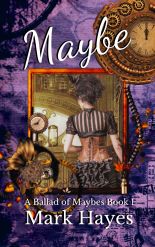
Currently I an rereading my 2020 novel Maybe…
Maybe is my second most successful book, at least when it comes to on line sales. While the first Hannibal novel is more successful, it is also over a year older. Maybe has out sold it A Spider in the Eye, though not by much , consistently since it release. It is, however, out on its own for Kindle Unlimited reads. It is also the first book of a trilogy, and also the only book so far written in that trilogy.
It has also been very popular with readers, who keep asking about the sequel…
From a commercial point of view I should be writing the sequels, but for one reason or another they keep getting put on the back burner. (A global pandemic didn’t help either) Also commercial success, nice though it would be, doesn’t motivate me, has a lot to do with this. However, I do want to write the sequels and frankly I should get on with them now the first Hannibal trilogy is complete. But my original plan for the series was a book every six months and its been over three years since I wrote book one. So…
Names are funny things. My name for example is derived from Latin and means ‘Consecrated to the god Mars’ and ‘warlike’, those that have met me may scoff at this. Other names can be a bit odd too. While other are a perfect fit. Take Alyssa for example…
Alyssa is a feminine given name with multiple origins. Alysa is an alternative spelling. As used in Western countries, the name is usually derived from the name of the flower alyssum. The name of the flower derives from the Greek ἀ- a- (“not”) and λύσσα lyssa (“mania”); the flower was formerly thought to cure skin diseases. It shares many variants in common with the name Alice and is occasionally considered a form of that name as well.
So ‘Not mania’, who would give a child a name which ostensibly is saying to the world ‘hey its okay I’m not suffering from a mental illness marked by periods of great excitement or euphoria, delusions, and overactivity’. I mean, its a statement I’ll give you that, but is it a statement you need to make for your child when you name them?
Of course no parent actually goes into that kind of depth as to the names they pick for their children. Otherwise naming a child would take for ever, I mean I didn’t name my son a name that means ‘exalted’ or ‘strong’ and certainly not ‘mountain of strength’ on purpose… Nor did I deliberately give my daughter a name that literally means ‘Woman of high rank’ or ‘princess’. The fact that both my children have Hebrew names is also a coincidence.
Parents are generally all a little strung out when it comes to naming children so don’t really do much research as a rule (though they will tell you differently if you ask them about one of the most important choices they ever made in there life. Speaking of which I went to school with a girl called Paige Turner I’ve always suspected her parents were sadists…) But there is another bunch of people who get to chose names for individuals. All be it that the individuals in question are creations of the mind rather than genetic material.
These people have no excuse for not doing some research into the names they give out. After all most of them have spend many hours of their life researching how to get rid of bodies, how difficult it actually is to stab a person in the heart, the effects of various poisons, decompression rates in ambient spring temperatures in northern Europe and other such perfectly normal things to have in their internet search histories…
I speak of course of authors…
Which brings me back to little miss ‘hey its okay I’m not suffering from a mental illness marked by periods of great excitement or euphoria, delusions, and overactivity’ or in the short form Alyssa… and why I bring this up. I’ve just finished a book who’s main character is a young woman called Alyssa. The book is full of strange goings on involving magic. Elemental magic prominently and witchcraft, covens. Its modern urban fantasy written by a talented female author from the North East of England. It is pacey, fun and full of mystery… While Alyssa is at the centre of the mysteries and fighting to control her own innate magical abilities while facing a shadowy threat and trying to come to terms with her past and her future…
Alyssa or ‘hey its okay I’m not suffering from a mental illness marked by periods of great excitement or euphoria, delusions, and overactivity’ Seems a good name for the character all considered.
Here though things get a little odd as there is a very good chance a talented authoress from the north east of England is reading this right now and thinks the above is me talking about their book. I’m not, or maybe I am…
Confused? Well let me explain, the next book I intend to read is a book who’s main character is a young woman called Alyssa. The book is full of strange goings on involving magic. Elemental magic prominently and witchcraft, covens. Its modern urban fantasy written by a talented female author from the North East of England. It is pacey, fun and full of mystery… While Alyssa is at the centre of the mysteries and fighting to control her own innate magical abilities while facing a shadowy threat and trying to come to terms with her past and her future…
This is a completely different book written by a different talented author from the North East of England… Both books have the word Magic in the title, though one of them spells it magick and both have surnames beginning with the letters BRO… Oh and I saw both authors at a scifi convention in Scarborough last month, where I bought copies of their latest books.
Books who’s main character is a young woman called Alyssa. The book is full of strange goings on involving magic. Elemental magic prominently and witchcraft, covens. Its modern urban fantasy written by a talented female author from the… You can see where this is going right?
In actuality, while both modern urban fantasy’s these are very different books, the one I am reading next is called Rising Magick and is the second of the Whitby Witches novels by Lillian Brooks. I read the first last year and really enjoyed it though its not my usual fayre. The second has been on my to read pile a while and got joined by the third so its been bumped up over some others, hence reading it next.
(As I am talking names, Lillian Brooks is actually a pen name, so a name the author chose for themselves, which makes you wonder if they looked up the meaning of the name before they adopted it. I have, because I’m me and its the kind of thing I do…’Pledged to god’ is an odd choice for practicing pagan, that’s all I’ll say, though I guess its not specific about which god so maybe not…)
The book I have just read is ‘Of Magic and Lies’ by Maggie Brown. Who’s main character is a young woman called Alyssa. The book is full of strange goings on involving magic. Elemental magic prominently and witchcraft, covens. Its modern urban fantasy written by a talented female author from the… Yes yes I know… There is making a point and then there is driving it home with a hammer, like a stake through the lifeless heart of a vampire, but enough about my Tuesday nights…
As far as I am aware these two talented Ladies, Lilian and Maggie, have never met, unless they met at Scarborough last month which is possible. Certainly it would seem unlikely they had met before that and collectively decided there main characters should share a name. It is pure coincidence that I manage to have books by both of them to read consecutively and the main character in both has the same name. Or they both chose Alyssa because ‘hey its okay I’m not suffering from a mental illness marked by periods of great excitement or euphoria, delusions, and overactivity’ Seems a good name for their character all considered. Or perhaps they never looked it up and they just liked the name…
Funny things names… As for authors, you can’t trust them. They know how to dispose of the bodies…
Book Review ‘Of Magic and Lies’ by Maggie Brown
I’m never quite sure what to expect when I pick up a book by a new writer. Particularly one writing in a genre that I don’t read a great deal of. While I love certain kinds of Urban fantasy I don’t extensively read within it, and rarely the type of urban fantasy that is aimed in general terms towards a female audience, deliberately or otherwise.
To be clear, there is nothing wrong with what I guess I would describe as ‘Chic lit Urban fantasy’. Its just not generally my cup of herbal tea. Herbal tea is also not my cup of herbal tea
That said however, the things I look for from any writer in any novel is solid writing, vivid descriptions, ‘real’ characters, intriguing plots, mysteries and the right kind of pace for the story to draws you along. Give me that and I don’t really care what genre I am reading, because you’ll hold my interest. This ‘Of Magic and Lies’ does brilliantly. There is mystery aplenty, Maggie’s writing is artful and involving, and some of the vivid descriptions are, well, very vivid…
The story is told mostly from the perspective of Alyssa, but on occasion from the perspective of the two men in her life. One her protector, the other well, that would be telling, but this too is skilfully done. Swapping perspectives like this could have broken the story, particularly as the two men know far more than Alyssa does about her past and the truth surrounding her, instead the second and third perspectives are used lightly. There is mystery to each of these characters and Maggie manages to keep that mystery while dropping little hints along the way. Nothing is quite what it seems.
There are other characters too that are intriguing, there is a certain amount of set up going on in this novel for a wider series, not just following on from this one but other novels running parallel to this series, which is a brave writing choice on the meta scale and one that could have unbalanced the novel, but Maggie manages to keep the main story on track while weaving the hints of her wider ministries into the novel with a certain seamlessness of which I am somewhat envious.
If you like urban fantasy, witches, the fay, and magic, wrapped up with a bit of feisty sexy chic lit style this is a novel for you. It’s also the novel for you if you just love a good read, good story and intriguing characters.
So there you go, apparently all female main characters in Chic lit Urban Fantasy’s are called Alyssa, its a rule apparently, who knew…
Seeking Inspiration is like seeking being struck by lightning, occasionally one must encourage the lightning a little. Others have said this better than me…
Here then are some quotes on subjects of which I am fond. * may they inspire.
Some editors are failed writers, but so are most writers. ~ T. S. Eliot
That it will never come again is what makes life so sweet. ~ Emily Dickinson
Be kind, for everyone you meet is fighting a hard battle. ~ Plato
We are all broken, that’s how the light gets in. ~ Ernest Hemingway
If you do not hear music in your words, you have put too much thought into your writing and not enough heart. ~ Terry Brooks
If you are in difficulties with a book, try the element of surprise: attack it at an hour when it isn’t expecting it. ~ H.G. Wells
The first draft is you just telling yourself the story. ~ Terry Pratchett
Fill your paper with the breathings of your heart. ~ William Wordsworth
*This is certainly not just a quick way to fill out a blog post…
Just waiting for inspiration to strike, as a writer, is standing in field on a warm summer day staring up at a clear blue sky, waiting for lightning.
It could happen, but you could be waiting a long long time…
If you want to be struck by the lightning you need to go stand in the field in the middle of a thunder storm and be prepared to get wet, windswept and bedraggled…
Even then, its is just a little more likely, but you will look awesome…
If you really want to be struck by the lightning of inspiration, you need to put in the effort, wear a full suit of plate mail, get a big iron sword, go stand in the field in then middle of the worst thunder storm in history and wave the sword about cursing the names of Thor, Zeus, Perun, Indra, Jupiter, Taranis and any other thunder god you can think of…
You still might not get struck by lightening, but at least you’ll have a story to tell. Even if the story is about a madman standing in a field curse thunder gods in full plate mail…
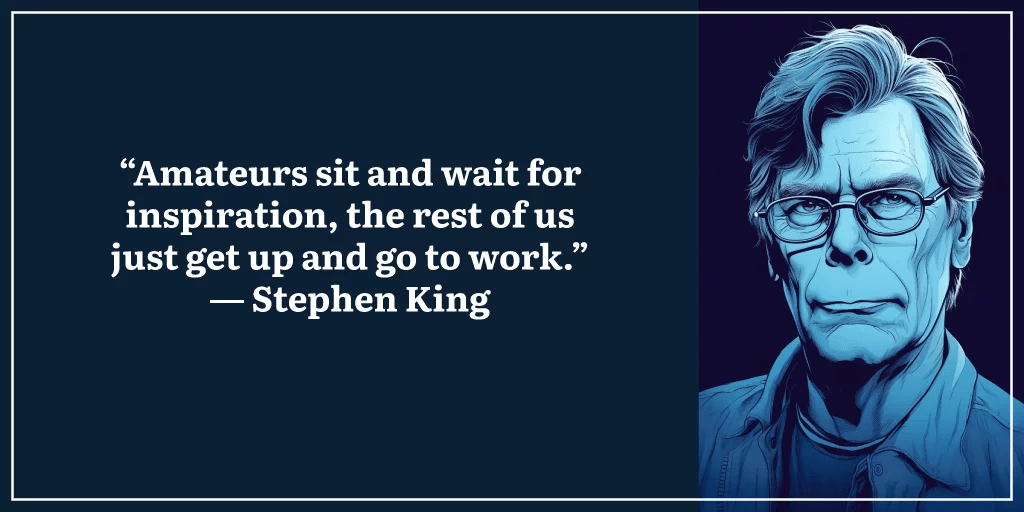
To quote Steven King, ‘Amateurs sit and wait for inspiration, the rest of us just get up and go to work…’
Nimue Brown puts this more elegantly than I in this blog, you should read it…
Inspiration isn’t something that always turns up on demand. For a person attempting to work creatively this can be a bit of an issue. It’s certainly the case that trying to create can be a way of inviting inspiration to come to you. If you aren’t making room for inspiration to happen, it’s not so likely to show up. Time contemplating can also work. Getting on with life and hoping inspiration will strike isn’t very effective at all.
My major source of inspiration has always been other people. That can work in a number of ways. Sometimes I get very excited about a person and that fills my head with ideas and makes me want to write. Some of the things I’ve written have been for specific people – that can mean writing blog posts on request, writing poems for people. I wrote my most recent book – Beyond Sustainability…
‘I’ll send an SOS to the world… I’ll send an SOS to the world …’
‘I hope that some one gets my, I hope that some one gets my..’
‘I hope that someone gets my … Message in a bottle….yer’
Some bloke called Gordon and his mates…
I happen to like The Police, the band, not the boys in blue. Message in a bottle however is at best a bit of a middling track. It’s no ‘Walking on the Moon’ or ‘Roxanne’ It does however take its title from the odd little maritime tradition of placing a message in a bottle, sealing it with wax and hurling it in to the sea in the hope that maybe, just maybe it will get back home to the people you love even if you don’t…
This is of course a mostly fictitious odd little maritime tradition, which is to say while it did happen on occasion before the 1800’s it really only gained prominence as a thing people did when a couple of writers managed to glamorise the idea, Perhaps most famously the idea of a message in a bottle was used by Charles Dickens in 1860 in his story story ‘Message from the Sea’, but before him a little known American writer called Edgar wrote a tale called ‘MS Found in Bottle’ which won him a writing contest in the ‘Baltimore Saturday Visitor’ in 1833 and a the not inconsiderable sum for the time of $50… Edgar would of course go on to be a contemporary of Dickens but was young at the time. His story, however, as much as Charlie-boys helped create a lasting cultural passion for placing messages in bottles and flinging them into the sea in the late Victorian period, which entered the cultural zeitgeist and ultimately managed to inspired Sting and the boys. However, this particular Poe story also has another legacy in other, interesting and many tentacled ways…
Unlike Poe’s earlier stories this one is not specifically humorous. Though there are some aspects of it that arguably retain some of Poe’s earlier humour. It is a tale of misadventure at sea, which was a popular narrative in the early 1800’s. It is easy to read this story as a deliberately over the top exaggerated tale mockingly taking a shot across the bows of similar but more mundane stories. Certainly that is a possibility, everything Poe had previously had published at this point contained elements of this kind of cynical humour. Personally, however, I feel this is more a case of Poe stepping away from humour and delving into something more out and out esoteric for the first time.
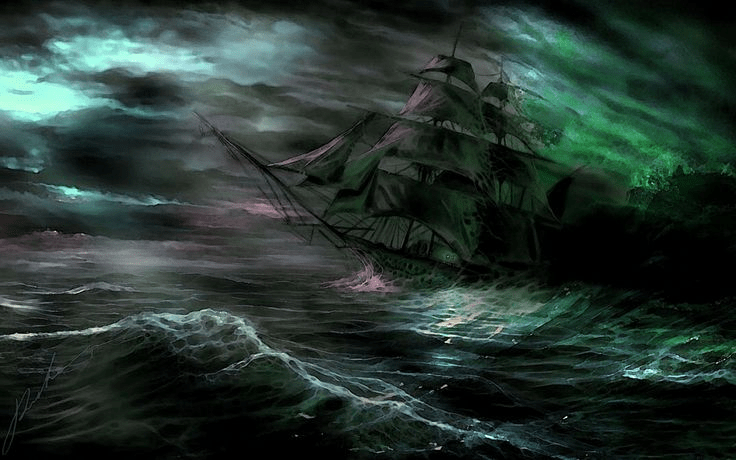
What is most interesting to me as a reader is the structure of the tale. A structure I’m well acquainted with having found it throughout the fiction of one particular members of the later generation of writers Poe went to go on to inspire. The whole story has a certain relentless building up of the tension, while the strangeness of the tale is steadily ranked up at the same time. To begin with the story is reasonably mundane. A traveller takes passage on a ship sailing out of Batavia, modern day Jakarta in what was to become Indonesia but was Part of the Dutch East Indies in Poe’s time. It sails happily south east following the coast of java for a couple of days whence it is becalmed for several more. Then, out of the still hot dry air the ship is suddenly hit by weird combination of hurricane and sand storm.
The ship capsizes, all hands save the narrator and a fellow passage (referred to only as the swede) are lost. The ship, more than half wreaked, is driven southward in the howling gales which continue for days. Its about this point things get really weird and the storm ceases to be natural in any respect. Poe’s narrator writes of great swells and and waves hundreds of feet high. The expectation is that any moment the ship will break apart and hurl its two remaining passengers into the ocean depths. Then as the ship reaches it final moments an enormous black gallon appears through the storm and as the two ships crash together the narrator manages to leap aboard the other ship.
Now things get really odd, the crew of the black ship don’t even notice the narrator, even if he is stood in front of then. All the crew of the black galleon are old men who seem half crazed. Meanwhile the ship sails ever southward, deep into Antarctic waters, and towards its doom. A doom the crew seem to invite and welcome, a final release from whatever curse lay upon the ship. Baring with them our narrator writing diary entries he finally stuffs int a bottle to hurl into the sea to tell his tale to whomever might find it before he meets his fate…
That then is the tale, but it is the telling of the tale more than the tale itself that has been of such influence. Poe builds the story (as he does in many of his later works) with layer upon layer of uncanny strangeness and increasing tension. While we might consider this far from unusual in Poe fiction, this was the first story in which he focus’s on this as a refined structure, though there were hints of it in the earlier works. This was a technique that inspired many later writers, notably HP Lovecraft’s a near century later. There are echoes of this style throughout Old Tentacle Huggers writings, but what reading this story brought most to mind was Lovecraft’s ‘The Temple’. Admittedly that may be because there are some surface similarities, ‘The Temple’ is another tale of the sea in which the narrator finds himself increasingly isolated by events beyond his control, swept along by strange currents and stranger events… But it is the layers of increasing tension and weirdness, each building up to the next that really mark the Lovecraft tale as inspired by this one.
The most notable thing about that Lovecraft tale is it is the first story he wrote that hints of some dark deity waiting in a lost realm below the ocean waves.
“He is calling! He is calling!”
‘The Temple’ HP Lovecraft
Lovecraft was not the only writer to draw inspiration from this story, Herman Melville credited Poe and this story as among his inspirations when he began to write Moby Dick. Joseph Conrad (He of Heart of Darkness fame) who had spent near 15 years at sea before he was a writer said of Poe’s story it was ‘about as fine as anything of that kind can be’. While Poe scholars are apt to say it was this story that truly launched Poe’s career. Certainly its is the first tale to read the way you expect Poe to read, with an ominous intensity wrapped in poetic language, creeping with ever more intensity towards a dark grim conclusion. In this tale then, you can see all that is to come late in Poe’s career.
FOUR RAVENS OUT OF AN UNKINDNESS, OR, ALMOST A FLOCK…
Should your read it: In this story you can see The Masque of the Red Death, The Telltale Heart, This is Poe becoming Poe, so if that interests you then yes you should read this… You can also see the coming of Lovecraft and the tentacle faced one lurking within, as well as much more.
Should you avoid it: There is no reason to avoid this tale, unless you get sea sick…
Bluffers fact: The word Poe uses for the storm that hits the narrators first vessel is ‘simoom’ which literally translates as ‘poison wind’. It is a violent roasting desert wind that often causes heat stroke. It is likely Poe confused a ‘simoom’ with a ‘monsoon’, a storm of a type far more likely to occur amid the Indian ocean.
Don’t you hate people who go to a gig and spend the whole time recording the event on their phone rather than just living the experience? I know I do. Such people need a firm talking to about their priorities in my opinion. You should be dancing about, shuffling your feet and tapping them in time. Enjoying the experience, letting yourself be drawn into the music… Not trying to keep the camera steady and viewing an event happing directly in front of you through the screen of your smart phone…
Really, just stop such heinous behaviours and enjoy the music, the experience. The vibrations of crowd. The joy of the performers. Live in the moment, not vicariously through digital remembrance of a gig you were supposed to be as much a part of as the band…
Okay, rant over, here are six videos I recorded at The Ominous Folk of Hopeless Maine gig on Beltane Eve at the gloriously gothic location of Woodchester Mansion, something of a Victorian Folly, being an unfished mansion house in the middle of a Park near Shroud…
Anyway, apologies for the shocking camera work, if you are going to record a gig I recommend using a convenient unfinished fireplace mantlepiece as a improvised camera prop (which I did for the last few…)
The Ominous Folk of Hopeless Maine are Tom Brown , Nimue Brown, James Weaslegrease, Suzie Roberts. They were joined by Kieth Etherington , Jessica Laws and Robin
Hopeless Maine is many things but started out as a web comic and later a graphic novel. If you have never come across Hopeless Maine before your life is incomplete m,, so follow this link to find out more… LINK TO HOPELESS< IT WONT EAT YOU















 The Passing Place