Just waiting for inspiration to strike, as a writer, is standing in field on a warm summer day staring up at a clear blue sky, waiting for lightning.
It could happen, but you could be waiting a long long time…
If you want to be struck by the lightning you need to go stand in the field in the middle of a thunder storm and be prepared to get wet, windswept and bedraggled…
Even then, its is just a little more likely, but you will look awesome…
If you really want to be struck by the lightning of inspiration, you need to put in the effort, wear a full suit of plate mail, get a big iron sword, go stand in the field in then middle of the worst thunder storm in history and wave the sword about cursing the names of Thor, Zeus, Perun, Indra, Jupiter, Taranis and any other thunder god you can think of…
You still might not get struck by lightening, but at least you’ll have a story to tell. Even if the story is about a madman standing in a field curse thunder gods in full plate mail…
To quote Steven King, ‘Amateurs sit and wait for inspiration, the rest of us just get up and go to work…’
Nimue Brown puts this more elegantly than I in this blog, you should read it…
Inspiration isn’t something that always turns up on demand. For a person attempting to work creatively this can be a bit of an issue. It’s certainly the case that trying to create can be a way of inviting inspiration to come to you. If you aren’t making room for inspiration to happen, it’s not so likely to show up. Time contemplating can also work. Getting on with life and hoping inspiration will strike isn’t very effective at all.
My major source of inspiration has always been other people. That can work in a number of ways. Sometimes I get very excited about a person and that fills my head with ideas and makes me want to write. Some of the things I’ve written have been for specific people – that can mean writing blog posts on request, writing poems for people. I wrote my most recent book – Beyond Sustainability…
‘I’ll send an SOS to the world… I’ll send an SOS to the world …’
‘I hope that some one gets my, I hope that some one gets my..’
‘I hope that someone gets my … Message in a bottle….yer’
Some bloke called Gordon and his mates…
I happen to like The Police, the band, not the boys in blue. Message in a bottle however is at best a bit of a middling track. It’s no ‘Walking on the Moon’ or ‘Roxanne’ It does however take its title from the odd little maritime tradition of placing a message in a bottle, sealing it with wax and hurling it in to the sea in the hope that maybe, just maybe it will get back home to the people you love even if you don’t…
This is of course a mostly fictitious odd little maritime tradition, which is to say while it did happen on occasion before the 1800’s it really only gained prominence as a thing people did when a couple of writers managed to glamorise the idea, Perhaps most famously the idea of a message in a bottle was used by Charles Dickens in 1860 in his story story ‘Message from the Sea’, but before him a little known American writer called Edgar wrote a tale called ‘MS Found in Bottle’ which won him a writing contest in the ‘Baltimore Saturday Visitor’ in 1833 and a the not inconsiderable sum for the time of $50… Edgar would of course go on to be a contemporary of Dickens but was young at the time. His story, however, as much as Charlie-boys helped create a lasting cultural passion for placing messages in bottles and flinging them into the sea in the late Victorian period, which entered the cultural zeitgeist and ultimately managed to inspired Sting and the boys. However, this particular Poe story also has another legacy in other, interesting and many tentacled ways…
Unlike Poe’s earlier stories this one is not specifically humorous. Though there are some aspects of it that arguably retain some of Poe’s earlier humour. It is a tale of misadventure at sea, which was a popular narrative in the early 1800’s. It is easy to read this story as a deliberately over the top exaggerated tale mockingly taking a shot across the bows of similar but more mundane stories. Certainly that is a possibility, everything Poe had previously had published at this point contained elements of this kind of cynical humour. Personally, however, I feel this is more a case of Poe stepping away from humour and delving into something more out and out esoteric for the first time.
What is most interesting to me as a reader is the structure of the tale. A structure I’m well acquainted with having found it throughout the fiction of one particular members of the later generation of writers Poe went to go on to inspire. The whole story has a certain relentless building up of the tension, while the strangeness of the tale is steadily ranked up at the same time. To begin with the story is reasonably mundane. A traveller takes passage on a ship sailing out of Batavia, modern day Jakarta in what was to become Indonesia but was Part of the Dutch East Indies in Poe’s time. It sails happily south east following the coast of java for a couple of days whence it is becalmed for several more. Then, out of the still hot dry air the ship is suddenly hit by weird combination of hurricane and sand storm.
The ship capsizes, all hands save the narrator and a fellow passage (referred to only as the swede) are lost. The ship, more than half wreaked, is driven southward in the howling gales which continue for days. Its about this point things get really weird and the storm ceases to be natural in any respect. Poe’s narrator writes of great swells and and waves hundreds of feet high. The expectation is that any moment the ship will break apart and hurl its two remaining passengers into the ocean depths. Then as the ship reaches it final moments an enormous black gallon appears through the storm and as the two ships crash together the narrator manages to leap aboard the other ship.
Now things get really odd, the crew of the black ship don’t even notice the narrator, even if he is stood in front of then. All the crew of the black galleon are old men who seem half crazed. Meanwhile the ship sails ever southward, deep into Antarctic waters, and towards its doom. A doom the crew seem to invite and welcome, a final release from whatever curse lay upon the ship. Baring with them our narrator writing diary entries he finally stuffs int a bottle to hurl into the sea to tell his tale to whomever might find it before he meets his fate…
That then is the tale, but it is the telling of the tale more than the tale itself that has been of such influence. Poe builds the story (as he does in many of his later works) with layer upon layer of uncanny strangeness and increasing tension. While we might consider this far from unusual in Poe fiction, this was the first story in which he focus’s on this as a refined structure, though there were hints of it in the earlier works. This was a technique that inspired many later writers, notably HP Lovecraft’s a near century later. There are echoes of this style throughout Old Tentacle Huggers writings, but what reading this story brought most to mind was Lovecraft’s ‘The Temple’. Admittedly that may be because there are some surface similarities, ‘The Temple’ is another tale of the sea in which the narrator finds himself increasingly isolated by events beyond his control, swept along by strange currents and stranger events… But it is the layers of increasing tension and weirdness, each building up to the next that really mark the Lovecraft tale as inspired by this one.
The most notable thing about that Lovecraft tale is it is the first story he wrote that hints of some dark deity waiting in a lost realm below the ocean waves.
“He is calling! He is calling!”
‘The Temple’ HP Lovecraft
Lovecraft was not the only writer to draw inspiration from this story, Herman Melville credited Poe and this story as among his inspirations when he began to write Moby Dick. Joseph Conrad (He of Heart of Darkness fame) who had spent near 15 years at sea before he was a writer said of Poe’s story it was ‘about as fine as anything of that kind can be’. While Poe scholars are apt to say it was this story that truly launched Poe’s career. Certainly its is the first tale to read the way you expect Poe to read, with an ominous intensity wrapped in poetic language, creeping with ever more intensity towards a dark grim conclusion. In this tale then, you can see all that is to come late in Poe’s career.
FOUR RAVENS OUT OF AN UNKINDNESS, OR, ALMOST A FLOCK…
Should your read it: In this story you can see The Masque of the Red Death, The Telltale Heart, This is Poe becoming Poe, so if that interests you then yes you should read this… You can also see the coming of Lovecraft and the tentacle faced one lurking within, as well as much more.
Should you avoid it: There is no reason to avoid this tale, unless you get sea sick…
Bluffers fact: The word Poe uses for the storm that hits the narrators first vessel is ‘simoom’ which literally translates as ‘poison wind’. It is a violent roasting desert wind that often causes heat stroke. It is likely Poe confused a ‘simoom’ with a ‘monsoon’, a storm of a type far more likely to occur amid the Indian ocean.
Don’t you hate people who go to a gig and spend the whole time recording the event on their phone rather than just living the experience? I know I do. Such people need a firm talking to about their priorities in my opinion. You should be dancing about, shuffling your feet and tapping them in time. Enjoying the experience, letting yourself be drawn into the music… Not trying to keep the camera steady and viewing an event happing directly in front of you through the screen of your smart phone…
Really, just stop such heinous behaviours and enjoy the music, the experience. The vibrations of crowd. The joy of the performers. Live in the moment, not vicariously through digital remembrance of a gig you were supposed to be as much a part of as the band…
Okay, rant over, here are six videos I recorded at The Ominous Folk of Hopeless Maine gig on Beltane Eve at the gloriously gothic location of Woodchester Mansion, something of a Victorian Folly, being an unfished mansion house in the middle of a Park near Shroud…
Anyway, apologies for the shocking camera work, if you are going to record a gig I recommend using a convenient unfinished fireplace mantlepiece as a improvised camera prop (which I did for the last few…)
The Ominous Folk of Hopeless Maine are Tom Brown , Nimue Brown, James Weaslegrease, Suzie Roberts. They were joined by Kieth Etherington , Jessica Laws and Robin
Hopeless Maine is many things but started out as a web comic and later a graphic novel. If you have never come across Hopeless Maine before your life is incomplete m,, so follow this link to find out more… LINK TO HOPELESS< IT WONT EAT YOU
Omelettes and metaphysical Philosophy make for strange bedfellows. Though who engages in a philosophical discussions on an empty stomach? In my experience a hungry philosopher spends most of his time thinking about food. It is hard to focus on considering the great questions of the age when the only question you really care about is where the next bacon sandwich is coming from… I speak from experience having studied Philosophy at degree level. My essays were best written after a hearty meal and a few glasses of wine…
I suspect this is a truth that held true for the great philosophers of the past, Aristotle, Plato, Hippocrates, Voltaire, Nietzsche. To a man I suspect they were useless before their first meal of the day. Though in the case of Nietzsche, he spent most of his time thinking about getting off with his younger sister, and hanging out with Mr and Mrs Wagner, a lovely couple with a surprisingly open attitudes to sexual proclivities for the 1800’s.
Yes that Wagner, The one who composed the Ring Cycle… He and Nietzsche had quite a thing for each other… Hitlers favourite composer, and the Nazi’s favourite philosopher were very close for several years in the 1870’s… Both of them were admittedly long dead by the time Adolf’s cronies were rounding up undesirables, which included intellectuals and those with proscribed sexual leanings, luckily for them one suspects.
But anyway Nietzsche was useless until he had eaten a well matured sausage and a little sauerkraut on a morning. Staring into the abyss is all very well and all that, but nihilism really bites when the larder is empty.
I may have wondered a little off track, hopefully you haven’t noticed though. In any regard this next story by our own Dear Edgar features a philosophising French restaurateur and chef, famed for his omelettes and metaphysical philosophy.
Pierre Bon-Bon is a man who is fond of find food and has fostered a reputation of having an ‘inclination for the bottle’, which is a particularly fine bit of phrasing by Poe… As is the narrators insistence that Bon-Bon is ‘profound and a man of genius as even the mans cat knew.’ Famed for his insight on the writings of the great philosophers of antiquity…
Which is to say he was something of a drunken, a bore, and much enamoured of his own intellect which he held in greater esteem than was perhaps was its due. This may also explain why one evening as the witching hour approached, long into his cups Pierre hears a voice he recognises at once as being the voice of the devil, a voice followed by the appearance of Old Nick himself. Bon-Bon is the kind of man who considers himself to have no intellectual equals. Something the narrator with a certain sardonic lint, is at pains to point out.
If Bon-Bon has one other flaw however, it is that he can not resist a bargain. Even if the bargain is against his best interests. And here is Lucifer, prince of lies, only too happy to expound upon the worth of a soul, indeed happy to explain that the souls of most all great philosophers end up in the care of the lords of hell…
Look too long in to the abyss and the abyss will make you an offer on your immortal aspect… Apparently.
And that there is the set up, an arrogant man with a high opinion of his own worth and intellect is visited by the devil, you can guess what happens next… Except that this isn’t exactly the story you expect nor is the devil the one you expect either. That is to say this is not the devil as most of us generally expect him to be portrayed. We are used to a certain degree of style and panache when it comes to Lucifer these days, along the line of Tom Ellis, Al Pacino or dozens of other portrayals including an particularly memorable one by Elizabeth Hurley taking on Peter Cooks role in the remake of Bedazzled…
Instead, Poe presents us with something of a disappointing devil. a dusty individual in unfashionable cloths from a previous century that are a size too small and past their best, wearing small green spectacles on the end of a long nose, down which he peers with nearsightedness. He lacks some of the flair you’d associate with the devil too. Rather than bribing Bon-Bon with temptations, he just wants to talk about long dead philosophers most of whom he admits to have consumed. Or at least consumed their souls. The consuming of souls appears to be his primary motivation for all he and his cohort of demons in hell do.
There is something very playful about this story, the use of language, the thread of humour and witticism that run through it. It is arguable the most accomplished of Dear Edgars first five stories published over the course of 1831 in the Philadelphia Saturday Courier. Certainly it is the most self aware and self-effacing. Like the other stories it was later republished with some heavy editing by Poe. The version you are most likely to read is the version from ‘Tales of the grotesque and Arabesque’ published some fourteen years later. Getting hold of the original version is a task in of itself, though not enough has changed to make it a task worth undertaking as I found after several hours tracking down a copy on line. Also the edits are an improvement, so if you read it read the later version, it was our own Dear Edgar who made the changes so its what he would have wanted…
This is not the story you might expect it to be, it certainly doesn’t twist in the way you would expect at the end. Though there is a twist there and a strangely satisfying one if your have read this between the lines rather than at face value which I suspect is the intent. It is clever, witty and if it has a flaw it is a tad slow to start, it makes a full meal of the set up when it could be sharper. But it is, importantly fun. Which frankly is something studying philosophy at degree level proved not to be…
Lets just say I like the idea that the devil, even if he is a dusty dishevelled devil, consuming the souls of the ‘great’ philosophisers, shall we, and leave it at that…
THREE RAVENS OUT OF AN UNKINDNESS, THE FORTH GOT LOST SOMEWHERE IN THE DEVILS DUSTY JACKET…
Should your read it: Read between the lines and knowingly, but its a entertaining little yarn that plays with language.
Should you avoid it: It’s fun if a little windy at times, but inoffensive except to the French… So that’s fine.
Bluffers facts: The original title of this story was ‘The Bargain Lost’, it wasn’t the devil that was encountered but a lower functionary of the same and Pierre Bob-Bon was called Pedro Garcia, but apart from that it is the same story except it started ‘It was a dark and stormy night….’
This opening line was later removed. At the time it was a reference to the works of Edward Bulwer-Lytton who had used it previously. He was a writer who could spin a good line once in a while… His most famous being ‘The pen is mightier than the sword.’
With no sense of the ironic Bulwer-Lytton utter failed to die in a dual, impaled on a rapier. Instead he died of an overly complex ear infection, had he caught this through a habit of scratching his ear with a pen-nib this would make up for his shocking lack of irony.
I had occasion over the extended May Day weekend to put some thought in to the basis of my belief system. That is, what I believe and feel to be the truth of it all. What it all mean and our place as individuals within, well everything…
When I say I had occasion to put some thought into this, I had a long drive back from the sunny green lushness of a country park in Gloucestershire through the darkening hours of the creeping twilight until the witching hour found me amidst the burning towers of Teesside once more… On such occasions its is perhaps only natural to start to wonder what its all about.
I was once baptised into the Church of England, and I attended Sunday school in my youth somewhat religiously. Which is to say I was sent there every Sunday morning along with my sister and brother, and was taught about religion in the way children are…
“This is what we believe, you must believe it too… Least the devil come and take you to his fiery abode… Now who wants cake and fruit juice?”
I attended Sunday school because it never occurred to me to object over much to cake and fruit juice. I went to confirmation classes because, well there was cake and grape juice by then and it was just sort of expected of me. The priest who took those confirmation classes was in fairness a typical CoE vicar, pleasant enough and almost entire unassuming. CoE vicar being the career of choice for the nice but slightly dim child middle class parents know isn’t going to make it in the real world…
“Our Jason isn’t overly bright is he, likes the bible stuff though m, lets send him to a seminary, what harm can he do there…”
This particular Jason was somewhat taken aback when, after a year of confirmation classes, in answer to him saying “Your confirmation will take place at Sunday service next week.” was “Nar, you’re alright, I don’t think I believe in any of it to be honest, and I don’t want to be a hypocrite. But I’ll get back to you if I change my mind.” And with those words I ended what must have been about a 14 year relationship with the Church of England, and Christianity.
I have no resentment towards the CoE or Christianity in general. Studying the bible taught me a lot about morality, how to order your life, respect for others and respect for yourself. The ten commandments are not a bad guide to living your life as it goes… Don’t kill, don’t steal, don’t cheat, don’t covert your neighbours ass (I use to have trouble with this due to the particularly attractive backside of the woman who lived next door to me in the early 90’s… And yes I know that’s not what it means…) But while I could appreciate the none Leviticus bits of the old book and the general ethos of don’t be a twat to others and maybe they’ll not be a twat to you, I just didn’t believe in the more religious aspects of the faith. Which is to say I didn’t believe in the CoE’s god, or for that matter any god conceived by human minds.
To miss-quote myself :
We are a microbe on the back of an ant we mistake for the rain forest, unable to comprehend the forest we deify the ant. We can not even grasp the true essence of the forest, let alone that there may be more than one forest…
So back to my long drive after celebrating Beltane in that strange county by the banks of the river Severn. A pagan May Day festival, at which no one presumed to ask me about my beliefs, because why would they… I drove back and found myself recessing them all the same. I do this a lot, it is one of the reason I like long drives through the night when there are few other cars about. As you push on through the darkness there is a kind of zen about the road.
I have at times described my personal belief system as that of a techno-pagan. A term I came across in the 90’s and never really bothered to examine very closely. I just liked the way it sounded…
TECHNO-PAGAN…
Also I liked the cyber-goth girls who were hanging out in similar clubs to me at the time. Calling myself a techno-pagan, with viking jewellery and arm rings,and spiked re-breathers, seemed kind of cool. I found pagan beliefs fascinating, and the pagan girls hanging out in those same clubs at the time, equally fascinating… Yes… I was shallow, fascinated with the idea of the pagan… but very very shallow about it… As we tend to be in our early twenties.
The techno-pagan thing kind of stuck with me all the same. I like the digital world, I find the science behind the digital world fascinating, the physics that underlays all those ones and zeros… I also find old gods, pagan spirituality, magic, the occult and everything that all encompasses fascinating… It can be a heady mix, technology and paganism… I love the strange ideas people have, old gods trapped in the machines of the digital age… Whats a thunder god if not a god of electricity… Where is the wisdom of the all-father found if not in Wikipedia, and where would Loki be hiding if not at the edges of things re-editing Wikipedia… Techno-pagan stuck with me because it covers all my bases, but its not really want I believe , it isn’t my faith, any more than the Church of England…
Because we are still no more than that microbe on the back of the ant.
For me paganism is about accepting you are part of the bigger picture, part of a picture so vast, so complex, it is beyond anyone’s real compression. The great vastness of the cosmos, the intrinsic dance of nature, the heavens , the seasons of this world and all worlds… You accept this and in accepting it realise you must go with the flow. Influence what you can, accept what you can’t and value compassion, love and spreading joy over all else… Because the world is vast, and tiny. Everything to us, yet insignificant on the grandest of scales…
But if you want faith, have faith in this, modern physics teaches of strange particles upon the quantum scale that can influence each other over any distance. Things so small they make up the basis of the things that make up the basis of atoms. Yet when something happens to one of these strange particle’s it will due to the wonders of quantum entanglements influence another no matter where that other may be. Next to it or at the other end of the universe and that interaction is instant over any distance. Ignoring all other rules of physics, even good old E=MC2… Instant interactions across all of space. Or for that matter across time. An impossible thought… The thought of a microbe on the back of an ant…
If there is a god, god is not the ant. God is not forest, or even the multitude of forests. God doesn’t exist on the scale of the infinite. Traditional religion is looking in the wrong place. God isn’t in the infinite, god is in the quantum.
We all are made up of atoms, and those atoms of particles and among those are strange particles. All of us, and all of everything. We are all interconnected and we all influence everything. If your looking for a god look inward. The divine exists within us all and within every grain of sand, every speck of dust. Strange particles that interact and react in quantum entanglements. Everything is all part of one great whole. When you pray, pray to everything, but first pray to yourself, pray for a glimpse of the divine within, for its there, in you, in all of us. Celebrate it and celebrate it in others, celebrate it in all things.
It was a good weekend, a great weekend in fact. And on the drive home I may have decided I am in fact a Quantum-Pagan…
Of course this may just because quantum goth girls are cute, if i ever meet one I will let you know.
Peter James Martin writes novels and stories steeped in folklore. They also feature a covetous rat that swear a lot. He puts a great deal of research into the folklore that features in his novels. He may also have put a lot of research into swearing rodents, I always suspected Roland Rat was a sweetheart personally but Kevin the Gerbil* is another story, as soon as the cameras stopped running his language would have made half the Royal Highlanders blush at the annual regimental vicar and tarts party.
*for those not old enough to remember, Roland Rat and Kevin the Gerbil were staples of UK kids TV in the 80’s, also, lucky you…
Here then is a guest post from Peter about some of his favourite North East folklore.
The Brave and the Odd ~ Some of my favourite Folklore
By Peter James Martin
Seeing as Mark graciously allowed access to his blog for this hallowed month, I thought it would be nice to get out from under the thumb of a particularly talkative rat, and spread my wings, and prattle on to all of you instead.
To those who don’t know me (you lucky few), I’m Peter James Martin, and I write the Brennan and Riz short stories (and a few other things but they’re not important right now). These stories are greatly inspired by folklore and tall tales from across the world, but the focus is definitely on those that I find around me, in lovely, sunny, Teesside. There’s tales of lost love, bold action, and quite the oddity that I’ve never fully got my head around, and I want to share them with you. So, sit there (yes you, stop fidgeting), and let me spin you a yarn about some of my favourite folklore from the area*
The first one is a local one, and it’s twisting the concept of folklore already. Why, I may hear you ask? Well, because for starters, it’s actually true.
What I’m referring to, of course, is the tales of tunnels that criss-cross under the town of Stockon-on-Tees. Starting at one end of the highstreet and terminating at the far end under the remains of the burned out church. I was first told of these by my dad when I was a young lad. Ever since then I’d been mindful when out and about in the town, of what lay under my feet. Later on, after some digging (and some literal digging by a company expanding it’s premise) more facts came to light about the tunnels, linking them to subterranean streets that now exist under modern office buildings. Further research hinted that the tunnels served the purpose of moving prisoners around, as one of the tunnels led to a former court house (now a pub, of course).
Another tidbit I found while conducting my own research was the tunnel’s connection to Stockton Castle, which sounds far more grandiose then what the reality was, where the ‘castle’ was a fortified manor house, a far cry away from places like Richmond Castle! The Castle had actually been torn down following the English Civil War, after the Scottish had occupied it. So far, pretty factual for folklore, especially considering one of the next items on the list, until I mention that some believed that Red Caps made their home in those tunnels. Don’t know what a red cap is? You’re probably not alone with that, these are a breed of goblin, known for dying their caps in the blood of their enemies, hence the name. They certainly aren’t friendly, or mischievous, skipping straight to murderous in their intent to protect their territory. Was it any wonder that I used this folklore for the basis of my second Brennan and Riz story, Goblins in the Tunnel. I liked having the distinction between two different types of goblin, as I wanted the more mainstream, normal goblin to portray a neutral role in my worldbuilding, instead of making them all one note.
To veer away from this direction, I want to look at a different piece of folklore, a very well known one at that given the amount of other works that have been inspired by it! Though I cannot count any of mine in this number…Yet. For this story, we’re going to the River Wear, part of the Tyne and Wear area. The place where the folklore hails from used to be known as the Lambton estate…Yes, we’re talking about the infamous Lambton Worm.
Our story starts with the young heir to the estate, John Lambton deciding that instead of going to church one sunday morning, that he’d much rather fish, and goes to the River Wear, where he encounters an old man (or an witch, as like some stories, this one has it’s differences depending on who’s telling it). The old man tells him that no good can come from missing church, and our hero pretty much ignores him. He only catches one fish that day however, and it is unlike any fish that he’s ever seen. Some descriptions call it a lamprey-like creature that is either as big as his thumb, or 90cm at its biggest. The head was said to resemble a lizard with 9 holes running along its snout. What does our hero do? He throws it down a well to be rid of it.
Years pass, and our hero ends up joining one of the Crusades (this fact has allowed people to try and date the story, suggesting the 14th century), and while he’s away, the forgotten worm begins to grow. A pause here to briefly mention the fact that in the old english, a worm wasn’t strictly talking about earthworms which is what most people would think of today. Back then, a worm resembled a snake, with scales and such. There is also Wyrm’s which is different again, being more akin to dragons. Then there’s also Wyrvens, which is different again but I’ll stop there and get back to old Lambton Worm…
Anyway, the Lambton Worm quickly outgrew the well (after poisoning it of course) and coiled itself around a local hill where it became a nuisance that could only be placated by John’s father giving it the milk of 9 cows everyday in tribute. Villagers tried to kill the beast, as did many a wandering knight. Suffice to say they all failed in this task, often ending up dead for the privilege. Sounds like everyone needs a hero, enter the returning John Lambton, stage right.
Seeking advice from a witch on how to deal with the worm threatening his home, John learns of how the beast is all his fault and aside from the lecture, he gets the help he needs. The witch tells him to cover his armour in spearheads to turn the creature’s tactic of crushing it’s prey to death against it, but she also tells him that after slaying the beast, he needs to kill the next living thing he sees…Can you see where this is heading?
Having prepared his now pointy armour, John rides out to fight the Worm. The fight goes down as the witch suggested, with the worm moving in to crush him, but is cut to ribbons by the special armour, and so, the foul creature is laid low, restoring peace to the land, but the tale doesn’t end there.
Before the fight, John arranged with his dad, that if he should succeed, he’d blow his horn three times, and his dad would release a dog that would run to John, allowing him to kill it and placate the witch’s curse. Things didn’t go to plan, John’s father got too excited on seeing him return to the castle, so even though John blew the horn, it was his father running to embrace him that he saw first. Not wanting to kill his father, John didn’t raise his sword, and in an attempt to try and keep the witch happy, the dog was released and killed (poor thing, it’s only crime was that it loved it’s owner). John thought that would have settled matters, but instead, a powerful curse was laid on the family for 9 generations, meaning that no Lambton would die peacefully in their beds. This held true for the first couple as accidents and warfare saw off some of the family members (but in reality, others did in fact, die in their beds, like Henry Lambton’s brother).
With a tale like that, you can see why it’s popular, this last one, however, is less well known. It’s also downright bizarre, reading more like a drunken tale that someone made up by the seat of their pants.What is this tale? Why, it’s the tale of Johnny Reed. Johnny was a parish clerk in a village near Newcastle upon Tyne. One night, he was walking back home when he spotted nine cats lurking near a country gate. One of them turns to him and shocks him by talking. It says: “Johnny Reed, Johnny Reed, tell Dan Ratcliff that Peg Powson is dead.” Frightened beyond belief, as you probably would be if a cat spoke to you, he raced back home and immediately told his wife of the encounter. His own cat was nearby, resting near the fireplace and as soon as he heard what was said, he jumped up with a start, and shouted: “If Peg Powson is dead, it’s no time for me to be here!”
After that outburst, the cat then ran out of the house, never to be seen again.
Sadly, there’s not much else that can be said about the story. The book I learned this tale from, Supernatural North East by Tony Liddell, does question the sobriety of the person who first came out with the tale. Which I think most people will agree with…
Well, there you have it. Some of my favourite tales, and while I’ve already used one of them as a basis of a story, the other two may still work their way into the Brennan and Riz stories yet…
Till we meet again,
Peter James Martin.
*- I may stretch the word ‘local’ here, but bear with me, I like talking about these.
At the back end of 2014 and running into 2015 I started writing a couple of steampunk novels by accident. What I was actually writing at the time was Passing Place, which is many things but steampunk is not one of them. At some point, in the midst of the forest in the cellar I got stalled, as often happens when I write. I needed a break from explorations of the meaning of existence and the flexible causality of the perfect sandwich, I needed to throw some frivolities at the page, steampunk seemed delightfully frivolous in this regard.
Steampunk is indeed delightfully frivolous, its one of the reasons I find myself drawn to it and the people who inhabit the subculture. It is also a fay thing that flits about and is hard to define…
So anyway, I spent a couple of weeks writing some frivolous steampunk to clear my mind, with no intention of actually doing anything with them, before forgetting about them completely and got back to Esqwith’s and the right way to drink brandy in Paris in 1922 after seeing the phenomenon that was Josephine Baker in her prime…
A year or so later, between edits of Passing Place I needed frivolity again, read back those early steampunk stories and found both Hannibal Smyth and Miss Maybe hanging out in my subconscious arguing about the whole concept of Steampunk, and more importantly what tense they should be written in. (weirdly the earliest incarnation of Maybe was originally written in 1st person, while the earliest Hannibal stories were in 3rd, neither was happy about this… as the novels would later attest.)
In any regard, my not for publication side project to get around writers block on the books I wanted to write has manage to spawn four novels so far with at least three more planned, this strange kind of chaos delights me. What delights me more however are the wonderful people I have met along the way since I accidentally started writing steampunk. It’s not airships and top hats, corsetry and parasols, or cogs and pith helmets that make steampunk the sub-culture that it is. It’s the people.
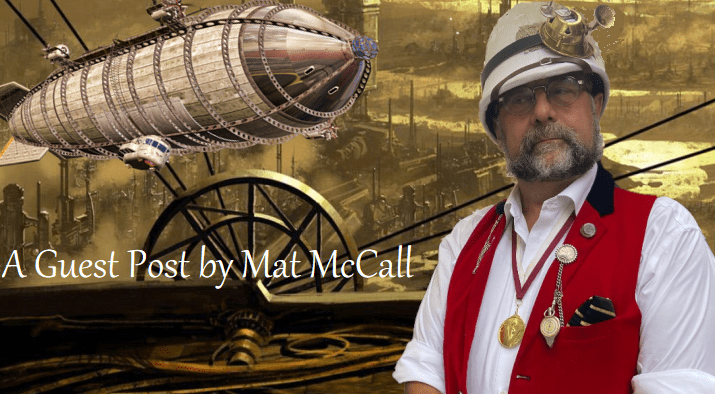
One of those people is Mat McCall, a bulldozer of joyous exuberance and invested enthusiasm who manages to drag unsuspecting people into a whirlwind of frivolity. I love this man… He has some thoughts on ‘What is Steampunk’ he is something of an expert on the matter, though he would never claim to be.
What is Steampunk?
Steampunk is a celebration of the 19thc origins of Science Fiction.
Although the name “Steampunk” is 20th century, the style and form of Steampunk goes back to the earliest 19th-century authors who created the genre of Science Fiction. Those first authors were writing in the dawn light of the Industrial Revolution, a time of infinite possibilities and infinite change. As time went on, their fiction became not only speculation but inspiration and warnings to future generations.
Science Fiction as a genre was not invented in the USA in the 1950s.
As a literary genre proper, Science Fiction came about in the early 1800s. Modern Science Fiction finds its progenitor in Mary Wollstonecraft Shelley, daughter of two prominent British philosophers and political activists and wife of the poet Shelley. She wrote what was described as a scientific romance, a cautioning letter to humanity regarding mankind’s hubris and foolishness on the doorstep of a new age of science; the industrial revolution. She created one of her generation’s most essential and enduring novels by mixing fact, contemporary science and fiction, and a healthy fear of what was to come.
Today if her book, ‘Frankenstein,’ was newly released, it would sit firmly between ‘Do Androids Dream of Electric Sheep’ and ‘I Robot.’ As it is, Mary Shelley’s ‘Frankenstein’ is the mother of all modern science fiction. And its imaginings and reimaginings, in books, theatre and most notably film, have had such a profound impact on our culture.
The first proper Science Fiction movie was Georges Méliès’ ‘Trip to the Moon,’ released 120 years ago, inspired by Verne’s 1865 novel, ‘From the Earth to the Moon,’ and HG Wells’ ‘First Men on the Moon’ of 1900. Science fiction has its roots deep within our culture, art, and imagination.
The first movie version of ‘Frankenstein’ was released 110 years ago and shaped our subconscious visualisations of one of the Steampunk world’s most important features: the mad scientist’s laboratory.
Steampunk celebrates the works and inspiration of those great creators, like Jules Verne, H.G Wells, Edgar Rice Boroughs, Hugh MacColl, and C.S Lewis. The filmmakers, from Méliès to Walt Disney, and right down to today’s authors, filmmakers and TV shows.
But what is or is not Steampunk?
There is no “canon” of work, no set of films or books, and no TV series that can be used to define what is and is not Steampunk. Steampunk is an inspirational vortex, a hurricane of creativity, drawing anything and all that appeals to the Steampunks into the eye of its ingenious whirlwind of imagination.
But is it all Fiction?
Well, yes and no. There’s an awful lot of science in the fiction and, there are many teachers, lecturers, educators, and people who just love to spread the word in Steampunk. The 19th c was an age of creativity on a scale unseen before, and a lot of what they invented most people have never heard of, from battery-powered jewellery to pneumatically powered railways, from Galvani’s experiments with reanimation to Hiram Maxim beating the Wright brothers into the air by 10 years. The real world of 19thc invention and science was almost as mad as the fictional world of Steampunk.
What you may see.
Steamers love dressing up. For some, a lovely Victorian dress or jacket and a fine hat worn at a jaunty angle are enough; for others, well, their own imagination is the limit.
As Steampunk as a movement spread, it encountered the cosplayers, who like to dress up as their favourite characters from comics, TV and film. You may have seen the Trekkies and, would be, Jedi at conventions, but Steampunk has no such limits.
There is no “you can’t wear that” or “that’s not in the films” in Steampunk, and so the Steamers have no limits to their creativity. We can take inspiration for our costumes from anywhere, from Lewis Carol to Batman, from the Dinosaur Hunters of 2000AD, and the ‘Land that Time Forgot’ to the real world of 19th C life; give it a Steampunk twist and wear it proudly.
Is there any logic to Steampunk?
Steampunks love the literature and style of the 19th and early 20th centuries, and Steampunks love science and invention, mystery, and adventure.
An excellent example of how things get drawn into the vortex of Steampunk; Conan Doyle created the greatest detective character of all. Writing in the late Victorian age, a lot of the forensic science Holmes used was cutting edge, virtually Science Fiction to his readers, so Sherlock Holmes is rightly drawn inexorably into Steampunk. And along with his creation, so is the author, Sir Arthur Conan Doyle. Doyle was a spiritualist and ardent believer in the reality of the Cottingley Fairies; though the images were first published in 1917, they, of course, are drawn into the creative vortex of Steampunk inspiration.
So, do not be surprised to encounter a Steampunk-inspired Sherlock Holmes sipping tea and taking tiffin with a Steampunk-inspired Victorian fairy, or H.G. Wells’ Time Traveller having a drink with an Airship Pirate and a couple of Morlocks.
Who are the Steampunks?
We are writers, musicians, dancers, sculptors, model makers, costume makers, performance artists, artificers, inventors and an innumerable multitude of other specialities and skills.
Because of the freedom of imagination within Steampunk, it has become the most diverse, inclusive, and encompassing of all communities. We welcome all ages, genders, abilities, disabilities, and ethnic backgrounds. We come from all walks of life, from the unemployed and students to academics, professional artists, and actors, from comics to lawyers.
Are there rules?
There is but one rule; Be Splendid. We value good manners and polite conduct at all times and try to encourage this by setting an excellent example for others. We value individuality, creativity, and artistic licence, by encouraging and supporting each other in our creativity, especially new members.
One other kind of rule; Steampunks do not take themselves seriously. This is all about having fun and escapism.
Can I join in?
We welcome all. You do not need to be an artist to join in. You do not need to be even ‘into’ anything particular. You don’t need to dress up in a fancy costume or know anything about Science Fiction. And if you love it, then Steampunk will awaken creativity in you that you never knew you had. Just bring yourself because you have so much more to give than you realise.
Simply come along and say ‘hallo.’ There are no barriers to Steampunk.
So why don’t I credit Jetta and modern Steampunk authors?
I would no more credit Jetta with inventing Steampunk than I would credit the guy that called an elephant an “Elephant” with the invention of the elephant. It’s not to demean his contribution as an author, but identifying and sticking a label on a thing, as would a moth hunter on a newly discovered moth, does not mean that that lepidopterist invented that particular kind of moth, no more than it means Jetta invented Steampunk.
As with Gibson, who did not invent Cyberpunk, other authors were writing similar dark future stories before he published Neuromancer, but Gibson named it and had a far broader and more profound impact upon the genre, and consequently all Science Fiction than Jetta ever has had on Steampunk.
Don’t believe me? Ask a dozen Science Fiction reading Steampunks; far more will have read Neuromancer than have ever heard of Morlock Nights.
For inspiration, most Steampunks go back to those early greats and the various filmic reinventions of their stories; Jules Verne, H.G Wells, Mary Shelley, et al., and that is why, although us struggling authors are contributing to the genre of Steampunk, and there is some damn good stuff out there, we will never be the actual sources of inspiration for the whole movement.
Steampunks are a community.
Steampunks are a community of like-minded individuals; we are all different, some very different, and we celebrate those differences. In fact, we encourage those differences. We do not judge people, nor single out or exclude people; such behaviour is simply not splendid, and that’s not Steampunk.
We are a refuge for the outsiders, the people that never fitted in with the ‘right crowd’ at school. The oddballs and we are very proud of that fact.
Steampunk is what Steampunks do.
Do not allow anyone to tell you what you can or cannot do, what you can wear, or what you can take inspiration from. A few years back, we had a lot of people arguing about what Steampunk is and what is not. Mostly these were people who had come into the community with fixed ideas of what they expected it to be and took to their soapboxes to tell us all we were wrong, and they were right. Very few of those people remain. There is no pure Steampunkiness, no right way to do it, and indeed, no one who claims to be an expert is an expert.
Afterword by Mark
Mat McCall is rubbish at self promotion… He writes wonderful novels and doesn’t even bring copies of them to steampunk events he is organising. He writes a long blog post like this about steampunk and doesn’t once mention his own down right remarkable novels in the process. The man is an idiot, I would not listen to anything he says , I’d go and read a book instead. I recommend one of his, The Dandelion Farmer for example… Or is you like heroic fantasy of the kind once written by David Gemmell you can’t go far wrong with Annis.
For reasons I will never understand authors insist on shortening their names. Elizabeth Tuckwell being one of them. Whats wrong with Elisabeth I ask you? Its a fine regal name, why would you shorten it to Liz? Says a man who was named Mark by his mum so no one could shorten his name…
This is true and why my sister is called Dawn. It’s also why we don’t have middle names… For some reason this logic came to an end when my Brother Stephen Archibald Grundlewick Muthusiala Hayes was born. He is also taller and distinctly blonder than either my sister or myself.
I have never wondered about this…
Miss Tuckwell who calls herself Liz so who am I to argue is a fellow Harvey Duckman writer, genuinely quite lovely and deserves a better introduction than I am giving her. She is also by strange coincidence the aunt of an old friend of mine from the west midlands branch of her family. They are weird with names too and change the family surname to Tredwell. What was wrong with Tuckwell I ask you?
Anyway, that’s enough blathering on, over to Elizabeth, who has far more interesting things to say.
Writers Groups By Liz Tuckwell
For Mark’s annual Indie Month, I thought I’d write something about my experience of writing groups. Writing is a solitary pursuit, but writers like to get together to discuss their craft and occasionally have a good moan about writing and publishing.
I’ve belonged to a few different types of writing groups.
One type of writing group is the critique group. I’ve joined a few of these. For example, I attended a Developing Your Novel course at the City Lit adult education centre in London and at the end of the course, some of us decided to set up our own writers’ group.
We met monthly in a pub. Four people would send an extract for everyone to read and provide comments at the next meeting. I found the comments very useful although occasionally frustrating as not everyone in the group was a SF or fantasy writer so didn’t understand the tropes. In the last year or so, COVID hit, and we met on Zoom. When meeting in person, we’d always made notes on a hard copy and passed it on to the writer. With Zoom, we merely gave our spoken comments which I didn’t find as useful. We met for five years until the group membership grew too small to be worthwhile. People left through moving away or ill health or pressures of work/study.
I did belong for a while to another writers’ critique group which met online. That group each put comments on a word document and shared it on screen, then sent it to the writer after the meeting. That was more useful in an online group although you were more at the mercy of technology and other writers’ tech savviness with that method. However, that group was small to begin with and unfortunately, a couple of people had to drop out, so it wasn’t really practical to continue.
Another type of writers’ group is the more social one. When I became a member of the select group of Harvey Duckman Presents writers, I discovered a number of them met weekly in a pub in Teeside. Shortly afterwards, COVID came, and they started meeting online which meant Harvey writers from further afield were invited to join them. I enjoyed the weekly Zoom meetings, getting to know the other authors and gaining useful information and insights from them. I was sorry when the end of COVID meant most of the group resumed meeting in the pub.
However, a few of us who couldn’t meet in person, have continued to meet online on Thursdays at 6 pm courtesy of Joseph Carrabis who hosts the meetings. If anyone is interested in the online group, drop me a line at liz@liztuckwell.co.uk. You’d don’t have to be a Harvey author to come along.
I also belong to another type of writers’ group, the London Clockhouse Writers Group. This one is a bit different because you have to pay per meeting, is specifically for SF, fantasy, and horror writers, and you need to have had two short stories published to be eligible to join. Most but not all of the writers live in the South East. Meetings used to be in person but are now online. The leader of the group provides a list of submission opportunities coming up and gives more information about them. He also sometimes provide writing prompts and we each write a short paragraph and share them. We also share news of submission successes. For more information, see https://clockhouselondonwriters.wordpress.com
In my experience, being part of a writers’ group is generally worthwhile. They can be helpful and good fun. However, you need to know what type of group you’re looking for. If it’s a critique group, you need to think about the size and what genres the other writers write in. In my opinion, a critique group needs to have at least six people to ensure its longevity. Whereas with a social group, you need to consider what size group you’re comfortable with. Just as importantly, you need to enjoy the company of the other people in the group which, you’ll find out pretty quickly. And nowadays, whether you want to meet in-person or online.
If you want to find a writers’ group in your local area, Writers Online https://www.writers-online.co.uk/writers-groups has a search function to look for writers’ groups. If you want an online group, I’d just Google it.
Liz Tuckwell has had several stories published in Harvey Duckman Presents anthologies. She’s also published a collection of short stories, Moonsleep and Other Stories and is currently working on an episodic novel about Tully, the hero of several stories set in an alternate Rome, in the Harvey anthologies. https://www.amazon.co.uk/Liz-Tuckwell/e/B00AMQ0RDW/
There is a lot said about climate crises and the need to save the planet. Much of this misses the important point that the earth doesn’t need saving. The planet will go on orbiting the sun in its merry little way, wobbling on its axis and basically not care a great deal about those odd ape descendants making a mess of its surface. We are relatively new in earths history and if we all died tomorrow the planet wouldn’t be overly fussed.
What we need to save is the environment that allows us to exist on the singular island in infinity that supports human life… But if we don’t the universe will probably not miss us.
On the whole I find that comforting. This view is however why I’m not the one your should come to to speak with any authority on climate change and how humanity can best save itself through green living.
For that you need a Nimue…
One of the big barriers to becoming more sustainable, is the widespread belief that it’s going to hurt us to do so. We are afraid we’ll have to give up all the nice things, all the good things and spend the rest of our days wearing itchy clothes made out of coconut shells and never being allowed to have holidays and only eating locally grown lentils.
Part of how we’ve got into this mess in the first place is a culture of selling each other stuff we don’t need while making ourselves feel miserable about the stuff we already have not being good enough. We waste an outrageous amount of physical resources and energy making things that all too quickly wind up in landfill. Meanwhile happiness is in short supply.
What I’ve tried to do with this book is look at the things humans actually find rewarding and how we…
Sir Willian Nettleton, fathered a string of bastards over the course of his fifteen years of being ‘lost’ on safari before he finally returned to Cape Town when the gin ran out. He went on to die of consumption in 1837 on the journey back to Teesside…
He was however not the first Sir William Nettleton, the first served in the court of Queen Elizabeth the first, and rose to the distinguished rank of as lord warden of the water closest, but never advanced beyond his post of holder of the royal wet cloth on a stick. Sir William also managed to explored no where, didn’t discover a vegetable, was crap at bowls and when the Spanish armada was spotted off Plymouth hoe he was in bed with a lady of negotiable pleasure in Plymouth, so ironically at the time of the attempted invasion he was spotted on a Plymouth… We will leave that there.
The current Willam Nettleton who can trace his roots back to Devon in January 1589, though for some reason he shortens his professional name to appear cooler and writes as Will Nett… Occasionally Will Nett sends me blog posts , they tend to be entertaining, well received, deceptively intelligent reads… He normally does this when he has a new book coming out. If he has a new one out this time however he hasn’t bothered to tell me.
Please note I made most of the above up… Most of it.
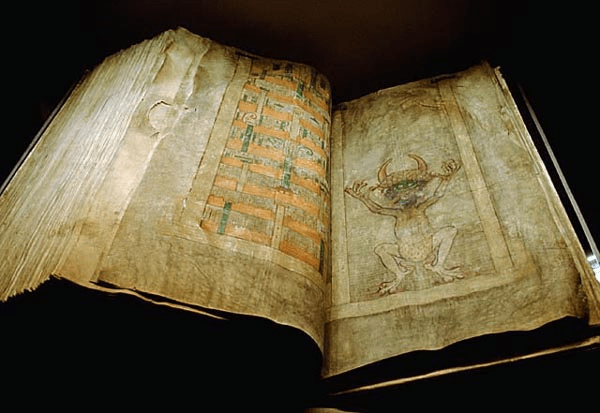
This gentleman with the Codex Gigas, gives us a sense of scale. He is not Will Nett The real Will can not pull off a moustache like this chap clearly can.
Now That’s What I Call Rubric: by Will Nett
I do NOT want to hear about your writer’s block; not anymore, you lazy pack of shirkers. Not now I’ve seen what’s capable when you throw on your cassock, moisten your quill tip, and settle in for an evening of furious penmanship. This is precisely what a largely-unknown Bohemian monk- possibly the appropriately named Herman the Recluse- did, around 1000 years ago when he sat down to write the book that appears before me now. The Codex Gigas is a 620-page behemoth that weighs approximately as much as my first car; a Ford Escort Ghia with fully-retractable aerial. It’s stored deep beneath the streets of Stockholm in Sweden’s National Library in Humlegarden Park, Ostermalm. The book, that is; not the car. The three-floor descent to access it seems apt as, notwithstanding the gargantuan effort involved in writing it, the work is probably best-known for its seemingly tenuous inclusion of the Devil, who gurns madly from page 290 like a loin cloth-clad Ftumch. (Google him if you’re under 40).
He’s squatting in his underwear with arms raised after a night of prodding and bullying our heroic author into finishing the 3-foot high tome, much the same way that modern day blog editors do now. Apparently written entirely in one evening, the author was of course largely undistracted by Love Island, social media and the goings on across the road at no. 91. Aside from the romantic ideal of an isolated monk hounded into action by a belligerent sprite such as Satan, are the facts of the matter. Specifically, that to have produced such an undertaking would have required the author to write continuously for 6 hours a day, for 6 days a week, for 5 years, which is only a slightly-less intense work rate than that of peak-era Stephen King. Given that the Codex author was a monk, he would likely have been occupied concurrently with his monastical duties; administering bowl haircuts; washing his arse in a stream; eating pebbles etc, and therefore it would have taken even longer to complete. All this considered, experts believe it may have taken anything up to 30 years to finish. Again, this is a rate of endeavor that most current authors, and certainly this one, could only dream of. The Codex went through the usual historical upheaval of various war-fuelled disasters, being fought over by the Hussites and Catholics, and was then sold on to various monasteries. It found it’s way into the private collection of Emperor Rudolf II in the late 15th century, where it remained until 1648 before being claimed as war booty by the Swedish army. It was thereafter kept in Stockholm for a largely uneventful 375 years, but for one comedic episode in 1697 when a fire at Tre Konor Royal cCastle saw the book thrown from a window to preserve it, which it duly did, but not before it crushed a member of the public who happened to be passing by.
The contents, all in Latin, are a smorgasbord of religious texts, from sections of the Vulgate Bible to Chronica Boermorum (Google that if you’re under 900 years old), and everything in-between; spell-casting tips; recipes; the Hebrew alphabet. Think of it as a medieval compilation album; Now That’s What I Call Rubric, if you will. Despite the legends surrounding the Codex, one of the most curious things about its author, effectively a ghost writer, is largely forgotten, and instead we’re still talking about the Devil after all this time.
The Codex is kept at the Swedish National Library (King’s Library), in Ostermalm, Stockholm.
Now get back to work.
Will Nett’s first book, My Only Boro: A Walk Through Red & White, is currently the subject of a treasure hunt that has captured the imagination of shovel-wielding sleuths from all over Teesside. Part of the detective work required is finding the specific tweets involved because the link Will sent Mark to put on this blog post doesn’t work…