Hopeless Joys

One of the best things being an indie author has brought to my life is I get to meet other indie and small press authors. This is not because they are all wonderfully creative giving people, (though as a rule they are), but because as well as been a collection of wonderful individuals they have often created wonderful works of art and fiction. The kind of wonderful that makes life worth living. Its also a collection of wonderful that I would probably have never been privileged enough to stumble across if I wasn’t an indie author myself, because its the kind of wonderful you need someone to tell you about if you are ever going to find it. And trust me on this, its a kind of wonderful that makes the lives of all that touch it richer.

As such, if only to address the balance of the universe and tip the scales away from the mundane mainstream of the popular that is packaged for everyone’s consumption, and advertised relentlessly, when I find something wonderful (and yes I know I have used that word an awful lot in the opening paragraphs but its the right word) I make a point of sharing it here.

To put it another way, the next marvel movie doesn’t need the likes of me to wax lyrical about it. Indie authors, artists and publishers on the other hand need all the exposure they can get, even from little old me.

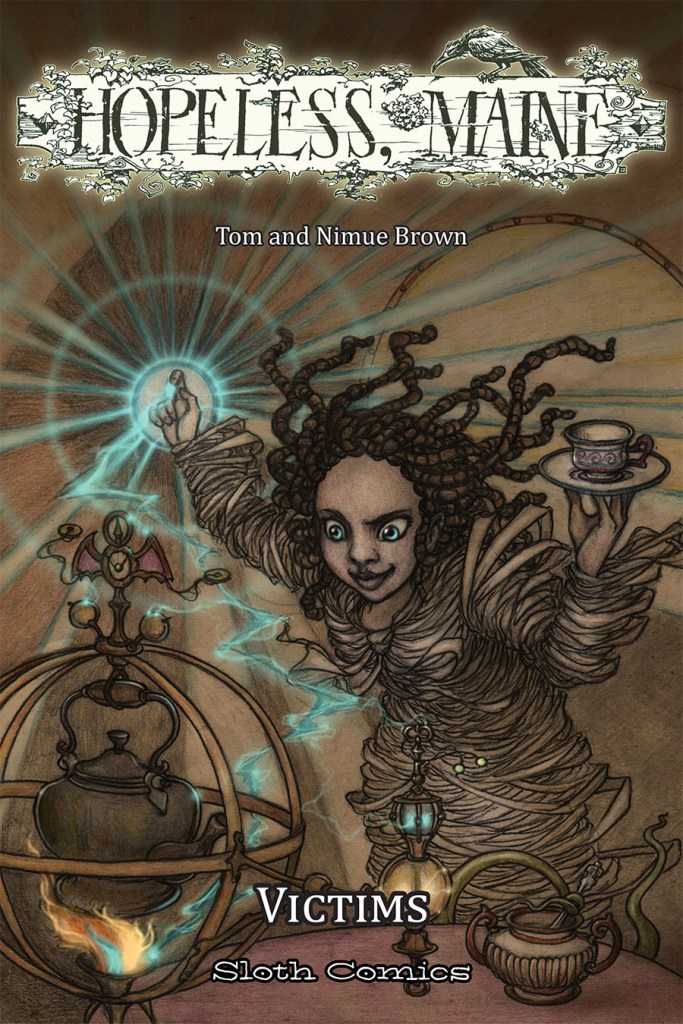
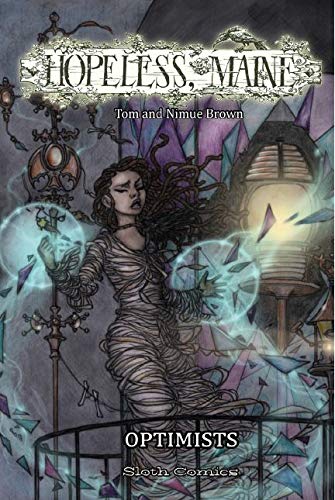
All of which, mildly rambling preamble, brings me to Hopeless Maine: Optimists, the forth graphic novel of the Hopeless Maine Quintet by Tom and Nimue Brown, which is due for release early next year. I was lucky enough to get a copy of at the weekend while working the stall next to their at a steampunk event in Gloucester that had been organised by a mutual friend, author Matt McCall, writer of The Dandelion Farmer. As a side note, that Event was enormous fun and I highly recommended any West country steampunk, or the steampunk curious, or just about anyone attend the next one…

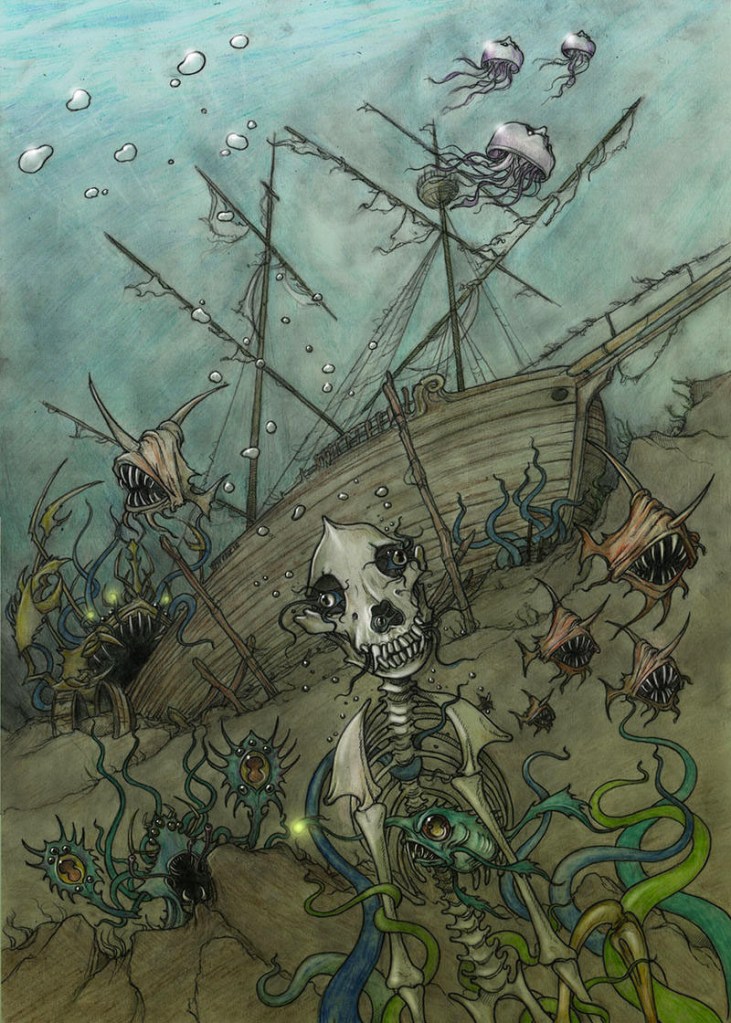
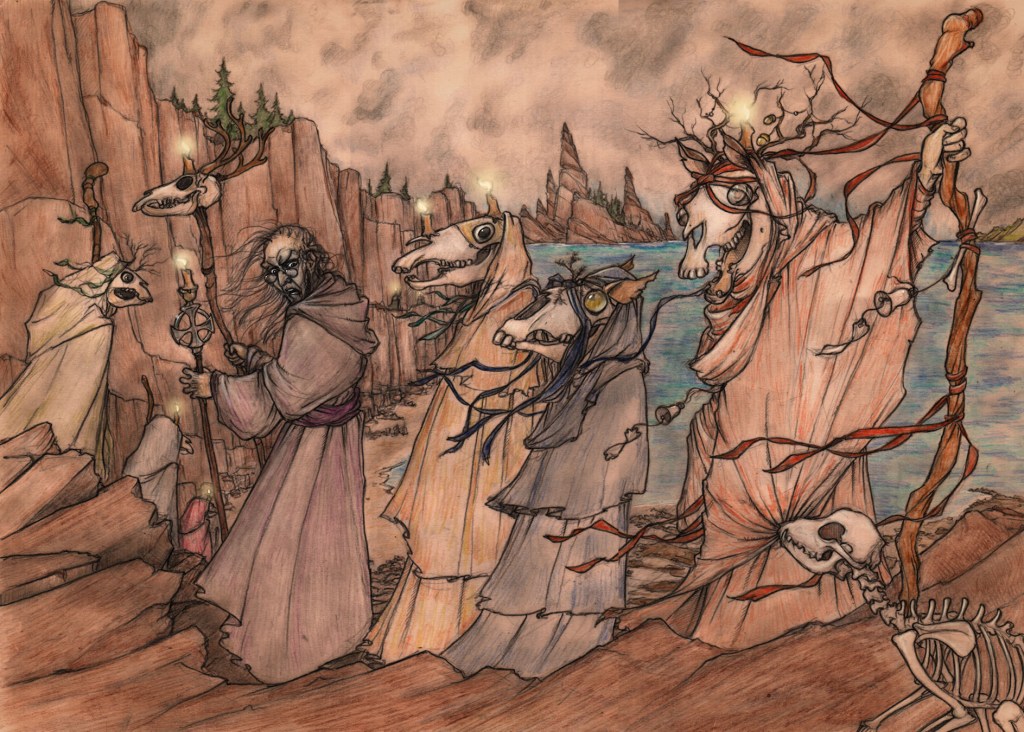
Why should you spend you hard earned cash, and read the Hopeless Maine novels? Because your life will be better for doing so. What more reason do you need. But in case that is not all it takes to tempt you to explore a strange fogbound island, somewhere and somewhen off the coast of Maine. An island that doesn’t let you leave, where the fauna and flora is both strange and dangerous, and something hides in the fog that is best not thoughts about, lets see if the art work does…

Now, I am not saying you should read the Hopeless Maine series just for Tom Browns art, though frankly that is reason enough… What makes these novels so good, so damn wonderful (there’s that word again) is that the art is paired with the words and storytelling of Nimue Brown. The elder gods were good when Tom and Nimue met, for they have birthed wonders between them. They are also among the nicest people I have been privileged to meet, and restore my faith in humanity and what humanity can be, each time our paths cross..

Where you start, if you have never visited the island before, well the best place to start would be Hopeless Vendetta, the collaborative blog/ community which Tom and Nimue not only share, but invite others to contribute to.

Then, once you have dipped your toe in the salty, and not entirely safe waters around the island, consider reading the novels… Frankly if you can just dip your toes I will be surprised.

For myself, I read Hopeless Optimists in bed, on a pile of extra fluffy pillows, by lamp lights, with a hot cup of coffee that steamed away till it wasn’t and never got picked up while I sunk deep down into the wonder of Hopeless for a couple of hours of just wonderful indulgent joy of art and story telling at its very best…

I will not tell you to read it, you should instead infer that in my opinion you should read everything. Trust me, you life will be better for doing so… And you’ll never wonder where all the spoons have gone again…

Posted in amreading, book reviews, books, dreamlands, druidry, indie, indie novels, indie writers, novels, reads, sci-fi, steampunk, supernatural | Tagged , , , , , , , , | 2 Comments

Fact Vs Fiction, by Dr Tamara Clelford

Todays offering on Guest Post Wednesday, the first of a new series of guest posts I’ll probably manage to put out on Thursday’s, is from a fellow Harvey Duckman writer and tapdancing physicist, Tamara Clelford, who’s has one of those doctorate things that intimidate those of us who developed out education by osmosis. She is also not in anyway scary, and does not spend her time developing interesting ways to murder people with technology, and get away with it…

She is one of the foremost experts in her field professionally, but assures me this is not because she has irradiated most of her peers and buried them in the void floor beneath her lab.

I chose to believe her, it seems safer that way…

FACT V FICTION by Dr Tamara Clelford

I’ve spent most of my life writing about facts in various different forms. Maybe I’m explaining facts to people, finding out new facts and presenting them or paraphrasing facts that other people have found out. Whatever the context I’m very comfortable writing about things that have happened, things that have been proved and presenting them in a report, document, paper, thesis etc. Fiction writing, however, I gladly left behind me when I waved goodbye to my last English class upon finishing my GCSE’s. This was done with the certainty of never returning to writing fiction. Well, that’s one promise I haven’t kept.

If you’ve read my previous guest blog here at the Passing Place you’ll know I wrote my first novel by accident, and indeed I did get into fiction writing on a whimsical whim whilst on holiday. Much to my shock and horror I really enjoyed it and haven’t managed to do as much writing as I would actually like to do. Words I thought I would never say, but we all evolve as life goes on.

I thought today that I’d have a look at my approach to fiction writing, and how it differs from my factual writing and actually why they are actually quite similar.

MY INSPIRATION

In factual writing you don’t normally talk about your ‘inspiration’ to write the paper or report you have to write. Normally the inspiration is along the glamorous lines of ‘it’s part of my job’. Well, I suppose if you are a fiction writer who lives off their books this could actually be the same reason there.

There’s normally a reason why you’re writing a factual report, and that is because you have created something new and need to tell people about it. What I create in these contexts I suppose does come from the inspiration to solve a particular problem or to fill a gap by creating a new thing. So, maybe I should use the word inspiration in work as well.

I’m more comfortable talking about inspiration for my fiction stories, even though it’s along a similar line. I’ve found out a fact and thought ‘I wonder how that happened’ or I’ve thought ‘wouldn’t it be fun if I could do x’ and then my brain has gone down a journey to solve that particular problem and out pops a short story or a book.

TO PLAN OR NOT TO PLAN

This is where the big difference is for me.

My factual writing is carefully planned out, I know what I need to explain, how it’s going to be explained and what graphs and equations I need to put in. Each stage is meticulously planned.

Fiction writing, I have a loose overarching idea in my head (for example: What if the takahē were part of a clandestine operation? Why do evil genius’s always wear a polo neck?) and start writing at the beginning and see where I end up.

The thought of planning a novel is as ridiculous to me as not planning a report!

WHERE TO START

I can hear my friend Katy singing “Let’s start at the vey beginning…………..” well I do and don’t agree with her. I suppose it’s about defining what your beginning is.

Fiction, yes, I think it’s a very good place to start as that’s how you read a book or a short story. Start at the start, end at the end and then do many many rounds of heavy editing to make the middle bit flow between the two.

Factual writing, however, I don’t read in chronological order. I read the abstract, the conclusions and then poke around in the middle to find out more details on the answers and how they were got. So, I write things accordingly. I write the conclusions first, because you already know the answer before you start writing. I then agonise over the abstract, as this is the most difficult bit to write so I start with a draft at this point. I then write the results, then the method and then the introduction. Then I have the fun task of getting the abstract into a good shape. So, I do start at the beginning of where I read, if not the beginning of the piece.

HOW TO DIVIDE UP THE TEXT

In factual writing you divide the text up with clear and informative section headings. There are no surprises – the results have the results in them and the method the method and so on and so forth.

However, chapter headings are often obscure, funny or misleading. Most of the books I read go for the classic approach of having catch chapter headings such as 1, 2, 3 or if they’re being posh one, two, three. Some of the books I’ve read recently (like Mark’s) have got actual chapter titles and I’ve really enjoyed deciphering them. I’m going to steal that idea and I’m going through the arduous process of adding chapter titles to my book, but I’ve made life easy for myself as I have a theme running through them.

WHERE TO STOP

In factual writing you finish your section at the end of the topic when everything is beautifully tied up. In a thesis this could be the end of the chapter, in a report the end of a section and a paper the end of a paragraph the sections just differ in size depending on the size of the overall document. You don’t do cliff hangers to leave the reader in suspense to find out the results of the experiment when they read onto the next section. Apart from anything else that would be pointless as you will have already read the main results in the abstract, so it’s very difficult to build suspense when you’ve already told them the punch line. What you do instead is build a secure coherent argument showing why the results are valid.

In fiction writing it couldn’t be more different. The book summary is obscured to leave the reader in a state of puzzlement, so they want to read the entire book. There is no upfront summary detailing the plot and the baddies, if you’re lucky there’s some hidden pointers in the text as you go through it. You also don’t tie up a section of the story at the end of a chapter, cliff hangers are king and almost mandatory. There’s no point writing a book where you have been left with no urgent reason to have to read the next chapter at 3am when you need to be up by 7am.

WHAT WRITE IN

For 4 glorious years of my life I was worked on a UNIX based computer. It was bliss and I loved it, but then I moved away from academia and it’s really difficult to function in the outside world without access to normal programmes. So, when I started working for myself, I decided to create the best computer set up I could and do a mix of the two and I started writing in LaTeX again. This is a great typesetting programme for producing documents with equations and images where you actually want them. It’s like a very high level programming language where I can just write things like \[WACC = K_e \times \frac{E}{E + D} + K_d (1 – t) \times \frac{D}{E + D}\] to give me a lovely looking equation rather than having to battle getting them into word. It’s bought me more pleasure and calm than it really should have.

However, writing fiction is probably not the best idea in LaTeX as the functionality doesn’t help and you can only produce pdf outputs. I actually write my fiction stuff in word at the moment, as this is probably the easiest format to transfer text in that has an inbuilt spell checker. I do know that some people write their work in specific writing programmes, I’ve had a look at a few of them but they don’t fit how I write fiction. As I’ve already told you there’s no planning involved so having to have some idea of what I’m doing ahead of time to just be able to write your book just doesn’t work for me.

HOW TO DEFINE ’THE TRUTH’

In academic scientific writing the truth is defined by you explaining your experimental process in sufficient detail that someone else would be able to re-create your experiment and they should get the same answers (within the measurement error). You can’t make stuff up or exaggerate, well I should say shouldn’t as people do try.

However, there are no such restraints in fiction writing. I like to start in a basis of a true story, something that has happened to me or I’ve read or observed, and then just take it further and further down the line so you very quickly end in a world of fantasy so you can explore all those ‘what-ifs’. Where the fantasy bit takes you can be different, it can be into a future world, a past world, a crazed situation or whatever your mind can think up as there are no limits.

BIO

Tamara is a star trek loving, pukeko obsessed, tap dancing, Queen listening, lord of low frequency and high-priestess of high frequency physics geek. Having worked in a variety of technical roles, both normal and clandestine, she is now a consultant working on physics based problems and data science. This latest incarnation has opened new doors to a wide variety of work and interests, like: an eclectic blog, writing a novel, encouraging people into physics, and teaching people how to code and do data science.

Follow Tamara on social media: @SwamphenEnts or if you want to see her technical life or learn to code go to swamphen.co.uk
Posted in #amwriting, amreading, amwriting, blogging, books, fiction, goodreads, Harvey Duckman, indie, indie writers, opinion, reads, sci-fi, writes, writing | Tagged , , , , , , , , | Leave a comment

Occasional reviews: Holly Trinity and the Ghost of York

As a son of the shire, I have spend many a day and night in the streets, snickers, and alleys of York. It is an old city, it was old before the Vikings got there, it was old before the romans set the first walls around it, it has old bones aplenty, both figuratively and actually.
There’s a pub, by the riverside, where they say some nights you can see the brush topped helmets of roman legionaries cross the bar floor, the ghosts of long dead soldiers marching on a road five feet below… I’ve sat in that pub, and drank dark ale, and yet I have never seen them myself, but I’ve met plenty who would swear to you they have, or something like it.
York has always been a city of ghosts. Old bones, as I say…

So, York is a perfect setting for a novel about a guardian who protects the city from the worst the supernatural world has to offer…

See the source image

Of course, it not as simple as that, having the perfect setting doesn’t mean anything unless you can bring that setting alive, give it breath, and the feel of the city and those old bones beneath your feet. Sawyer does that. He does that even if you have never walked those streets yourself, crossed its bridges, wondered down the shambles or walked it’s ancient walls. It feels like York, the great Northern capital, the original second city. A city with old bones.

But Sawyer also does more. He has a cast of characters that you will both love and fear for, and indeed just fear. The title character, Holly, is a joyous invention. Mysterious, strange, awkward, mad and fascinating. I could not help but be put in mind of Matt Smiths Doctor Who, but that’s a bit of a disservice, Holly is a singular invention in her own right, but she has that mad infectious otherness about her that characterised Matt Smiths iteration of the infamous time lord.

The main character Mira is drawn into Holly’s world, the supernatural underbelly of York, because when a mad woman saves your life and draws you into the madness, you can run and hide, or you can run with her… Mira choses the latter.

Mira is as much a joyous invention as Holly, as are all the characters in the novel. There is a richness to them, in the same way as there is a richness to the old bones of York. There are layers to everything, the plot is deeper than it first appears. Deeper and darker, there are more twists and turns than the old streets of York itself. There are insidious and sinister ghost and other things lurking everywhere, there is also humour, quirks, and joy.

The other characters all have life and energy of there own, be they human or more than human, or what if left after the human departs this world…

All of this is wonderfully realised, masterfully written, atmospheric, and just a plain joy to read.

It leaves you wanting more, luckily, there are still plenty of old bones in Sawyers York, And the Sleeper will wake again soon I am sure… Frankly, I am looking forward to it.

Posted in amreading, amwriting, book reviews, books, fantasy, fiction, goodnews, Harvey Duckman, horror, indie, indie novels, indie writers, indiefriday, indiewriter, novels, reads, sci-fi, supernatural | Tagged , , , , , , , , | 2 Comments

The Dyslexic Writing Process

Over the years I have written a lot about writing, and different bits of the process. I’ve also written once or twice on the subject of dyslexia. This is not really a post about the latter and a lot about the former, but my process, and every writer develops their own, is to an extent informed by how my mind works. So it’s difficult to talk honestly about my process, or explain why it is my process, without mentioning that I am dyslexic.

So lets get the D word out of the way. Dyslexic’s think differently, their brains process things in a different way, the result of which is they tend to approach things in different ways, and its most common symptom, which is to say how it is perceived, is word blindness, making both reading and writing a more complex skill for a dyslexic to master.

Think of reading and writing like rock climbing, most people have four limbs, but some people might have been born with only three. Both four limbed people and three limbed people can learn to climb, but the three limbed have a more complex time learning to do so. It doesn’t mean they cannot scale Everest, they may a sherpa to help them (but so did Hillary, even though he was the ‘first’ to climb the worlds highest mountain).

To the Top of the World and Back | Sierra Club

Okay that’s not a perfect analogy, and my Sherpa Tenzing is a combination of time, patience, a good editor and MS word. I am also also not deep in the dyslexic spectrum, which helps. But the point is that a lot of my writing process is informed to an extent by how my mind works, so my dyslexia is part of it.

Also though, just before I move on to the ‘meat’ of this post and talk about process. My synopsis that my dyslexic brain causes me to think differently to the way the majority of peoples think, is both entirely correct and utter hogwash. Which is to say, it is most likely true, but we have absolutely no way of knowing. No one knows how anyone else ‘thinks’ or ‘how there mind works’ it is literally imposable to do so. Because you can only ‘think’ the way your own mind works, and so you can only experience the universe and everything within it through the filter of how your own mind works.

We also assume the brain is where the mind resides. But the mind is much like the soul, no one can point to your soul, no one can actually point to your mind. All we ‘know’ for sure is the brain interprets nerve impulses and sends out nerve impulses through electrochemical reactions. Your mind does so much more. Otherwise a portion of your mind would be spending all its time reminding your heart to beat and telling your kidneys to stop complaining about last nights quart of scotch. Someone who suffers a terrible brain injury, or with dementia, or whatever affliction of the organ we call the brain, may merely have lost aspects of the connection to their mind, which exists in a cloud like bubble on a fourteen dimension of reality and sort of floats about three feet to the left of your central cortex.

Maybe when you ‘real connect’ with someone and you’re ‘really in sync’ it is actually your floating cloud like minds are intermingling on a high plain of reality, while you share a caramel latte in a coffee in Bracknell.

The point being, we just don’t know how each others minds work, or even what each others minds really are. So for all we know no one’s mind works the same way anyone else’s does. Or all minds work exactly the same way and we are kidding ourselves that we are actually in anyway individuals. Claiming therefore that I am dyslexic and therefore my mind works differently is clearly facile on my part… Fuelled no doubt by the endless desire of my fourteenth dimensional floaty cloud mind to find something, anything, that sets me apart and makes me ‘special’.

Except its does, all dyslexic’s think a little differently from non-dyslexic’s and interpret written information in a different way to the ‘norm’ whatever the ‘norm’ is. But then who wants to be the ‘norm’, I would sooner think a little differently…

This also explains why I started writing this long post about my writing process, got distracted and wrote about something else entirely.

Which, oddly enough, more often than not is my writing process.

Posted in amediting, amreading, amwriting, dyslexia, editing, humour, indie, indie novels, indie writers, indiewriter, reads, writes, writing | Tagged , , , , , , , , , | 2 Comments

Dandelions on Mars

I had a moment of genuine glee while reading last night as a spaceship from the planet mars crashed into Surrey’s Horsell common in 1857… The astute and well read among you may be able to guess why, but to be clear, it is all to do with the date, 1857…

This event, I should add, has both very little, and everything, to do with the novel I was reading. The ‘landing’ of this spaceship is the prelude to an invasion, conquest and colonisation of one world by the inhabitants of another which lays the fertile ground for the actual novel. But again its that date that is important, as that date is 40 years before another famous literary landing on Horsell common. The first landing site of the Martian invasion fictionalised in HG Wells War of the Worlds.

Hence my glee, its the small details that make me smile.

The landing 40 years before Wells, is in a ship piloted by two earthmen who had been kidnapped for study by Martians as part of their preparations to ultimately invade the Earth. Their escape from the red planet, with irrefutable proof of life on Mars and the Martians intent, sets about a leap in technology in Victorian England and among other 19th century colonial powers, who do what the colonial powers did best and pre-empt the threat of mars by invading the red planet themselves, quite wisely if Wells is anything to go by. Leaving us with a late Victorian Human society on Mars, and a blend of Martian and human technology. A revolution by colonists to throw off the colonial powers for self rule later, we have the mars we find ourselves embroiled within in Mat McCall’s ‘The Dandelion Farmer’.

This is the kind of Mars envisioned by Burroughs, and other pulp era writers. A mars of strange creatures and strange Martian societies. It’s also draws from Bradbury, Wells, a smidgeon of Lovecraft and many other sources. There are lots of gleeful little references in here, such as the president of Tharis (one of the independent human states) is called Bradbury. There are so many in fact I suspect I missed as many as I stumbled over and that’s a tribute to the gentle way these little asides are slipped into the narrative.

That narrative, a complex epic narrative at that, is told entirely through the device of journals, letters and other more oblique sources that give you the over all story from the various perspectives of the principal characters. While not a unique way of putting forth a narrative I have seldom come across a whole novel done this way. There should be an inherent weakness in telling a story this way. With the various extracts over lapping events and retelling the narrative from a second perspective. Particularly later in the novel when most of the principal characters are all present for the same events. Yet it is a tribute to the craft employed by McCall’s writing that each voice is sufficiently different, each view point distinct and focused on different aspects of events, that at no point does it feel a weakness. If anything in fact what should be an inherent weakness of the narrative becomes one of its greatest strengths.

The story is compelling in of itself. It starts with all the aspects of a traditional western plot. A vile industrialist, Du Maurier, is trying to oust the dandelion farmer of the title, Edwin Ransom, from his land. When buying Edwin out fails he falls back to violence and intimidation, that escalates quickly. But while this is going on our hero finds a mysterious man, with a metal arm, named Adam Franklin, who has lost his memory, to the point he does not even realise he is on mars, squatting out on his land. Adam is very much Shane at this point, the man with a complex relationship with violence and a difficult history, who helps the oppressed Edwin fight back against his oppressor. While this, set against a backdrop of mars, would be compelling in of itself, Edwin’s troubles with Du Maurier are just one thread of a much more complex narrative, that slowly layer upon layer builds throughout the novel.

Du Maurier’s real reasons for wanting Edwins land are embroiled within this. As is Edwins farther-in-law’s suspicions about the native Martians that vanished 25 Martian years before (1 Martian year is approximately just under 2 earth years) and his planed expedition to discover where they went and reinitiate contact with them.

There is a lot to unpack here and a raft of interesting characters with their own complex viewpoints. Aside Edwin, his wife, and father-in-law, there is a female go-getter reporter straight out of 1920’s pulp fictions, a brave rocketeer/hunter/adventurer of mildly dubious breeding, an aging archaeologist specialising in Martian archaeology and his feisty daughter, the old solider, sent to keep an eye on things, a spiritualist aunt with a herd of small dogs, a scoundrel or two, automatons with almost human personalities and a multitude of supporting’s cast.

But the most interesting characters are Adam Franklin, and Aelita.

Adam is far from what he first appears, and far from what he knows himself to be at the start of the novel. His journey back to himself, and realising not just who but what he is, would make a fascinating novel all on its own. He struggles with the realisation that the truth behind his existence brings only more mysteries and when that same realisation comes to his friend towards the end of the novel another layer of complication is layer out for the sequel which I very much look forward to reading.

And then there is Aelita, the most complex of all the characters as she is not human, but a orphaned Martian raise among humans. A devout catholic by education, closeted away form the world by an over baring husband, she knows next to nothing of her own heritage. Something which starts to change when she joins Professors Frammarion (edwin’s father-in-law) expedition against her husbands wishes. Events take place that lead her to start to rediscover her alien heritage, history, and something more.

By the end of the novel it is these two characters more than anything that drive the mystery, though that is to sell short all the other intricate complexities to the plot, with so many characters and all of them engaging and intriguing in their own ways.

In short, this novel is a tour-de-force, fascinating and very different, told in a way that could have easily become unhinged and distracted if a less artful scribe had penned it. I couldn’t have written this (and I so wish I had), I doubt most of the writers I know could have written this. I say that as one privileged to know many very talented writers. This however is unique, a narrative told in a way I and I doubt few others would even attempt, yet alone done so with such mastery. Which is what makes it such a wonderful read.

That, the depth, and pure invention within these pages.

If you read one book this year on my recommendation, (which surprisingly people do on occasion) read this one.

Posted in amreading, amwriting, book reviews, books, Canadian steampunk, errol the bookcase dragon, fantasy, fiction, goodreads, indie, indie novels, indie writers, indiewriter, novels, reads, retro book reviews, sci-fi, steampunk | Tagged , , , , , , , , , , | 7 Comments

Harvey Duckman Presents: Volume 8

Ben Sawyer's avatarBen Sawyer

Looking to escape to another world with a super fast read? Looking for urban fantasy that is a bit different? Or weird stories to make you think? Wanting to discover speculative fiction from writers that could become your new favourite authors?

Harvey Duckman presents the eighth in a series of short story anthologies featuring some of the most exciting voices in science fiction, fantasy, horror and steampunk today.

Volume 8 includes stories by: Christine King, Mark Hayes, Alex Minns, Muriel R. Blythman, Adrian Bagley, Crysta K. Coburn, Peter James Martin, Joseph Carrabis, Jack Pentire, R. Bruce Connelly, Melissa Wuidart Phillips, Davia Sacks, Liz Tuckwell, Kate Baucherel and Alexandrina Brant.

Edited by C.G. Hatton.

View original post

Posted in Uncategorized | Leave a comment

It’s just not Cricket… and other matters of research

Research is an important aspect of the fiction writers tool box.

That may seem counterintuitive, after all its fiction, we just make it up don’t we?

But actually when ‘just making things up’ research can become more important than you might imagine. If you want the reader to invest in the world of your characters you need it to be convincing. Write something based in the mid Victorian period, for example, even a fantasy where the ‘rules’ of the universe are different, you still need to make sure all the little details are right. However you also need to accept something else, the unfortunate truth that some of your readers will have very odd idea’s about how people lived, spoke and how society worked in the past. In short you need to do your research, while accepting it will be entirely lost on some readers. (I might expand on that in a later post, if I do it will be a bit of a rant, just so your prewarned…)

The reason I bring up research, aside it being a subject that i think people might be interested in, is because of a little bit of kismet. The England vs India test match at Headingly is entering its third day, with England in a commanding lead after James Andertons devastating spell on the first morning ripped the India batting line up apart, while Joe Root notched up a century at the crease, and the new Harvey Duckman Anthology is out tomorrow.

Clearly these two events are entirely linked…

Okay that’s a little tenuous, I will grant you. But not as much as you might assume. This is because my own contribution to this Harvey volume, a short story entitled Mandrake, the titles namesake is a Victorian gentleman magician, by royal appointment to the court of St, James. A man with many secrets, and as it happens rather firm opinions on the subject of cricket… The latter being important to the story because a fair portion of it takes place in the lords pavilion, and I also used it as a backdrop to explore certain aspects of the quasi-Victorian society inhabited by Lucifer Mandrake and his compatriot Sir William Forshaw (who unlike Mandrake is a bit of a cricketing enthusiast).

Mandrake and Forshaw are, to an extent, analogous to a Homes and Watson. Though I say this only because its the most obvious comparison to how there relationship works. That relationship, one characters being exceptional and unusual in some way, the other acts as the conduit of the more mundane everyman, is one that existed in fiction long before Arthur Conan Doyle first put pen to paper. I also say it because readers will make that comparative link, which I will admit is partly my intention, though not for the reasons the reader might first assume.

However, the point of this post was to talk about research, and while reading Sax Rohmar novels etc might count as research, it isn’t quite what I was getting to.

Cricket, that most gentle of sports, where the players break for tea is often considered a sport of the middle classes. A sport played by sports men of a certain calibre, particularly if we are talking about the Victorian and Edwardian era…. At least that is the image that most likely comes to mind when you think of a Cricket match at Lords in mid Victorian England. Lucifer Mandrake however expresses a different opinion…

Cricket is, as any right-thinking Englishman knows, the pursuit of louts, drunkards, ruffians and gamblers.

Yet, despite all this, somehow the sport of cricket itself remains terminally dull. 

On the face of it that might seem a bit strange, but actually its not. In the mid 1800’s that really was a common view of the sport and its spectators. It suffered from much of the same issues English football suffered from in the 70’s and 80’s. Drunken fights, and abusive fans were common place. Corruption was rife with betting syndicates bribing teams to throw matches. Questions were asked in the house of commons. There were moves to ban spectators or the sport entirely, for fear of the corrupting influence of the game causing the working class to skip days at work.

Why is this important? Interesting research though it may be. Well mostly it grounds a story in aspects of reality. Oddly enough however cricket only came into the story at all because I needed somewhere for several events to take place. Someone, it seems, is reanimating the corpses of dead members of the house of lords in order to influence a vote, and Mandrake takes it upon himself to investigate. He discovers this is taking place because quite by chance his friend Forshaw mentions in passing that he bumped into a former Lord both believed was dead. The man in question had been heading to Lords. The cricket ground, not the chambers in the houses of parliament. which Leads Mandrake to observe…

…if there was one place you are likely to find festering reanimated corpses engaged in a cruel mockery of life, other than the House of Lords itself, then it’s probably a safe bet to look to the members pavilion at Marylebone Cricket Club.

My course of action was therefore clear, I would have to face the tedium…

Mandrake as you may gather has a somewhat sardonic wit and little love for cricket. He also is more than he appears to be but who isn’t.

Cricket is not the only thing that required some research for this story, in fact several important aspects of the wider plot in which this story sits came about after research into the Sax Coburg dynasty from which Queen Victoria sprang, how she ascended to the throne and certain political issues involving the Sax Coburg family, the duke of Cumberland, and Hanover. The Hanoverian question was a major part of political life in early Victorian Britain, and indeed had things been handled differently, if for example a coven of magicians had tried to intercede in politics for their own reasons, then history could tell a very different story. Research is a treasure trove every author should plunder…

I predominantly write fantasy with a lent towards steampunk, or to put it another way, I make things up. But just because I makes things up doesn’t detract from the need for solid research and grounding fantasy and science fiction in reality before you twist it to see what snaps under the strain. research is, ultimately, everything.

Mandrake, is a product of research, so much research in fact that the short story I planned to write may well lead to a novel or two because the character, as so often is the case, took on a life of his own, and the research gave me a rich vain of narrative in which to plunder. But it may be a long while before any novels see the light of day, I have a rather a long list of works in progress, so we will have to see.

However, the short story named for the character does appear in Harvey Duckman Volume 8 , which comes out tomorrow and I am looking forward to finding out what the world thinks of the magician by royal appointment to Victoria Sax Coburg.

Posted in amreading, amwriting, books, editing, fantasy, fiction, goodreads, Harvey Duckman, humour, indie novels, indie writers, indiewriter, novels, reads, steampunk, supernatural, writes, writing | Tagged , , , , , , , , , , , | 4 Comments

From small acorns…

The English language in its never ending colonial expansionism co-opted many years ago. A word that was originally Turkish, though it had deeper roots in Persian and Arabic. Like so many words of other languages who’s vowels my mother tongue acquired in a back alley with a pen tied to a stout billy club before dragging the constants off to the Victoria and Albert Museums reading rooms, it is seldom used entirely in reference to its original mean.

This word is kismet. Which in the original Arabic was the word used to describe something as being divinely ordained, the will of Allah. In English this is watered down to mean something that is fated, a matter of destiny. Or in it’s most common usage, something that was was just meant to be, no matter how unlikely that may of seemed when it was first suggested.

I’ve always been rather fond of Kismet as a word. It rolls around the tongue and has a street Yiddish quality to it despite not being Yiddish at all. But the most interesting thing about kismet is you never really know if the word applies to anything until long after the event. You can say that the meeting of two people who later marry was kismet, but its best if you don’t day that until the wedding feast…

This, as you may have gathered, is something of a digression from the original intent of this post. But hey, I’m a writer, I like words, and as for digressions they just tend to happen once I start writing. But anyway, not to digress further, in two days time something of a landmark moment will occur. This landmark is the reason I titled this posts ‘From small acorns’ when it perhaps should have been called kismet…

The small acorn in question, was a few writers meeting up in the pub a few years back because one of them had young children who were going to Brownies and an hour to spare before she had to pick them up again. Hence, ‘lets have a little writers get together’ on a chilly Thursday night. The writer in question was C G Hatton, who aside her own novels is also the publish and main editor of best little an independent publish house in the north east of England, possibly the world, depending on your point of view ( mine being that it is ). That little writers get together over a pint included in its number yours truly, which was clearly a mistake, but such things happen. Everybody enjoyed the get together, and I managed to hide my habitual insecurity and shyness with my usual carefully constructed disguise as a loud mouthed opinionated intellectual yob. That first night turned into another and then another, and friendships were forged, opinions shared and cannibalism mentioned more times than was strictly necessary…

Then in a moment that might have been kismet, or just blind chance, someone made the suggestion that as we all wrote differing forms of genre fiction, perhaps we could throw a few short stories together and produce an anthology. (I genuinely aren’t sure who had the original idea, there was drinking involved.)

If only we knew a publisher and editor who could take the project on…

Stories were written and sent to Gillie to collate, collect and, well, forgotten about for a while. Because these things take a while and it was still just an idea, spoken about over a pint… But then about six months later, Gillie excited tells us all the anthology is done… Thanks in the main to Gillie, her husband Andy and publishing partner Graham, because all the other thirteen writers in that first volume ever did was string a few words together in pretty patterns, the first Harvey Duckman Presents anthology was born.

Now, a little lesson honesty here. I was astounded by the quality of the writing in that first anthology. I was astounded it all came together. But more importantly I was astounded that I was actually in it. Because while I on occasion have been known to present myself to the world as loud mouthed opinionated intellectual yob, I am actually an insecure, shy, introvert who never actually believes anything he writes is worth a crap ( ie. like every other writer I’ve ever met). I had three novels and a novella to my name at the time, but this was the first time someone else had published my work. And while my novels were all well received there is undeniably something special about being publish alongside those who you aspire to have as peers. In short, I was over the moon to be included and proud to be a part of that very first Harvey.

What i didn’t suspect was much to come of it. Anthologies have never been a large market, and they seldom run to more than a couple of volumes, Indeed volume one is often volume only. But small acorns and kismet… And that landmark I mentioned…

This coming weekend see the publication of Harvey Duckman volume 8. Which it is worth mentioning is actually the tenth Harvey Duckman anthology, when you include (as we surely do) the Pirates and Christmas specials. Ten books, which I am both delighted and still not a little astounded, to not only be associated with but to have a story in each one of them.

Among these pages there are stories of Hannibal Smyth’s misadventures with cheesecake, of a space pirate with a radioactive thingy, a fishy Lovecraft inspired tale, Sigmund Fraud on a rowing boat, Love in the Passing Place, a tower that doesn’t like being watched, a murderous rampage with a little plastic Santa, of narrative particles and big publishing goons, ands more besides. And those are just my stories…

I remain delighted and not a little astounded to find myself in the company of so may gift, new, fascinating writers (65 in the series now) . I have discovered so many of my favourite new writers between the pages of Harvey’s and gone on to read there novels and novella’s. It is and remains a joy to be part of this series of books, and I will ever be thankful to the wonderful C G Hatton (no mean writer herself) for her continued faith in my misbegotten tales.

In the latest Harvey I have a tale with a new character that may just have their own series of novels in the future. But even if Lucifer Mandrake never steps out beyond Harvey Duckman Volume 7 they have a home and have seen the light of day, thanks to a little kismet, and that which comes from small acorns… And I can not wait to find out what people think of them.

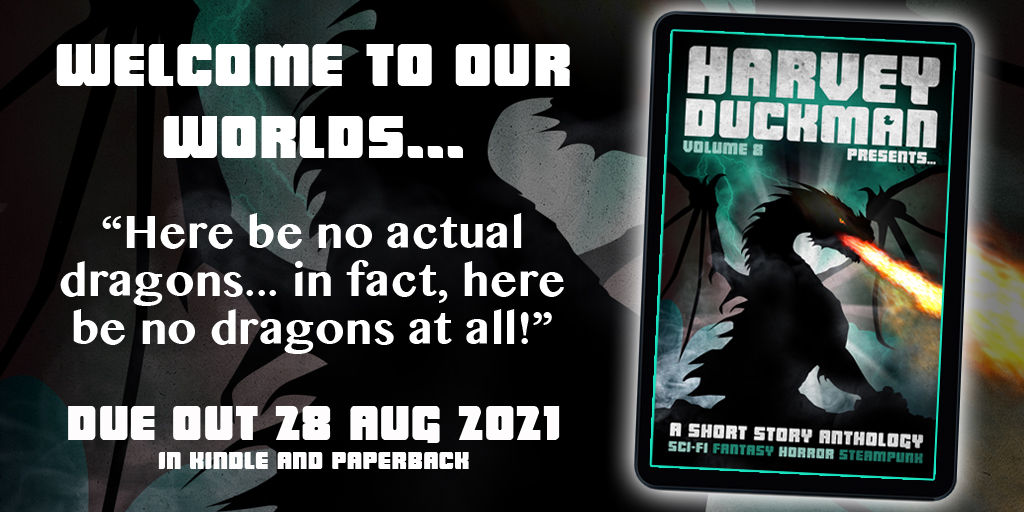
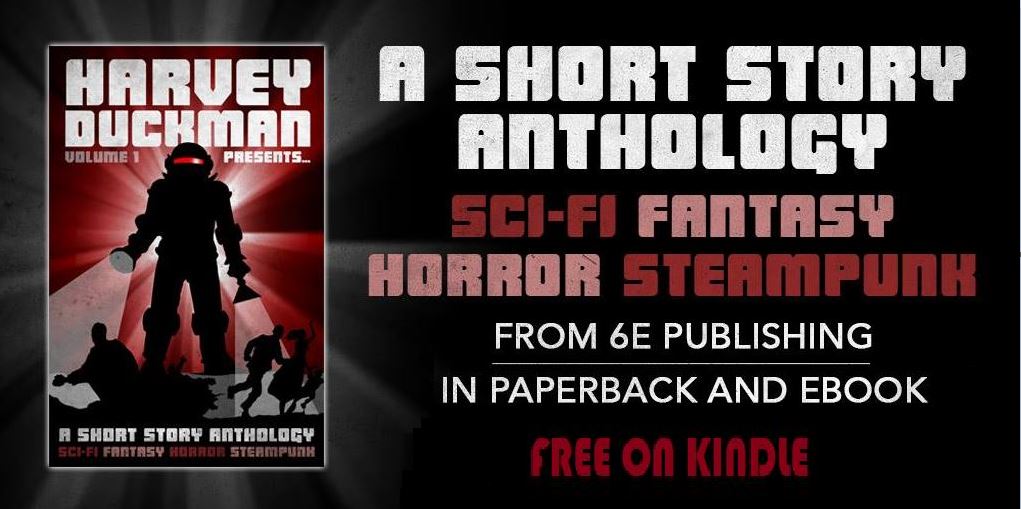
Harvey 7, which does indeed contain no actual dragons, but 15 stories I can’t wait to read from fourteen gifted writers (and me) is out this weekend. I’m sure a link or three will appear before long to lead you to our worlds. But in the mean time, if you have never picked up a copy now is a good time to start and that first small acorn Harvey Volume One is now free in eBook on all platforms. So what’s stopping you…

And if your a writer yourself, or would like to be one (which is much the same thing) you could do worse than consider submitting to Harvey yourself… And if your a reader, you could do worse than check out the Harvey website. HERE

Posted in amreading, amwriting, big questions, book reviews, books, booksale, cthulhu, fantasy, fiction, goodreads, Hannibal Smyth, Harvey Duckman, horror, humour, indie, indie novels, indie writers, indiewriter, Lovecraft, novels, opinion, Passing Place, pirateday, pirates, publication, reads, rites, sci-fi, steampunk, supernatural, writes, writing | Tagged , , , , , , , , , , , , , , , | 2 Comments

It’s been a while…

Hi, its been a while…

Of cause, you may not of noticed, but the Passing Place has been on something of a hiatus. Real life has been throwing curve balls and writing blog posts has been thrown somewhere down the bottom of ‘the list of important things I need to get done’.

But occasionally its nice just to check in and say hi, so this is me checking in and saying hi.

Harvey and the duckmen…

I’ve been involved with 6E’s Harvey Duckman anthologies since day 1, back then they planned a one off anthology of scifi, fantasy, horror, steampunk and general weirdness, written by fifteen different writers and asked me to submit a story. Which I did.

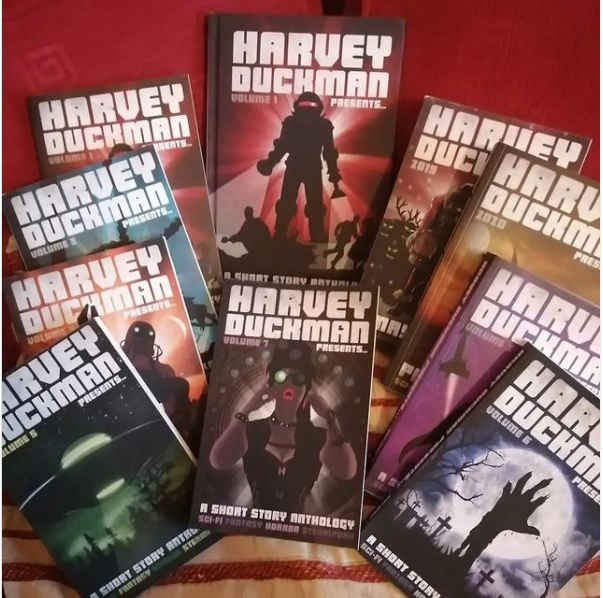
That original idea has grown and grown, into what is currently seven volumes of the main series and two specials (Christmas and Pirates).

Volume one is now even available in hardback…

Image

But they are not stopping there, volume eight is due out in the next few days, and i’ll post the cover of that little delight when I finally get to see it. As with all the others, because they keep asking me back, there is a story in volume eight written by yours truly, and I am really looking forward to hearing what people think of a my character, Lucifer Mandrake court magician to Victoria Sax-Coberg, of whom there will be more to come…

Hannibal Smyth

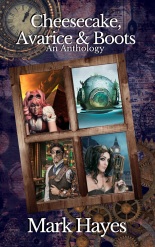
Speaking of that first volume of Harvey Duckman, it was almost the literary debut of old Hannibal himself. My story in volume one The Cheesecake Dichotomy was written while I was still working on the first Hannibal novel A Spider in the Eye and when I submitted the story early in the summer of 2018, had the first Harvey been published shortly after then it would have been. But that first volume of the anthology took a while to put together and in the mean time Hannibal debuted in my novella ‘A Scar of Avarice,’ and ‘A Spider in the Eye was finally published a couple of months before the first Harvey made it to the printers. Chronologically however ‘Cheesecake’ remains the first complete Hannibal story and one that’s more important to series than many might assume.

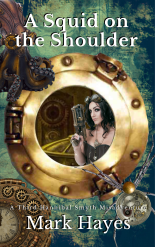
But back to Hannibal, I said way back in May that the third novel was written and I was on with the second draft. This remains the case, my over optimistic estimate of having it done and dusted by now has been derailed by life. But it’s progressing and I’ll hopefully be through with the all important second draft by the end of next month. The Squid may not entirely be on the shoulder, but its crawling its way up there.

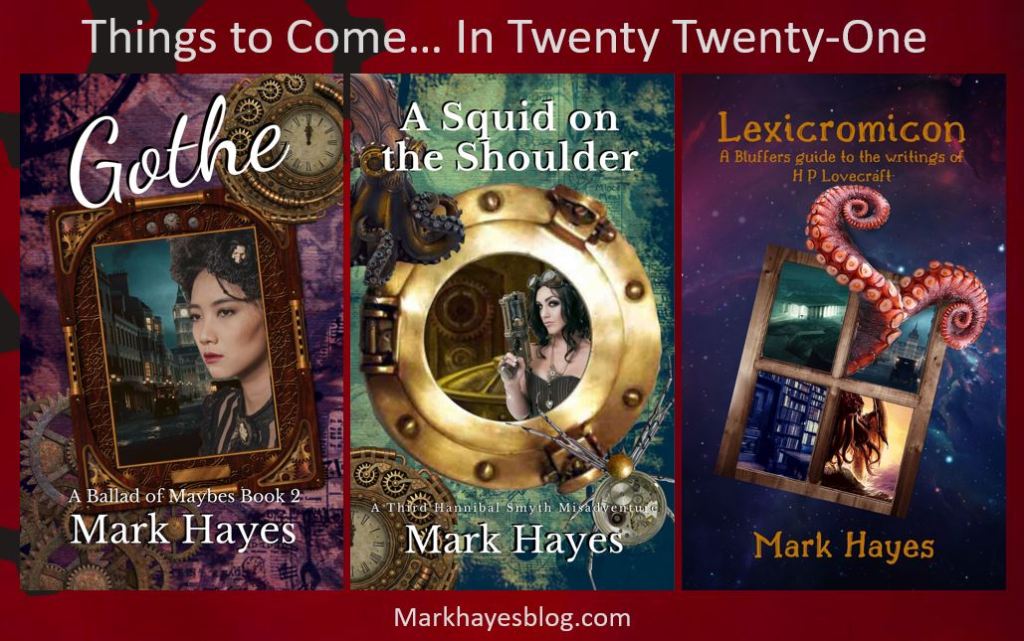
This third volume nicely rounds off the first trilogy, and the Hannibal that goes on from there will be a little different after all he has been through. Coincidently, as I was talking about HD1, ‘A squid on the shoulder’ is heavily influence by that first Hannibal story from way back in the first Harvey Duckman, with the unexpected but I hope much anticipated return to the series of Henrietta ‘spanners’ Clarkhurst, as Hannibal finds himself on the island of Doctor Musk. Not that you need to have read ‘The Cheesecake Dichotomy’ to enjoy ‘A Squid on the Shoulder’ but the fall out from ‘the cheesecake incident’ as its still called in the members bar of ‘The In’s and Outs’ looms mightily over this third novel and the previous novels in the series.

Hettie ‘Spanners’ Clarkhurst

The Maybe’s

Back at the start of the year I was talking about getting three books out this year. This looks a forlorn hope now as life has got in the way in ways I always hoped it never would, but I am not going to rush to finish a book that’s not as good as I can make it and life ain’t going any easier on me right now so the best I can do is give you an update.

The second novel in the Maybe series is still in its first draft and has been slow going, but its not been forgotten and hopefully Gothe will make an appearance early next year.

The Lexicomicon is still in the works and the working drafts are with my editors, so hopefully more news on that soon

And finally, the Elf Kings Thingy is not forgotten either, but bringing out an episode every week has been , I will get back to that tale before too long.

Or were, but hopefully some of them will

Anyway that’s all for now, I hope this finds you and your life in good shape. Much love to all

Mark

Posted in amreading, amwriting, blogging, editing, fantasy, fiction, goodnews, goodreads, Hannibal Smyth, Harvey Duckman, horror, humour, indie, indie novels, indie writers, indiefriday, indiewriter, novels, reads, sci-fi, self-publishing, the elf kings thingy, writes, writing | Tagged , , , , , , , , , , , , | Leave a comment

Naming the Novel

An interesting read on a subject I always find fascinating. Book titles are always a challenge

Ben Sawyer's avatarBen Sawyer

“It’s as good a name as any. And I’m not likely to forget it. That happens sometimes.”

When I first put this site together, I wrote a sentence that has more or less been there ever since – “Waking the Witch is the first novel in a series of urban fantasy stories, and is currently slouching its way toward publication.”

The novel became Waking the Witch in my head while I was writing the earliest chapters and quickly became lodged. There was just one problem – nobody has ever really liked the title that much.

For me, the phrase resonated with all the characters, both literally with Holly rising from eternal slumber and more metaphorically with both Mira and their antagonist, who embodied a potential to be fulfilled and a malevolence bubbling up from within respectively. All of them were waking their witches in their own unique way.

(It’s…

View original post 283 more words

Posted in Uncategorized | Leave a comment