The post-con collapse

Working a convention is exhausting. I am not alone in this. Almost every author I know has much the same story. Conventions are draining, much I suspect because writers tend not to be the kind of people who are naturally gregarious. We chose to hide our personalities in books, we chose to spend time staring at words in the never ending search for the perfect sentence and to enjoy the world from behind the visage of the observer. We watch, we speculate, we consider, and we imagine. Directly interacting with it is something else entirely.

Now when I say this I do not mean that writers are incapable of been perfectly normal functioning adults. Though that said they are writers so normal left on the first tide and sailed off long ago. However in day to day life, when they are just a person who is also a writer, they can function just fine. It is however in the moment they have to present as a writer that things go a little sideways.
A writer at a convention stands, or sits, behind a table and stares out into the void of

  • ‘I used to read but I never get the time to any more’
  • ‘I don’t really read books’
  • ‘blank featureless stare follows by the smallest of nods and then wanders off’
  • ‘I will engage you in conversation for several minutes, say the book looks interesting, then say I have no money and wonder off again’
  • ‘I am a bored adult dealing with a child who is also bored and a significant other who is also bored and this have no interest in engaging with anyone on the off chance it would relieve my boredom’
  • ‘I’m a Cos-play girl, in a cos-play world, I look fantastic, in mostly plastic’
  • ‘Have you got a card or something,’ which may be ‘I don’t care but want to appear interested’ or ‘I read eBooks mainly, or just don’t want to carry heavy books about with me today…’
  • can I buy these on amazon?’
  • ‘Bert’

Of these only Bert is interested in anything you have to offer. Bert is a bit odd though, you worry about Bert. You worry about yourself because your talking to Bert, and you also worry that were the roles reverse you would be a Bert…

None of this is entirely true, there are plenty of lovely people who go to con’s. Most people in fact. The Cos-play girls are almost certainly lovely people as well, even the odd Dalek. I love cons and the people who go to them. but when I am working a table they can suck the life out of you with the sheer number of negative interactions. It is why I perfer to do them with people, like Kate, Ben or Gill. Two or more writers can keep each other going through the dark times between 12:30 and 2 when people are off having lunch and the same three cosplayers have wandered past for tenth time as dancing Deadpool’s with a smart speaker playing something atrocious, which is hilarious the first couple of times…

Working cons is a draining experience, working two in quick succession (Saturday and Sunday) even more so as you have to arrive early to set up and leave late to pack down, early mornings, long days, and the peopling…

I suspect my IRL boss for the day job was unsurprised to receive an text message on Sunday saying I was going to take Monday off.

On top of all this I gave out the very last of my pre-covid bookmarks half way through Saturday, and had none at all on Sunday. Given the ‘I only read ebooks, and/or can I get them on Amazon?, crowd are lovely people who I want to get my books that way not having bookmarks is a problem…

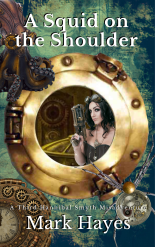
I had designed and order fabulous new book marks (see below), I order then weeks ago, they had not arrived in time for the two con’s. They arrived on Monday….

I may have sworn… a lot….

So anyway the advice for authors is this, do cons they are great. Take a Ukulele with you, and a silly hat. Smile a lot, even at the ones who aren’t going to give you a moment. Smile with the ones who waste your time a little. Smile at Bert, even if he worries you. Take a friend so your not suffering alone. Get plenty of sleep before hand, and allow your self down time afterwards

And importantly , order the bloody bookmarks at least a week earlier than you think is reasonable because they will arrive later then you think…

Posted in amreading, books, cthulhu, Dear Edgar, humour, writing | Tagged , , , , , , , , , , | 2 Comments

Dear Edgar 34 # Three Sundays in a Week

Occasionally, amid explorations of obsession and madness, horror and satire, existentialism and human frailty… You just need to tell a ridiculous tall tale or two to keep yourself amused. Nothing could be even slightly problematic about that could it…

Well…

Here is the thing, while this is nothing more than a tall tale, and wasn’t problematic to any great degree at the time when our Dear Edgar wrote this, reading it now with modern eyes can throw up the odd,,, lets call them niggles. And as much as I am a firm believer that if you read something you should read it in full knowledge that it is ‘of its time’, those niggles still bears a modicum of examination, not least because the niggles in this case are more directly reflective of dear Edgar himself.

In this tall tale our narrator, who never supplies us with his name, seeks permission from his grand uncle Rumgudgeon to marry the young and beautiful Kate, his grand uncles other ward. The grand uncle agrees with but one stipulation. The narrator can not marry the girl, who is his second cousin insists to the narrator that:-

You shall have Kate and her plum when three Sundays come together in a week — but not till then… …I am a man of my word. 

Okay, so ‘niggles’

Firstly the narrator wants to marry his cousin. Now it should be noted she is desirous of this too, and marrying your second cousin was not that unusual in the mid 1800’s. Half the royal families of Europe were related to each other in that way for a start, but still to the modern reader…

Secondly there is the matter of ‘her plum’ now I am not entirely sure what ‘her plum’ refers to in this context, only that it is mentions several times, and the grand uncle is some what desirous of her plum too, apparently…

Then there is another matter, the narrator has ‘seen his fifth Olympiad’ which is to say he is twenty as the Olympics’ are every four years. An oddly anarchic term in the 1840’s given the modern Olympics did not arise for another fifty plus years. His cousin Kate however is only fourteen. Now again this was not an issue in 1840’s America. this is not to say it was common, but it wasn’t uncommon or illegal to marry at that age, with a parents or guardians consent.

When he was twenty-six Poe married his own cousin Virginia Clemm officially in 1836 when she was fourteen. They obtained a marriage license when she was only thirteen in the neighboring state. I am well aware to our modern eyes this seems a whole heap of wrong. It would also be illegal now in the very states where it was legal then. I have also had people tell me they don’t read Poe now because to there mind he was a pedophile. Which were he trying to marry a fourteen year old today he would certainly be. And there is nothing wrong with their view.

That said, transposing the morality of today on to the past is something of a foolish endeavor and if your going to do so you should do so utterly, so you should probably stop reading Shakespeare as well. You have to take these things in context. Poe married Virginia legally with the consent (admittedly begrudgingly given ) of her parents. They went on to have a happy marriage. If you don’t wish to read Poe now because the morality of his day differs from your own I commend your integrity, I just don’t think your reasons for doing so are right.

More importantly I don’t think you should tell me, or anyone else, not to read Poe because his 1800’s morality is not your own 2000’s morality. This has happened several times… This is problematic because it is of it time, it was not problematic in its time. which is the point. If you want to know the difference, read some Lovecraft, there was a man who was problematic for his time…

But back to this ridiculous tall tale.

It is Kate, the would be bride, who comes up with a somewhat contrived solution to the three Sundays in a single week conundrum, with the help of a couple of navel offices who have circumnavigated the globe in opposite directions, both have crossed the international date line, so one is technically a day behind, and one technically a day ahead. So for the two sailors and the couple three consecutive days are effectively ‘Sunday’.

The uncle keeps to his word, and the couple marry… hussar.

Its a tall tale, its quite funny because of the way its written, but its nothing more than that short , funny , clever and written to make its reader smile.

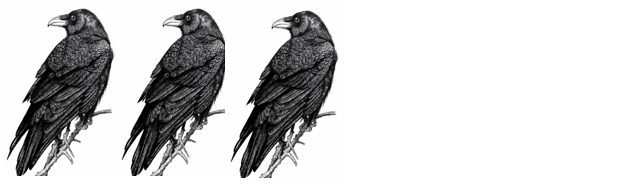
THREE AMUSED RAVENS WHO SAW THE JOKE COMING BUT LAUGHED ANYWAY

SHOULD YOU READ IT: It is a perfect example of a tall tale, it is written to a punch line and writing to be funny in the tell as well as the end. As a writer it is interesting, as a reader merely amusing. But it is certainly amusing.

SHOULD YOU NOT READ IT: If you can not read this through the filter of the morality of its time, then you should not read it. Likewise if you can not separate writer and story. As I said earlier this is problematic because of its time, it was not problematic in its time. which is the point.

Bluffers fact: Crossing the international date line does not in fact change the day and the world keeps spinning, the entire premise of the story is wrong in that regard. As was Jules Verne when he used that plot device to have Phileas Fogg win his bet in around the world in 80 days…

Posted in humour, Poe, reads, retro book reviews, Uncategorized | Tagged , , , , , , , , | Leave a comment

New Book, Conventions, and an update

Occasionally, just occasionally, everything all comes at once. Which is why I have an ear infection, am currently deaf on my left side, feel like curling up in a dark room under a blanket, just as I have the busiest weekend of the year. Oh and my new book marks haven’t arrived…

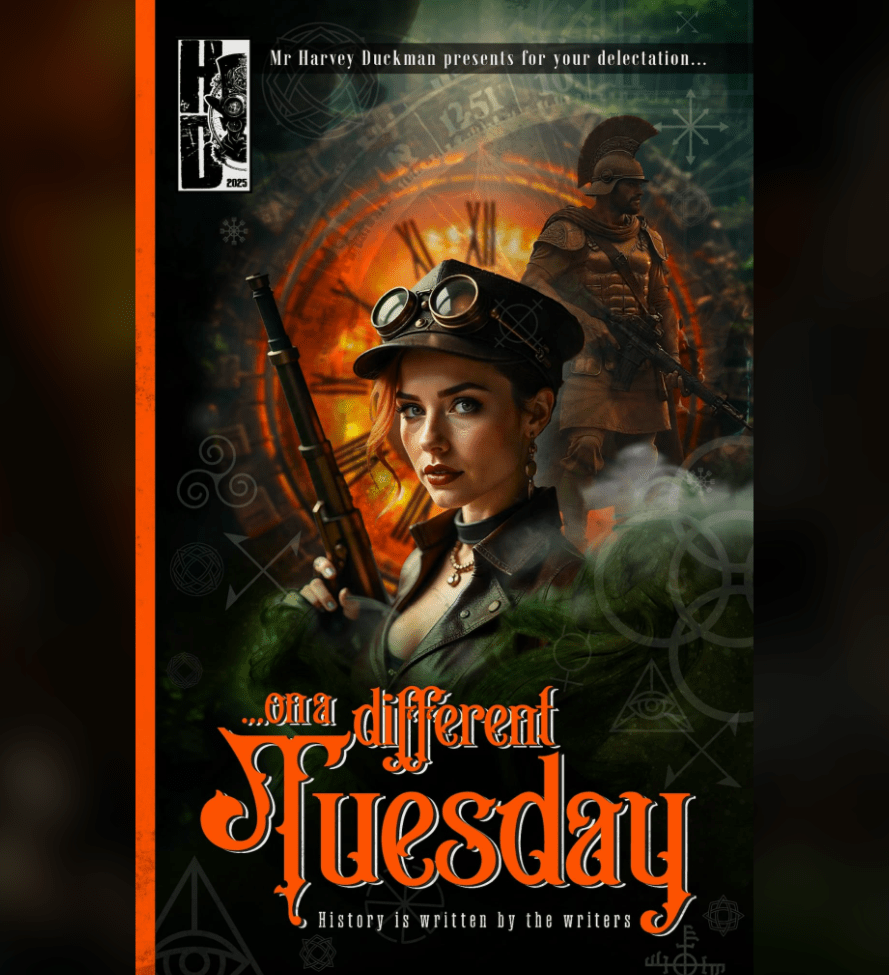
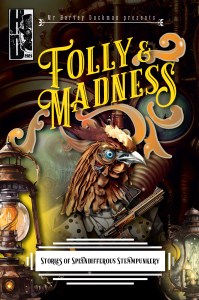
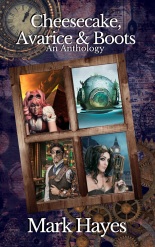
The Big news first, Today sees the release of the latest Harvey Duckman Anthology, this one is Alt History, with a healthy dose of steampunk. Because someone said Alt History was a broader church and less niche than just steampunk so would have a wider appeal. As that someone was me I am not going to disagree. It has certainly made for a fabulous collection and one I am very proud to be part of.

My own contribution in this anthology is a story from the Maybeverse, which isn’t a thing as yet but when has that ever stopped me. Anyway History is written by the writers, as the tag line says…

Harvey Duckman is back with a fabulous collection of stories examining alternate histories, from the Romans, to the middle ages, through the 1600s to the Victorians and the 20th century and beyond… what if history wasn’t quite as our records remember?

Looking for original, wonderfully imaginative stories from a bunch of fantastic writers? Sit back and enjoy a glimpse into our weird and wonderful worlds.

Featuring funny, poignant, dark, thought-provoking and always entertaining short stories from Liz Tuckwell, Steven C. Davis, John Holmes-Carrington, Anna Atkinson-Dunn, Darren Goossens, Hugh Alan, Mark Hayes, CK Roebuck, Mary F. Carr, Keith Errington, Reino Tarihmen, Zachary Taylor Branch, Ben Sawyer, Phil Sculthorpe, Davia Sacks, Will Nett and Michael A. Clark.

As it is called On a Different Tuesday, we are of course releasing it on a Friday ….

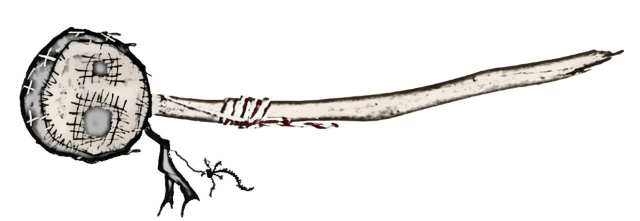
A quizziling stick, or rather a stick with which to Quizzel

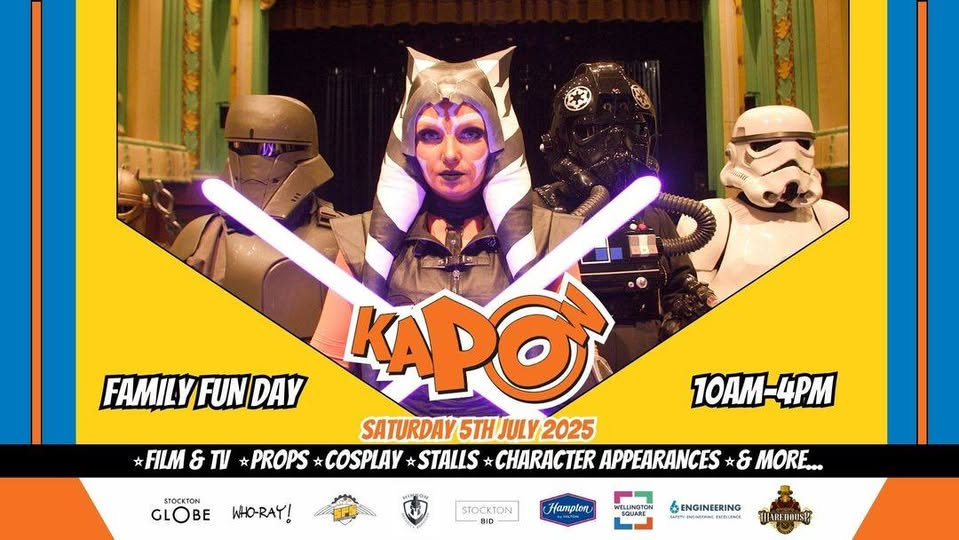
Tomorrow Myself and several Harvey writers including the editor herself will be at the Globe Theater in Stockton on Tees at Kapow, a lovely local scifi con we do every year. If you are local to the area at all bob in. We will be talking books and stuff

On Sunday , three of us will be further up the A1 in Newcastle Comic-Con doing much the same thing but in a different hat.

One final bit of news, I have finished the second draft of the new book on Lovecraft I was commissioned to write. Which makes me very happy as I can get back to writing fiction..

Posted in fantasy, Harvey Duckman, indie, indie writers, steampunk | Tagged , , , , , , , , | Leave a comment

Dear Edgar 33 – Eleonora

The One remains, the many change and pass;
Heaven’s light forever shines, Earth’s shadows fly;
Life, like a dome of many-coloured glass,
Stains the white radiance of Eternity,

Our dear Edgar, as you are doubtless aware, was something of a romantic, or at the very least aspired to write romantic poetry. The four lines above are very much of the romantic poetry tradition. They were read out by Mick Jagger at fellow Rolling Stone Brian Jones funeral. They are not however the words of Poe, but come from the poem Adonis, by Percy Bysshe Shelley, who is perhaps most remembered in these latter days, despite his own fame, as the husband of Mary Shelley.

The Shelley’s were of course at the heart of the 18th century Romantic tradition, as they hang about with that big blouse wearing, opium addict, syphilitic and peer of the realm Bryon. they went to all the best parties in Italy, got annoyed by that bloke Coleridge and his obsession with enormous sea birds and told ghost stories that would cause generations to come to find themselves pointing out that Frankenstein was the name of the Doctor not the monster… heady days.

Edgar, the romantic and poet, of the mid 19th century probably wished he had been around fifty years earlier when the Romantics movement was in full swing. he would have been gutted had he known the New Romantics movement would not turn up for another hundred and forty years, though I am not sure what he would have thought of Spandau Ballet, but he would have probably loved Adam and the Ants… because who doesn’t.

In any regard, if this all seems a little off track and your wondering what it has to do with anything, it is all about the third line in that snippet from Shelley’s Adonis.

Life, like a dome of many-coloured glass,

Because our dear Edgar stole it, or at least part of it, for his own fanciful romantic tale Eleonora.

The Eleonora of the title is the love of the narrators life, his cousin… he lives with her and his aunt in The Valley of the Many-Coloured Grass, which is an idyllic paradise full of fragrant flowers, fantastic trees, pink flamingos and a River of Silence. An isolated little world all of its own untrodden by the footsteps of strangers. And in the valley of the many-coloured grass the cousins fall in a deep all abiding love.

So that bodes well….

When Poe wrote this tale, that is awash with romantic language and imagery, Virginia his wife and half-counion had herself fallen ill, with the sickness that would eventually, in five more years, be the death of her. Aspects of this story foreshadow her demise, and there is little doubt that when writing a tale of romance such as this, certain autobiographic aspects were imbued in the story. Poe’s deep romantic attachment to Virginia is well documented. While their familial relationship, and Virginia’s age when they wed leads to a discomfort among our modern sensibilities, that he loved her and that love was reciprocated is hard to dispute.

Eleonora falls ill, and the tranquil joy of the valley of many-coloured grass is broken with it. The River of silence grows murky, flowers wilt, the fantastic trees shed leaves and the flamingos fly off never to return. The valley of many-coloured grass is no longer a sweet eden in which innocents dream of love. But before she dies Eleonora extracts a promise from her lover, that he will never forget her, or the Valley of the many coloured grass. That he will hold her forever in his heart and love no other.

And so our narrator vows to her, with ‘the Mighty Ruler of the Universe’ as his witness, that he will never bind himself in marriage ‘to any daughter of Earth’. Which is a beautiful sentiment, and of course and utterly foolish vow. This is a story by Poe , we have read Ligeia we have read Morella, we can all see where this is going. You don’t make a vow to a dying woman in a Poe story and not expect to pay a price for it later in the tale.

Eleonora dies, the valley dies with her, at least in the eyes to the protagonist, and he leaves the valley. Time passes and eventually he finds himself in a strange city. In that strange city far form the valley of the many-coloured grass he meets Ermengarde, a beautiful woman who fills the void in his heart. the memory of the valley and his life with Eleonora a distant memory, he forswears his vow and marries Ermengarde.

Yes, I know, clearly the narrator has never read any Poe…

The shade of his forsaken Eleonora comes one night to visit our narrator from beyond the grave…

So wrathful ghost of a forgotten love visits the man who has forsworn himself in his vow to her, clearly his suffering with be great, his guilt will drive him insane and he shall suffer as will the woman who replaced his lost love. There will be much weeping, a dragging of nails down chalk-boards, the haunting screams of harpies in the night. For guilt and paying for forsaking vows are Poe’s favorite themes. Oh yes, we readers of Dear Edgar know what is coming… Where were we, oh yes…

The shade of his forsaken Eleonora comes one night to visit our narrator from beyond the grave….

Sleep in peace! — for the Spirit of Love reigneth and ruleth, and, in taking to thy passionate heart her who is Ermengarde, thou art absolved, for reasons which shall be made known to thee in Heaven, of thy vows unto Eleonora.

If that is not a twist of an ending to a Poe story I don’t know what is. A vow forgiven, a blessing given… It is almost as if our Dear Edgar was suddenly faced with the mortality of the woman he loved and was dealing with the concept of life beyond Virginia. Or perhaps that is just projection on our part knowing what was instore. What is sure is this is a very different Poe romance. The Valley of the many-coloured grass is a different setting to the dark gothic houses and castles you normally find in his fiction. The lovers have passion but not rage, joy but not anger. It is arguably his most romantic tale. Certainly the imagery has deep sexual overtones, while there is innocence and awaking knowledge within the story. It is a beautiful piece with a surprising ending, if only because it is not an ending you would expect from a tale by Poe.

The hero of the tale is love itself and the hero wins out over. I am sure Percy Shelley would have approved, once the opium wore off and if he wasn’t wrestling with Lord Bryon in an Italian lake.

FOUR RAVENS,

SHOULD YOU READ IT: This is very much a tale written as prose poetry. It is romantic and uses romantic language. You should perhaps read it to your lover by candle light..

Bluffers fact:  Ermengarde is an odd name, the use of it in this story inspired H.P. Lovecraft, who read a lot of Poe, to use the name in ‘Sweet Ermengarde’ in a story he wrote mocking a certain kind of romantic fiction prevalent in the 1920’s. That story inspired the name of Sweet Ermengarde, a German Goth Rock band, who are a lovely bunch of fellows who once offered me tickets to their UK tour, just before it was scuppered by covid. You should look them up, they are well worth a listen.

Posted in Poe, reads, retro book reviews | Tagged , , , , , , , , | Leave a comment

Still Researching Lovecraft

I am still engaged in a project involving a book about the worlds of H.P. Lovecraft. I originally mentioned this just over a month ago, in a post called Researching Lovecraft… This as you may have guessed is a follow on from that post, as people liked it and because I failed my sanity rolls, so had to crack on with writing the book….

Part of the brief is a short biography of Howard, between 5k and 10k, which covers his life from birth to death and everything in-between. While I have a copy of S T Joshi’s biography on old tenacle hugger (which I recommend for those of an academic lint), somewhere in the upper library, otherwise known as the spare bedroom where men fear to tread. It has been some years since I read it and I felt it would be cheating to borrow heavily from it. it felt more important to start afresh, keep it lighter than Joshi, while not skipping over anything important. I have my own style which any reader of my non-fiction will recognize. One perhaps less worthy in an academic sense, but one would hope more readable.

Besides which, a short biography is supposed to lean into the ‘short’.

That all said, there has been no shortage of research involved. What is included in the final cut maybe 20% at most of the notes I took double checking things I already know and fresh research into anything I didn’t. There were some fun little facts thrown up along the way, which may make the cut in one way or another but the rabbit holes were deep, the warrens winding and there was many a twist back on oneself along the way. So here are some of the more… unusual notes, or entertaining little factoids, depending on the way you look at them.

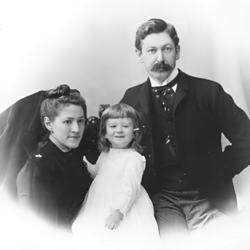
Howard with his mum and dad age 2 (that’s Howard at age 2, his mum and dad were older, obviously)

Young Howard wore a dress, this was not unusual, it was in fact very normal for young boys in the 1890’s, even if it does seem a little odd from a modern perspective… He also wore pink which was considered a very manly colour. Any conclusions you draw from this says more about you than it does about Howard…

Lovecraft’s maternal Grandfather had the wonderful name, Whipple Van Buran Phillips.

Whipple was a freemason and successful businessman. He also owned much of the land around a small town called Greene in the west of Rhode Island state.

When Lovecraft first met his later wife Sonia Greene, he defiantly didn’t say , “Ma Grand pa Whipple used to own him a town called Greene.”

The above is not because it would have been a terrible chat up line… But because it would have made Howard sound like a backwoods racoon-hunter, which would have horrified him.

When he got himself appointed as chairman of the UAPA’s Department of Public Criticism he embarked on a campaign to advocate the use of ‘British English’ over ‘American English’ which he believed, in his typically xenophobic way, to be a bastardised version of the language, watered down by immigrants from Russia, the Slavic nations and Jews.

Irony flag: American English is far closer to the English of Shakespeare than modern British English…

This was also why ‘The Colour from Outer Space’, using the British spelling, because xenophobia…

Second Irony flag: Sonia Greene, Lovecraft’s wife, until he died as he never filed the papers for his devoice, was actuality a Ukrainian of Jewish stock, though she came to New York as a young child. She was therefore exactly the kind of immigrate he thought were ruining New England.

Speaking of Sonia , Howards aunts disapproved of her, not because of her heritage, or even that she was a widow with a teenage daughter, but because they thought she was a gold digger…

Third irony flag: Once they were married Sonia Greene supported Howard finically for years, as he was quite unable to get a job…

Sonia became an unintentional bigamist when she remarried in 1936, because she believe Howard had filed the devoice papers. he had, but he had field them in his desk draw rather than with the county clerks office. She did not learn she had still been married to him until 1945, when she also found out he had been dead for eight years…

Sonia later wrote a short memoir entitled ‘The Private Life of H. P. Lovecraft‘ in which she said he performed ‘satisfactorily’ as a lover. Damn girl…

Posted in Nyarlathotep, opinion, reads, writes, writing | Tagged , , , , , , , , | Leave a comment

Maybe Tuesday

In another universe, where a man in a small lab in China didn’t drop a non-descript vail on the floor (allegedly) on a Tuesday in late 2019, the release of my 2020 novel ‘Maybe’ might have gone differently. It must have been a Tuesday when he dropped the vial, these things always happen on a Tuesday. No one ever accidently changed the course of history on a Monday.

As it was Maybe was released in mid March 2020 just before the world was shutdown. Of all the issues Lockdown caused, the release of a novel by a indie author been scuppered is a fairly minor one I know. The only person truly affected by this bit of lockdown fall out was me, but affected I was. I had a grand list of 10 events I was going to do from the end of march onwards. I had never done many events at the time, only a couple in fact. but I was going to brave the world and throw myself into it that spring. I was full of energy and Maybe was my totem. I planned to write two more novels in the Maybe series, I planned to write them both over the course of that year, fueled by the energy of hope and passion.

Lockdown happened, and while it has been six years now since that first lockdown, the events scene has never really recovered. Several large events were wiped out. Promoters lacked the energy to start over. Sci-fi conventions, steampunk gatherings and other events just do not get the same footprints they got pre-covid.

Other things happened too. From a mental health point of view Lockdown was isolating for many people. For me personally a little more so as I live alone. While you might think been forced to stay at home would be ideal for a writer, the ‘great Lockdown Novel’ really isn’t a thing, most writers I know struggled, as did most of the other artists I know. Turns out when you must stay home, the last place your want to be is home.

As a book Maybe struggled to get off its feet. People weren’t reading in the summer of 2020, I have the sales figures to back up that statement for all my books. Sales did not pick up till we came out of lockdown. The ‘book tour’ of conventions never happened. And I could not write the sequel because I could not write. By the time we got passed it all and I found the will to write again in late 2021, it felt like Maybe needed to sit a while. I needed to write other things until I found the headspace for the lost covid novels

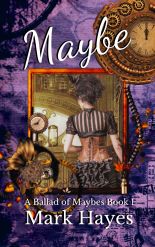
Despite all this ‘Maybe’ has been among my most successful novels aside the Hannibal Smyth books. It is very well reviewed and very well liked, not only by my readers, but also by me. I reread it over the winter while I was writing Lucifer Mandrake, and found I wanted to get back to Eliza Mayabee, and Benjamin West. I also had around 30000 words in abandoned drafts that were not quite the way I wanted to go with the next novel. The ballad of Maybes needs two more books, and I need to write them. I have vague outlines for them both that keep changing and at some point I will get down and write them , and nothing is ever thrown away. Even if I never use any of those 30000 words, they exist in my internal cannon. I know this, I will get to it…

Which brings me to ‘On a Different Tuesday’ the latest Harvey Duckman Anthology. This one is a collection of Alternate History. Everything from Steampunk to Ancient Reme (a version of Rome if it was founded by the other twin), dark visons of a Sherwood than never was, or, well, anything. Stories set in alterative versions of the past where something is a little different. So, right in the middle of my wheel house…

Typically I had an abundance of ideas, and typically I struggled more with writing a story for this anthology than I did for the previous four combined. I am in the middle of a complicated project taking much of my writing brain, and coming off a new book in Lucifer Mandrake. I struggled with half a dozen stories and none of them were working, and the deadline came and went as I struggled with the last idea I had. I was in fact close to just abandoning it and for the first time not writing a story for a Harvey Anthology. I would not submit anything I wasn’t happy with. I refuse to half ass a story or just throw something together that would devalue the anthology. I had a duty of care to the Harvey project, to the editor, to other writers involved, and frankly to myself. Because I would have to look at the book and know I wasn’t happy with my own contribution.

Then on the Tuesday after the deadline had passed* I remembered the 30000 abandoned words of the second maybe novel, and that in the midst of that manuscript there was a couple of chapters that worked as a short story. Not could work if I nailed them together with a few nouns and taped over the cracks with an adverb or three. Did work. And not just in a ‘oh this is part of a bigger thing’ kind of way, but as a self contained piece.

*Yes it had to be a Tuesday because it always is, and yes I was passed the deadline, but I look cute in a kilt so what are you gonna do?

So I dug them out, put the two chapters together in a separate word documents, read it through twice, then made notes as I read it a third time. Then spent six hours rewriting it so it actually worked.

‘An Infatuation of Maybe’ was the result. Its a short story in the Maybe cannon , set between book1 and what will eventually be book 2. It is the first new Maybe story since the release of the novel way back in march 2020, and so it is at least five years late… But hopefully those readers of mine that loved Maybe and want more Eliza Mayabee stories will be pleased. Also hopefully it will drive me to write the second and third novels. If the world doesn’t fall apart next Tuesday.

On A Different Tuesday is available now on preorder and will be fully released on kindle and in paperback and hardback on the 4th of July. With 17 stories by 17 authors, and I am proud to be among them once more. It is and will be fabulous, because Harvey collections always are and I am very proud to be among them, as I almost wasn’t, and because I found the story worthy of joining this talented and delightfully divergent procrastination of authors.

Harvey Duckman is back with a fabulous collection of stories examining alternate histories, from the Romans, to the middle ages, through the 1600s to the Victorians and the 20th century and beyond… what if history wasn’t quite as our records remember?

Looking for original, wonderfully imaginative stories from a bunch of fantastic writers? Sit back and enjoy a glimpse into our weird and wonderful worlds.

Featuring funny, poignant, dark, thought-provoking and always entertaining short stories from Liz Tuckwell, Steven C. Davis, John Holmes-Carrington, Anna Atkinson-Dunn, Darren Goossens, Hugh Alan, Mark Hayes, CK Roebuck, Mary F. Carr, Keith Errington, Reino Tarihmen, Zachary Taylor Branch, Ben Sawyer, Phil Sculthorpe, Davia Sacks, Will Nett and Michael A. Clark.

All this means A ballad of Maybe’s (of which maybe was always intended to be the first book) has grown a little larger, at last. Which pleases me a great deal. If you have never read Maybe this may be a good time to grab a copy. Of course there is no bad time to grab a copy, but one feels this is perhaps a good time to mention it exists.

Because Eliza told me to tell you, and one does not argue with Eliza Mayabee if one knows what good for you.

Posted in fantasy, goodreads, indiewriter, reads, sci-fi, steampunk, writes, writing | Tagged , , , , , , , , , | Leave a comment

Dear Edgar – 32 : Never Bet the Devil Your Head

“I’ll bet the devil my head” as the expression goes...

Or rather doesn’t, because no, I have never heard the expression either.

However as our dear Edgar wrote this story in 1841 there is a fair chance it was an expression at the time, but one that has long since fallen into disuse. But if so then it was a bit of a silly expression, even used colloquially, because as we all know, if you make a bet with the devil, there is a good chance he is gonna turn the odds against you. So may be there is a moral to this story… Or may be there isn’t… Because after a number of serious stories, deep philosophies, and complex tales, with this story Poe goes back to irreverence, satire and has a little dig at those who say every story should have a moral.

As this is satire, our dear Edgar did not hold back. Subtle went out the window from the start. The narrator of this little tale is Poe himself, who starts with mention of the critique that every tale should have a moral or be without worth. Looking back at the most recent stories Poe wrote prior to this one you would be hard pressed to find one with a moral as such. Something our narrator takes a moment to decry.

It is then the real tale begins, as Poe tells us of his good friend Toby Dammit. A man of more than a few vices. This is apparently, according to Edgar in the guise of the narrator, because Toby’s mother was sinister handed and used to flog him with her left hand. Apparently, this is considered to be most improper. This unfortunate parenting has driven Dammit to become overly fond of making spurious bets and the expression “I’ll bet the devil my head”.

Now, Poe being a man of fine morals, no matter what the critics say about his stories, does his best to break his friends bad habits. But Toby is, well Toby and sometimes you just have to let your friend be who they are.

So one day the two friends are traveling somewhere or other and they come across a bridge with a canopy over it, a gloomy sort of bridge but Toby Dammit is not a man to be affected by such things and is in a fine mood. So across the bridge they go. until at the midpoint there is a small turnstile and Toby doesn’t feel like paying a penny to go through it. “I’ll bet the devil my head I can jump over that.” says Toby with a grin…

It is then Poe spots a odd little man stood near the turnstile grinning. A very odd little man , with something off about him, why could it be he is the devil himself, come to take that bet?

At this point I’ll step away from telling you the tale itself, so as not to ruin the series of increasingly farcical jokes that are told as the tale progress. Lets just say Toby loses his bet, very defiantly loses his bet. And what happens to him after that is, well I am not sure deserved is the right term. What does happen is Poe gets all that seriousness out of his system because when he goes for satire and humour, he very much goes for satire and humour. It is all very over the top but it isn’t pretending not to be. In the process Poe takes shots across the bows of homoeopathy, which to his great surprise doesn’t cure his decapitated friend. Transcendentalism takes a couple of punches too as do sophists. But mostly this is a kick to the groin of those that believe a story only has worth if it has a moral at the end.

Poe is very definitely venting his spleen here, but doing so with humour. In your face, subtle as a house brick through a window humour, but humour none the less. My own tastes tend to run a little more subtle I will be honest, but there is a ribald silliness about this which is clearly Poe getting some stuff off his chest. It is also fun, which makes a change after a lot of serious worthy Poe stories, that were serious and worthy but not overly fun.

THREE RAVENS WATCHING AS FOOLS MAKE BETS WITH THE DEVIL…

Should you read it : Its short light relief and should make you smile, and hopefully i have not spoiled any of the jokes too much

Should you not read it: Its not exactly cerebral, and suffers form a lot of Poe’s satire does in that it either hits or misses depending on your mood

Bluffers fact: In 1957 a radio play of this story Toby Dammit was played by Daws Butler, a voice actor I suspect you have never heard of, but you have heard his voice (or versions of it) a million times. Among his many many roles, he was Hucklberry Hound, Droopy, Hair Bear (of the hair bear bunch), Bingo (of the banana splits), Snap, Crackle and Pop (of rice Krispies), and Yogi Bear…

This means Yogi Bear and Hair Bear are the same person… Oh and for a short time (in the original pilot episode) he was both Barney Rubble and Fred Flintstone, which must have confused Wilma and Betty.

Posted in amreading, Poe, reads, Uncategorized | Tagged , , , | Leave a comment

Cogkneys, Minoan’s and Devilish Preludes

Anyone following this blog over the years will be aware my taste in reading can be a tad ecliptic. Well buckle up buttercup, ecliptic was three turns back.

Completely Ribald : for your pleasure. By Mr Arthur Foot and Miss Tilly Maydme

The Cogkneys are one of the alter egos of Karl & Andrea Burnett who have been entertaining steampunks and others for over fifteen years with ridiculous songs, ribald jokes and props that are fully in keeping with the music hall traditions, mixed with all kinds of modern pop culture refences. This book contains those fifteen years of lyrics and poetry with such delights as

‘Hot Glue Gun Blues’ which if you have ever tried to put together a cosplay costume’ of any kind you will recognise.

‘Oh those naughty Tentacles’ because lets face it why not

And the seminal work ‘My Childhood Sweetheart is Featured in an Erotic Daguerreotype I Purchased From the Tabacconists’ (something of a nod to the 80’s classic ‘Centrefold’ by the J Giles band)

Fifteen years is a long time, and there is a lot of this sort of thing… and a wonderful thing it is too. But there are also several short prose stories and a novella which feature the Burnetts alter egos, and the same music hall style risky humour and interplay that anyone who has seen the Cogkneys live will recognise and laugh along with.

This is a very silly book, a heavy tomb as well as it was fifteen years in the making, it is also not a book you sit down to read, its a book you leave on the coffee table and pick up occasionally while you drink your tea to peruse for a couple of minutes… An hour later you will remember you acctually intended to do something else, and you will , the moment you stop giggling…

You should buy a copy for that reason alone, and if you get a chance to see the Cogkenys live, or any of their many alter egos, pop along. You will be entertained, I promise you this.

A final note, Karl Burnett once appeared in a play called ‘The Drag King in Yellow’ this was his finest achievement as the play is one of the greatest works in the history of human civilization. He fails to mention it this at all in this book, which seems something of an oversight…

Labrys & Horns: An Introduction to Modern Minoan Paganism By Laura Perry

I am the worlds worst pagan. I say this because I follow no particular tradition but my own. I have a self constructed belief system based on a heady mix of paganism and quantum physics. You can read something of this here if you wish. Because of this I read a fair amount of physics journals as well as modern pagan books. I also have little rituals, that I don’t even recognise as rituals. But as I say I am the worlds worst pagan, but I am open to pagan thought.

Laura Perry is someone who came into my orbit (on face book , blue sky and blogs) because of Nimue Brown. Laura is not the worlds worst pagan… She is an expert in Minoan culture and a practising member (and one of the leaders/founders) of Ariadne’s Tribe, a world wide pagan group following the tradition and practises of Modern Minoan Paganism.

Partly this book explores the history and culture of the Minoan civilization that flourished on Crete between 1900 and 1400 BCE. Before the Mycenaean Greeks, and a thousand years before the classical Greeks. To put that in perspective, if we were now classical Greece around the time of Plato, the Minoan’s culture for us ended before the Norman invasion… Minoan culture was a long… time ago, Old Kingdom Egypt ago. What we know about them is based mainly on archology, luckily there is a lot of archology.

What we know about Minoan religious practises is also based mainly on archology, and not a little guess work, though very educated guesses informed by the archology and what was recorded by the ancient Greeks a thousand years later which would also have been guess work and biased by their own beliefs which to an extent grew out of Minoan culture.

It is an interpretation of Minoan belief systems based on years of research that forms the other part of this book, along with guidance and practical advice, for those that may want to follow the path of Ariadne’s Tribe, or incorporate aspects of Minoan ritual into their own lives.

This book is on every level fascinating no matter if you feel a personal connection to Minoan belief or you just wish to explore one of the most ancient Mediterranean cultures and walk the footsteps of our forbearers. It is also written with an accessible richness of humanity to it that makes it a joy to read, no matter what you may believe, or be open to believing…

A final note. Above my front door, on the inside of the house, facing into the house, is a greensman mask, hand painted by me, that I hung there several years ago because it felt the right place to hang it. I reach up and touch it when ever I leave the house to go out into the world for a while. It is not a conscious thing, and before I read this book I had no idea why I did so, indeed barely realised I did. Now I know why, because even the worlds worst pagan needs little rituals to ground themselves in this world…

Devilish Preludes by Ben Sawyer

Ben Sawyer is a lovely fellow author from York who writes about Holly Trinity, a sleeping protector of the city who awakens when she is needed to fight monsters and ghosts, with an umbrella and a Kate Bush mix tape. I know Ben because he writes for the Harvey Duckman anthologies and I have shared many a table with him at conventions trying to convince people to buy dead trees covered in ink.

Last year he released a short story in ebook on Amazon and I pointed out he could have made it into an admittedly slip, paperback, which he could put on the table at conventions and sell the way drug dealers offer dime bags for free to get people hooked… But with dead trees cover in ink. He ignored this advice, so I berated him some more when I next saw him in Leeds at a convention, after I had been drinking with my son the night before and had the worlds worst hang over having been dragged to the dive bar he manages till five in the morning.

Apparently Ben finally took my advice… This however is not that book…

This short tome holds within it three short stories that expand the Hollyverse. For a start only one of the stories features Holly herself, and only one is set in York. The first is some what chilling and involves the mystery of who puts rope swings on trees. The second involves rules, and ‘The Department’ of whom Ben could write a while series of novels I suspect (and may encourage him to do so) . The third, well I have not read the third yet for a reason but I have no doubt it will be fabulous.

If you have never read any of Bens, Holly Trinity novels, you should dip your toes in the water with this little book. If you have read both of Bens current Holly novels ( the third is due in October this year) you will need no encouragement to read this book, so get on with it.

A final note, the reason I have not read the third story in this book is I have not yet finished Bens second novel because my to read pile is rediculous…

A Final Final note: For various reason I have not completely finished (or at least finished with) all three of these books, not entirely, The Cockney’s because its a coffee table book, and I have lost my coffee table, so it is sat on my desk. I delve into it now and again when I want a smile. Laura’s because in parts it’s a refence book on practical paganism and you never finish a book like that, you return to it constantly, and Bens because I need to finish Monsters at the gate first.

I reviewed them now because it felt like the time to do so .

Posted in amreading, book reviews, druidry, fantasy, humour, pagan, steampunk, urban fantasy | Tagged , , , , , , , , , , , | 1 Comment

Dear Edgar ~31 : The Colloquy of Monos and Una

I generally like a little philosophical pondering. While in my own fiction I generally endeavour to write an engaging story before anything else, the odd bit of philosophical pondering and even metaphysical debate has been known to find its way in. The mysteries of existence have ever fascinated me, and I studied such for my degree. I am, technically at least, a philosopher, and have been known to read Nietzsche, Descartes, even Plato for fun. All of which would suggest that I should enjoy this, the second of a trio of dialogues our Dear Edgar wrote to engage in pondering upon matters of existence between spirits in the after life…

However, given the first of the trio was The Conversation of Eiros and Charmion which I found less than entirely engaging, I tempered my ardour somewhat in advance. The first of these tales earned a solitary raven with good reason. It was at best dull, at worst somewhat unreadable. More importantly it didn’t really have anything to say, instead the spirts in question discussed the end of the world, the inspiration for which was a doomsday cult for an Armageddon that never happened. The story of the inspiration was far more interesting that the dialogue Dear Edgar wrote.

This did not bode well… But I took an open mind into the story.

Unlike the previous dialogue this tale is acctually a philosophical and metaphysical dialogue between two characters. In this case the characters in question go by the names Monos and Una, which are in turn the Greek and Latin for one. Between them they, and by extension Poe, explore themes of life, death, the nature of existence, and the relationship between the mortal world and the spiritual.

One of the issues with this piece of philosophical meandering wrapped up and a dialogue between two spirits is however is it fails to do what the best philosophy almost always does, its fails to express anything with a succinct beauty. The quote up above ‘All that we see or seem is but a dram within a dream’ is not from this dialogue, it is from a poem Pow wrote nine years later. Yet in comparison it is a much better piece of philosophy than this laboured piece, at least in my opinion for whatever that may be worth.

Written on the footsteps of The Island of the Fay there is a general theme informed by Poe’s growing abhorrence of North Eastern states of America’s increasing drive in the 1840’s towards mechanization and a primally industrial culture. He had developed the opinion that there was a need to return to nature to redefine the soul of humanity. There is however more than a degree of hippie-dippieness going on here. There are broader themes in regards to life, death, the impermanence of existence, decay both moral and physical.

It really is a bundle of laughs….

I am in fairness doing this dialogue a disservice here, compared with its predecessors this conversation has a lot to say and explores several interesting themes. It does however suffer from the same issue as the first in that it is a conversation between two entities who have passed beyond and, importantly, not an actual story. Instead it is a frame work for our Dear Edgar to explore his idea’s and concepts. It is rich with imagery and somewhat beautiful if occasionally macabre prose. It isn’t however a narrative, which, to be fair, it was never intended to be. The characters of Monos and Una are sympathetic allegories of unity and loneliness. The conversation is interesting in the abstract, but a tad indulgent as philosophy.

The problem I have with it is it isn’t a story, and while philosophically it is interesting Poe is far better at expressing complex themes and idea through an actual narrative than in what is a forced and somewhat disappointing way.

TWO RAVENS EXPRESSING CONCEPTS OF IMORTALITY WHILE DEAD

Should you read it : If you enjoy a philosophical meander

Should you not read it: If you are looking for a story, just avoid this as there isn’t one here.

Bluffers fact: By the time this ‘story’ was published (September 1941) Poe was several months into his stint as editor of Graham’s Magazine. Of his time at the magazine he said this.

“Perhaps the editors of no magazine, either in America or in Europe, ever sat down, at the close of a year, to contemplate the progress of their work with more satisfaction than we do now. Our success has been unexampled, almost incredible. We may assert without fear of contradiction that no periodical ever witnessed the same increase during so short a period.”

So, he was not full of himself at the time at all….

Posted in amreading, book reviews, opinion, Poe, reads, retro book reviews | Tagged , , , , , , , | 1 Comment

Extra-dimensional conjurer…

An interesting on fellow Harvey writer Ben Sawyers blog in which he accuses me of being an extra-dimensional conjurer…

I’ve been called worse ( and I may add that to my BlueSky handle…)

Posted in indiewriter, supernatural | Tagged , , , , | Leave a comment