The spirit of 76

With apologies for the title of this piece to those pillars of post-punk The Alarm, 1976 was a long hot summer full of discontent, and a musical revolution that changed everything. A year in which Pete saw his dreams come true, though that didn’t make him a hero, just one of the lucky few…

Oh sorry that’s The Alarm again…

Strange as it may seem that song, about the spirit of 76, the summer of Punk, of The Damned’s New Rose, Of the Sex Pistols sing God Saves the Queen, of safety pins, bondage trousers and mohawks… Refences decidedly unpunk Beetles and the Cavern club. The song was however part of the sound track of my youth, and one of the first singles I ever bought when it came out in 1985 a decade after the birth of punk. I am, you see, too young to have been a punk. In the summer of 1976 I was 6 years old, playing on a beach, and had no idea for the turmoil been created in the emerging Punk scene in London and elsewhere. Which considering it was laying the seeds for much of the music of my own rebellious youth is something of a shame.

Over the decades since I got to see a lot of the bands of the punk era first hand, Stiff Little Fingers playing Alterative Ulster at Leeds Poly in the late 80’s, The Damned, having morphed into their Goth pomp at St Georges Hall in Bradford, The Stranglers several times, Siouxie Sioux no where near enough times. And even a Sex Pistol…

The sex pistol in question was why I started out talking about the punk by mentioning The Alarm, because the only time I have ever met a sex pistol was at the bar after a gig at a relatively small venue in Leeds where ‘Dead Men Walking’ had been playing, A band that consisted in its first incarnation of The Alarms Mike Peters, Kirk Brandon of Spear of destiny, Pete Wylie of the Might Wah (no I don’t know why either, neither did he really), and The Sex Pistol, the legend that is Glen Matlock.

In the least spirit of punk way, I thanked Glen for a great gig, then I struggled back to the table we had grabbed at the back of the pub with three pints of lager and a packet of crisps (actually two pints of Guinness and a glass of coke for my cousin who was driving, and no crisps… but what are you gonna do..)

Glenn smiled, gave a nod of the head in response and took his own pint back to the table by the stage where the roadie was stripping down the PA, Peters was laughing with a bloke in an Alarm T-shirt and Kirk Brandon was talking loudly with the ever annoying ‘Spear’ fans. I have no recollection of where Pete Wylie was, I am not sure he did either.

Anyway that is that, the entirely of my ‘I met a Sex Pistol’ story… Thrilling wasn’t it..

The next time I saw dead men walking there were a still a four piece but the void left by the departure of Pete Wylie had been filled by a guitarist wearing trademarked plastic sunglasses, another 76 legend, the Captain himself… But moving on from this rather niche music journalism… To the reason you are reading all this… Which is the fault of a somewhat more accomplished Music journalist, who probably owns even more guitars than I do, and can undoubtedly play them better than I. Stephen Palmer, who has written A History of Punk: Punk and Pistolry, a book all about the heady days of 76 and 77, the birth and death of first wave Punk.

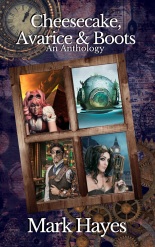
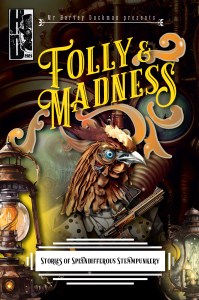
As an aside, the last time I talked about one of Stephen’s books it was a book about the constellation of taurus and the spiritual associations of Bulls through out human pre-history and beyond. Before that it was a trilogy of ‘steampunk adject’, novels. He has range, that’s all I am saying…

I was too young to have been a punk when it was rebellious to be so, my musical awakening consisted of Big hair, eyeliner and the merciful release label. But goth, new wave, post punk, industrial and new rock wearing splendor only happened because Punk turned the world upside down in 76-77 and reinvented music. Just how much they changed the music world. All my heroes started out on indie labels, all my heroes were influenced by ‘the spirit of 76’ not the Alarm song but the spirit of punk.

I know the music, As I said earlier I have seen many of the bands over the years, or at least later incarnations of them, but I don’t doubt that while the later versions were probably more polished musically, and the audience as enthused as ever, an audience of middle aged, balding men, trying to pogo like they did in their teens to bands that are no longer rebelling but remembering when they did, is not really the same as being at the 101 club when a pre-pistols Sid Vicious drummed for Susie before she was Siouxie…

Stephens book is a window into the heady days of punk, set against the politics and life in Britain at the time. Not just the music but the fashion and anger that surrounded it. The attitude, venom and the characters that made it such a unique moment in British Musical culture. Stephen knows his music, and clearly loves the music of the era. His passion for the subject is obvious throughout, making this an insightful joy to read.

The insight is to a world long passed, almost half a century passed in fact since the opening barrage of John Lydon sneering out ‘God Save the Queen’ with all the revile and venom he could muster caused outrage. But for all the outrage, for all the establishments anger, the musical world was never going to be the same afterwards. The pistols were inspired by the Ramones, the pistols in turn inspire pretty much everyone else to one extent or another.

This book is a window on an era, a moment in musical history, a moment of social change and upheaval. The beginning of the end of post war establishment Britain. Punk had arrived…

Its a great read for anyone, even those born too late to have been there …

Posted in books, Goth, music, reads | Tagged , , , , , | 1 Comment

A Hint of Scarlet

Last night I had an idea… Well, more than one, which was a bit of a problem. The last thing I did before turning out the light was scrawl in a notebook the out line for a book I have been considering for a long while. This outline consisted of nothing more than a bunch of chapter names and briefs outlays, but from small acorns…

The book I outlined before the light went out doesn’t currently have a title . Not even a working title. It exists purely as a concept though one I have been delving into for a long time now, and that has been touched upon in a few blog posts over the last few years. It is a book about Pagan spiritual identity, and quantum physics. Two subjects seldom spoke of in the same breath but two subjects that I believe are intertwined. The latter can inform the former, and the former give depth to the latter.

It is in essence a book about Quantum-Paganism*. This is not the smallest possible form of paganism, and yes I am making that joke before anyone else does. Though in fairness to that joke, the temple of the quantum pagan does have a congregation one, so maybe it is… But speaking as that congregation, it is not quite as unlikely as it sounds. Paganism is for many at heart a connection to the natural world as well as the spiritual. The two entwined in many respects. Quantum Physics teaches us that everything is connected, indeed connected in stranger more wonderful ways that we might imagine. This is a very personal belief system to me, as it helps me explain, well, me. Many pagan belief systems are deeply personal. This is to be a book about mine…

Whether anyone would want to read it is anther matter, but I seldom worry about such details.

*you can read more about this here…

With the lights out I lay in bed and my mind drifted over the ideas as I gently slipped into a peaceful sleep… In exactly the same way a force nine gale is peaceful… My mind is ever a busy place, and the howling was most unquiet and woke me again at five, which given I went to bed at two was not ideal…

Once I awoke I had other ideas… One of which was that I really should try and get back to sleep (this did not happen though I lay there trying to do so for some time.) It was then , as I lay there, my mind annoying abuzz with what may pass for ideas if you don’t look too closely, that I tried to make myself forces on one chain of thought. Its an old trick that sometimes works. Quiet the storm of voices by focusing on one…

Which brought me to another book idea, one I have done more than outline in a notebook but also less than outline. Indeed, the lack of an outline is the biggest problem I have with this one. None of the outlines I have previously played with have felt right. I have a few thousand words of bits and bats written but no real direction. I know what the book is about, who the book is about, and what it needs to be, but it hasn’t felt right, and I have been wrestling with one for about a decade.

Then last night, or rather this morning while I was trying to make it back into last night, I had something of a break through. Scarlet started speaking to me, as she has previously only whispered. So perhaps, just perhaps, it is time.

Time to return to Esqwiths Passing Place, someone unexpected just didn’t walk in passed Sonny the doorman. Yet somehow, he notices, is stood by the bar. A young girl, way too young to be in a bar, even this bar… Scarlet is here, though she isn’t Scarlet yet, she is going to be. Scarlet Sometimes, who is not quite living her life in order, and is not quite what she appears to be.

Last night I had an idea… This may be the one.

Or of course sleep deprivation

Posted in #amwriting, amwriting, big questions, books, pagan, Passing Place, reads, writes, writing | Tagged , , , , , , , , , | Leave a comment

Ben ‘W’ Sawyer, perhaps…

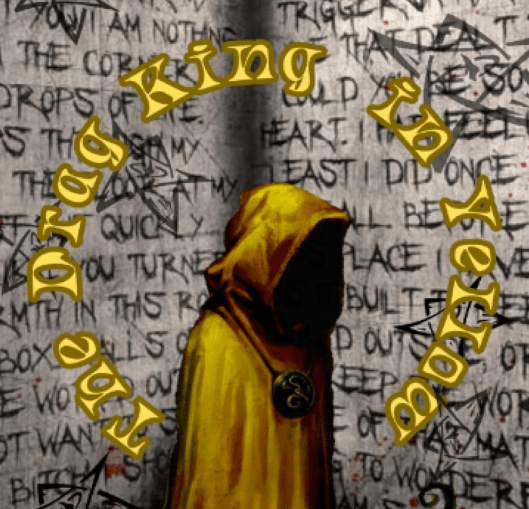
Fellow Harvey writer, Doctor who cosplayer, and supplier of sweets to small children Ben Sawyer has defiantly not taken any inspiration form Robert W Chambers for his next novel… Which I am looking forward to immensely, and will be out at Halloween…

If you have never heard of Robert W Chambers and don’t understand the reference I am not entirely sure why you are reading my blog, you have clearly never read it before, but hello and welcome we always like a new face/willing sacrifice around here. Or unwilling ones come to that… Anything that will keep Hastur at bay a little longer.

Beware the yellow sign….

Posted in Uncategorized | Leave a comment

At the risk of appearing sarcastic…

Because I have not done a Quote post in a while…

People say you can not live without love. Personally i think oxygen is more important. ~anon

Always remember that you are absolutely unique. just like everyone else. ~ Margaret Mead

Little things affect little minds ~ anon

The secret to staying young is to live honestly, east slowly, and lie about your age ~ Lucille Ball

I am not young enough to know everything ~ Oscar Wilde

I am not trying to be difficult, it just comes naturally to me. ~ anon

If you find it hard to laugh at yourself, I would be happy to do it for you ~ Groucho Marx

Experience is merely the name men give to their mistakes ~ Oscar Wilde

And finally, ahead of his time as ever…

People say satire is dead. Its not dead: it’s alive and living in The White House ~ Robin Williams*

*If only he knew…

Posted in quotes | Tagged , , | Leave a comment

Dear Edgar 41 ~ The Gold Bug

There are readers who, for reasons I have never truly understood, consider The DeVince Code to be a work of great fiction. To which I can only say this… ‘APPLE’, I mean come on, aside from the ‘shadowy’ villain of the piece been introduced around page 100, wearing a big sign saying ‘I am the shadowy villain” ‘ only to be revealed, to no ones shock, as the shadowy villain 300 pages later… ‘APPLE’.

Robert Langdon, the protagonist is a ‘symbologist’, while his love interest Sophie Neveu is a cryptologist . Yet it is Langdon who figures out the five letter word that is the key coded to a ‘cryptx’ with only the impenetrable clues found at the tomb of Sir Issac Newton… Which much to readers surprise, and the cryptologist’s is ‘APPLE’… I have long suspected that Sophie-the cryptologist did not work this out purely because it is such a dumb obvious answer to the clues… Or it could be that Dan Brown is just a tad sexist and despite Sophie being a cryptologist, which is a real discipline, she could not possibly work any of this out without Langdon the ‘Symbologist’, which isn’t, explaining the ‘complicated’ bits…

Anyway, as I was saying ‘APPLE’

Why am I on a bit of a rant about ‘The DeVince Code’? you ask. Well for the most part because Cryptology plays a central part in our next Dear Edgars story ‘The Gold Bug’, a tale with a few issues, that is a little awkward to categorize. It could possibly be consider another of his ‘detective’ stories, though it is a very different type of story from the ones involving Dupin. It is a story however that among other things inspired Robert Louis Stevenson when he was writing treasure island and one that has influenced every tale of buried pirate treasure there after, right up to and including The Goonies…

The Gold Bug, was a story, also something of a treasure for Edgar, as he submitted it to a writing contest and won $100 for first prize. This was after he had originally sold it for $52 to Graham’s Magazine before he asked for it back to enter it in the contest and never returned the money. Instead he pocketed the original sum on the vague promise to write some reviews for the magazine. This was the most Poe ever made on a single story and it was also his most widely read stories in his life time. Only the poem ‘The Raven’ righted a larger audience.

Before we go any further however, we need to talk about the the major problem with the text, the portrayal and characterization of one of the main characters, Jupiter. Jupiter is an African American, formally a slave and now the servant of William Legrand, the narrators friend and acquaintance. In fairness to Poe he wrote this story in 1843, 18 years before the civil war and 23 before the slavery was finally ended in the United States. Jupiter as emancipated slave was something of a rarity in southern states. One who chose to stay with his master, as a paid servant, loyal to the last member of the family.

This may seem unlikely, but it was not as rare as one might think. Slavery was generational, a slave emancipated by his master at an advanced age oft knew no other life. So Jupiter choosing to stay and be a servant to the son of his former owner does not stretch credulity as much as we may think. It is also not the issue I have with the character of Jupiter. The issue is everything else about the former slaves portrayal. His dialogue is all written in unsophisticated Pidgeon English, showing him to struggle with complex concepts and with expressing himself. Showing him intellectually to be much the lesser of his white former master. Even to the extent of him not knowing his right from his left. Or for that matter even the concept of right and left. For which he is constantly belittled by his ‘beloved’ former master Legrand.

Now I do not for a moment think that every character should be portrayed as having the same intellectual gifts. But this was not the first time Poe portrayed a black servant as very much the ‘lesser’ to their white master, be they a slave or emancipated. This is also the most blatant such portrayal in his stories.

Then there is the matter of the words used to describe Jupiter that would not be used in such context today. Readers should be warned in this regard. The portrayal of Jupiter is very much ‘of its time’ and its time is pre-emancipation 1843. It grates on me as a modern reader, and I am not an African American. In much the same was a Sophie Neveu’s portrayal in The DeVince Code grates on me and I am not a woman…

Putting the issues with Jupiter aside the bulk of The Gold Bug is a treasure hunt. The hunt for Captain Kidd, reputedly buried treasure somewhere on Sullivans island, South Carolina. Legrand has quite by chance come across a mysterious parchment, written upon with invisible ink in a substitution cipher. A cipher that holds the key to the location of the notorious pirates buried treasure. Without explaining any of this to our narrator or Jupiter, Legrand takes them off on a mysterious hike into the woods at night. At the culmination of this hike Legrand sends Jupiter up a particular tree that the trio have been looking for. ( because southern gentlemen do not climb but old negro’s do). In the tree on a particular branch Jupiter finds a skull, nailed to the tree.

Legrand issues instructions telling Jupiter to drop a small object through the right eye socket of the skull. Which he does, after the whole left and right eye socket ‘hilarity of the black man not knowing his right from his left. And off the trio go with Legrand pacing out a number of steps and then taking a shovel, handing it to Jupiter so the servant could dig… (because southern gentlemen do not dig holes) and doing so they unearth a treasure… Eventually.

Its at this point Poe through Legrand explains what they are doing out in the woods dropping things through the eye sockets of old skulls nailed to trees. Legrand explaining how cleverly, through the use of logic, he managed to decipher Captain Kidds cryptograph. A feat somewhat more complicated that figuring out the five letter word to unlock The Device Code cyptex was APPLE, thankfully. Mostly this involves following rules as one might apply to solve any letter substitution code. The most common letter used in English is almost always E therefore the most common symbol in the cypher phrase is probably E, and so on.

Despite the issues with the story getting to the point of Legrand’s showboating as he explains just how to crack a cypher there is a lot to be said for it. It is interesting, compelling even, and it has had an impact far beyond it self. It an odd mystery story with an odder explanation. Imperfect but fascinating all the same. And like much of Poe’s work.

FOUR RAVENS, LOOKING AT ONE RAVEN REMOVED FOR REASONS…

Should you read it: Well yes, but with a wary eye, read it in full knowledge of its flaws

Bluffers fact: Leo Marks and William Friedman, and Englishman and an American who probably never met, were both inspired as children reading The Gold Bug to pursue an interest in cryptology. In the second world war they both served as code brakers for their respective governments, one working with SOE (the predecessor of MI5) the other cracking the Japanese Purple Code.

To an extent then, this Poe story shorted the second world war and saved the lives of many allied soldiers… Which is almost enough to forgive its flaws… And certainly more than the DeVince code ever managed to do…

APPLE…

Posted in amreading, books, Dear Edgar, opinion, Poe, reads, retro book reviews | Tagged , , , , , , , , , | 3 Comments

Tuesday Too

Meanwhile, elsewhere

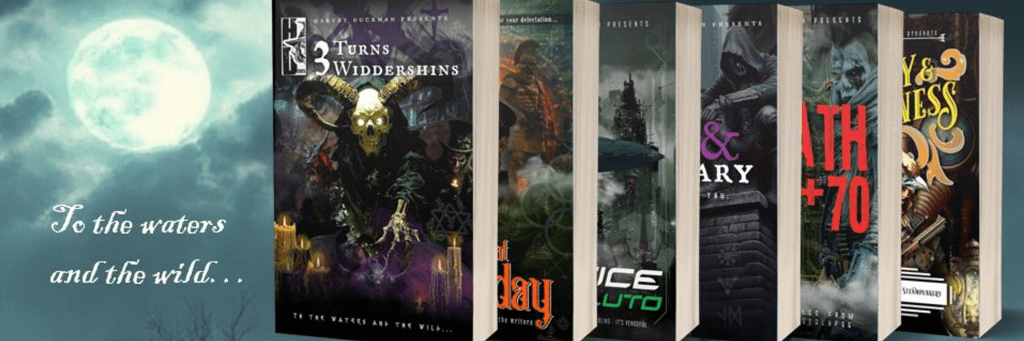
(Things the last couple of weeks have been somewhat hectic in the Passing Place of late hence the blog has been quiet… normal service will resume shortly, but until then , buy book read books , enjoy books, and occasionally send a review… )

Posted in Harvey Duckman | Tagged , , , , | Leave a comment

Dear Edgar 40 ~ The Tell-Tale Heart

True!—nervous—very, very dreadfully nervous I had been and am; but why will you say that I am mad? The disease had sharpened my senses—not destroyed—not dulled them. Above all was the sense of hearing acute. I heard all things in the heaven and in the earth. I heard many things in hell. How, then, am I mad? Hearken! and observe how healthily—how calmly I can tell you the whole story.

There is a more than even chance that you have at some point in your life read ‘The Telltale Heart’. There is a reason for this. The Telltale Heart is a story almost everyone in English speaking countries encounter at school in an English lit class because it is much beloved of English Curriculum makers. One of the main reasons for this is it is short enough for a teacher dealing with abused attention spans to read aloud in class, or give teenagers to read with some hope they will get to the end, and even possibly engage with it.

It is pure coincidence that it also happens to be one of the most perfect examples in all of English literature of corrupt first person narration. This is to say a narrator who’s version of events can not in any way be taken at face value.

In the very first paragraph, the one I have quoted above, the narrator takes pains to insist on his own personal sanity, something he repeatedly continues doing throughout. As he does so he goes on to explain that he lived with an old man to whom he professes no ill feeling. Nor, he tells us, did he have the slightest design upon the old mans money and property. Such is his love for the old man that if it wasn’t for one of his eyes being a filmy pale blue vulture like eye as we are told by the narrator, ever giving him an evil look, then he would never have murderously slaughtered him, chop up his body into tiny pieces, and hidden those pieces under the floor boards.

Our delightful, so very sane, narrator goes on to provide more proof of his sanity, such as the meticulous way he plans his crime, how carefully he creeps into the old mans room each night. Taking whole hours just to open the old mans bedroom door, a inch at a time, due to the squeaking of the hinges. Before observing his pray for hours on end but not acting on his need to kill for a week, because he loves the old man. he does not in fact act until the old mans ‘evil’ eye opens one night while he watches. Because it is the ‘evil’ aspect of the old mans eye that is his homicidal obsession.

All the rest of that aside, that it doesn’t occur to this ‘sane’ man to oil the door hinges during the day is some what telling… but maybe thats just me…

The narrator offers still more ‘proof’ of his sanity, having hacked the old man to death the night he opened his ‘evil’ eye, the careful way in which he butchers the old mans corpse and hides it under the floorboards, clearly displays he is of clear mind. For only a sane man would be so careful and considered in the concealment of his crime.

A logic by which you could prove the sanity of Doctor Cripin as he was entirely sane as he used an acid bath to dispose of his victims… Or indeed, the demon barber of Fleet street, Sweeney Todd, was in complete control of his faculties as he used his victims to supply the meat of his to Mrs Lovett of the pie shop down stairs…

Though it has to be said Mrs Lovetst’ pies were damn fine…

All this proof our narrator offers as to his sanity is in justification his final action in the story. When the police have arrived at the behest of a neighbor who heard screams in the night. The narrator shows them around the scene of the crime. Unperturbed by their presence, at least at first. But then he begins to hear a dull monotonous thudding sound coming from under the floor boards and his horror when he realises what it is.

How can they not hear it too?

That relentless thud, thud , thud that is the beating of of the tell tale heart of his victim.

It could be argued that when our Dear Edgar wrote The Telltale Heart he perfected the art of the short phycological horror story. this is certainly an argument the teachers of English Literature have been putting forward for a centaury or more. It is certainly the architype for stories narrated by those not entirely of sound mind. Many of the short stories of Robert W Chambers use the same core concept of a corrupt narrator who’s words can not be trusted at face value because their questionable sanity. Lovecraft uses the same trick repeatedly but never more so than in his seminal work ‘The Rats in the Walls‘. Part of the attraction of such stories is the reader is free to interpret the events being related. Free to decide if events did happen how they are told of if the narrators mental faculties twist teh telling.

As such tales go however, The Telltale Heart is not the most complex. Instead it is merely one of the first such stories, blurring the line between the narrators reality and the truth in such a corrupt fashion. In that it is frankly masterful. A story you know you can’t believe, but somehow want to. You want the heart to be beating under the floorboards, for all it becomes increasingly clear the narrator is insane. For all it is obviously his guilt making him imagine the hearts baneful rhythm. The image of a still beating heart beneath the floorboards remains a provocative thought provoking one.

It is a tale that can, and does, fire the imagination of even those most jaded of readers, bored teenagers in an English Lit classroom.

I speak from experience…

A SANITY OF RAVENS PEEKING THROUGH THE FLOORBOARDS

Should you read it: Yes, Though you more than likely already have at some point, read it again anyway…

Bluffers fact: Despite being one of the most evocative images in literature, for one generation at least it is surpassed by another heart beating under floorboards. The heart of Frank Cotton hidden beneath the floorboards of the attic in his old house, when his brother cuts himself and drips blood on the floorboards it seeps through and the heart begins to beat, as it does a circulatory system starts to rebuild itself around the heart ands slowly reform into Frank and drags his soul free of hell. Something a certain Cenobite calls Pinhead is less than chuffed about…

This incase you don’t get the reference, is one of the most graphic and surreal scenes in Clive Barkers Hellraiser. A movie based on Clive’s original novella The Hellbound Heart. A movie scene it is unwise to watch while tripping on mushrooms…

How I know this is between me and the later 80’s…

Posted in Uncategorized | Tagged , , , , , , , , | 2 Comments

Tuesdays…

Meanwhile….

(Things the last couple of weeks have been somewhat hectic in the Passing Place of late hence the blog has been quiet… normal service will resume shortly, but until then , buy book read books , enjoy books, and occasionally send a review… )

Posted in Harvey Duckman | Tagged , , | Leave a comment

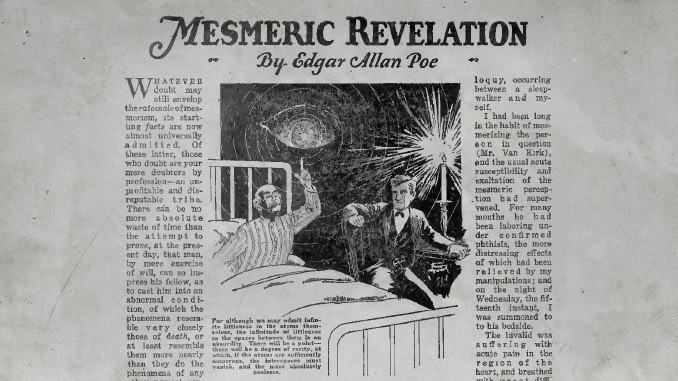
Dear Edgar 39 ~ The Pit and the Pendulum

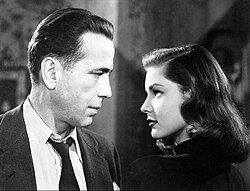
At the end of the 1961 movie based, somewhat loosely, on this story by our Dear Edgar, Elizabeth, played by the Queen of all Scream Queens Barbara Steele, is gagged and trapped in the iron maiden, watches helplessly through the bars as three survivors step back out through the door to the torture chamber, which is then is closed and locked forever. This final scene is filmed from her point of view and brings to a chilling end to the movie that is somewhat etched in my memory from when I saw it many years ago.

Aside the wonderful Barbara Steele, the movie also features the immortal Vincent Price turning in one of the great roles of his career. The movie is something of a masterpiece of the horror genre with many a horror trope born of it. The movie was the second of eight movies based on Poe’s stories to be adapted, in a series that began with ‘House of Usher’ made by American International Pictures between 1960 and 1964, all but one of which stared Vincent. ‘Pit’ was also the most successful movie the studio ever produced. Which isn’t bad for a movie that has only a passing relationship with the sorce material…

Then again don’t they all.

You are probably aware by now that I and fond of the occasional tenuous link. So here is a rather tenuous link to the rather tenuous bluffers fact at the end of the The Mystery of Marie Roget about Italian horror movies. After ‘the Pit and the Pendulum’ Barbara Steele went on to become a major star in those same Spaghetti horrors. Which much like Spaghetti Westerns had something of a boom period in the 60’s and early 70’s. Italian Horror was very much the place to be…

But all that aside, the movie version of The Pit and the Pendulum, wonderful though it is, merely draws a little upon the original story. Indeed the first two thirds of the movie has no direct relation to the story at all. In essence the movie merely takes some of the horrific imagery from the original text and reproduces it in celluloid. In fairness to the screenwriters involved it would have been hard to make a movie based solely on the original story not least because a great deal of the story takes place in pit black darkness, and in the head of the only real character in the story and unnamed Englishman who falls afoul of the Spanish Inquisition.

This is where Poe’s story begins, with the narrators trial, a trail he doesn’t fully understand, not least of of the things he doesn’t not understand is what he stands accused of. Aside been English in the Spanish city of Toledo. Whatever his crime he is sentenced to death, and then falls unconscious as he is dragged to the place of execution. He awakens in darkness and it is here the horror of his situation comes home to him.

The Pit and the Pendulum is very much a phycological horror story. Some might, not incorrectly, say it is the titular phycological horror story. It is written to raise the heart rate, to put the reader on edge. Something it does rather too well. It is a technique that has been copied by many, layering on the neurotic fear, one layer at a time. Building the sense of hopelessness. The condemned narrator is tortured with his ever nearing demise. first in the darkness of a room he feels his way around, in the center of which is a gaping maw if a pit, a pit that will not kill those who fall into it, but will break their bones and leaving them in a state of lingering agony for many days until they finally die.

By luck more than judgement he avoids that fate only to awaken strapped to a table, while above him a crescent blade swings back and forth with metronomic precision. and after each swing it drops one notch lower. The narrator is faced again with his demise, a demise that is unescapable as time is the ending of us all. The pendulum measuring out time is a dark metaphor. Time will kill us all…

Of course, he escapes this doom in the end, which is almost a shame. This ending doesn’t ruining the story by any means, but somehow the bleak darkness of the movies ending is better. the narrator of Poe’s story survives these tortures and is freed when the French take Toledo. Give me Barbara Steele locked in an iron maiden watching he last hope extinguished any day… But I am not a glass half full kind of writer, I am more the glass is empty and your dying of thirst kind of writer…

This is hardly the first horror story Poe wrote, and certainly not the last, it is however the one that raised the bar, that made the phycological elements of the telling more important than the story itself. Pervious tales had elements of horror layered over the story. In this story the horror is the story. It is dark and all consuming that way. It is why it can get under a readers skin. Why a reader starts to feel the terror of the narrator as their own. Up to this point in Poe’s career, the story was unique and it is a style that many modern writers have tried to emulate. Lovecraft build his whole career on attempts to emulate this story.

It is a perfect tale in that respect, in that it does exactly what Poe set out to do. It gets under your skin, and crawls about…

A FLOCK OF RAVENS FULL OF DARK INTENT

Should you read it: Yes, when you are alone, in a dark room , by a single lamp… Alone with your heart beat…

Bluffers fact: In 1969 our dear queen of all scream queens Barbara Steel married a writer call Poe. James Wilber Poe , a screenwriter known for ‘Cat on a Hot Tin Roof’ ‘Around the world in 80 days’ and ‘they Shoot Horses, Don’t They?’ among others. He was not in any way related to our own Dear Edgar as far as I can tell. Which was something of a disappointment as I spent a good hour trying to find out if this was the case, just because it would have made a better bluffers fact…

Posted in amreading, Dear Edgar, horror, movies, Poe, Uncategorized | Tagged , , , , , , , , | Leave a comment

The Humpty Dumpty Controversy

‘Humpty Dumpty sat on the wall’

‘Humpty Dumpty had a great fall’

‘All the kings horse’s and all the kings men’

‘Couldn’t put Humpty together again’

I have questions, many questions, but lets consider first why did Humpty fall. Obviously, people do fall off walls we know, but in general not just because they are just sat on them. In actuality, sitting on walls is not an inherently risky proposition.

As to why he was sat on the wall in the first place, well the obvious answer is of course to better view a military parade. This is after all why all the kings horses and all the kings men were passing by and thus able to attempt to patch him up. Mayhap therefore he got over excited, tried to stand up on the wall in order to get a better view and doing so slipped and fell.

This could make sense, except he was already high up. this was no mere garden wall he was sat on. he had to be high up because he ‘had a great fall’, not a minor tumbler. A great fall that did irrevocable damage… So why would he need to stand up, he should have been able to see everything perfectly well and remain seated on the wall. And the rhyme very clearly says he was sat on the wall, and doesn’t make any mention of him standing on it. If the purpose to the rhyme is to serve as a warning about the dangers of walls surely it would make mention of his standing on the wall. so no he was defiantly sat. So how did he fall?

How indeed… Was he perhaps pushed, and if so by whom… And why?

But that is one mystery which much like the occupant of a grassy knoll in Dallas Texas will remain unknown one suspects… But let us move on to the second part of the rhyme… Which if anything is more sinister

‘All the king’s horses and all the king’s men’ , ‘Couldn’t put Humpty together again.’

Well, this begs a question, several in fact. Firstly, who was in charge. All the kings horse and all the kings men is a lot of men and a lot of horses. perhaps that is a little too literal, perhaps it refers to ‘The Kings Troop’ a ceremonial unit of the British army. Also known as the Royal Horse Artillery, that has teams of six horses pulling 13 pound gun carriages. With other members of The Kings Troop escorting on horseback. The unit has 140 men and women in it and twice as many horses. that’s a lot of men and horses. perhaps how literally all the kings horse and all the kings men but as far as parades are concerned they seem the likely candidates.

But why would all of them try to put Humpty together again. Do any of them have advances medical degrees? I would venture the horses do not. So why are they even trying, can someone not get the horses out of the way? I doubt the one hundred and forty men and women of The Troop include any doctors either. Medics perhaps, but only a couple of them at most, and why is an officer not taking charge?

Besides which since when would the parade stop, should there not be a couple of members of the St John’s Ambulance kicking about? Or are they all off blagging free entry to football matches and Glastonbury?* Or were they paid off as part of the conspiracy. I mean there isn’t a public event that doesn’t have at least a couple of them about, drinking tea and smiling with the vicar. I bet they even got to see Ozzy’s final gig for nothing….

But no, not a sign of the St John’s Ambulance, or an officer in charge, just a mad scrabble of horses and men utterly failing to put Humpty together again, as if medicine and the setting of broken bones was some kind of jigsaw. have you ever tried to do a jigsaw with 140 other people and a herd of bloody horses, no wonder they couldn’t put him together again…. They were all fighting over whether to start with a corner piece and the edge of just dive into the middle…

So pushed not fell, and no medical staff in attendance. Some one had it in for poor Humpty clearly… But all of this is as nothing, when we consider one final question, the great question , the one that we all should be asking ourself and has been hidden by the madness of horses and men .

Humpty Dumpty, why do we think of him as an egg…?

He isn’t… At no point does the rhyme say anything to imply he is an egg. Humpty was never an egg, Humpty was a person, a person forgotten in all this because of that braggard Lewis Carrol, a man ever fond of his drug induced fantasy life, and obsessed with his niece Alice, went out of his way to rewrite history and convince the world that Humpty Dumpty was an egg by portraying him as such in Through the Looking Glass.

What was Carrol motive in doing this?

What was he trying to hide?

Will we ever know?

What we do know for sure is this, Lewis Carrol was a card carrying member of The St Johns Ambulance…

Remember this, if nothing else, Humpty was never an egg until they told us he was. Believe what you will, but never believe what they tell you.

Humpty Dumpty was never an egg…

*the St John Ambulance are a wonderful organization and its members fine people who give up their free time to help people. I will not hear a word said against them… They may be listening…

Posted in big questions, humour | Tagged , , , , , , , , | Leave a comment