Speaking the words and the necessary evil

I have an odd confession to make, well not so much a confession, I require no absolution here, but a confession all the same. My previous blog post, EX Oblivione, was not written by me…

Well not as such, I wrote it, I haven’t started cheating and farming out my Lovecraftian blog challenge to other writers. I just did not write it the way I normally would. Fingers to the keyboard, ‘tippy tappy type…’ labouriously typing one word after another on my ever worn down keyboard. Instead, I tried something new, rather than type the blog out I spoke to the computer and let it do the typing for me, using the inbuilt speech recognition software that comes as part of Windows 10. An experiment of sorts and as a means to defeat that old necessary evil… But I get ahead of myself… Let me take this back a little first…
IMG_4739

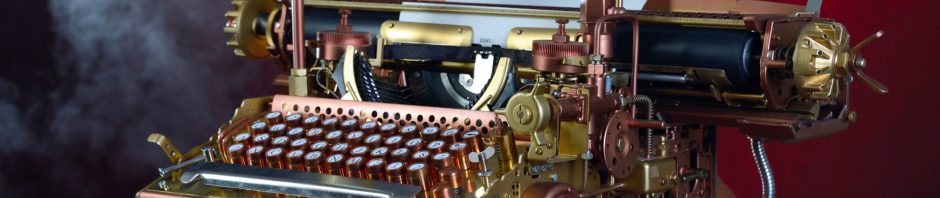
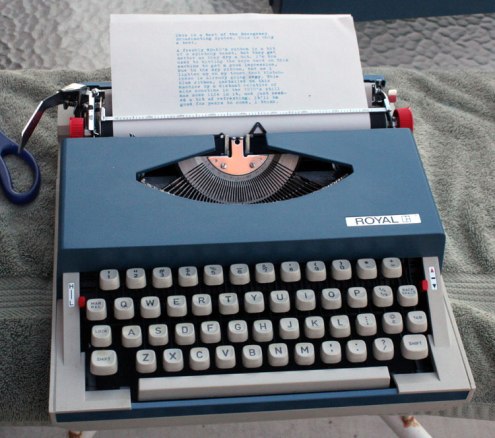
Way back in the grim dark age of technology, or as we called it at the time the 80’s, I learned to type on an ink ribbon typewriter. I would have been twelve or thirteen at the time, earning pocket money by typing up my dads plumbing invoices. Then wasting his ink and paper typing stories more in hope than expectation while black vinyl spun on the turntable at 33rpm. A time which taught me the value of learning a skill (20 pence an invoice added up in the pocket money stakes) and the value of Tipp-ex liquid correction fluid. Which, I may add, was not to be used on invoices. Mess up an invoice and you started over, which probably cost my old man a fortune in headed notepaper. I did, however, use it in my attempts to write stories and those first vainglorious attempts at the writer’s craft, which given that I am dyslexic meant I used rather a lot of it. So much that I am surprised I was not high as a kite listening to those 80’s grooves, inventing strange worlds and even stranger characters in my early teens.  Correction fluid is solvent based and was a favourite huff of a certain kind of school boy back in my youth…

Dyslexia is a curse of a kind and an occasional blessing, but it does not help you as a typist, and the quicker you try and type the more often you make weird little errors. In these more enlightened times of the internet, google, computers and importantly to myself word processors, dyslexia is less of a curse to my typing. Though it certainly makes for mildly annoying little typos ( such as my innate ability to type form instead of from every time and spell the ‘teh’ nine times out of ten when I type) and of course those far more annoying ‘necessary’ evils…

If you’re paying attention, you may have noticed me use that odd phrase from the title of this piece a couple of times. So I should perhaps explain what the ‘necessary‘ evils are… As a dyslexic, my Achilles heel is words that are not spelt phonetically ( like ‘fanetically‘ itself for example). The English language is full of them, and my brain doesn’t do that little leap that tells you to ignore what it sounds like and spell it the ‘right’ way. It’s too busy just managing to bridge the divide created by the weird bit of wiring that is going on behind my eyes… My accent doesn’t entirely help in this case either. I do not speak BBC middle English, I am a Yorkshire man from Leeds who has lived in the north east for some time and picked up hints of Newcastle and Middlesbrough along the way…. Which is to say the Phonetic’s I speak in are not entirely the Phonetics of newsreaders…

Wordprocessors and add ons like Grammarly are a fantastic boon with many things. They pick up most of the ‘from’ form’ errors and all those annoying ‘teh’s. But word processors have their own Achilles heels, and necessary is one of them. You see necessary according to my brain is spelt ‘ness-er-cery’ and there is not a word processor in the world which will correct that. It is only because I use the word often enough to take a mental back step when I type it that I manage to not spend five minutes wrestling with different letter combinations (and occasionally bludgeoning it) until the word processor finds one that’s close enough to right for it to correct it for me. Which would not be too bad, but necessary is but one of many words that catch me out and fuddle spell checkers at the same time. More than once I have known the exact word I wish to use but ended up changing it to another just because I have had enough to spell checker wrestling. The upshot of which is I spend a lot of time editing, even when I am not editing…

Which brings me back to where I started and the previous blog post experiment… I am, when not writing, a techy. Which is to say I work with technology and am an engineer by trade. So it is natural to me to find technological solutions to my problems. One of which is the amount of time it takes to write first drafts. I type fast, but I edit myself as I go, so which the characters may flow from the keyboard, my actual typing speed is a trade off with the amount of basic editing I have to do. the faster I type, the more teh and ‘from’ ‘form’ I have to deal with, and all the others I have not mentioned. Let alone all those basic little errors that creep into my typing. So while telling ‘Alexa’ to play some Dillon a few days ago it occurred to me that these days I talk to my hi-fi, I talk to my phone when I want it to ring some one, or just answer a question about the nearest coffee shop… I even talk to my Kindle these days as I just upgraded to one with Alexa on board… So why in hells name do I type everything I write on my PC…

As I am a techy the next thing I did was run over to keyboard and start looking up the best speech to type software that was out there in internet-land… Which proved to be a bunch of expensive options and a long list of incompatibilities… I was a tad disheartened because here was a solution to those ‘necessary’ evils and the ‘from’ ‘form’ problem. as well as my general ecliptic typing… But the best speech to type software did not appear to compatible with Office 365 and would require an investment of cash I was not entirely certain I wanted to make for something which I may decide I hated or turn out to be useless for me. I write in a certain way because I think in a certain way and deal with my dyslexia in a certain way. Dictating to my PC may actually hinder my creative methodology as much as it benefits my transcriptions…  And I so hate to waste money (you can take the man out of Yorkshire, but he will always remain a Yorkshire man all the same, deep pockets and short arms tis the way…) So I shelved the idea to the back of my mind for a while.

Then I realised that I was missing something rather important. While looking through a couple of tech sites on the off chance of there being a freeware solution out there, windows 10 comes with a speech to type app. Yes, that operating system most of us not praying at the church of St Steve are using has all the software I needed, built into the OS. It just had not occurred to me to look. It might not be the cutting edge best in the market, but it was a good place to start.

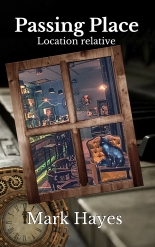
So, long story not made particularly short that’s what I did. I set up speech to type and decided to try it out on a Lovecraftian blog post. My innate pessimism expecting teething problems (there were many) but hopeful that the experience would be useful. Which it was, though there are a few issues. However, it occurred to me others may wish to try this themselves, and while I am back at the keyboard tonight, writing this blog post, I am going to repeat the experiment a few times and try using it for the first draft of my next but one novel ‘Something Red’ the sequel to ‘Passing Place.’   (‘Spider in the eye‘ is in final drafting and I am not going to even attempt to use speech to type to do that, certainly not yet anyway). I intend to do a little work on ‘Something Red’ in the next few weeks anyway so its a good time to experiment…

So things you need to know if you want to try speech to type with Windows 10, most of which I learned the hard way…

  • The Win 10 program is an access aid rather than just speech to type, so it is global to your pc and you can find your changing web pages by mistake when you say the wrong thing, which is a little weird and bloody irritating…
  • Run the training program, it teaches you how to use the software to edit etc but importantly it ‘trains’ the program to your voice and how you say words ( I did not do this till I had grown somewhat frustrated with the app. it was working so much better afterwards)
  • Perceiver, after the ‘training‘ app has run you will know how to highlight a word the app ‘hears’ wrong and correct it without using the keyboard and the app is smart, it learns from its mistakes and ‘hears’ you better as it learns those little foibles of your voice. So the more you use it, and the more you correct it without resorting to the keys, the less you need to and the more the words just flow.
  • Use the insert key often… the text appears in a little box (at least when using it to write in a web page) and you have to insert it into the page. Nothing is more frustrating in this process than ‘writing’ several lines and losing them when the app decides you just told it to go to a web page…
  • Never leave a web page open when you have searched the word ‘Nihilism’ an hour ago, forgotten doing so, then use it in what your ‘writing’ and then what the text box vanish while the web pops to a different window… ( okay that last one was just me, but it’s a general point)

As an experiment it was I think a successful one. True, the post took longer to write than normal, mostly because I was wrestling speech to type even more than I wrestle the word proccessor. Though once I learned how to use the software to make the app learn my voice properly things improved dramatically. And yes I finished it off by hand after the first drafting of the post. But that was the point, what I wanted to achieve was first drafts which didn’t feel like an exercise in editing as I go. More to the point if I do edit I want it to be editing, not wrestling the word processor, the endless stream of ‘teh’  ‘form’ and all those ‘necessary’ evils to deal with..

So, I have seen the future, it does the typing for me while I talk to it… As long as it doesn’t start talking back, it will be a good one…

Posted in opinion, self-publishing, writes, writing | Tagged , | Leave a comment

EX Oblivione: The complete Lovecraftian #27

“There is nothing better than oblivion, since in oblivion there is no wish unfulfilled.” ~ H.P. Lovecraft ‘In defence of Dacon

As a philosophical statement, let’s be honest here, the above is a bit on the bleak side. Though no one ever accused our man Howard of having a sunny disposition. This particular tip-bit comes from a nonfiction essay he wrote in defence of his fiction in 1921, which by coincidence was also when he wrote EX Oblivione. A certain nihilism was evidently on his mind at the time.

ex-oblivione-5k-1024x775

The tale itself is as much a prose poem has a story. It tells of a man that close to the end of his life, who dreams each night that he is walking through a city. There, each night he comes to an imposing wall with a gate within it. He knows somehow that should he pass beyond the gates of he will never return. Beyond that he knows little. The wise dream sage’s that lay within the city offer different accounts of what lies beyond the gates. Some tell of immense wonders while others tell of horror and disappointment. Yet all speak of a drug which will unlock the gates.  And so despite not knowing what lays beyond the gates the man decides he must find out for himself, even with the knowledge to pass through them is to never return.

Some have occasionally equated the tale with Lovecraft’s supposed obsession with suicide. They choose to ignore the hints within the text of that the man sufferers a wasting disease, choosing instead to interpret ‘forever being freed from the pain of the real world‘ as Lovecraft speaking of human existence itself. It’s not an entirely unreasonable idea, it has to be said, Lovecraft’s struggles with depression and the struggles of his family with that old black dog are well documented. To believe he never contemplated suicide is any point in his life would seem naive. However, personally, I choose to believe it is no more than an exploration of what may lay beyond this mortal life. Though it has to be said, the view expressed within the tale has a certain grim absoluteness to it. In so much that it says that nothing lays beyond that final gate but the infinite void that is death. Just oblivion. Just nothingness. An end to everything…

So happy little tale this is not.

Despite this, it has an intrinsic beauty about it, which belies its nihilistic nature. For the narrator of the story that oblivion would be a welcome wonder. A final release from everything and the idea of that nothingness is to him preferable to life. Which is a cheery thought is it not…

maxresdefault (2)

When this story was first published in the United Amateur, it was under the pseudonym Ward Phillips, perhaps because of the nihilistic nature of the piece, and a desire to separated it from his usual fiction. It’s grim from the outset, beginning…

‘When the last day’s were upon me and the ugly trifles of existence began to drive me to madness like small drops of water that torturers let fall ceaselessly upon one spot of the victim’s body. I loved the irradiate refuge of sleep’.

When a man’s life equates to water torture is not difficult to conceive why oblivion would be a welcome release from his torment. Yet, it is perhaps the dark nature of this tale that holds a certain fascination for me. There have been times in my life when I have suffered from depression myself, which I have occasionally written about in other parts of my blog. Because of this, a certain level of contemplation of what lies beyond Lovecraft’s gates has played upon my consciousness. As perhaps they have played upon the consciousness of all of us at one time or another. But then what lays beyond is after all part of the zeitgeist of the human condition.It is a theme that goes far beyond Lovecraft’s writings, whole swathes of philosophy are focused upon it. While Howard Phillips has no greater insight than any of us, there is always a certain grim attraction to its contemplation. Particularly in our darker hours. If this tale does nothing else, it explores that theme with all of Lovecraft’s dark passion for the subject. It draws you into its grasp, till oblivion seems a welcoming end in of itself. Which is a neat trick to pull off when you as a reader are happy as a sand boy at the time…

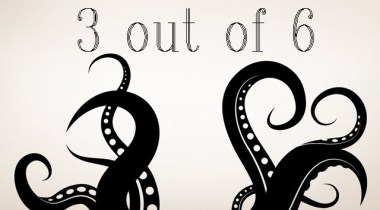
Due to that certain fascination, I have with what lays at the other side of those gates, if nothing more, it scores four groping tentacles of nihilistic doom. Though I recommend been of a sunny frame of mind before you delve into its grasp. Oblivion may be a compelling idea of what lies ahead of us all, but personally, I would prefer to remain oblivious of what really lays beyond those gates for some time to come…

4out 6

Further Lovecraftian witterings 

Posted in depression, Lovecraft, reads, sci-fi | Tagged , , , | 2 Comments

The Music of Erich Zann: The Complete Lovecraftian#26

Listen to them, the children of the night. What beautiful music they make: Bram Stoker…

Music and horror have always been linked. Watch any horror movie, with the music track off, and you will see what I mean. We are programmed somehow to feel a chill down our spine when discordant notes are played. The shower scene in psycho as the knife comes down. That strange theme that gets played whenever is about to die in a horrendous way in the Omen series. Listen to them without the pictures, and they will produce the same guttural reaction. The music from jaws, the music from the Exorcist, the music from Halloween, Friday 13th, take your pick. They all have discordance and visceral natures. So it’s unsurprising that a tale involving discordant music crops up in Lovecraft bibliology. ‘The Music of Erich Zann‘ is, however, a tale with so much more to it than just music. It is a tale discordant by its very nature.

There is something seductive about ‘The Music of Erich Zann‘, it draws you in, in much the same way the protagonist is attracted to the music of the viola being played on the floor above him in the boarding house on the Rue d Auseil. There is a clue in the name of the street. A couple of clues to be exact. First, there is the Rue part. Lovecraft was always drawn to Alexander Poe. He who wrote of murders in the Rue Morgue. Yes, it is true that Rue is merely the French word for street, but it is no coincidence I feel that Lovecraft chose to place this, his most Poe inspired work, in a French street. The second clue to the nature of the story is the second half of Rue Auseil.

the_music_of_erich_zann

The second clue to the nature of the story is the second half of Rue d Auseil. While the name is fictional and not truly a French word, the closest you can come to it in French is Au Seuil, which is the French for portal… Which subtly hints about what is really going on in this tale… Not least because when we join the story we are told by the protagonist that he can not find the Rue d Auseil on any map of the city, or even the district in which it resides. He remembers staying there for a few months and the events that took place but not how he came to live there for a time in the first place. The description of the district and the Rue d Auseil itself is both hauntingly familiar, yet unerringly strange, there is a slightly off quality to it. A place that is a part of a city you know well, but is some how out of key, discordant, or just plain wrong. An older part of town, which feels like it has gone to seed. The kind of area you wander into late at night and feel as if you have stepped across a boundary into somewhere else. The inhabitants look strange, the street is not paved, the smell of the place is different, it seems indeed like the idea of purgatory, a place between our world and the next.

I have a fondness for this idea of purgatory, though not in the Christian sense of the word. The idea of places existing slight out of key with our reality, soft places that you can wander into if the conditions are right, and from them find your way somewhere else, literature is full of them, from Stephen Kings ‘thinys’, C.S.Lewis’s wardrobe, the mist marches in Morecock’s Von Bek and countless other examples including my own ‘Passing Place’. From the description given by Lovecraft, Rue d Auseil is almost certainly one of these soft places, between our here, and somewhere else…

In his boarding house at the top of the hill that forms the Rue d Auseil, the protagonist has a view of the great wall at the end of the street which blocks all view of what lays beyond. Indeed he is told the only place high enough to see beyond the wall is the highest garrot in the house, where resides the viola player Erich Zann. Our ‘hero’ has heard Zann playing his strange hauntingly discordant music in the early hours each night from his room below and is both repulsed and drawn to it in equal measure. In time he works up the courage to meet the man himself and ask him about it. Where upon he discovers the man is mute, and beyond his viola communicates only by carefully written notes. Zann also seems to be haunted himself, strangely draw and nervous, yet all the same, he agrees to play for our ‘hero’, and it is at this point that things get really odd…

What interest our protagonist most is not the strange music which seems to come from the viola but the strange counter point that comes from beyond the shuttered window. The only window on the Rue d Auseil that looks out above the great wall at its height… What lays beyond the wall. a vista of the city all lit up in the night?  Or something else, something strange and wrong? And as Zann plays his singular instrument, its notes crying out in the night, a wind gets up and events go downhill fast… Indeed, everything goes to hell, one way or another…

Perhaps it is the subject matter, but ‘The Music of Erich Zann‘ sings to me. For want of other words. It has strong elements of Poe at his best, certainly there is some imitation of Poe’s style involved, but Lovecraft make it his own. You can feel the darkness of the city at night, the strangeness of the street, the discordance of the music. The deep impending doom of the violist, this strange mute man so gripped with a terror unnamed. It is Lovecraft close to his best and makes me wonder how many tentacles you would need to play the violin. Five I suspect, well poissibly not, but the tale itself gets a 5, a disturbing eldrich 5 at that…

5out 6

As a side note… While I am not much of one for the classical genre, I like my music heavy on the electric guitars, bass and drums side. But I do have a soft spot for the occasional bit of classical, Holst planet suite is haunting at times. The tale of Erich Zann’s discordant music has inspired more than one musician, however, and while it doesn’t really fall within my normal tastes there is something seductive and beautiful about this particular peace by Alexey Voytenko. It is perhaps closer to Lovecraft’s own imagining of Erich Zanns playing than makes for entirely comfortable listening… Yet I like it all the same…

But then the doesn’t the devil always have all the best tunes…


Further Lovecraftian witterings 

Posted in book reviews, Lovecraft, music, mythos, rites | Tagged , , , , , | 1 Comment

‘Passing Place’ 99p-99c Sale

Step in from the cold, through the saloon door of the strangest bar in creation. A place where causality is just a set of rules and the rules can be bent. Where no one knows your name, but everyone has a story to tell. Where the answers to that most impossible of questions may lay, “Why?” In a novel that goes everywhere and nowhere, and is about the journey in-between. Welcome to Esqwith’s Piano Bar and Grill. A ‘Passing Place.’ A place off to one side of reality, where your troubles can just slip on by. An impossible place that bridges dimensions and time itself.

cellar 2 sale

Sonny, the doorman, drinks his brandy and tells a story of death row. A green haired girl sits in her tree and speaks of the wolf of winter. The Weaver of tears, cries her diamonds, and the Gunslinger speaks of death riding in on desert winds. The Greyman tells of his soulless world, before dancing with his mop once more. While in the kitchen the chef bends causality to make the greatest sandwich in the world, and the devil behind the bar tells tall tales while he pours you a drink. A place where stories are told and retold a new, and a place where something lurks unseen, something from the void, something dangerous, something hungry, something red…

facein the dark 2 sale

“The Greyhound pulled away into the thunderous summer storm, leaving in its wake a dishevelled, world-weary figure in the dark, deserted bus station.”

Richard is a man come to an end. Grieving after the death of his wife he has travelled the back roads of America in the search for an answer to that most impossible of questions. Why? Looking for that answer in all the wrong place. In a Hicksville town in the western desert, he answers a want ad for a piano player and finds himself in the Passing Place, an impossible bar, where the patrons all have stories to tell…

Fantasy and sci-fiction collide with horror and the supernatural in a world where reality is a matter of perception…

tree sale2


Format: Paperback Verified Purchase

This book is an (unexpected) gem as far as I am concerned. I read the writer’s first book as well, which was also an enjoyable read, but this one fitted a lot better with the genre I normally read. It’s a very interesting mixture of fantasy, horror, a doorman with a past, a club with a forest attached, an engaging personal journey…all mixed with a bit of suspense.
…oh, and there is a cat. An odd one…
In summary, it combines many different things with a story that goes nowhere and everywhere, and I will be waiting impatiently for the sequel….


For free sample chapters click on the box below….

Posted in books, Passing Place, publication, reads, sci-fi, writes | Tagged , , , , , , , , , , | 1 Comment

The Quest of Iranon: The Complete Lovecraft#25

Some tales are more interesting in the abstract than in the telling. Sad though that may be, ‘The Quest of Iranon‘ is one such tale. While it’s a pleasant enough read, it does not really have anything that grips you in the way you would wish a Lovecraft tale to grip you. It’s a meander, rolling along without much impetus, to a conclusion which is just a little too predictable. Which is one of the problems that you come across with Lovecraft, He has a habit of walking a crooked path through the forest to a destination you can see long before you arrive, yet insisting he follows the path all the way, rather than cut through the trees. Often though the journey is worth it. ‘The Tree‘ for example does much the same thing, but there is a tension in ‘The Tree‘ and a feel of the impending doom-laden ending to it that carries you along the journey which is lacking in ‘The Quest of Iranon‘. This is more a meander for the sake of it, rather than with any great purpose, and when you get to the end, you wonder why you made the journey at all…

Lovecraft himself may well have thought much the same when he wrote it in early 1921. Indeed I suspect it resided in the bottom drawer of his writing desk for some time, forgotten and uncared for. Certainly, it is far from his strongest work. Much in the way From Beyond‘ this feels like Lovecraft lite, and like ‘From Beyond‘ it did not find its way into print until a decade and a half later when he had achieved a modicum of fame and the appetite for his work in the pulp magazines caused him to delve into his earlier discarded manuscripts. There is, however, something about ‘The Quest of Iranon‘ that sets it apart from ‘From Beyond‘. Unlike the latter, Lovecraft was trying to do something different in this tale, indeed it was also the start of something which helps set Lovecraft apart from other pulp writers.

Through out the early works, which I have already covered, I have been making mention of the later works that refer back to them. It is a common theme, which helps link the stories with reoccurring characters and places, as well as events. Often it is the case that he mentions something in passing that later crops up in another tale or even becomes the seed for the whole of a new tale. In ‘The Quest of Iranon‘ however is the first occurrence of the reverse, with earlier tales being referred back to. For the first time here Lovecraft was mythos building, looking at the stories he has written before and referring back to them. Which may explain much about ‘The Quest of Iranon‘. It meanders around because it is a vehicle built to do so. He was making a deliberate effort to tell a story that was in aspect a travel-log of his own work. It was, in essence, an experimental piece, playing around with the idea of his tales becoming a greater whole. Turning them into a cycle of stories, rather than a series of one offs.

In some regard this is hardly surprising, Lovecraft wrote for pulp magazines with thrived on characters coming back in new stories. Lovecraft’s close friend and fellow writers Ron E Howards ‘Conan’ and ‘Kull’ stories, for example, built on worlds, histories and ideas that carried common threads. Characters that came back time and time again. Recurring stories and themes gave the characters ‘cover’ potential and drew in readers. If Lovecraft had a weakness in this regard before 1921 it was his stories were all one offs with little narrative thread to link them. His tales were unlikely to feature on the covers of the pulps and were regarded as filler by publishers. He might get his name on the cover writer’s list but it was not seen as a draw and usually, he wasn’t mentioned at all on the covers of early pulp magazines. Finding ways to tie his tales together, from a purely commercial point of view, made sense. Readers like to feel a story is part of something bigger. Which is as true today as it was then, which is the reason trilogies and long sprawling series novels like ‘A Song of Fire and Ice’ (the Game of Thrones novels the predate the tv series) and ‘The Wheel of Time’ novels are so popular. Readers like to invest in characters and worlds, and Lovecraft did not give them such investment. Each tale was separate, unique, and had to sell itself on its own merits alone…

So with ‘The Quest of Iranon‘ Lovecraft was in all likelihood looking for ways to link stories together and give his readers something more. Which is what he found as he lay some easter eggs in the text, which is what makes ‘The Quest of Iranon‘ interesting in the abstract, as a writer reading his work in the order it was written, rather than the order of publication.

By the time it was first published Lovecraft’s fan base was not only used to these little references appearing in his work and the greater thread which moved through his stories, they expected it. The greater was more than the sum of its part. the oblique references to Lormar, the land in ‘Polaris and Iranon stating he had “…gazed on the marsh where Sarnath once stood,” a reference to ‘The Doom that Came to Sarnath‘, were the least of connections you would expect in his stories. But when he wrote ‘The Quest of Iranon‘  it was a new departure for Lovecraft as a writer. One that I find interesting as a fellow member of the craft, for all it is a prosaic read in of itself.

valzonline1

The story itself is a simple one about a golden haired wanderer, telling tales about his past as a prince in the great city of Aira as he travels. Tales of a city no one else has heard of, but he claims is full of wonder, which is surely a case of Lovecraft writing Lovecraft… His obsessions with lost and mythical cities run as a thread through many tales after all. In this case, the tales of Aira are ones Iranon has told so often he can not separate truth from fiction. Longing always to return, but some how never doing a great deal about it until his life long friend passes from the world of the living. The ‘Quest’ for the dreaming spires of his lost city, on which he poetically waxes constantly, leads him finally to an old shepherd in a land long fallen to ruin, and the shepherd tells him a truth, one which if you do not suspect long before it is revealed you really have not been reading closely. It is Lovecraft, the style, the verbiage the use of ideas and the way it reads. But is it just Lovecraft by rote, and much like ‘From Beyond’ you would expect something more.

As I say, what is interesting about this tale is when it was written, more than how. That it took so long to be published says much about Lovecraft’s own opinion of it. The context of the experiment it represented in his writing is far more important than the tale itself. If anything it was Lovecraft becoming Lovecraft as we know him now. The weaving of threads between stories and the gossamer links that build the web of the greater whole are what make this tale stand out. But as a read in of itself, it is disappointingly a bit below average, and when it finally became ink in the pulps it is unlikely it even raised an eyebrow.

Putting that greater context on one side it rates a measly three tentacles, grasping to be part of the whole, and if I am honest I think I am generous to give it three… If however, I was rating on the tales importance it would probably be a quintet of the little suckers, this is the point Lovecraft began to craft a universe of his own making, rather than just give glimpses of the discontiguous without a greater whole. It is interesting to me that he wrote this just after Nyarlathotep. Perhaps the masks of the faceless one guided him to a take this broader view of his tales… It would be strangely discomforting to think so…

3out 6

Further Lovecraftian witterings 

Posted in dreamlands, Lovecraft, mythos, retro book reviews, writing | Tagged , , , | Leave a comment

Physics and the Voodoo Doll…

Occasionally my dyslexic brain and the weird way it makes connections, goes off on an odd tangent and I find my self-thinking about something in a new way. New for me that is, not necessarily new because no one else has ever thought it, but new and decidedly odd all the same.

I have a passing interest in many subjects, among them physics and magic. Not the rabbit from the hat kind of magic, but the ‘real’ stuff for want of a better description. The idea of magic, and the way it has been practised by humanity, hokum though it is for the most part. These are two subjects that should not interact and have nothing in common, physics being the king of sciences ( so physicists tell me at any rate), and magic being well a made up concept to explain the unexplainable, or is that physics again…. Occasionally, in the modern world of quantum physics, you could be understood for confusing the two. A universe made up of 90% dark matter we can not actually explain or point to but we believe is there, well that’s as good description of magic as it is of physics, but what got me down this particular culdesac of thought was ‘spooky particles’  and quantum entanglement…

1cfe8-quantum2bentanglement

For those who don’t know, in quantum physics, entangled particles remain connected so that actions performed on one affect the other, even when separated by great distances. The phenomenon so riled Albert Einstein he called it “spooky action at a distance.” … Entanglement occurs when a pair of particles, such as photons, interact physically.

Meanwhile, according to a basic definition of sympathetic magic, such as, to give the perhaps most well-known example, a voodoo doll… All sympathetic magic is based on two principles: first, “likes produce likes,” or that an effect resembles it cause; and, second, that things have been in contact with each other continue to react upon one and another at a distant even after they have been severed or disconnected. The Law of Similarity, and the Law of Contagion.

So, ‘spooky particles’ behave in a manner to which you can apply the principles of sympathetic magic, and the Law of Similarity and the Law of Contagion can be said to apply to Einstein’s photons, in exactly the way they are supposed to apply to a Voodoo Doll…

download (8)

Indeed, spooky particles are not just a theory its a theory backed up by experimental proof.  Which also means, as my dyslexic brain decided when the thought occurred to me, that’s these same experiments have also proved that the laws of sympathetic magic, the laws of the Voodoo doll, do actually have some basis in the physical universe…

So anyway, I just thought I would share this odd revelation of my dyslexic brain… I am off to make voodoo dolls of Teresa May and Donald Trump … (anyone got access to their finger nail clippings or a strand or two of hair at all?)

Posted in dyslexia, humour, pointless things of wonderfulness, rites | Tagged , , , , , | 4 Comments

Harlem’s Hellfighters…

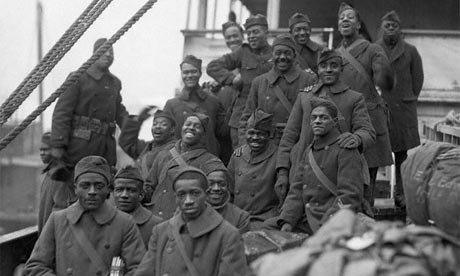
‘The Ballard of Pvt Burbanks’ a pivotal chapter in ‘Passing Place’ tells what you could call the ‘origin’ story of  Sonny Burbanks, the doorman at the very strange bar of the title. ‘Very strange’ is perhaps an understatement when describing the Esqwiths Passing Place, and the relative nature of its local, but I am not mentioning this here in order to sell books. The reason I bring it up is more prosaic, a little on the sad side, and because of events in Charlotteville Virginia at the weekend. Also, I mention it now because it’s a hundred years since the USA entered the first world war and a hundred years since the 15th New York Infantry, which was to become the 369th infantry regiment, was formed.

I came across the story of the 369th while looking around for background for Sonny’s story. research is a blessing to a writer I find, even if what you are writing is a sci-fi/fantasy tale. Not so much because it is good to have a little real history in the mix, but because while doing the research you can find whole new stories hiding in plain sight. Which was the case with the 369th, or as they called they were christened due to their exploits in WW1 by the French, the ‘Harlem Hellfighters.’

blackamericansoldiers2

At the time I was doing a little research into black American soldiers in WW1. As one of a couple of ideas I was playing with for Sonny’s background, and at the time it was just background, I had no real intention of writing ‘the Ballard’ that became the fourth chapter of the novel. I just wanted ground for the character to stand on, a place to set his feet. It’s something I like to do with any major character, though I seldom write these down, nor do they necessarily end up in the finished story. Just because I need to know who they are as a person, does not imply I need to explain these details to a reader. Though a passing reference here and there doesn’t harm. However, with the 369th I hit pay dirt, it was not just character background, it was a story begging to be told. One all the stronger because it is at its heart a real. It gave Sonny a tale to tell about his life which strengthened the character in my own mind, in the novel and for the readers as well. The latter is the most pleasing aspect as the writer because I have been repeatable told by readers how much they like the character. Simply put I got him right, which I could not have done without the 369th I suspect, or at the very least he would have been a weaker character without them.

The history of the 369th is the history of an unwanted black regiment, (unwanted by the general staff that is.) Back in 1917, the view of the general staff was that mix regiments were a bad idea, white soldiers should not have to fight alongside blacks. Such were the unfortunate US social politics of the day. Interestingly no one ever asked black soldiers if they had any issue fighting alongside white ones, but then no one actually asked the black soldiers anything. Even in the killing fields of France, the black regiment of Harlem’s finest were kept separate from their fellow warriors, indeed to the extent they were held behind the lines, doing menial work, because the general staff did not want blacks in the trenches alongside whites. It was not until the French asked for support on their section of the line that the 369th saw action. Even the reason that the 369th was sent to support the French had its roots in the social politics of the time. The US Constitution disavows any US serviceman fighting under the direct command of a foreign power. Indeed this was the reason that Eisenhower, not Monty was in overall command of the D-day landings in WW2. But back in WW1, the general staff decided that there was a loophole when it came to that troublesome black regiment they could not decide what to do with. A black regiment was not covered by the Constitution as they didn’t exist when the founding fathers wrote it… So if the French wanted a regiment under their command, then they could take the 369th, presumably as they were not real US servicemen…

The French, a nation who had no problem with ‘coloured troops’ were happy to take them. They care nothing for the colour of a soldier’s skin, they cared only that a man was willing to shed blood for the cause. Blood is red no matter who sheds it after all. Under the French, the Hellfighters spent more time on the line than any other unit. The French awarded 170 Croix de Guerre, their highest award for any foreign soldier to members of the regiment. Just think about that for a moment. A regiment of black Americas, unwanted by their own commanders, spend more time on the front lines than any other unit allied or axis and are awarded more medals than any other unit by the French. While their own nation treated them like a second class soldiers, they shed blood for the cause, and it took the French to pin medals on them for it… Not that America did not recognise the regiment’s bravery, George Seanor Robb, a white lieutenant with the regiment, was one of only 44 Americans to have been awarded the Congressional Medal of Honor in WW1. Henry Johnson, a black pvt on watch in the Argonne Forest on May 14, 1918, he fought off a German raid in hand-to-hand combat, killing multiple German soldiers and rescuing a fellow soldier while experiencing 21 wounds, was also award the CMoH, it just took 98 for it to be award to him post-humorously by President Obama.

The 369th also caused the French love affair with Jazz, and numbers several notable jazz musicians and composers who would later become famous in their ranks. While many 369th soldiers went on to excel elsewhere. The 369th itself went on to give Americans their first African-American general in world war 2. Its history is rich, full of valour and honour, and blood being shed for the USA. Blood the same colour as anyone else’s, as the French would tell you.

Black Americans make up 12% of the total population, yet around 17% of servicemen in the US forces. Soldiers who put their lives on the line for their country. The army has long been seen as a way out of the poverty trap for the less fortunate members of society, in the US and likewise around the world. Yet it says something that the three walks of life that black Americans are over-represented in, when compared to the percentage of them in the population, is the services, sports and the guests of correctional facilities. What it says is rather unfortunate, and to be clear a gross generalisation, but the life path of too many young black males in America is to be good at sports, join the army or unfortunately end up behind bars one way or another. And yes that is a gross generalisation, it just happens to be one backed up by the statistics is all.

The flip side of Sonny Burbank’s life, both before and after the army was the racially segregated southern states. Which also involves a fair bit of research on my part. It became the story of a black soldier coming back from the war to life in a nation which did not care much for him. Back to low paying jobs on the edge of criminality, working the doors of jazz clubs and bars and moving on when the resentments he carried with him built up too much and he stepped over the line. Until the line stepped over him and… Well, that’s a story I have already written, and not really why I am writing this post, save that having read a lot about the Harlem Hellfighters when I was researching for Sonny character, I believe these is a story that needs telling and remembering.

The reason for the post is the abhorrent events in Charlotteville. Racism is, it has to be said, always something I find abhorrent. The re-emergence of the far-right as a political movement I find frankly horrifying. I am sure that they are a minority, but it is a powerful and growing minority all the same. To see Nazi salutes and flags on the streets of a small American town, whose motto btw is ‘A great place to live for all of our citizens’, is chilling, and I am sure is no reflection of the people who actually live in the town. That there was a death through an act that can only be described as terrorism, saddens me greatly.

charlotteville nazi flag

All the while, just as in WW1, WW2  and every other war of the last century American soldiers both black and white have shed blood for freedom and democracy. The same colour blood, just as it was when the 369th did so in France.

I am no fan of America and Britain’s recent wars or war in general. I believe that they are in part responsible for where we find ourselves in the world today. The war on terror, led to the war on Isis, by creating the political vacuum in which Isis was born. But I will always support the British troops who follow the politician’s orders. Just as I would expect any American to support their boys and girls in uniform no matter what they thought of the wars those troops were being sent to fight and die in. And I sure as hell don’t care a damn about the colour of their skin, I only ever see the uniform.

The 369th Harlem Hellfighters fought in two wars before it was disbanded, the latter of these to rid the world of the Nazi’s and their fascist ideals. Red blood was shed, just like the red blood of every other allied soldier. Britain and America are free nations because of the sacrifice of these men. But Nazi’s are a snake in the grass, and they never really went away. As Charlotteville sadly shows us. But they did not win in the 1940’s and they ain’t going to win now. Least ways that is my hope and my belief that the vast majority of Americans find the events at Charlotteville as abhorrent as I do, it’s important to remember that I feel… But then, to steal a line from old Sonny himself, who has on occasion a philosophical turn of mind…

“What do I I know, I’m just the doorman…” 


Posted in amreading, amwriting, fiction, humanrights, indie, indie novels, indiewriter, opinion, Passing Place, politics, rights, writes, writing | Tagged , , , , , , , , , , , | 2 Comments

Sea Glass Revelations

A few miles north of my home are the seven beaches of Seaham. A wild and windy stretch of the County Durham coast line that stretches for several miles either side of the small village come port of Seaham on Sea. As you would expect from the grim industrial wasteland of the North East of England, there was a time when the port was some what busier than it generally is today, when Seaham was home to the largest glass works in the north.

Seaham glass works did not make beautiful things. It was an industrial plant making bottles in a time before plastic and aluminium became the materials of choice for the majority such things. Mass produced soft drink bottles and jam jars were its meat and drink. The aesthetics of pre and post war drinks bottles aside, these were practical things made for a purpose, rather than to be pleasing to the eye, but it was a thriving industry for a time. Sadly, in terms of the employment prospects in the town, the glass works is long gone like much of the industrial base of the north east. Not even a rusting shell of a building is left to mark where it once stood. the only thing to live on in fact was the industrial waste the plant produced and dumped in the spoil heaps down the cliff side. Ever since these spoil heaps have been slowly eroded away by the sea because the glass works existed in a time before ‘environmentalism’ existed. A time when dumping your waste in the north sea was just considered normal business practice. The result of this practice is, however, something surprisingly beautify in its own way that the town is famous for now. Seaham sea glass…

17202894_10202830586601601_1293425095920631905_n

All along the seven beaches around Seaham, the industrial waste of a bygone era is steadily being washed, rounded off and worn down from slag glass to little droplets of sea glass. Glass pebbles not manufactured in factories but by the moon, gravity, and the ever swelling tides of the north sea. Walking along those windswept beaches at low tide and you can pick up glass gems both clear and opaque. Bottle green and blues, red glass tears and others aside. The waste of last century turned by nature itself into the curiosities of today. It is a little bit beautiful, and if you pause for a moments reflection you can think on that and realise that this is nature correcting the world. Taking glass those fully little ape-like creatures made by superheating sand, then chucked away when it was malformed or broken and turning it, ultimately, back into the sand it began as. Sea Glass is just the middle stage as nature does its work after all.

That is the thing with nature, no matter what we funny ape-like creatures may think. It was here before our ancestors first thought it would be a good idea to stand upright and started hitting others with rocks for having ideas they did not agree with. The mountains will out last us, as will the seas. the oceans will rise and fall and a balance will always return to the world eventually. Sand will return to sand, indeed at Seaham, it is doing so in only a few short generations of those up-right ape creatures with their funny little ways, war, murder, religion, fast food, plastic bottles…

There is a thing though, the glass slag heaps of Seaham that are slowly been turned into gemstones are, well, one thing. The plastic bottle generations waste is another. The seas may change broken glass into the gem stones then back into the sand they come from, but plastic will take a little longer for even the power and resilience of nature to over come. Which is becoming something of a problem…

Heres a little reading I did myself after a recent walk along the shore line picking up the odd bit of sea glass as I took the sea air…

https://www.5gyres.org/faq

https://www.plasticoceans.org/the-facts/

http://theterramarproject.org/thedailycatch/sea-trash-upon-ocean-plastic-bags/

The sea glass of Seaham is pretty, as humanities waste goes it’s quite nice in fact, not so the plastic shores….

_85853489_thinkstockphotos-486841118

I don’t wear hemp shoes, I seldom hug trees, I am not in any way an environmentalist… I do however quite like walking along the sea shore, it’s a good place to think. I quite like breathing too, come to that, and while I know that the world will always return to balance eventually. I know that unlike sea glass, plastic will take not a few decades to break down in the ocean but hundreds of thousands of years. The waste of the previous century, its broken bottles in the Seaham slag heaps, that’s just sand returning to the sand. The waste of our generation, those plastic bottles of irony that we made to carry drinking water, will be around long after those funny ape-like creatures have perhaps even finished our evolution and actually realised hitting each other with rocks for having different points of view is probably not a good idea. If they have not choked to death in seas of plastic first.

Plastic, the wonder product of our age, choking our oceans, perhaps we should do something about that… Just a thought, from a walk along the sea shore picking up glass gemstones in the sand…

Posted in opinion, pointless things of wonderfulness, rant, rights | Tagged , , , , , | 1 Comment

Words of Wisdom 3

Words of wisdom from writers a little more famous than myself… Part of a very occasional continuing series of posts with writers quotes about the craft… And because I find myself in need of inspirational quotes as I launch myself into another editing phase on Hannibal Smyth…

“Never underestimate the intelligence of your audience.” ~Jon Scieszka

“You can make anything by writing.” ~C.S.Lewis

“Your intuition knows what to write, so get out of the way.” ~Ray Bradbury

“If I waited for perfection, I would never write.” ~Margret Atwood

download (7)

“A non-writing writer is a monster courting insanity.” ~Franz Kafka

“People think that stories are shaped by people. In fact, it’s the other way around.” ~Terry Pratchett

“The first draft of anything is shit.” ~Ernest Hemmingway

b05ca173d1328d8af297bfca45b13e28--writing-quotes-writing-tips

“Inspiration does exist, but it must find your working.” ~Pablo Picasso

“I can shake off everything as I write, my sorrows disappear, my courage is reborn.” ~Anne Frank

And finally, because it always makes me smile…

“It’s okay. Writers should be strange.” ~Sally McLean


Earlier posts on writer quotes…   words of wisdom  further words of wisdom 


Posted in pointless things of wonderfulness, quotes, writes, writing | Tagged , , , | 1 Comment

Nyarlathotep: The Complete Lovecraftian#24

Nyarlathotep . . . the crawling chaos . . . I am the last . . . I will tell the audient void. . . 

Of all the pantheonic creatures of mythos created by Lovecraft, Nyarlathotep is perhaps second only to old tentacle face himself in its impact upon popular culture. I say ‘it’ because Nyarlathotep is an ‘it’, not a ‘he’. Yet it is also the only old god that appears in human form, though that is but one of its forms, and indeed in other tales, Lovecraft went on to write, Nyarlathotep is referred to or appears in a myriad of ways. From the ‘tall, swarthy man’ who resembles an ancient Pharaoh of Egypt several times. But also appears as, ‘the black man‘ in ‘The Dreams of the Witch House‘, ‘A bat-winged tentacled monster’ in ‘The Haunter of the Dark’ and is mentioned in passing in other tales. My favourite description of him is from ‘The Rats in the Walls‘ where he is mentioned almost in passing as the ‘faceless god in the caverns of Earth’s centre‘. Which in part is what makes him so attractive as an antagonist in both Lovecraft own work and beyond. Nyarlathotep walks among us, whereas the rest of the Outer gods are both utterly alien, exiled to the stars or sleeping fitfully beneath the waves in the case of Cthulhu.

e97245d6eff26110a2dc69f76980151a

Nyarlathotep walks among us, sowing seeds of disorder, a crawling chaos indeed. A creature of a thousand faces and none. Servant of Azathoth, the messenger of the outer gods, a bringer of madness for madness sake. An Outer, who can appear human and interact on a human level in ways that Yog Saraoth, Hastur, Cthulhu and all the rest can never do. Little wonder he has so much appeal to other writers, not to mention computer game designers, role-playing gamers, musicians, filmmakers and much more besides. The impact of Nyarlathotep on popular culture is extensive by any measure. Which is a little strange for a creation that began back in 1920, as the centre of a short piece of prose published in ‘The United Amateur’ in November that year. Though Lovecraft himself went back to Nyarlathotep more than once over the years to come.

With Nyarlathotep having such a huge impact, and tendrils reaching so very far through the Zeitgeist of popular, and importantly geek, culture, it is perhaps a little odd that I must admit until I reach ‘Nyarlathotep‘ in this blog series I had never read the original story. I have previously read most of the other Lovecraft tales in which he makes an appearance. I have also come across him in so many other ways over the years, from Call of Cthulu games, to novels and in pixels all over the place. But never in this first and original form. Which I will admit lent a certain degree of anticipation to reading the tale which has been on the ‘coming soon’ list of the Lovecraftian more or less since I started the blog series, gradually moving down the list as I got closer to it with a strange sinisterness about it. ‘Nyarlathotep‘ has been coming since day one.  What is the saying about ‘never meet your heroes…‘? Would it apply here? Never meet your ‘faceless god in the caverns of the Earth’s centre’?  You’re just asking to be disappointed after all…

So then, what is ‘Nyarlathotep‘ about when it comes down to it? The tale itself, rather than everything that came after it. Did it indeed disappoint? The answer to the latter question is no. The answer to the former… that is more a matter of interpretation. For what it is worth what follows is mine, but it could be read in any number of ways… But my own view stems from this particular passage, early in the prose.

A sense of monstrous guilt was upon the land, and out of the abysses between the stars swept chill currents that made men shiver in dark and lonely places. There was a daemonic alteration in the sequence of the seasons—the autumn heat lingered fearsomely, and everyone felt that the world and perhaps the universe had passed from the control of known gods or forces to that of gods or forces which were unknown.

It is a tale of the end of times, or the end of one age and the beginning of another. A time, to steal a little from elsewhere in Lovecraft’s writings, when ‘The Stars are Right‘ or on the cusp of becoming so, and madness rules. The world of logic and science has had its veils of sanity stripped away and magic of the old, dark, sinister kind is seeping into the world once more, and its harbinger is Nyarlathotep, emerging from old Egypt and walking among us. Everywhere he goes he leaves madness behind. Opening the eyes of humanity to the cosmos it can not even begin to comprehend.

Nyarlathotep_summoning_-_Copy

There is a lurid quality to the tale. In many ways, this is Lovecraft at his most descriptive. Where in other tales he hints, in this, he uses that description as a blunt instrument on the senses of the reader. Yet it is a blunt instrument used with enviable precision.

 A sickened, sensitive shadow writhing in hands that are not hands, and whirled blindly past ghastly midnights of rotting creation, corpses of dead worlds with sores that were cities, charnel winds that brush the pallid stars and make them flicker low. Beyond the worlds vague ghosts of monstrous things; half-seen columns of unsanctified temples that rest on nameless rocks beneath space and reach up to dizzy vacua above the spheres of light and darkness.

This is a masterpiece in creative writing. If you ever wish to know how to get under the skin of a reader, to raise a heartbeat and constantly build to your conclusion, this is the tale to study.   It builds with a slow progression through only 1149 words from beginning to end, but relentlessly as it does so. Like a piece of music progressing towards a crescendo in the final passages.

maddening beating of drums, and thin, monotonous whine of blasphemous flutes from inconceivable, unlighted chambers beyond Time; the detestable pounding and piping whereunto dance slowly, awkwardly, and absurdly the gigantic, tenebrous ultimate gods—the blind, voiceless, mindless gargoyles whose soul is Nyarlathotep.

There is something of terror in this tale. Something of horror, and something primal about it. A fireside tale told by the damned. If you let it seep into you and go with the rhythm of it. Which is why I sought out a public domain audio recording of the tale because it’s a tale to be told, as much as to be read.

Listen to it, if you have the time, but if you listen, really listen and imagine you are sat around a campfire in the ruins of the old times… and I defy you not to feel the chill of the east wind, and perhaps to fear those six tentacles that are creeping towards you through the darkness….

6out 6

As ever Further Lovecraftian witterings 

Posted in cthulhu, horror, Lovecraft, mythos, Nyarlathotep, reads, retro book reviews, sci-fi | Tagged , , , , , , | 15 Comments