The Outsider: The Complete Lovecraft#30

Every writer will on occasion be influenced in style and subject by those whose writing he admires. That’s why they are called influences after all. Sometimes this is deliberate, sometimes not so much, and on occasion sometimes the writer doesn’t realise they have been influenced at all until they read the story sometime later. With that in mind, this is what Lovecraft himself said of ‘The Outsider’  in a letter a few years after he originally wrote this macabre and visceral little tale…
  “It represents my literal though unconscious imitation of Poe at its very height.”

So when I say this story reminded me of Poe, in much the same way ‘The Music of Erich Zann‘ did, I’m in good company drawing that comparison. Certainly in style, and more than a little in content old Edgar looms large, but it also harkens back to earlier gothic fiction, most noticeably for me Mary Shelley’s grand opus, which undoubtedly had influenced Poe. All the resonances of Frankensteins monster are here, along with the trappings. A dark crumbling castle, long abandoned and rotting, the loneliness and longing of the protagonist devoid of companionship, the isolation and despair, and in the climax of the story and its poignant moment of self-awareness.

The tales protagonist, in Lovecraft’s favourite first-person narrative, knows nothing of his own history. His first memories are of being alone, wandering the halls of the half-ruined darkness enshrouded castle. A castle with no reflective surfaces, all mirrors long destroyed, and the ever-present darkness shrouding others. He reads old books in the library by the light of spluttering candles and explores the endless dusty corridors and wonders who he is, and from whence he came. He could almost imagine himself a ghost, or some other long-dead remnant of this forgotten place. All he knows of the world beyond the castle walls he learnt from books. While he seeks a way to pass beyond the barriers of the forest and the castle walls, long years pass. Longing for companionship in a well of loneliness, dwelling in the decaying darkness among the shadows, the rats and the ruins. A lost soul embodied in its own futility.

You could only get more gothic than this if you overlayed a ‘Sisters Of Mercy’ soundtrack and got Peter Cushing to read it to you in a dark velvet smoking jacket, while Peter Lorie served you with red wine in crystal goblets…

And, the gothic themes continue throughout. When he finally leaves the castle, the protagonist stumbles upon another castle, one strangely familiar to him, yet one full of life. A great party in full swing, all light and life and joy. The positive to his homes negative. But when he enters the castle his progression through the party is reminiscent to deaths walk through ‘The Masque of the Red Death’… All who see him flee before him, fear and loathing upon their faces. Then there is the final scene, the moment of reveal, which is Frankenstein and the pond…

Just to be certain of the tales Gothic pretensions Lovecraft opens the tale with an epigram is from Mary Shelley’s contemporary, and close friend of her husband, Keats’ the romantic poet ‘The Eve of St. Agnes’.

That night the Baron dreamt of many a woe;
And all his warrior-guests, with shade and form
Of witch, and demon, and large coffin-worm,
Were long be-nightmared.
—Keats.

Turn up ‘Temple of Love’ and dig out the eyeliner…

I like a good gothic tale, and Lovecraft does just that in ‘The Outsider‘. Its heritage is obvious, but it is none the worse for that. Beyond itself, there is little to link this with other Lovecraftian ushering, the briefest of connections to the last tale he ever wrote ‘The Haunter of the Dark‘ that sits at the very end of the story like an odd little addition to give it some link to other tales. Though unless he came back from the dead, a ghoulish visage of himself, to add that little amendment after his death, then I suspect the ending is just a final little twist. The Ghoul fleeing to Egypt to live among the dead.

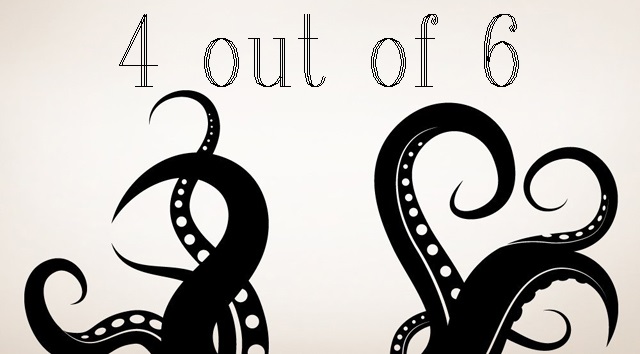
It is a shame though, think of it, zombie Lovecraft returns to edit his tales… He could finish ‘Azeroth’…  He could read this blog… Ermm… Oh hell…  Just to be on the safe side, I will give this a nice solid four tentacles… Just in case that shambling figure coming up behind me has been reading my thoughts on ‘Celephais and wants a quiet word…

4out 6

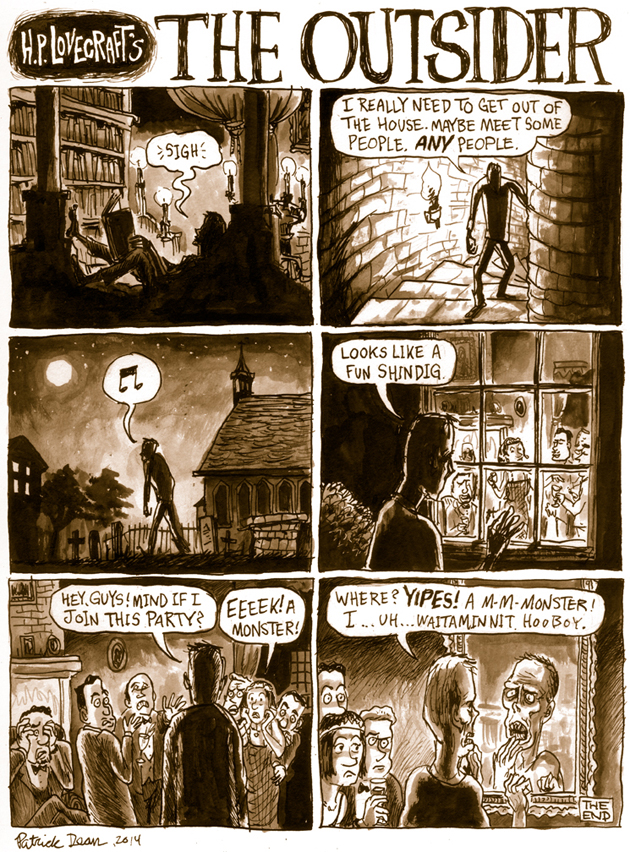
As a final aside to this one here is the complete synopsis of the tale in a quirky comic form just because it made me smile when I stumbled over it…

LovecraftComic outsider

Patrick Dean, the artist who created the comic, has more of these and lots of other fun stuff on his website, so if you enjoyed that pop along….  (his Nyarlathotep is genius…) http://underwhelminglovecraft.tumblr.com/

Further Lovecraftian witterings 


ASOA pres8 banner

Posted in cthulhu, horror, mythos, Nyarlathotep, reads, retro book reviews, Uncategorized | Tagged , , , , | Leave a comment

That Offensive Word…

The internet and ‘Faceache’ writers groups, in particular, throw up the occasional odd question. Odd to my mind at least, not odd to the person asking the question. Probably I find them odd because I have some fairly firm views rooted in British liberalism, as well as firm views on writing. Generally, I will comment, or not, as the mood takes me and time allows. Hoping to impart a little of my ‘wisdom‘ for want of another word. On occasion, I can get myself on a sticky wicket by doing so, but that’s the thing about opinions, we all have them, and if you have one you may as well use it on occasion. Also, I like writers groups and those odd questions sometimes lead to me having an expansive thought or two which may even be of value to the world in general… Besides as I have occasionally preached, involvement in the writer community is a good thing for a writer to undertake…

The latest ‘odd’ question I stumbled over was this one, which I am borrowing along with my response, which I have expanded on a little. Apologies to the questioner for stealing their question, which might have had its tongue firmly in its cheek when it was asked… It remains a bit odd, but an important one for a writer to consider all the same….

 So, the “n” word is off the table.
“Racist scumbag” is now off the table.
Will everyone please let me know what words offend them so that I can make sure that I don’t make things ugly?
Step right up — don’t be shy. If there’s a word or phrase out there that you don’t like, let me know and I’ll be sure to add it to my “List of Words and Phrases That Must Not Be Uttered By a Character.”

My answer is actually relatively simple, there is no “List of Words and Phrases That Must Not Be Uttered By a Character.” Nor should there be. I was a little more expensive in my reply. However, I have both edited ( mainly just to clean it up a tad) and expanded on it here after…

No writer should ever censor their writing in this way. If the character they are writing would use an offensive word, then use that word. Don’t get me wrong, this only applies to an internal monologue or a stream of consciousness and the characters dialogue. So where you use the word in question ‘which ever one it happens to be‘ is entirely dependant on the form your writing takes. An entirely first person narrative could use such words where ever they fall in the narration, a third person narrative, on the other hand, should only use such words where they should be coming from, the character.

As a writer, you’re not true to your character if you censor what they think and say. The important thing here is if your not true to your character the character will not feel real. Not to you, and certainly not to your reader. It doesn’t matter who your character is, a tough cop on the mean streets of Billingham or a lime green alien girl who dances in a strip bar just south of the planet Gimpplesuiten. They have to feel real, or the reader can not suspend their disbelief. They should talk, think and behave in a way which is true to that character. If they use words that are offensive in some way it is the character who offends. If indeed someone is offended.

If I can illustrate the point with a pop culture reference, ‘The Hound’ in Game Of Thrones constantly uses words that are offensive in of themselves. One word in particular I know several female friends of mine find especially offensive. Indeed it appears to be his favourite word. But that is part of who the character is and doing using that word as often as he does is true to that character… Those same GOT watching female friends of mine all like ‘The Hound’ as a character. If he suddenly ceased to use that particular word, the one that starts with a C as I am sure you can guess, they would I suspect quickly stop buying into ‘The Hound’s’ character. He would cease to feel real. Something Rory McCann, who plays him knows, which is why he has been known to add a few more C***s to the part than exist in the original scripts, despite the actor himself, not being inclined to use that word outside of that context. Which is the point, it is the character, and who he is that makes the use of that word right.

iss-78a0cf85-1bbd-4d2e-a265-99a60a2193ca

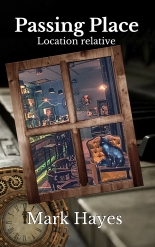
I myself have used that other big one, the ‘N’ word, in my novel Passing Place, it was used by Sonny Burbanks when he is telling his story to Richard, the Piano Player. Sonny is a coloured man who was born at the turn of the century, 1900, in South Carolina. Sonny’s world was one of the post slavery American south. A place rife with the racism of the time. He used it in the context of illustrating the verbal abuse that was inherent in his everyday life… It’s the only time the character uses the word, the only time the word appears in the novel. It fit what he was saying, and the story he was telling, and he would use that word that way. Do I, the writer, like the word, ever use the word or consider the word to be one that anyone should ever use in this day and age, or should have ever been used in the past come to that, no… But Sonny, the urbane, wise, doorman working at my impossible bar would use it in the context and in the way that he did. Frankly, I would have been untrue to him, and lying to the reader had I placed that word in his mouth. All I would have succeed in doing would be making Sonny the character less than what he is.

Sonny Burbanks is right at the heart of, or perhaps it’s truer to say embodies the soul of Esqwiths Passing Place, the transdimensional piano bar and grill that is the backdrop of the novel. He needed to be right, he needed to be ‘real’ for the readers. Or the novel would not have worked. He may not be the main character as the story of the novel is told from the perspective of Richard, but Sonny still has to be right, just as all the other characters have to be right. If I had not used that ‘N******’ when he told the tale that forms his backstory he would not have been as real as he is. Of all the characters in the novel, Sonny is the one that readers usually point to as their favourite. So I know I got him just right and made him real for them…

So there is my opinion, my view right or wrong. A writer should never censor their characters thoughts and words. And finally, I would add that if a reader can’t distinguish between the words and thoughts of a character, and find themselves offended by the use by a character of a particular word.  Then they (the reader) are been offensive to writers in question. No one is forcing anyone to read a writer’s work, you can not expect a writer to be untrue to his character and somehow make that character live at the same time…  Everyone has a right to be offended, don’t get me wrong, but no one has the right to impose rules or censor what characters can or can’t think and say. Or to think that a character should be any less than true to their nature…

adios for now

Mark

Links to my own social media, by all means, connect with me on them.

FACEBOOK    TWITTER   GOODREADS

Other posts on writing and self-publishing are collected here:

https://markhayesblog.com/publishing-and-writing/


Posted in opinion, rights, writes, writing | Tagged , , , , | 5 Comments

Scrap-ends…

For no good reason, or perhaps the best reason of all, I’ve spent a listless hour pondering my way through a folder on my desktop that predates the hard drive. The folders called scrap-ends. It’s an apt description used as a name. One which occurred to me when I made the folder initially several hard drives ago. It’s called scrap-ends folder because it’s where I deposit my scrap, in much the same way a blacksmith of old would dump the scrap ends of metal he has worked on in a pile at the bottom of his workshop, for when he needs a foot of half inch iron rod… Or, a wargamer puts all the bits from plastic sprues he has not used to build his space marines, for the day he needs a spare shoulder pad, bolt gun or orc head to mount as a trophy on a new model…

The old empire built things to last, even if lasting mean’t clinging on by its fingernails to the edge of the roof.

In the case of the folder on my desktop, however, ‘Scrap-ends’ is the file I dump all the odd little bits of writing I have worked on but never actually finished, a collection of ideas, rambling descriptive pieces, choppy narratives and (more than a few) opening pages of books that I will never write. Or at least have not written yet…

Those that were once us are baying, lost souls which in ages past ran with the great pack, now but broken shadows. They are baying for my blood, hunting me, leading their masters along the paths of my scent. They are straining at the leashes marks of their slavery.

To put it another way, ‘Scarp-ends’ is the digital equivalent of my note books. I, like most writers I have spoken to over the years, have a lot of note books scattered around with a few words scribbled down in indecipherable scrawls. Some of these date back to my teenage years, those best-forgotten times of utter confusion and wistful earnestness. Others are still fresh paged and awaiting the mutterings of muses that will inspire me to scrawl something down in them. (often when read back later I need to decode my scrawl first to figure out what the hell I wrote down…). But I work mostly on the keyboard these days, with word as a rule, though I occasionally have a wander to strange pastures like scriggler… As such, I occasionally type away when that muse inspiration has crept up behind me with a lead-pipe, while my heads still ringing from the blow. Sometimes just for one night, or a couple of hours or ten odd minutes grabbed before I have to rush somewhere while the idea was fresh…

He removed his bowler hat and brushed the ever present dust off the crown. Not that it made any great difference, dry motes of dust were attracted by his clothing in the most polished environment, and the office of de’Manfess and Mr Spleen, Practical Lawyers to the Court.’ were anything but. If there had been air in his lungs he would have sighed, instead it was more of a whistle as the air sucked in through the holes in his chest.

Strange idea’s, bizarre plots, grotesque and beautiful characters, funny little diatribes and whole elaborate worlds, in concept at least, have been created and then expired in this way. Like microcosmic universes, born in vibrant explosions, only to boil away into nothingness after mere moments. Generally for a very good reason. What reason you ask?

Small prey, unworthy the effort, I move away from the things of man. Feeling the joy of my new form.

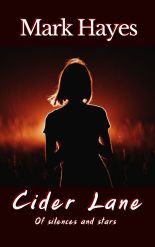
Well, because I am too busy writing something else at the time. Or the idea fades in my mind. But mostly the former. If I stopped writing Cider Lane when another, possibly equally good or even better idea occurred to me, I would have never finished Cider Lane. Passing Place, a novel that started out as one of my scrap ends, if not several of them, took five years to write because I was so busy writing scraps. Though that includes a year of writing Cider lane which also started out life as a scrap-end I was playing with while I was struggling with Passing Place. Unlike most scraps, it did not burn bright then fade away from my mind, and I found myself staying with it.

The watchers in the shadows of the courtyard mostly agreed afterwards that it had not been malice on the kings part. He was, they were all sure just punching the air in his rage. It was a pure accident that the heralds head happened to be in the way.

Currently, I have three novels in the works, ‘Something Red’ the sequel to ‘Passing Place’, ‘A Spider In The Eye’ a Hannibal Smyth steampunk/Flashman comic novel, and ‘Maybe’s Daughter’ a more possibly more serious steampunk tale. Yet I still bash out the occasional piece of scrap. It’s a fun way to get your narrative juices flowing sometimes. And of course, all of the above started out as fodder for the scrap folder. It is a constant well of inspiration in some ways. In others, it is a graveyard for lost ideas and the novels I will never have time to write… But graveyards have head stones, and all those odd little quotes scattered through this post (in case you’re wondering) come from those headstones.

The incisor long lost in a school yard fight over a girl, whose name I hardly remember, sprouts anew.

Every writer needs a notebook, and in this digital age, every writer needs a ‘Scrap-ends’ folder. Or maybe it’s just me… But I can’t help wonder some times, when a strange mood takes me, if deManfess and Mr. Spleen practical lawyers to the Fea court will ever get to search for the human child who stole what ever it was the King wanted to keep safe. Indeed what is de’Manfess? Mr.Spleen is a zombie of some kind, but his partner, no idea apart from ill-tempered. And what, when it comes down to it, is a ‘practical’ lawyer? I no doubt had answers to these questions once, for a fleeting few hours, perhaps at some point, I will pick up the scrap and start writing and then maybe I will find out. The same is true of the wolf’s tale, the strange tale of the shy tower, the woman (possiably she was a woman, I really don’t remember) in the woods, or the other scrap ends I read through earlier.

Hopefully, I will get to find out someday, and as this post is a bit of a scrap-end itself I shall leave you with this odd little scrap thought from the scrap-end folder for which I have no context at all…

I am seldom short of words but never sure what to say, while dreaming of the perfect sentence…

Posted in books, indie, indie novels, indie writers, nanowrimo, opinion, quotes, reads, the elf kings thingy, writes, writing | Tagged , , , , , , , , | 2 Comments

The Bad Review…

No one likes to receive a bad review, be it as a writer, as a seller on eBay, or for that matter for your pecan pie from a dinner guest…

download (9)

In the case of the pie, well if your guest doesn’t like it they don’t have to eat it, and what the hell, more pie for those who do.

As far as eBay is concerned a bad review as a seller can be a kick where it hurts, it might even freeze your account. (as happened to me once when the buyer of a spare ADSL adapter I sold them for a quid complained about the price, the packaging and the wrong kind of rain ruining their begonias.)

As a writer, it can hurt, because what is reviewed is something you have put your heart and soul into. It’s like beating up on one of your children and may seem like it has been done for no other reason than malice. (much like the eBay review that got me banned as a seller, despite sending them a second ADSL adaptor and really going the extra mile to accommodate a string of increasingly ridiculous requests, bitter, moi? Not at all.)

Only the very vain, or the stupid, would expect to please everyone, or that their work will be universally praised. Getting a bad review is just something that happens. As a writer, you’re supposed to live with it and move on. Perhaps, if the criticisms are valid, intelligent and constructive, you can learn from a bad review. But if you expect everyone to like your novels you need a bit of a reality check. Yet despite this, bad reviews still hurt you personally, unless your skin is thicker than rhino hide. Reviews that seem driven by nothing but malice, however, well that’s something else, and I am not even sure how to respond to them. Which, in case the title was not a clue, is the reason for this particular post…  To be exact, this American review of Cider Lane…

1.0 out of 5 stars Not worth the time
ByAmazon Customer on June 21, 2017
Format: Kindle Edition
I wish I could give this no stars. The book skips back and forth, is very disjointed and frankly did not hold my interest. In the beginning, I liked the character development, but this quickly failed too.

As you can see from the date, I have sat and stewed on this for a while now. If anything this post is about moving on from that and putting it behind me, because it has been sat there irritating me for a while. Not because I feel it is an unfair review, assuming this is genuinely what the nameless reviewer thought then they are entitled to their opinion. Cider Lane has plenty of great reviews, which balances out any damage to my ego, though not the damage to its rating on Amazon.com, as I have fewer reviews on the US Amazon site so this single bad review has an unreasonably adverse effect on the rating. Most of the reviews are on Amazon.co.uk, but I am a British Author, and to the extent that the book is written for an audience it is set in Britain, in British English and is more likely to appeal to British readers, the rating on amazon.co.uk isn’t affected at all by the review above.

The reason it irritates me is what the reviewer says. It’s clear they did not enjoy the book, it’s also clear they either did not enjoy the stylistic and narrative choices I made when I wrote it. That’s fine BTW. I made narrative choices about how I wished to tell my story. I could have told it is a simpler straight through fashion. Start a story at point A, write in a straight unweaving line to point B… But I wanted to write something I found interesting as a writer, a little more challenging as a writer, and in fairness perhaps more challenging of the reader. This would be what the nameless reviewer refers to as ‘skips back and forth’ which I can’t deny, but it does so for good reasons.

Cider Lane is told in the main from the perspectives of its two main characters, Susanna and Colin, in alternate chapters. Once the paths of these two main characters cross their stories intertwine. They are very different characters. Their individual perceptions of events differ. Indeed, it is how each of them perceives different events, how their motivations differ, and how the actions of one are misunderstood by the other that is the core of the story. It is that which made the story an interesting one to tell, and that was the challenge in telling it. The difference between the one holding the blade, and the one the blade is pointed towards, and the interplay between these two narrative viewpoints is at the heart of everything. To complain it ‘skips back and forth‘ is to miss the point entirely.

Yet, even that is fine. I never expected it to be a novel for everyone. I  never expected everyone to ‘get’ it. There are several reasons why I chose to self-publish this novel, rather than pursue a publishing contract, but one of them was simply that I would not expect a publisher to want to publish a first novel that makes off-beat narrative choices from the word go. If for example,  Iain M Banks was not a best-selling author already then I suspect his publishing house would have rejected ‘Use of Weapons‘ because of the narrative choices made in the novel. (The narrative tells the story in a reverse chronology, beginning at the end and moving to the beginning of the story) While Cider Lane is not ‘Use of Weapons’ and the narrative choices are not quite as boldly different, it is still atypical, and off-beat enough that the mainstream would not touch it with an unknown writer. For exactly the same reason, I never expect it to be universally liked, not everyone enjoys something atypical.

What does bug me is this, why would anyone write this review in the first place? There is nothing constructive about it, it is just a demolition for the sake of a demolition. It is not comparable to going out to a restaurant, been insults by the staff, being given cold food, badly cooked and then over charged, such an experience would warrant a bad review. It’s a novel, one the reader clearly did not enjoy, which is fair enough, but to be this scathing, and even to take the time to write a review for a book you have enjoyed so little seem strange to me. When I am not enjoying a book, which happens once in a while, it’s either because it ‘isn’t for me‘ or because I just am not drawn into it. What I do then is put the book down, and read something else. If I read a whole book, it must have had something in there for me. I don’t think I have ever reviewed a book and given it less than three stars, certainly not if I am actually taking the time to write a review, I would have to really really hate a book to give it one star and state I would have preferred to give it none at all. I could understand this (to an extent) if the review had paid $20 for a hardback and then found out they hated it. But in all probability, given when the review was published on Amazon, two weeks after the Kindle giveaway when I made the novel free for a week, the anonymous reviewer paid nothing for my work at all. A free book he or she did not enjoy, yet took the time to write a hatchet job on…

It’s almost a back handed compliment that a review was written at all. I’m not discouraged by it, indeed apart from a blip on my Amazon ratings its just seems to me to be the rantings of a strangely objectionable individual. This little post has let me get it off my chest. Cider Lane has plenty of great reviews, it even won an award once.  Take the review at the bottom of this page, also from Amazon.com,  A review so good I had to pinch myself ( and double check it was Cider lane they were talking about frankly as it sounded like a better novel than my own to me when I first read the review.)

What ever moved ‘ByAmazon Customer on June 21, 2017‘ to write such torrid a review of Cider Lane, in the unlikely event they ever read this, I am sorry you disliked the book so much. But I hope, and indeed pray to the fictional sky god of my choice, that you both, find some joy in your life, and never read one of my books again. Or indeed anyone elses, because I am not sure anyone deserves reviews like this… Writer’s strive to craft something from nothing, sometimes we fail, but no writer ever deserves a review like this. We all get them though, once in a while, we all scream with frustration once in a while. This is me ranting it out of my system, so now that’s done I shall take a breath and get back to writing stories that people, on the whole, seem to enjoy.


And: Just to redress the balance of the universe…

5.0 out of 5 stars An Excellent Existential Read!!
ByA Randallon November 21, 2015
Format: Kindle Edition
“All these anxieties are in your subconscious only. You must reconcile yourself with the environment around you. Come to comprehend you are under no threat. Aspect your milieu and scrutinize it in immeasurable facet. You will conclude you have naught to endure with apprehensive quintessence.”

You must, you must, you must. You will, you will, you will.” It is the dictate of Society, the so called “social norm,” which we all find ourselves conforming to.

These are the instructions given Susanna by the psychiatrist her parents have hired to render her “normal.” A bullied, anxious teen, Susanna has developed a coping mechanism of withdrawal deep into her own mind and soul, so effective that she is able to block out the horror of seeing her family perish in a burning car. The only survivor of the accident, she internalizes feelings of anger and guilt, while simultaneously reinforcing the mental process that separates her from her fears, via a deeply ingrained numb existence. In a state of shock after the car accident, her numbed state-of-mind leads her to an empty cabin on Cider Lane where she will meet Colin, a drifter who, from personal experience, has learned that Society’s dictates of “must” and “will” serve only to define—and confine—the human spirit in a power-hungry world, filled with selfish ambition, where those who refuse to conform find themselves on the fringes of humanity.

“Cider Lane” by author Mark Hayes is steeped in existential questions of “being.” What is our purpose? How does one define Right and Wrong? And who exactly is it that deems himself/herself worthy of standing in decree of Right and Wrong? And why do we listen when those who pass such judgments are as human as the rest of us? In this book, Mr. Hayes has given us much to think about as Susanna and Colin come to know one another and discover that transcendence of soul and mind can be dangerous in an automated atmosphere of “musts” and “wills.”


Posted in book reviews, cider lane, opinion, writes, writing | Tagged , , , , | 2 Comments

The Nameless City: The Complete Lovecraft #29

“That is not dead which can eternal lie,
And with strange aeons, even death may die.”

~Abdul Alhazred

There can be few tales of tales more Lovecraftian than ‘The Nameless City‘. A tale rejected by ‘Wierd Tales‘ twice and a succession of other professional titles, almost published in a magazine called ‘The Fantasy Fan‘ which manages to fold just after accepting the tale. Then finally been published six months before Lovecraft’s death in the ponderously titled ‘Fanciful Tales of Time and Space’ a quarterly magazine of such high reputation you probably never heard of it until now.

As an aside into sci-fi magazine history, ‘Fanciful Tales of Time and Space‘ ran for a whole one issue before it disappeared due to the amount it had cost to produce in the first place… it is now a very rare collector’s item, so rare in fact that even a copy of the 1977 facsimile reproduction would cost you $40 from a rare book dealer, an original 1936 copy in reasonable condition went for $350 at auction in 2007, which is the most recent sale of one I can find.  Lovecraft collectors, in particular, would pay a lot more than that now for a copy should you ever find one in an old attic somewhere. Not least because while this was not the first true Cthulhu mythos story to be published, it is considered by many to be the first of those mythos stories to be written by the old tentacle hugger. Of course, if you are a Lovecraft reader, crawling around old attics could play on your nerves somewhat, who knows what could lay in wait behind that moulder stack of cardboard boxes that smell of the rank fear of small rodents and strange fungi…

Regular readers will know I do not entirely agree with the orthodox view of ‘The Nameless City’ place as the first Cthulhu mythos story. There are hints, and suggestions aplenty in earlier works like ‘The Temple‘ and ‘The Doom That Came To Sarnath to name just two. Lovecraft had been finding his way to the streets of  ‘The Nameless City‘ for some time. Indeed, the latter of those examples crops up in this story when our narrator is describing the lost city he has stumbled upon in the Arabian desert…

 …and thought of Sarnath the Doomed, that stood in the land of Mnar when mankind was young, and of Ib, that was carven of grey stone before mankind existed…

The orthodox view stems in part from this tale holding the first mention of everyone’s favourite mad Arab and author of the Necronomicon, Abdul Alhazred. the writer of the ‘dreadful’ two line poem at the top of this entry. Dreadful in the literal sense, in that it encompasses dread and the doom that will come to all when the stars are right, the big bad who sleeps below the waves reawakens, and the old gods crash through the dimensions we laughingly call reality…  The mad old beard tugging, teeth gnashing, doom merchant Arab returns in most of the major mythos stories to come,  ‘The Hound’, ‘The Festival’, ‘The Shadow out of Time’, ‘The Case of Charles Dexter Ward’, ‘The Dunwich Horror’, ‘The Whisperer in Darkness’, ‘At the Mountains of Madness’, ‘The Dreams in the Witch House‘, ‘The Thing on the Doorstep‘, and  of course, ‘The Call of Cthulhu‘. All of which were written after and almost without exception published before, ‘The Nameless City‘. To say Abdul Alhazred has an important role in the Cthulhu mythos is some what redundant… So the fact he is first mentioned here certainly adds strength to the orthodoxy. It’s also interesting that Lovecraft himself considered this to be among his favourites of his own stories, perhaps because this is where so many threads in his earlier work come together to form a greater whole. Certainly, I ain’t about to argue against the writer’s opinion of his own work. While I may disagree with the orthodoxy, ‘The Nameless City‘ is the ideal place to start if your interest in Lovecraft stems mainly from his Cthulhu mythologies…

2012-06-08-namelesscity-2-sketch7

Lovecraft may have considered this a favourite, but it is not without criticism. Lin Carter, who among other works wrote a number of stories based in and around the Cthulhu Mythos, once said of it…

“a trivial exercise in Poe-esque gothica”, “overwritten and over-dramatic”.

Lin’s pastiches are probably the largest body of Lovecraft inspired work to be centred directly on his mythos, indeed, he doubtless made a better living out of Lovecraft’s creations than Lovecraft ever did himself. Including a lot of work for Chaosium the makers of the ‘Call of Cthulhu‘ RPG games, who probably did more to bring Lovecraft to the attention of my generation than anyone else. That Lin calls the story Poe-esque is in ‘the pot calling the kettle to confirm its colour’ territory. Lin’s built he career the shoulders of other writers. His Lovecraftian tales are very much written in the style of Lovecraft, just as his Conan and Kull tales are written in the style of Robert E Howard (in this case to the point where he post-humorously co-authors several of Howard’s unfinished tales…). While he went on to write a lot of interesting, fun, and well-written work that was entirely his own, and in the style of Lin Cater, it is fair to say Lin was a master of the pastiche and has no leg to stand on accusing Lovecraft of borrowing from Poe in this way. At the same time, however, this does mean he is well placed to hold an opinion on whether ‘The Nameless City‘ is ‘over written‘ having spent so much time writing in the style of Lovecraft himself.

Lin has a point, though I am loathed to agree entirely. ‘the Nameless City’ does have an ‘over written’ feel to it. Take this passage…

In the darkness there flashed before my mind fragments of my cherished treasury of daemonic lore; sentences from Alhazred the mad Arab, paragraphs from the apocryphal nightmares of Damascius, and infamous lines from the delirious Image du Monde of Gautier de Metz. I repeated queer extracts, and muttered of Afrasiab and the daemons that floated with him down the Oxus; later chanting over and over again a phrase from one of Lord Dunsany’s tales…

In that one passage, Lovecraft drops more names and academically clever references than a desperate for attention starlet at a Hollywood party. Only the Mad Arab himself is entirely fictional. The tension of the narrator tale builds up steadily throughout, as Lovecraft stories are want to do, but even for Lovecraft, there is a piling on of tension that makes ‘The Temple’ seem like a merry little jaunt in a submersible…  Overwritten may not be entirely fair, as the tale sets out to build lay upon lay of fraught tensions as the narrator delves deeper and deeper into the nameless ruins of a city that predates all historical records, possibly predates even mankind. As he delves deeper, the more disturbed and the more disturbing his story becomes. This layered approach to the tale negates for me the over-dramatic accusation, it is what it is, and what it is supposed to be. A deep dive into the past, through the dust of aeons, in a city built by a race alien to our understanding, a race of lizard creatures whom may still survive in the depths of the ruins, waiting for a time to emerge once more…

I said at the start few tales of tales are as Lovecraftian as this, the same applies to the tale itself. This is for me Lovecraft writing for Lovecraft. He did not write this with the view to sell it (though god knows he tried to do so.) He wrote it for himself, for the writer he wanted to be, telling the stories he wanted to tell. Which is why I suspect it was among his favourites, we are always proudest of our true born… If it is over written it is done so on purpose, this is exactly what Lovecraft wished it to be. After all what is more Lovecraft than this passage towards the end of the tale…

Monstrous, unnatural, colossal, was the thing—too far beyond all the ideas of man to be believed except in the silent damnable small hours when one cannot sleep.

It is not perfect, but it close to being the perfect Lovecraft tale, for which alone I would give it five tentacles, groping out for us all from the dark recesses of its creator’s mind…

5out 6

It is another of the free to read tale available from the Lovecraft archive so if you fancy a walk through the ruins of a reptilian race not quite as dead as you might like them to be you can find it here:- and until next time I will leave you with a single thought, those Egyptian must have got the idea of Sobek the crocodile god from somewhere right, and you can hide a lot of cities under the sands of the desert… Lovecraft was just making all this up right?…

Further Lovecraftian witterings 


Posted in Lovecraft, mythos, reads, retro book reviews, rites | Tagged , , , , | 1 Comment

Courting Disasters…

Lawyers are almost always played out on TV as smart, snappy, insightful individuals of high intellect who ask just the right question to catch a witness or a defendant off guard. It has become something of a stereotype, and like most stereotypes, in the real world they don’t always play out exactly as you expect them to. A while ago, as I was doing some research on a novel (literal translation, browsing the internet for anything that could distract me from writing my next novel…) I came across a few examples of court transcripts where the Lawyers were having a bad day to the bar…

tumblr_m4yjp0UlGO1rwm1nmo1_500

These are not jokes, just genuine bits of court transcript… For no other reason than the amusement factor, I have collected a few over time and thought I would share them here… Enjoy…

Lawyer: Doctor, before you performed the autopsy, did you check for a pulse?
Witness: No.
Lawyer: Did you check for blood pressure?
Witness: No.
Lawyer: Did you check for breathing?
Witness: No…
Lawyer: So, then it is possible that the patient was alive when you began the autopsy?
Witness: No.
Lawyer: How can you be so sure, Doctor?
Witness: Because his brain was sitting on my desk in a jar.
Lawyer: I see, but could the patient have still been alive, nevertheless?
Witness: Yes, it is possible that he could have been alive and practising law.

Lawyer: How far apart were the vehicles at the time of the collision?

Lawyer: Doctor, did you say he was shot in the woods?
Witness: No, I said he was shot in the lumbar region.

Lawyer: Now doctor, isn’t it true that when a person dies in his sleep, he doesn’t know about it until the next morning?
Witness: Did you actually pass the bar exam?

Lawyer: What did the tissue samples taken from the victim’s vagina show?
Witness: There were traces of semen.
Lawyer: Male semen?
Witness: That’s the only kind I know of.

Lawyer: Can you describe the individual?
Witness: He was about medium height and had a beard
Lawyer: Was this a male or a female?
Witness: Unless the Circus was in town I’m going with male.

Lawyer: How was your first marriage terminated?
Witness: By death..
Lawyer: And by whose death was it terminated?
Witness: Take a guess.

Lawyer: Doctor, how many of your autopsies have you performed on dead people?
Witness: All of them. The live ones put up too much of a fight.

Lawyer: she had three children, right?
Witness: yes.
Lawyer: how many were boys?
Witness: none.
Lawyer: were there any girls?

Lawyer: You were there until the time you left, is that true?

Lawyer: So you were gone until you returned?

Lawyer: You say the stairs went down to the basement?
Witness: Yes.
Lawyer: And these stairs, did they go up also?

And finally a personal favourite of mine ….

Lawyer: Did he kill you?
Witness: ………….(too dumb struck to answer we assume.)

Posted in goodnews, humour, writes | Tagged , | Leave a comment

Sweet Ermengarde: The Complete Lovecraftian #28

Some collections of Lovecraft which claim to be complete utterly ignore ‘Sweet Ermengarde’, thus expunge it from their pages. There are reasons to do so, not necessarily good reasons, but reasons all the same. I know this because of the two ‘complete‘ collections I own, and only one of them includes the tale within its pages. Also, Lovecraftian scholars commonly discount the story, as it is not linked in any way to the mythos and I suspect because it is not in anyway pompous or worthy. You see, Lovecraft, that most serious, austere and priggish of writers, which ‘scholars’ of his work admire, ‘lowered’ himself when he wrote Sweet Ermengarde, to the level of a common parodist… For this horrendous crime (being funny and enjoying himself by taking the piss, gently, out of a particular kind of story) some of his scholars denigrate this story as not being ‘Lovecraft‘. Despite the relatively clear fact that he wrote it. Though I must add here, others hail it as a comic gem alongside ‘A Reminiscence of Dr Samuel Johnson’ as I discovered while doing some research on the story that was noticeably absent from my Kindle edition of ‘The complete Lovecraft…’

download

Now before we go any further, let me deal with that comparison. If you have read all these posts from the beginning, you will know my opinion of ‘A Reminiscence of Dr Samuel Johnson’  is a bit of a mixed bag. It was the only story so far to get zero tentacles (though it did get four Johnsons) and as I said at the time:

It is not what I expect from a writer of horror and delver of the dark places of the human psyche.

Which of course puts me in the same category as those Lovecraftian scholars who dismiss ‘Sweet Ermengarde: Or The heart Of A Country Girl’ to give it its full title, for not been real Lovecraft… So that’s me hoist by my own petard. Dismissing a tale because it’s outside the writer’s typical genre… I should know better.

I have never believed in sticking to a genre as a writer myself, or that any other writer should stick to a genre. This is not to say common traits don’t run as threads through my own work or that of other writers who write in different genres. I can tell a text is by Stephen King whether it’s horror, sci-fi, or contemporary fiction about escaping from a prison by crawling through the shit pipe… But no one is dismissing as unworthy ‘Rita Hayworth and the Shawshank Redemption‘ for not being horror, just because its writer is most renowned for horror staples like ‘Carrie‘ and ‘Christine’. Nor do they degrade his play at the fantasy western ‘Lord of the Rings‘ style epic ‘The Dark Tower’ for not being ‘Misery‘. No one applies genre restrictions to Mr King. I don’t apply them to my own work, (Cider Lane and Passing Place are two completely different novels, not even vaguely in the same ballpark). So why so I or indeed we ascribe such restrictions on what is and isn’t Lovecraftian fiction. H.P. wrote ‘Sweet Ermengarde’ and just because it is not his normal work does not mean it should be dismissed by anyone. Including me… So Let us regard ‘Sweet Ermengarde’ as her suitors Squire Hardman, and handsome Jack Manly do in the tale, as a simple country girl which should be judged on her own merits, or at least those of her father’s farm and his liquid crop of good moonshine…

If you have not guessed from the names of her suitors alone, Sweet Ermengarde is not a work of subtle humour. Indeed Lovecraft does his best to throttle a joke out of every opportunity, as this early passage describing his erstwhile heroine shows:

Ermengarde confessed to sixteen summers, and branded as mendacious all reports to the effect that she was thirty. She had large black eyes, a prominent Roman nose, light hair which was never dark at the roots except when the local drug store was short on supplies, and a beautiful but inexpensive complexion.   

Subtle is not the word… This is humour with a bludgeon, and strangely enough, it reminds me of early Prattchet, of ‘The Colour of Magic,’ ‘The Light Fantastic‘, pun-laden and aggressive in its parody, (Unlike Pratchett’s later more successful and subtle works that cast direct parody aside. Oddly enough Prattchet parodied Lovecraft in ‘The Light Fantastic’ with a great old one in an ancient dark, dank temple causing havoc for Rincewind and Twoflower…). Ermengarde also has much in common with some of P.G.Wodehouse’s shorter fiction of whom Lovecraft was a contemporary and Prattchet a fan. Though both are better writers of humour than Lovecraft on the evidence of this tale, there is enough here to draw favourable comparisons to them all the same.

The target of Lovecraft’s parody is a certain kind of novel, which follows a predictable plot, young innocent girl falls in love with a Manly boy, while she been subject to the attentions of a lecherous misser who seeks her fortune. There is much spurning, rejection and double-dealing lead to fortunes been reversed and reversed again. While the motives of all become more spurious as time goes by. Until the young girl becomes a more worldly,  far less innocent and manipulates events to best suit herself. There is innuendo, puns and a plot which holds a certain amount of delightful silliness about it. A rags to riches story, all be it a parody of one, of the type read by an entirely different crowd to the weird tales audience Lovecraft normally wrote for.


Is this Lovecraft’s best work, no, not by any margin. It did not find a market until some six years after his death and even then it was as a filler in a collection of his stories rather than a work in its own right. It stands out only because it is so different from his norm, and perhaps had he found a market for this kind of tale in the early 1920’s, he might have written more under the pseudonym ‘Percy Simple’. There was a market for such comic tales from which many writers made a good living. Perhaps, however, the loss to the comedic pages of magazines like ‘Punch’ etc. is our gain. Had Lovecraft focused on tales like this he may have gotten closer to his goal of making a living from his writing than he ever did, but the horror genre would have been poorer for it, and as I said, he was on this evidence no Wodehouse…

Should you read it? Well, as it’s in the public domain it can be found here, if it does not appear in your own ‘Complete Collection’. It should bring a smile to your lips if not a chill to your spine. It is not your usual Lovecraft, it hardly rates even the smallest of pseudopods, let alone its own tentacle. It is funnier than you would think though and an oddly compelling read. So no tentacles but otherwise I would not dissuade you from doing so if you want a good chuckle…

0 out of 6

As an aside, Sweet Ermengarde is also the name of a German Goth rock band, who have produced among other things a whole album of Lovecraft inspired goodness called EX Oblivione...

a2958310677_16

Which I have linked here just because… well I have a fondness for Germanic Gothic Metal bands that stems from my love of Bauhaus, and its a nice link into the previous bit of Lovecraftian goodness EX Oblivione I reviewed last time… If you listen to it, listen to it loud… I am not sure if Lovecraft would approve, and Percy Simple I suspect would approve even less, but no one ever claimed you had the right to censor what you inspire in others… Any more than editors should decide what can be included in a complete set of your works…

Further Lovecraftian witterings 

Posted in goodreads, humour, Lovecraft, reads, retro book reviews | Tagged , , , , , | 2 Comments

Speaking the words and the necessary evil

I have an odd confession to make, well not so much a confession, I require no absolution here, but a confession all the same. My previous blog post, EX Oblivione, was not written by me…

Well not as such, I wrote it, I haven’t started cheating and farming out my Lovecraftian blog challenge to other writers. I just did not write it the way I normally would. Fingers to the keyboard, ‘tippy tappy type…’ labouriously typing one word after another on my ever worn down keyboard. Instead, I tried something new, rather than type the blog out I spoke to the computer and let it do the typing for me, using the inbuilt speech recognition software that comes as part of Windows 10. An experiment of sorts and as a means to defeat that old necessary evil… But I get ahead of myself… Let me take this back a little first…

IMG_4739

Way back in the grim dark age of technology, or as we called it at the time the 80’s, I learned to type on an ink ribbon typewriter. I would have been twelve or thirteen at the time, earning pocket money by typing up my dads plumbing invoices. Then wasting his ink and paper typing stories more in hope than expectation while black vinyl spun on the turntable at 33rpm. A time which taught me the value of learning a skill (20 pence an invoice added up in the pocket money stakes) and the value of Tipp-ex liquid correction fluid. Which, I may add, was not to be used on invoices. Mess up an invoice and you started over, which probably cost my old man a fortune in headed notepaper. I did, however, use it in my attempts to write stories and those first vainglorious attempts at the writer’s craft, which given that I am dyslexic meant I used rather a lot of it. So much that I am surprised I was not high as a kite listening to those 80’s grooves, inventing strange worlds and even stranger characters in my early teens.  Correction fluid is solvent based and was a favourite huff of a certain kind of school boy back in my youth…

Dyslexia is a curse of a kind and an occasional blessing, but it does not help you as a typist, and the quicker you try and type the more often you make weird little errors. In these more enlightened times of the internet, google, computers and importantly to myself word processors, dyslexia is less of a curse to my typing. Though it certainly makes for mildly annoying little typos ( such as my innate ability to type form instead of from every time and spell the ‘teh’ nine times out of ten when I type) and of course those far more annoying ‘necessary’ evils…

If you’re paying attention, you may have noticed me use that odd phrase from the title of this piece a couple of times. So I should perhaps explain what the ‘necessary‘ evils are… As a dyslexic, my Achilles heel is words that are not spelt phonetically ( like ‘fanetically‘ itself for example). The English language is full of them, and my brain doesn’t do that little leap that tells you to ignore what it sounds like and spell it the ‘right’ way. It’s too busy just managing to bridge the divide created by the weird bit of wiring that is going on behind my eyes… My accent doesn’t entirely help in this case either. I do not speak BBC middle English, I am a Yorkshire man from Leeds who has lived in the north east for some time and picked up hints of Newcastle and Middlesbrough along the way…. Which is to say the Phonetic’s I speak in are not entirely the Phonetics of newsreaders…

Wordprocessors and add ons like Grammarly are a fantastic boon with many things. They pick up most of the ‘from’ form’ errors and all those annoying ‘teh’s. But word processors have their own Achilles heels, and necessary is one of them. You see necessary according to my brain is spelt ‘ness-er-cery’ and there is not a word processor in the world which will correct that. It is only because I use the word often enough to take a mental back step when I type it that I manage to not spend five minutes wrestling with different letter combinations (and occasionally bludgeoning it) until the word processor finds one that’s close enough to right for it to correct it for me. Which would not be too bad, but necessary is but one of many words that catch me out and fuddle spell checkers at the same time. More than once I have known the exact word I wish to use but ended up changing it to another just because I have had enough to spell checker wrestling. The upshot of which is I spend a lot of time editing, even when I am not editing…

Which brings me back to where I started and the previous blog post experiment… I am, when not writing, a techy. Which is to say I work with technology and am an engineer by trade. So it is natural to me to find technological solutions to my problems. One of which is the amount of time it takes to write first drafts. I type fast, but I edit myself as I go, so which the characters may flow from the keyboard, my actual typing speed is a trade off with the amount of basic editing I have to do. the faster I type, the more teh and ‘from’ ‘form’ I have to deal with, and all the others I have not mentioned. Let alone all those basic little errors that creep into my typing. So while telling ‘Alexa’ to play some Dillon a few days ago it occurred to me that these days I talk to my hi-fi, I talk to my phone when I want it to ring some one, or just answer a question about the nearest coffee shop… I even talk to my Kindle these days as I just upgraded to one with Alexa on board… So why in hells name do I type everything I write on my PC…

As I am a techy the next thing I did was run over to keyboard and start looking up the best speech to type software that was out there in internet-land… Which proved to be a bunch of expensive options and a long list of incompatibilities… I was a tad disheartened because here was a solution to those ‘necessary’ evils and the ‘from’ ‘form’ problem. as well as my general ecliptic typing… But the best speech to type software did not appear to compatible with Office 365 and would require an investment of cash I was not entirely certain I wanted to make for something which I may decide I hated or turn out to be useless for me. I write in a certain way because I think in a certain way and deal with my dyslexia in a certain way. Dictating to my PC may actually hinder my creative methodology as much as it benefits my transcriptions…  And I so hate to waste money (you can take the man out of Yorkshire, but he will always remain a Yorkshire man all the same, deep pockets and short arms tis the way…) So I shelved the idea to the back of my mind for a while.

Then I realised that I was missing something rather important. While looking through a couple of tech sites on the off chance of there being a freeware solution out there, windows 10 comes with a speech to type app. Yes, that operating system most of us not praying at the church of St Steve are using has all the software I needed, built into the OS. It just had not occurred to me to look. It might not be the cutting edge best in the market, but it was a good place to start.

So, long story not made particularly short that’s what I did. I set up speech to type and decided to try it out on a Lovecraftian blog post. My innate pessimism expecting teething problems (there were many) but hopeful that the experience would be useful. Which it was, though there are a few issues. However, it occurred to me others may wish to try this themselves, and while I am back at the keyboard tonight, writing this blog post, I am going to repeat the experiment a few times and try using it for the first draft of my next but one novel ‘Something Red’ the sequel to ‘Passing Place.’   (‘Spider in the eye‘ is in final drafting and I am not going to even attempt to use speech to type to do that, certainly not yet anyway). I intend to do a little work on ‘Something Red’ in the next few weeks anyway so its a good time to experiment…

So things you need to know if you want to try speech to type with Windows 10, most of which I learned the hard way…

  • The Win 10 program is an access aid rather than just speech to type, so it is global to your pc and you can find your changing web pages by mistake when you say the wrong thing, which is a little weird and bloody irritating…
  • Run the training program, it teaches you how to use the software to edit etc but importantly it ‘trains’ the program to your voice and how you say words ( I did not do this till I had grown somewhat frustrated with the app. it was working so much better afterwards)
  • Perceiver, after the ‘training‘ app has run you will know how to highlight a word the app ‘hears’ wrong and correct it without using the keyboard and the app is smart, it learns from its mistakes and ‘hears’ you better as it learns those little foibles of your voice. So the more you use it, and the more you correct it without resorting to the keys, the less you need to and the more the words just flow.
  • Use the insert key often… the text appears in a little box (at least when using it to write in a web page) and you have to insert it into the page. Nothing is more frustrating in this process than ‘writing’ several lines and losing them when the app decides you just told it to go to a web page…
  • Never leave a web page open when you have searched the word ‘Nihilism’ an hour ago, forgotten doing so, then use it in what your ‘writing’ and then what the text box vanish while the web pops to a different window… ( okay that last one was just me, but it’s a general point)

As an experiment it was I think a successful one. True, the post took longer to write than normal, mostly because I was wrestling speech to type even more than I wrestle the word proccessor. Though once I learned how to use the software to make the app learn my voice properly things improved dramatically. And yes I finished it off by hand after the first drafting of the post. But that was the point, what I wanted to achieve was first drafts which didn’t feel like an exercise in editing as I go. More to the point if I do edit I want it to be editing, not wrestling the word processor, the endless stream of ‘teh’  ‘form’ and all those ‘necessary’ evils to deal with..

So, I have seen the future, it does the typing for me while I talk to it… As long as it doesn’t start talking back, it will be a good one…

Posted in opinion, self-publishing, writes, writing | Tagged , | Leave a comment

EX Oblivione: The complete Lovecraftian #27

“There is nothing better than oblivion, since in oblivion there is no wish unfulfilled.” ~ H.P. Lovecraft ‘In defence of Dacon

As a philosophical statement, let’s be honest here, the above is a bit on the bleak side. Though no one ever accused our man Howard of having a sunny disposition. This particular tip-bit comes from a nonfiction essay he wrote in defence of his fiction in 1921, which by coincidence was also when he wrote EX Oblivione. A certain nihilism was evidently on his mind at the time.

ex-oblivione-5k-1024x775

The tale itself is as much a prose poem has a story. It tells of a man that close to the end of his life, who dreams each night that he is walking through a city. There, each night he comes to an imposing wall with a gate within it. He knows somehow that should he pass beyond the gates of he will never return. Beyond that he knows little. The wise dream sage’s that lay within the city offer different accounts of what lies beyond the gates. Some tell of immense wonders while others tell of horror and disappointment. Yet all speak of a drug which will unlock the gates.  And so despite not knowing what lays beyond the gates the man decides he must find out for himself, even with the knowledge to pass through them is to never return.

Some have occasionally equated the tale with Lovecraft’s supposed obsession with suicide. They choose to ignore the hints within the text of that the man sufferers a wasting disease, choosing instead to interpret ‘forever being freed from the pain of the real world‘ as Lovecraft speaking of human existence itself. It’s not an entirely unreasonable idea, it has to be said, Lovecraft’s struggles with depression and the struggles of his family with that old black dog are well documented. To believe he never contemplated suicide is any point in his life would seem naive. However, personally, I choose to believe it is no more than an exploration of what may lay beyond this mortal life. Though it has to be said, the view expressed within the tale has a certain grim absoluteness to it. In so much that it says that nothing lays beyond that final gate but the infinite void that is death. Just oblivion. Just nothingness. An end to everything…

So happy little tale this is not.

Despite this, it has an intrinsic beauty about it, which belies its nihilistic nature. For the narrator of the story that oblivion would be a welcome wonder. A final release from everything and the idea of that nothingness is to him preferable to life. Which is a cheery thought is it not…

maxresdefault (2)

When this story was first published in the United Amateur, it was under the pseudonym Ward Phillips, perhaps because of the nihilistic nature of the piece, and a desire to separated it from his usual fiction. It’s grim from the outset, beginning…

‘When the last day’s were upon me and the ugly trifles of existence began to drive me to madness like small drops of water that torturers let fall ceaselessly upon one spot of the victim’s body. I loved the irradiate refuge of sleep’.

When a man’s life equates to water torture is not difficult to conceive why oblivion would be a welcome release from his torment. Yet, it is perhaps the dark nature of this tale that holds a certain fascination for me. There have been times in my life when I have suffered from depression myself, which I have occasionally written about in other parts of my blog. Because of this, a certain level of contemplation of what lies beyond Lovecraft’s gates has played upon my consciousness. As perhaps they have played upon the consciousness of all of us at one time or another. But then what lays beyond is after all part of the zeitgeist of the human condition.It is a theme that goes far beyond Lovecraft’s writings, whole swathes of philosophy are focused upon it. While Howard Phillips has no greater insight than any of us, there is always a certain grim attraction to its contemplation. Particularly in our darker hours. If this tale does nothing else, it explores that theme with all of Lovecraft’s dark passion for the subject. It draws you into its grasp, till oblivion seems a welcoming end in of itself. Which is a neat trick to pull off when you as a reader are happy as a sand boy at the time…

Due to that certain fascination, I have with what lays at the other side of those gates, if nothing more, it scores four groping tentacles of nihilistic doom. Though I recommend been of a sunny frame of mind before you delve into its grasp. Oblivion may be a compelling idea of what lies ahead of us all, but personally, I would prefer to remain oblivious of what really lays beyond those gates for some time to come…

4out 6

Further Lovecraftian witterings 

Posted in depression, Lovecraft, reads, sci-fi | Tagged , , , | 2 Comments

The Music of Erich Zann: The Complete Lovecraftian#26

Listen to them, the children of the night. What beautiful music they make: Bram Stoker…

Music and horror have always been linked. Watch any horror movie, with the music track off, and you will see what I mean. We are programmed somehow to feel a chill down our spine when discordant notes are played. The shower scene in psycho as the knife comes down. That strange theme that gets played whenever is about to die in a horrendous way in the Omen series. Listen to them without the pictures, and they will produce the same guttural reaction. The music from jaws, the music from the Exorcist, the music from Halloween, Friday 13th, take your pick. They all have discordance and visceral natures. So it’s unsurprising that a tale involving discordant music crops up in Lovecraft bibliology. ‘The Music of Erich Zann‘ is, however, a tale with so much more to it than just music. It is a tale discordant by its very nature.

There is something seductive about ‘The Music of Erich Zann‘, it draws you in, in much the same way the protagonist is attracted to the music of the viola being played on the floor above him in the boarding house on the Rue d Auseil. There is a clue in the name of the street. A couple of clues to be exact. First, there is the Rue part. Lovecraft was always drawn to Alexander Poe. He who wrote of murders in the Rue Morgue. Yes, it is true that Rue is merely the French word for street, but it is no coincidence I feel that Lovecraft chose to place this, his most Poe inspired work, in a French street. The second clue to the nature of the story is the second half of Rue Auseil.

the_music_of_erich_zann

The second clue to the nature of the story is the second half of Rue d Auseil. While the name is fictional and not truly a French word, the closest you can come to it in French is Au Seuil, which is the French for portal… Which subtly hints about what is really going on in this tale… Not least because when we join the story we are told by the protagonist that he can not find the Rue d Auseil on any map of the city, or even the district in which it resides. He remembers staying there for a few months and the events that took place but not how he came to live there for a time in the first place. The description of the district and the Rue d Auseil itself is both hauntingly familiar, yet unerringly strange, there is a slightly off quality to it. A place that is a part of a city you know well, but is some how out of key, discordant, or just plain wrong. An older part of town, which feels like it has gone to seed. The kind of area you wander into late at night and feel as if you have stepped across a boundary into somewhere else. The inhabitants look strange, the street is not paved, the smell of the place is different, it seems indeed like the idea of purgatory, a place between our world and the next.

I have a fondness for this idea of purgatory, though not in the Christian sense of the word. The idea of places existing slight out of key with our reality, soft places that you can wander into if the conditions are right, and from them find your way somewhere else, literature is full of them, from Stephen Kings ‘thinys’, C.S.Lewis’s wardrobe, the mist marches in Morecock’s Von Bek and countless other examples including my own ‘Passing Place’. From the description given by Lovecraft, Rue d Auseil is almost certainly one of these soft places, between our here, and somewhere else…

In his boarding house at the top of the hill that forms the Rue d Auseil, the protagonist has a view of the great wall at the end of the street which blocks all view of what lays beyond. Indeed he is told the only place high enough to see beyond the wall is the highest garrot in the house, where resides the viola player Erich Zann. Our ‘hero’ has heard Zann playing his strange hauntingly discordant music in the early hours each night from his room below and is both repulsed and drawn to it in equal measure. In time he works up the courage to meet the man himself and ask him about it. Where upon he discovers the man is mute, and beyond his viola communicates only by carefully written notes. Zann also seems to be haunted himself, strangely draw and nervous, yet all the same, he agrees to play for our ‘hero’, and it is at this point that things get really odd…

What interest our protagonist most is not the strange music which seems to come from the viola but the strange counter point that comes from beyond the shuttered window. The only window on the Rue d Auseil that looks out above the great wall at its height… What lays beyond the wall. a vista of the city all lit up in the night?  Or something else, something strange and wrong? And as Zann plays his singular instrument, its notes crying out in the night, a wind gets up and events go downhill fast… Indeed, everything goes to hell, one way or another…

Perhaps it is the subject matter, but ‘The Music of Erich Zann‘ sings to me. For want of other words. It has strong elements of Poe at his best, certainly there is some imitation of Poe’s style involved, but Lovecraft make it his own. You can feel the darkness of the city at night, the strangeness of the street, the discordance of the music. The deep impending doom of the violist, this strange mute man so gripped with a terror unnamed. It is Lovecraft close to his best and makes me wonder how many tentacles you would need to play the violin. Five I suspect, well poissibly not, but the tale itself gets a 5, a disturbing eldrich 5 at that…

5out 6

As a side note… While I am not much of one for the classical genre, I like my music heavy on the electric guitars, bass and drums side. But I do have a soft spot for the occasional bit of classical, Holst planet suite is haunting at times. The tale of Erich Zann’s discordant music has inspired more than one musician, however, and while it doesn’t really fall within my normal tastes there is something seductive and beautiful about this particular peace by Alexey Voytenko. It is perhaps closer to Lovecraft’s own imagining of Erich Zanns playing than makes for entirely comfortable listening… Yet I like it all the same…

But then the doesn’t the devil always have all the best tunes…


Further Lovecraftian witterings 

Posted in book reviews, Lovecraft, music, mythos, rites | Tagged , , , , , | 1 Comment