It is a reasonably undisputable fact that HP Lovecraft is more well known now than his most of his literary contemporary’s from the golden age of pulp scifi/fantasy magazines back in the 1920’s and 30’s.
Indeed, were you asked to name any of those contemporary’s, beyond those who were already famous writers at the time who’s shorter works occasionally got serialized in magazines like Poe, Wells and a few others, I suspect you would struggle. There is however one writer who made his name in magazines in the same era who’s name is recognizable and who’s work many could name. Ron E Howard.
Howard and Lovecraft were not just rivals for the attention of the editors magazines like Weird Tales, they were also close friends. Indeed it was often Howard in the early days pushing editors to consider Lovecraft’s work for publication, after Lovecraft first came to his attention with ‘The rats in the walls‘ . Howard was easily the bigger name at the time and remains so after both of them died within a nine months of each other (Ron E Howard died first, a loss which devastated Lovecraft.)
On the face of it, purely from a literary point of view, its odd that Howard was more successful than Lovecraft. The bulk of Howards work was centered around heroic fantasy, a genre he more or less invented with King Kull, Solomon Kane and most famously Conan the Barbarian. While these were undeniably successful, and Howard was extremely prolific, no one could accuse him of pushing boundaries in the way some of Lovecraft’s fiction does.
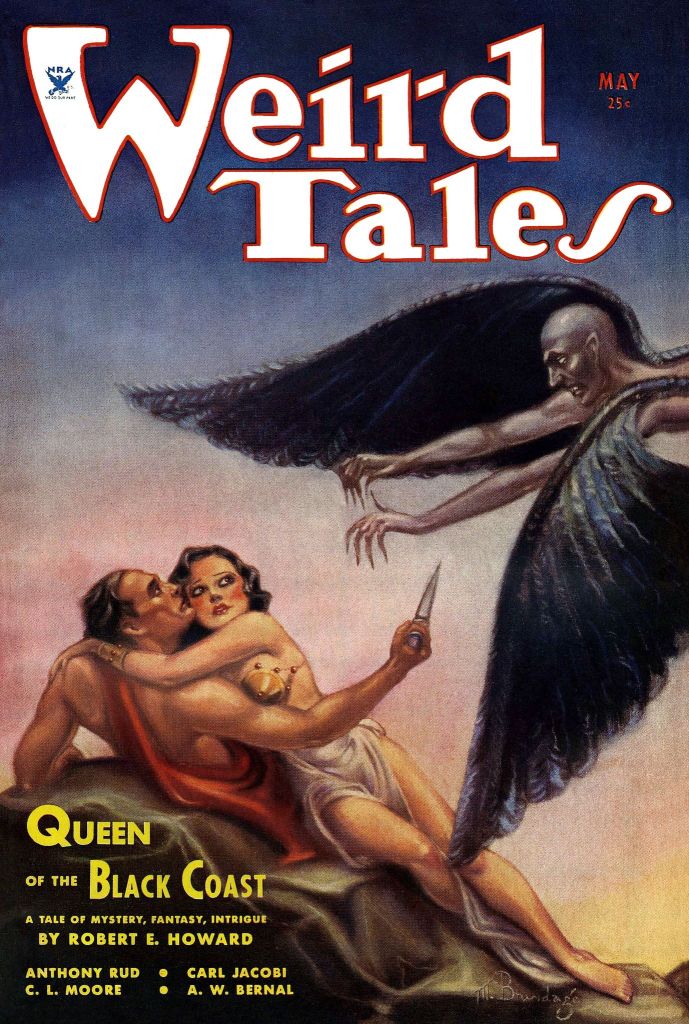
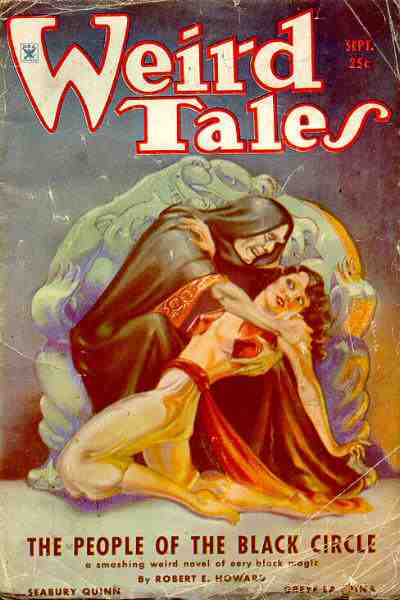
If the editors of Weird Tales and other pulps were interested in stories that were different and unique then Lovecraft should have held more appeal than Howards mainstay of macho sword wielding barbarians rescuing a string of nubile scantily clad priestess from the clutches of a foul magicians and giant snakes… But Ron E Howard, also wrote under a number of pen names, including Sam Walser who wrote exclusively for ‘Spicy Stories‘ a pulp mag that specialized in what for the time was soft core pornography, in short he knew his audience, knew his editors and more importantly knew how to get on the covers of the magazines. As it ever has, in the 1920’s and 30’s sex sold magazines.
And there was the reason Ron E Howard successfully made a living as a writer while his close friend Howard Lovecraft failed to do so. Howard wrote cover material…
Meanwhile Lovecraft’s blend of Cosmic Horror never really held the same graphic appeal as far as editors were concerned so even at his height in the mid to late 30’s seldom graced the cover of the magazine itself. So Lovecraft even at his best never commanded the fees his friend Howard could collect for run of the mill stories, which is why (along with ‘Spicy Stories’) one of them made a good living out of writing and the other didn’t.
Which just go to show, nothing much changes, it’s not what you write that matters, but the amount of clothing the girl on the cover will have that matters to publishers, and if you want to make a living as an independent writer, write erotica…
Writing is a solitary activity, which suits me just fine. Anti-social introverts make good writers, and good writers tend (though not exclusively) to be anti-social introverts. This is not a bad thing, for we take flight in worlds of the imagination…
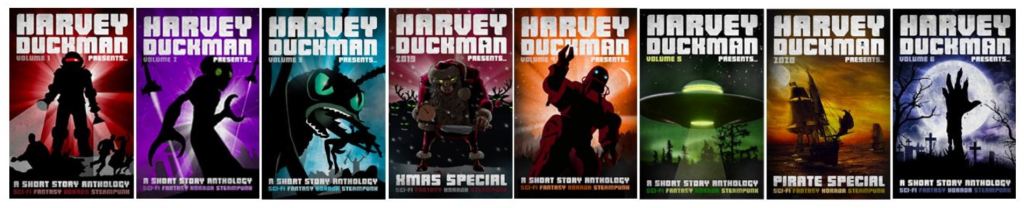
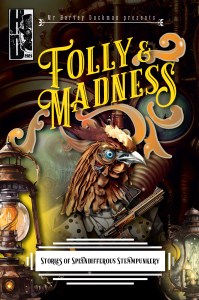
That said, much to my introverted anti-social souls horror, I love being part of the community of independent authors and nothing exemplifies that more than 6E’s Harvey Duckman Presents series. Each new volume features 15 writers, some established, some making their debut’s, and is filled with stories of Science fiction, horror and fantasy (with a liberal dose of steampunk).
Its a rich community, and a rewarding one to be part of as a writer. Not only because I get to write stories for these anthologies, and be published alongside my piers. But because I get to read all these wonderful stories as well.
In this latest volume, the sixth in the main series, the eighth if, as you surely must, include the Christmas and Pirate specials, there are debut stories from new Harvey writers C K Roebuck, D T Langdale, J A Wood and Alexandrina Brant, along with the long awaited return of writers from earlier volumes like Ben McQueeney, AD Watts and J S Collyer. As well as some Harvey stalwarts, myself, Peter James Martin, Liz Tuckwell , Joseph Carrabis and others.
As ever I was excited to read them all and I’m working my way through them backwards, as I wanted to read some of the new writers first and a couple of them happened to be at the back of the book. I was particular excited to read CK Roebucks story as it is the first of his stories to be published anywhere, and I know how excited Craig has been by this. (spoiler, its not only a great read but an intriguing one). While when I read Joseph’s I was afterward I was left with a thoughtful hour of contemplation that stopped me getting to sleep, which is the highest compliment that I can afford any writer, and that just two I have another 13 stories yet to read… I don’t doubt they will all be wonderful in one way or another, funny , insightful and entertaining. Even if one of them is written by an Anti-social introvert in a top hat.
Harvey is a grand experiment, a great adventure and a wonderful journey both for the writers and the reads. So what i am saying is, Welcome to our worlds, join us…
As your mostly likely aware, on occasion I throw my blog open to guest posts from fellow authors. Normally these only happen in April and October, but when they have something new and exciting out it would be a shame to not let them talk about it here. So here is a little post by my esteemed and occasionally mildly terrifying fellow Harvey Duckman author Kate Baucherel. Who’s wearing her non fiction techno pagan hat today.
One of the joys of being a science fiction writer is the freedom to bend the real world around my plot and follow my subconscious down rabbit holes as characters take on a life of their own. While all the tech in my books is real (or at least, likely to be real based on where we are now) I can generally let my imagination go wild on how and where it is used and the impact it has on my tale.
I also write non-fiction. Up until now that’s been a similar, albeit more structured, process, weaving a compelling narrative around tech which really does exist. In the last few weeks, however, I’ve discovered a whole new discipline. I’ve become the custodian of other people’s stories, and with such power comes great responsibility, as they say.
It all started with an innocent question. “You’re an author, aren’t you?” Suddenly I was pitched headlong into a time-critical project to produce a book on blockchain and cryptocurrency in time for Paris Blockchain Week Summit – which is happening right now (I’m attending a panel on financial services and crypto assets on the other screen as I write). This is my field – I haven’t had to get up to speed on the tech, thank goodness – but I found myself faced with a new brief. I now had not only to interview people for their insights, but to relate their story verbatim and present it in an accurate and compelling way.
If there is one thing I have learned over lockdown with endless rounds of podcasts and interviews, it is that the best interviewers say the least. It’s hard to keep it zipped when you know the subject well, but it’s worth it. Quite apart from anything else, it allows people to express what you might already know from their unique point of view. I discovered nuances I hadn’t appreciated and built on my own expertise, which was fabulous.
The next challenge was to present the raw interviews in a palatable way for a book. Luckily, our favourite editor Gillie Hatton at Sixth Element took us in hand. She gave us the tools we needed to blend a Q&A style with a narrative style and come out with something consistent that let the interviewees speak for themselves while pushing their story along nicely. This was a side of editing I had never experienced, and it was a real education with fantastic results.
Once we had a good manuscript we came to the hardest part. When the things people say end up on paper (even electronic paper), they have more permanence. We sent out proofs of each chapter to the interviewees and asked for any final, factual, material changes. It was tense. Some last-minute changes came back, occasionally contradicting the original recorded transcripts. We scrambled those final edits through with hours to spare. A success! What’s Hot in Blockchain and Crypto made it to launch in time for the conference. We gather it’s rather a good read. “The book is like a fireside chat with the people creating some of the coolest new tech on the planet,” says the first review. I think we can call that a steep learning curve to success!
“What’s Hot in Blockchain and Crypto – Volume 1” by Ash Costello and Kate Baucherel is available on Kindle
About Kate Baucherel (by Mark)
Kate Baucherel is a digital strategist, a writer of both non-fiction books that explain technology while making you laugh, cyber-crime sci-fi (her third SimCaviler novel is much anticipated this year), and short stories for the Harvey Duckman Presents series (her Christmas tale was particularity compelling). She is also an internationally renown expert on Blockchain, an occasional guest lecturer at universities, as well as a panellist and speaker at technology conferences around the world. More importantly Jackie Carlton once bought her a drink and she has been known to dress up as Han Solo at Halloween (or whenever else she can get away with it probably). If that is not intimidating enough, she is also is a black-belt in several martial arts including Karate, octopus catapults, parenting and the internet …
She lowered her phone and glanced at the screen. What she saw there provoked a cry of sheer joy that echoed around the empty church as she leapt into the air.
“Holy mother of flip, it’s only scutting Christmas!”
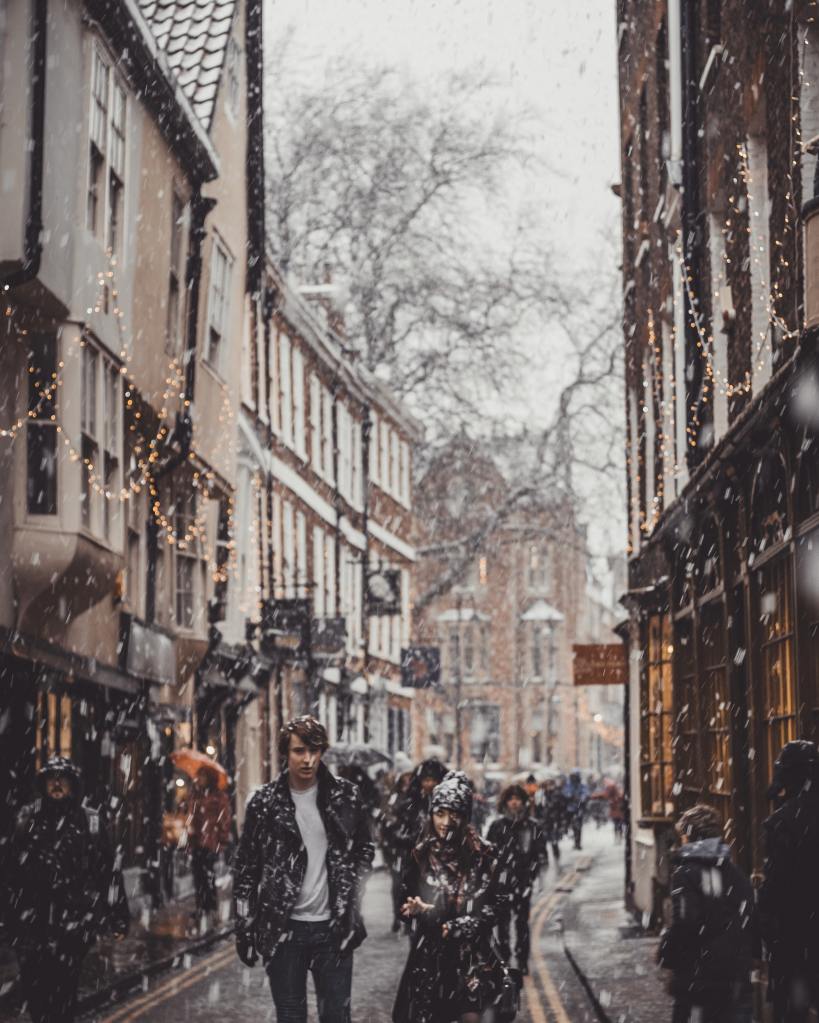
Holly Trinity has protected the city of York for over 400 years. That’s an awful lot of Christmases.
Because there are an awful lot of Christmases, really, a lot of different ones. In York, the Norse midwinter festival clung on well into the 16th century, and shadows of it continued for centuries to come. The 21st of December once marked a time of suspended order when “whores, thieves, dice players and other unthrifty folk” are granted free reign of the city, a celebration which carried the magnificently Lovecraftian name of the Yoole-Girthol.
Christmas stories, including the ones I have written, are often about chaos. If Christmas Day represents stability, Christmas Eve…
Christmas is coming, the goose is looking worriedly at the chopping block, good will to all men, women, and those who define themselves as neither. the fat bloke in red with a beard you could lose reindeers in is preparing for his one day of work a year. All is good in the world, or at least a little less terrible…
Ho Ho Hoooo my god it’s still 2020…
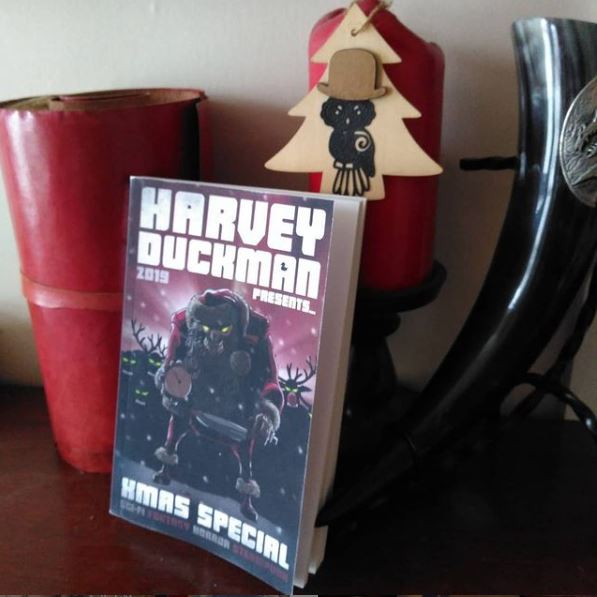
But in order to take your mind off the year from the scrapings behind the fridge of our collective zeitgeist the good folks at sixth Element publishing have released the Harvey Duckman Christmas Special from a better year in paperback form. (And incase you missed it’s somewhat delayed release last year this festive treat is once again available on Kindle.)
As usual I have a story in the Christmas special, a happy little story about little plastic santa’s and murderous impulses…
Of course, there are all the other Harvey’s you could buy for Christmas as well including this years wonderful Pirate special. You can find out more at Harvey’s website… While as I have a story in each one (and two in one of them though I refuse to admit which cunning pen name is mine) I am of course bias, but they are frankly wonderful and you should read them all if you love sci-fi, steampunk, fantasy and a touch or two of horror.
If your paying attention you may just see the as yet unpublished Harvey volume 6 at the end, clawing its way out of the ground… It may yet crawl its way out before Christmas… And yes I have a story in that one too, a story about a tower which doesn’t want you to pay attention to it…
Anyway, A merciful Christmas to all my readers, and may the coming year be better for all of us than the one we are crawling through today…
October came and went with twelve books, as i revisited David & Lynn Eddings grand opus as I am want to do every decade or so. As an exercise, rereading a huge fantasy epic with the eyes of a writer takes some time. One benefit of which is my to read pile of indie books has grown somewhat. The downside being I am a little behind in terms of reviews I have half promised people.
In actuality I never promise reviews, I work on a simple basis that I never promise them because I refuse to give bad reviews. If I don’t like a book I don’t write a review, because though the book wasn’t for me someone else may love it and I don’t want to dissuade anyone. Also any indie book represents a huge investment in time and mental energy for the writer, as a writer myself I know just how much each book we write means to us, so I’ll be damned before I rip apart anyone else’s dreams.
That said 90% of all indie books I read tend to be awesome. Not least because indie writers are free from the constraints of commercial publishing, so they are free to write their vision rather than water it down at the behest of Big Publishing. Also my personal policy on reviews means that when I say a book is great, its because I mean its great. Not because I feel obliged to say so. But anyway, that all on one side, my backlog of books in the reading pile has grown as I said. So I thought I would share the list, I am not reviewing them here, just letting you know these books are out there waiting to be read. I’m hoping to get them read in the next few weeks.
The List
Currently top of the heap, (and I am about halfway through this awesome bit of steampunk), is Amster Damned by Nils Nisse Visser. Its actually one I have been meaning to get to for a while, having read Nils prequels to this novel. I’m happy to report it is everything I expected it to be, full of characters that manage to be both larger than life and firmly grounded in equal measure. I hope to have finished it in the next few days when you can expect to see a full review.
Next up, because I have been waiting on this one a while, is Kate Baucherel’s Tangled Fortunes, the third and latest of her Simcavalier novels, set in the near future. I amour the first two novels in this series, as suspect I will love this one too. (I am not alone in this, there is a possibility Simcavalier will be making the leap from the page to the tv via net flicks in the near future. )
Then Cyber crime will give way to Cyber punk with Craig Hallam’s Oshibana Complex, which has been sat in my to read pile a while. A somewhat further future in which humanity is software downloaded into plastic bodies to live lives as directed…
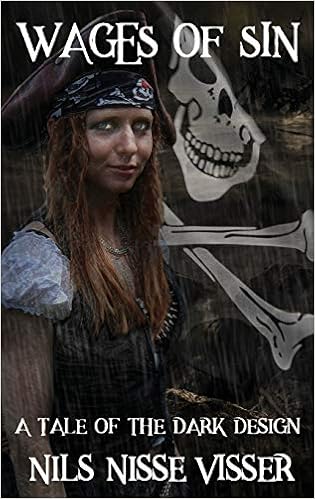
Then there is another novella from Nils Nisse Visser (no preview yet as its not out on kindle, only in paperback.)
On top of this list I am currently reading the world of crit role. Just because I am an unmitigated geek, but that’s by the by…
Finally I have just gotten myself a paperback copy of the Harvey Duckman Christmas Special. This wonderful collection (which included a short story by yours truly) was released on kindle last Christmas (almost literally as it came out on the 23rd of December) Because of which unlike the rest of the Harvey series it wasn’t released in paperback. This left a gap on my bookshelf of books ‘wot I wrote…’ This has been rectified. With the Christmas spirit starting to peek rover the advent calendar at us, now would seem the perfect time to get yourself a copy, or buy the paperback for a geeky friend or relative…
Its October, the leaves are falling, the witches are abroad, and I’ve opened the blog up to guest writers again. Yes its Indie October. Throughout October some old favourites among my guests will be returning along with some new voices. Today’s Guest Post is from Teesside travel author Will Nett, who has been looking into the hirsute.
Note. The management would like to point out all opinions expressed here are Will’s own…
Next week’s US election has got me thinking about some of the big historical voting issues, but perhaps none more so than that of facial hair, of which no candidate who had any has been elected since William Taft in 1909. Even he drew the line at a beard though, instead favouring the sort of hipster lip slug you can now see in any Shoreditch vintage bicycle repair shop.
As far as the modern electorate are concerned, particularly in the US and the UK it seems, beards are wholly unelectable, despite their undoubted resurgence over the last decade.
Slather yourself in butternut squash puree, as Donald Trump appears to have done, our present your hair as if it was based on a child’s macaroni cheese and straw painting, a la Boris Johnson, but when it comes to facial hair, don’t go there.
On the UK side of the water, Lord Salisbury remains the last Prime Minister to wear a full beard, since his premiership back in 1902, although this is not as groundbreaking as it may seem, coming in an era when dogs, women and children were issued with a set of enormous muttonchops at birth.
Almost half a century before Salisbury went full werewolf, Abraham Lincoln sported a beard after apparently receiving a letter urging him to grow one. A few weeks before his White House victory, in 1861, a little girl called Grace Bedell wrote to him that ‘all the ladies like whiskers’ although it is unclear if she was in fact referring to cat food. He grew a beard anyway, and was elected shortly after. Oddly, he went for the ‘beard only’ option, declining to grow a moustache, thus confirming my own theory that it is impossible not to look either absurdly odd, or downright sinister, when wearing a beard and no moustache, as my own attempts have shown.
As I am unable to grow a moustache in the little groove beneath my philtrum- is this a genetic thing?- I always end up looking like my fellow Yorkshireman, Guy Fawkes, but after he was beheaded and booted through the streets of Parliament Square. A little current affairs nod, there. I don’t just pull this out of thin air, you know.
I dabbled with a goatee earlier in the year but looked like Joe Mantegna, so now I’ve gone for the full Tom-Hanks-In-Castaway shebang to see out the year, by which time attention will have turned to the most famous beard of them all. I mean Father Christmas. Not God. God’s not real.
About Will Nett
Will Nett is about 40, from Middlesbrough and the author of My Only Boro, the book that was a bestseller in the town for three Christmases in a row. Will is one of the most affable writers in the Tees area, and his global appeal and general popularity have seen his writing career straddle two millennia. He is an incurable backpacker, occasional banjo picker and habitual note-maker/taker, most of which have found their way into his Gonzo-steeped books, which also include Local Author Writes Book, and his riotous travelogue, Billy No Maps. He has been a Sudoku salesman, snooker table repair man, model, cinema usher and unprofessional gambler. His latest book, The Golfer’s Lament, was submitted for the William Hill Sports Book Of The Year Award 2020.
Its October, the leaves are falling, the witches are abroad, and I’ve opened the blog up to guest writers again. Yes its Indie October. Throughout October some old favourites among my guests will be returning along with some new voices. Today’s Guest Post comes to you from the shores of Sussex, and the finest Dutchman I know, he’s also the only one I know but that does not detract from how lovely he is, Nils Nisse Visser, with the second part of his mildly epic guest post.
Accreditation, flag designed by Bram Janssens (Dreamstime) and Flying Dutchman on stormy seas by Corin Spinks, Corinography
In part one of this guest blog I went on a bit about the history of The Flying Dutchman, with due attention to the literary traditions. Born in The Netherlands myself and having a decent grasp of the Dutch language, I included Dutch contributions to the ongoing legend, as these are relatively unknown outside the Low Countries. That included Piet Visser’s novel De Vliegende Hollander (The Flying Dutchman) and ended with the revelation that I’m related to this author.
I didn’t properly find out about this until 2018. Ever since I had started writing fiction in 2014, family members had mentioned that a relative had written a book but I never really picked up on this. As other authors will know, a common reaction to being a novelist is “Oh, I know someone who wrote/is writing/might write a book” or “You know, if I didn’t have more serious things to do I might write a book” and similar remarks in that vein.
In 2018, corresponding with my father Rob Visser about writerly things, he mentioned it again, providing more details. He said that my great grandfather Piet Visser had a cousin, also called Piet Visser, who had been a prodigious writer in his day. My dad had several of his books lying about, and would I be interested in one of the copies?
That spurred me to do some online research and discover that Piet Visser (1867-1929) had a whopping twenty-one books to his name, predominantly boy’s adventure stuff related to Dutch history. He was reasonably successful, with many of his books seeing multiple editions printed between 1900 and the late 1920s.
Above: Book covers of Piet Visser’s many works. I had written DRAKA RAID before I knew about him and was pleased to discover we shared an interest in the old Saxons.
There was very little else I could find about the man himself, other than locating him in our family genealogy and discovering an academic study that touched on his writing. It was in the latter that I hit a jackpot. The author argued that Piet Visser’s writing was old-fashioned seen from modern eyes but that in his day he was quite innovative and influential, even inspiring other Dutch authors like Johan Fabricius. To evidence this, he compared several extracts from Visser’s Heemskerk op Nova Zembla (1900) with extracts from Johan Fabricius’s Scheepsjongens van Bontekoe (1934) (Bontekoe’s Ship’s Boys) – and they did indeed show remarkable similarity.
It doesn’t happen to literary characters in the Netherlands often, but the famous ship’s boys have their own statues in the harbour of Hoorn where the story starts. Image Joop Hoek (Dreamstime).
If there are any Dutch readers of this ramble, they are likely to react with a wise nod and a “Say no more, say no more.” Fabricius’s book is enormously popular in the Netherlands. No less than 34 editions were printed between 1934 and 2016, with some 300.000 copies sold. At this point I recommend you watch the first six minutes of the 2007 feature film on YouTube, as there’s very little Dutch dialogue to contend with, and it will give you an excellent impression. Link: https://www.youtube.com/watch?v=lniH8_-Uf_I
To pick up the thread again, like countless Dutch children, I too had encountered this book and for me it was THE book of my childhood. I’m pretty sure my mum Marijke must have sighed with exasperation as I picked the book again and again for bedtime reading, and then read it for the umptieth time with a torch beneath the bed covers after she had bid me goodnight (I had the good fortune of growing up in a household where reading after lights out was strictly forbidden but where, by miracle, my torch never ran out of batteries. When I moved out, I was highly surprised to discover that torch batteries needed to be changed every now and then).
I must have read the book a hundred times if not more, and that’s no exaggeration. My copy literally fell to bits and I would correct my mum if she so much as misread a single word or skipped a bit because I pretty much had it all memorised. To put it into an Anglo-Saxon context, Peter Hajo (the main protagonist) was my Luke Skywalker. I fully identified with him, not to mention his adventurous journey to Asia as well, as I spent six years of my youth growing up in Asia (Thailand & Nepal).
So many years later I was over the moon with the discovery of the Visser – Fabricius connection. It meant that Piet Visser had, indirectly, influenced my reading experience since childhood. This changed my interest in the man’s writing history into a full-blown obsession. The guy had got my mojo running, so to speak, and I felt that I simply had to do something creative with this ‘inheritance’.
Accreditation: Painting by Charles Temple, WikiCommons
Having just re-watched Johnny Depp strutting his stuff again in Dead Man’s Chest (Confession: I have two DVD copies of each Pirates of the Caribbean movie, just in case one has a flat tire or something) and having discovered Piet Visser’s De Vliegende Hollander in its entirety at the Gutenberg Project, I decided that The Flying Dutchman was a good place to start. This decision was also helped in that the famous ghost ship is more likely to ring a bell with English speaking readers than the siege of Alkmaar or the relief of Leiden.
Piet Visser’s publisher, Kluitman, is still very much active. Even though the pre-1923 copyright laws applied, I thought it polite to approach them and signal my interest in ‘doing something’ with my great grand uncle’s work. They were absolutely lovely about it and encouraged me to scribble away.
Arthur Dixon, a self-proclaimed fan of my writing, suggested I translate some of the books, and possibly think about Steampunking one or two of them.
I duly started translating the first chapter of De Vliegende Hollander, but as mentioned in part one of this guest blog, it was one long info-dump and my fingers itched to make editorial improvements. The obvious thing to do was to rewrite the story, so that was my next step.
I tinkered with the name of the protagonist and captain of The Flying Dutchman, Pieter van Halen. The Dutch ‘Pieter’ and English ‘Peter’ is pronounced exactly the same, so I decided to opt for Peter, as there would be sufficient Dutch names for the reader to cope with, and I personally do like main characters at least to have names that are easy to digest. ‘Van Halen’ is, of course, also a well-known and most excellent hard rock/heavy metal band, so there I opted for the old-fashioned spelling of ‘van Haelen’ to mark a difference. This was personal, as every time I read ‘van Halen’ I felt the urge to play ‘Jump’ at top volume, which was jolly much fun but didn’t help with the reading or writing.
Deciding on the name was the easy bit, because in every other aspect Peter van Haelen was to pose a great many headaches.
Accreditation: The skipper of The Flying Dutchman as imagined by Howard Pyle
In brief, Peter van Haelen is a misunderstood genius. He has great aptitude for building ships, but his designs are derided, his ambitions mocked at. It takes him more than a decade and many sacrifices to realise his dream, a ship unlike any other which he names The Swift Christina. He proves everyone wrong, but the strain of it all drives him into madness, and subsequently immortal doom aboard his beloved ship that becomes known as The Flying Dutchman.
As mentioned in the first part of this guest blog, Piet Visser deals with the emotional turmoil of going insane in a single short sentence: He went completely insane. It was my firm belief that the descent into madness was what most modern readers would be most interested in, so I approached the story from that angle, intending to equip van Haelen with relatable human emotions. That’s where the trouble started. This is going to sound really weird, but my internal dialogue produced Piet Visser himself, staring over my shoulder and contesting every change I wanted to make. I was basically having arguments with a dead relative.
The planned story ground to a halt, and then became completely bogged down because of this quandary. I decided to let it rest and pursue some other options, because Arthur’s advice to consider Steampunking the story had been ever present in my mind as well. I will get to those projects in a short while.
Returning to the possibility of a rewrite some months later, pondering the difficulty posed by Peter van Haelen being very much Piet Visser’s creation and reluctant to be tampered with, I considered different POVs. Another main character, van Haelen’s young cousin Andries, wasn’t a possibility, because he wouldn’t be a very sympathetic protagonist (can’t really reveal much more than this without going into spoiler territory). Then it struck me that both my Wyrde Woods books and my Smugglepunk books were much lauded for the realistic presentation of female protagonists.
The reason I like to opt for female protagonists, by the way, is simple. I taught in secondary education for twenty years and was struck by how many positive male role models could be found in books for youngsters, and how very few meaningful roles there were for girls and women. The best way to remedy that deficiency, I reckoned, was to do something about it and write them into existence. Hence Wenn, Joy, Maisy (Wyrde Woods), Alice (Smugglepunk) and Lewinna (Draka Raid).
With this in mind, I took another look at Lottie, Andries van Haelen’s sister who appears on a few pages only, with just a handful of lines in which she proclaims how lucky she is that a heroic man has come to save a damsel in distress. Cue an evil grin. Piet Visser obviously had very little interest in Lottie, discarding her as soon as possible after announcing her gratitude for a manly saviour. He could bloody well have Peter van Haelen, who I’d leave as intact as possible as Piet’s creation, and I would reinvent Lottie as Liselotte van Haelen, let her swan about the entire story and tell it from her perspective. This would also make the descent into madness easier to convey, as it would be told from a female perspective, and in general women are a lot more attuned to emotions and mental health processes than blokes who are still often taught to view this as unmanly ‘weakness’.
Lottie, or rather Liselotte, took to her new role like a fish to water. The wind picked up and the story sailed out of the Doldrums at amazing speed. It’s not fully finished yet, but I was confident enough in a successful conclusion that I asked Tom Brown, the artist behind Hopeless, Maine, to design a cover for me. At my request, Peter van Haelen is an echo of Howard Pyle’s Dutchman, and Liselotte full of vulnerable determination and courage that very much reflects her character. I’m hoping that the first book of three planned, Flying Dutchman: BLEAK FUTURE, will be available for purchase in 2021.
Accreditation: Peter van Haelen and Liselotte van Haelen aboard The Swift Christina, as created by artist Tom Brown of Hopeless, Maine fame.
Next up, I had run into Jan Slauerhoff’s poetry on the phantom ship. I translated a few stanzas to use in Bleak Future and was then inspired to write an epic poem of my own, inspired by his work. I called the poem The Flying Dutchman, which isn’t very original but at least makes reasonably clear what it’s about. I’m chuffed that the poem has been selected for inclusion in the CUPPAS (Coastal Union of Pirates, Privateers, Aviators & Steampunks) Anthology SCADDLES, especially because this book is choc-a-bloc full of excellent goodness with fantastic stories about nautical naughtiness in different genres by authors whom I all admire a great deal. The book is due to be published in the next few months (autumn 2020).
Accreditation: All artwork by Corin Spinks, Corinography, featuring some of the Hastings and Eastbourne Pyrates.
Back to Arthur Dixon’s suggestion that I consider Steampunking (or in my case Smugglepunking) some of Piet Visser’s work. It was very tempting indeed, because a mad & misunderstood inventor would feel most at home in this genre. Moreover, the essence of Smugglepunk is the continuation of the heyday of south coast smuggling into the latter half of the nineteenth century with the use of airships and Steampunk technology. As such, I had been exploring aviation a great deal already, and it didn’t require a great many braincells to connect the concept of a Flying Dutchman to this approach. Peter van Haelen could be reborn as an airship designer, genius once again and unashamedly mad as a hatter. Fortunately, this time, Piet Visser remained silent on the subject.
Accreditation: Top two Peter van Haelens, Maya Kruchankova (Dreamstime). Bottom two Peter van Haelens, Andrey Kiselev (Dreamstime).
The final prod needed to embark on this project was the news that Writerpunk Press was organising their sixth Anthology, Taught by Time, based on myths and legends. The only response I could give to the question on whether I felt comfortable writing about any well-known legends or myths was a hearty “Yarr”, of course, pretty much having all I needed at hand already.
I had, by the way, already contributed to two Writerpunk Press anthologies, with ‘The Oval Sky Room’ (my very first Steampunk story) in the Poe themed Merely this and Nothing More, and the first version of ‘Rottingdean Rhyme’ in What We’ve Unlearned.
When I was first encouraged to submit a story, my main selfish thought was that Writerpunk Press were based in Seattle, Washington, which to my mind was Nirvana territory and wouldn’t it be awesome to have “I’m a West Coast SteamGrunge Writer” as a pick-up line in pubs?
Whereas these days, I find it hard not to write Steampunk, back then it was all new and the kind folk at Writerpunk Press helped me take my first steps in this new genre, supplying endless wise advice and words of encouragement that helped me gain confidence. In short, I owed them my very best.
I decided to set the story in my existing Smugglepunk world, in which rumours of The Skirring Dutchman allowed a look back at the early days of aviation, in which Peter van Haelen played a considerable part in developing ‘skicing’, wind-powered flight by heavier-than-air vessels (‘skirring’ being the name used for steam-powered flight). Not too much of a spoiler, I reckon, to suggest that should The Skirring Dutchman appear in this story, Peter van Haelen would be at the helm for a guest appearance.
So far all the Smugglepunk stories had been told from smuggler perspectives, so I reckoned it would be refreshing to reverse that perspective. Enter Ensign Albert Peabody, serving on Her Majesty’s Aeroship Beresford, a brand-new state-of-the-art Cloud-Corvette class coastal patrol ship.
Accreditation: Rigging background AndyH12 (Dreamstime), boy Roberto Galan (Dreamstime)
Taught by Time is scheduled for release before the end of 2020 and includes most excellent stories by many other authors as well.
All of the Writerpunk Press Anthologies published so far, and I, for one, can’t wait for #6, Taught by Time.
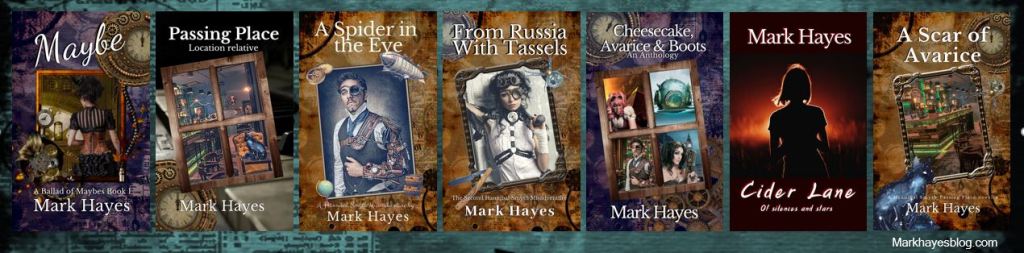
A late-night chat with author Mark Hayes on female protagonists who were more than wallflowers or receptacles of manly favours, resulted in his suggestion that I ought to read his newly published Maybe. I did and wasn’t disappointed. His Eliza Tu-Pa-Ka dances across the pages as one of those characters whose spirited and realistic portrayal will linger long in the memory.
Being selfishly absorbed in my own work, it struck me that Eliza and my Alice Kittyhawk would have got on well, and that Eliza was precisely the sort of role model I’d like Alice to be exposed to. It also occurred to me that the two were contemporaries, albeit in different creative universes. When life gets back to something representing normality, I hope to meet Mark at an event one day and have a few drinks at the end of it to discuss the possibility of mayhap having the two meet and interact.
Nils supplied no accreditation notes for this picture, I have no idea of its origins
In the meantime, I reckoned, there was another possibility. In ‘The Skirring Dutchman’, the Steampunked (and still relatively sane) Peter van Haelen is described as arriving in London aboard his revolutionary new airship and receiving some attention from the press. This was at about the same time that Eliza’s father, MaeYaBee Tu-Pa-Ka, was setting up shop in London. So, we have two genius ship-designers, both somewhat misunderstood, and both suffering from that unnatural defect of not being English, in London at the same time. Would they not have sought one another out to exchange ideas? I thought it would be interesting to plant a seed of possibility in the Smugglepunk novel Fair Night for Foul Folk I am working on. It would also allow me to add a very brief reference to ‘The Skirring Dutchman’in the novel.
I contacted Mark who was happy to have a short reference in Fair Night for Foul Folk. He’s written a splendid blog about this exchange although – until he reads this blog – remains unaware of my vague notions of perhaps exploring these connections further in the future. Mark’s Blog on this topic can be found HERE (LINK).
The passage in question is part of a conversation highwayman Andreas Black conducts with Alice, in which the early history of aviation is referred to:
“A Rozzer?” Black smiled. “I preferred to think of myself as an aviator, truth be told. It was in the early days of flight, when pioneers like MaeYaBee Tu-Pa-Ka, Madeline Scarthorpe, Al Hapfold, Pascal Houvin, and Peter van Haelen were at the forefront of new discoveries. Before the Air Corps was renamed the Royal Aero Fleet. The Corps was never deployed against Free Traders, unlike the RAF.”
I’m sharing this novel online as a Lockdown special, btw, and Daren Callow of Tales of New Albion is reading chapters on the British Steampunk Broadcasting Co-operation. The Lockdown special can be found here https://www.nilsnissevisser.co.uk/fair-night-for-foul-folk-(serial) and the BSBC readings on Daren’s Tales of New Albion FB page, or the BSBC FB page.
Accreditation: Background image Lee Roberts CC by-sa 2.0. Portraits of Alice & Pip Heijo van de Werf. Cover design Corin Spinks.
Having agreed to my use of MaeYaBee Tu-Pa-Ka, Mark smelled an opportunity to press me once again about considering a submission to a Harvey Duckman Anthology. He mentioned a pirate themed special coming up later in the year. Ever so slowly my dim mind perceived that this would be a great opportunity to build further upon my Steampunked version of The Flying Dutchman. Moreover, developments in Fair Night for Foul Folk had provided a perfect crew, airship, and reason for another run-in with Peter van Haelen’s cursed airship.
The main character of my Smugglepunk stories is Alice Kittyhawk, the daughter of a legendary smuggler. Alice actually appears very briefly in ‘The Skirring Dutchman’, literally just a few seconds and she remains unnamed, although faithful readers will know exactly who she is. I decided that a Harvey Duckman story could be twinned to the Writerpunk Press story, told from Alice’s viewpoint this time, and taking place a few weeks before ‘The Skirring Dutchman’ does in order to throw a whole different light upon her brief appearance in Ensign Peabody’s story.
Thus, Alice takes to the sky once more, in ‘Learning the Ropes’, as apprentice of Cap’n Ray Spinks aboard his Dread Leopard, with a motley crew consisting of real-life members of the Hastings and Eastbourne Pyrates gang. Mayhap, just mayhap, she’ll meet Peter van Haelen up there in the realm of clouds – tis for me to know and for you to find out.
So, two years after encountering my great grand uncle’s De Vliegende Hollander and his Peter van Haelen, I can look back with some satisfaction. The rewrite of the original story progresses in a healthy manner. A long poem on The Flying Dutchman inspired by Dutch traditions is due to be published in SCADDLES before the year is up. Arthur Dixon’s suggestion to punk away has been heeded, with ‘The Skirring Dutchman’ due to be published in Taught by Time this year, and ‘Learning the Ropes’ out now in the Harvey Duckman Pirate Special.
Accreditation: Background image Ratpack2 (Dreamstime), rat by Linda Bucklin (Dreamstime), all completed by Corin Spinks
It would be remiss of me not to mention the other Flying Dutchman story in the Harvey Duckman Pirate Special, Peter James Martin’s ‘The Rat Who Served on The Flying Dutchman’ (A Brennan and Riz Story).
Peter James Martin was kind enough to make some time to chat about his submission.
He told me, “The main thrust of the Brennan and Riz series has been shining a light on folklore, myths and legends. I’ve discovered so much folklore from the area, some of it on my doorstep I never knew about. England is a nation of immigrants, each bringing stories with them, and I love dissecting them getting to the roots. What I really hope is that after reading my work, people will go off to discover the root tales for themselves and then maybe keep looking for more.”
I told him I really enjoyed reading his story, taking special delight in just how delightfully unpleasant Riz (a rat) is. I was kind of worried about a cutesy cute overload, which is what I usually encounter when talking animals enter the fray.
Martin’s response, “Riz’s origins are a bit more complex than turning the talking animal trope on its head. His development started him off as a small robot back when Brennan was the star of a sci-fi idea. The character that would become Riz held many of the same attitudes. When I revised the idea in 2017 and came up with the Brennan and Riz series, the move to a rat felt natural.”
Naturally, talk focused on The Flying Dutchman.
Martin said, “When I first heard of the pirate special, I didn’t think I could submit to it because of a perceived difficulty in doing a pirate story. Could I fit what I wrote about around pirates? And vice versa? Did I have any stories I could tell about pirates?”
“To solve this, I looked over myths and legends of the oceans, and among the first was The Flying Dutchman. First thing I had to do was to separate it from the Davey Jones mythology that a certain company forced the legend with for a certain movie franchise. I studied the first few stories of the mysterious vessel and that of its true captain. At this point the ideas of the story began to take shape. I do wonder about the effect of Disney combining the legend with the Davey Jones lore – what new generations will learn about it.”
The true captain Peter James Martin refers to is a familiar face in the story to be sure, the aforementioned Hendrik van der Decken. To be honest, my first reaction was to (nearly) exclaim that Hendrik van der Decken was an English invention, but then I realised I’d be skating on very thin ice there.
For one, the Dutch sources remain mostly shrouded in the Dutch language which isn’t spoken or read very widely, so it would be unfair to expect people to have easily located this. Secondly, I’d placed my Steampunked version of Peter van Haelen, and his phantom airship, on the Sussex coast simply because I like writing about the Sussex Coast, so I wasn’t exactly being faithful to the likely historical origins at the Cape of Good Hope. Last-but-not-least, I have been unable to find any historical precedents for Peter van Haelen, so it’s likely that he was entirely the brainchild of Piet Visser. That places his invention around 1900, which gives Hendrik van der Decken a considerably longer pedigree.
I told Peter James Martin that I quite enjoyed the movie franchise we’d been talking about, but that I had certainly noted that mainstream mass entertainment tends to suffocate the tales tied to regional culture and geography.
That meant our own submissions to the Harvey Duckman Pirate Special was unlikely to even leave a dent in the popular images evoked in people’s minds by a superpower like Disney.
Nevertheless, we agreed that it was great that so many different interpretations could result from a single subject – in this case The Flying Dutchman. We concluded that the strength of the legend is that the lack of exact facts, or supremacy of any one of many captains for that matter, allowed a great deal of scope for creative reinvention and the subsequent rejuvenations of the story allowed for its enduring legacy. We were both pleased to have played a part in this by means of the Harvey Duckman Pirate Special.
All in all, I greatly enjoyed our conversation – just as I thoroughly enjoyed Martin’s take on the Dutchman.
Nils is a free-lance writer, occasional poet, archer, Homelessness activist, who was born in Rotterdam in the Netherlands in 1970 (which was the best year ever to be born *Mark), he grew up in the Netherlands, Thailand, Nepal, Oklahoma, Tanzania, England, Egypt and France. Taught English at various Dutch secondary schools for 18 years, but his firm belief that education is most effective when it is fun raised a few eyebrows. Having been told too often that he lived in his imagination, he took the hint and moved there on a full-time basis. He currently lives in Brighton in the county of Sussex in England.
Rather confusingly he sometimes writes as Nils Visser, Nisse Visser or Nils Nisse Visser. For which he apologies.
Its October, the leaves are falling, the witches are abroad, and I’ve opened the blog up to guest writers again. Yes its Indie October. Throughout October some old favorites among my guests will be returning along with some new voices. Today’s Guest Post is from
When Mark asked if anyone was interested in writing a post for his blog, I wondered what to write about. And then it came to me – flash fiction!
Flash fiction has become far more important in the last few years although it’s been around since 1986. Other names you might hear it called are short-short stories, sudden fiction, postcard fiction, minute fiction, furious fiction, fast fiction, quick fiction, skinny fiction, immediate fiction and nanofiction. But the most popular names are flash fiction or micro fiction.
In the very unlikely possibility that you hadn’t heard of it, flash fiction are stories of up to 1,500 words or thereabouts. The maximum number of words is disputed, some say 1,000, some say 1,500 but it’s around that. Interestingly, there is no minimum. You can have 140 characters or six-word or ten-word stories. One popular word length is 100 words otherwise known as a “drabble”. Apparently, that word length first started in fan fiction and then spread out.
Writing flash fiction is an art in itself. It teaches you how to focus on the essential in a story. How do you get a story across in six words? And writing a twitter tale forces you to tell a story as tightly as possible. You’ll write “he’d seen” rather than “he had seen” and “&” is a real space saver. A real incentive to be concise when writing one on Twitter is to see the dreaded pink square showing you’ve run out of words.
Writing advice is now that a piece of flash fiction shouldn’t rely on a gimmick or a joke or go for a twist at the end rather than have deeper significance although I’m not sure I entirely agree. Here’s an example of what they say not to do (thoughtfully written by me a few days ago).
Some people believe that you can write a piece of flash fiction in a couple of minutes and it’s a piece of cake. I disagree. To write a piece that tells a story or sets a mood within the constraints of an inflexible word length and for it to be also grammatically correct, is quite a feat.
I attended a course in flash fiction, which made me realise a) what an art it is and b) just how much flash fiction there is around. At the end of the course, the tutor handed the class a big wodge of paper stuffed with information about flash fiction magazines, websites and competitions.
There are plenty of collections of flash fiction to read. I typed in ‘flash fiction’ in the search box on Amazon just now and lots of books of flash fiction popped up. I also noticed that there’s a number of books on Amazon very eager to teach you how to write flash fiction.
I now write stories nearly every day the #vss365 prompts (stands for very short stories) that appear every day on Twitter. There’s a large community of writers who write for #vss365 prompt. There are quite a few others. At the moment, there’s #vssmurder and #spooktober for the month of October. I also sometimes write ten-word stories based on the prompts issued by @hangtenstories.
If you’d like to see some examples, might I humbly recommend my own collection. I’ve recently republished a collection of flash fiction stories, modestly called Fantastic Flash Fiction. It was originally called Dribs and Drabbles, a play on the phrase “dribs and drabs”. Yes, M’lud, guilty as charged – trying to be too clever by half. It contains a selection of fantasy, fairy tale, science fiction and horror stories by length ranging from six-word stories to “twiterature’ to a couple over 1,000.
About Liz Tuckwell
Liz Tuckwell lives in London, England with her husband. She has an identical twin sister but hasn’t published any books about twins so far.
She writes quirky fantasy, science fiction and horror.
Liz loves science fiction particularly timetravel and alternate history. She also likes urban fantasy, steampunk, historical and crime fiction. She enjoys reading, writing, watching films and travelling to far away places.
Liz wrote a novel aged thirteen. Sadly, her father threw this literary gem out while having a clear out while she was at university.
Its October, the leaves are falling, the witches are abroad, and I’ve opened the blog up to guest writers again. Yes its Indie October. Throughout October some old favorites among my guests will be returning along with some new voices. Today’s Guest Post is from…. Erm… Well actually its just from me, but its about Craig Hallam, a man who is wrong about few things.
Craig Hallam, who is trying to win the ‘most prolific Indie Author Mark knows of the year’ award, has a new book out. I would love to tell you all about it, but I haven’t read it yet. (its on the nightstand pile of books waiting to be read, about three down from the top.) It does however have a really nice cover, which is about all I can tell you at the moment. However he did recently ask the internet for questions on write and his new book and recorded a video answering almost all the questions he was asked… Its a fun, interesting and insightful watch, and there were lost of very interesting questions.
For reasons, I would like to point out two things,
1/ His answer to the final question is clearly incorrect, A marathon will always be a marathon, the Americanization of chocolate bar names has to stop now. Its a slippery slope, and if we continue down this road one day soon a mars bar will be called a milky way, and god only knows what a milky way will then be called. Sometimes you just have to pick a hill to die on, this is mine!!!
2/ The other question of mine was perfectly reasonable…
Given the ever greater expansiveness of the universal id that speaks to individuality in an uncaring, cold, cosmos, of which the individual is merely the most insignificant of all things imaginable; and the vibrancy of metaphysical thought that can supplant the void to bring light and colour to an otherwise grey and meaningless existence, as well as the intrinsic beauty of the fragile and obtuse; what would you say is the fundamental lesson we can learn from the visualization of impossibility from what would seem the most prosaic of art forms, a collection of twenty six figures rearranged in seemingly random patterns to convey meaning: by observation of those patterns as they are first visualized them laid down in prosaic fashion so that they can be visualized once more by others through the medium of imagination?
Clearly the answer is art is good for the soul and people should read more books like Oshibana Complex, written by the wonderful imagination of authors like Craig Hallam (no matter how wrong he is when it comes to chocolate bars)
All, joking aside, while I haven’t read it yet, I have read everything else Craig has written and I know without turning a page this will be a great read and also one that will cause its readers to have to think a little, Craig has a habit of being a little deep, often without realizing it, like all the best writers. He’s also a fellow Harvey writer, and likes unleashing waves of fire on Space Marines, which is always to be encouraged..
Welcome to Shika-One City, humanity’s final home.
Nations have come together. Gender and race are petty concerns of the past. But not everything is well in Shika-One.
Humanity can no longer procreate and has to synthesize future generations. But there aren’t many genetic templates to go around and meeting yourself on the street is a daily occurrence. With so many people wearing the same face, the synths of Shika-One strive for individuality in a world where stepping out of line can lead to the shredder.
In this pulsing neon world lives Xev and eir friends, all hard-working synths who maintain their designations to earn the XP to live and hope to afford the holographic shams that cover up their similarities. That is, until a new synth makes Xev start to ask big questions that might upset the status quo.
In Shika-One, life is cheap.
Xev is about to discover what e’s worth.
Oshibana Complex is out now, in paperback and on a variety of EBook platforms. read it, and remember, a marathon is a marathon…













 The Passing Place