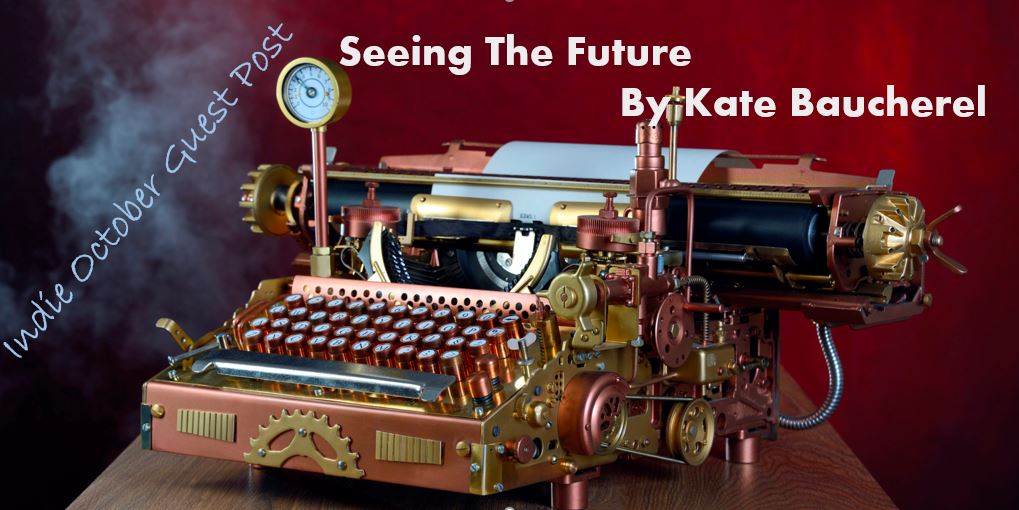
Its October, the leaves are falling, the witches are abroad, and I’ve opened the blog up to guest writers again. Yes its Indie October. Throughout October some old favourites among my guests will be returning along with some new voices. Today’s Guest Post comes to you from Teesside’s own Nostradamus, futurist, and terrifyingly smart queen of Crypto currency Kate Baucherel
Writing near-future science fiction can be a challenge in more ways than one. I grew up steeped in scifi, dreaming of far future and fantasy worlds from Earth and Mars to the Culture, the Uplift universe, Middle Earth, and the Discworld. When I started to build the world of the SimCavalier, however, the timing of the first tale was dictated by the subject matter and the plot. I had to make it familiar enough to readers that the message of good cybersecurity practice hit home. I had an idea about criminals playing the financial markets as cryptocurrencies came to equal the power of sterling, and my gut feeling was that it had to be placed no later than 2050. I wanted to let loose all the automated tools which are lurking on the edge of our vision right now. I ended up in the mid-2040s, and ran with it.
Soon after publishing the first book, strange things began to happen. Innovations which I had pitched twenty years hence started to appear in real life. Delivery robots were pictured falling off kerbs in the snow in Milton Keynes. Bitcoin, which had been quite niche when the tale was titled, suddenly exploded into public consciousness. Cybercriminals pushed malware out with legitimate software updates. I took note of all this for the second adventure, Hacked Future, and made a greater effort to extrapolate and invent less plausible scenarios. The destruction of Notre Dame cathedral, for instance, or a backstory of a global pandemic.
Oops.
The third adventure of Cameron and the team, Tangled Fortunes, is deep in final edits and is available for pre-order now. I have already seen whispers about some of the imagined scenarios making their way into real life – mining landfill sites for precious metals, for example (no spoilers!). It has been suggested that in another era I might have been burned as a witch, evoking shades of Agnes Nutter.
Where does all this come from? One thing that most writers quickly discover is that their style is buried deep inside them and they have little choice over how they present their stories. It seems that the writing voice I had as a child has resurfaced as an adult. I remember spending hours at an old typewriter creating my own derivative stories in the worlds of Dr Who, the Tomorrow People, and Star Wars, including one memorable attempt at a script with some willing chums who acted it out in the park. I simply played complete scenes in my head and wrote down what I saw. A black and white TV with three channels was enough at that time to inspire my visual imagination. Now, I’m working in technicolour.
“I can almost see the director just out of shot,” said editor Gillie Hatton, her red pen working overtime on Tangled Fortunes. She’s hit the nail on the head: everything I write I see in my mind’s eye and describe for the reader. I couldn’t write any other way, and it’s important for all writers to realise that their own voices are distinctive and unique. When I open any of the Harvey Duckman anthologies, I know the individual tones of my fellow authors and I embrace the familiarity. For those I’ve met, I can almost hear them narrating their stories. There is such a spectrum of storytelling, of styles, of points of view, and it is all down to the voice of the individual.
I’m still chasing the future and writing down the scenes which flash through my mind. For now, though, I invite you enjoy the third SimCavalier novel, Tangled Fortunes, which is released on Halloween and can be pre-ordered on Kindle.
About Kate Baucherel (by Mark)
Kate Baucherel is a digital strategist, a writer of both non-fiction books that explain technology while making you laugh, cyber-crime sci-fi (her third SimCaviler novel is much anticipated this year), and short stories for the Harvey Duckman Presents series (her Christmas tale was particularity compelling). She is also an internationally renown expert on Blockchain, an occasional guest lecturer at universities, as well as a panellist and speaker at technology conferences around the world. More importantly Jackie Carlton once bought her a drink and she has been known to dress up as Han Solo at Halloween (or whenever else she can get away with it probably). If that is not intimidating enough, she is also is a black-belt in several martial arts including Karate, octopus catapults, parenting and the internet …
As it is that most wonderful time of the year again, and the ghost and ghouls are gathering in the shadows… Thoughts turn once more to the coming November. So here is the annual pre-NaNoWriMo post
With November less than a month away, and in the mildly self-aggrandizing of attempting to offer some advice to budding writers… This is the story of how I managed to write my first novel. It is also the story of how I managed to write my nineteenth novel. They just happen to be the same book. The other eighteen are still sat on hard drives, in paper copies or in one case on an old Amiga floppy disc I can not access. You see, in case you have failed to guess, the only reason Cider lane became my first novel was because I actually finish writing it. More importantly, perhaps, I actually finished the first draft.
Like most writers I suspect, I have started a lot of projects over the years, far more than nineteen technically, as I have endless notebooks and scrap ends, one-off chapters of unwritten masterpieces (or utter drivel in all likelihood). That nineteen…
Its October, the leaves are falling, the witches are abroad, and I’ve opened the blog up to guest writers again. Yes its Indie October. Throughout October some old favourites among my guests will be returning along with some new voices. Today’s Guest Post comes to you from the shores of Sussex, and the finest Dutchman I know, he’s also the only one I know but that does not detract from how lovely he is, Nils Nisse Visser .
Images licensed by Dreamstime, contributing artists Bram Janssens & Grandfailure
The author behind A Passing Place takes mischievous pride in going off on tangents before getting to the point of any given blog. Well, hold me grog, sailor, because I intend to surpass him in this. Bear with me long enough, and in due time the relevance will become clear, but first:
Once upon a time the Dutch had a mighty fine legend concerning the folly of a sea captain who dared defy the elements and was subsequently doomed to roam the Seven Seas forever, striking fear in the hearts of sailors to this very day.
The story of The Flying Dutchman probably originated at the Cape of Good Hope in South Africa in the 17th century. Cape Town was then Kaapstad, founded by the Dutch East Indies Company (VOC) to provision their ships. The Cape is notorious for ill-tempered storms. It’s likely that the story of The Flying Dutchman followed the defiance of one captain who refused to be cowed by a tempest and sailed into it, to never be seen alive again. It’s possible that the early stories were also connected to VOC Captain Barend Fokke, whose incredible speed in completing the journeys to and from the East were regarded with suspicion – it was rumoured by envious colleagues that the Devil himself must be involved in such feats.
Although reported sightings of The Flying Dutchman occur all over the world, the waves surrounding the Cape of Good Hope prevail above all other waters. There was a spate of sightings during World War Two, many witnessed by scores of people, including the military. Admiral Dönitz of the German Kriegsmarine noted U-Boat reports about a mysterious schooner under sail in the area. Lieutenant Commander Nicholas Monsarrat (author of The Cruel Sea (1951)) claimed to have seen The Flying Dutchman near to the location where King George V had seen the ghostly ship in 1881 as a young boy, and a small Australian warship on its way to Cape Town is reputed to have radioed a distress call consisting of two words before disappearing without a trace: Flying Dutchman.
Image ‘The Gust’ by Willem van de Velde, 1680. Artwork in the public domain, photo Rijksmuseum, Amsterdam.
By this time stories of the ghostly ship had long been hijacked by the English and changed somewhat in nature. For example, they placed the captain (who they named as Hendrik van der Dekken/Decken) and ship in Terneuzen, which had a harbour the size of a toddler’s paddling pool at the time. A sailor would have been hard-pressed to turn a jolly boat around in it, let alone squeeze in a three-masted East Indiaman of considerable tonnage. Tut-tut. Do you research peeps.
What remained was the defiance of nature/God, and subsequent punishment to roam the oceans until Doomsday. Added was the notion that captain and crew were allowed on land once every so many years, and/or attempts to hail other ships to hand over letters to family members long dead and gone – a poignant touch. Needless to say, accepting the letters was a fatal mistake.
Since then Hollywood got its hands on the tale, changing it again to have the ship captained by Davy Jones, as tentacled opposition for Cap’n Jack Sparrow and company, though there’s a nod to possible earlier captains and crews because Davy Jones hadn’t always been captain and others could follow him: “The Dutchman must have a captain”. The romantic entanglement between Davy Jones and sea-goddess Calypso has echoes of Wagner’s Der Fliegende Holländer opera (1843), as Wagner added a redemption-through-love theme to the saga. Until Pirates of the Caribbean hit the screens, Wagner’s interpretation did more than any other to ensure a lasting cultural legacy for The Flying Dutchman.
Image of Captain Jack Sparrow licensed by Dreamstime, contributing artist Pholtana Wongsuchart
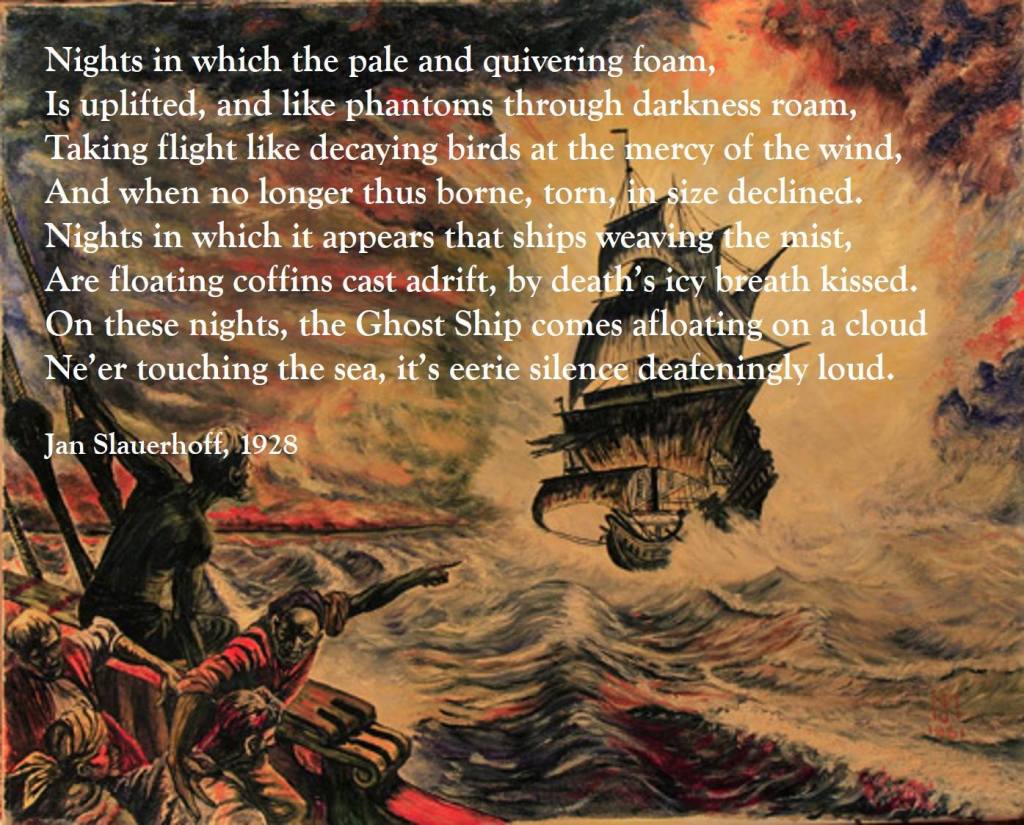
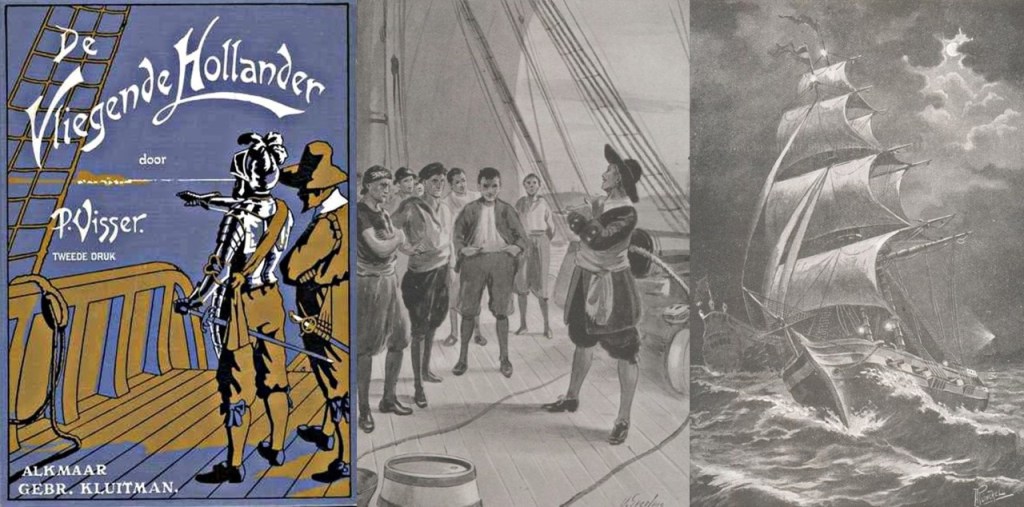
In the meantime, there were Dutch attempts to steal the story back. Piet Visser’s De Vliegende Hollander (The Flying Dutchman) was moderately successful in the Netherlands, seeing a first edition in 1901, a second in 1910, and a third in 1918. Jan Slauerhoff, possibly the most influential poet in Dutch literature and a seaman himself, added to the Dutch oeuvre in his 1928 Eldorado bundle, with no less than three poems about The Flying Dutchman (‘The Eternal Ship’, ‘The Ghost Ship’, and ‘The Flying Dutchman’).
None of this work was ever translated to English, so the book and poems never gained much traction outside of the Netherlands. Both Visser and Slauerhoff rejected the traditional Puritan theme of offending God (nature) and subsequent divine punishment.
Slauerhoff was influenced by French romanticism and preferred to dwell on the notions of death and decay as a natural state of affairs, rather than the consequence of offending a deity. For English reference, Slauerhoff’s approach was somewhat akin to Rime of the Ancient Mariner, minus the punitive aspect in Coleridge’s epic ballad. The title of Slauerhoff’s bundle, Eldorado, was a homage to Edgar Allan Poe as Slauerhoff felt a great deal of kinship with Poe’s inner struggles and admired Poe’s oeuvre.
With kind permission of Corin Spinks, CorinographyPainting “The Flying Dutchman” by Louis M. Eilshemius, 1908.Painting by Jan van der Mee, 1961. For the clever clogs who noted the earlier statement that this stuff hadn’t been translated: This is my own translation.
It’s not known where Visser got his inspiration from. Although there’s much justifiable criticism about his writing, his interpretation is refreshing, if not ingenious. His take on The Flying Dutchman is an origins story of the cursed ship, rather than the consequence (Scary McScaryboatface scaring scared seafolk). Like the original Dutch and English versions, the curse is a punishment, but there is no tug of war between Heaven and Hell, nor divine retribution. Instead, Visser allows for the remarkable human ability to walk a path of self-destruction – and in this case a trajectory into madness. Interestingly enough, the final demise of sanity takes place in the company of historic pirates of the Caribbean, rather than merchant sailors at Cape Town.
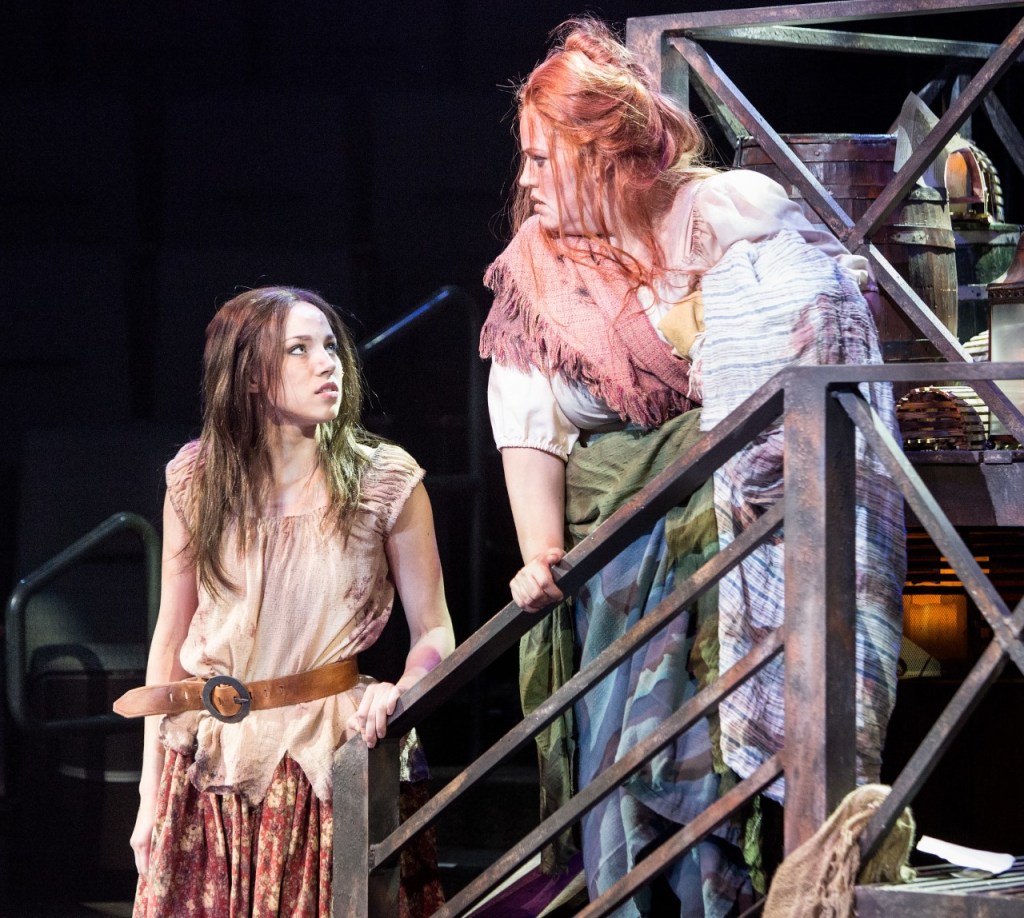
Visser’s weakness is his writing, although it must be said that in his day (early twentieth century) he received praise for innovate storytelling and it was said he thoroughly modernised the type of stories he excelled at. Unfortunately, that praise doesn’t withstand the eye of a modern reader. The entire first chapter of De Vliegende Hollander is basically one long info-dump. When he gets around to actual storytelling, there are a few genuinely entertaining gems to be found, such as the character of Griet Kals, an innkeeper who has much in common with Victor Hugo’s Madame Thénardier (Everybody raise a glass to the master of the house!).
2.0 Generic (CC BY-NC-ND 2.0), Hale Centre Theatre, Anna Daines Rennaker as Eponine and Camille Van Wagoner as Madame Thenardier, Les Misérables, Victor Hugo.
Unfortunately, Griet Kals and the protagonist’s cousin Lottie are the only female characters in the book. Amusing as Griet Kals is, she remains a caricature, and Lottie gets all of two sentences in, exclaiming how fortunate she is that a dashing manly hero has appeared to save a damsel in distress.
Equally unfortunate, Piet Visser lived and wrote at a time in which boys and men were taught to be devoid of emotion. Therefore, the most interesting aspect of his story – the psychological process of impending and then full insanity, is dealt with in one single brief sentence: He went completely insane. For a modern audience, with a preference for show-not-tell and with an almost insatiable appetite for psychological motives and processes, this tends to be a disappointment.
The cover of the second edition of Piet Visser’s De Vliegende Hollander, and two internal illustrations by O. Geerling featuring Captain Peter van Haelen addressing his crew and The Swift Christina, afore she became The Flying Dutchman. Source: Project Gutenberg.
At long last the relevance of this long rant, in which I’ve hoped innate fascination with The Flying Dutchman has kept you going. To reward your patience, the relevance is twofold.
First-of-all, it can be said that the Harvey Duckman Pirate Special which was recently published (and which y’all ought to be reading by now), sustains the enduring legacy of The Flying Dutchman, containing no less than two stories on the topic: Peter James Martin’s ‘The Rat Who Served on The Flying Dutchman’ (A Brennan and Riz Story), and my own ‘Learning the Ropes’ (A Smugglepunk Tale).
Secondly, Piet Visser was my great grand uncle. I don’t mind admitting that my mind is a rather peculiar place which I barely understand myself – what I do know is that my set of thought processes have made much of this family connection to Piet Visser, and hence The Flying Dutchman. It probably wouldn’t stand in a court (and doesn’t need to be as the pre-1923 copyright rule applies), but as far as my noddle is concerned Piet’s literary legacy is a family inheritance to treasure…and fiddle with.
Arr, me hearties, I’ve been fiddling the tune of The Flying Dutchman in a great many ways, but seeing that I’ve run out of space, you’ll have to wait for part two of this yarn to find out how…till then, Fair Winds to ye.
With kind permission of Corin Spinks, Corinography. Author Nils Nisse Visser, self-proclaimed guardian of Piet Visser’s The Flying Dutchman, looking pretty at Rye Bay, Sussex.
About Nils Nisse Visser
Nils is a free-lance writer, occasional poet, archer, Homelessness activist, who was born in Rotterdam in the Netherlands in 1970 (which was the best year ever to be born *Mark), he grew up in the Netherlands, Thailand, Nepal, Oklahoma, Tanzania, England, Egypt and France. Taught English at various Dutch secondary schools for 18 years, but his firm belief that education is most effective when it is fun raised a few eyebrows. Having been told too often that he lived in his imagination, he took the hint and moved there on a full-time basis. He currently lives in Brighton in the county of Sussex in England.
Rather confusingly he sometimes writes as Nils Visser, Nisse Visser or Nils Nisse Visser. For which he apologies.
Towards the end of his life Lovecraft had a minor crisis of confidence in his own writing. Such minor crisis are not particularly unusual among writers, it probably was not the first time in his career, it was probably the last only because of his premature death, but we know this because of a letter he wrote to a friend in October of 1933, in which he wrote the following:
I am at a sort of standstill in writing—disgusted at much of my older work, and uncertain as to avenues of improvement. In recent weeks I have done a tremendous amount of experimenting with different styles and perspectives, but have destroyed most of the results
One of these experiments, an incomplete fragment, is ‘the Book’. Presumably spared the fireplace because old tentacle hugger saw something in it, though where he intended to take the story is something we will never know. Aspects of the last few paragraphs of this fragment have echo’s in ‘The Shadow out of Time’, which Lovecraft went on to write shortly after this fragment was penned, though the concepts involve are very different, the results experienced by the narrator bare some similarity, so its certainly possible this was a failed branch of that same narrative tree.
I’ve said before, with those other posthumously published fragments that publishing ghouls sought out after his death, that we will never know what they may have finally become. As with ‘The Evil Clergyman‘, ‘The Book’ is clearly unfinished, and later drafts might have changed a lot of the narrative and style. This is more clearly written as something to be published, even if it is incomplete. It reads more polished than ‘the Evil Clergyman’ does, because of that however it also lacks something. There is nothing particularly new in this story, if Lovecraft’s was experimenting with styles, he was not going far off the beaten track with this one.
Like the previous fragments, Azathoth, The Descendant and others I always feel like this is delving into the writers scrap draw. All writers have them, a folder full of half written, half conceived ideas. My own is mostly in the form of notebooks, or in a folder on my cloud drive called, oddly enough, ‘Scrap’. Is there any value in that folder, we sure, to me. Its a collection of half conceived ideas, and occasionally they draw me back to them. What there isn’t however is any stories. Nothing is complete, its just idea’s half formed, so beyond myself they are of little or no value to anyone and that is exactly what ‘the book’ and all those other fragments are.
Unlike ‘The Evil Clergyman’, incomplete though that is, it is at least an actual story, with a beginning, middle and end. This fragment on the other hand is merely a beginning, there is a certain intrigue about it, a wistful hunger to know more even, but that’s about it, and its instantly forgotten after you have read the thousand or so words that comprise the fragment.
Man, who seems unsure about who and what he is, starts to tell you about a book he found in a dark forbidding bookshop. Reading the book he took what it told him and made an arcane circle of some kind and…..
And that’s more or less all there is. Its something or the completest to read perhaps, but frankly worthless as an exercise, it isn’t a story… So like those other fragments the publishing ghouls sought out after Lovecraft’s death it worth no more than a solitary tentacle. Though to be honest that is a stretch. It adds nothing to Lovecraft’s literary legacy, the mythos or the greater wealth of human understanding. Its nothing but an example of publishers been willing to cash in on the vague post-humous fame of a deceased writer to put out any old rubbish in order to sell magazines. Which is just a little bit sad as it dilutes the quality of Lovecraft’s fiction as a whole that way.
Old tentacle hugger had more than his fair share of strange dream by anybody’s standards. It was often these dreams that inspired aspect of his stories and occasionally there entirety. This story however is unique among the collected works because unlike other stories inspired by dreams this is not so much a story inspired by a dream, as a recounting of the dream in its entirety. Its not even a story as such, as it was never written down as one. Instead this text is taken from a letter Lovecraft wrote to his friend Bernard Dwyer in part of which he recounted a dream he’d had, and said he intended to base a story upon it.
After Lovecraft’s death, when weird tales and others were rooting through his papers this letter was found and the recounting of the dream was later published as a story, though it never was.
It is therefore nothing but Lovecraft narrating a dream he’d had to a friend. Whatever fuller tale he might had decided to turn this into we will never know. Instead it is a bit of literary grave robbing by the publishers of weird tales. A tale that is not a tale, or certainly not a tale as told in the way the writer would have presented it to the world. Its a short little read, that bounds along with little exposition, recounting the dream in it’s entirety with no real anchor as such. There is none of H P’s laborious later style here, no long introduction involving ponderous family histories and tentative connections. It is in fact just a story, told from a dream, cast adrift of contextual constraints. A simple tale, in all regards.
And oddly enough, its all the better for it. This is frankly refreshing, and feels more like Lovecraft’s early work. It draws you in quickly, keeps your attention, moves along with pace, and because its not mired in exposition it keeps you there. Its just a fun read, a perfect insight into the place where Lovecraft’s stories come from , without them being mired in his later obsessive drone. It has everything I loved about early Lovecraft stories, the sense of urgency and place without place. It’s disturbing in the right way, partly perhaps because I know this is a recounted dream, rather than a story about a recounted dream.
Lovecraft would never have submitted this story to publishers as it stands. he might never have submitted it at all, but if he had used this as the basis for a story he would have made it three times as long, there would have been a history of the clergyman who used to live in the attic rather than a mere nod towards his dark reputation. There would have been an explanation of his downfall, of what he was burning and why, of his suicide and all that led to him haunting that place. There would have been exposition aplenty, and layers of brooding tensions. But I suspect it would also lose everything I like about this story in the process.
This is raw Lovecraft, Lovecraft from the source undiluted by pretension or anything else. Just a story, just and awful chilling horror story of a haunting and evil spirits. Frankly the only thing Lovecraft would have done by writing a story based on this tale is ruin everything good about it.
Now I realise I have said very little about the story itself, that’s because you should just read it. Its worth the time it takes to do so, its a little gem amidst the coal of Lovecraft’s last few stories… So, when you have five minutes go and read it at the link below.
This is not a masterpiece, its not even a piece at all in any real sense, but its still good value for five slithering tentacles, just be thankful Lovecraft never got around to ruining his tale by writing a story based upon it.
It is true that I have sent six bullets through the head of my best friend, and yet I hope to shew by this statement that I am not his murderer. At first I shall be called a madman—madder than the man I shot in his cell at the Arkham Sanitarium. Later some of my readers will weigh each statement, correlate it with the known facts, and ask themselves how I could have believed otherwise than as I did after facing the evidence of that horror—that thing on the doorstep.
That is the opening paragraph of what for me is on the face of it an underrated Lovecraft short story. That strange bunch of notable critic’s whoms opinions on Lovecraft’s stories are held in high esteem almost universally consider it among the poorest of his later stories. Though these are the same critics who consider Through the Gates of the Silver Key to be masterful so I would question the validity of their opinions, not least because it holds a personable charm to the characters that inhabit it. Interestingly its also one of the few Lovecraft stories, and certainly the only mythos story that has a strong female character with agency within he story.
Now I know what you may be thinking, a strong female character with agency in a Lovecraft story… finally, we only had to go through 63 other stories to finally get one… Put the bloody flags out, Lovecraft actually managed to get past his misogyny and write a female character at last… Well don’t get your hopes up too far. While Asenath Waite Derby is indeed a strong female character with agency in the story, she’s also, not… but we’ll get to that.
The story is told to us by Danial Upton, who has indeed unloaded a revolver into the face of best friend Edward Pickman Derby (Asenath’s husband), and done so while Edward was confined in Arkham’s asylum. A violent and uncharacteristic action by a quiet family man, who has borne witness to the strange and gradual procession of his friend by a dead magician Ephrain Waite, (Asenath’s father). While Ephrain died before Asenath and Edward met at university, he never the less leaves a long shadow over there relationship. Not least of which is the initial attraction between them been based up a mutual interest in the arcane.
Asenath and her father hail from a small fishing port off the new England coast called Innsmouth, yes that Innsmouth, and there is more than a hint or two that Asenaths mother was in fact a deep one hybrid. Asenath herself is described as ‘dark, smallish, and very good looking except for over-protuberant eyes’ that common trait among the old families of the Innmouth area… So there is more than a hint of deep one blood about her.
As time goes by however Danial notices odd behavior by his friend, whos personality will switch on occasion, leaving him with little memory of preceding events. It is only later that Edward confided in Danial he believed that he is being gradually processed by his wife, or rather by his wife’s deceased father, and that his wife is herself actually processed by her fathers soul, and he is using her body to as a convenient safe haven while he transfers his soul once more in to the body of ‘her’ husband a man of independent wealth… So, what can you say about that, save perhaps…
‘Oh for the love of Cthulhu, Howard Philip Lovecraft you utter utter shite, you finally write a decent female character. A female character that is narratively strong and has agency within the story, and it turns out she’s her own father using her/his body as a pit stop while she/he tries to become a man again… You utter fucking arsehole…’
It’s possible you consider the opinion expressed above a little strong… Which it is, I will admit, in the context of a single story. The central narrative idea is interesting, unique and different in terms of Lovecraft’s work. It’s a well written story, and as an idea its well executed. I have no objections about the actual story at all, I really quite like it, more than most of Lovecraft’s critics it would seem. So as a story ‘the Thing on the Doorstep’ is a good read, it’s different enough from his others to stand out, it certainly has memorable well written characters in it, characters who feel more alive and real than some of Lovecraft’s more stifled characterizations. It also has to be said Asenath is a well written character…. So taken as a single story this has a lot that is good about it.
But this story is the only story in Lovecraft’s entire cannon with an actually strong female characters with agency. The only one… And it turns out she is actual a shell inhabited by a man using that shell to try to process another man…. Her agency exists merely to give agency to her fathers spirit… If this was one female character out of many in his body of work then that’s not an issue, its is merely an element of the narrative, when however its the only female character of any weight you ever write, and her whole agency is as a puppet for a mans intentions and desires, it is unsettling to say the every least and says nothing good about Lovecraft.
To get back to the story itself a moment, Danial notices over the course of time the changes in personality Edward goes through. Edward himself, on the occasions he is himself, suspects he is being processed by his wife at first and it is only later he comes to believe it his actually the spirit of her father at work. As the story goes on the weight of evidence grows as Edwards sanity is slowly eroded. Once he is hospitalized things comes to a head when Danial hears a knock at the door, a knock which is familiar as the patterned knock used by Edward whenever he came to visit. When he opens the door…
Lovecraft’s misogyny is well known. It is one of those things you may believe you just have to accept when you read Lovecraft, like his racism and rightwing political outlook. When you read his work you have to be prepared to accept these things are there and decide if you are willing to see past it and enjoy the stories for what they are. To an extent I generally do that, while I never gloss over these issues I focus on the tales themselves. But on occasion, such as in the case of The Dreams of the Witch House or The Horror at Red Hook, its difficult to look past those issues. With the latter I managed to get past the issues the former I did not. The Thing on the Doorstep is more Witch House than Red Hook. ironic though it may be that the story with an actual female character in it is the one that screams loudest of Lovecraft’s misogyny, that’s what it does, for me at least.
Its not a bad story, certainly its not as bad as so many of his notable critics claim, but while their issues are with the story itself, my own are with the story in context to his wider body of work and frankly I find it abhorrent and hateful, the true horror of this tale is not the tale itself but the misogyny it encapsulates… As I said at the start of of this post, the story is on the face of it underrated by Lovecraft’s notable critics, but the thing is their reasons for disliking the story are the wrong reasons. Its the sheer indulgent misogyny that is the problem with the tale. Which ironically not the issue those critics have with it. The story in of itself warrants around four tentacles in my somewhat ecliptic rating system, but taking it in the wider context it gets a big minus from me for the utter shit storm it is…
Its October, the leaves are falling, the witches are abroad, and I’ve opened the blog up to guest writers again. Yes its Indie October. Throughout October some old favourites among my guests will be returning along with some new voices. Today’s Guest Post comes to you from a strange land across the ocean, where racoons and the occasional bear wanders through his garden, and they don’t use the letter U correctly… New England’s own Joseph Carrabis
Is your work product of art? Bit of a trick question, that.
Art is also a product. The question has more to do with production values. There’s a difference in the care put into producing a Velvet Elvis versus the Mona Lisa. It has nothing to do with Da Vinci thinking, “Yeah, some day, hot dang, I’ll be remembered for this.” I doubt he did. It was commissioned work. But he definitely put more time into it than he made on the commission. He wanted to do a good job.
Not sure anybody on the Velvet Elvis production line has such thoughts. Ever heard anybody at a burgerjoint call from out back, “Wow, Charlie! That’s one damn good fry you made!”?
The “work versus product” question has been with me since January of this year (2020). I took a class with a recognized, award winning author. Personally, I never liked their work. It was okay written at best, not well written. Not even stylishly written. It didn’t really stand out from much of the other stuff on the shelves.
It was (to me and in a word) meh.
For that matter, I never understood why this author’s work got awards.
Okay, yeah, I do; produce what the public wants and it’ll get recognition. That’s another difference between art and product; Art may take time to be recognized.
The “work versus product” question resurfaced for me when I read The Best of C.M. Kornbluth. I enjoy bronze, silver, and golden-age science fiction and fantasy. Kornbluth’s work fell more into the product than most. By his own definition, too, according to the editor’s notes and author quotes in the book.
The hammer fell… …with a class exercise we were given by the author mentioned above; something written by said author, intended to be flash fiction and too long by about 300 words. Cut it down to under 1,000 words. Go!
I started reading. It was, as before, okay. Some good turns of phrase (and being honest, I picked up one learning gem in the class. If I can learn one thing in a class, I’m thrilled). A nice idea in there, somewhere. I redlined unnecessary adverbs, adjectives, fixed some tense issues, clarified a speaker here and there. Removed some expository lumps. There was one paragraph that completely threw me; the POV shift was so abrupt I had no clue who’d taken over the story and it didn’t add anything so I pulled it. A quick word count showed I’d loped off about 280 words. Okay, another few minutes and I’d find twenty more words to cut.
Ding! Time’s up, pencils down everyone.
Then the award winning author showed us how they’d cut 300 words. They removed the last paragraph.
Which included the character evolution of the story, as in A.J. Budrys’ line that Star Wars couldn’t end with the destruction of the DeathStar, it had to end with someone saying “We destroyed the DeathStar!” (or close to) signaling that the characters understood their job was over, their task completed, their goal reached, the story done, and most importantly, letting the reader/viewer know the story’s over.
But this author simply cut out the last paragraph to meet the word limit requirement. They even said, “It’s ready to go now.”
Really?
Essentially the story ended with “We”, not “We did it! Not even “We exclamation point!”
The reasoning? Now it fit the “1,000 word max” criteria.
A beautiful demonstration of product v art. Who cares if it still makes sense as a story, it fits. Send it off. We’re done. An understanding that helped me understand why I never liked this author’s work.
They produce great stuff if you’re looking for a blowoff read. Lots of people are. I prefer work I can grow from, learn from.
Guess I’ll never win any awards. Not while I’m alive, anyway.
About Joseph Carrabis
Joseph Carrabis is boring and dull. He holds patents covering anthropology, linguistics, mathematics, neuroscience, psychology, and a few dozen other fields. He created a technology based on these patents that ended up in over 120 countries, and a company with offices in four countries. He’s vowed to never do that again. Now he writes fiction and hopes you enjoy it.
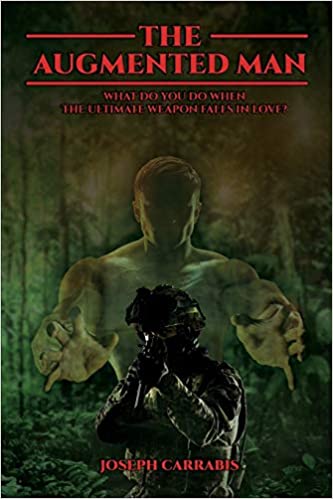
As well as his own fiction, including among other splendid works The Augmented man (marks review of which is here) he is also a regular contributor to the Harvey Duckman Anthologies, though we do make him put all the U’s back in the words that need them…
Its October, the leaves are falling, the witches are abroad, and I’ve opened the blog up to guest writers again. Yes its Indie October. Throughout October some old favourites among my guests will be returning along with some new voices. Today’s Guest Post is from Teesside travel author Will Nett
It hangs in the air as you approach. Once you get inside a 20 mile radius you can almost taste it. By the time they first glimpse the grey gloom of the water, even the professional cynic, eg; me, is fully invested. I wanted it to be in there. I stuck my head around the gift shop door to enquire as to what time the next sighting was, as though a centuries old, or even prehistoric, beast, was operating on some sort of office rota. There’s been 22 official sightings at time of writing, 7 of which are by the same person, an Irishman who’s never been within 50 miles of the place in his life, but instead watches a livestream of the Loch from his home across the Irish Sea. Well, it can’t be any less entertaining than Mrs’s Brown Boys, I don’t suppose.
I’m in Drumnadrochit, or ‘Drum’ as I’ll now refer to it, in order to save ink. It’s effectively the ‘Village’ from TV’s ‘The Prisoner.’ Everyone knows your business before you’ve even arrived, all of the buses are driven by the same insufferably cheerful driver, and the weather is modified every 90 seconds by a man sitting at a console somewhere beneath the village green.
It was a motley crew that eventually set sail in this post-Coronial world of cryptozoological exploration. So much for trying to save ink. There were a couple of Parisians on the roof, a pair of Poles in the wheel house, and myself draped over the engine block. I’d positioned myself in such a way as to be able to grab Nessie around the neck and wrestle it onto the boat.
We blasted off from the little harbour around the ‘horn’ of Urqhuart Castle under the reassuring steerage of Skipper Mike, who’s booming tour-guide tones punctuated the various points of interest in a discourse that took in ditched WWII bombers, disastrous water-speed records, and the importance of making sure there’s a ladder attached to the outside of the boat before going for a dip.
It was another Irishman who gave birth to the legend of the Loch in the first place. 1350 years ago, a chap called Columba- who I like to think of as being played by Peter Falk- learnt of a local man who’d been killed by a ‘water beast.’
Intrigued as Columba was, he was not so curious as to investigate the matter himself, instead sending one of his mates out for what he presumably convinced him would be a leisurely swim. Sure enough, the ‘water beast’ set about our unassuming piece of human Nessie bait as he casually backstroked around the Loch. By way of defense he fell back on the tried and tested method of the Catholic Church and wielded the sign of the cross using his index fingers, which was enough to prevent further mauling and returned the ‘beast’ back to the depths, and its abandoned shopping trolleys and car tyres.
I’m not a man of religious faith, or a believer in urban myths, but I wanted to believe this.
I wanted it, this ‘water beast’ or anything, to rear up, and smash the boat and everyone in it to pieces. I wanted to see ‘it’ or anything.
The suggestion of a monster is a powerful thing.
About Will Nett
Will Nett is about 40, from Middlesbrough and the author of My Only Boro, the book that was a bestseller in the town for three Christmases in a row. Will is one of the most affable writers in the Tees area, and his global appeal and general popularity have seen his writing career straddle two millennia. He is an incurable backpacker, occasional banjo picker and habitual note-maker/taker, most of which have found their way into his Gonzo-steeped books, which also include Local Author Writes Book, and his riotous travelogue, Billy No Maps. He has been a Sudoku salesman, snooker table repair man, model, cinema usher and unprofessional gambler. His latest book, The Golfer’s Lament, was submitted for the William Hill Sports Book Of The Year Award 2020.
Okay, before we start, let me just reiterate once more, Randolph ‘bloody’ Carter…
I am, as astute readers of previous blogs in this series may remember, not the biggest fan of Lovecraft’s ‘dreamlands’ stories. Nor am I a huge fan of Randolph Carter in general. The only Randolph Carter story that has done well under my occasionally erratic spotlight is Lovecraft’s novella ‘The Dream-Quest Of Unknown Kadath‘ and the reasons I like that story are all to do with the greater mythos rather than the story itself. My hopes for this story were not high therefore… Which is slightly odd.
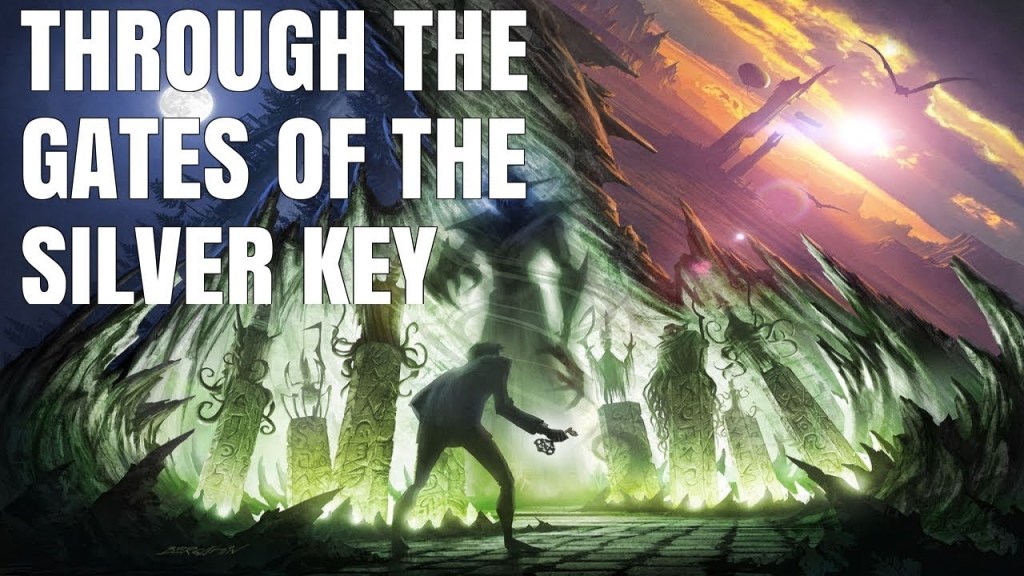
‘The Silver Key’, a story I loathed, was unsurprisingly the central inspiration for Through The Gates Of The Silver Key. Indeed it is a sequel to that story written primarily because a fan of old tentacle hugger, Edgar Hoffmann Price, who was also a writer himself, asked Lovecraft to write it, go so far as to send a 7000 word original draft of the story to Lovecraft. Telling the tale of ‘what happened next…’ to dear old Randolph Carter, after he unlocked the gates at the end of ‘The Silver key’.
Lovecraft’s vanity, reasonably enough, was such that he was swayed by the idea, and took that 7000 word draft and rewrote it into something that ended up twice that length and, according to Hoffmann, left fewer that 50 words of his original draft in tact. Despite this many accredit this tale to both authors as a collaboration. Hoffmann was reportedly very pleased with the resulting tale and full of praise for Lovecraft’s reworking of what could be one of the first examples of fan fiction to surface in the zeitgeist.
Despite my trepidation about reading yet another story with Randolph in it, when I first came round to this one I was looking forward to it. I wrote in my review of the dreadful The Silver Key, that I remembered this story fondly… Remembered was clearly the wrong word, at some point however in the dim distant past around the late 1980’s when I was young and impressionable I did read this particular tale and there was something about it that spoke to me.
I don’t remember what it said, and I am fairly sure it lied…
That’s one of the problems with rereading things I read while still a teenager, a few decades, a whole lot of living, and more refined tastes can mean that stories I loved when I was effectively not much more than a kid, don’t really stack up any more. I suspect what I was drawn to back then was the strangeness of the tale. In part a psychedelic dream sequence where Randolph becomes just one fragment of a cosmic id, and shares the bodies of other nodes of existence, there are wild fascinating ideas here, idea’s I suspect I had never come across when I first read this story way back in the dim darkness of the past. A past which increasingly is indeed another country…
Fast forward to a more cynical and well read now, and everything I doubtless found fascinating when I first read this story is still there. But the writing, the description, the plot and everything about this story aside the original ideas (only about half of which were Lovecraft’s to start with) is awful. The wonder is sucked out of everything and replaced with bland, dull, over written, and frankly boring narrative.
Take for example this passage..
He provided a light-wave envelope of abnormal toughness, able to stand both the prodigious time-transition and the unexampled flight through space. He tested all his calculations, and sent forth his earthward dreams again and again, bringing them as close as possible to 1928. He practiced suspended animation with marvellous success. He discovered just the bacterial agent he needed, and worked out the varying gravity-stress to which he must become used. He artfully fashioned a waxen mask and loose costume enabling him to pass among men as a human being of a sort, and devised a doubly potent spell with which to hold back the bholes at the moment of his starting from the black, dead Yaddith of the inconceivable future. He took care, too, to assemble a large supply of the drugs—unobtainable on earth—which would keep his Zkauba-facet in abeyance till he might shed the Yaddith body, nor did he neglect a small store of gold for earthly use.
Maybe that sparks your interest, maybe you are not unlike me as a seventeen year old and all power to you if that’s the case. I’m not even sure I was like me as a seventeen year-old. Perhaps my memory confused this story with another when I remembered it fondly. Frankly however my summing up of the Silver key was:
I’m not saying don’t read it, really I’m not, but if you do read it, for the love of all thing scaley don’t blame me…
The same applies to this sequel, as does the score it recieved, its only saving grace is that’s the last of Randolph Bloody Carter… Well except for another collaboration, Out of the Aeons, which he wrote with Hazel Hearld, but that never appears in the ‘complete Lovecraft, collections so I’m going to forget it even exists… Because it may be a work of utter genius but I will happy take the risk of that unlikely truth rather than read the words Randolph Carter again.
Its October, the leaves are falling, the witches are abroad, and I’ve opened the blog up to guest writers again. Yes its Indie October. Throughout October some old favorites among my guests will be returning along with some new voices. Today’s Guest Post is from Dr Tamara Clelford
Mark
If you’d told me two years ago I’d write a novel, I would have laughed. Absolutely no way would I write a novel, no way could I write a novel. Well, except it turns out, by accident.
I’ve always loved reading and I read a lot. I have a set genre of books that I like: thrillers where you learn things, think Robert Ludlum, Tom Clancy, Dick Francis etc. But I have never enjoyed writing fiction, not even when I was in school. I write a lot for work, but I write coding and technical reports all based in fact. This is a far cry from enjoying writing fiction.
I used to work in a gym and I remember a colleague saying she had at least one good book waiting to come out. I was in awe that someone I knew thought they would write a book, and that statement has stuck with me since. Fast forward a few years and one of my good friends with spare time whilst working abroad wrote a book as part of NANOWRIMO, the National Novel Writing Month. The seed planted about writing a book all those years ago in a gym in Sheffield had finally started to think about germinating after a conversation in a house in Bermuda.
But it took a few more years for the seed to actually germinate. In fact, it took an extended holiday in New Zealand and a strange story about a resurrected bird. Whilst I walked along the shore front in Wanaka on the 31st of October I read a series of story tiles giving a timeline of the history of New Zealand. One caught my attention:
‘1946 Dr Geoffrey Orbell proved takahē not extinct’.
Well, I knew they weren’t extinct as we had literally seen some on our trip. So I googled the story behind this tile over the rest of my cup of coffee and my imagination ran wild. I started to think: how great it would be if this takahē story was actually all a government conspiracy, they were never extinct just being used for something in the second world war, and what if their ‘use’ was actually still viable for an evil genius to exploit today?
I had entered the plot of a Ludlum book, but this time a plot of my concoction. I decided the protagonist was going to be a woman on holiday in New Zealand, she’s going to see some things going on and be able to recognise them for what they are because of her obsession with spy books. She’ll then use her science skills to foil the evil master plan. What do they say – write what you know and want to read. All the books I read have male protagonists who save the day: why shouldn’t it be a woman, and why shouldn’t that woman be a Radio Frequency engineer on holiday? In a 15 minute period I had a whole plot for a book sorted in my head, all whilst holding a conversation on a totally different topic with my husband. On our way back to the flat I explained the plot I had come up with and said it would make a great book, I got an answer I wasn’t expecting ‘Well, you know what tomorrow is, don’t you?’.
If you don’t know, NANOWRIMO takes place every November. You register your book title on the website, update your word count each day, and ‘win’ if you write 50,000 words in November. So, with only hours to spare I sorted out a title for my novel, riffing on the Ludlum titles, registered on the NANOWRIMO website, and the next day started writing my novel.
I literally started at the beginning and just wrote what came to mind. I enjoyed it. No, I really enjoyed writing the book, seeing my ideas and characters come to life and I even enjoyed editing it. With hindsight a plan might have been useful, as I had to go back and alter facts because of something I decided would happen later on in the novel. As the novel takes place across New Zealand, timescales and geography have to be accurate.
I ‘won’ NANOWRIMO, even though I battled jet lag and started working full time. I hadn’t quite finished the book, but I finished it by the end of the year. Then it fell dormant as I had no idea how to get it published. I didn’t stop writing though: I started a blog, wrote articles for magazines and was able to fully enjoy the process.
Help comes to your aid at the strangest places, in this case it was in Ten Forward in Scarborough Spa. I have loved star trek since being a small child: I am and always will be a Trekkie. So come April, I was excited to go to Scarborough SciFi Convention again. Alongside all the wonder of a SciFi Convention I ran into Sixth Element Publishing and realised this was the perfect company to help get my book published. We discussed the new-to-me world of publishing and how to get my book to the point where it would be out there in the wide world for everyone to read. I liked their approach to publishing and I liked their enthusiasm for books and the way they help new authors like me. So, I dived in.
Today that little seed has become a 5cm high shoot ready to blossom into a published book, all really by accident. I have had my manuscript read through and a story telling mentoring session by Sixth Element, which has been incredibly useful and has made my book a much better read. I’m in the process of making the last few alterations before moving onto final edit, production, proofreading and then book production! What I have learnt in my accidental journey into writing a novel is that you don’t need a masterplan – you can just type words into a document and see where they take you. I can enjoy writing for fun and like what I have written, even though the 14 year old me would snort with laughter at that statement. If I can write a book and enjoy it there is definitely a good book inside of everyone waiting to come out!
About Dr Tamara Clelford
Tamara is a star trek loving, pukeko obsessed, tap dancing, Queen listening, lord of low frequency and high-priestess of high frequency physics geek. Having worked in a variety of technical roles, both normal and clandestine, she is now a consultant working on physics based problems and data science. This latest incarnation has opened new doors to a wide variety of work and interests, like: an eclectic blog, writing a novel, encouraging people into physics, and teaching people how to code and do data science.