I wrote the original version of the post below in 2016, I came across the original draft of it in one note earlier today while looking for something else. I have only made a couple of superficial changes, and tidied up the language a little, but for the most part this is an exact restatement a decade later… Sadly, something do not change…
So, we are at war AGAIN.
The last war destabilised a region to the point where extremist militants carved out their own empires across international borders and having done so become a terrorist threat to the western world.
So we are going to war. Again. .
I know its a wild and wacky idea , but perhaps we could try not bombing people and creating the reason for the next war. We have done this particular dance on and off for about the whole of human history.
Perhaps we could try a new approach ,
I would like to suggest we give it some new name, to distinguish it from war. Perhaps, we could call it Peace. Under the new approach of peace the people we don’t bomb this year will not become the people we then have to bomb in five or ten years’ time when they are frankly a bit pissed off with the west for it policy of bombing them.
Peace would instead mean that having not bombed them now, they will have less inclination to attempt to bomb us in future. In turn we will then not have to go to war. and the billions and billions spent on the policies of War can be spent on policies of peace. For example, funding the NHS and not having food banks as a basic requirement of a bankrupt welfare state. Free high education, better state pensions, a decent standard of living for all, homes for the homeless. Nice peaceful things rather than bombs.
We have tried this war thing time and again ,
I know as a civilisation we are a bit slow on the uptake at times, but frankly it’s past time we realised war as a policy doesn’t work. That is unless you’re trying to perpetuate a corrupt ruling class, an industrial military block and breed a state of paranoid acceptance among your people of increasingly intrusive state control designed to keep the rich in power and control. A state where the poor do as there told and accept that they are ruled by those who know better. While blaming the problems of the state on the refugees from countries where the ruling elite have perpetuated war.
So…
Why not give this Peace idea a chance, there possibly a song someone could write about that idea now i think of it.
Let’s try not killing more people in wars, followed by wars followed by more wars. constantly breeding the next bunch of militant gun wielding fanatics who want to exact some revenge because we keep bombing them. Frankly, if we were bombed every day year on year, we would probably be a little tetchy ourselves,.
Fine Bone China is somewhat literally named. It is made by grinding up bone burnt bone ash and added the resultant powered to a mixture of clay and ground stone. This helps bind the clay allowing you to make much finer, or thinner walled, cups and saucers, or tea pots etc. This is an ‘ancient Chinese process’, invented in Stoke on Trent in the 1790’s and used to allow British potters to compete with imported porcelain. Indeed it was only called Bone ‘China’ because the rich almost exclusively bought expensive imported Chinese porcelain and so owning a set of fine ‘China’ was considered aspirational among the middle classes.
Buying a set of Bone China was the equivalent of buying a knock off Chinese copy of a Gucci bag. Only the British potters were doing the knocking off. It was also why ‘willow pattern’ Chinese plates were such a popular design, with its ‘ancient Chinese folk story’ told in the pattern that was first designed in Stoke on Trent and is exactly as Chinese as Robbie Williams and Stanley Mathews aren’t.
Bone ash, ground stone and clay are relatively cheap and bone ash really is a great binding agent. As you may imagine, you get bone ash by burning bones. Specify in the case of most fine bone China, the leg bones of cows. Why the leg bones of cows you ask? Well mainly as cow leg bones have a low iron content, burn hotter, produce a finer ash and that helps add to the translucent qualities of fine bone China.
However, while cow leg bones are reputedly the best for the process, most any animal bone will do, chicken perhaps, or horse, or indeed when it comes down to it human… All you need is the right kind of furnace. It is possible therefore, if you are of a mind, to make fine bone China out of the bones of your vanquish foes…
Note. I say possible, not legal, nor entirely ethical…
That said however, skulls are bones. Ergo, if you learn the porters art and find yourself not entirely burdened by moralistic constraints it is possible to drink from the skulls of your enemies. in the most civilized British way imaginable..
This appeals to my barbarian potters soul…
In other news strange people, the kind of people who might well drink tea from the fine bone China of their vanquished foes have been singing things… (actually they are perfectly lovely people who have never ground the bones of their enemies because they don’t have any enemies… )
Also in other news the ever lovely Madeleine Holly-Rosing, the writer/creator of the popular and long-running steampunk supernatural series, Boston Metaphysical Society. has a kickstarted going on for her other series Morgana Pendragon. As ever I recommend anything she is involved in.
click on the entirely appropriate picture below to find out more,
Madeleine almost certainly doesn’t drink tea from the fine bone China of their vanquished foes, due to being American and prefering coffee…
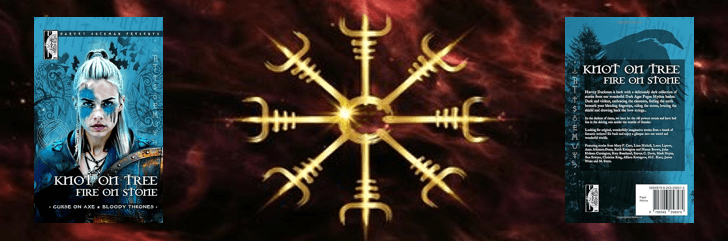
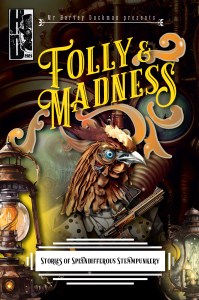
And finally as we are on about barbaric things… A reminder that the latest Harvey Duckman anthology is out there in the world, a somewhat pagan delight called Knot On Tree, Fire On Stone: Curse On Axe and Bloody Thrones , because sometimes a title does not know when to stop… (its actually from an ancient four line pagan war poem me an Gillie made up on New years day, that is to say that special kind of ancient that applies to things that aren’t…
Knot On Tree,
Fire On Stone
Curse On Axe
Bloody Thrones
As for Harvey writers having a propensity for drinking tea from the Fine Bone China of their vanquished foes?
Well if they put the rum to one side long enough …
As a writer who has spent a great deal of his fictional time in the mid 1800’s for one reason or another, I have spent many a long hour researching the Victorian era and the ‘eccentricities’ of it. The Victorians for all their occasionally stuffy, starched collars and hidden ankles, engaged in a lot of penitently bizarre things. Mediums were popular after dinner entertainment among the wealthy classes, as was mesmerism. Spiritualism in general was on the rise, as was an interest in the ‘eastern’ religions, and inviting ‘holy’ mystics to speak to your guests was not unusual.
The strangest after dinner entertainment however was undoubtedly the ‘mummy party’. This was not a party where all the men stripped down and put on nappies while been tended to by large breasts matronly women, though ‘nanny’ parties almost certainly happened… But the other kind of mummy, the Egyptian kind.
I am aware mumification was not an exclusively an Egyptian practice, but in terms of a mummy party they are, as this was the great post Napoleonic wars era of Egyptology. In Victorian England the only mummies anyone cared about were Egyptian.
A ‘mummy’ party involved inviting your guests to stand around an watch as an ancient Egyptian was unwrapped from his burial garb. Doing so while drinking brandy and smoking cigars, with a light sherry for the ladies and perfumed handkerchiefs supplied. Guests would often be offered snippets of the mummies wrappings as party favors, and with a bit of luck at least one of the female guest with be over come with the vapors, to add a little spice when the evening was reported socially.
What could be more Victorian than desecrating bodily remains and destroying another cultures heritage for the purposes of entertainment…
‘Mummy’ parties were not an exclusively British endeavor. Though unsurprisingly they were very popular in London for several years and the Egyptian wing of the British Museum was more or less funded by them, with the well to do hiring in mummies who were occasionally rewrapped repeatedly, for further parties. They were equally popular in the well to do parts of the eastern united states, like New York, Boston and Philadelphia. It is therefore not beyond the realms of possibility therefore that our own Dear Edgar attended such an event in the mid 1840’s, though this is pure speculation on my part. Even if he did not attend one personally however he was certainly aware of the phenomenon, as a ‘mummy’ party is the basis for this particular story.
There is something oddly laudable about this tale. Foremostly as it mocks the whole idea of the ‘mummy’ party with a delicious degree of satire, but also because it mocks the idea that modernity ( in this case 1840’s modernity) was the very peek of human civilization and knowledge. Attending Doctor Ponnonner mummy party after eating far too much Welsh Rabbit (a spicy cheese on toast/grilled cheese popular in Wales) and drinking a fair few bottles of stout, our narrator is very excited at the prospect of watching a mummy be dissected. He was actually already abed when the call came, but got back up and rushed across town to witness it.
The mummy in question turns out to be called Allamistakeo, in keeping with Poe’s favorite hobby of making up very silly names. What is most interesting is however that when they remove the sarcophagus they discover, as they cut into him, he isn’t actually dead. Instead he was embalmed alive, on purpose, and should have been woken up a century or two later, not several thousand.
There are some oddities to consider with this story, beyond the obvious one… One been that Allamistakeo claims to be in the prime of his life at only around 700 years old. A refence to the early chapters of the bible whence the first humans lived many hundreds of years. He also say that the Egyptians were monotheistic and the various animal headed gods of ancient Egypt were all aspects of the one true god. The same being true of all pagan pantheons. The world was also not created 10000 years ago but has always existed. These are all fringe ideas that were prevalent in Poe’s time to one extent or another. The pagan gods been aspects of the one true god in particular was a popular theory expounded by some religious leaders. It is all a bit of an odd mash up of different ideas, which I suspect was Poe’s drive for including them. They are all equally silly in their own way, and Poe for all his romanticism was a rationalist thus this is all poking fun at fringe ideas.
In the end the narrator decided he has had enough of the 1840’s and seeks to get himself embalmed so he can be woken up in a couple of hundred years to see what life is like in 2140.. Good luck to him there as that would be in about 15 years time and I am not entirely sure the human race is gonna make it…
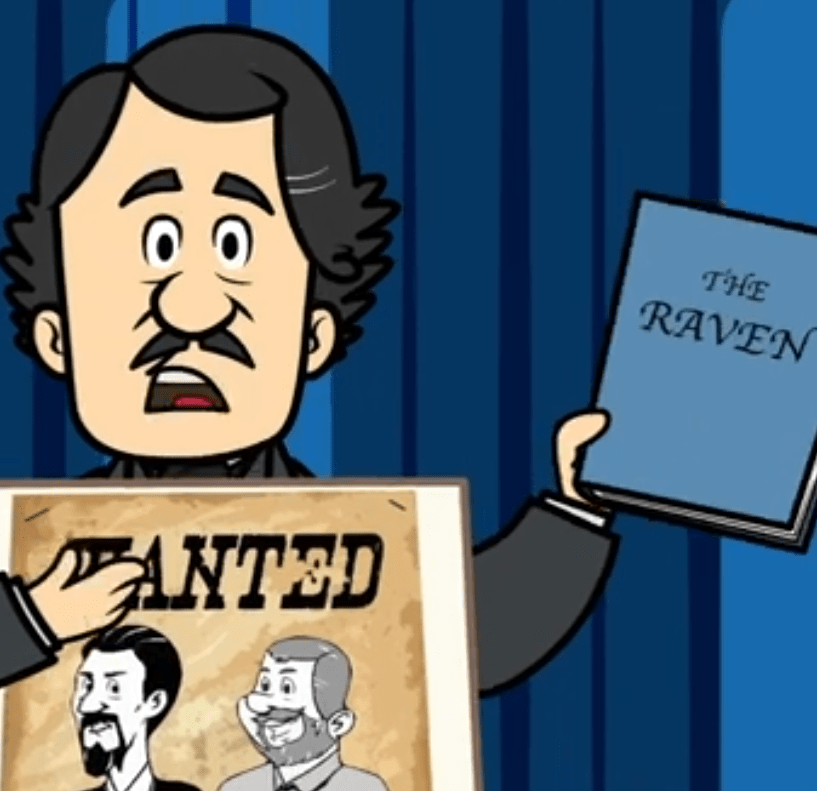
This story lives and dies by its wit and the wit of Allamistakeo. If you take it exactly as seriously as I suspect it was intended then it is a lot of fun, but one would argue potentially not as fun as the 2019 theater organ animated Electro Swing comic opera based upon it. An operetta that features the line, sung (as Poe) ‘I’m the guy that wrote the Raven, yes every single word.’ As well as a song about Welsh Rabbit.
I genuinely do not know if composer Richard deCosta and Lyricist Thomas lane managed to make the entire animated feature. If they did I could not find it, but the below is a delightful teaser for it that was produced while they were trying to get the money together in order to do the full thing.
It is however a delightful madness… In keeping with the original story. So I kind of hope they did and it will turn up one day fully formed…
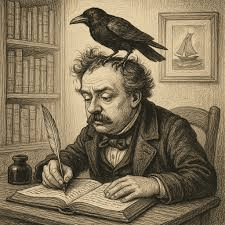
FOUR RAVENS OF DELIGHTFUL MADNESS
Should you read it: There are worse ways to pass a little time, the operetta is worth a watch too.
Blaggers fact: Remarkably Richard deCosta’s 2019 operetta is not alone in musical versions of this story. Italian composer Giulio Viozzi wrote and produced a one act opera which he named Allamistakeo, unfortunately my Italian is dreadful, so I shall not recommend this one in so much as it might be wonderful but even without the Italian I don’t follow, the recording I found was dreadful, as if it was recorded on an old mono cassette recorder and then the tape was left on the radiator for a few days.
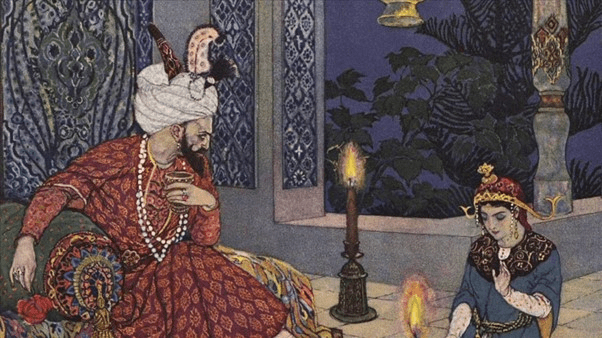
Truth, as the old saying goes, is stranger than fiction. It is also on occasion harder to believe. Fiction has the advantage of the internal logic of the story. Truth has to actually be true, even if that truth is very carefully hidden behind convenient lies. Our dear Edgar, idly explored this idea in his satirical sequel to ‘A Thousand and one Arabian Nights.’
In the unlikely event your not aware of the original, A Thousand and one Arabian Nights is a famous collection of Middle Eastern folktales and stories. It’s history is extremely complicated but it certainly dates back to the 10th century and probably in some form several centuries earlier. It is occasionally referred to as the Arabian Cannon, though it is perhaps more rightly considered Persian rather than Arabian for the most part.
The framework of the collection is the conceit that these stories are told by Scheherazade the beautiful and wise Viziers daughter to her husband the king. The king, Sharryar, has been married before, and was greatly in love with his first wife, before he discovered she was inviting others to her bed and had her executed. In his anger he took to marrying a new virgin every day, sleeping with them on the weding night, then strangling them when the cock crowed each morning.
This has gone on a while…
Eventually when the Vizier can find no more virgins to wed to the king, virginity having lost much of its appeal among the ladies of the city, Scheherazade volunteers to wed the murderous king, but does so with a plan, she is going to tell him stories, but carefully make sure she doesn’t finish any story just before the cock crows each morn, and this she does, for a thousand and one nights. Until the king has fallen in love with her and no longer desires to strangle his new wife…
The thousand and one stories told by Scheherazade have origins from Egypt to India but are now considered to be the tales of the Arabian cannon, among the most famous among them being the stories of Aladdin, Ali Baba and of course Sinbad the sailor. There are many others and the collection has been added to and redacted at various times in its thousand year history. Stories by their nature fall in and out of vogue, but just about every type of story and genre imaginable is within the cannon, many of them utterly fantastical in nature.
Which brings us to our Dear Edgar and ‘The Thousand-and-Second Tale of Scheherazade’ in which Scheherazade tells one final story, and pushes her luck somewhat for the King doesn’t believe almost any of it. Scheherazade final tale is of the eighth and final voyage of Sinbad and describes all the strange things he discovers along the way, each more unlikely than the last. Such as this description of one of the strange things Sinbad encounters on his journey.
This terrible fowl had no head that we could perceive, but was fashioned entirely of belly, which was of a prodigious fatness and roundness, of a soft-looking substance, smooth, shining and striped with various colors. … in the interior of which we distinctly saw human beings … and then let fall upon our heads a heavy sack which proved to be filled with sand!
The king doesn’t believe any of this, but in actuality what Sinbad is describing here is a hot air balloon. Then there is this one…
a man out of brass and wood, and leather … with such ingenuity that he would have beaten at chess, all the race of mankind
Again the king believes this a complete fabrication, but it is in essence a description of ‘the Turk automaton’ and these two examples are not alone. Almost every miraculous and unlikely thing Sinbad encounters is a description of something real if odd discovered or constructed in Poe’s own time. Such as the Babbage computer, or the understanding of how coral is formed, or the extensive caves systems in Kentucky.
Each new oddity in Sinbad’s is found by the king to be increasingly far fetched, ridiculous and he becomes increasingly irate, if not insult, by them. Meanwhile Scheherazade isn’t paying quite enough attention to her husbands displeasure.
She also finishes her tale just as the cock crows…
The king then precedes to exhibit a rather unfortunate literary critique, and well, goes back to old ways.
This whole story, which is a story about a story told within a story about a woman famous for telling stories, relies on one very simple conceit. Everything can be fantastical if you tell it the right way. But to get the joke you need to know the references being made, most of which depend on you having an 1840’s understanding of the world.
This is a very clever story but to get the most out of it you need to understand each of the refences many of which are a tad oblique. On first reading the fantastical things Scheherazade describes do just seem ridiculous, it is only when you know what Poe is doing that they becomes clever and interesting. Much of the story just goes over the readers head, because that conceit is too well disguised. If you have to go and read an explanation of each of the refences to get the jokes then they are not actually funny. Take the enormous headless fowl above, in retrospect that is a brilliantly funny description of a hot air balloon, but I would be prepared to bet you did not realize that till I explained what it was. I certainly didn’t until I did some research on the story after I read it the first time. It was a lot funnier on the second read through…
And there is the crux of the problem with this story…
THREE RAVENS THAT HUNG ABOUT LONG ENOUGH FOR THE JOKE TO BE EXPLAINED
Should you read it: Well, yes, knowing that the jokes are there you should., its is very clever and a little funny in of itself.
Blaggers fact: The only part of Scheherazade final tale that the king believes to be true when Sinbad tells us that he discovers “the earth being upheld by a cow of a blue color, having horns four hundred in number” which is of course the only part of the tale not based on something real.
Trilogies, popular fiction is littered with them. Duologies are a rarer beast and Quadlogies rarer still, but for reasons that may not be wholly apparent trilogies remain ever popular. I have long suspected this has much to do with the heroes journey, the mythical template for mythical story telling Joseph Campbell forged in the blood of the kraken. A trilogy just works if you are using it to tell the hero’s journey. It gives four acts to each book, and the requisite twelve in total to complete Campbell’s arc. There is however a much simpler reason for trilogies, after three stories a writer may have no stories left to tell without an indulgence of repetition.
Yet readers always want more of the characters they love and some writers will write endless stories based around a single central character who does not necessarily change a great deal. The heroes journey is not the story. They are a medium through which the story is told. Some writers though lose their love for a character. Sir Author Conan Doyle famously killed off Sherlock Holmes so he could write other stories, only to bring him back with some reluctance a few years later when he was offered too much money to refuse.
Modern writers will often write seemingly endless series. Take the wheel of time for example, originally planned by Jordan to be a trilogy, Jordan changed the plot half way through the third novel in the series so the ‘big bad’ turned out to be a minion of the real big bad and the series was extended to what became 14 books as well as a prequal and three companion volumes. Books 12 through 14 were finished by Sanderson after Jordans death, based on Jordans notes for book 12 that were stretched out across 3 volumes, because the publishers offered Sanderson a three book deal…
Now I am well aware that The Wheel of Time is a well loved series, but I personally never finished it. The original trilogy was great, up to about the point Jordan got the recites for the first books sales, and the decision was made to ‘extend’ the series, after that for me it felt ever on plot progression even though each book became longer. I gave up after book 8 came out in 98, but many I know persevered to the end and it remains a well loved series. For me though it would have worked better had Jordan just written the trilogy he originally intended.
In any event, the reason I bring up trilogies is because The Purloined Letter is the third installment of that rarest of things a series of stories by our own Dear Edgars This been his third and final story featuring his own ‘great detective’ C. Auguste Dupin. The detective that was to become the inspiration for the aforementioned Sherlock Homes, as well as Hercule Poirit and many others. Unlike the great literary detectives to come after him, there are only three Dupin stories and each of them is unique in that they deal with the detective in very different circumstances. To that degree it is a perfect little trilogy of stories, as it avoids becoming a parody of itself.
The Purloined Letter is set after the events described in The Murders in the Rue Morgue and The Mystery of Marie Rogêt, but Dupin is still in Paris and still sharing rooms with our unnamed narrator, at this point the six month stay has extended to two years and in that time the amateur sleuth has developed something of a reputation for solving the unsolvable. So when the Prefect of the Parisian police comes up against a vexing conundrum it is to Dupin he turns.
The matter in question is a personal letter that was written to the Queen, that was ‘acquired’ by an unscrupulous minister, which he is now using to blackmail her. The Prefect knows the minister took the letter, and that he is using it to blackmail the queen, but he can not act against him openly without harming the royal house and revealing the letters existence. Nor have they been able to require the letter despite some ‘grey area’ policing. They have staged break ins at the ministers offices and home to search them top to toe. They have also found spurious reasons to search the gentleman himself. All to no avail and as long as the minister holds the letter he has the queen in the palm of his hand.
After a while Dupin is moved to act. He is, as he explains, a supporter of the queen and he also has personal reasons to despise the minister in question. There is also the minor manner of a 50000 franc reward for returning the letter to its rightful owner… This is somewhat out of character for Dupin who has previously refused fiscal rewards, but perhaps two years of living it up in Paris has started to eat into his savings…
Both pervious Dupin stories involved murders, in the first he examines the crime scene to unravel the mystery. In the second he searches for clues in news reports. In this tale however Dupin brings his mind to bare not on physical clues but the phycological make up of the criminal in question. This is something of a shift and makes it a different kind of detective story.
Of the three Dupin stories this is to a degree the least interesting because it lacks the kind of mystery at the heart of the other two. Perhaps it says something about the human condition that we find it harder to engage with a mystery that doesn’t involve a murder, but you would be hard pressed to find any modern detective story that lacks for a corpse. We have a morbid fascination with death, lets us be honest. As such a stollen letter is a tad prosaic in comparison. We even know who stole the letter, the only mystery here is where it is been held. Considering where Dupin finds it, the Parisian Police Prefect should consider firing some of his men for not discovering its whereabouts in their searches, considering the great lengths they went to, unscrewing table legs and checking between floor boards etc.
Dupins great leap of ratiocination (to use Poe’s term for what Dupin does) is based upon his insight into the character of the minister, and his belief he would hide the letter in plain sight, the more to feel superior to those searching for it.
It is the equivalent of hiding a secret file on your computer by putting it in a folder marked ‘documents’ and just changing the files name to something bland and uninteresting.
Dupin guesses this based on the ‘character of the minister’ and retrived the letter which has been turned inside out, and the reverse side written upon, then placed in the letter rack inthe Ministers fount parlor… It is all a tad too neat, as is the self-assured nature in which he asks for the reward in advance, before agreeing to recover it.
In the end it is a bit twee. However that is not entirely a bad way to sum up all three Dupin stories. What makes them memorable is what they inspired, which can be said for Dupin himself. Of the three The Murders in the Rue Morgue is easily the best and this one is a bit too flat for my own tastes. Perhaps it needed a good murder…
TWO RAVENS LOOKING AT THE MANTLEPIECE WONDERING WHY NO ONE THOUGHT TO LOOK THERE IN THE FIRST PLACE
Should your read it: Its not a bad story, it just isn’t one that leap’s off the page and grips me. You may think otherwise.
Blaggers fact: Having aid everything I have said about trilogies, it is worth baring in mind that this was written and published towards the back end of 1844. The love of Edgar’s life, Virginia, was seriously ill for the next two year, and died in January 1847. Poe was devastated, turned back to the bottle. If he intended to write more Dupin, he never did, but this doesn’t mean this was only ever intend to be a trilogy of tales.
The ravens come, dark wings with dark news. Thought and memory sit upon the gallows tree when the one eyed god hangs waiting. The Duckman comes…
On the 23rd a new Harvey Duckman anthology will be released ( it is available on pre-order now). fifteen new tales, from fifteen authors. Tales of a pagan past, of dark visons, of ice and blood., of axe and fury, of dreams and visions, of gods and giants, and the burning fires of the halve.
She utters words of honeyed violence to sooth the savage at her breast.
I harken to her words, but they are as nothing to me. Garbled sounds, senseless, meaningless. Words from across the whale road. Words from the lands of the cross carriers. The land where they worship the murdered god.
Her words are no more than utterances. The words of one already lost. One already half a draugr. Already half among the woken dead.
There is such a thing as a literary in joke. A private reference within a story that only those in the know will appreciate. Such things are oft times carefully constructed in such as way that the sit in the narrative without breaking its stride. The trick is to make them natural, fit in with the story been told, and perhaps hint at the humor even to someone not in the know.
An example of this, from my own novels, would be the refence to ‘the Crediton badger’ in Lucifer Mandrake: The Esoteric Cricket Ball. To briefly explain, in part of the narrative, Lucifer is explains to the reader the dangers of using glamours, and warning that you can become your disguise if you are not careful, and how folklore is littered with examples of this. There is a certain irony to this warning you would have to read the novel to understand, but to illustrate the point he is making he makes mention of a couple of examples, one of which is the Crediton badger, a man who moves from London to Dorset, becomes reclusive, and is eventually turns into a badger.
The Crediton Badger perfectly illustrates what I needed Lucifer to illustrate and is humorous into the bargain. Many a reader may have smiled at this bit of frippery. One reader however messaged me directly, after laughing loud enough to scare his cat. A reader called Clive, who happens to be a good friend of mine, and a few years earlier had moved to Dorset to the small town of Crediton. Clive who started going grey as a teenager when his hair was otherwise quite dark, has long sported the nickname badger…
Aside Clive, a few friends may also have spotted the reference, but none of them would have laughed as hard as he did. the only person to laugh as hard was me, when I received his text, which I had been waiting for since I wrote that line over a year before. It was a very private joke that sat in the narrative unseen by all but the one it was aimed for. Importantly though, it was a private joke that did not detract from the novel.
Which is somewhat opposed to everything about The Literary Life of Thingum Bob, Esq. Now I am in no way certain that The Literary Life of Thingum Bob, Esq is littered with our Dear Edgars private jokes. Jokes written at the expense of collogues within the world of 1840’s magazines and periodicals. Jokes that draw a bead upon his fellow editors, writers and publishers. However, the story being a long series of in jokes carefully constructed to lampoon the industry is the only explanation which makes any sense as to why this story exists. Which is something of a problem either way.
If this isn’t a carefully constructed parody of the East Coast American magazine publishing industry in the 1840’s then its a long dull story that, while it has merit in its narrative structure, is not half as funny as it needs to be to be anything other than terminally dull.
Thingum Bob, named for his grandfather, Thingum, rejects the life of a barber, with his dear papa and sets out instead on a career as an editor and poet. At first he tries trickery, coping out an old poem and submitting it to different magazines all of which reject his work venomously. He then tries other means, gets one story published but without recompence. There is a lot about circulations rising and minuscule sums of money been paid to writers. And a whole lot of repetition which if this was humorous would be witty and clever, if that was you were a fellow writer in the 1840’s.
There is also Thingum himself, who is something of a narcist, something more of a pillock, and probably also mean to be a joke. He is entirely unlikable and self-absorbed. I suspect Poe was lancing at those who send magazines contributions he had to deal with in his professional capacity as an editor. Writers’ full of their own sense of worth and surety as to the quality of their prose. Having come across a few of these types of writer as an editor myself this at least did raise a rye smile.
I also have little doubt there are refences to individual editors and the spoof names for the magazines doubtless contain clues to actual magazines. If I was part of the 1840’s magazine reading set, I would probably give the occasional rye smile. If I was an 1840’s writer or editor I may chortle a little at the events described and the parody of the industry. I suspect that in 1843 this was a down right hoot of a story…
It is not 1843. The jokes are dull, the refences long gone, and the story struggles to hold any interest for me. Unlike the Crediton Badger this is not a small in joke within a much longer work. The whole story is the joke and while I am a writer with a fascination for the period and its literature, I don’t really find it all that amusing. Which is the problem
If I don’t find the jokes about 1840’s publishing funny then I suspect no one really will.
ONE LITTLE RAVEN, SITTING IN A TREE, SHRUIGGING ITS SHOULDERS.
Should you read it: No, just don’t. Unless you are a 1840’s publisher and really bored…
Blaggers fact: ThingumBob is a phrase often used when someone has forgotten the name of whom they are talking about. As this tale is best left forgotten its is entirely apt.
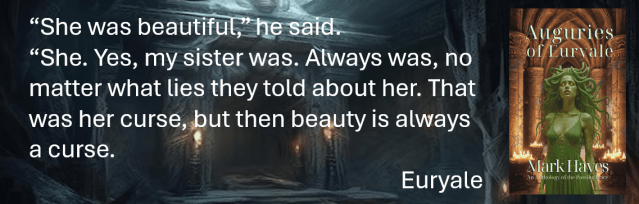
Esqwith’s Passing Place is a bar that sits on the edge of many realities and is part of none. It is a place people stumble into some times and tell stories.
Stories of auguries cast in kitchens by Victorian arcanists. The last survivor of an end of the world. The sister of Medusa, in a charity shop in Cheem. A herder of books who was once someone else. The final proof of god on a world of endless sunlight. Men in Dark Tweed and strange things in the Thames. The divine Sibel in a goth club in Streatham. The infatuating Miss Maybe, Quizzels and how to Quiddle them. As well as other tales of nothing, hungry things and a tale that no man knows.
So anyway, that’s it, my new anthology is out there in the world. I can put it to bed, it is done, all that’s left is marketing to try and get people to consider reading a copy. In terms of being the writer this is now a finished project, cast out into the cold uncaring world.
I hate the marketing part. I never dreamed of been a marketer. Writing is my passion , my dream, my desire. Spending my time trying to convince people to buy books isn’t and never has been.
So why should you buy a copy of Auguries of Euryale, because it is full of good stories, stories that will make you laugh, cry, think, smile, wonder and hurt a little in that good way books can make you hurt a little. If you read this blog from time to time you know how I tell stories. If this is your first timer reading my blog , hello…
You should buy a copy of this anthology, I promise it will not break you, though I can’t promise it will not try. There are more than a few very personal stories in the collection, though I am not about to tell you which ones they are. Any book is am open window, if the writer has done their job right. There is always a little blood on the page, a slither or two of the authors soul between the bindings. If your not leaving the odd open wound out there then are you even trying to say something real.
There is a lot of fantasy, Urban and otherwise, in this anthology. There is also a lot of darkness and humanity, which is often the same thing. As well as life and death, as the two are linked. Bits of me inhabit every story, sometime mere slithers, in some though, aspects of my souls are laid bare, if you care to look closely.
Not all the stories are personal in that way, but in all of them the red on the page isn’t ink.
In the very first story in the anthology Lucifer Mandrake, my Victorian arcanist, casts an augury, and in doing so explains why the only thing that matters is the casting is blood.
Shed blood for an augury, shed blood for the page.
I have other stories to write, other tales to tell, more blood to shed. These are now told and the blood is ingrained in the pages. Euryale guards her temple, the last survivor climbs the hill, the Men in Dark Tweed are waiting, the final proof of god sits between the light of four stars on a planet called midnight, the book herder waits for the rustle of pages, the Sibel calls her coven to dance around the stone, and Miss Maybe has a most unsuitable suitor. All the while no man waits for the daughter of the sea.
I don’t do marketing, there is no blood in marketing, the blood is already shed on the page.
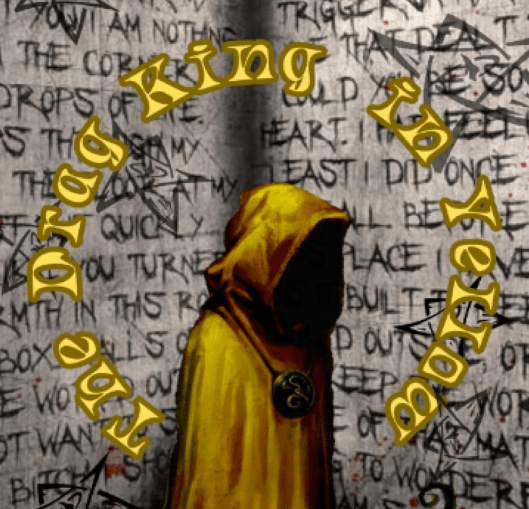
A few years ago now A steampunk group in Gloucester decided to do a themed event, with the mildly preposterous title, Steampunks vs Cthulhu. As their, not exactly, local expert I was asked for suggestions for things they could do and if I would volunteer to do anything for the event. And so I agreed to do a talk on the life and work of HP Lovecraft, having recently finished a book on old tentacle hugger’s works. I also suggesting, in an entirely off hand way, that they could put on the second act of ‘The King in Yellow’.
This was of course a joke on my part. However, if you are unaware of why it was a joke, let me explain. The King in Yellow is the fictional play, in the novella The King in Yellow by Robert W Chambers. The second act of which is cursed in that it send any one watching it, or performing it, insane.
Matt, who was planning the event, and I knew full well had a copy of The King in Yellow, and very much was aware of the joke said. “Great idea, write it…”
I gave him ‘the look’. The look that says, ‘sure I’ll get right on that sometime never…’ But then Nimue Brown, who normally wrote silly little plays for such events said. “I don’t know about The King in Yellow, but I would be up for being a Drag King in Yellow’… At which point Jessica Law piped up, ‘oh can I be a Drag King in Yellow too…’
This left me somewhat boxed into a corner by my ‘cleverness’.
Several months later, a small Gloucester amateur dramatics group did indeed put on a one act, twenty minute, play called ‘The Drag King in Yellow’* . As far as I am aware no one was sent mad, or at least madder…
*There is a video of the play being performed available here on You Tube, consider yourself prewarned. It is also available as a manuscript Here , but you would be mad to buy it. It only exists in paperback because I wanted to gift the cast with them.
The Drag King in Yellow is my only foray into the world of amateur Dramatics, for which the world of amateur dramatics is most grateful one suspects. Theater is not my world. I may like to take in a play every now and again but my knowledge of the theater is far form encyclopedic, this last is unfortunate only in that having just read The Masque of The Mummers I can’t help but feel I missed a few theatrical jokes. However, that in no way detracted from the joy of the novel.
Ben Sawyer is a writer well versed in theater, the love of theater, and I suspect some experience of amateur dramatics, informed one of the two main branches of the plot of this, his third Holly Trinity Novel. In the midst of York’s medieval festival A local Am-Dam is staging an old, and reputedly cursed play. The curse is real and enacted by ‘the mummers’ strange ghosts in period theater wear and blank featureless faces. Somehow more terrifyingly they communicate exclusively with lines from the plays of Pinter, Greene, Bennet and others.
There are other threats to the old city as well, the big bad is stirring, and the truths behind Holly herself are waiting to be revealed, while the supporting cast is as ever deeply entwined. Mira’s ex is back in town with his spirited wheelchair bound sister. His best mate is getting he band back together, which is good because the current lead singer thinks he is a Viking. Meanwhile a reporter has got his hands on an arcane artifact that gives him the powers he shouldn’t have.
Holly Trinity is awake, which never bodes well for the old city. Armageddon may be round the corner. But at least she gets to go to the theater.
This is a joyous romp of a novel as all Bens novels tend to be. As ever the city of York is as much a character in the novel as a setting. Ben writes of the city with a vibrancy that gives it life. Much like his other characters, which have the same depth and layers as his plots.
If you haven’t read his previous novels you should. If you have you will not need me to convince you to read this one.
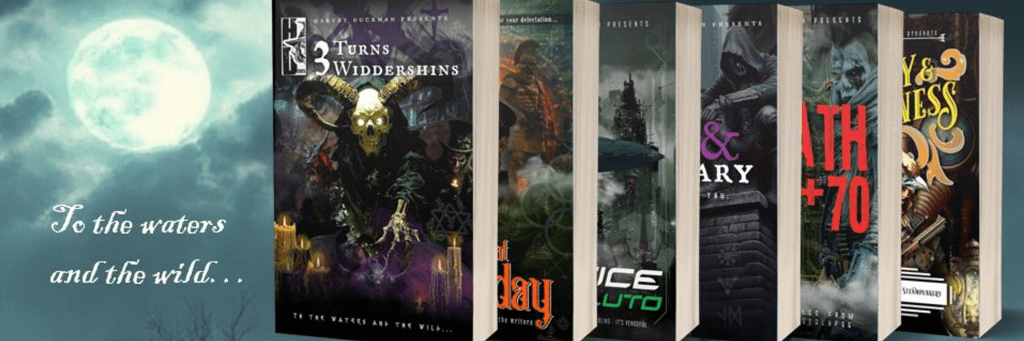
Aside the Holly books Ben also writes stories for the Harvey Duckman Anthologies, which as you may be aware I am also associated with. they have a new book of dark pagan stories available for preorder on kindle, that will be out in paperback and hardback from the 23rd of January It joins the six pervious ones below in the ever expanding range of Harvey anthologies.
While talking books, my own new anthology, which I should also mention is out on the 16th…
Our Dear Edgar, as you know, to an extent invented detective fiction with his August Dupin stories, The Murders on the Rue Morgue, The Mystery of Marie Roget and The Purloined letter. He created the literary conceit of the genius detective solving crimes with an everyman sidekick who takes the position of narrator, cheer leader, and tells us of their astoundment when the detective reveals how he solved the crime.
Without Poe’s Dupin there is no Sherlock Holmes, at least not in the form we are familiar with. Poe invented the Sherlock architype, but also the Doctor Watson type everyman who tells us the stories. Holmes and Watson in turn inspired Agatha Christie’s Poirot and inspector Japp among many others.
As a archetype for detective stories the three Dupin’s are hard to dismiss. They were not however the only detective stories Poe wrote, this story ‘Thou Art the Man’ is another example. It is however something of a failed experiment of a story if you compared to his other detective stories, or as he termed them, tales of ratiocination, because this tale is told to us by the detective himself, and loses the mystery element in the process.
This is not to dismiss the story, which is in its own way inventive and well constructed. It is quite a fun little read as well, with more humour on display than Poe’s other detective tales. This is not to say the tale is told for laughs but it has a certain baroqueness to the names and characters that brings a rye smile. It centers around the murder of Barnabas Shuttleworthy, a fellow of some wealth in the town on Rattlebrough. While no one can find the corpse Shuttleworthys nephew is accused of his murder, the narrator, who is also the detective, however believes there is another villain afoot. Charles Goodfellow, the dead mans best friend.
A elaborate ploy is used by our detective to unmask the villain involving the corpse of Shuttleworthy a case of win and ventriloquism. But here in lays the problem, because we are told the tale by the detective themselves the tension is lacking. the big reveal is more of an ‘I told you so’ and it all falls a bit flat in the end.
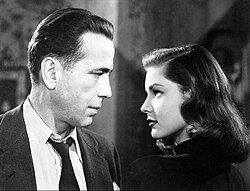
There are of course plenty of detective stories told rom the point of view of the detective, Raymond Chandlers, Philp Marlowe stories, for example. But those employ a very different way of telling a story. . . generally with a touch of down at the heel alcoholism and ‘then she walked in, the dame that done me wrong…’ With twists and turns, betrayals and backstabbing , that the detective fails to anticipate. Such stories work because it involves a flawed detective struggling against the machinations of others. There is none of that in Poe’s story, instead this is a tale of a clever detective using his cleverness to unmask a villain and that is essence is why it is something of a meh of a story. There is no suspense, no reveal beyond how the culprit is revealed.
Marlowe (Bogart) and the Dame who done him wrong…
Clever detectives need flaws, and those flaws need someone who will reveal them , it why Holmes needs Watson to tell his story. Holmes would be a terrible narrator, and that is exactly what we have in this tale. A clever detective just being clever, without any real charm. Its not a bad story, it has fun within itself and its not a bad read, it just feels flat, or perhaps just too one dimensional to really inspire the reader. And experiment with the detective genre that doesn’t work.
THREE RAVENS THAT ARE NOT ALL THAT SURE THERE SHOULD NOT BE LESS OF THEM.
Should you read it: There is no reason not to, but there isn’t really a reason to do so either…
Blaggers fact: The line the corpse speaks, ‘Thou art the Man’ is most likely refences Samuel 12:7, in which King David is accused of laying the way for his marriage to Bathsheba by arranging for the death of her first husband Uriah.
Or alternatively it may be based on a line in ‘the Great Moon Hoax’ articles, of 1835, which claimed Sir John Herschel had discovered a civilization of Vespertilio-homo on the moon, or for those without a working knowledge of Latin… Batmen. Yes Batmen on the moon…