Dear Edgar #22 The Fall of the House of Usher

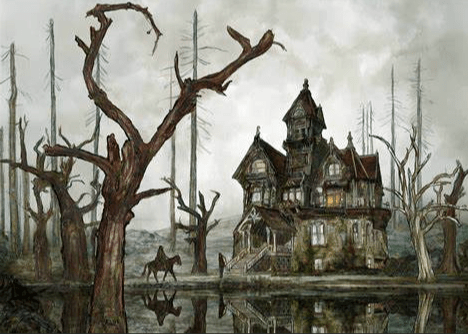
~at length found myself, as the shades of the evening drew on, within view of the melancholy House of Usher.~

1838, the year ‘The Narrative of Arthur Gordan Pym of Nantucket‘ was published was also the year that our dear Edgar moved with his wife Victoria to Philadelphia so he could take up the job of assistant editor of Burtons Gentleman’s Magazine. This also marked the beginning of what was undoubtedly his most prolific and eventually most successful period as an author.

The Philadelphia years were later blighted when Victoria first fell ill, but this was still a few years away when in 1939 ‘The Fall of the House of Usher’ was first published to minor acclaim in Burtons. It is a story many consider not only to be a gothic classic, but as foreshadowing his wife’s decline into consumption that became the very real tragedy in Poe’s life that was to come.

Usher was certainly the most lauded of the stories to be included in Poe’s short story collection ‘Tales of the Grotesque and Arabesque’, published the following year. Most of the stories in the two volumes set released by Lea & Blanchard we have already covered, a few others first saw the light of day in that publication and will be coming up soon, but to focus on ‘The Fall of the House of Usher’ for the moment, it is a tale in which our Dear Edgar returned to some of his favourite themes.
The themes of three earlier stories in particular are echoed in this story, those being Morella, Berenice and Ligeia. Which is not to say that Edgar was obsessed with putting female characters into soporific states that seem death like and letting them decay and wasting away, but it is a theme that comes up time and time again in the early tales. What is odd is that these themes were so prevalent before the wasting disease that took his wife from him not many years later was diagnosed. Equally the male characters in all these stories react to these tragedies with obsession and madness that echoes how the death of Victoria was to plunge him into a deep alcohol fuelled depression and began his own downward spiral to an early grave.

Occasionally life imitates art in dreadful ways.

The story itself is told to us by an unnamed narrator, who tells us he has been drawn to visit his friend Roderick Usher at his families isolated and rundown house. Roderick request this visit due to his melancholy illness, and the soon to be fatal illness of his twin sister Madeline. The narrator who seems somewhat enamoured with Roderick rushes to his side and spends several days in the mans company, seeing Madeline only the once in this time, a strange fae like figure that doesn’t acknowledge his presence.

At this point Poe has Roderick sing a poem called ‘The Haunted Palace’ to the narrator which seems to echo much of the state of The House of Usher. This is not entirely surprising as the poem in question was written by Poe and published separately earlier the same year. As poems go, its not among his best…

Some time later Roderick informs the narrator that his sister has died and takes him to view the corpse, which Roderick has lain in state in the dungeon like cellar. There to lay for two weeks until she can be buried. Of course, she is not actually dead, have you not read Poe before, ‘she’ is never dead… Just like in the earlier stories the woman in question has fallen into a death like coma. Yet Roderick claims he is convinced she is dead and the narrator convinced by him, though he does comment as to the rosy nature of her cheeks.

From this point onwards there is a building of atmosphere, the reading of a medieval romance called The Mad Trist that has some baring on Roderick’s state of mind. All the while strange cracking sounds and the master of the house descends further and further into madness. Roderick admits he has put his sister in her coffin alive. He is convinced of this and yet will do nothing, until his sister breaks out of the coffin, and attack Roderick, killing him with fear and herself as this is her final act, the narrator flees and behind him the house is struck by lightening and falls into the dark dank tarn on whoms shores it resided.

There is of course much more to the story than this brief synopsis, though it is in essence the tale, a tale that is renown for its tell. It is a masterclass of tension and atmosphere. It is gloomy, dark and full of foreboding, and that is exactly what it is meant to be. While it is true there is little new in this tale if you have read earlier Poe tales, specify the three mentioned above., this is the apex of those stories. This is Poe perfecting his own style, it avoids the overblow verbosity of Berenice, reuses the unworldly surrealist nature of Ligeia and mixes it with the darkness of Morella. Taking the best aspects of all three tales and melding them into something close to perfect.

There is a reason that this is both the best known and most critically acclaimed story in the ‘Tales of the Grotesque and Arabesque’ collection. It is Poe at his best, his grim gothic brooding best.

AN FULL UNKINDNESS IN ALL ITS WONDERFUL GRIM GOTHIC BEAUTY

SHOULD YOU READ IT: If you read only one of Poe’s tales from among his early works make it this one. Read it by the light of too few candles and let the motes of dust in the air distract you.

ISSUES: Well, there is an argument to be had, that the poetry was unnecessary. But I am really clutching at straws here.

Bluffers fact:  ‘The Fall of the House of Usher’ would have made Poe an utter fortune in rights had he lived in a different century. In 1928 two entirely separate silent movies were made. The first of these is a French movie by Polish born Jean Epstein who is an odd character who aside his ‘Usher’ movie mostly made documentaries about Britany. The second of the 1928 movies, an American made short film is for me far more interesting. Not least because it is like watching a psychedelic trip in black and white, that becomes increasingly strange as it goes along. ‘The last Theatre’ You Tube channel put it to music some years ago, and did a fabulous job doing so

The sheer number of further interpterion’s of ‘Usher’ is testament to its longevity in the zeitgeist.

If your enjoying this steady wander through Poe, you might want to check out the first blog series I did on HP Lovecraft in the paperback edition
Posted in book reviews, Dear Edgar, Goth, horror, opinion, Poe, reads | Tagged , , , , , , , | Leave a comment

Dear Edgar #21 The Man That Was Used Up

Let us begin with a question. When does a man cease to be a man? Which is to say, at what point have you replaced so many of his parts he is not longer the sum of them…*

*To be very clear form the offset this is a hypothetical question posed by this particular story. I do not suggest this question should be applied to real people nor would I condone anyone who did.

Poe posed this question in his story in the 1839 edition of Burtons Gentleman’s Magazine in his story ‘The Man That Was Used Up : A Tale of the Late Bugaboo and Kickapoo Campaign’. The man in question is Brigadier General John A. B. C. Smith, a famous war hero of the ‘Indian’ wars. The general is sought out by Poe’s unnamed narrator because he is considered to be ‘one of the most remarkable men of the age’ which he certainly proves to be, in one respect at least.

Before we go any further it needs to be remembered that Poe was a former soldier himself, and while he never served in the west he would have known plenty who did from his time at West Point. His opinion of the people and tribes of the first nations was clearly coloured by this experience and the common opinions of colonial Americans of the period. The Little Bighorn was still over thirty years away, Wounded Knee fifty. The ‘Indian’ wars were current events through out Poe’s life. This does perhaps make it slightly odd that of the two tribes mentioned in the story only one of them is real.

The Kickapoo people’s are now three midwestern tribes, sharing a common heritage and Algonquain language that now reside in Olkahoma, Kansas and Texas, though their origins lay further north where they resided in half of what is now Illinois before being forced south in the 1830’s. There are around 5000 Kickapoo’s remaining on reservation land in the US today. In 1800 there were closer to 100000…

The Bugaboo’s on the other hand are entirely fictional, so probably faired better…

In any regard the Kickapoo and Bugaboo of Poe’s story are not the relatively peaceful tribesmen upon whom a genocide was committed. Peaceful tribes force in to war against a violent foe determined to run them off their lands, repeatedly cheating, lying and breaking treaties. The narrative of western colonialism being the aggressor was not a narrative that would gain sympathy among Poe’s readers or indeed from Poe himself. Thus the native tribes make for a perfect boggy men for this story, slowly whittling down the valiant Brigadier General John A. B. C. Smith and whittled him down they have. Luckily however the story focus on the effects more than the actions of the ‘natives’, though the depiction of barbaric practices treatment of prisoners is entirely one sided as one may expect.

At the beginning of the narrative we are told Brigadier General John A. B. C. Smith is, ‘an impressive physical specimen at six feet tall with flowing black hair, large and lustrous eyes, powerful-looking shoulders, and other essentially perfect attributes’ and this indeed the man the narrator meets at the beginning of the tale.

Later however the narrator begins to hear rumors that cast shade of doubt on the truth of the man. All is not quite what it seems and many a lady who has admired the general for afar, well they will not be drawn beyond to say it is a shame that he… well…

Eventually the narrator visits the general at his residence and there he discovers the truth that no one will say aloud. The general, the fine figure of a man he met earlier, is in fact a facade. The general has paid for his sins in the Indian wars and the Bugaboo extracted there tole upon him.

The general is a man of parts, most of those parts having to be attached by his much verbally abused servant, a negro house slave, on a morning. The cork leg, the false arm , the wig , the false eye, the false pallet … All wonderfully made , a wonder of modern science as it were. but never the less, the general was a man , ‘all used up’

The problem with all this and what was intended as a humorous tale of a man who is more parts than human, a cyborg if you like, long before the word cyborg was invented. When is a man no longer a man… A job the story does well…

But the humor, beyond the narrators questioning of various socialites to find out more about the general, is lost due to the racism in the depiction as savages of an actual native people who were among the most peaceful and put upon tribes in north America, forced marched south to less plentiful scrub land to open up Illinois for white settlers. Then there is the other racism of calling a fictional tribe the ‘bugaboo’ which given the word literally means boggy-man or monster , and finally there is the racism directed by the general at his servant which is used by Poe for comic effect…

All of which is no way as humorous in these latter days than it was intended to be when Poe wrote it and as much as Poe needs to be read with him being ‘of his time’ in mind, sometimes that excusing of the writer doesn’t make the reading of their tales any easier.

A PAIR OF RAVENS LOOKING AT EACH OTHER SHIFTILY NOT REALLY WANTING TO ADMIT THEY LIKED IT

SHOULD YOU READ IT: It isn’t terrible , in fact it still is quite amusing in parts, it just has a few too many issues and not enough charm to make up for them.

ISSUES: Well there is the racism. Then there is the other racism and finally there is the racism…

Bluffers fact:  There are many tales about men who are all used up. Michael Moorcock was inspired by this tale when he wrote his short story ‘The Stone Thing’ about a warrior who has replaced many parts of himself over the years springs to mind. In Moorcock’s tale the final punchline involves one singular piece of anatomy that was replaced with a carved piece of granite. The lady with the warrior admires it beauty, its girth, its pleasing curvature… everything in fact, and bemoans only that it was made of stone. “Alas, there is little else in the mountains of the stone men” says the warrior, sadly.

I, amused by Moorcock’s tale, and knowing granite is by nature mildly radioactive once wrote my own tale of a warrior that was all used up for an anthology. Mine was in a sci-fi setting, in which the final bit of the man that aliens had changed was also a fine example of a thing admired by a princess for it beauty, its girth, its pleasing curvature… Though she does bemoan that it was made out of Strontium 90, even if it is useful to have it glow in the dark that way…

So, Poe is indirectly responsible for a radio active penis. I am not sure what he would think about that.

Posted in amreading, Dear Edgar, humour, Poe, sci-fi, steampunk | Tagged , , , , , , , | 1 Comment

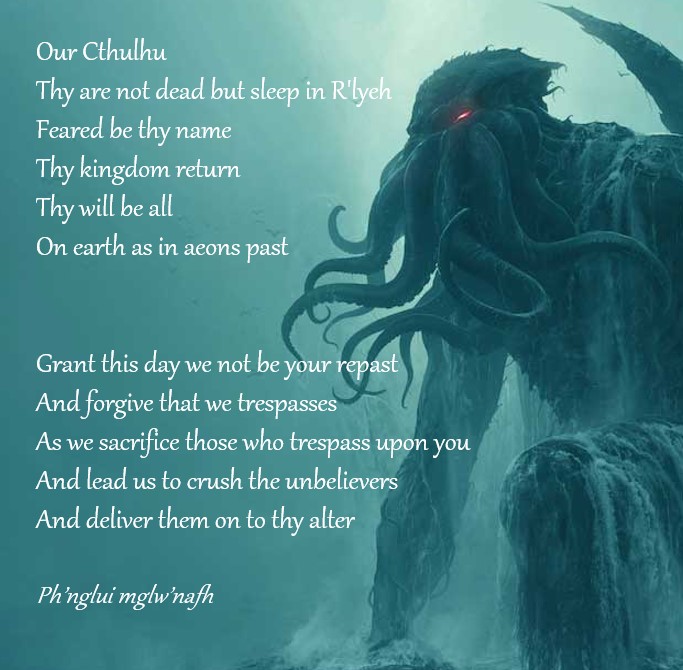
The Cultist Prayer

I was raised in The Church of England and thus I learned The lords prayer by rote, as one does when your are sent off to Sunday school every Sunday to listen to bible stories and be taught about the great beard in the sky, my prospective salvation, hell and what not…

I am sure those raised in the Cult of Cthulhu experience much the same.

In any regard, it was a slow morning when this thought occurred to me…

May the old one’s look kindly on your existence

Posted in big questions, books, cthulhu, dreamlands, horror, Lovecraft, rites | Tagged , , , | Leave a comment

Redux: Beguiling darkness: Tethered

The below is a post form earlier this year that induced a review of a book that had not at the time yet been published. As it has now been published I am redoing the original post with a link to the book itself, which I highly recommend.

In the distant past before the lost years and the breaking of the world, in a younger less cynical time, I was sent a manuscript to read. This was about four years ( three atrocious prime ministers and one pandemic) ago and no one knew what was about to happen. Which is to say a lot. So one hopes that the writer of the manuscript in question will forgive me if I admit I had more or less forgotten everything about it by last month when I was asked if I wanted an ARC copy of the final novel.

The only things I really remembered were being impressed with the authors style, the darkness of the setting, finding myself drawn in by the involving central character and wanting to know where the story was going to go. So of course I said yes, I would love to an ARC copy. I then went back and read the notes I’d sent for the author back in 2020.

Between the earlier draft novel I was sent in 2020 and this ARC a whole lot of revision and some whole sale changes have been undertaken to the manuscript. Well its been four years, or maybe a life time, its hard to tell some days… All of which is good, because nothing about this book has been rushed, there has been some major cutting along the way, the latter half of the book in particular is heavily revised, as is the part played in the narrative by the supporting cast.

One character a minor but notable villain, doesn’t die where I am sure I remember her dying in the original draft, indeed it is unclear if she dies at all now (though quite possibly she does). As I quite like the character in question, who is equally complex in her own nasty way, that rather pleased me, as she stands to return in a bigger role in another novel with luck.

This is a book littered with strong female characters who very defiantly have their own agency as well as their own flaws, it would have been easy for one of them to draw the spot light off the main character. One of the minor flaws of the early draft was that the main characters ‘friend’ Beth had a habit of overshadowing her at times. Beth could carry another novel in her own right, strong, darkly humoured, honourable, unflappable yet with a certain vulnerability and a sentimental streak, she is moved to do what needs to be done and whats right, rather than whats easy, or whats legal… She is a wonderfully well rounded character that could easily sit at the centre of all this, yet in this final version of this novel she remains firmly stage right and best supporting actress through out and never upstages Evie who carry the novel throughout.

That is a hard trick to pull off as a writer. To balance such a strong set of characters and make sure the lead remains firmly the lead is hard. Generally a writer ends up watering down the other characters, something you could not accuse JA Wood of doing here. Nothing has been watered down. Only polished and improved in the four intervening years since I last read of Evie’s world.

But lets leave Evie to one side for a moment and talk about the world which she inhabits. It is a dark and beguiling place. You get the sense that at the heart of this world is a civilisation in decline. Parts of the great city she inhabits are rundown, abandoned or over run with criminal gangs. A whole ward of the city was once powered by strange devices run on ‘ebony’ a dark essence drawn from the aetheric plane. The Ebony ward is not alone in its sense of decay and decline, whatever Ebony actually the taping of the aetheric plain for power is in part responsible for the slow breaking down of society. There was a war, a catastrophic war at some time in the past, and the world is what survived. Some people have powers, chimeric powers, that cause some to label them demons. To control and contain them they are tethered by priest of a complex religion of ten gods , the ten travellers, using a strange substance called taroais that is lethal to chimera, binding them and their powers, which also slowly kills them. And this is the progressive nation…

This is part steam punk, or perhaps diesel punk, part urban fantasy, part dark fantasy and a whole lot of fascinating. Not least because the writer doesn’t make the mistake of explaining the world too deeply, so the readers perception and the writers vision may not be entirely the same, but it entices you further in with snippets here and there. We get the names of a couple of the ten gods and only the vaguest idea what each god is for, yet even this is done with a delicate hand. Evie, we aren’t quite told, has ten studs in her ear, one for each god. While she is not overtly pious she has a habit of touching these much like one might touch a crucifix of a anhk. It subtleties like that which make the characters and the world seem alive and vibrant through the writing without it been forced. We get hints of the worlds history, hints of other nations and hints as to the true nature of chimera. But there is a careful vagueness, and much left to the imagination and it is all the better for it. It leaves you wanting more, while keeping the story flowing.

But back to the characters themselves, if Beth has several layers of complexity, Evie has so many more. A recovering addict, leading a double life, hiding the truth about herself and in deep with the seedier side of society and gangsters forcing her to pay off her debts by making illegal devices for them. The rift between her and Beth haunts her and she is forced to sink or swim and is starting to drown, and all this is before she blackmailed into ‘acquiring’ an object from a second criminal gang, by a woman who knows she is a pulse chimera and how much damage that secret could do both her and her parents. From there things only get more complicated and dangerous for Evie, everything she loves is under threat and she is far from blameless, at least in her eyes, as her Blackmailer is part of a dark conspiracy of rich and powerful people who seek to rid the world of all chimera.

This is a fabulous ride of a novel, through a dark gritty fantasy landscape, with strong characters, betrayals, surprises, shocks, a whole world of imagination to explore and wonder at. There will I am sure be more to come, and I was delighted to go back to it and see how much what had been a good book when I read the early draft four year ago has been revise and polished into something so much more than it was.

J.A.Woods Tethered is out now, (finally). Its took a few years to write, but is none the worse for that. This is among the best pure adventure I have read in what seems like an age, it rich, dark and leaves you wanting to read more. I can not recommend it enough.

Finally I will add that J.A.Wood had also written short story’s that appeared in the original incarnations of Harvey Duckman Presents. She will also be making a much welcomed return to the new Harvey Duckman Presents Anthologies in the forth coming and as yet untitled Dark/Urban Fantasy anthology that will be out at the end of January with a story involving a perfectly normal rabbit…

Posted in amreading, book reviews, books, fiction, reads, steampunk, supernatural, writing | Tagged , , , , | Leave a comment

Holly Trinity and the apocalypse

Ben Sawyers ‘Holly Trinity’ is a wonderful creation, the protector of York who sleeps below the city until needed, then raises her umbrella and does battle with the supernatural forces that plague the city. Often, of late, listening to Kate Bush songs while she does so…

He is also a nice chap…

This is his blog on his Holy story in Death +70

Posted in Uncategorized | Leave a comment

After the end…

For the Latest Harvey Duckman Presents anthology, which was released today, I wrote a story set after an apocalypse (as this was the brief given this is a collection of post apocalypse stories) about an old man walking up a hill 70 years after the end of the world…

Except that is not what the story I wrote was about at all. It is the story I set out to write because after several false starts that never quite seemed right I finally started writing a story for this book after the book had been given a name by its wonderful editor in chief CG Hatton, and so i knew the book was to be called Death+70 based on the conceptual idea of how quickly nature will recover post the end of the world.

If you have ever seen ‘Seven monkey’ and the over grown streets of New York post virus you will get the idea. Just as if you see footage of how fast the wilderness has recovered and thrived around Chernobyl, or regrown over abandoned buildings anywhere. Nature is resilient, the end of our civilization would not bother it in the slightest, no matter how big the bang we go out with. To the trees we are just walking fertilizer that has not gone back into the ground yet. (the trees could well be farming humanity btw, think about it , we breath in oxygen and turn it in to the carbon dioxide they need, and we are basically a sack of carbon and chemicals which are their main food stuff)

The point was the natural world recovers, and as that was the title of the book I thought well if I have a character who was about fifteen at the end of the world, he would be eighty-five seventy years later. Some one with vaccines in there system from before the fall, and who benefited from modern nutrition while they were growing up could go on to live that long. So I came up with an old man climbing a hill to visit the grave of his lost love, seeing the world that regrew after the apocalypse. It fitted with the title of the book and seemed a nice idea.

So as I say I wrote a story about an old man walking up a hill 70 years after the end of the world…

But as I said that is not what the story I wrote at all, it was the story i set out to write, what I wrote instead was an allegory on a different subject. A story about the helplessness of old age, the insidiousness of creeping dementia and ultimately finding some dignity in death. This was not my intention, it is merely what the story became, stories have a habit of doing that, finding ways to be about something other than you intended. To become personal, when you intended them to be otherwise.

Dementia is a subject close to my heart, my mother has been slipping from in degrees for several years. It is a slow death that kills the mind before the body, and you watch your loved ones wither before you. It is also the future I expect will come my way in time, which frankly terrifies me. As I say, sometimes, more often than we perhaps admit, the stories we write become personal in ways we did not intend.

In any regard, I will be donating my ‘fee’ for this story to the charity Dementia UK. I do not actually take a fee from ‘Harvey’ as a rule, so in actuality I am donating the amount my fee would be if i took one. In essence it is the same. The below is from Dementia UK’s website, and more eloquent than I on the subject.

One in two of us will be affected by dementia in our lifetime. Families living with the condition are often left feeling exhausted, overwhelmed and alone. With your support, together we can provide vital specialist dementia nursing services, so more families can access our life-changing support and live as well as possible, for as long as possible. Please donate today and help ensure no one faces dementia alone.

When a new book is released I generally urge people to get a copy and my tale aside it is a wonderful collection of stories and you should get one. Really you should , there are a host of wonderful writers in there, with wonderful stories. Frankly I think it is probably the best collection I have ever been part of. All the stories are amazing and the wealth of imagination that went into them astounds me and I helped curate it. So please buy a copy
But regardless if the book doesn’t appeal to you, or indeed if it does and you do buy a copy (which i hope you do) , please take a few minutes out of your day to visit Dementia UK’s website and read about there work at https://www.dementiauk.org/ If only for the memory of an old man who may one day walk up a hill

Posted in amreading, big questions, books, dystopia, fantasy, Harvey Duckman, writes, writing | Tagged , , , , , , , | Leave a comment

A Gentleman

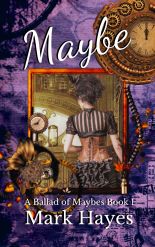
There follows an orphaned piece from my scraps folder, which I think was originally written as the opening to a short story that would have served as a prequal to my 2020 novel Maybe. That it was written in 2021 suggests I intended to write it for one of the originals Harvey Duckman anthologies, applying uncommon good sense and writing something linked to open of my novels for the anthology. Which was also probably why, as a short story, it never got finished. It is however a fun little piece, involving two of the major Characters in Maybe, Benjamin West and Gothe.

A Gentleman

“It seems to me, that the use of lockpicks should fall under the remit of a gentleman’s valet, rather than the gentleman himself.” Benjamin West grumbled just after he snapped his second pick in quick succession. 

“I’m sure there are those who might agree with you West, but sadly I regret to inform you that I do not.” His former manservant observed, in a voice which were you to describe it as arid would be to suggest it was moister that it was. Think instead of the word desiccated… 

“Really? And why is that Gothe?” West asked, more to distract himself than out of genuine interest.   

Gothe waited until his employer managed to hook the broken tip free and had once more commenced his efforts to pick the desk draw before replying. When he did it was with typical stoicism. “In the first instance, West, I am not in fact your valet. While in the second, I neglected in my youth to be trained in the arts of the common thief.” 

The lock was frustrating, mostly because it should have been simplicity itself. A simple mortice, locking a desk draw. Opening it should have been the work of a moment to open. The lock however seemed to be deceptively complex. He narrowed his eyes and stared at it while he pulled a third #2 short-hooked-pick out of the small fold over leather case at his side he set about using it. Though at this point he was not so much trying to pick the lock as clear the broken tip of the previous pick from the keyhole.  

“Yes well…” West said began then bit his lip as he tried to concentrate on the task at hand. He tasted the salt and iron of blood in his mouth and paused to dabbed at the small cut in an absent-minded fashion before returning to his task, and levering up what he hoped was the last of the pins, before sliding in the crank and giving it a satisfying twist to the right.  

The lock clicked.  

West turned to his former manservant, his face a picture of smug satisfaction. “Luckily one of us knows the value in the ‘arts of a common thief’.”  

“I am sure that is a matter of great pride for your grandfather having paid for your expensive education West.” Came the arid observation in return. 

Benjamin gifted Gothe a flinty stare as he pulled the draw open. 

If perhaps he had been paying closer attention to the draw and less to his former manservant’s pallid visage Benjamin West might have noticed the trick latch that sprung up as the draw opened. Had he noticed he could have held it in place with his spare hand while he hooked it in place. It was after all a simple trap designed to catch out an amateur thief. 

There was a flash and explosion of black powder filled the air. Caught out by the trap, Benjamin had not the wit to hold his breath, and thus got a lung full of whatever foul concoction the dust trap contained. Whatever it was it burned, and he collapsed reeling to the ground half coughing, half choking. 

Gothe looked on impassively, thinking to himself of the advantages of breathing been more a choice than a necessity. 

What is in the draw and why was the draw trapped? Well, I know the answer to that, but its not really something I need to trouble you with, save to say what is in the draw directly leads to Benjamin West and his former manservant Gothe attending a funeral in a drizzle, and making the acquaintance of Miss’ Maybe’ aka Eliza TuPaKa, who promptly due to a misunderstanding shoots one of them… But that’s just the opening chapter of ‘Maybe’.

Posted in amreading, amwriting, books, fantasy, Harvey Duckman, indie novels, indiewriter, steampunk, Uncategorized | Tagged , , , , , , , | Leave a comment

The End of the world is not the Ragnarök

I write stories, you may be aware of this… Some stories are written for specific projects, others just begin because I am throwing words at a page and seeing what happens, and some stories are written because they want to be. Sometimes all three.

Quite a while back now, I was asked to write a story for a forth coming anthology of stories. The brief for which was Tales of the Post Apocalypse. As is my want, I began by more or less ignoring the brief, in order to find the story I wanted to tell. The first attempted involved a world over run by werewolves, which was a some what hairy apocalypse. But while I liked the seed of the idea it did not grow. So I started over. This is not unusual, I often do this, many a tale never gets past a few hundred words. But conversely some that start out as nothing more than a half idea of an interesting scene can grow beyond all measure. Sometimes a seed needs a few years to germinate.

This is why I always keep the seeds, the scraps of stories…

For the anthology I found a lot of seeds but none of them were the right seed and when the deadline approached I was still scratching around in the wasteland for a seed that would grow. Mostly I was trying to approach the brief from different angles. This went on a while, in fact I missed the deadline, and the second deadline, and almost missed the ‘okay this is defiantly the final dead line it goes to the printers on Monday’ So in desperation I wrote a story about an old man walking up a hill 70 years after the end of the world. Almost annoyingly that last attempt with a simple premises work out rather well. It ended up being a story about something I had wanted to write for a long time, deeply personal in a somewhat oblique way, and a ‘perfect’ counterpoint, in my opinion at least, to the many other great stories in the anthology written by other writers.

That last part if often my goal in any anthology, which is something of a conceit. The degree to which the story, ‘The Tawny Eyes of Caroline’ is a ‘perfect’ counterpoints other stories in the anthology is debatable, but I think this one in particular works well in that regard. Which is my excuse for it taking so long to write…

In any regard, one of the scraps I wrote for this project that I rejected was a interesting idea that morphed into something of a prose poem. A poem about another man at the end of the world, sitting in a cave in this case rather than walking up a hill. It was however the wrong kind of apocalypse… Or to be more exact the idea was to start within one apocalypse myth and move through others.

That is not how it worked out, it wanted to stay where it started and the idea I had for it wasn’t going to work, in part because it was far too ambitious for the purposes of the anthology (I wrote out a ‘plan’ in note form and realised that if I took this where I wanted to then this was a novella length idea, and novella length prose poems are so 1700’s… I did however enjoy writing the piece, and while it is far from complete, its is more stylistic than a tale right now, I still liked the results.

So anyway, here is the most complete excerpt of the prose poem, that isn’t going to be in the forth coming Harvey Duckman anthology of post Apocalypse tales ‘Death +70’ and was instead replaced by a story about an old man walking up a hill 70 years after the end of the world.

This may be called ‘fimbulwinter’ but I really couldn’t say.

She utters honeyed words of violence to sooth the savage that waits within the child that whimpers at her breast
I hear her words, but they mean as nothing. Utterances of the lost, spoken to the raging of the darkness in her mind
The madness has taken her, as it has taken so many. Only the child that whimpers at her breast hold her in check.
A thread of sanity, waiting to be snapped
They huddle behind me in the darkness of the cave around the fire that gives out only the memory of heat
Heat has left the world, the fimbulwinter is upon us. The serpent stirs the black waters of the ocean
Fenris prowls the even night, his children howl in the dark hunting
hunting us.
I sit cross legged at the entrance of the cave and stare off into the darkness
My axe is cold, frost crisscross’s the handle and the fingers that hold it, but the blade is sharp still and blood still flows in he that would wield it.
The Ragnarök is over, we are what remain

She utters honeyed words of violence. I hear them not as words but liken to the hiss of the serpent, the hiss of madness
She utters honeyed words of violence and the child whimpers at her breast and I sit, the ache in the small of my back grown the longer I remain still. The ache in the small of my back reminding me I am alive, despite the ice that forms upon my beard.
Ice forms in my tears, blurring my eyes. The fimberlwinter is upon us. The serpent stirs the black waters of the ocean
Fenris prowls the even night, his children howl in the dark hunting
hunting us.
I sit cross legged at the entrance of the cave and stare off into the darkness
My axe is cold, frost crisscross’s the handle and the fingers that hold it, but the blade is sharp still and blood still flows in he that would wield it.
The Ragnarök is over, we are what remain

I found them on the road. Lost in the twilight of the world, lit by neither moon nor star, only the fading afterglow of the falling world.
I should have left them there. The woman and the child at her breast. I should have left them to the darkness and the howling of wolves.
Had I left them they would be dead. Lost to the Ragnarök. A feast for Fenris, bones to be picked by ravens, haunted things, ghosts unto the world.
Had I left them it would have been a kindness. A quick death, bereft of suffering. But I am selfish, I would not be alone in the ever dark
My axe is cold in my hands, my finger bitten by the frost, but blood still flows, and the heat of my anger sustains me.
Beyond the cave mouth fires burn upon the waters and the serpent moves through the waves. The monstrous children of Loki do their fathers bidding, and my breath freezers in the air.
The Ragnarök is over, we are what remain

The anthology this tale will not be appearing is as I said, called ‘ Death +70’ it is the latest Harvey Duckman anthology and is rather good,

It features disturbing, thought-provoking, darkly funny and entertaining short stories from Kate Baucherel, Jenna Warren, Nimue Brown, Lee Arrowsmith, Ben Sawyer-Walpole, Robin Blasberg, Ross Young Sarah Spence, Melissa Rose Rogers, Anna Atkinson-Dunn, Keith Errington, CK Roebuck, Tamara Clelford, R Bruce Connelly, Nyki Blatchley, Phil Sculthorpe, Mark Hayes and CG Hatton.

And a story about an old man walking up a hill 70 years after the end of the world… Which is in no way a story on the theme of dementia, quality of life, the bitter sweet beauty of nature and the right to decide if it is time for you to lay down for the last time. It is just a story about an old man walking up a hill 70 years after the end of the world…


Harvey Duckman presents… DEATH+70 is due out 6th October 2024… in paperback and on Kindle.

You can find out more about the Harvey Duckman project here https://harvey-duckman-is-alive.ghost.io I urge you to do so.

Posted in amreading, books, fiction, Harvey Duckman, indie, indie writers, pagan, reads, supernatural, writes, writing | Tagged , , , , , , , , , | Leave a comment

The darkness

I am the darkness that dwells in your head

I am the secrets you’ve never said

I am the malice that lay at your heart

I’ve always been with you, right from the start

I am the darkness behind your eyes

I am words spoken you know to be lies

I am the whispers heard on the wind

That say you are worthless and that you have sinned

I am the questions you ask yourself in the night

The answers you fear when you turn out the light

I am the whispers you try to deny

The thoughts that come to you while in bed you lie

I am the thought that you’re better of dead

I am that darkness that dwells in your head

I am given birth by nothing but lies

Tomorrow will come and with it sunrise

Posted in amreading, amwriting, pagan, reads | Tagged , , , | 1 Comment

Dear Edgar #20 The Narrative of Arthur Gordon Pym of Nantucket

As authors go you would be hard pressed to find many with a legacy as influential as that of our own dear Edgar. Poe’s works have inspired directly or indirectly much of what we now perceive as the western cannon. Few modern horror writers can not trace the roots of their influences back to Poe in one regard or another. He laid the popular ground work for detective novels too. While surrealist fantasists certainly owe him a debt or two. As for Gothic fiction, he has arguably been of greater influence than even Shelley and Stoker (who was himself much influenced by Poe) for while they created lasting characters that informed their own sub-genre’s, Poe work informs so much more of the work that came after him.

Despite the broad influence of his work, however, the majority of Dear Edgar’s body of work and influence stems form his poems and short stories. Poe, like Lovecraft after him, only completed one novel in his life time. The ponderously titled ‘The Narrative of Arthur Gordon Pym of Nantucket’. The novel was written between the early 1830’s and 1837, With the first two chapters originally written as short stories for a collection he never released.

It was finally published in 1838 after it was delayed for a year by the publishers after the stock-market crash of 1837. Yet even when the novel was first published in full it was done so not under Poe’s name directly, but the name Arthur Gordon Pym and presented at a true account of his adventures, not an unusual publishing device at the time. Fictional ‘true accounts’ were often presented as authored by the narrator. While it is not an uncommon literary device to write a story presented in the reflective first person, it is rare these days that such stories are not published under the real authors name, and even rarer that they are presented as ‘truth’. Though found footage cinema has been trying to pull this trick for decades…

The first time Poe’s name was actually attached to the novel was when it was published without his permission in London. Ironically, as his main complain was they used his real name, the novel was more or less responsible for first making Poe’s name in British literary circles and led to many of his earlier works finding there was, with or without permission, into British periodicals. His fame in Europe only grew from her on and was soon eclipsing his early renowned in America, and also lead to later editions in the USA carrying Poe’s name as author and being presented as the fiction it was.

Comprising the Details of Mutiny and Atrocious Butchery on Board the American Brig Grampus, on Her Way to the South Seas, in the Month of June, 1827. With an Account of the Recapture of the Vessel by the Survivors; Their Shipwreck and Subsequent Horrible Sufferings from Famine; Their Deliverance by Means of the British Schooner Jane Guy; the Brief Cruise of this Latter Vessel in the Atlantic Ocean; Her Capture, and the Massacre of Her Crew Among a Group of Islands in the Eighty-Fourth Parallel of Southern Latitude; Together with the Incredible Adventures and Discoveries Still Farther South to Which That Distressing Calamity Gave Rise.

Full subtitle of The Narrative of Arthur Gordon Pym of Nantucket

The above is the subtitle Poe gave to the novel, which serves quite well to sum up the entire narrative.

What is missed out of Poe ridiculously long subtitle is the main character stowing away in the most literal of senses aboard the first ship and almost starving to death. Almost staving to death again on a floating ship wreck before resorting to a singular bout of cannibalism, (two pages after the cannibalism episode Pym suddenly remembers there is an axe lodged in the remains a of a mast and hacks his way into the ships stores, which had he remembered the whereabouts of the axe earlier would have avoided the whole raw long pig feasting). While ship wrecked there is also the passing a Dutch ghost ship, which is presumably a reference to the flying dutchman, and a whole lot of stranger stuff that goes on the further south Arthur Pym finds himself.

The latter half of the book, is very much a journey into the the unknown southern regions beyond the Antarctic circle, which is not the Antarctic we know. Indeed beyond the ice there is a subtropical region warmed by odd currents form the pole itself and the book ends with Pym paddling a canoe towards the pole itself and the strange bright light that burns there. It becomes in short a tad bonkers, while being written very straight there is a degree of the comical about the final few chapters. As this is all in the narrators ‘own words’ there is every chance he is a little mad and the experiences he went through on the ship wreck and beyond sent him insane. The novel has a trick ending (Pym doesn’t finish his narrative due to dying before writing of what he discovered at the pole itself) This is slight disappointing but frankly there is no real way it could have ended differently without stretching what credibility it has as a narrative beyond breaking point. There is no explanation of how two men in a badly made canoe, with nothing to eat but sea turtles, managed to get back from the south pole to Nantucket, though we know it took him six more years to do so as the opening chapters state he was away for seven in total. But frankly it is a better novel for the way it ends.

This is almost certainly the most readable of Poe stories up to this point in his career. Having the freedom of a novels format to play with clearly suited him. In effect there are several different tales here all linked in one long narrative, the first chapter is a short story that was originally published separately a couple of years before, and the difference is style is explained by Pym who says he employed a writer called Poe to present that first part of his tale as fiction, before deciding to write it himself. The story of the mutiny aboard the Grampus and eventual shipwreck is a separate tale, while the final section in the Antarctica feels like a whole different adventure story. Yet it all hangs together beautifully. Even if it is jarring to read about a bear attack on the Antarctic ice shelf and the latter half being more a fantasy than anything else. As long as you can accept the fact that little was known about the Antarctic when Poe wrote this, and his readers were not raised watching David Attenborough’s Living Planet. While this is a flight of the imagination, it was not entirely fantastical at the time, as there were many odd theories about the southern regions around.

This was over 70 years before Roald Amundsen became the first man to the south pole, ruined Robert Falcon Scott’s legacy. Scott’s infamous tragic attempt to reach the south pole in 1912 was named the Terra Nova expedition. Terra Nova being the Latin for New Earth, which offers some perspective of just how little was known about the region. Even now it remains the least explored region of earth, though an archipelago of subtropic islands inhabited by south sea islanders warmed by an unknown white light at the pole is not likely to be discovered one suspects.

I approached this novel with a degree of trepidation due to Poe devote the ‘Old Tentacle Hugger’ Lovecraft. Before embarking on the Bibliography of Dear Edgar I did the same with Lovecraft and like Poe, Lovecraft wrote many short stories but only one novel. In Lovecraft’s case it was ‘The Case of Charles Dexter Ward’ which was to say the least a struggle (though I scored it 4 out of 6, so its not terrible). Poe’s novel in comparison to Lovecraft’s is very modern and reads well. Its a little mad towards the end but then madness and Poe is nothing new at this point. It was certainly a better experience than reading Lovecraft’s novel, though not quite up there with ‘At the Mountains of Madness’ which it inspired.

A FULL FLIGHT OF MURDEROUS RAVENS…

SHOULD YOU READ IT: If you only read one Edgar Alan Poe novel in your life time you should make it this one. Admittedly it is the only one… But read it anyway, it will surprise you.

ISSUES: While it is not overt there are some issues with the text in terms of race. However, these are minor and ‘of there time’ , as opposed to the kinds of issues you come across in Lovecraft’s work.

Bluffers fact:  The Narrative of Arthur Gordon Pym of Nantucket inspired a lot of other writers and their work, but most notably Lovecraft’s At the Mountains of madness where his giant albino penguins cry out tekeli-li or takkeli. This is the same cry used by ‘deep’ Southsea islanders who slaughter the crew of the Jane Guy.

Bonus Bluffers fact: Mark Hamill plays a character called Arthur Gordan Pym, in the Poe based Netflix series The Fall of the House of Usher. Supposedly this series is set after his adventures at the south pole, and Pym is now a lawyer acting for the Usher family, who refuses to talk about the adventures of his youth.

Posted in amreading, book reviews, Dear Edgar, Poe, reads, retro book reviews | Tagged , , , , | 2 Comments