1844 was one of the most prolific years of our Dear Edgars life, despite this he did not write a great deal of note in that time. This is to say much of what he wrote was fairly average fiction by his own high standards. The previous year of 1843 had brought us high water marks with The Tell-tale Heart, The Goldbug, and The Pit and The Pendulum. the 1844 stories suffer from comparison.
All this was set against the degenerating health of Virginia. His wife had first showed signed of Tuberculosis two years earlier, coughing up blood while singing at the piano. While she recovered somewhat from the initial bout of consumption it was clear her health was never going to fully recover, the next two years were years of steady decline. Our Dear Edgar found solace in the bottle as he had in the years before his marriage. The worse she got, the more he drank and the more he brooded.
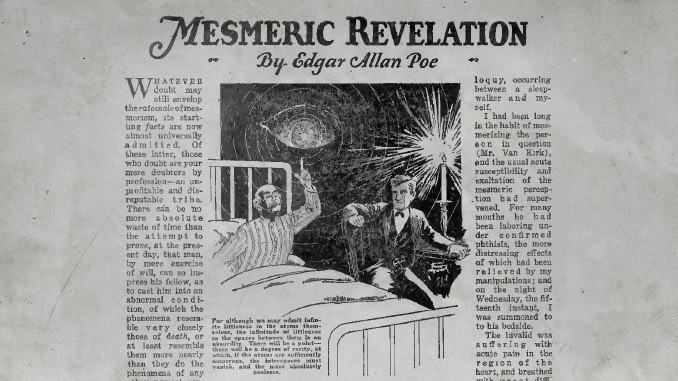
Sometime in late 1844 Poe was to pen the poem that was to make him famous, though The Raven was not published in the January of the following year. Nothing else he wrote in 1844 would have much of an impact. Among them was this tale, Mesmeric Revelation, which from the first is not really a story at all.
What Mesmeric Revelation is in terms of story is no more than a framework in which to discus meta-physics, in much the same way he did with the earlier stories The Conversation of Eiros and Charmion, and The Colloquy of Monos and Una. Unlike those two earlier examples Mesmeric Revelation manages to hold the interest even though it is admittedly heavy going at points. However, that said I must declare my own interest here, it is a story that leans heavily into ideologies and concepts that fascinate and inform somewhat my personal belief system. Which I shall not burden you with here.
The story, for what part of this is a story, involves a mesmerizer, or hypnotist, putting a subject close to death into a deep hypnotic state, and then asking him questions about exitance and god. The theory been that as the mane is close to death he will have insight into existence, the intellect and the soul. And by extension the divine.
So he puts him under hypnotic suggestion, asks a series of questions, which become increasingly complex, then after a long dialogue between the Mesmer and his subject, the dying man expirees. That in essence is the story. What makes it interesting is the dialogue between the Mesmer and his client.
What is plain is Poe was using this story as a medium to express some complicated philosophical ideas. What is thought, and what is the mind among them. Does the mind exist independent of the body, and if so what is death. The body dies but does the mind continue, is the mind not in essence the soul and if the soul exists then what is its relationship to the divine. And how, can any of that be looked at through the medium of ‘modern’ physical science.
Of course the ‘modern’ Physical Science we are talking about here is modernity as it was in 1844. At the time the smallest possible thing we had conceived of was the atom. It would be over 50 years before Thomson discovered the electron, another 20 until Rutherford identified the proton and 14 more after that before Chadwick discovered the neutron. The point being Poe’s understanding of the physical universe was very much the understanding of the 1840’s and so much of what the Mesmer’s subject reveals is based on our pervious understanding. The theory of Luminiferious Ether was still cutting edge scientific thought. To find the divine in ether, and say it permeated all things was an interesting, some may even say profound, concept in 1844.
The idea of un-particled matter took Luminiferious Ether a step further, effectively saying god exists in the realm of thought, in the infinite littleness between atoms…
To the modern eye, in the era of quantum physics, and string theory, this all seems a tad quaint. I find it interesting because it looks at the divine through the medium of cutting edge science in the 1840’s, because I have sought to look at a pagan divine through the medium of quantum science. It is both inspiring to know Poe did much the same in this tale, and humbling to realize that he was limited by the science of his time. Just as we are by ours.
THREE VERY INTERESED RAVENS… (FOR MYSELF THERE WOULD BE FOUR BUT I AM AWARE THIS IS MY OWN BIAS OF INTERESTS)
SHOULD YOU READ IT: It is not a story, there is no narrative and there is no twist at the end aside a dying man dies. However if you like metaphysical debate, even if the context is dated, then yes you should.
Bluffers fact: The existence of aether, which later became known as ether originated with Sir Issac Newton, and was put forward in his Third Book of Opticks. The final book of the trilogy. It was very well received at the time but lacked the gravitas of some of Newtons other work.
The shallow blue Aegean sea between Greece and Modern Turkey is a basin of ancient civilizations, where east meets west and the cultures that first sprang from ancient Mesopotamia mix. To the south of that sea, when the Aegean borders the deeper waters of the Mediterranean lays an island that birthed a culture older than Greek legends. A thousand years older than the Greece of Aristotle and Plato. Older even than the Mycenaean Greeks who predated the Classical culture and inform so many Greek myths. The island is Crete, but once more than 3500 years ago, it was home to the Minoans, arguably the first great European culture.
In actuality to call the Minoans themselves Europeans is something of a stretch, the best guess historians can offer is the people that first settled Minos migrated there from Anatolia, either due to drought, or population pressures. Coming to Crete they brought much of their culture with them but once isolated on the island that culture quickly evolved. Their myths and stories evolved too, from those of the upper reached of Mesopotamia, into something distinct, different and culturally based around the islands climate, as well as their own journey to become Minoans.
Now I could write a lot more about the Minoans and their culture, history and ascendance but frankly if I did I would probably get a lot of it wrong, there is every chance some of the above is wrong, so if you want to know more about it you should go and read Labrys & Horns: An Introduction to Modern Minoan Paganism By Laura Perry, which I reviewed back in June as is all the primer you will ever need, and has a great list of other books you can go on to read if you fall in love with the Minoan culture.
The reason I am talking about the Minoans today is because of one of Laura’s other books, one which came out in may this year, and is just a special kind of wonderful.
Tales from the Labyrinth: Modern Minoan Myths
Examples of the art within Laura’s book
Tales from the labyrinth derives it name, to an extent, from one of the most well-known myths about the island culture. A myth that comes down to us through the Greeks, the myth of the labyrinth of King Minos and the creature that dwelled within it it, the Minotaur. Though that myth is just one of the many fragments of Minoan mythology that comes to us through the Aegean cultures that came after. The problem is that many of them are just that mere fragments form a culture who had writing but not in a from we can now interpret, there has never been a Rosetta Stone for the Minoan language. Linear A as it is called, is similar in some to early cruciform script but only to a degree, and is unique to Crete.
What Laura has done is take the foundations of what is known about Minoan mythology and built upon it to create a modern interpretation of those myths and the mythology as a whole. Given them structure and a thread, tied them as all mythology is, to the culture itself, the island of Crete and the seasons of the eastern Mediterranean. In Crete the growing seasons is the winter of northern Europe, You plant around Halloween and harvest around easter. The summers are hot and dry, a dead time when nothing grows.
The fragments of mythology you might recognize from later cultures where the growing season is summer are turned on the head a little. Also Laura is entirely open about much of her work been educated guesses. Highly researched, well informed, guesses. But none of that matters. What she has put together is a beautifully complex interweaving of the known and the unknow to produce what is as close as we can get to a mythological cycle for a culture so distant from our own. But it is a culture that may be distant but one that informs our own even across the chasm of years between us.
This cycle of myths has also been beautifully illustrated by Laura in her own Minion inspired style, based on the art of the island found in mosaic, on pottery and else where. The art is just that, beautiful, which is why while it would be worth buying this book on kindle for the words alone, the art makes it worth buying in paperback, or hardback even. This book is just a beautiful thing, I am sorely tempted to by a second copy, just to cut out a few examples of the full page art and frame it for the walls in my study*
*no of course I don’t really have a study, I just call my front room my study. One of the advantages of bachelorhood in later life is you can choose what your rooms are for…
The complex mythology is a wonder, a walk through our collective cultural past. The art is beautiful in both simplicity of complexity. In all this is a joy to read, and reread, and to just look at.
But, there is also more to it than simply that, it is a window on humanity soul, our pagan past, and the mythology that is the seed from which we grew. Yes these are modern interpretations and yes the are based on mere fragments, but even so these stories remind us of who we once were, of a common past. Something we all need once in a while.
In 1844, the second great cholera pandemic (1826 – 1837) had been over for seven years, fear of the disease had not lessoned and minor outbreaks had continued to occur. More importantly perhaps than the minor out breaks that the authorities had learned to contain were the lasting phycological scars the pandemic created within society. One of which was a tendency to isolate sick communities entirely if cholera was suspected, which was not unbeneficial as long as you were not one of the healthy barricaded in with the sick. The other was an increase in Taphophobia, the fear of been buried alive.
The reason Taphophobia increased dramatically in the aftermath of the cholera pandemic’s was simple enough, the authorities often mandated that the dead be buried as soon as possible. In the case of the poor, who due to lack of sanitation tended were far more likely to be caught up in a major outbreak this often meant mass graves for whole districts, with the bodies of the dead wrapped in shrouds and thrown in, like the plague pits of old. Grim stories abounded of people wrongly pronounced dead, awaking to find themselves buried under the bodies and weakened by illness struggling to exhume themselves before the pit was filled in. Wealthier victims too were said to awaken within their coffins, and in some rare cases fight their way free, or be heard by loved ones visiting the grave site and rescued. Which lead to the popularity of ‘grave bells’ like the design below.
Of course much of these cases were urban myths that spread the way such things do. That said one notable doctor of the time Henry Jacques Garrigues known mostly for the introduction of anesthetic to America once said…
“out of every 200 coffins put under ground in this country the occupant of at least one of them is simply in a lethargic state and is buried alive”
It was against this background that our own Dear Edgar wrote The Premature Burial. Though in no way was this his first delve into the subject. Back in 1835 at the height of the second cholera pandemic Poe wrote Berenice, the name sake of which was mistakenly buried alive, in 1839 Madeline Usher was entombed alive before the house fell and while those are obvious examples they are not alone. Poe knew the the fear of been buried alive was a very real fear commonly held within the populous. If anything it would be surprising if he had not written about it. What he wrote is something of a masterpiece of phycological horror…
The story begins with the narrator talking about the ghastly fates of many, relating several famous examples of people being presumed dead, or buried alive either by accident or design. Most of these I can only assume were Poe made up, or took from reports of a dubious nature, but all of them hold the germ of possibility and are described in detail. A couple of these would be gripping stories in of themselves, in particular the wonderful tale of Mademoiselle Victorine Lafourcade which could almost be an outline for a decades spanning novel that could have rivaled Wuthering Heights as a gothic romance.
The narrator, it is fair to say, is a tad obsessed with stories of those who are inhumed before their time, and obsession that starts to affect him directly when he develops catalepsy, and fears he will fall into a stupor and himself be buried alive. Because of this he has left complex instructions to avoid such a fate, such as he is not to be buried until his body begins visibly putrefying. That a safety catch be fitted to the family tomb so it can be opened form the inside, and slotted vents be fitted so sunlight will always reach through into the tomb.
This story is all about the build up, which is slow and deliberate in nature. Poe takes great pains with the small stories full of gruesome details to explore the reasons behind his narrators fear of been buried alive. It is a tad long winded, which make me suspect he was again been paid by the word as the main story is really the second half of the tale, in which the narrator focus on himself. Unlike some of the other times when Poe was clearly ‘being paid by the word’ the story as a whole does not suffer from feeling bloated, the early part which may be filler is still wonderfully written and engaging. Where the story does go astray a little is for a section towards the back end which becomes very esoteric for a short while which doesn’t seem to fit with the rest of the tale.
There is nothing wrong with the esoteric sequence, it is beautiful in its own strange way, but it just doesn’t need to be there, and feels odder for it, but that perhaps was Poe’s intention. His narrator believes he is in a casket below the ground and his worst fears have come true, so a little esoteric sequence talking to death is not entirely out of place, just at odds with the more prosaic nature of the tale as a whole. Yet again, like the long introduction section it just works with a dark beauty all its own just the same.
The ending is something of a stretch, but this is a story for the telling not the pay off at the end. Suffice to say the narrator is not actually in a coffin and it is his own fear that convinced him that this was to be his fate. But not every story is about the end and this one is truly a story about the telling.
A GREATER FLOCK OF RAVENS GATHERED AROUND A FRESH GRAVE
Should you read it: It is one of those perfect stories that hits every note, a Ballard of beautiful wonder that is perfect because it is perfect. So yes, yes you should…
Bluffers fact: Before this story, as I mentioned earlier, Poe wrote several stories including Berenice, The Fall of the House of Usher, Morella, Ligeia, with the exception of this one and the later story The Cask of Amontillado the victims of these premature burials were all women, and all of them come back to haunt the men telling the story.
We are not sure what this says about our Dear Edgar, but he certainly was something of a taphophile, but then so are we all at Halloween.
This is a bit of a rant, you may disagree with it, and that’s fine…
There is a friend of mine, a good friend, a friend I like very much, and with whom I share a great many foundational moral principals, who I find my self snoozing for 30 day on Facebook every month. Not because I dislike or are offended by any his posts in general, but because they are relentless.
Utterly unbearably relentless.
At one point, while not snoozed, he put up a post say “If you are offended by the things I post feel free to unfollow me.” but I am not offended. I agree with them, and I do not wish to unfollow him, I just want him to be less utterly relentless… It is a problem, and indeed it is a problem that affects peoples mental health, drives wedges between them, and I would argue, doesn’t help the cause he is trying to champion either.
To explain why I think this, lets go for a wander down memory lane… To a simpler time.
When I grew up, and for the early part of my adult life the news was a thing you got in national newspapers on a morning and local papers on an evening. There was also the news every two hours for five minutes on the radio. While on TV the early evening news for half an hour at 6 o’clock, and the evening news at 9 (or 10 if you watched the other side). And that was it. News entered you life in half our segments if you didn’t have better things to do than watch it.
Obviously there was not less news, but there was less news coverage. You knew there was a war on somewhere in the Middle East because Kate Aidie was there in a flack jacket and helmet dodging bombs to report on it. If there was something we needed to know, she would tell us…
Fast forward to the world of 24 hour news cycles and channels, social media et al. And I can not tell you the name of any war correspondent.
I can tell you a lot about war however, which is perhaps a good thing. Wars do not get forgotten, and human suffering does not get forgotten… As long as it a war involving some kind of western political interest. There are many conflicts going on in the world that no one is highlighting but lets not get into that right now. the point is that if you want to know what is going on it is easy to go and find out, and Kate Aidie doesn’t need to tell you.
This is to say a simple google search, a flick through Blue-sky or Twitter, and you will find all the terrible things you could possibly wish to know about. But you have to go look. Which is good, because sometimes you don’t want to. Not because you don’t want to know. Not because you want to close your eyes to the horror of the world. But because you need a break…
Oh for the good old days of half hour news programs you did to need to watch.
So back to my friend, a left wing Christian with a heart in the right place. Slightly left of center just below the four rib… He has very strong opinions about the current genocidal war in Gaza, the Ukraine and British politics. I know this because I know him. I agree with almost 90% of everything he posts on these subjects, the 10% I disagree with is simply because I am slightly less left and more center on some subjects. So to be clear I have no problem with the posts he makes.
The problem I have is the sheer relentlessness of his posts. Five posts on Gaza today, five posts yesterday, five posts the day before that… Every post is about horrible things, terrible things, things I agree we should be righteously angry about. And individually I agree with his sentiments in each of them. Collectively however they are a constant hammer on a nail that is already hammered in place. They make me numb to it all.
I can be angry about Gaza, Thump, Ukraine, The Right Wing and Nigel bloody Farage. I can be angry about all of them. But I can not be angry about all of them all the time. More importantly I don’t want to be.
Another of the things he has said is “If my posts upset you, good they are supposed to be upsetting!” and it is there he loses me. Social media is not the nightly news, I do not go on social media to be upset by the shit going on it the world. I don’t want my friends to constantly post about the horrible things that are happening. Indeed I go on social media for the exact opposite reason, I go there to connect with friends and to get a break from the horrible shit in the world.
I have 24 hour news, news sites for that, and ‘gods forbid,’ twitter. For all the bad shit.
On social media I want to see pictures of my fiends in silly costumes, friends bad jokes and news that makes me smile. If a friend does have bad news to share I want to know about it is the personal bad new like illness or the death of a loved one. Things I can offer support and sympathy for or even a helping hand. Not impersonal news about children been bombed on the Gaza strip. I am already aware of that and it is not something I can do anything about and furthering our awareness of things we are already aware of achieves nothing. It is not like we are unaware to start with.
This is not to say a post now and again is a problem in this regard. I am all in favor of keeping the issue present in the zeitgeist but several posts an hour, every day, constantly, achieves nothing good. It makes people numb to the word and care less not more. It is psychologically damaging, and not just to the ones who’s feed is getting flooded with the horrific but to the one doing the posting to begin with.
We know what is going on in the world, I am probably more aware than most, but I do not need friends to remind me when I am looking to escape from it all for a few moments. Life is short and happiness is a finite, so spread joy not tears.
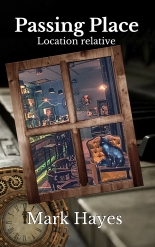
Currently I am typesetting a second short anthology of stories of the kind I oft refer top as Passing Place tales. That being stories of a certain kind, the kind that might appear between the pages of my 2016 novel Passing Place after which this blog is named. This has lead to me needing to redo the Also By pages. Normally this is black and white pictures of cover, with a small blurb or an edited down review. Or a simple list of books on one page.
In the kindle version thee would of course have links to the versions, but in print it just acts as a list.
I decide to do something different for Auguries of Euryale, my forthcoming anthology of my own work. I decided instead to write it in a more narrative style, telling a story of my novels and other works. I think it sort of works as a more interesting way to do the Also by pages…
Before ‘The Strange and the Wonderful’ came The Passing Place itself, a novel about Richard, a piano player, coming off the road trip to end all road trips as he was seeking answers to an impossible question. Why his wife took her own life…
The novel is centered around the telling of stories in a strange bar on the edge of reality. A Bar that is advertising for a piano player in a bus station window, when Richard pitches up with his last couple of dollars in a Midwest town in the middle of a thunderstorm. The card also says that any successful applicant must know one song in particular. ‘Endless Winter’, an obscure track for an equally obscure 70’s album. A song that also just happens to be Richards deceased wife’s favorite song.
It is then that the cat tells him to take the job.
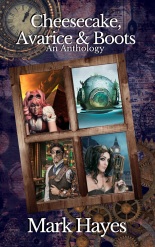
A third anthology of short stories by the same author is ‘Cheesecake, Avarice and Boots’ which contains a novella set in the Passing Place, when Hannibal Smyth falls into the bar, in a most literal sense, when he is thrown off the side of an airship. When not avoid a painful death by falling into an impossible bar rather than the middle of the Pacific Ocean, Hannibal Smyth, who’s real name is Harry Smith when he is not posing as a member of the officer class in the Royal Airship Force, is serving queen and country as a somewhat unwilling agent of The Ministry in an alternative steampunk modern era in which Queen Victoria is over two hundred and been kept alive by nefarious means to hold together a British Empire that never fell.
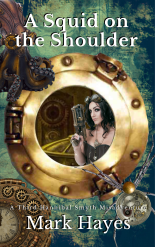
As well as the novella and several of the short stories in ‘Cheesecake, Averice and Boots’ Hannibal is also the protagonist and somewhat unreliable narrator of a trilogy of novels, ‘A Spider in the Eye’, ‘From Russia With Tassels’, and ‘A Squid on the Shoulder’. A rogue, a liar, murder, thief, traitor and unwilling agent of the crown, Hannibal tells the reader from the very beginning that they can not trust a word he says.
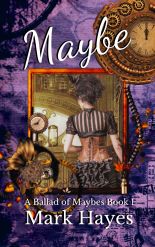
While Hannibal Smyth is Steampunk in a twisted version of the modern era, the world of Hannible Smyth diverged form our own in the mid-Victorian period when HG Wells took it on himself to alter the natural course of events. It is in this earlier era that the novel ‘Maybe’ is set. In ‘Maybe’ Eliza Tu-Pa-Ka morns the death of her father the brilliant Samoan engineer Ma-Ya-Bee and seeks to hold his murders to account with the aid of Benjamin West, of the Kensington West’s and his former manservant Gothe, who is formally alive. Intrigue abounds as shadowy villains put the fate of the empire at risk. A game of high stakes is being played. Higher Stakes than Eliza, mistakenly called Miss Maybe, could have imagined.
Staying with alterative Victorians we come to ‘Lucifer Mandrake and the Exoteric Cricket ball’. Mandrake began as a short story in a Harvey Duckman Anthology. A tale of the kind you oft come across in the Passing Place, one set in a Victorian world where the arcane is real and governed by Newtons Laws of Magic. A tale that grew from its telling as once Lucifer Mandrake was born in that short story it became obvious there was novel waiting to be written.
Lucifer is Arcanist to the Court of St James by appointment of the queen herself. Plots are afoot, someone is resurrecting dead peers of the realm and sending the back to the house of lords as zombies. Someone is bound to notice eventually.
There is a threat to Queen Victoria herself, as plotters seem to replace her with the King of Hanover. An old grimoire has been stollen, an face from Lucifer’s past returns to haunt him. He must face a haunted version of his own city in the fae realm, break foul enchantments that endanger the royal family and betrayal by those he trusts most.
But more than that he must face the other version of himself, the one within, hidden behind the eyes of Luci Drake.
Lucifer, Hannibal, Miss Maybe and others have all walked through the doors of The Passing Place. Miss Maybe was there right at the start, appearing briefly as a cameo in the original novel long before her own story was ever written or even fully conceived.
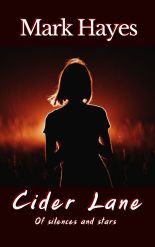
Others are there too, Susanna from my very first novel ‘Cider Lane’ shows up as a nightmare in a corridor. H.P. Lovecraft has sat at the bar, before he was asked to leave for preaching about abstinence and sent out into the garden to stare out into the darkness beyond at something red…
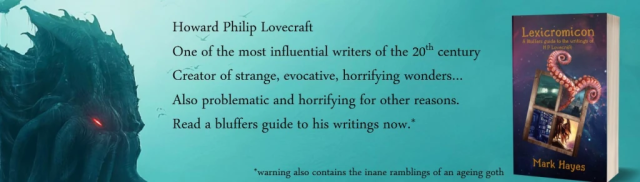
At some point the author of these Novels and short stories accidently wrote the ‘Lexinomicon’ a non-fiction guide to Lovecraft’s fiction, which lead to him being invited to write a second book on The Strange Worlds of H.P. Lovecraft.
This is also not the end, the doors of The Passing Place never close, new stories are waiting to be told. New novels waiting to be written.
Something Red dwells in the darkness waiting with Scarlet Sometimes. Lucifer Mandrake, Hannibal Smyth and Miss Maybe all have new tales to tell. Meanwhile Anna Kirkpatrick a teenage witch from Teesside is waiting round the corner with Mr Spleen and deMafesss practical Lawyers to the Fae Kings court on her tail. She has gotten hold of something precious to the Elf king, and at some point she might even work out what it is and tell the author…
May your darkness hold glimmers of light and your light hold shades of darkness.
With regards for happy readings
Mark Hayes 2026
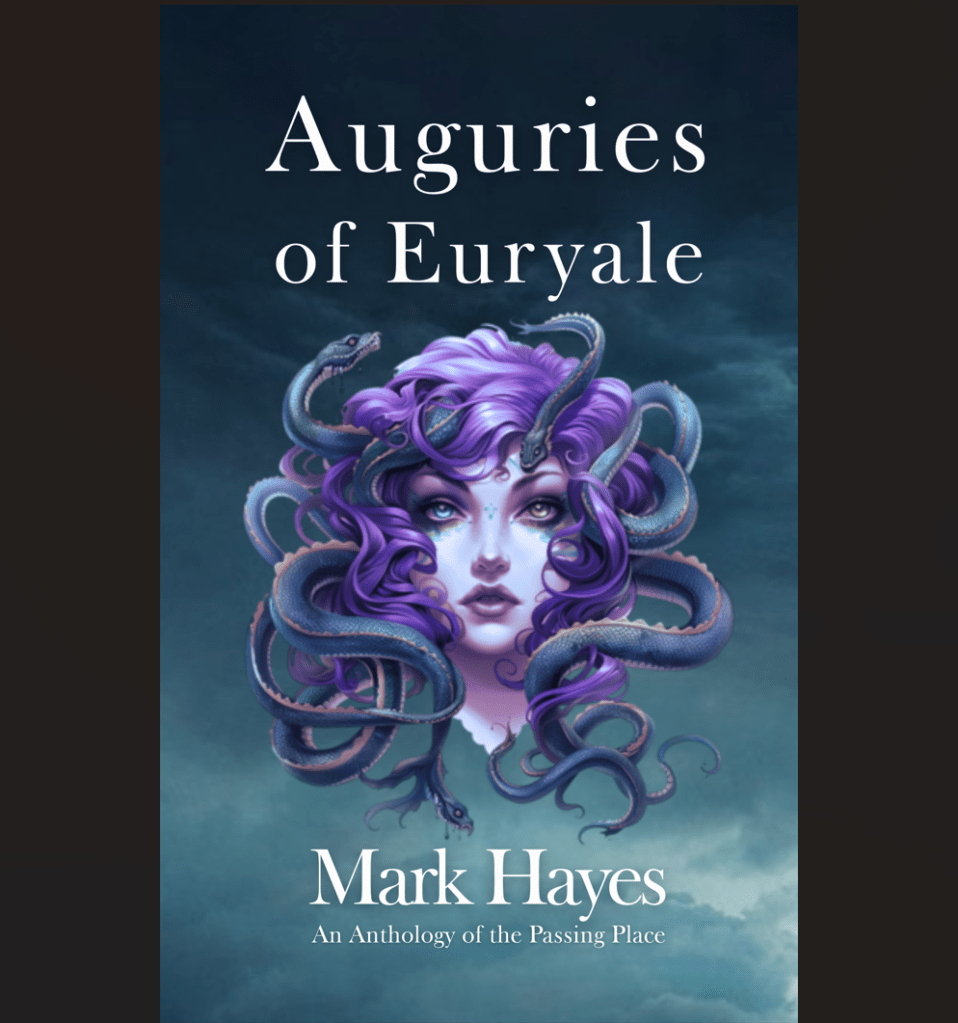
Auguries of Euryale will be out in the new year, if not before, but it is running late for a December release so January seems favorite right now. The name comes from a combination of two of the stories in the book. Auguries which is a new Lucifer Mandrake story set ten years after the novel, but written to avoid spoilers. And Euryale, who’s name you might recognize as she is one of the two immortal sisters of medusa. Euryale now works in a charity shop in Cheem, because immortality chafes if you don’t keep yourself busy. There are twelve stories in total some long some short, all the kinds of tales that would be told in the passing place.
Science Fiction is awash with tales of procession or bodily transference, not by satanic forces though they are plenty of those, but stories told by a protagonist who processed for a time the body of another. Often these processions are in an earlier or later time and place, or someone is fully transported to another time and place. There are many variations on the theme but the theme is very much the same each time. It is a stranger in a strange land, not sure of themselves nor the world they find themselves in.
It is not an uncommon device. The other great literary Edgar, Edgar Rice Burroughs who is perhaps best known for Tarzan, wrote the Barsoom series set on Mars, in which John Carter a 19th century American spends a lifetime living on a Mars that may or may not have corresponded to the Mars of his own time period. Lovecraft used the device multiple times but never more so than in his seminal ‘The Shadow out of Time’. Michael Moorcock uses it frequently, perhaps best in his Oswald Barnstable novels, but the Ekerose incarnation of the enteral Champion, was very much a man repeatedly placed out of his time and place. And this is without even saying anything about Stephen Donaldson’s Thomas Covenant novels. When it comes down to it even Freaky Friday uses the same basic device… And there are many many other examples I could spout.
All these stories have something in common, a thread that goes back to this story by Poe. There may be earlier examples that inspired Poe but I struggle to put name to one. So it is not impossible that Poe was the first to use the idea of processing the body and mind of another in another time and place, and did so as the central conceit of this story. Which is something of a shame, as the story itself somewhat lacks luster, is a bit fuzzy in places. This is not to say ‘A Tale of the Ragged Mountains’ is a bad story, it isn’t but as it is somewhat ground breaking in literary terms it is disappointingly a little bland. Possibly this is because of the Mad Max handcuffs paradox*.
*The Mad Max handcuffs paradox In brief…
At the end of the first Mad Max movie, Max handcuffs the Toecutter to a car that is rigged to explode. He gives Mr Cutter a hacksaw and tells him he can either saw through the hardened steel of the cuffs in half and hour, or his hand in a couple of minutes, and it si up to him… This is not the paradox…
The paradox is to do with the movie SAW. I was watching Mad Max at a UNI movie night, (I was there because the film club were showing Mad Max on the big screen, so why wouldn’t I go along, they had done Bladerunner the week before). “Meh,” one of the Media studies students said afterwards. “I saw that handcuff thing in SAW, how unoriginal…” The student in question was missing the salient point. Mad Max predated SAW by over twenty years. He was unimpressed by the ending of Mad Max because he had seen a movie that borrowed the same idea twenty odd years later.
This then is the Mad max paradox, otherwise known as Media Studies students are not always collectively the brightest…
The point here is that ‘A Tale of the Ragged Mountains’ is not in anyway a bad story, it just doesn’t seem awfully original… Not when you are someone who read Edgar Rice Burroughs, Michael Moorcock, and Lovecraft, etc, long before he ever read ‘A Tale of the Ragged Mountains’ a fairly obscure Poe story that doesn’t have the grandeur you would want from something truly original. It isn’t for this particular kind of science fiction what ‘The Murders on the Rue Morgue’ is for detective fiction.
This strikes me as a bit of a shame…
The story itself is, as I said, a little fuzzy, and being told to us second hand by an unnamed narrator, but is mostly the account as told to him of strange events that were experienced by Augustus Bedloe, prior to his death. Augustus a young man of independent wealth but fragile health, had employed an old doctor called Templeton who was a devotee of Mesmerism, which when Poe wrote this was not a forgotten fringe alterative medicine, but a mainstream medical theory. In much the same way the use of leaches would have seemed a perfectly reasonable medical practice to Chaucer. This is to say our dear Edgar did not write this story to poke fun at Mesmerism, rather it was a current medical theory that fit the needs of his story.
Bedloe benefits from the administrations of mesmerism by Dr Templeton and starts to take long walks in the hills and mountains that surround his Charlottesville home. It was on one such walk, that became longer that pervious ones, Bedloe encountered a thick mist in a gorge, just as (tellingly perhaps) his prescription of morphine was kicking in. So he walks into it, as it looks pretty.
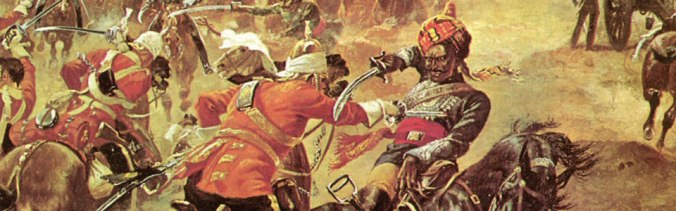
He steps out the other side to find he is no longer in the ragged Carolinian mountains, but is instead somewhere else entirely. Something he realizes when a half naked man of eastern extraction rushes past him pursued by a hyena. Recovering his senses somewhat he discovers he is in what he takes to believe to be the the middle east or perhaps India. Eventually he stumbles across a city of minarets and archways which he makes his way through before finding himself besieged with British officers as a battle rages in the streets. Then he is shot in the head with an arrow and dies. Only to find himself once more in the ragged mountains. Whence he goes home and recounts his story to his friends the doctor and our unnamed narrator.
Dr Templeton is shocked by all this. Not so much by the strange events Bedloe claims to have experienced, but that they are events he knows. Before coming to America as a young man he had served with the British out of Calcutta and was at the siege of Benares, almost forty years before. What Bedloe described as his death was the exact way the Doctors friend Oldeb had died.
Shortly afterwards Bedloe dies and in his obituary someone spells his name without the e at the end. The narrator notices with no small surprise at that point that Bedlo is Oldeb backwards…
This is all fine but the problem is there is a whole lot of implication as to what is actually happening, but it is all very fuzzy. Did the doctors mesmerism awaken the memories of a pervious life perhaps. Was Bedloe his old friend Oldeb reincarnated, perhaps… Does that explain the odd repour between them, or did Bedloe go back in time in spirit then processed Oldeb? The little twist at the end seems tacked on and that just adds to the confused nature of the story.
This is not to say its badly written, It’s Poe, of course it isn’t badly written. Nor is it a poor story, it is more that I am just not sure it has the courage of its convictions. To the mast of the uncanny and rum it was not nailed. Instead Poe left a whole, ‘it was a dream’ possibility open, even with the tacked on twist at the end. It would have worked better had he leant heavily into the strange time travel and procession of another body, or else to mesmeric influence causing him to have delusions that stem from the doctors memories. Or any other explanation come to that, it is all a bit ‘well it could be this, it could be that.’ Which gives it a all a bit ‘meh!’ feel.
I don’t dislike the story, but if a story like this crossed my desk for an anthology today I would send it back to the writer and suggest he give it another pass, sharpen it up and decide what the story really is about. Which seems an arrogant thing to suggest when the writer of this story is Edgar Alan Poe, but this while perfectly ok as a story, is just that, its ok… nothing more.
Where as it could have been The Murders on the Rue Morgue of procession fantasy…
THREE MILDLY CONFUSED RAVENS ALL A FLUSTER
Should you read it: Well yes, perhaps, possibly, I mean sure, why not, but meh!
Bluffers fact: Mesmerism, which also goes by the name Animal Magnetism, is the theory that everything that lives has an energy field around it. This was first proposed by Frank Mesmer in the 18th century, hence the name. His name is also linked with hypnosis which is occasionally referred to as being mesmerized. Louis XVI of France was so taken by Mesmer’s theories that he organized not one but two Royal Commissions into the field, One of these Commissions was with the French Academy of Sciences, an august body that included among its ranks the ageing American Ambassador to France, Benjamin Franklin who served on the commission.
Benjamin Franklin was far from the lone famous name upon the commission, among it ranks there was a middle-aged Scientist and Physician who like Frank Mesmer was to lend his name to something the would out live him in the public mind, and indeed it was to leave quite an impression on Louis XVI . His name was Joseph-Ignace Guillotin
For all the weather-beaten world-worn cynicism that I may occasionally be accused of by those that know me. A weather-beaten world-worn cynicism that our own Dear Edgar could have been said to share. I am at heart a romantic, which is to say while I do not believe there is such a thing as love at first sight, I wish to live in a world where such a thing exists. It has always struck me as somewhat unlikely however.
The Spectacles is not a short story about love at first sight. It is instead a story about love at first myopic blur. As someone who went through the trauma of going short sighted around the age of ten, when I started to realize I could not read the large projection in the school assembly, I have some sympathy with Poe’s protagonist in this tale. I hated discovering that I needed to wear glasses, hated wearing them then and if I am honest still do. So I would avoid doing so whenever I could, while I could get away with it.
And that is the essence of this entire story, which is by way of a long form, somewhat over elaborated, joke. Its the kind of story a standup comedian my tell in a five minute bit with a lot of weaving about. The summery of which really does comes down to love at first myopic blur. Everything that happens in the story is entirely determined by the unwillingness of the protagonist to wear his spectacles.
The protagonist has the somewhat preposterous name Napoleon Buonaparte Simpson, having changed his last name from Froissart in order to inherit a large sum of money for a distant relative. That change in last name is important to the twist in the tale, which is really three twists, the first of which is set up in a potted family history. The second by the little Corsicans namesake falling in love ‘at a distant’ with Madame Lalande who due to his unwillingness to wear his spectacles he confuses for a much younger woman.
And that is that, it is a long winded about a man who for vanities sake will not wear his glasses and ends up marrying an octogenarian, as until they are wed he never sees her properly. Who he then discovers, just to add another twist is also great aunt, her own last name having changed when she wed her deceased husband Mr Lalande, she too was previously a Froissart.
There is one final twist, which is the whole wedding was a fake set up by his friend and Madame Lalande, to teach Napoleon a lesson. One he duly learns and is never seen about without his spectacles again.
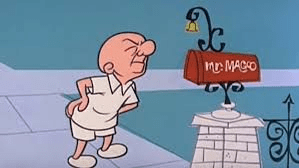
Like many of Poe’s comedies this is partway a farce, but unlike some of them it does hold up as a comedy but it has a predictability about it. This is Mr Magoo gets married, and beyond that central conceit is lacking somewhat in finesse.
In essence then this is not the kind of story for which one reads Poe, its a story anyone could have written and had it not been Poe would have been long forgotten. It has charm but not enough. It is clever in some regards with the set up, but not so much in execution.
TWO MYOPIC RAVENS STARING AT THE SAME CARCASS
Should you read it: there is no reason why you should not, but it is more a question of why you should. Your day will not be particularly better for doing so.
Bluffers fact: Spectacles were invented in northern Italy in the thirteenth century by monks in order to read manuscripts. They were simple things at the time. It wasn’t until Edward Scarlett opened his ‘Old Spectacle Shop’ in 1725, some 500 years later, that anyone thought to puts sides with hooks to go around the ears on them. So for 500 years peoples glasses were constantly falling off. No doubt this was hilarious…
Because one is as ever behind on reviews, as well as general book news here is a catch up in general on my book news and a few new releases form authors I have reviewed before and recommend.
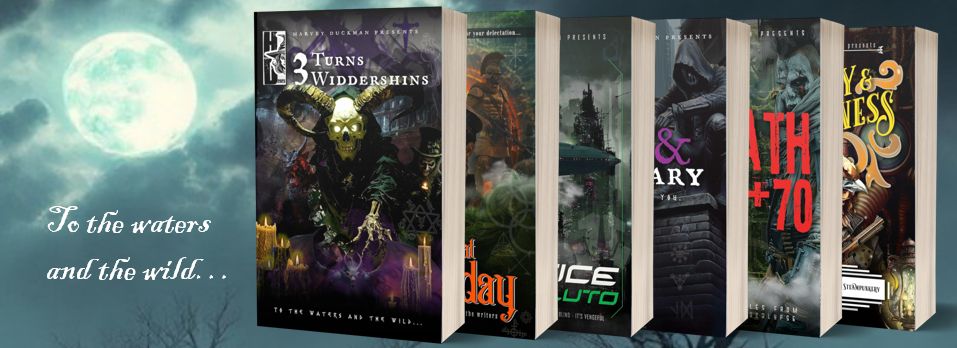
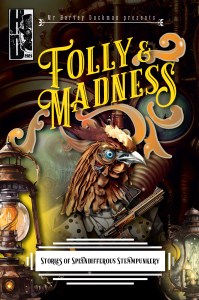
Firstly this month saw the release of the sixth Harvey Duckman anthology 3 Turns Widdershins, a project I remain immensely proud of, producing high quality anthologies from a vast array of talented writers. There is of course more to come from Harvey and the next anthology is in the works , as is a special ‘Welcome to our Worlds’ book that will be out later this year.
If you want to find out more about Harvey you should go to the website HERE
Two of my fellow Harvey’s have new books out this month, Kate Baucherel has released her sixth and final Simcavalier novel, rounding out the second trilogy. I have not yet read this one, but I will as I love this series of near future cyber crime
Meanwhile Ben Sawyer, who at this point must be Yorks favorite son, is releasing his third Holly Trinity novel on Halloween As its not up yet here is a link to the first of this increasingly wonderful series
Stepping away from Harvey, six months ago I read the third of Shelley Adina’s Lady Georgia Brunel mysteries. I have been meaning to write a review but I read it in a busy period and the need to write a review slipped my mind, as sometimes happens. In any case a short review is as follows:-
This is wonderful, read it.
You might want to read the first two beforehand, you don’t really need to, but why would you not. If you have read them you don’t need me to tell you to read this one. Shelley’s cosey steampunk/period mysteries are a delight. They have a gentleness to them, Georgia and her maiden-aunt Millie fall into adventure once more and fight their way through without ever losing a sense of decorum, despite the chickens they seem determined to keep aboard their airship. The world need more of Georgia and Millie, luckily there is plenty to come I am sure.
Another book I read, enjoyed, and put on my to review pile then forgot I had a to review pile (this is a serious problem) is Laura Liptrot’s debut novel Dreamcatchers, which is a delightfully chaotic romp of a book that hops around and makes only as much sense as it needs to at times. As I am a tad chaotic at times I quite enjoyed the splintered narrative of childhood. There are layers to this novel, it reads at first like a child’s fantasy novel but it has a deeper resonance to it than first appearances. It is pure escapism , and who doesn’t need a little of than now and again
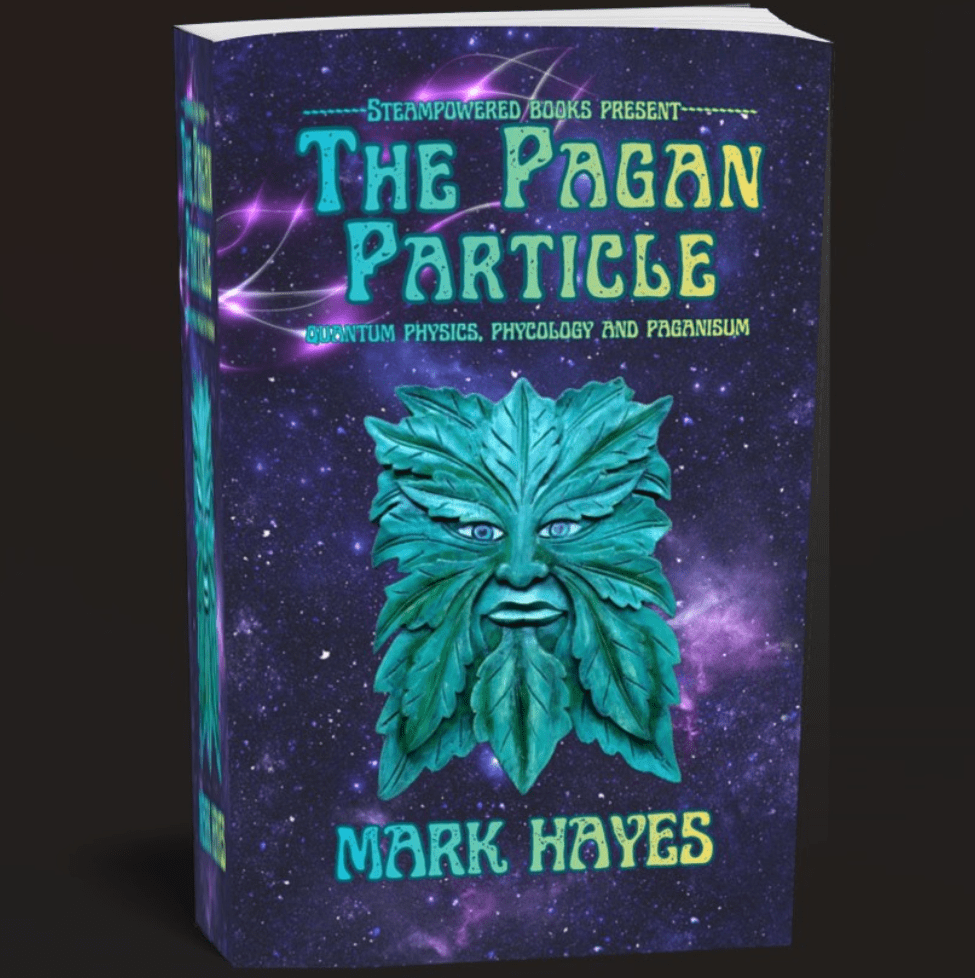
Finally, in the previous blog I published the introduction to a non-fiction book on quantum physic, philosophy and paganism I am sort of writing currently between the more important work of making stuff up… Since I published it I had time one boring lunchtime to do an initial pass at a cover, I quite like the one I put together. I also needed a better title as what is been written is not entirely what was first envisioned, though it is very much the braod sweep.
So here is the cover reveal of a book I might writer (about 10k in the file now so it is actually being written, but how long it will take is anyone guess, and at some point it will take a back step for the next novel )
Last week, because I don’t have enough to write, I started work on a project that has been kicking about for a few years. While it may never see the light of day, as it is in part a personal project, I have been encouraged through conversations with a few people to write a book on pagan mysticism, faith and quantum physics…
With that in mind, as I needed a distraction, I wrote an introduction piece for the book, which was going to be short and intended to be humorous, it got a tad out of hand and required some additional research as these things are bound to do… but it inspired me to keep on with the project and I went on to write a couple of chapters as well and got to just shy of 10000 words last week, as well as sketching out in note form the rest of the book. There is a lot of work to do and there will be much revision, and exactly when if ever the book will see the light of day is another matter. But I thought i would put the introduction here, as some of you may enjoy it. In any regard, I present the introduction (in its present 1st draft form, please bare that in mind) to the book on paganism I am sort of writing that has no firm title as yet
The Quantum Pagan an Introduction
50,000 years ago, amidst a great plain that would one day be called the Serengeti, a man sits cross-legged before at a smouldering fire pit. He is not paying attention to the fire as it splutters down. Instead, he is staring up at the lights in the sky.
His people, the people of the south and the east call him Hura’tuoi, which means he who wonderers. The people of the north and the west snigger at this and call him Hura’tuoa, which means he who wanderers. It will be fifty millennia until this terrible play on words is funny once more. In another time and another language. Humanity will have learned a great deal in those intervening years, but will not have gotten any better at puns…
It is a clear night, the vista of the stars moves slowing through the heavens as Hura’tuoi watches and tries to ascribe meaning to the lights he sees. He has left his people and walked out into the bush alone, here to camp and contemplate. His people think him strange, and in truth he has always been a little strange. He thinks too much and feels too little, they say of him, but this is not true. He feels everything and when he stares at the sky he is seeking connection. He is seeking to understand what he sees and in doing so understand, perhaps even define, his place in the cosmos.
Hura’tuoi believes there is a connection between the heavens and earth. He perceives patterns within the stars, patterns that he does not understand but longs to. In the millennia to come his peoples descendants will give those patterns names and tell stories of them. But that is in the time to come, Hura’tuoi like his kin, of necessity lives in the now. His stories are the stories of the hunt and hunger. His stories are the ones that tell the people where to find the fruits and edible roots as the season turn. Where the antelope will be, come the days of rains. Where water will flow in the days of drought. Hura’tuoi and his people are connected to the world in the most direct of all possible ways. Most of his people are locked in a daily struggle for existence, He is the exception, the shaman. He is one who finds time to wonder about the universe, rather than just where the next meal is coming from. He is the foreshadowing of the humanity to come. A humanity that will seek to understand the cosmos in ways he could not comprehend, on the African plains fifty millennia ago.
He is among the first of his kind, a human who stares up at the stars, wonders what they are and wonders about his place in the universe. Hura’tuoi stares up at the stars, as his untended fire dwindles to ash. He wonders at the majestic turning of the heavens. He wonders at the cosmos he seeks to connect with.
Right up to the moment he is mauled to death by the pride of lions that has been stalking him.
It would be close on to forty thousand years until people like Hura’tuoi could stare into the night sky, wonder about the cosmos, and be able to be reasonably safe in the knowledge that large predators were unable to stalk them. Sometime between 10000 and 9000 BCE by our best estimates, around 11000 years ago, in the fertile crescent of Mesopotamian, small neolithic farming settlements began to appear as humankind figured out how to plant and harvest grains. In the years between Hura’tuoi and the birth of civilization, many humans must have looked up at the heavens, wondered about our place in the universe and told stories. Some of them may also have been mauled to death by lions… It wasn’t until we achieved a level of civilization that allowed for the next meal to be more of a certainty than a mere possibility that humanity was truly in a position to wonder about those strange lights in the sky, but by then we had already learned to use them, both as reference points for navigation and as measure of the passage of time.
Gobekli Tepe, situated in the southeast of modern turkey, is one of the oldest sites of human habitation. The earliest parts of the complex are thought to have been built by nomadic peoples as a place for mysticism and ritual. Just why they chose this site is a matter of speculation but what we do know is they were a people amidst a transformation from a society of hunter gatherers to one of farming and animal husbandry. The site which probably began as a ceremonial hub was occupied to one extent or another between 9500 and 8000 BCE. That’s one and a half thousand years. To put that expanse of time into some form of context one and a half thousand years ago from today a newly fragmented Europe was emerging after the final collapse of the roman empire, the Sui dynasty was reunifying China and the Mayans were building ziggurats.
Fifteen hundred years is a very long time, at least in human terms. Longer still when you consider in modernity a generation, the period of time it takes for a person to be born, raised to adult hood and have children of their own is around thirty to thirty-five years or so, in the developed world. In the neolithic world the average generation would have been between only fifteen to twenty years. It is not a stretch to say Gobekli Tepe was inhabited for something around eighty-five generations. Again, to put that in perspective, going back eighty-five modern generations would put us somewhere in the middle of bronze age Greece…
To be succinct humans lived at Gobeki Tepe, for a very long time
However, they also left it a very long time ago. Arguably, the most famous neolithic monument in the world is Stonehenge. The Circle of stones in the plains of Wiltshire that was constructed around 3000 BCE or 5000 years ago. This was around the same time period as the construction of the megalithic temples of Malta. Both those temples and Stonehenge are aligned with the stars and the equinox’s, as indeed are some aspects of the Gobeki Tepe complex. But for a little more perspective, as we sit her in modernity we are closer in time to the forgotten builders of Stonehenge and Malta’s temples, than the builders of those wonders were to the builders of Gobekli Tepe, and we know very little about any of them. What we do know is Gobekli Tepe was not alone. There are many other sites around the world where humans have come together to build sites of mysticism and spirituality that align with the stars, and the turning of the seasons. Gobeki Tepe is merely one of the oldest that has not been removed by the ravages of time.
What Gobeki Tepe, Stonehenge, the temples of Malta and all the rest are is proof, if ever it was needed, that our most common trait as humans is a desire to understand our place in the cosmos and to connect to it. A desire that predates Gobekli Tepe, that predates even my poor unfortunate Hura’tuoi. Humanity has had a concept of the spiritual for a very long time. While religion and religious practices almost certainly developed as far back as 50,000 years ago in the Upper Paleolithic in the form of shamanic rituals. There is sporadic and disputable evidence of such things stemming from even further back. The simple truth is we have no idea how far back in time humans have been staring out at the universe seeking something more than themselves. Prehistoric cultures are by their very nature, before history, but we have been seeking the divine for a long time.
Modern paganism, as practiced by myself and others, does not look so far back in time. The deepest back in time we look in any real sense is probably back to the Minoans and Crete a thousand years before the Greece of Plato and Aristotle. Modern druidism, which is but one branch of paganisum, has no real roots with the builders of Stonehenge but is based on 19th century romanticism. Modern pagans look back on ritualism from the Greek, Roman, and latterly the dark age societies of northern Europe for answers. Others look to the native religions of the America’s and other cultures that have been subsumed into western religion. We have little connection with the builders of Gobekli Tepe, or indeed the builders of Malta’s temples, or Stonehenge. Except in one very important way. Modern pagans, like their ancestors before them, right down to Hura’tuoi and beyond, are still seeking a connection to the universe. Seeking a spiritual link to the cosmos. Seeking to find their place, and in doing so to find that which is divine…
Modern paganisms many branches are all reaching outwards, while looking back to the past. There is nothing wrong with this, but while this form of paganism brings a sense of belonging, connection and fulfillment to many, it has never felt entirely right for me… While I feel that same desire to find and connect with something of the divine, to be part of a greater spirituality, part of the world and the universe, I also worship at another altar. For while paganism calls to me, I am and always have been, fascinated by science and more importantly physics. On the face of it, it may seem difficult to conciliate the philosophy of quantum physics with any form of Pagan mysticism. Certainly, it has taken me more than a few years to find my own way, my truth, if you will. This book is, however, an expression of that truth, and my search for it.
I am not looking for converts, I am not going to presume to teach anyone how to be. I will however tell you whom I am, the path I have chosen and perhaps cast some light upon the journey it took me to get here.
Now, importantly, while I have my back to the fire, I can feel its warmth, and I have checked for lions.
So, I think it’s time to stare at the stars again, for a while…
A pre-warning, this is not really a post about cats, it does feature a cat, and some cat related jeopardy, so to put your mind at ease, Tommy the cat, who is the cat in question, is fine now. You don’t need to go worrying about the cat. Okay, moving on.
On Friday in the wee hours of the morning I got a text about my sons cat Tommy. Tommy was ill, and my son was in a bit of a panic. Mid morning on Friday I got a phone call from my son saying eh had taken Tommy to the vets first thing and things were not looking good. The early prognosis was that Tommy’s kidneys were shutting down due to infection and he was likely to need an operation. My son was justifiably worried about this. There was every chance the cat would not survive with the operation and a near certainly he would not survive without it.
My son loves his cat. As many people love their cats. In much the same way that some people love their dogs… But my son is a barman, going through a messy break up, who has no money. Vets are not free. there is no such thing as a NHS for pets. And while he had pet insurance he wasn’t sure how it worked and if it was going to be covered.
Luckily, he also has a dad who just got paid to write a book on H.P. Lovecraft*. For all of old tentacle huggers many flaws did love cats, and even without the Lovecraft book money I am lucky enough to have the resources to cover the vets bills so it was not the issue it could have been. I told my son not to worry about money I could cover the bills, and he could worry about the insurance afterwards
*I will talk of this in another blog at some point i am sure…
So I drove down to Leeds and did what any vaguely adequate parent would do in the circumstances and was there for my son, and only made the obvious joke about how much cheaper it would be to just get a new cat once. Friday was a long day, a day that left my wallet a couple of grand lighter. Because vets are not cheap, and stays in pet hospitals comes at a premium.
Luckily as I said my son has pet insurance, the costs should be reclaimable, though nothing is guaranteed, insurance companies are buggers for finding loopholes… But my son been reunited with his now healthy cat (all be it requiring a special diet from now on) is worth more to me than money ever is. As was the below Instagram post from my son earlier today…
So all’s well that ends well…
There are certain right wing politicians in this country, politicians who have well documented connections to private medical companies, who express the opinion that the National Health Service should go down the route of funding via medical insurance. Basically, changing to the American model.
Now, I am aware that this blog has a fair number of American readers, and I am aware some Americans are adamant that a free at the point of use, state funded, universal health care system is a symptom of a socialist hell scape. I have long suspected this is because American politicians have gone on record saying this is the case for decades, while pocketing the campaign contributions form insurance companies. Stating the American system has produced the best hospitals and standards of care in the world… This is not entirely incorrect either. But only if you can afford the medical bills…
Yes, you may say, but Americans have the choice to buy medical insurance, while we have to contribute through taxation whether we use the medical facilities or not… Which is true… But I will take the latter rather than the former any day of the week. I would also point out that on average what a tax payer in the UK pays towards the NHS is significantly less than the average Americans medical insurance, for those who can afford it.. But back to cats…
All cat owners love their cats. My son, a cat owner, has just enough money and just enough sense to have pet insurance. Not all pet owners do however, usually because it is an expense they can not afford on the off chance they need it. What happens then if a cat owner with no insurance goes to the vet because their cat is ill.
Well, they could just pay out what they need to pay, but if they could not afford/justify the cost of, insurance then it is doubtful they can cover the bill out right. Most vets will offer easy term repayments, or ‘pet loans’ to cover the cost, but again if you could not afford the insurance, then can you afford the pet loan? Some might say if you could not afford the insurance you should not have had the pet, but people love their pets… For some a pet might be all they have at times.
How is this circle to be squared, well there are other options, take the pet home and do what you can to stop them dying in pain alone. Or ask the vet to do what I imagine is the worst part of a vets job, while knowing an animal could be saved, but that the owner can not afford to save them…
That their is feline economics. The cat lives if you can afford the cost of keeping it alive, otherwise, good night fluffy, and this nice woman in the lab coat is going to help you go to sleep.
Humans are more expensive to keep alive than cats. Medical insurance isn’t cheap, and the older you are the more it costs , because the older you are the more likely you are to need it… In America right now the Trump administration is in the process of removing Medicaid from up to 15 million of its citizens in order to give the richest 1% more tax cuts. Average medical insurance premiums are likely to double. More people will be unable to afford medical insurance and will roll the dice on staying healthy. From beyond the shores of America this seems insane. Here, in the rest of the civilized world where we have universal health care and no one going into bankruptcy due to medical debt the whole American health care system has always seemed insane, but this is new levels of madness.
The American system, it seems to me, is the same system we use for cats. With the same kind of feline economics…
Meanwhile at this side of the pond, the NHS has many flaws, and yes there are waiting lists , and doctors appointments are not always easy to get. But it is free at the point of use and no one has ever had to decide if they can afford the bill. I would suggest people keep that in mind when next this visit the ballot box when snake oil salesmen are trying to suggest you would be better off without it…
Anyway that enough politics, normal service will resume shortly with some Poe stuff , a book review or two and the usual withering on.
















 The Passing Place