Is your work product or art?

Its October, the leaves are falling, the witches are abroad, and I’ve opened the blog up to guest writers again. Yes its Indie October. Throughout October some old favourites among my guests will be returning along with some new voices. Today’s Guest Post comes to you from a strange land across the ocean, where racoons and the occasional bear wanders through his garden, and they don’t use the letter U correctly… New England’s own Joseph Carrabis
Is your work product of art? Bit of a trick question, that.

Art is also a product. The question has more to do with production values. There’s a difference in the care put into producing a Velvet Elvis versus the Mona Lisa. It has nothing to do with Da Vinci thinking, “Yeah, some day, hot dang, I’ll be remembered for this.” I doubt he did. It was commissioned work. But he definitely put more time into it than he made on the commission. He wanted to do a good job.

Not sure anybody on the Velvet Elvis production line has such thoughts. Ever heard anybody at a burgerjoint call from out back, “Wow, Charlie! That’s one damn good fry you made!”?

The “work versus product” question has been with me since January of this year (2020). I took a class with a recognized, award winning author. Personally, I never liked their work. It was okay written at best, not well written. Not even stylishly written. It didn’t really stand out from much of the other stuff on the shelves.

It was (to me and in a word) meh.

For that matter, I never understood why this author’s work got awards.

Okay, yeah, I do; produce what the public wants and it’ll get recognition. That’s another difference between art and product; Art may take time to be recognized.

The “work versus product” question resurfaced for me when I read The Best of C.M. Kornbluth. I enjoy bronze, silver, and golden-age science fiction and fantasy. Kornbluth’s work fell more into the product than most. By his own definition, too, according to the editor’s notes and author quotes in the book.

The hammer fell…
…with a class exercise we were given by the author mentioned above; something written by said author, intended to be flash fiction and too long by about 300 words. Cut it down to under 1,000 words. Go!

I started reading. It was, as before, okay. Some good turns of phrase (and being honest, I picked up one learning gem in the class. If I can learn one thing in a class, I’m thrilled). A nice idea in there, somewhere. I redlined unnecessary adverbs, adjectives, fixed some tense issues, clarified a speaker here and there. Removed some expository lumps. There was one paragraph that completely threw me; the POV shift was so abrupt I had no clue who’d taken over the story and it didn’t add anything so I pulled it. A quick word count showed I’d loped off about 280 words. Okay, another few minutes and I’d find twenty more words to cut.

Ding! Time’s up, pencils down everyone.

Then the award winning author showed us how they’d cut 300 words. They removed the last paragraph.

Which included the character evolution of the story, as in A.J. Budrys’ line that Star Wars couldn’t end with the destruction of the DeathStar, it had to end with someone saying “We destroyed the DeathStar!” (or close to) signaling that the characters understood their job was over, their task completed, their goal reached, the story done, and most importantly, letting the reader/viewer know the story’s over.

But this author simply cut out the last paragraph to meet the word limit requirement. They even said, “It’s ready to go now.”

Really?

Essentially the story ended with “We”, not “We did it! Not even “We exclamation point!”

The reasoning? Now it fit the “1,000 word max” criteria.

A beautiful demonstration of product v art. Who cares if it still makes sense as a story, it fits. Send it off. We’re done. An understanding that helped me understand why I never liked this author’s work.

They produce great stuff if you’re looking for a blowoff read. Lots of people are. I prefer work I can grow from, learn from.

Guess I’ll never win any awards. Not while I’m alive, anyway.

About Joseph Carrabis

Joseph Carrabis is boring and dull. He holds patents covering anthropology, linguistics, mathematics, neuroscience, psychology, and a few dozen other fields. He created a technology based on these patents that ended up in over 120 countries, and a company with offices in four countries. He’s vowed to never do that again. Now he writes fiction and hopes you enjoy it.

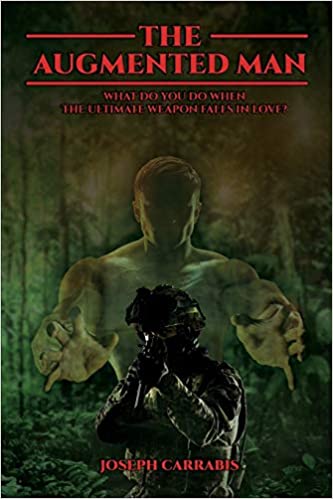
As well as his own fiction, including among other splendid works The Augmented man (marks review of which is here) he is also a regular contributor to the Harvey Duckman Anthologies, though we do make him put all the U’s back in the words that need them…

Links:
https://josephcarrabis.com
http://twitter.com/JosephCarrabis
http://www.facebook.com/JosephCarrabisAuthor
http://www.linkedin.com/in/josephcarrabis
https://www.goodreads.com/author/show/3465227.Joseph_Carrabis
https://www.pinterest.com/josephcarrabis/the-evolving-me/
https://www.instagram.com/josephcarrabis/
https://www.bookbub.com/authors/joseph-carrabis
https://www.youtube.com/channel/UCcPgvILded-intS45LTkTVA
http://nlb.pub/amazon

Posted in amediting, amreading, amwriting, books, fiction, humour, indie, indie novels, indie writers, indieoctober, indiewriter, publication, rant, reads, writes, writing | Tagged , , , , , , , , , , , | 2 Comments

The Suggestion Of A Monster

Its October, the leaves are falling, the witches are abroad, and I’ve opened the blog up to guest writers again. Yes its Indie October. Throughout October some old favourites among my guests will be returning along with some new voices. Today’s Guest Post is from Teesside travel author Will Nett

It hangs in the air as you approach. Once you get inside a 20 mile radius you can almost taste it. By the time they first glimpse the grey gloom of the water, even the professional cynic, eg; me, is fully invested. I wanted it to be in there. I stuck my head around the gift shop door to enquire as to what time the next sighting was, as though a centuries old, or even prehistoric, beast, was operating on some sort of office rota. There’s been 22 official sightings at time of writing, 7 of which are by the same person, an Irishman who’s never been within 50 miles of the place in his life, but instead watches a livestream of the Loch from his home across the Irish Sea. Well, it can’t be any less entertaining than Mrs’s Brown Boys, I don’t suppose.

I’m in Drumnadrochit, or ‘Drum’ as I’ll now refer to it, in order to save ink. It’s effectively the ‘Village’ from TV’s ‘The Prisoner.’ Everyone knows your business before you’ve even arrived, all of the buses are driven by the same insufferably cheerful driver, and the weather is modified every 90 seconds by a man sitting at a console somewhere beneath the village green.

It was a motley crew that eventually set sail in this post-Coronial world of cryptozoological exploration. So much for trying to save ink. There were a couple of Parisians on the roof, a pair of Poles in the wheel house, and myself draped over the engine block. I’d positioned myself in such a way as to be able to grab Nessie around the neck and wrestle it onto the boat.

We blasted off from the little harbour around the ‘horn’ of Urqhuart Castle under the reassuring steerage of Skipper Mike, who’s booming tour-guide tones punctuated the various points of interest in a discourse that took in ditched WWII bombers, disastrous water-speed records, and the importance of making sure there’s a ladder attached to the outside of the boat before going for a dip.

It was another Irishman who gave birth to the legend of the Loch in the first place. 1350 years ago, a chap called Columba- who I like to think of as being played by Peter Falk- learnt of a local man who’d been killed by a ‘water beast.’

Intrigued as Columba was, he was not so curious as to investigate the matter himself, instead sending one of his mates out for what he presumably convinced him would be a leisurely swim. Sure enough, the ‘water beast’ set about our unassuming piece of human Nessie bait as he casually backstroked around the Loch. By way of defense he fell back on the tried and tested method of the Catholic Church and wielded the sign of the cross using his index fingers, which was enough to prevent further mauling and returned the ‘beast’ back to the depths, and its abandoned shopping trolleys and car tyres.

I’m not a man of religious faith, or a believer in urban myths, but I wanted to believe this.

I wanted it, this ‘water beast’ or anything, to rear up, and smash the boat and everyone in it to pieces. I wanted to see ‘it’ or anything.

The suggestion of a monster is a powerful thing.

About Will Nett

Will Nett is about 40, from Middlesbrough and the author of My Only Boro, the book that was a bestseller in the town for three Christmases in a row.
Will is one of the most affable writers in the Tees area, and his global appeal and general popularity have seen his writing career straddle two millennia. He is an incurable backpacker, occasional banjo picker and habitual note-maker/taker, most of which have found their way into his Gonzo-steeped books, which also include Local Author Writes Book, and his riotous travelogue, Billy No Maps. He has been a Sudoku salesman, snooker table repair man, model, cinema usher and unprofessional gambler.
His latest book, The Golfer’s Lament, was submitted for the William Hill Sports Book Of The Year Award 2020.

Will Nett on Amazon
TEES on line interview

Posted in amreading, amwriting, books, goodreads, humour, indie, indie novels, indie writers, indieoctober, indiewriter, reads, writes, writing | Tagged , , , , , , , , , | 2 Comments

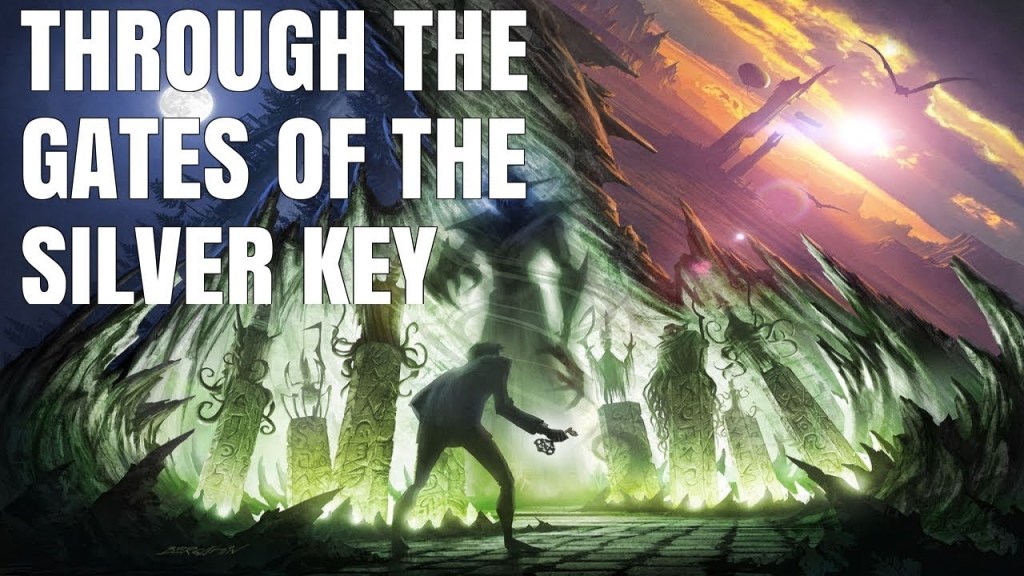
Through The Gates Of The Silver Key : TCL 63

Okay, before we start, let me just reiterate once more, Randolph ‘bloody’ Carter…

I am, as astute readers of previous blogs in this series may remember, not the biggest fan of Lovecraft’s ‘dreamlands’ stories. Nor am I a huge fan of Randolph Carter in general. The only Randolph Carter story that has done well under my occasionally erratic spotlight is Lovecraft’s novella ‘The Dream-Quest Of Unknown Kadath‘ and the reasons I like that story are all to do with the greater mythos rather than the story itself. My hopes for this story were not high therefore… Which is slightly odd.

‘The Silver Key’, a story I loathed, was unsurprisingly the central inspiration for Through The Gates Of The Silver Key. Indeed it is a sequel to that story written primarily because a fan of old tentacle hugger, Edgar Hoffmann Price, who was also a writer himself, asked Lovecraft to write it, go so far as to send a 7000 word original draft of the story to Lovecraft. Telling the tale of ‘what happened next…’ to dear old Randolph Carter, after he unlocked the gates at the end of ‘The Silver key’.

Lovecraft’s vanity, reasonably enough, was such that he was swayed by the idea, and took that 7000 word draft and rewrote it into something that ended up twice that length and, according to Hoffmann, left fewer that 50 words of his original draft in tact. Despite this many accredit this tale to both authors as a collaboration. Hoffmann was reportedly very pleased with the resulting tale and full of praise for Lovecraft’s reworking of what could be one of the first examples of fan fiction to surface in the zeitgeist.

Despite my trepidation about reading yet another story with Randolph in it, when I first came round to this one I was looking forward to it. I wrote in my review of the dreadful The Silver Key, that I remembered this story fondly… Remembered was clearly the wrong word, at some point however in the dim distant past around the late 1980’s when I was young and impressionable I did read this particular tale and there was something about it that spoke to me.

I don’t remember what it said, and I am fairly sure it lied…

That’s one of the problems with rereading things I read while still a teenager, a few decades, a whole lot of living, and more refined tastes can mean that stories I loved when I was effectively not much more than a kid, don’t really stack up any more. I suspect what I was drawn to back then was the strangeness of the tale. In part a psychedelic dream sequence where Randolph becomes just one fragment of a cosmic id, and shares the bodies of other nodes of existence, there are wild fascinating ideas here, idea’s I suspect I had never come across when I first read this story way back in the dim darkness of the past. A past which increasingly is indeed another country…

Fast forward to a more cynical and well read now, and everything I doubtless found fascinating when I first read this story is still there. But the writing, the description, the plot and everything about this story aside the original ideas (only about half of which were Lovecraft’s to start with) is awful. The wonder is sucked out of everything and replaced with bland, dull, over written, and frankly boring narrative.

Take for example this passage..

He provided a light-wave envelope of abnormal toughness, able to stand both the prodigious time-transition and the unexampled flight through space. He tested all his calculations, and sent forth his earthward dreams again and again, bringing them as close as possible to 1928. He practiced suspended animation with marvellous success. He discovered just the bacterial agent he needed, and worked out the varying gravity-stress to which he must become used. He artfully fashioned a waxen mask and loose costume enabling him to pass among men as a human being of a sort, and devised a doubly potent spell with which to hold back the bholes at the moment of his starting from the black, dead Yaddith of the inconceivable future. He took care, too, to assemble a large supply of the drugs—unobtainable on earth—which would keep his Zkauba-facet in abeyance till he might shed the Yaddith body, nor did he neglect a small store of gold for earthly use.

Maybe that sparks your interest, maybe you are not unlike me as a seventeen year old and all power to you if that’s the case. I’m not even sure I was like me as a seventeen year-old. Perhaps my memory confused this story with another when I remembered it fondly. Frankly however my summing up of the Silver key was:

I’m not saying don’t read it, really I’m not, but if you do read it, for the love of all thing scaley don’t blame me…

The same applies to this sequel, as does the score it recieved, its only saving grace is that’s the last of Randolph Bloody Carter… Well except for another collaboration, Out of the Aeons, which he wrote with Hazel Hearld, but that never appears in the ‘complete Lovecraft, collections so I’m going to forget it even exists… Because it may be a work of utter genius but I will happy take the risk of that unlikely truth rather than read the words Randolph Carter again.

Further Lovecraftian witterings as ever can be found here

Posted in fiction, goodreads, horror, Lovecraft, mythos, Nyarlathotep, quotes, rites, sci-fi, supernatural, Uncategorized | Tagged , , , , , , , , | 1 Comment

The Accidental Novel

Its October, the leaves are falling, the witches are abroad, and I’ve opened the blog up to guest writers again. Yes its Indie October. Throughout October some old favorites among my guests will be returning along with some new voices. Today’s Guest Post is from Dr Tamara Clelford

Mark

If you’d told me two years ago I’d write a novel, I would have laughed.  Absolutely no way would I write a novel, no way could I write a novel.  Well, except it turns out, by accident.

I’ve always loved reading and I read a lot.  I have a set genre of books that I like: thrillers where you learn things, think Robert Ludlum, Tom Clancy, Dick Francis etc.  But I have never enjoyed writing fiction, not even when I was in school.  I write a lot for work, but I write coding and technical reports all based in fact.  This is a far cry from enjoying writing fiction.  

I used to work in a gym and I remember a colleague saying she had at least one good book  waiting to come out.  I was in awe that someone I knew thought they would write a book, and that statement has stuck with me since.  Fast forward a few years and one of my good friends with spare time whilst working abroad wrote a book as part of NANOWRIMO, the National Novel Writing Month.  The seed planted about writing a book all those years ago in a gym in Sheffield had finally started to think about germinating after a conversation in a house in Bermuda.  

But it took a few more years for the seed to actually germinate.  In fact, it took an extended holiday in New Zealand and a strange story about a resurrected bird.  Whilst I walked along the shore front in Wanaka on the 31st of October I read a series of story tiles giving a timeline of the history of New Zealand.  One caught my attention:

 ‘1946 Dr Geoffrey Orbell proved takahē not extinct’.

Well, I knew they weren’t extinct as we had literally seen some on our trip.  So I googled the story behind this tile over the rest of my cup of coffee and my imagination ran wild.  I started to think: how great it would be if this takahē story was actually all a government conspiracy, they were never extinct just being used for something in the second world war, and what if their ‘use’ was actually still viable for an evil genius to exploit today?  

I had entered the plot of a Ludlum book, but this time a plot of my concoction.  I decided the protagonist was going to be a woman on holiday in New Zealand, she’s going to see some things going on and be able to recognise them for what they are because of her obsession with spy books.  She’ll then use her science skills to foil the evil master plan.  What do they say – write what you know and want to read.  All the books I read have male protagonists who save the day: why shouldn’t it be a woman, and why shouldn’t that woman be a Radio Frequency engineer on holiday?  In a 15 minute period I had a whole plot for a book sorted in my head, all whilst holding a conversation on a totally different topic with my husband.  On our way back to the flat I explained the plot I had come up with and said it would make a great book, I got an answer I wasn’t expecting ‘Well, you know what tomorrow is, don’t you?’.  

If you don’t know, NANOWRIMO takes place every November.  You register your book title on the website, update your word count each day, and ‘win’ if you write 50,000 words in November.  So, with only hours to spare I sorted out a title for my novel, riffing on the Ludlum titles, registered on the NANOWRIMO website, and the next day started writing my novel.  

I literally started at the beginning and just wrote what came to mind.  I enjoyed it.  No, I really enjoyed writing the book, seeing my ideas and characters come to life and I even enjoyed editing it.  With hindsight a plan might have been useful, as I had to go back and alter facts because of something I decided would happen later on in the novel.  As the novel takes place across New Zealand, timescales and geography have to be accurate.  

I ‘won’ NANOWRIMO, even though I battled jet lag and started working full time.  I hadn’t quite finished the book, but I finished it by the end of the year.  Then it fell dormant as I had no idea how to get it published.  I didn’t stop writing though: I started a blog, wrote articles for magazines and was able to fully enjoy the process.  

Help comes to your aid at the strangest places, in this case it was in Ten Forward in Scarborough Spa.  I have loved star trek since being a small child: I am and always will be a Trekkie. So come April, I was excited to go to Scarborough SciFi Convention again.  Alongside all the wonder of a SciFi Convention I ran into Sixth Element Publishing and realised this was the perfect company to help get my book published.  We discussed the new-to-me world of publishing and how to get my book to the point where it would be out there in the wide world for everyone to read.  I liked their approach to publishing and I liked their enthusiasm for books and the way they help new authors like me.  So, I dived in.  

Today that little seed has become a 5cm high shoot ready to blossom into a published book, all really by accident.  I have had my manuscript read through and a story telling mentoring session by Sixth Element, which has been incredibly useful and has made my book a much better read.  I’m in the process of making the last few alterations before moving onto final edit, production, proofreading and then book production!  What I have learnt in my accidental journey into writing a novel is that you don’t need a masterplan – you can just type words into a document and see where they take you.  I can enjoy writing for fun and like what I have written, even though the 14 year old me would snort with laughter at that statement.  If I can write a book and enjoy it there is definitely a good book inside of everyone waiting to come out!  

About Dr Tamara Clelford

Tamara is a star trek loving, pukeko obsessed, tap dancing, Queen listening, lord of low frequency and high-priestess of high frequency physics geek.  Having worked in a variety of technical roles, both normal and clandestine, she is now a consultant working on physics based problems and data science.  This latest incarnation has opened new doors to a wide variety of work and interests, like: an eclectic blog, writing a novel, encouraging people into physics, and teaching people how to code and do data science. 

Follow Tamara on social media: @SwamphenEnts

If you want to see her technical life or learn to code go to www.swamphen.co.uk/online-learning

Posted in #amwriting, amediting, amreading, amwriting, fiction, indie, indie novels, indie writers, indieoctober, indiewriter, nanowrimo, novels, opinion, publication, reads, self-publishing, writes, writing | Tagged , , , , , , , , , , , , | Leave a comment

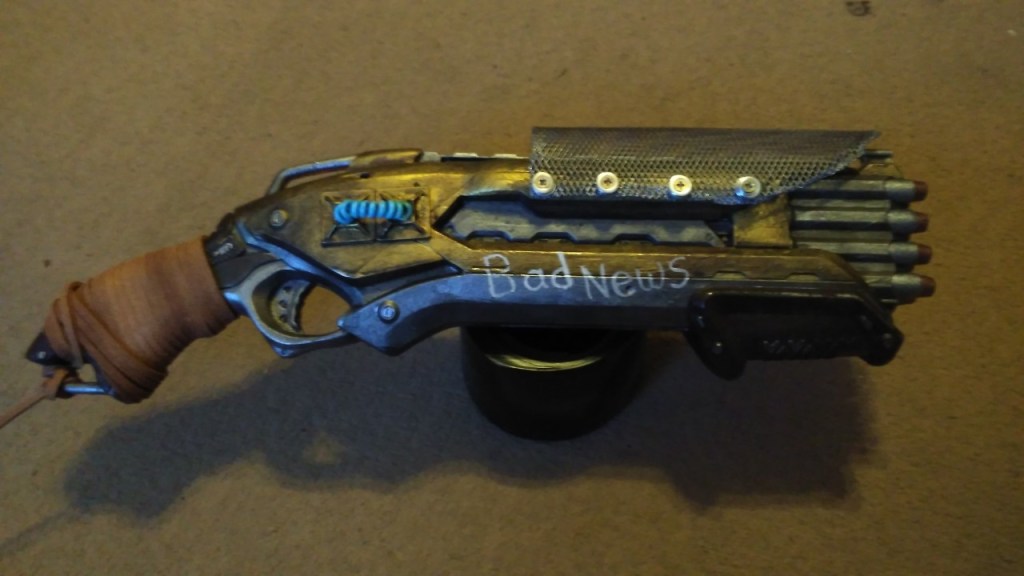
Bad News…

“I should be writing…”

To be fair this is one of those statements I make quite often. “I should be writing…” generally refers to absolutely any time I am doing anything else. Which is quite often. On occasion however any writer needs to do something else. Creativity in words is not the be all and end all of creativity. Sometimes you need to do something more practical and physical.

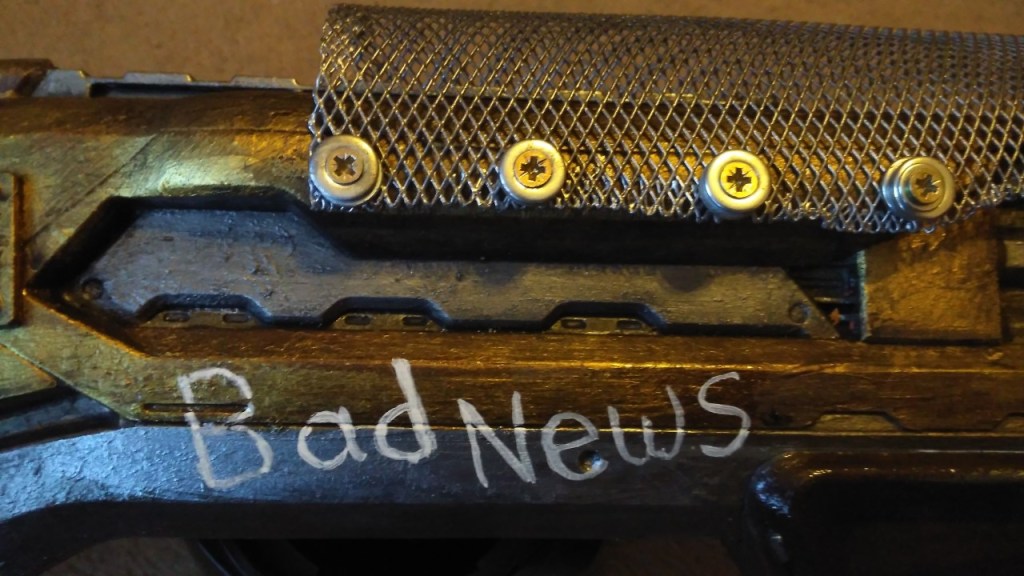
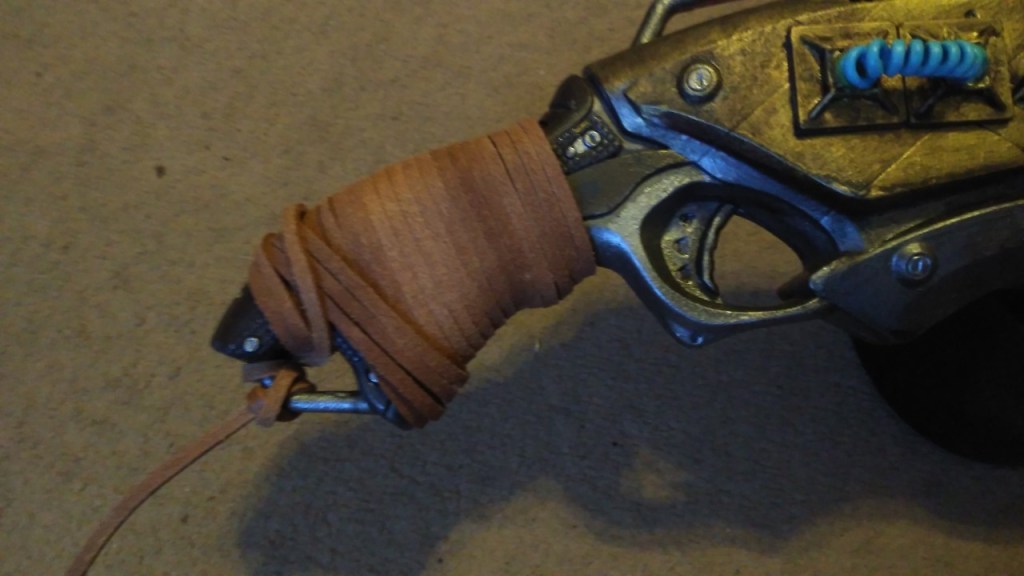
Bad News started out as a simple nerf shotgun, designed to firing its eight dart load in pairs, as you pump it in typical pump shot gun style

For those that are interested, as last time I did this I got a few questions on the nitty gritty of what I did, the first task was to ‘key’ the surface of the gun with san paper, partly to get rid of the raised words, but mainly because shiny plastic doesn’t take paint well, even model acrylic’s designed for plastic. As such ‘keying up the surface with sand paper gives you something that will actually take pain easily.

The paints are layered, and of Couse a wise man would have taken pictured with each layer if he was going to write a blog post about turning a toy nerf gun into a steampunk nerf gun he would have taken pictures at each stage…. But when am I ever wise…

The first couple of layers are dark metallic acrylics, and dark browns for the stock and pump handle. Then a third layer of bright metalic’s was added, before a finishing dark wash to give it a slightly grimy used look. There is also a layer of matt model varnish over the trigger and the section of the gun down which the pump is pulled to protect the paint from the slide.

The metal heat cage over the top of the barrel, is actually the metal mesh from an old office letter tray, cut to size and shaped with the edges doubled over, it was then painted in a dark iron metallic to give it a less shiny aluminium look. then screwed in place. Interestingly the first time I screwed it on I jammed the pump mechanism, which was mildly annoying as I prefer these things to still work when complete. luckily when I stepped the screws back with washers it cleared up the mechanism and it still works.

The blue wire is just wire from a power cable coiled tightly around a nail and glued in place, while the raised sections it connects to are actually plastic self-adhesive cable tidy’s I used to cover up the ‘NERF’ icon and give the gun a little extra shape and design.

The stock handle was covered with 3mmx 2mm leather thong carefully wrapped around it to held in place by friction.

As projects go it was a fun one, and done over the course of several months as I originally was doing this to offer as a sign up prize for my mailing list at events, but as Covid put pay to that, its just another of my steampunked nerf guns decorating bits of my house. Hopefully when the world opens up once more and I can get out and meet people I can use it as intended… But as I quite like this one now its finished I may need to make a second one for that.

Anyway, as I said at the start of this, I should be writing novels not mini guides to steampunking a nerf gun. So I’m going to get back to that.

Mark

Posted in amwriting, books, Canadian steampunk, Hannibal Smyth, pointless things of wonderfulness, steampunk | Tagged , , | Leave a comment

October reading…

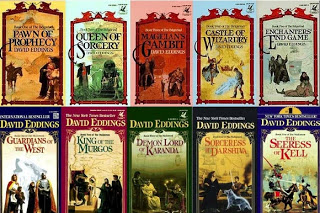
A couple of weeks ago I decided on little more than a whim to take a dip into the well of nostalgia and reread an old favourite ‘Pawn of Prophecy’. It a book I first read when I was a teenager in the middle of my epic fantasy stage. As I am in my fifth decade, that was along time ago, but in fairness that was not the last time I read it, its a book and a series I have fallen back into about once a decade. Every time I do I half expect it to disappoint me, yet it never does. There is however a few problems with ‘Pawn of Prophecy’….

Plot wise the five book The Belgariad and its five book sequel The Malloreon could be described as a little trite. Hidden Heir stories always are. But what keeps me coming back in the characters and the interactions between them. Quite frankly I love the characters, even though each individual main character is a caricature of fantasy land characters, the sarcastic thief, the hulking berserker, the wise old wizard, etc. The characters still feel well rounded and interesting. There are a host of other things that seem predictable and a tad hackneyed even, yet even knowing the story, knowing the characters , and knowing everything that happens in these books I still find myself picking up the books every decade or so and reading them again. And every time I do I have to read all 12 books (there are two others after the two series) because I genuinely love these books and love getting lost in David & Lynn Eddings world and characters.

This is a problem…

The problem being that unlike going back an rereading a Terry Pratchett novel, or one of my David Gemmell’s, or picking up a classic like Fahrenheit 451, a big fantasy series, and this is a particularly big one, becomes a reading time sink. As such, while I indulge in nostalgia, with the occasional scribbled note about character interaction (as its the interactions between characters that make this series) as its hard as a writer to switch off that part of my brain when reading, my reading pile of new books has started to stack up.

Now that’s not a bad thing, I always have a stack of books to read, but it still gets a little bigger every few days. It is also a matter of balance, one of the most important skills a writer needs is reading. A writer does not just read for pleasure, which is not to say that reading is not a pleasure, but to expand there toolkit (hence the comment about making notes on character interactions). The greater the breathed and depth of your reading the more tools you find yourself able to play with. Rereading old books can be as useful as reading new ones, more in some ways as I tend to be more analytical when I reread old books these days, but reading something entirely has the capacity to send you off on entirely new tangents of thought and imagination.

The problem is however, on top of all the other books in my reading pile I have two new books from a couple of my favourite people as well as authors, because as part of a growing community of indie authors that is slowly spanning the globe I am exposed (for want of a better word) to the novels and worlds of some fabulous authors outside the mainstream of supermarket paperbacks. I always look forward to these books from any of my fellow indie writers. Yet they are sitting in the fallow pile waiting for me to finish the series I am reading, which has left me feeling a tad guilty (which is clearly ridiculous, but I’m a ridiculous kind of person.) I feel all the more guilty as it is #IndieOctober a made up festival of indie writers, made up by me of all people, which I use to try and help indie writers find an audience, and grow a readership by letting them post guest blogs and doing lost of reviews and other things indie writer relates through out the month of October (I did this last year and it was quite successful) So I feel I should be reading these indie books I have on my reading pile…

This is all a tad ridiculous, the obligation to read these two books is entirely self-imposed, and its not as if I don’t want to read them… I just want to finish the last four and a half books of the Belgariad/Malloreon first… But that may take a while, the last two are particularly long novels… I am also entirely sure neither Craig or Nils will be offended that I want to finish other things before reading their books, yet I still feel guilty…

Self-imposed obligations are the worst…

I’ll just need to find more reading time. damn you sleep, why are you required?

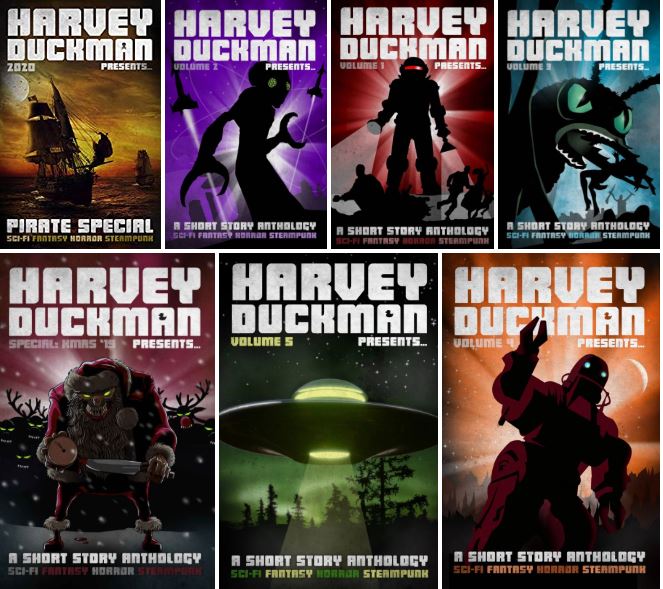
As a side note, as well as loving indie writers, I have a soft spot for indie publishers, so as it is #indieOctober a little mention of them too. I often mention 6E publishing, as they are personal friends, produce the Harvey Duckman anthologies and importantly are are just fabulous people. Sloth Comics are also seem to be particularly good people, but that maybe because I love Hopeless Maine… But the special mention today is for Inspired Quill, as I decided to buy Craig Hallam’s latest novel direct from the publisher, mainly on a whim and because Amazon make enough money out of me. Supporting small press publishers is important to me because they support indie writers, and care more about the books than the money. But its also such a nice experience when they send you a free bookmark along with the book , and a hand written note… Bless there cotton socks… It brought a extra little smile to my face.
Posted in Uncategorized | Leave a comment
Managers took my power circle

Its October, the leaves are falling, the witches are abroad, and I’ve opened the blog up to guest writers again. Yes its Indie October. Throughout October some old favorites among my guests will be returning along with some new voices. And first up the unique and occasionally worrying mind of Andrew ‘Indefatigable’ Hill. A man known for many a strange opinion, some of them seemed to make sense at the time…

Mark

If you have an Android phone you may recently have elected, been badgered or compelled to upgrade to Android 10. For us cynics, any enforced software upgrade to previously perfectly serviceable kit is replete with risks and scant reward.

With a heavy heart and little confidence, I yielded to the regular micro aggressions of polite but persistent ‘notifications’ and pressed update.

Mercifully, after a lot of egg timers and restarts the phone sprang back into life.

But there was something I quickly noticed.

The main screen in Android typically shows a circle drawn around a clock. The circle ticks down to signify battery charge left, like the minute countdown to your weekly programme for Schools & Colleges (it was a thing). This enables the user to quickly, almost subconsciously, keep track of how long is left until your pocket pet of wonderful information becomes a plastic rectangle of uselessness.

Cometh the update, cometh the death of the battery circle. Instead a wispy circle with no apparent function. Why? Why! Why?

This caused me some vexation, why would the owners of Android, Messers Google Inc, make something worse by choice? They got gazillionally rich by coming up with great ideas, often solutions to problems you and I didn’t know even were a problem. That is till they fixed the problem for you. They certainly fixed the lives of Encyclopedia Britannica salesfolk (it was a thing).

Then I had my very own little lightbulb moment. It is really simple. All those quirky folk who thought out of the box in Silicon Valley, made a piece of the gazillonality for themselves and promptly left the box. In place of the innovators, challengers and disrupters came the managers. Managers who struggle to create often instead go for change, for its own sake.

So, it just gets changed.

And you can’t go back.

Ever.

About Andy Hill

andy

Based in North East England, Andy works as a freelance writer and capital market consultant. In other words, a hand to mouth existence scrabbling for paid work. These skills lend themselves with aplomb to the overcrowded world of direct publishing.
Andy’s first work “I Saw You” rocketed to number four, in the prestigious Kindle Love Poetry Top 100 Free chart. Bettered only by Shakespeare, Keats and Shelley in a flush of ego and hubris, Andy splashed out on a new fridge and fly crib, only for those fifteen minutes of fame to evaporate in sixteen minutes.

He has also written for many of the Harvey Duckman Anthologies, including the latest pirate special which is out now the latest of which is out now.

Posted in #amwriting, amreading, amwriting, big questions, humanrights, humour, indie, indie novels, indie writers, indieoctober, indiewriter, pointless things of wonderfulness, rant, reads, writes, writing | Tagged , , , , , , , , , , | Leave a comment

Awesome and unexpected connections

I’ll let you in on a secret here, some authors are occasionally known to partake of a nip or two of rum. Also, sometimes these same authors will engage in late-night chats with another author who may or may not have also partaken of a nip of rum or two. Such conversations can wander around many a subject and things may be said that when the light of day cuts through the curtains the following morning are lost in the throbbing hangovers which belie just how much rum constitutes a nip…

Writing, late a night, can be a somewhat solitary endeavor, so when these conversations, over a nip or two of rum, spring up they are bound by the sacrosanct laws of immutable agreement. Those being that no matter what is discussed any agreement struck between parties is held to be struck, even if you don’t remember doing so. Though that said, no author I know personally would abuse this unspoken agreement between scribes.

Now all this may seem rather random, though if you have been here before I doubt that surprises anyone, but the product of one of those late nights with a nip or two of rum and a half remembered conversation came to light this afternoon when I notice that most estimable gentleman of Smuggling folk Nil Nisse Visser had posted something on Facebook in which he had ‘tagged’ me.

If you tuned into the British Steampunk Broadcasting Cooperation earlier this week for Tales at Almost Bedtime in which Daren Callow read chapter 11 from “Fair Night for Foul Folk”, you may have picked up on Black listing innovators of airflight.

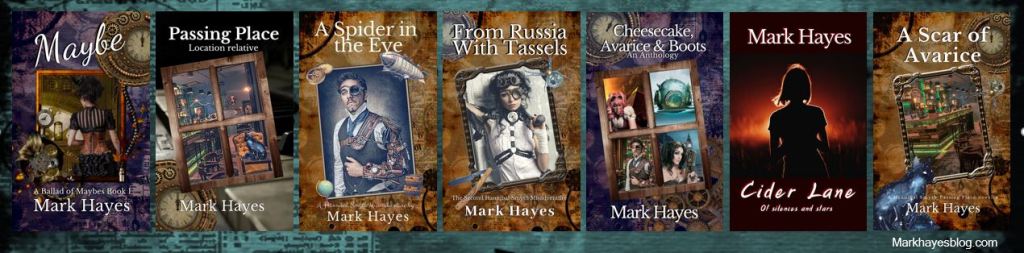
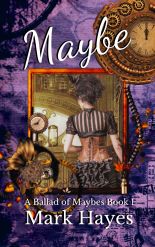
Amongst others, Black named MaeYaBee Tu-Pa-Ka from Mark Hayes’s most commendable novel “Maybe”, and also one Peter van Haelen. The original Peter van Haelen was the main character in Piet Visser’s 1901 “De Vliegende Hollander” (Flying Dutchman).

Piet was my (Nils) great-grand-uncle and I decided that gives me a vague right to mess about with his creations. Van Haelen was a daft inventor and innovator, so a Steampunked version was tempting. Further information about Steampunked van Haelen’s background is revealed in two short stories, ‘The Skirring Dutchman’ in Writerpunk Press’s “Taught by Time” Anthology (due out in 20/21), and ‘Learning the Ropes’ that appears in the HD Pirate Special (Hot off the press!). The stories are narrated from opposing perspectives but take place in the same setting, a few weeks apart. Van Haelen makes a personal appearance in both, at the helm of a ghostly airship…

With gratitude to my great-grand-uncle Piet Visser, and thanks of course to the fine folk at #HarveyDuckman for including “Learning the Ropes” in the Harvey Duckman Pirate special, now available online: https://www.amazon.co.uk/gp/product/B08FZV3HT2/

After my first reaction of ‘how awesome is that’, I had a few moments of trying to remember if Nils ever told me he intended to throw MaeYaBee Tu-Pa-Ka’s name into his story as one of the fathers of airships. Which was about the point I recalled a conversation between us, late at night, with a nip or two of rum inside me, in which Nils asked me if he could do so, because he enjoyed ‘Maybe’ so much. I’d said yes of course. Vanity alone would have impelled me to do so.

MaeYaBee, for those who have never read Maybe, is a Polynesian engineer who signed on to an expedition with notable explorer Edward West (notable not so much for his discoveries as his lack of them). MaeYaBee’s new ship mates struggled with the pronunciation of his name and over time they started to shorten it to the nearest Anglican equivalent word ergo ‘Maybe’.

While MaeYaBee signed on as just a box standard shipping hand, he shown a remarkable affinity for mechanics and engines and soon became the defacto engineer on the voyage. He and Edward West became firm friends, with a mutual respect built between them and when West returned to England he set MaeYaBee up with his own engineer shop in Cheapside, where MaeYaBee fell in love, married and sired a daughter, Eliza who he raised on his own after the death of his wife. The novel itself opens on the sad occasion of MaeYaBee’s funeral. With Eliza in morning, and looking for someone to blame for her fathers murder, just as Benjamin West ( son of Edward who disappeared fifteen years before) and his former manservant Mr Gothe arrive at the cemetery, things get complicated at that point…

MaeYaBee is a character in the background of the novel, as his funeral is the starting point. But his life and his life’s work are central to everything that happens to Eliza and Benjamin. He was a genius and his great passion throughout his years in London was airships of which he built many models and designs. In the Hannibal universe (Maybe is set some 150 years before the Hannibal stories) he is the defacto father of British Airpower, despite not being British himself. So he fits nicely into Nils Blacklisted airship engineers in his smugglepunk universe. Which was why, he says with the fog of rum impaired memory, he wanted to use the character as a reference, and why I was more than happy for him to do so.

Of course, then I had forgotten all this until Nils posted the above on Facebook, so it was a genuinely awesome surprise to stubble upon this some six months later when the esteemed Darran Callow read Nil’s story for the BSBC. (I went and listened of course, and was impressed by how calmly Darren managed to get his tongue around MaeYaBee Tu-Pa-Ka, which can’t have been easy when you come across a name like that in the text your reading, beside sit not like I know how it pronounced…) Coming across this post genuinely made my day, its lovely to find your creations have wondered off into someone else’s imagination.

I can also heartily recommend joining the BSBC (who really should start a you tube channel so I can link it.) As its a bloody marvelous idea, created as a response to COVid canceling all those wonderful steampunk festivals I normally fail to get to anyway. Full of readings, interviews, music and other steampunk delights.

Clicking on the banner below should take you to there Facebook group if your interested in joining them.

Posted in amreading, amwriting, books, fantasy, goodnews, goodreads, Hannibal Smyth, Harvey Duckman, indie, indie novels, indie writers, indiewriter, novels, pointless things of wonderfulness, reads, retro book reviews, sci-fi, steampunk, writes, writing | Tagged , , , , , , , , , , , , , , , | Leave a comment

The Dreams of the Witch House : TCL 62

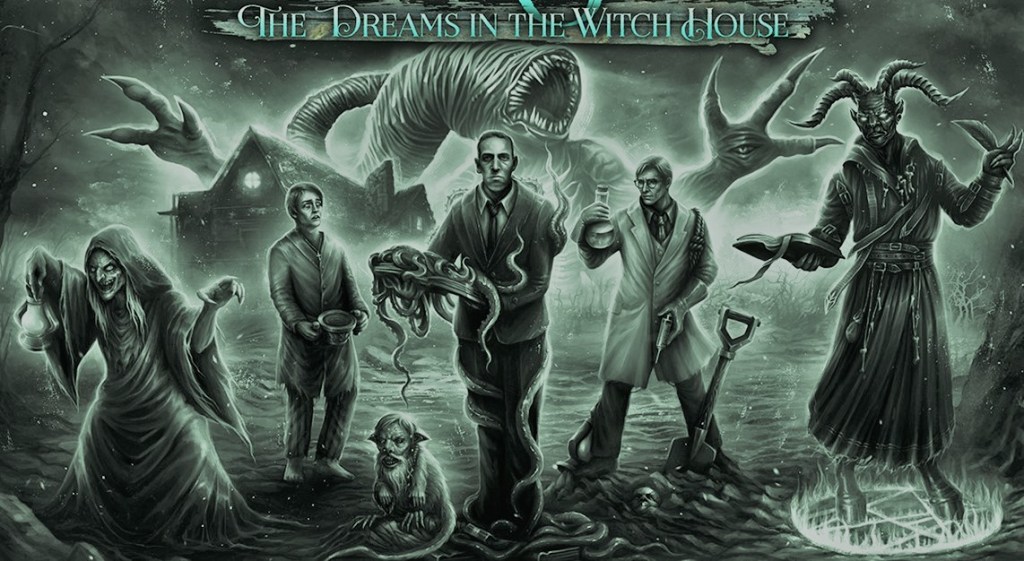
In terms of Lovecraft stories The Dreams of the Witch House is a little odd due to its mixing the cosmic horror that is Lovecraft’s staple with hints of Judo-Christian concept of the devil. It stands out as the only real example of Lovecraft doing this in any of his cosmic horror tales. Rooting aspects of this story in pseudo Judo-Christianity should work well, there is a logic to it, after all explaining things in terms of religion is what humanity has been doing for thousands of years, so seeing the devil in a manifestation of cosmic horror, or the roots of judo-christian myth laying in aspects of Lovecraft’s myths is not only logical but enticing as a concept. Doing so in a story that involves witch craft and witches, those traditional worshipers of the devil, is also logical. After all, who is to say if a witch is praying to the devil or some cosmic horror that takes on that aspect. there si so much that could be done with this idea… Unfortunately given the way it was done, there are also troubling questions raised by his doing so, but I’ll get to that in a moment.

The story itself centers are William Gilman a student of mathematics and, of all things, folklore at dear old Miskatonic University. Probably the only University in the world where such a odd pairing for a joint degree could be studied… As such Gilman takes an attic room in The Mason House in Arkham, a house that bears the local nickname, ‘The Witch House’ as one of its former residents was Kexith Mason, who was to be tried for witchcraft in 1692 when he mysteriously disappeared from a jail cell in Salem. His former residence developed a reputation as being haunted that persists to the present day in the way such rumors do. Rumors linked to the premature deaths of several residents over the last couple of centuries. Residents who all occupied the same attic room Gilman find himself living in. A room that he soon realizes is distinctly odd, with strange almost unearthly geometry.

It is then Gilman starts to dream, and such odd dreams they are…

In his dreams Gilman is witness to cities of elder things, strange impossible geometric shapes that communicate with him, and other oddities. He also encounters a witch called Keziah and her strange rat like familiar Brown Jenkins which while having a rodent body has a human face. But this is only the start, the dreams escalate as does the effect these dreams are having upon Gilman in the physical world. Among other things he goes deaf due to the inhuman sounds he hears in his dreams. Eventually Keziah takes him to meet ‘The Black Man’ a who makes him sign ‘The book of Azathoth’ whence he is taken to the throne of Asathoth and forced to kidnap a child for sacrifice in the dream…

And here is where the issues starts …

‘The Black Man’ is the allegory for the devil. The epitome of evil. He is also Nyarlathotep, the crawling chaos, the harbinger of Asathoth who will usher in the age of chaos and destroy human civilization. Now, in aspect, that is all well and good, but specifically throughout this story the coven hoofed devil is called ‘The Black Man’ and ‘The Black Man’ is therefore the harbinger of chaos and destruction in the form of Azathoth. Remember this was written by H P Lovecraft in 1932, the era of Jim Crow laws, Nazism coming to power in Europe, and Lovecraft’s racist views, opinions and rhetoric are well documented. The subtext whether intentionally or otherwise is obvious.

…a tall, lean man of dead black colouration but without the slightest sign of negroid features: wholly devoid of either hair or beard, and wearing as his only garment a shapeless robe of some heavy black fabric.

In fairness, Lovecraft’s description of ‘The Black Man’ states he does not have negroid features. It could be argued that this distances the character from any obvious allegory of Lovecraft’s views on what he calls elsewhere in his letters and writings ‘The negro Problem’. But that’s a thin defense when Lovecraft’s views are well established and the portrayal of ‘The Black Man’ as the Judo-Christian Satan was problematic at best even in 1932. Its difficult to read the story and put that on one side. It is in fact possibly the most obnoxious bit of racism in all of Lovecraft’s writing. In previous stories the case, no matter how loosely, could be made that racist opinions and views expressed were the views of the narrators of those stories. Here however it is clearly a view expressed by the writer himself, as here it is the subtext which is expressing the abhorrent views. Perhaps all the worse for the literary slight of hand in that description above.

The ‘Black man’ controversy and the desire of those who have drawn upon this story to distance that controversy from the story as a whole is mostly the reason why the picture above shows a devil figure bedecked with horns. It’s also why when the Lovecraft historical Society commissioned a Rock opera of the dreams of the witch house ‘The Black Man’ was somewhat overtly replaced with Satan in the story.

That album is rather good all considered, if you like operatic rock music with a entwined story. Its not up there with Jeff Wayne’s War of the Worlds, or likely to inspire me, in part at least, to write a novel as Jeff’s album did, but what is? If you like the genre there are worse ways to enjoy the story… Such as reading Lovecraft’s original.

The complete playlist for the Lovecraft Historical Society Rock Opera ‘dreams of the Witch House’, if you like that kind of thing (I do but I am aware I may be in a minority )

Putting the controversy of ‘the Black man’ to one side, (and frankly everything about this story could have been better, or at least less horrifying for the wrong reasons, if he was described and refereed to differently throughout,) the story is a reasonable read. There is a certain obviousness about the ending, and some of the imagery early on in the dreamscape sequences is tedious, but that may be just me, I have never fully got along with Lovecraft dreamland’s fiction. Certainly there are aspects of horror that are visceral images that are horrifying in the sense you want. Brown Jenkins the man faced rat eating his way out of Gilman, for example, is particularly nasty bit of imagery in the good way. But the final ending has a predictability about it, there were other ways he could have gone with it which would have been far more interesting. But that last is perhaps a niggle of my own . Its a solid enough ending but its a solid ending to a fairly weak story.

Of all Lovecraft’s later works this is one of, if not the, weakest. Perhaps it better than I give it credit for, but I find it hard to get past the whole ‘The Black Man’ problem, particularity in light of the world as it is today and all that is going on. But even in better times I doubt I would find it easy to stomach the racist subtext. Because of that but mostly because its just not the best of stories it gets a lowly two tentacles. Read it if you feel you must, but if you want my advice, stick on the rock opera, crank the speakers up to eleven and enjoy the story in a much better way…

Further Lovecraftian witterings as ever can be found here

Posted in Uncategorized | 1 Comment

The Shadow over Innsmouth / TCL #61

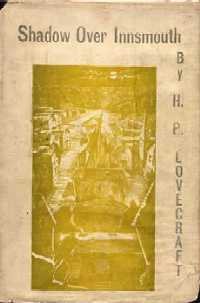
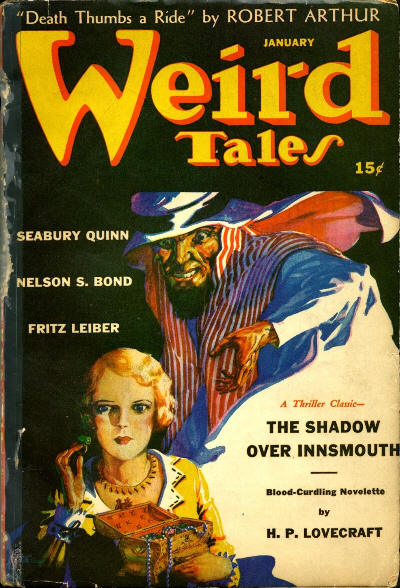
While many of Lovecraft’s stories were published in periodical magazines like Weird Tales in his lifetime, only one was ever published as a book, even then the whole print run was only 200 copies each priced at a dollar. It carried many typos and print errors, so many in fact that Lovecraft insisted a corrections sheet be included after the fact. Lovecraft himself was not even particularly taken with the tale in question and originally had no plans to offer it for publication at all. It was too long for most magazines, hard to split in to more reasonably sized parts as was done with ‘Call of Cthulhu‘ and ‘At The Mountains of Madness‘. When it was published in hardback Lovecraft complained about the poor quality of the typesetting and was generally disappointed by the whole enterprise. The publication was a failure and contributed to the collapse of the small publishing house. None of which did much to lighten Lovecraft’s own view of the story.

These days of course, a good quality 1st edition copy of this book, which in case you missed the obvious was, ‘The Shadow Over Innsmouth’ will cost you anything up to $7000 now as copies are highly sought after by Lovecraft collectors.

Despite Lovecraft’s own lack of faith and general dissatisfaction with Innsmouth it is widely considered to be one of his seminal works. It also has within it some of the best action sequences of any of Lovecraft’s stories, which make it more accessible than many of his stories. there is actual pace to that action, which helps drag the reader along, something many of Old tentacle Huggers tales often lack. All the while it keeps the level of steadily building tension and slowly impending dread that you expect from Lovecraft.

The story begins simply enough, with Lovecraft’s favorite trope of a narrator retelling his tale after the fact. Robert Olmstead (the narrator) never actually names himself, his name is only known from Lovecraft’s notes on the story which were publish after his death. Olmstead is doing a tour of New England doing government genealogical research when he arrives in the small dilapidated fishing village of Innmouth which by coincidence was the birth place of one of his ancestors. He realizes fairly soon that there is something odd about the place, and more interestingly in terms of genealogy the people.

They walk with a distinctive shambling gait and have queer narrow heads with flat noses and bulgy, stary eyes.

As a government researcher Olmstead is not exactly made welcome by the insular inhabitants. But he starts to gather information all the same, and so the strange history of the town, its links to a strange religious cult  ‘The Esoteric Order of Dagon’. A cult which he is told by a clerk called Zadok practiced human sacrifices and worshiped the ‘deep ones’. As well as the local population interbreeding with the deep Ones themselves. Olmstead is understandably a tad unnerved by all this, but finds it hard to credence the fantastical tale he is told.

Side note. Dear old Dagon, it’s oddly comforting to read that name, from way back in January 2017 when I started this little challenge, the first six tentacle story and only the forth of these blog posts. On how happily naive I was back then… but I digress.

Olmstead might have brushed all this off if he had not then been marooned in the town when the bus he planned to leave on develops engine problems and he is forced to stay the night. Going back to the clerk to talk more he discovers the man has vanished, the same man who had urged him to leave town. then some time in the night, as he sleeps in a crappy hotel room, he wakes to find someone trying to break in to his room , and the action starts as unnerved he makes a break for it into the night through the hotel window.

What happens next is uncharacteristically for Lovecraft all a bit pulp action adventure as Olmstead tries to elude the strange inhabitants of Innsmouth, and an influx of deep-ones (best described as fish-men, or perhaps merlocks…) who have come for there tribute and congress.

All of which makes for a cracking read, for all Lovecraft’s dismissal of the story. It then spirals towards a conclusion, before the epilogue which goes back to Lovecraft’s more tried and tested style. As an older Olmstead becomes aware he is undergoing a transformation of s his own and his ancestral Innsmouth blood is calling him to the sea…

The Shadow Over Innsmouth is one of Lovecraft most loved tales, its also one of his most accessible, it has few of his faults (which as we know are many) and ironically the very things about the story Lovecraft felt were weaknesses by are probably its strengths. It had a little action and adventure about it as well as Lovecraft’s brooding dark horror and steady building of tension. It, along with At the Mountains of Madness, and Call of Cthulhu form a somewhat unholy trinity in some respects as the stories most recognizable by non-Lovecraft fans, they may know little about Lovecraft but these three they have heard of. It has also, like the other two, has inspired artwork, pc-games and board-games as well as countless other writers.

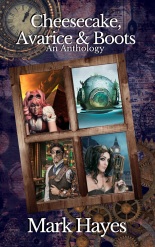
Including a little known science-fiction writer from the north east of England who wrote a story inspired by this particular bit of Lovecraft’s mythos called ‘The salmon swim both ways’ that was first published in the Harvey Duckman Anthologies V5, and later as part of my own anthology Cheesecake, Avarice & Boots.

Of the trinity its my least favorite, mountains and Cthulhu have something a little extra about them that this story falls just short of, I was tempted to give it only five tentacles because of this, but that was mostly because it came straight after mountains, so I thought i should give it five and a half, but then, possibly because of its deep one connections the half tentacle grew back…

Further Lovecraftian witterings as ever can be found here

 Welcome to the Lexinomicon, a bluffers guide to the writings of H P Lovecraft.
Posted in 2020 quotes, amreading, book reviews, books, cthulhu, fantasy, fiction, goodreads, horror, Lovecraft, mythos, Nyarlathotep, pagan, reads, retro book reviews, rites, sci-fi | Tagged , , , , , , , , , | Leave a comment