Reviews for Passing Place

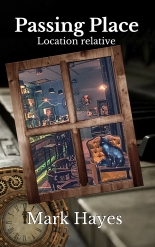
While I seldom post reviews of my own work on my blog, it is occasionally a worthwhile exercise, and as people have been nice enough to write I really should. As such here are the a few of the current Amazon reviews for Passing Place. Or as it may also be called, look these people enjoyed my novel, so would you, so give it a try…

facein the dark 2

5.0 out of 5 stars A journey to nowhere and everywhere. Loved it…

By F. de Vocht on 26 Sept. 2016
Format: Paperback Verified Purchase
This book is an (unexpected) gem as far as I am concerned. I read the writer’s first book as well, which was also an enjoyable read, but this one fitted a lot better with the genre I normally read. It’s a very interesting mixture of fantasy, horror, a doorman with a past, a club with a forest attached, an engaging personal journey…all mixed with a bit of suspense.
…oh, and there is a cat. An odd one…
In summary, it combines many different things with a story that goes nowhere and everywhere, and I will be waiting impatiently for the sequel….

tree2

Format: Paperback
This is Mr Hayes second novel…
There’s more than a touch of the Neil Gaiman, who gets a nod when one of his characters makes a cameo appearance.
The concept is rather nice… I don’t want to give too much away, but a strange bar requiring a piano player meets a man on the edge of desperation… With sundry encounters and many tales (and indeed tails) along the way.
A favourite character of mine is the doorman, and his back story is very interesting indeed.
I enjoyed this book and look forward to the next.
4.0 out of 5 stars A nice touch of the mysterious
By Pitbadger on 12 Sept. 2016

girl in the coridor 2

5.0 out of 5 starsA book not to pass on

By Robert Treadwell on 21 Feb. 2017
Format: Paperback
The passing place is Mark Hayes second published book but the writing and the depth of book would no hint at this.
The story slowly tells the tell of a man looking for himself and comes across the place that we all need at some point in our lives – a place where we can pull up a chair and tell our life stories around a fire and bounce off each other. The author draws you into the stories and you can’t put the book down as you want to discover the next twist and turn, who will appear next and what is their story and how did they come to be passing through.
The author is able to change pace as well as type be it horror or sci fi or fantasy and still keep you drawn into the web of the story.

Highly recommend that you dip your toe into the paddling pool of works of this author – and before you know it you are up to your neck and swimming in a rich sea of worlds that touch ours.
cellar 2

Amazon.com: 5.0 out of 5 stars
1 of 1 people found the following review helpful
5.0 out of 5 stars Mr. Hayes reached deep in his soul to produce … 27 Sept. 2016
By Katie S – Published on Amazon.com
Format: Kindle Edition
Mr. Hayes reached deep in his soul to produce this read and a philosopher emerged, spinning a tale that takes us alongside the main character, Richard, whose grief presents reality in a questionable light. This is not my usual genre (slightly dark fantasy), but I have to say I was blown away by the in-depth look into the human psyche. A highly enjoyable 5 star read.

eye2

Links to my own social media, by all means, connect with me on them.

FACEBOOK    TWITTER   GOODREADS

Posted in opinion, Passing Place, pointless things of wonderfulness, publication, self-publishing, writes, writing | Tagged , , | 1 Comment

The choice illusion

It’s an old trick, a good one, one with many variations, many names, but its all the same trick. A trick that hangs on the same guiding principle, creating the illusion of choice. the illusionist can pull this off with one person, a small group, in a club, a theatre, on TV, hell with an audience of the whole world. Ask the right questions and you can guide the outcomes. Let me run you through it. Suspend your disbelief for a moment, because I have just told you everything you really need to know about the trick and how it works, so forget this first paragraph and let me write something down on this piece of paper while you open that brand new deck of cards for me, Marko the Marvelous magician extraordinaire…

a-hand-of-cards

Marko…   draws something on rd on a piece of paper, folds it in half and sticks it in his hatband where everyone can see it “open the pack and split the cards into red and black, just throw out the joker’s for now, we won’t need them.”

Audience… splits the desk by colour and hands the jokers to Marko who throws them away. Then places the cards as instructed in two piles.

Marko… “Okay then, pick a pile, and remember to watch the cards…”

Audience…  points at one

Marko…  turns other the half the audience picked “the blacks, okay then that just leave us with red cards,, hearts and diamonds,, divide them up by suit.” then he throws the black cards behind himself.

Audiance… divides up the deck once more 

Marko… “Okay then, pick for me, hearts or diamonds?…”

Audiance…. “Hearts”

Marko… “Okay, that just leaves us with diamonds then…”  he pick up the heart and throws them the way of the black cards, “Now Let’s get rid of the picture cards as well while were at it as we can’t really divide them..” he picks up the diamonds and sorts of the jack, queen and king and throws them away too “Now lets see, how can we do this, I know split them into odds and evens.” hands the deck back to the audience member. 

Audiance…  split the cards into two piles once more.  

Marko …  palms both piles and moves them about a bit, dropping them and picking them up, Nothing fancy then puts his finger on one pile and says “What do you think odds or evens?”

Audience…  thinks for a moment, knowing there is a trick going on and trying to second guess it, then says “Odds”

Marko…  turns over the pile, its evens, he shrugs ” Oh well not to worry,” he says as he throws them behind himself and the asks the audience to pile the pile into highs and lows. Then does the same dancing little shuffle of the two decks and puts a finger down on one pack “So what do you think this time highs or low?”

Audience… thinks some more, mildly disappointed they got it wrong the last time. Then says “Low”

Marko… turns over the two card pile, and brightly says ” Your right.” smiling. 

Audience.. smiles back, they got the choice right. a little “Yay” even gets exclaimed.

Marko… throws away the high cards and “So just the five and the three left…” folds each slightly and dances them over the table then ” This time you pick, put your finger on a card.” The audience does just that and Marko says... ” So which do you think it is the five or the three?”

Audience … thinks for a moment then says “Five…”

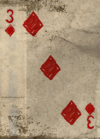
Marko… pick up the other card and looks at it, Smiles and says “Your right it is, which leaves us with this one, the three of diamonds”  he turns over the card, as the Audiance member smiles having made the right choice…       

Then Marko takes the piece of paper out of his hatband reveals…

FNV_3_of_Diamonds_-_Gomorrah

So did you spot it, did you see the trick, the slight of hand, the slip and slide. If you didn’t then you should read it again because the trick is right there for you to see. It’s less impressive written down than with a real magician doing it. Easier to see passed the smiling face, fast hands and quick words, but it’s a trick that has been around for centuries, and fools people every day. Variations of it are everywhere. Sometimes the piece of paper with the cards name is in the hatband, sometimes it’s painted on the underside of an aeroplane that will fly over at just the right moment. Or perhaps written in icing on a child’s birthday cake. It doesn’t matter, the trick always ends the same way.

The trick is not the card, or the piece of paper, or the magician’s smile. It’s simply this, make the audience think they are making choices, that their actions influence the cards discarded, and that their decisions lead to the three of diamonds. That the magic lay in Marko the Marvellous knowing somehow which card they would choose ahead of time by some secret art taught to him by the learned.

Rather than Marko never letting them make a choice, indeed, making every choice for them, steering them down a path he knows they will follow, because its not the cards we should have been watching, but the choices we were bene given.

Magicians have done this down the ages, but they are amateurs when it comes to this trick. The real trick being described above, the one pulled off all the time, everyday in fact, is called politics. And politicians are so much better at convincing people they are making decisions and making a choice that has some influence on the outcome than magicians ever are. We all know magicians are frauds even though we go along with the trick most of the time. Yet somehow we keep convincing ourselves the same is not true of others who offer us the pretence of a choice while they stack the game for the outcome they design.

And that, in all honesty, is my opinion of the Brexit referendum and the American election come to that…


Posted in humour, pointless things of wonderfulness, politics, rights | Tagged , | Leave a comment

The rules of good writing…

There are a great many rules when it comes to good writing. Many a word count has been written explaining them in infinitesimal detail. Generally, however, the best way to explain the rules is with a little humour. Humour being generally the best way to make a serious point or two at any time. So here is the list of do’s and don’t that should be pinned to the wall above of every writer’s desk some days…

  • 1. Avoid Alliteration. Always.
  • 2. Prepositions are not words to end sentences with.
  • 3. Avoid cliches like the plague. They’re old hat.
  • 4. Comparisons are as bad as cliches.
  • 5. Be more or less specific.
  • 6. Writers should never generalise.
  • Seven. Be consistent.
  • 8. Don’t be redundant; don’t use more words than necessary; it’s highly superfluous
  • 9. Who needs rhetorical questions?
  • 10. Exaggeration is a million times worse than understatement
  • 11. Avoid carefully, prudently and judiciously the overuse of adverbs
  • 12. Avoid writing lists

ce6013a056c97b483315e114d8cc59d4

Posted in humour, writes, writing | Tagged | Leave a comment

The Impossible Search for the Perfect Sentance…

Occasionally writing becomes the search for the perfect sentence, this can sometimes become an obsession, and like all obsessions, it has a dark side. That may seem a strange thing to say, but you’ll have to go with me here to understand what I am getting at. Just as my 1000 a day habit cured me of apathy, and a degree of procrastination, the change of approach and the discipline it required also highlighted to me another issue I had with writing, the constant unerring drive to edit.

Now don’t get me wrong, editing is a vital part of the process, show me any writer who claims they don’t need to edit and I will show you a liar. We all do it, to one degree or another, and more than one of us is obsessive about it. Terry Pratchett, the father of Discworld, was known for ‘fiddling’ with his text right up to the point of no return when his publishers sent a novel to print. When asked in an interview why he did this he replied, “It’s hard to let your children go out into the world.” he is not the only one, it’s a sentiment repeated by many authors.

Editing can be incredibly creative in its own right. Another Terry story, this one told by Niel Gaiman, occurred when they were writing ‘Good Omens’ together. Niel wrote a passage and sent it to Terry, and the next day received it back with a note from Terry saying he had added six words to the passage and made it 33% funnier…  A little sub-story telling the readers a little about a passing characters life, and how he used to lay on the grass with his then-girlfriend and spooned in the sunlight beside the canal. To which Terry had added the words ‘and on one memorable occasion, forked.‘ Which is about as perfect a sentence as is imaginable in the context of the tale been told.

As Stephen King has wittily said…

1724393-Stephen-King-Quote-To-write-is-human-to-edit-is-divine

Therein lay my problem back in the days before I made a conscious effort to change my approach to writing and embark upon my 1000 a day habit. Quite apart from my procrastinations, and general willingness to be distracted, I was obsessed with the search for the perfect sentence, and in that quest, I would find myself mired in an ‘edit as you go’ mentality. To give you an example, I actually rewrote the first three chapters of ‘Passing Place‘ about thirty times over the course of two years, while (and this is the important point) not making any headway with chapter four. It is a problem which I share with other writers. The desire to make every word sing, to make every sentence a perfect sentence, before moving on to the next, only to open up the document the day after and find it is all so much drivel to your jaded eyes and start over once more.

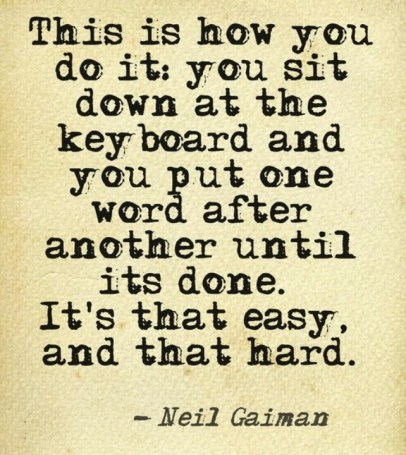
I had a conversation with another writer on Facebook the other day, which was sparked by a message about a previous post, but mainly by the quote from Neil Gaiman below…

96a9a6586bfe8ef8696d4db726703886

The argument put forward by the other writer was, in essence, “Yer, but then you spend hours editing it and get nowhere.”  Which was a reasonable enough observation, but when we spoke about it a little further the crux of his problem came to light. He, much like I used to be so often, was stuck in a first draft. Ever reworking a few thousand words in search of a perfection that was at best a pipe dream, if not utterly unattainable.

Let us take a moment and consider why perfection is unattainable in a first draft, there are a couple of reasons that spring to mind.

  • Until they have a complete first draft then most writers, myself included, have only the faintest of ideas what is actually going to happen. Yes, folks, we make it up as we go along, by definition in fact.
  • No writer is ever satisfied by what they have written. Okay, that might not be entirely true of everyone, but certainly, the vast majority of us are seeking perfection, and the only person who can judge if it is perfect is the harshest critic we have, ourselves.

My advice to this writer, based on my own experience, was to write rather than edit. That is, rather than seek the perfect sentence just write, and keep writing. If you go back to the previous day’s work, something I always do, just read through the last couple of paragraphs or so, tinker if you must for ten minutes. Get it out of your system. Then push on with the writing. Write it through, and get that elusive first draft finished.

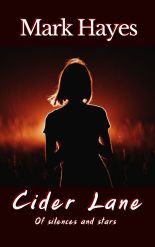
This is what I did with ‘Cider Lane’. It’s how making myself write 1000 words a day became a novel, because at some point I found my flow and a story I needed to tell, so I told it to the audience I had to please first above any other, myself.  In all, I was writing a lot more than 1000 words a day when I was in full flow. The first draft that came in at 65000 words I wrote in a little under a month, and sure then the editing began, and the search for those perfect sentence. But it is a hell of a lot easier to find those perfect sentence when you at least know where they are leading to. By the time you have finished your first draft you know your characters, you know how they think, how they react, and where their story is going. Which matters, because, the perfect sentence is a sentence in context. When your characters speak, the words need to be spoken as they would speak them. In the same way, your narrator’s point of view will infect the way a sentence is written, and a perfect sentence is only perfect if it conveys what you really want it to.

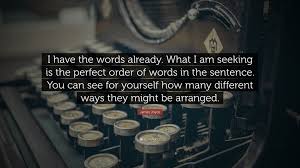
download (2)

James Joyce was a man who sought perfection with words in the first attempt, he was its fair to say better at it than most. He famously would consider it a good day’s work if he got a whole sentence down, provided it was the right sentence.  I am not James Joyce, however, and I know I will edit myself into extinction if I let myself do so. Better I find to leave editing to the second draft.  My way is not necessarily the best approach for all. It just works for me, but I will champion it all the same, to anyone lost in the quagmire of first draft editing and the endless search for that elusive perfect sentence.

So if you find yourself in editing hell while working your way through draft 1, stop editing, just write and keep right on writing…

Of course, once you start writing draft 2 its basically all editing and all bets are off. That’s the time to seek the perfect sentence…

adios for now

Mark

Links to my own social media, by all means, connect with me on them.

FACEBOOK    TWITTER   GOODREADS

Other posts on writing and self-publishing are collected here:

https://markhayesblog.com/publishing-and-writing/

Posted in publication, self-publishing, writes, writing | Tagged , | Leave a comment

1000 A Day Habit…

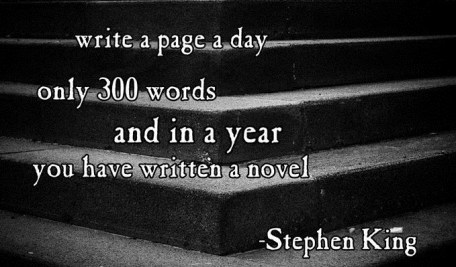
To be a writer, you have to write… this was a conclusion I came to a few years ago, which still holds true. To borrow some advice from one more qualified to talk about successful writing than I…

download (1)

This then is the crux of the matter. You can say you want to be a writer, dream of being a writer, you can even have the word ‘Writer‘ written in your passport, but unless you actually do some writing…

The problem, as often as not, is there are some many other things to do rather than write, which is a somewhat solitary activity you undertake in your writing cave. There are movies to watch, series to absorb on Netflix, books to read (because if you don’t read a lot you will never be a writer), a social life to have, work of the paying kind to do, social media, video games, sports team to watch, walking in the sunshine, life in general. There is a lot to do and only so many hours in the day. How then do you find time to write?How indeed… Well you make time is the simple answer, you apportion a part of your day to writing.

Put aside the Xbox controller, the TV remote, turn off Facebook, twitter, and those hilarious YouTube videos of cats. Set a time to write and do it, whether it’s a couple of hours on an evening or you get up two hours earlier on a morning or use your lunch hour at work. When is not really important, it’s doing it that matters. It doesn’t even matter how much you write in your cave time, not really, though I have found it wise to set some form of target for myself. To borrow from Mr. King once more…

7495ff62a881c3cbb988006969899369

Which is, as ever, wise advice from Mr King… though what you actually have is a first draft and an appointment with the editing demons. But it is a point well made.

I set myself a target a few years ago of writing 1000 words a day. This was way back before my first novel ‘Cider Lane‘ when I was still struggling with what would eventually become my second ‘Passing Place‘. I say struggling, it would be more accurate to say avoiding. I would write when the mood took me, if no other distraction was on offer, all the while following every other bit of advice I had ever read about becoming a writer. I kept notebooks on me all the time, another at the side of my bed. I would analyse every movie I watched to figure out what the script-writer was doing behind the actors. I would note down anything that seems like a good line, or an interesting turn of phrase, or an idea that crossed my consciousness. I read everything I could, as vociferously as I ever had. All of which are good habits to have as a budding writer, but what I didn’t do, importantly, was actually write. Pen did not touch paper, keyboard did not rattle with keystrokes. Every now and again I would have a couple of hours of trying to put a few words down, but that gets you nowhere if it’s just every now and again.

So I decided to set myself a target, a 1000 words a day, every day, rain or shine. Turn off the TV, shut down Facebook, shut out the world, write, and… It worked…

Not straight away, it took time to force myself into a routine. Time to find that space in the day to write, and time to find my stride. But I wrote, one word after another, and kept doing so. I wrote short silly tales, erotic scenes, long marauding jokes, worked on ‘Passing Place‘ which was still very much in its infancy, blog posts on my old blog. Anything really. I just wrote. My hard drive if full of snippets here and there of those 1000 a day snippets. Stories that start nowhere, go nowhere and say nothing much, but one day I might stumble over and make something of. Several chapters in ‘Passing Place‘ started out that way once I finally got into the novel properly a couple of years later. The important thing at the time was not what I wrote, but that I wrote. A 1000 words a day, every day, which usually became more, but it was never less, even if what I was writing was utter tosh because usually after a while it became good. Like an athlete training his body to compete, a writer needs to train his mind to write. So I kept at it, sometimes just scraping past the thousand, sometimes rushing past and writing twice as much or more. And finally somewhere along the way I started ‘Cider Lane‘ though I did not know that’s what I was doing at the time.

When I finished the first draft of the novel I did not realise I was starting I took some time out deciding I had earned a break from all that hard labour. Yet within a few days, I was missing that thousand a day habit. It is, after all, an addiction of sorts. Not ready to edit I started back on the randomness for a while. Somewhere along the way, Kram Seyah dipped his toes in the water for a while. When I finally published ‘Cider Lane’ a year later I did take a break for a few months. Too long in fact, as getting back into the habit was hard work and took several months or forced labour but once I did ‘Passing Place’ began to take shape.

And now… which is the reason behind this post, I find myself back out of the habit, nine months after publishing ‘Passing Place’ and I have written very little. I have plenty to work with, ‘A Spider in the Eye’ sits waiting to be written, as does ‘Maybes daughter‘ (both at around 50k words and waiting for the real work to begin.) I have a couple of chapters ‘Something Red‘ the sequel to ‘Passing Place‘ kicking about on the hard drive. But what I don’t have is the old habit of a thousand a day. So it’s time to make time once more and get back in the habit. And to any budding writers out, my advice is if you want to be a writer then do the same.

To leave you with another quote, this one from Neil Gaiman which I think is apt for this subject…

96a9a6586bfe8ef8696d4db726703886

Which is exactly correct in every sense…

(coincidently this post is 1137 words long, that’s my thousand a day for today at least, which is a start…)

adios for now

Mark


Links to my own social media, by all means, connect with me on them.

FACEBOOK    TWITTER   GOODREADS

Other posts on writing and self-publishing are collected here:

https://markhayesblog.com/publishing-and-writing/

Posted in nanowrimo, opinion, writes | Tagged , | Leave a comment

Self-Publishing: A Guidebook for the Tourist#6 Proofreading

It may seem obvious, but in case it’s not, or even if it is…

1/ Proofreading your novel.

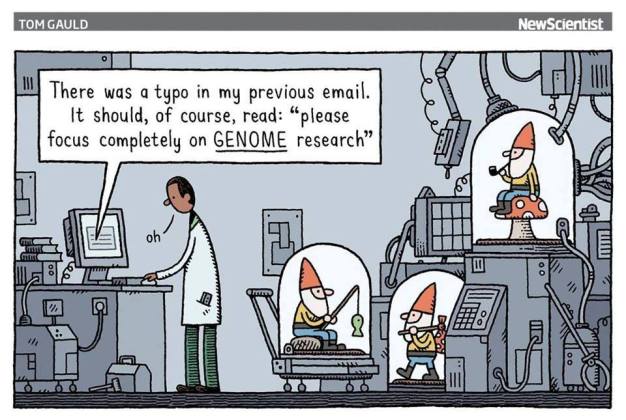
There is nothing, and I do mean nothing, as important as having a good proofreader or three. No matter how many times you try to proofread your own work, you will miss things. Lots of things. Believe me, I know this to my cost. It does not help that I am dyslexic, but that is not an excuse or even the main reason I miss the odd typo or three. Being word blind, which is another way to describe dyslexia, I am just a little more likely to miss typos than most. Every writer is too close to their own work and can fall into the trap of thinking their manuscript is perfect. From silly little errors to frankly annoying big ones. Never publish until your manuscript has been proofread several times.

For example, I have read more than one indie novel where a character’s name is spelt differently in chapter six than it was in chapter one. The first published version of my first novel Cider Lane managed to use the word ‘cloths‘ for ‘clothes‘ among several other oddities that crept past me. I had it fully proofread and re-edited several months after the original release when my readers had become my proofers. Your readers should never feel the need to email you and point out a bunch of typos, and they will believe me.

30629780_10155454210548581_7221520692523565056_n

2/ Grammarly

One of the best investments any writer can make. Yes, I know ‘Word’ and every other word processor has their own spell checker built in. Yes, I know that modern word processing software also has grammar checkers and other editing tools. And yes, I know there are writers software suites out there like ‘Scrivener’ that has lots of bells and whistles to do the same sort of thing that ‘Grammarly‘ does, as well as all the other toys it gives you to work with. But none of them is a simple straightforward and as easily customisable as ‘Grammarly’. Whether you run it live as you write, or turn it on afterwards to proof a document it will catch far more than just typos, and bad grammatical errors. It is a great first step before you hand the manuscript over to a proofreader. I really can not recommend it enough, and as I am dyslexic, as I may have mentioned, I really make the software work for its supper…

3/ Proofreading other stuff

No one is going to read a novel written by someone who’s promotional work has typos and grammatical errors in it. The same is true for a writers blog posts (the irony here is implied), Facebook posts, even tweets. They just won’t, it’s as simple as that. No matter how good your novel, no matter how much work you have put into it, no matter how carefully you have proofed it, no matter how shiny the cover, or how many good reviews you get. If your ‘come buy me’ click bait teaser has a typo, people will spot it, and deride you for it, and will not be interested in your novel at all. Because no one wants to read a badly edited, unproofed novel, and that’s the expectation you have created. See the lovely little twitter teaser ad below.

faces in the dark

Did you spot it? I drew your attention to it having a typo so you probably should have done, but even if you haven’t, believe me, plenty did. ‘Hers‘ does not, never has and never should, have an apostrophe in it. It is elementary grammar, yet it slipped past me entirely when I made the picture because the text was taken from an early draft. In the final draft, it reads ‘And every face was Carrie’s‘ which does have an apostrophe. But I built the teaser and several others while I was waiting for the proofreader to get back to me on the final draft. Then forgot about it until I used it a few months later without thinking. The several people who took delight in pointing it out at the time on Facebook were lost to me as potential readers before I even started… And even the new polished version of the same teaser below will not hook them back, once they are gone they are gone for good because your mistakes will stick in their minds…

facein the dark 2

4/ Proofreading everything…

Do you sense a theme yet?

You’re a writer, writers have to write right, or writers have to write correctly if you prefer grammatical exactitude over alliteration. This is a thread that will follow you throughout your professional life as a writer, and even if you have a full-time job, and writing is a hobby, you should want, and definitely need, to treat it as a profession. You need to make sure everything you write is written well, grammatical errors are avoided, typos stamped upon and avoided like the plague that they are. Because every facebook post you put out there as Joey McBloggs the Author of ‘Down on the Farm’ needs to be correct. If a potential reader keeps seeing posts from you on faceache that are full of typos, or just grammatical nonsense, then they are not going to take a chance on your novel. They may point out your errors, but that’s about as far as it goes to being interested in your writing, no matter how interesting what you have to say happens to be.  I know this only too well because when I am tired, or just posting off a flippant facebook message, I am more likely to miss something due to my dyslexia than most people.

I combat this with Grammarly, which runs in the background on everything and every bit of hardware and software I use bar my phone. But it doesn’t really matter how you combat the typo grammar demons, just as long as you do. Find a way or a piece of software that works for you. Just avoid the pitfalls of not reading what you have written till after you hit send, it is far too easily done no matter who you are.

5/ Speed is not everything (or reasons to proofread)

Don’t rush to publish, no matter how tempting it is to just get your work out there. It pays to wait, it pays to get it right. What’s more important publish your book a few days after you type ‘The End‘ or publishing it the right way, six months and several proofreaders later? It’s the latter, trust me on this if nothing else.

It is tempting, oh so tempting, to publish it as soon as you think it’s ready. But do you really want to pull it off the market three months later and reproof it because you have been told about every grammatical error and typo people have found?

I, blatantly, made this mistake when I published my first novel. There were reasons I did so, personal reasons that while I will touch on them, I am not going to go into any depth on here and now. Suffice to say I was in a bad place at the time, bordering on depression, at the wrong end of a broken relationship, and out of work for the first and only time in my adult life. Having written my first novel, getting it ‘out there’ seemed like the way to lift myself out of the hole I could feel myself sliding into. It was the happiest thing in my life at the time in all fairness, so I rushed into it. While I do not regret doing so, I wish I had held off and had it proofread properly. When I did, several months later, I released it again, a much more polished novel. But I have no idea how many people read an excerpt on Amazon before I did so, and found a novel fully of typos and walks away, but I know people did because more than one has told me so in the years since. I have got a few of these lost readers back, through hard work, but I doubt I have got them all back or ever will…

6/ Finding good proofreaders

My advice is to find a friend or two who is honest enough to tell when you have written garbage. Fastidious enough to take their sweet time going through your work, and will do so with a smile. I have a couple of good friends who proofread for me these days, (after I run manuscripts through Grammarly).  But friends who can proofread to a good standard are hard to find, and ones willing to do it for you are harder still. There are other options. However, the internet is full of people offering to proofread for you ‘for a small fee’. But bear this in mind…

If someone is offering to proofread for $5 per 10,000 words, you’re not going to get their best work. At most, they will skim through, or run it through software of some form. Even $5 per 1000 words is cheap to the point of being given away. Buyer beware is all I am saying.

If you’re going to get your work proofed professionally by a pay service expect a minimum of $10 per 1000 words or to pay on an hourly rate that will work out close to the same. Even then it is cheap, and you want someone who will do the best job possible for your work.  The best advice is to talk to the community and ask for people to recommend a proofreading service. (Yes, I know it always seems to come back to engaging with the community, but other authors really are the best resource available to you.)

I don’t use a professional service because I have very professional friends, who are also fellow writers doing it for me. For which I am ever thankful…


adios for now

Mark


Links to my own social media, by all means, connect with me on them.

FACEBOOK    TWITTER   GOODREADS

Other posts on writing and self-publishing are collected here:

https://markhayesblog.com/publishing-and-writing/


Posted in dyslexia, publication, self-publishing, writes, writing | Tagged , , , , , , , | 1 Comment

The Cats of Ulthar: The complete Lovecraft#17

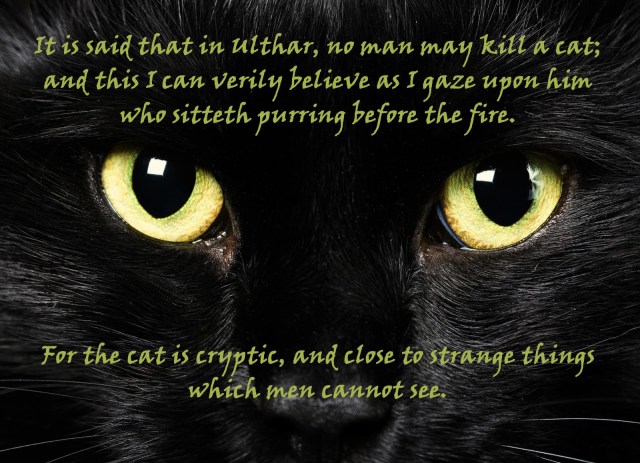
Cats walk between worlds, the real and the mystical, the mortal and the spiritual, the land of the living and the land of the dead… Least ways this is a recurring theme through fiction and the mythologies of the ancient world.  Bast, the Egyptian cat goddess may be the most well-known, but she is far from alone. Humanity has always had an odd cultural relationship with the feline. Unlike their canine equivalents, cats are more house guests than pets. No one ever trained a cat to hunt along side them, or to guard their homes, and the chances of the cat fetching your newspaper is minimal. Lovecraft was a lover of cats, and of all his stories, ‘The Cats of Ulthar’ was among his favourites.

rCPEDdp

If ‘The Doom that came to Sarnath’ is Lovecraft doing myth, ‘the Cats of Ulthar’ is Lovecraft doing folk-law. Not ‘folk-law’ of the fairy-tale variety, but more of the darker roots that lay behind even the most sanitised modern versions of fairy tales, closer to the original brothers Grimm tales they collected from the backwoods of Germany in the .early 1800’s. The original Grimm tales were bloodier affairs, the ‘happily ever afters‘ we are all so used to did not feature heavily. In Snow White, the queen died by being made to dance in red-hot iron shoes. the original sleeping beauty is repeatably raped by the prince and only awakens not by true love’s kiss but when one of the children she has borne the prince sucks the spinning wheel splinter from her hand. And those are some of the more pleasant examples. Lovecraft, unsurprisingly, take his ques from the original tales rather than the children stories they became.  ‘Ulthar‘ is a dark piece of folklore, yet a charm to it all the same.

Lovecraft tale may well have been inspired by folklore, but it was also doubtlessly inspired by Irish writer Lord Dunsany. Lovecraft was a Dunsany fanboy, and ‘The Cats of Ulthar’ among other things, is an imitation of the Irish writer’s style. Of all Lovecraft’s tales it is for me the most Dunsian, but it is far from the only one inspired by Edward Plunkett writings, in particular, his dreamers tales, The White ShipThe Street and The Doom That Came to Snarth, which were all written earlier in his career were likewise Dunsany inspired. As were other tales to come.

The village of Ulthar is a place where no one harms a cat, certainly no one would every be so foolish as to kill one. As such it is something of a haven for felines, or to put it another way, a little over run with the furballs. This amiability towards felines is not from a communal love of cats however, but stems from bloody events in the village’s past. Just like all good folklore, it all comes back to blood at some point.

The villains of the piece are an old couple with evil habits, who take a certain glee in the torment and killing of their neighbors pets. The villages know of the old couples vile deems but fear them too much to take action against them. They do however, learn to take care to keep there animals away form the old couples cottage. Time, as it is known to do, passes. Until one day a group of travelers pass through the village. Among them a young boy who speaks little but loves his small white kitten. When events take a predictable turn, and the kitten is found dead, the travellers, Romany gypsy’s by their description, lay a curse of sorts upon the old couple, and blood leads to blood in a grisly and feline fashion.

Lovecraft understood folklore, in much the way he understood myth. It needs a darkness to it, a layer of shadow, of suggestion and possibility. ‘The Cats of Ulthar’ is a masterclass in the dark fairytale. A touch of morality to it, to give it strength, bad things happen to the bad people. The guilty pay for their actions. While others live with the consequences. So no one harms a cat in Ulthar, because should they ever be tempted to do so, they have only to look towards what remains of the vile old couples cottage on the edge of the village, and what little remains were found within…

This was, we are told, one of Lovecraft’s favourite tales. I must admit to having much fondness for it myself, but then I have a fondness for dark folktales, cats and the odd whisper of blood in the wind. I am hard pressed to give this anything but six creepy tentacles of Lovecraftian goodness, as I find it somewhat flawless…

6out-6

Further Lovecraftian witterings 

Posted in dreamlands, Lovecraft, opinion, retro book reviews | Tagged , , | 3 Comments

The Terrible Old Man: The complete Lovecraft#16

Among other things, I am a bit of an aficionado of the ‘Future Shock’. For those that have never heard of them, they are short one-off stories in the British comic 2000AD, generally written by new up and coming writers, and offering their first break into comics. Among these were future luminaries of the craft like Niel Gaiman, Alan Moore and Grant Morrison. Often, the strips themselves stay just that, as short one shots. Sometimes though one of these short stories will become a springboard for characters and ideas that morph into long-running stories. Perhaps the finest and most famous example of this is ‘Comic Rocks’:’Terror Tube’ which spawned ‘Nemesis the Warlock’. Despite the actual character Nemesis not actually appearing in the original one-shot, except as the unseen driver of the ‘Blitzspear’. While that was an atypical ‘Future Shock’ as it did not follow the standard formula, it is an excellent example of a bigger story coming out of something small. Of which the same can be said for Lovecraft’s ‘The Terrible Old Man’. A tale which much in the way of the typical 2000AD future shocks follows a simple formula that has been around in short stories forever, be they in a graphic form like a ‘Future Shock’ or the purely written form as Lovecraft’s tale is.

091417bb795e81855fbec1d8730abbb3

The ‘Future Shock’ formula is to set the scene, introduce your protagonists and some form of goal, be it survival or stealing or revenge or whatever, then let the scene follow and expected course before a twist in the end. Be that a rampaging horde of star barbarians on an endless crusade to rape, pillage and slaughter their way across the stars, for generation after generation until… The horde attack a peaceful planet, a heavenly place, millennia after they struck out from their barbaric home world. Then after they shatter the world, they discover quite by accident it is their own home world they have destroyed because space, and the universe as a whole, is curved. Travel far enough you always end up back home…

Protagonists, scene, goal, twist….

The protagonists in the horde story realising what they have done, fall back to the only thing they know and set off once more to continue their crusade. In another future

In another future shock, a group of shipwrecks spares fight among themselves for what looks to be the only edible-looking plant (an odd looking turnip) they can find on the barren rock they are marooned upon. They fight and fight, in increasingly vicious ways.  Until they have killed each other off, and the last survivor, bloody and beaten, crawls towards the only food to be found. As he collapses a few feet from the star-turnip, the ground begins to shake, and the star turnip turns out to be a lure like sprouting off a large beast that has laid in wait all along. Who happily says something about food always turning up if you are prepared to wait around long enough…

Protagonists, scene, goal, twist…

The Terrible Old-Man‘ follows the same formula. A gang of housebreakers staking out an old house on the outskirts of a small New-England village. They set a plan to break into the house of an old man, shunned by the other village folk. It seems like easy pickings. There are some weird sounding stories about the old man, but the burglars are ‘of that new and heterogeneous alien stock which lies outside the charmed circle of New England life and traditions.’ They therefore, do not put much stock in the villagers and are a rough lot used to taking care of themselves if the need arises.

terrable1

If you detect a little of Lovecraft’s xenophobia in that sentence btw, your not the first to do so. The robbers are named Angelo Ricci, Joe Czanek and Manuel Silva, and clearly new immigrants. One can not help but think that were Lovecraft alive today he would be among the wall border wall building brigade. It is with a mental sigh I note this, as much as I love Providence Rhode Islands most famous literary son’s worlds of fiction, I struggle with his politics at times. Interesting side note, Providence these days is among many other things a large group gay population and was named ‘Best Lesbian Places to Live‘ and had the first openly gay mayor of a state capital. I can’t help wondering what a staunch old Republican like H.P. would have made of that, I suspect he would not have been pleased, but shame on him for that… moving on.

The three robbers plan is for one to wait outside while the other two go in and ‘interview‘ the old man about his treasure. So there we have the setup, xenophobia aside, three thieves set to rob and threaten a helpless old man… Two go in the house and what happens to them in the house happens off stage while the third waits there return with the engine running.

Protagonists, scene, goal…

And then the twist, the old man is not helpless, but a practitioner of the darker arts. He appears, eyes glowing yellow and all hell comes with him. The bodies of his would-be robbers are found the next day, miles away, mutilated and very very dead…

It’s a short story, following the forms of short stories and doing so in almost as few words than I have used to talk about it. It’s not particularly notable for it, or original. Foolish robbers discovering to their cost a mark is not as easy or defenceless as they believe…

What is notable is that like ‘Terror Tube‘ (and the reason I talked about ‘future shocks‘ in the first place) is what comes from it. The small New-England village is called Kingsport and comes back in future stories as a somewhat larger town. It’s visited by Nyarlathotep in ‘The Dream-Quest of Unknown Kadath‘, Randolph Carter in ‘The Silver Key’, mentioned in Lovecraft’s only full-length novel ‘The Case of Charles Dexter Ward‘ and four other tales as well. The ‘Terrible Old Man’ himself reappears in ‘The Strange High House in the Mist‘ though he is far more a benevolent figure in that tale. While as a tale itself it is uninspiring, what it helps to inspire is so much more.

I give out tentacles for the stories themselves, however, so it gets only three. It’s a tale for the completest or someone with only a few minutes to pass, but where it leads is far more interesting than where the journey starts.

db0d7-3out2b6

Further Lovecraftian witterings 


Posted in 2000AD, Lovecraft, retro book reviews | Tagged , , , | 1 Comment

Nietzsche’s sister

“God is dead”

As a German philosopher of some little note once said, and for many people, that’s probably as much as they know about Nietzsche, the quotes. There is, after all, a lot of them, he is the most quotable of philosophers. Yet even having studied philosophy at a university level, and touched more than a little on his work I knew next to nothing about the man himself and his life. Which is a strange blind-spot as the man’s life, loves and passions must have influenced his works after all.

friedrichnietzsche1

Katie Salvo, a friend of mine, indeed, the main proofreader on my last novel, has written a novel drawn from meticulously researched fact which go no small way to rectifying this blind spot. Though I approached reading the novel and now reviewing it with a certain amount of trepidation because Katie has been a huge help with my own writing. I hate writing glowing reviews unless I am been utterly honest, yet I had no desire to disappoint a friend when reading and reviewing their own work. I was, I will admit, a tad afraid I would not enjoy the novel.  As it turned out I need not have worried at all…

The novel follows the life and tells the story of, not Nietzsche himself but of the woman who exercised the most influence on him throughout his life. His sister Elizabeth. A woman of somewhat singular determinations and passions herself. Through his sister, we learn a great deal about the character and flaws of the great philosopher. As well as his sisters own flaws and the flaws of the fledgeling nation of German in which they lived.

I have always held a keen interest in history, the history of the German people before 1914 is not something I have read in detail. Which is surprising when you consider the influence of Germany on everything that came after. Before the early 1900’s the world was dominated by the great European powers of France and Britain. Germany in comparison was almost a bit part player. Important in Europe but with little influence beyond it compared to the vast colonial empires. Yet it had its own character and was going through its own growing pains as a nation to be. It is that missing period, the foundations of Germany, it’s political struggles and ideologies that form the backdrop to the life of Elizabeth and her brother, and it is this strange alien world which drew me in as much as the characters within it.


The circles that Elizabeth and her brother move in are among the elite of this dawning German. Wagner, the composer of Germanic nationalism in more ways than one, is one of Elizabeth’s several lovers.As indeed was her brother himself. They had a consuming, destructive, and utterly incestuous affair that threatens to ruin them both, and their relationships with others. Indeed Elizabeth is a woman who, while she maintains a public facade of Victorian virtue, is never short of lovers among people of influence and power. It would be easy for the author to have focused on these affairs and done so without a delicate touch. Instead, they are alluded to, never hidden but never dwelled upon for the sake of it.

Like all great books should, this is one that will teach you much about its subject and it’s setting. The alien way (to me) in which the Jews of Germany were vilified long before the rise of national socialism, yet somehow they were vilified with a strange politeness of the Victorian era. The seeds of anti-Semitism which in years to come lead Germany down far darker paths are easy to see. Yet they too are not dwelled upon luridly. They are part of the story but not sensationalised as they easily could have been. While the characters various views are expressed there is a balance to the way this is done which avoids characters been dominated by them. Making them living breathing pieces of flawed humanity on the page rather than cliches.

In the end, this is a story about love, and its tragic consequences told with an elegant flourish. Through its pages, you can slip into a different time and place, its tone and style in keeping with the writing that feels Edwardian in places, though not to its detriment. It is told in a way that fits the era being described. The affair between brother and sister which is at the heart of the story, was a scandal then, as it would be now. But as a German philosopher of some note once said:

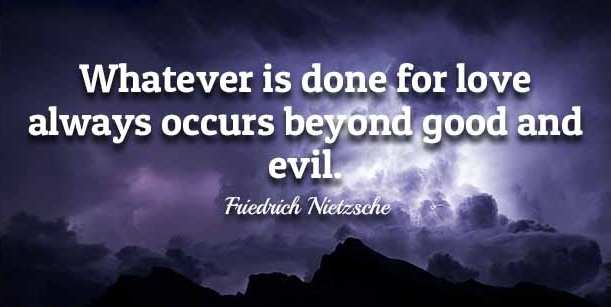
‘Whatever is done for love always occurs beyond good and evil.’

Katie Salvo’s God is a Bedlamite is available on Amazon click here .

Posted in book reviews, books, publication | Tagged , | 6 Comments

Self-publishing: A Guidebook for the Tourist#5: ‘Free’ books

The internet is full of ‘Free’ books, you can’t go on writers forums without finding them all over the place. The Facebook groups are full of them, Twitter will throw them at you, readers sites like Goodreads and other book sites overflow with them. Amazon and other resellers even encourage it to a degree. The E-book revolution has brought about an avalanche of ‘Free‘, which like all good avalanches has crushed and destroyed everything in its path. Lots of writers have complained about it, blog posts are full of opinions on the negative impact it has had on the book market and the profession as a whole. These are opinions I agree with… But I am going to utterly ignore for an hour while I write this because instead of telling all the reasons ‘Free’ is bad, I am going to explain the reasons it can be good for you. With a caveat, however, that being why while you may want to consider making a book free for a short time, it has to be at the right time…

freebooks

First off, however, if you have written your first novel and are thinking of making it free, even just free on a kindle countdown type deal… STOP NOW… Seriously, don’t do it, you’re making a grave error. It may seem tempting, giving your novel away for a while to get a lot of readers quickly, build up reviews, find an audience, get it ‘as it were’ out there. But that is not what is going to happen. Remember this important adage, ‘No one values that which they get for nothing…‘ and if they don’t value it, they may not even read it anyway. Kindles around the world are full of ‘free‘ books that got downloaded when they were on sale for nothing and are just left to collect virtual dust on the ram, before been deleted to sit on the cloud to make space for the next few free books that will never get read. Mine I may add is as bad as anyone else for this. So if you have written one novel, and are even considering making it free for a few days on Amazon, stop now. If you are going to give something away, give it with purpose.

Giveaways competitions and ARC freebies at this stage make sense, but not open house Amazon free book sales.

Giveaways because you offer to give away say, five copies of your novel, to random entrants to your competition will get people to sign up with their email addresses to your mailing list. At which point you can send them flyers, with the reasonable assumption they signed up with a degree of interest in reading your work. Or having signed up have a degree of interest now. It’s a good way to get readers to at least look in your direction, and if you do them through a site like ‘Goodreads‘, you are pulling them towards you. On ‘Goodreads‘ the giveaway competition service they run is tied to people marking your book ‘to read’. Which puts it firmly on their radar, and on the radar of their friend’s list as well. It also adds to the number of people who have marked your novel ‘to read’ so if someone looks at it on ‘Goodreads’ it looks popular. While everyone who doesn’t win a free copy is at least aware your book is out there now, and, by the law of averages, a few of them at leats will buy a copy, having had their interest spiked in the first place.

ARC freebies are giveaways with the express intent of getting reviews. They are an unspoken contract between writer and reader, ‘I give you a free copy, you give me a review.’ It’s a tried and tested formula, and if you’re going to give your work away, at least your going to get something back. There are dangers, be careful who you ask, and make sure if you’re giving out e-books you’re doing so safely with copy protection via kindle mail. But go for it all the same.

But, and I can not stress this enough, if you only have one novel, do not give it away in general… All your doing is adding to a flooded market and by the time you write your second novel 99% of the readers you found will have forgotten your first book and have no inclination to buy your next one. No matter how good the first one was…

The time to consider going down the ‘Free’ road is after you have a few books in print. Especially if you have a series written because readers read authors as often as they read books. Hook them with a free copy of your first novel, and while you have them on the line, they are far more likely to buy the second, third and forth. It is a truism that you will find repeated by most advice sites. I have read more than one publishing article that advises a writer to not even bother spending time promoting books till they have three or four written for this exact reason. Sad as it may be, it is true that readers are less inclined to buy the first novel if the writer has only written one book. Even heavyweights like ‘George R R Martin‘ and his ‘Game of Thrones‘ are subject to this rule. Long before the TV show came out, the first novel only really began to reach high sales after the third came into print. And that was not Martins first novel, he already had a large following, but the novel became a real best seller when there was a series of books on the shelf. Readers like to know they can read the next, and the one after that, before they commit to the first book. Even if your novels are unrelated to each other and not even in the same genre, such as my own ‘Cider Lane‘ and ‘Passing Place‘, having more than one book out there makes the first novel all the more attractive to a reader.

With this in mind, giving away the first book in a series makes a certain amount of sense. Many authors discount the first novel, putting it in the 0.99 bracket. Then give it away for short periods in the hope of hooking readers into a series, and as a tactic, it works. The same can be said for short stories and novella’s that lead into your novels and are permanently free on your website, or through Kindle, etc. Free is not a bad sales tactic. Indeed it is a damn good one. It has got me to try a new author on more than one occasion, and I have no problem with ‘Free’. Just use it wisely is my advice. If you’re giving something away, make sure it is to get something in return. Make sure it is to get a reader or two, to reach your audience.

I have never made one of my novels free, I have however made one of Kram Seyah’s free as an experiment. Kram, as you may know from reading my blog, is a writer of nihilistic erotica with swords and the occasional touch of sorcery thrown in. It’s a niche market within a niche market and was an experiment to start with. Written as much to satisfy my curiosity as anything else. As ‘A turn of the glass: Passions of the dragon queen: vol 1‘ is a novella, with a narrow target audience, it does, however, serve to illustrate the  ‘free’ market…

untitled

When I first released ‘A turn of the glass‘ at the strip end price of 0.99c it did not sell many copies. It is short even for a novella, just over 20000 words it barely qualifies as more than a short story in some respects. It would not be unreasonable to consider the minimum price you can sell for on Amazon to never the less be something of an over pricing of the book. Yet despite this, its is erotica and sex, as the old saying goes, sells. So I expected I might sell a few copies, and after a little bit of publicity, it did just that. It was not uprooting trees, but it was selling in dibs and drabs, a copy here and copy there, not enough to make me rush to write a sequel. The original was written as much to allow myself a break after the first draft of ‘Passing Place’. It would have to sell a lot more than half a dozen copies a week to make it a priority, and as with all book sales after the first month or so that half a dozen a week started to tail off. Remember this is a niche market within a niche market and a short novella, and I only did minor publicity work on it. The occasion facebook post, or mention on a forum in passing, and that’s about it. But part of the experiment was ‘volume one‘. As ‘Kram’ intended to add volume two and three etc. at some point. So I decided to put it on ‘sale’ for free through Amazon on a Kindle book deal and see what happened, and did a little (though only a little) publicity work on erotic writing forums and fantasy forums a day or so before.

In a week I sold over 400 ‘free’ copies of ‘A turn of the glass‘. Which was four times as many copies as I had sold previously in the three preceding months. Bare in mind when I say minimal publicity I mean just that, I was not trying hard to sell this. I relied almost entirely on the lure of ‘free’ and Amazon own internal publicity algorithms that go into action when a book goes on ‘sale’.

If you’re interested in the maths of how much ‘A turn of the glass‘ has made me, and how much money the ‘free’ giveaway cost me, here are some rough maths for the first 4 months it was in print.

General price 0.99c  giving a royalty per sale of 0.17c     100 sales

100 sales  = $17   or  $13 when its declared on my tax return.

Which is quite a bit less than I make for an hour at my day job… and ‘sales’ of 400 free cost me $52  after tax …   Clearly I have conned myself out of early retirement here…

The important figure though is 400 in a week as opposed to 100 in three months, and when I repeated the sale a few months later, it sold another 300 with no publicity at all apart from the inherent Amazon promotion.  In all free sales now stand at about 1200. Whereas I have sold about 300 in the 18 months or so it has been on sale. Which is not bad for something I make no actual effort to sell.

The point here is that if Karm Seyah wrote a few more volumes, all those free sales would have some benefit to him. If everyone who had bought volume 1 and only a quarter of those free sales went on to buy volume 2, sales of volume 2 would double. 600 rather than 300, and a quarter is conservative because readers read authors. Anyone who got volume 1 for free, then bought volume 2 because they enjoyed V1, is likely to also buy V3, V4, V5, etc.. even with the law of diminishing returns (a drop off of readers as you go through the volumes happens to all writers of series). So giving away volume 1 to attract readers can pay back multiple times in sales. Well as long as they enjoy your story, the writing is good, and it is enough to make them willing to pay for the next book.

Have faith in your writing …..

As I have said ‘A turn of the glass’ was an experiment, and as it is not really what I want to write its an experiment I have taken no further. It has however shown the power of the ‘free’ book and hopefully shows when it is worth using.

I know a few authors who’s single drive is to make money from writing. They are nice enough people, but I am not over enthused by their books. Perhaps because I know they care more about making money than the craft. I care more about finding readers than making money, but I resent the idea of all my hard work bene given away without purpose, and you should too.  ‘That which is given freely holds no value‘ as someone once said. I want people to read my work, but I also want them to recognise it has value, if only as entertainment. So should you with your own writing.

Kram Seyah may write volume 2 of ‘Passions of the dragon queen‘ one day. As I enjoyed the act of writing and it gave me a break from my other work which I needed at the time. Having given his work away for free, he may well sell a few more copies of volume 2. If those readers the ‘free’ fished up have not forgotten volume 1. In fairness, they most likely will have done by then, but the amazon algorithms will not have done so they may well see it pop up in feeds all the same.

When I publish the first two Hannibal Smyth novels I am writing, I will probably use the same tactic to boost sales. (I am deliberately planning to release them both within a couple fo months of each other.) My drive, as always, is readers not profit, and free books is a way to find readers. I just advise you use it wisely… because there is no such thing as a free book, it cost you more than a slither of your soul and a whole lot of time to write it in the first place.


Adios for now.

Mark


For more on Self-publishing and writing:  https://markhayesblog.com/publishing-and-writing/
 

Posted in opinion, self-publishing, writes | Tagged , | 1 Comment