The page count problem…

Wheather you self-publish or go the traditional route page count is a problem for a writer. The reasons page count matters are different, but the result is the same. But for a writer, unless you’re one of those rare ones that ‘just does it for the money’ rather than someone deeply passionate about your work, the page count isn’t really a consideration. You’re telling a story, the story is as long, or short, as the story needs to be. No writer wants to cut something short to fit in with a length prescribed by the industry, and no writer is going to pad for the sake of padding to achieve the same result.

Sometimes, when you self-publish, you have to wear a different hat for a while. the writer has to go have a coffee and a breath of fresh air while the publisher takes charge. then the publisher has to take the writer to one side and ‘explain’ to them why they need to put a little thought into their page count. At least with traditional publishers, you’re not arguing with yourself at this point…

Let me try to explain why this matters. Normally, as a writer, I talk in word counts, not page counts, but a publisher needs to think in page counts. A traditional publisher wants a novel between 250 and 400 pages long. Unless the writer is well established when the rules are different. The reason is simple economics, the more pages in a book, the more it costs to print, and the more it costs to print the smaller the profit to be made. Sure you can charge more for a longer book, but if you’re trying to sell a writer that’s not an established name you want to keep the price’s reasonable and minimise your risk…

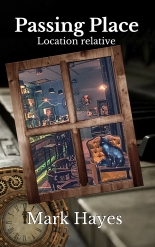
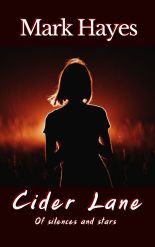
A self-publisher has exactly the same concerns but from a different angle. Print on Demand costs more or less scale directly with page count. For example, ‘Passing Place‘ is more expensive than ‘Cider Lane,’ not because one is a newer novel, or that I believe one is worth more than the other, but because the base cost on POD for ‘Passing Place‘ is almost twice that of ‘Cider Lane‘, and that is purely down to page count. Print cost leads to minimum list pricing, ergo Passing Place is expensive in print.

And yes, of course, Passing Place is worth the cost, and I would not have cut out huge swathes of the novel to make it cheaper to print, it is the length that it is, but all the same page count matters…

Because of this with, my next novel ‘A Spider in the Eye’ I have increasingly found myself worrying about the page count as it keeps growing with the final (ish) edit I’m working on. While I don’t wish to trim for the sake of trimming, I find myself doing so anyway. Trying to work out if I can cut whole sections just to meet a page count… While not wanting to cut anything for any reason other than literary ones.

‘If its good for the story to lose something fine, but for page count, sod that… ‘

So It was time to put my publisher’s hat on and have a really good think before talking to the writer, explaining the options and some of the home truths about publishing…

‘A Spider in the Eye’ is too long, and while that doesn’t matter if it was only published as an Ebook it does matter if it is published in print, and I always want my books to be available in print. Sorry but I am a bibliophile, I want to hold the damn thing in my hand, they are not real to me until I do… If, however, it keeps growing through the edit as I suspect it will it will end up a good hundred pages longer than ‘Passing Place‘ Or twice the length of ‘Cider Lane‘. The POD cost would be too much and print copies would have to be priced too high, and the only person to ever hold one in their hand would probably be me.

There is, however, one solution to all this. ‘Spider in the Eye‘ has always been planned as the first book in a series. There is a natural point, just over halfway through the current edit, where I could split it into two novels…  Which given I will probably add a good 10000 words more before I get to that point in this edit would make it about the same length as ‘Cider Lane‘.. the second book would probably run to a similar length.

So there you go, thanks to my publisher self, repeatably shouting at my writer self I am not now close to publishing my next novel… Instead, I am close to publishing my next two. Which only leave me with the issue of thinking up another title…

(yer, of course, I have already thought up the title for the second book, I am just keeping it to myself for a bit…)


ASOA pres8 banner

Posted in Hannibal Smyth, indie novels, Passing Place, self-publishing, writes, writing | Tagged , , , , , , , | 2 Comments

Writers on reading…

The old sage and great whit Stephen King says in ‘On Writing‘ “If you want to be a writer you must do two things above all others: read a lot and write a lot.” Occasionally I forget the former when I am too busy with the latter, Or forget the latter when I am too busy with the former. But then we all get lost in a good book once in a while, getting lost in a world of the imagination is more or less the point quite often. To be human, I sometimes think, is to tell stories, and listen to them…

Here then, because I have not done one of these for a while, are some quotes from the great, the good, and the occasional persistent scribbler, on reading…

“We don’t need a list of rights and wrongs, tables of dos and don’ts: we need books, time, and silence. Thou shalt not is soon forgotten, but Once upon a time lasts forever.”  ~ Philip Pullman

“Never trust anyone who has not brought a book with them.” ~ Lemony Snicket (aka Daniel Handler)

“Reading is the sole means by which we slip, involuntarily, often helplessly, into another’s skin, another’s voice, another’s soul.” ~ Joyce Carol Oates

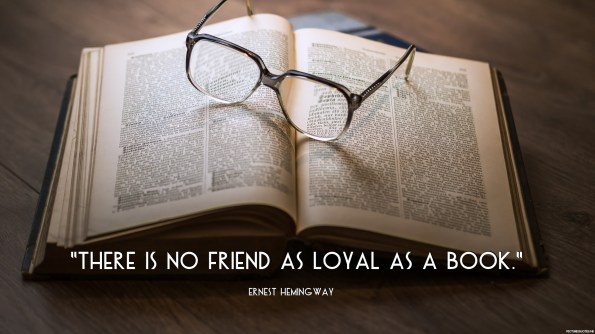
ernest_hemingway_quote_there_is_no_friend_as_loyal_as_a_book_149

“What a miracle it is that out of these small, flat, rigid squares of paper unfolds world after world after world, worlds that sing to you, comfort and quiet or excite you. Books help us understand who we are and how we are to behave. They show us what community and friendship mean; they show us how to live and die.” ~ Anne Lamott

“It is what you read when you don’t have to that determines what you will be when you can’t help it.” ~ Oscar Wilde

“The one way of tolerating existence is to lose oneself in literature as in a perpetual orgy.” ~ Gustave Flaubert

7717cf3bc9b9571a347289ba3d439d15

“My alma mater was books, a good library…. I could spend the rest of my life reading, just satisfying my curiosity.” ~ Malcolm X

“No matter how busy you may think you are, you must find time for reading, or surrender yourself to self-chosen ignorance.” ~ Confucius

“Picking five favorite books is like picking the five body parts you’d most like not to lose.” ~ Neil Gaiman

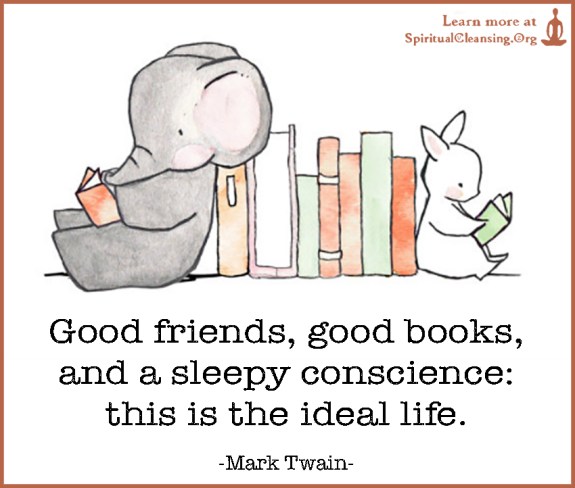
Good-friends-good-books-and-a-sleepy-conscience-this-is-the-ideal-life.

And finally, because on occasion one likes to pretend one truly understands the bleak nihilism of a certain cheerful German-speaking Bohemian Jewish novelist and managed to read ‘The Trial’ without it seeming to be such a trial to do so… And because quoting a certain cheerful German-speaking Bohemian Jewish novelist and Dr. Seuss in the same post amuses me way too much not to do it…

“I think we ought to read only the kind of books that wound or stab us. If the book we’re reading doesn’t wake us up with a blow to the head, what are we reading for? So that it will make us happy, as you write? Good Lord, we would be happy precisely if we had no books, and the kind of books that make us happy are the kind we could write ourselves if we had to. But we need books that affect us like a disaster, that grieve us deeply, like the death of someone we loved more than ourselves, like being banished into forests far from everyone, like a suicide. A book must be the axe for the frozen sea within us. That is my belief.” ~ Franz Kafka

Ever a ray of sunshine there Franz…

edit: In case your wondering I actually love the bleak nihilism of Kafka, I just don’t understand it, except when I am drunk, feeling philosophical and claim to do so.


ASOA pres8 banner

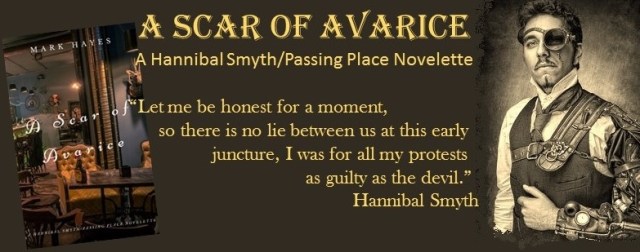
A Scar of Avarice: Available now on Kindle and in paperback

Posted in #amwriting, amreading, goodreads, humour, opinion, pointless things of wonderfulness, quotes, reads, writes, writing | Tagged , , , , , , | Leave a comment

The waiting room of the psyche…

I am a little bi-polar, though that is not unusual, almost everyone is to a degree. We all have highs and lows, and our moods swing between them. the truly bipolar are just those for whom the swing between extremes is more pronounced and the extremes all the greater. I, while not at the extreme end of the spectrum, am a little more bi-polar than your average man in the street, whomever that is, and whichever street he happens to stand in.

Outside influences beyond my control affect me more than they should, while things under my control are no less triggers. I am however very self-aware. I know when I am getting down, and I generally can spot when I am being a tad on the manic side. I can take steps to level myself out in most cases. I am undoubtedly lucky in this regard…

I have however been down for the last week or so, noticeably so not only to myself, and while I know the cause, it’s a bit of a strange one. Indeed the cause is closely associated to my own preferred method of self-medication. Which if you are a regular ready you might be aware is writing, as I explained in this post a couple of months or so ago. I am not going to go over all that again here. Suffice to say for me writing is more than a mere hobby, it is part of my life in an intrinsic way.

The problem, or what has lead to an extended period of the ‘downs’ for want of a better word, is that when you write there comes a point when a thing is written… And as you might also be aware I released a small novelette about ten days ago. The process of turning what you have written into a book and everything else involved with getting it out there, where ever there happens to be, is almost by necessity a manic period. I get hyped up, I am rushing about mentally, doing all the little jobs here and there I need to sort out, blurbs , covers, typesetting, last-minute edits, angst, worry, sending the final copy off, fixing the final copy when it comes back with a couple of errors, sending it off again. then telling people it is out there in the first place. Manic Manic Manic…

Then suddenly, a day or two after its finally published the backwash hits you. All that energy is expended, and you’re suddenly drained, spent… And that’s when I swing to the other end of my spectrum… That’s when I slip into the ‘downs’ and they always end up being the deep downs… It’s also when you start waiting… Because readers will read in their own time. Readers are the thing that you have no control over and bare in mind up to this point you had absolute control of everything to do with your book. Be it a short novella like ‘A Scar of Avarice’ or a full-blown novel like Passing Place. Once you put it out there all you can do is wait.

Wait and hope, that somewhere someone is reading the damn thing and sort of, kind of, maybe, likes it.

Wait and hope that maybe someone will even take a moment to tell you they liked it.

Wait, and hope, and try not to feel like you need external justification to reassure you bruised psyche that you’ll be fine. That it doesn’t matter if anyone likes it or not, that you have no reason to worry, because the only person who needs to like it at the end of the day is yourself, and you write first and foremost for yourself. While knowing at your core that it does matter, if only to you. While trying to climb back to that happy middle ground between mania and depression…

So, here I am, in the deep downs, several days after publication, waiting…

Except I’m not, not now, I’ve got past that down and moved on to sod it. Which I why I am actually writing this short post at lunchtime. To remind myself that it is the writing that matters, the sun is shining, and life is remarkably good. Time to stop the waiting in the deep downs and get on with the next thing. Let the waiting take care of itself…


Posted in depression, goodnews, goodreads, Hannibal Smyth, insomnia, opinion, Passing Place, self-publishing, writes, writing | Tagged , , , , , , | 1 Comment

An Authors Avarice…

I may have mentioned this… But forgive me for being overly excited about a new release…

flier

Normal service, whatever waffling meanderings on writing, Lovecraft, politics, the world, and general geekery can be described as normal will resume shortly. But in the meantime, you’ll just have to bear with me…

Or of course, you could buy a copy in paperback, or on Kindle, or read it on Kindle unlimited, or all three… Indeed buy a second copy of the paperback and hide it under that loose floorboard in the corner of your bedroom,  in case you’re raided by The Ministry and the Sleepmen take one away…

Now an apology…

scar of averice

And yes I will stop going on about this soon, but in the meantime, if you’re so inclined please like and share this post, so others may hear of this little novella of which I am unreasonably proud… And it may even aid my author’s avarice … That strange driven desire to have as many people as possible read my work…

ASOA flier


Posted in fiction, goodreads, Hannibal Smyth, indie, indie novels, kindlesale, nanowrimo, novels, Passing Place, pointless things of wonderfulness, publication, reads, retro book reviews, sci-fi, steampunk, writing | Tagged , , , , , , , , , , , , , | 1 Comment

New release…

Well, it’s finally out there.


Though… For reasons I am not entirely sure of the kindle version (edit kindle version now live too)  is taking some time to go live, however, available in paperback NOW for the tiny price of 4 squids…
And on kindle very very soon for a single squid…
My little novelette A Scar of Avarice…

Note, squids is not a typo, but for those that don’t buy things in cephalopods, pounds will do 🙂

https://www.amazon.co.uk/dp/1717378250/ref=sr_1_12…

Alternatively, if you live outside the former heart of the British Empire, in the land which replaced it for $5.49

https://www.amazon.com/dp/1717378250/ref=sr_1_5…

(disclaimer: cephalopods are not a negotiable currency, neither are crustations.)

I suspect I will mention it again in the next couple of posts but just thought I would do a quick one first …

Kindle links are finally active as well 🙂

US…


UK

Posted in amreading, books, booksale, Esqwiths, fiction, Hannibal Smyth, indie, kindlesale, nanowrimo, novels, Passing Place, publication, reads, sci-fi, steampunk, world book day, writes, writing | Tagged , , , , , , , , , | 3 Comments

Piano Player or Pianist…

Sam, he who was famously, but never actually, asked to ‘Play it again,‘ was the piano player in Rick’s bar in Casablanca. To my mind, that is whom he is, ‘The Piano Player’, he has never been ‘The Pianist’.

That may seem like an odd distinction to make because frankly, it is an odd distinction to make. It’s also one I have never thought much about before. But if you were to ask me ‘Who was Sam in Casablanca?‘ I would, I have no doubt, say ‘He was the piano player.‘  Because bars have piano players, they don’t have pianists.  Its why the sign in the bus station window in ‘Passing Place‘ reads :

Coming ever closer ........

Because advertising for a pianist to play at Esqwiths Bar and Grill, just seems utterly absurd… Okay, I know, a Piano Player at a bar and grill equally seems a little absurd, but it feels right to me or did when I wrote it, and it was being Sam from Casablanca that more or less was the job that was being advertised… Sort of, though the bar is not a bar, and it’s location,,, well that’s all relative…

Why am I tell you all this, eclectic readers? Well because I got back the proof-read copy of ‘Scar of Avarice’ this morning and while I have been working through it and seeing what my proofreader has changed one of the things he changed was Richards ( the main character in ‘Passing Place’, who is also featured in ‘Scar of Avarice’ ) job  Piano Player to Pianist, and as I worked through the manuscript for an hour or so  that kept happening. Most of the little changes here and there that my proof-reader has made add to the overall novella. He has done a fine job. But I found myself stuck on this one change. (there were others of course, but this is the one that stood out.)

I found myself questioning if it should be Piano Player or as my proof-reader insisted (though only in the proof, not actually in person or anything.) Pianist.

Pianist is the right word for a person who makes there living tickling the ivories. I know that, I have always known that. But after letting it bug me for a couple of hours I realised something very important. Something every writer realises on occasion. The right word is not always the right word. Sometimes you have to go with the word that actually feels right…

So, with nothing but love and respect for my proof-reader, who has done a fantastic job for me, Richard will remain, The Piano Player…

In other news:  Scar of Avarice, or A Scar of Avaris (damned if I can decide which is right, with the ‘A’ or without it… going to end up going with my gut on that one, once my gut decide’s ) is that much closer to being published … yay …

ASOA flier


Posted in books, Esqwiths, goodnews, goodreads, Hannibal Smyth, indie, indie novels, novels, opinion, Passing Place, pointless things of wonderfulness, reads, writes, writing | Tagged , , , , , , | 1 Comment

Rambling through a full edit…

Stephen King explains in On Writing that his approach to second drafts and editing involves reducing the word count of a novel by a good ten per cent. Having read my fair share of Mr Kings novels, one hates to think how long they were to start with, but I can see his point. There is a natural desire as a writer to be wordy. At least I find that to be the case for me. (regular readers of this blog are shocked by this revelation I am sure…) So If I do not watch myself, I have a tendency to ramble in early drafts.

With previous novels, that tendency to ramble has perhaps been less checked that it should have been in final edits. Though I do make a conscious effort to avoid rambling too much, and no one has yet accused my novels of being too verbose, so I’ve hopefully got away with it. People generally like them for a start…

But with ‘A Spider In The Eye’ I have a different problem. Unlike my previous novels, this one is narrated by the main character. It is in effect first person, but at the same time because of where and when he is telling his story it has a degree of the memoir about it. All of which is fine, it is a stylistic choice I made after I originally wrote the first few chapters as a third person narrative. While it worked in the third person, the first person just suits the story I am telling more. Hannibal’s own insights into events are what makes the story work for me as a writer.

But therein lays a problem. For a while I tend to ramble a little if left unchecked, Hannibal is far more inclined to ramble than I am, and finding that sweet spot between what is Hannibal’s voice and what is my own rambling is somewhat challenging. Not that I am complaining, the challenge of bringing a fictional character own voice to life was the reason I decided on writing this particular novel this way. If it were easy, well it would be no fun at all…

There is a touch of the masochist in every writer. If we did not secretly enjoy the struggle, I suspect none of us would do it. Though that could be just me.

So here I am, editing away my rambling, while not editing away Hannibal’s rambling, and trying to cut away the chaff… Which begs the question, as I am consciously trying to cut more than I add, of how a mere 76 pages into a 416-page document, the word count has grown by another 1000 words.

Still, I know that the 75 pages I have done are far more polished and cleaner than they were when I started this edit, So I guess, as Hannibal would say “small victories and all that…”


Posted in #amwriting, Hannibal Smyth, indie, indie novels, opinion, pointless things of wonderfulness, rant, writes, writing | Tagged , , , , , , | Leave a comment

The Call Of Cthulhu: TCL #47 Part 2 The Tale of Inspector Legrasse…

“Ph’nglui mglw’nafh Cthulhu R’lyeh wgah’nagl fhtagn.”
“In his house at R’lyeh dead Cthulhu waits dreaming.”

The above is from the second part of Call of Cthulhu, Lovecraft’s most well-known work, and one of his best. I’m not going to make any bones out of this, Call of Cthulhu is something of a masterpiece as far as Lovecraft’s stories go. It’s a sea change in his stories, moving from smaller personal tales to a wider perspective. This is a tale of events that span years, aeons in some respects, and are global in scope. It doesn’t tell of horrific events in one location happening to a single narrator. Instead, it instils a sense of dark wonder, at a horror that encompasses all human and the world. Importantly, however, tries to do so in such a way that the reader’s disbelief can be utterly suspended, and make them envision that menacing darkness that lays beyond this pool of light we call the rational world…  Which is a neat trick, if a writer can pull it off.

The Tale of Inspector Legrasse…

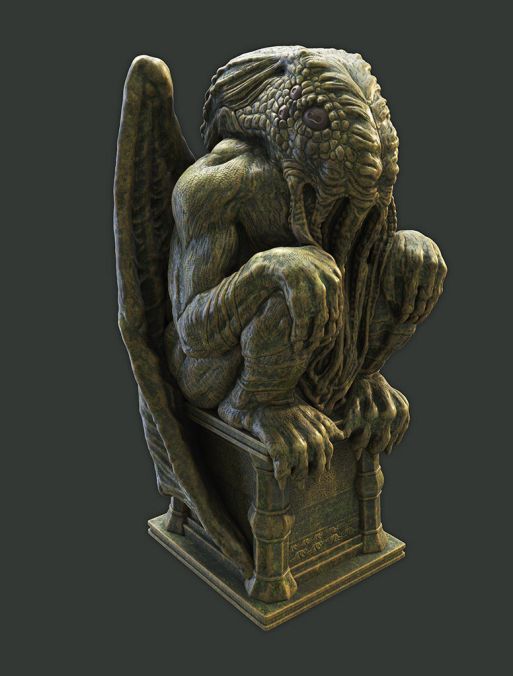
This part of the tale explains why the erstwhile Professor Angell was so interested in the bas-relief that gave the first part of the story, ‘The Horror In Clay’ it name. As opposed to dismissing the sculptor of the foul piece of art as a madman for his talk strange haunting dreams and driving urge to create the image of the being we know of as Cthulhu… the simplest explanation of which is, it was not the first time the professor had come across such a figure. The first time was some seventeen years prior at a meeting of the American Archaeological Society when an inspector of the New Orleans police came before the gathered alumni of that organisation bearing an ancient statue of an unfortunate province…

cthulhu-statuette-3d-model-obj-fbx-stl-mtl-3b

That statue, perhaps unsurprisingly, is one of the most popular Lovecraft collectable’s, or at least the several hundred different versions of it that have been created over the last few decades by various artists. Which is a wonderfully odd fact when you think about it. The Statue in the story had been in the possession of an ancient cult practising foul rites in the worship of the great old one represented in this strange piece of cunningly carved soapstone. Now representations of this fictional statue of a fictional god-like being reside on mantle pieces and in display cabinets around the world. The fictional cult of Cthulhu has far and away been surpassed by the cult the fiction created…

What’s that old chestnut about the power of belief shaping the gods, and the power of gods stemming from belief… In moments of whimsy, it is a strangely worrying thought that so many Cthulhu ‘worshipers’ look up at the craven image of the one who awaits the stars being right…

But idle speculation of the nature of belief on one side lets get back to the story. Inspector Legrasse tells the assembled great and good of American archaeology how he came by the statue, in the depths of the swamps below New Orleans, breaking up a strange ritual gathering where ten people were murdered to be the beat of tom-tom drums. A tale dark enough in the telling but what adds to its credence are the observations of Professor Webb one of Angell colleagues who came across a similar cult in Greenland years before, also practising dark rites. One which chanted in a strange dead language the words…

“Ph’nglui mglw’nafh Cthulhu R’lyeh wgah’nagl fhtagn.”

Words which he could not translate at the time. Legrasse, however, heard that same chant in the swampland of Louisiana and managed to ‘persuade’ one of the members of the cult he arrested to translate it as much as it could be into English…

“In his house at R’lyeh dead Cthulhu waits dreaming.”

So now we have events in New England, Greenland and Louisiana swamps all tied to this strange image. But more than this as the narrator begins to investigate his uncle’s papers and beyond. He also begins to suspect that his uncle’s death was not entirely as innocent as it first appeared. Was his uncle killed by this strange cult that seems to have tendrils everywhere? What secrets lay behind all this…

It is the secrets that lay behind it all that really make this tale what it is, and it is this second part that the reader really starts to get a greater view of it all. Its disjointed in places, and suffers the fate of any tale that tries to encompass something so huge in scale so quickly. The further the narrator’s story goes into his own journey, the more he discovers, the more profound the mystery… the more horrifying the possibilities… It would be an easy thing to fail in this story, yet it doesn’t, all it does is draw you further in. A certain level of awe is inspired along the way.

I’m not going to talk much more about it, or all the lays upon lays of story here. Because at the end of the day I would not wish to spoil this tale for anyone who has not read it. But this is myth building at its finest, the growth of the mythos and the darker history of the world before humanities rise feels real, for all it is just a story, which is the real trick here, this is not just a suggestion of a time before human histories narrow scope but something darker and more fleshed out than in any earlier tale by old tentacle hugger…

The middle third of a tale is normally a tough cookie, but this builds on the first and sets up the third masterfully. So another five tentacles reaching out of the depths of the ocean… which is where we will be going next come to think of it…

5out 6

Further Lovecraftian witterings as ever can be found here

The first part of this three-part post is The Horror in Clay …

Next, the final part, ‘The Madness from the Sea...’

Until then I am off to move my statue to a more respectful part of the mantle place because you never know…

“That is not dead which can eternal lie,
And with strange aeons even death may die.”


Posted in amreading, cthulhu, goodreads, Lovecraft, mythos, Nyarlathotep, opinion, rites, sci-fi | Tagged , , , , , , , | 2 Comments

Advice for writers in a slump

A facebook friend struggling with their first novel was asking for advice or more accurately was bemoaning the struggle they are having getting words on paper. So after telling them not to be so hard on themselves. I wrote out a quick set of tidbit advice for those aspiring to write in the hope, vain though it may be, that it would help them a little. So I thought I would share it here, as I had written it anyway. There is probably nothing new in this I have not mentioned before, and as ever I don’t always follow my own advice, but for what it’s worth …

  1. Change your writing routine, if you write on an evening, get up early and write, if you write on a morning try a late night writing
  2. If you normally write with music on, turn off the music
  3. Turn off all social media, just close down your browser and stop all alerts coming through
  4. Change where you write. Its a laptop, you can move to another room, sit on the bed, slouch on the sofa, writing at the kitchen table
  5. Avoid distractions by not let the distractions access to you (leave your phone in another room)
  6. Change your chair (this actually works really well for me,)
  7. If you normally write in silence, turn on some music, but something that can sit in the background
  8. Pick a time to be your writing time and stick to it
  9. If you edit as you go, stop, no first draft is perfect, Hemingway was right on that score
  10. If you never edit as you go, read back the last two chapters and edit them
  11. Write, just write,, don’t worry about it being good, or right, or perfect, just write,
  12. Set your self a target, remember 300 words a day every day for a year is 109200 words, that’s a novel, just 300 words, make yourself write that many because really 300 words a day, of course, you can do that, and if you do more some days… Well then…
  13. Did I mention write?
Posted in #amwriting, nanowrimo, rant, writes, writing | Tagged , , , , , | 1 Comment

The Call Of Cthulhu: TCL #47 Part 1 The Horror in Clay…

“That is not dead which can eternal lie,
And with strange aeons even death may die.”

No story by H.P. Lovecraft has had a more pervasive impact on popular culture or done more to establish ‘old tentacle hugger’ as a major literary influence than ‘The call of Cthulhu’. As for the old star spawn itself, Cthulhu is without a doubt the most widely known of all Lovecraft’s creations. Cthulhu is simply everywhere in modern popular culture.

Just how widespread Old Tentacle Face is can be demonstrated by a quick look around my front room at home, which for the sake of pretentiousness I’ll call my study. I have in there a Cthulhu POP figure, a crocheted Cthulhu made by my friend Cal, a Cthulhu inspired piece of wall art (technically a page of the Necromonicon made by a Canadian artist), several Cthulhu T-shirts occasionally hang on the radiators to dry, any number of Cthulhu inspired books, Cthulhu inspired comic books, the Call of Cthulhu B/W movie on the shelf with other DVD’s, Cthulhu inspired board games, Cthulhu inspired card games, Cthulhu Dice, Cthulhu badges, and several  RGP game books for everything from The Call of Cthulhu, Cthulhu Dark Ages, Cthulhu Romans, Cthulhu in Space. And remember this is just in my study, I did not bother looking for my Cthulhu cufflinks  …
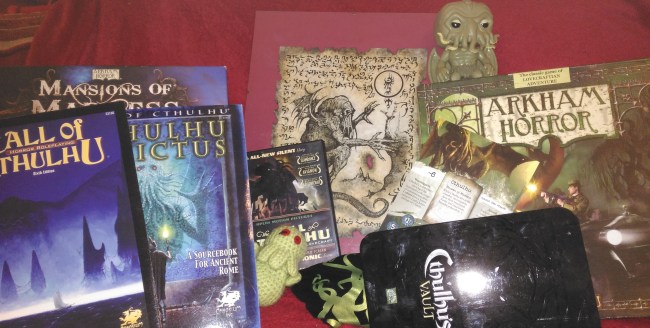
stuff

Old Tentacle Face is frankly everywhere in my house. Which is surprising because when it comes down to it, I am not actually a collector of  Cthulhu memorabilia, this is just stuff that has accumulated over the years… Even if you bear in mind that I am a habitual geek who has a fascination with such things, it is safe to say that beyond just Geekdom itself, Cthulhu is everywhere in the modern cultural zeitgeist of western civilisation… So with that in mind, this is a tale with a reputation to live up to.

The story itself is told in three parts, which begin with our narrator, one of the endless unnamed, Not-Randolph’s who inherits the papers of a deceased wise old uncle… Stop me if you have heard that little nugget of plot before… Yes indeed, we are back in Not-Randolph’s discovering strange rites and mysteries, through the medium of an old uncle… I guess after reading ‘Cool Air‘ last week I should not be surprised by this, but let’s not get bogged down in that old trope once more. I covered it well enough last time out.

The three parts of this tale are titled The Horror in Clay, The Tale of Inspector Legrasse, and  The Madness from the Sea. In many ways, you could treat them as three different tales all closely linked by a central thread. Unlike other episodic tales by Lovecraft, Herbert West being the example that springs to mind, this central thread really holds it all together and makes it the complete tale it is, and the threads left hanging by the first two parts are all sewn together in the final one. It is this that sets it apart for me over some of Lovecraft’s other long tales, for while he had tried to do this before in the likes of ‘The Lurking Fear’ he never really managed to hold the reader’s interest (mine at least) or build upon the foundations he had laid in the earlier parts of the story.

But ‘The Call of Cthulhu’ is built on stronger foundations than anything he had tried before. Not only does it build on the foundations it lays for itself as you read it. It builds on the foundations of the best of his earlier tales and sits astride them, going all the way back to Dagon one of his earliest tales of all. Threads upon threads are in here. Cyclopean columns from the depths of the ocean, the ravings of everyone’s favourite mad Arabian, the Necronomicon itself, all that otherwise tedious wondering about in the dreamlands he is so fond of, all the mythos stories that came before this have all been building irrevocable towards ‘The Call of Cthulhu’. In some respects, this is where Lovecraft really starts to come together, and while I am aware I have said similar things with other tales, this really is the point Lovecraft starts to put all the pieces of his mythological jigsaw together.

As I said this is a tale in three parts, and while I have kept these witterings on Lovecraftian lunacy to one post a story in the past. With the occasional small diversion off topic. In the case of this one seminal tale, I am going to wonder a little further than normal, as its a tale in three parts I am going to review it, if what I do with these stories could be accused of being reviews, in three parts also. You may have figured that out from the title…

The Horror in Clay

So it begins, and our narrator another ‘Not-Randolph Carter’ sorting through the effects and papers of his deceased  Grand-uncle George Gammell Angell, Professor Emeritus of Semitic Languages in Brown University, Providence. The Uncle died in mildly strange circumstances, though nothing seemed to be untoward as such about his death, and the sorting of his old papers should have been relatively dull is studious activity. That is save for one box of papers, a set of papers filed under the strange heading “CTHULHU CULT”. Within these papers are documented evidence that centres firstly around a young sculpture who was suffering from strange dreams and making an even stranger object. A Bas-relief of a strange, impossible nightmarish creature. A creature with the head of an octopus, the wings of a dragon and the body of a man, with the script of an unknown language upon it.
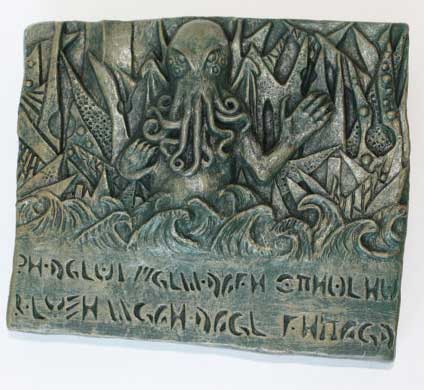
horror-in-clay

The young artist who crafted this had been beset with strange dreams in the last week of March and the first of April. Which lead to him to the Professor and to make the Bas-relief. The professor for reasons which come to light later in this tale takes a great interest in this rather than kicking the young fool out the door. More so when he connects it to other events around the world at the same period of time. The young artist is not alone in suffering from strange dreams and odd compulsions.

This first part, as is the nature of first parts, spends a lot of time laying down the land and this part of the tale most closely matches the opinion expressed by Lovecraft’s himself of the story as a whole, which was:

“rather middling—not as bad as the worst, but full of cheap and cumbrous touches”.

While I’m no more inclined to agree with Lovecraft’s opinion than I normally am, it does sum up this first part rather succinctly. It is a bit of a trawl, interesting certainly, but hard going in places. But it does cover an impressive scope. While it tells the story of the artist and his compulsion to create the hateful little tablet, it also is full of hints and portents of something much bigger, indeed, global in its scope, linked to what would otherwise seem nothing more than a man being driven to near insanity by bad dreams. It is the scope of the uncanny that is going on which sets this story apart. For our artist is not alone, others around the world are taken be a strange madness, driven to create strange art and other oddities. Obscure little religious cults are oddly active. the inmates of asylums are restless causing concern among the medical community. All of this is played out in a collection of strange and otherwise unrelated cuts discovered among the professor’s papers by our Not-Randolph. Even then this seems a strange obsession for an academic who specialises in ancient languages… But this is not the first time he has comes across that strange ominous name, Cthulhu…

Call-of-Cthulhu-preview-Could-this-be-the-PS4-and-Xbox-One-s-next-cult-hit-horror-game-681400

As a read goes, this first part is slow and it only really starts to build towards the back end of it all. But it does give a sense that something big has happened, something beyond the normal ken, and far beyond a simple ghost story. Which is the key, for me, to this story, both in this first part and as a whole. The idea that humanity is as nothing in the greater scheme of the cosmos, and there are things hidden from us that we should be grateful lay hidden. In the end, the opening paragraph of this story betrays the scope of it all, and with it the scope of what Lovecraft was attempting to convey in this story. And it is among the best opening paragraphs of anything Lovecraft ever wrote in my opinion…  I defy anyone not to want to read on after reading it…

The most merciful thing in the world, I think, is the inability of the human mind to correlate all its contents. We live on a placid island of ignorance in the midst of black seas of infinity, and it was not meant that we should voyage far. The sciences, each straining in its own direction, have hitherto harmed us little; but some day the piecing together of dissociated knowledge will open up such terrifying vistas of reality, and of our frightful position therein, that we shall either go mad from the revelation or flee from the deadly light into the peace and safety of a new dark age.

So to the score, for this the first part of ‘The Call of Cthulhu’. It’s not the best part, its weaker than the other two, but it lays the groundwork so well, I was tempted just to give it six and be done with it, but I have dropped a mark for trawl it feels in the middle…  So five it is…

5out 6


Next,

Part two, ‘The Tale of Inspector Legrasse.’ 

Part three, The Madness from the Sea

Further Lovecraftian witterings as ever can be found here
Posted in amreading, books, cthulhu, dreamlands, fiction, goodreads, horror, Lovecraft, mythos, Nyarlathotep, rights, sci-fi | Tagged , , , , , , , , | 4 Comments