Worth more in scrabble…

“England and America are two countries separated by the same language!” attributed to George Bernard Shaw, or possibly Oscar Wilde, or purely apocryphal, as its one of thsoe quotes no one is entirely sure about even the QI elves aparantly….

U is worth 1 point in Scrabble, and it occurred to me this means that the word colour is worth 1 point more in Britain than it is in America. I know that’s an abstract way, to sum up, the difference between two variants of the same language, but it’s probably an important one. Well in international Scrabble tournaments at any rate.
Serious men in cardigans probably debate long into the night, which dictionary to use an adjudicator when the world championships take place.
I was assuming there is a Scrabble world championships because there is an elephant polo world championship. Which is proof if it was ever actually needed of humanities ability to make a competition out of anything. BTW care to guess the 2004 world champions of Elephant polo. Scotland….  If anyone can figure out how that happened, let me know…. But putting strange pachyderm sports to one side. It seemed a safe bet that a Scrabble world championship existed when I was first thinking about this post, and it turns out it does indeed.

a writers tool box….

So somewhere in the world serious men in cardigans must have met around a pop-up table and debated if colour or color should be the agreed word for the championship. After all, there is no doubt the influence it has on the scores. Perhaps if it takes place in the UK they use the Oxford English Dictionary,, and if it occurs in the US they use a Webster’s dictionary…. but if that’s the case imagine the difference it could make in the world records… Think about it a moment, U may only be worth 1 point, but a Z is worth 10. So you see what you need to realise is that realise is worth 9 fewer points in the UK than realize is worth in the US…  And that’s before some smart arse uses it on a triple word score, drops and s on the end and gets the fifty bonus points…
What if it takes place in Nigeria, as it did in 2015 (yes I looked it up, but not going to let facts get in the way). But which dictionary do they use then, and if a UK player takes on a US player …. does the US player have an advantage. Or does it all even out, those 10 point Z’s you can use in more places in American English, against all the 1 point U’s that suddenly have so many more uses in The Queens original variant?
So yes, it was a slow day at work, and my mind wondered a little…
Regardless, men in cardigans care deeply about these things I have no doubt.

Why is any of this relevant, (except to the men in cardigans)?
Well as I am sure your aware I have published two novels.
What do you mean your not aware of that, it’s not like I have never mentioned it before? The links are at the side of the page. Do you think this blog is just here as entertainment and occasional waffling on about scrabble and elephant polo …

Ahem, sorry, where was I?
Oh yes, as your aware I have published two novels, and like most self-publicists I have done so in my own native language of English. The one with all the U’s all over the place and S’s in realise… I wrote them in English, which is somewhat universal as long as you know when a hood is a bonnet, and a boot is a trunk. The spelling of words, well that’s slightly Tom Ate Toe, Tom Art Toe. And in all honesty, a little confession here, it never occurred to me that I should actually make American additions of my novels with the American English spellings.

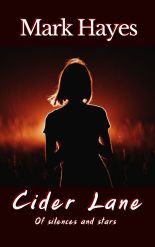
Let me say that again, because I doubt I am alone in this. It never occurred to me to make American English versions of Cider Lane and Passing Place…

I self-publish, which if you have read this blog before I am sure you know, and it’s a common mistake that happens to most if not all self-publishers. I know this because I have read a lot of Indie novels. The American ones are in American, the British ones are in British, and the Europeans ones all depend on which English teacher they had…
Yet it shouldn’t be, because in common with most of my indie author friends who self-publish I want my product to be as good as anything that comes out of a major publishing house. I had Cider Lane reproofed and reissued it to get rid of those annoying typos that crept past the proof-readers and myself that readers spotted, because when you hit a typo it jumps out at you  (The first time you read something, not the hundredth like most authors have their own books).

Yet by publishing in America in British English, I am doing the same to all my American readers. As is almost every indie author. Sure I would not change the title of my book from ‘Harry Potter and the Philosopher’s Stone‘ to ‘Harry Potter and the Sorcerers Stone‘. Because unlike the American publishers of J K Rowlings work I don’t believe Americans are unable to comprehend certain words and their meanings.
Cider Lane, however, is set in Summerset England, where they say Tom Art Toe, and a car had a bonnet and a boot, not a hood and a trunk. So the native vernacular should stay the same, but the spelling of words… that should be another story. After all, all it will take me is a few hours in a word processor set to American English to run through the manuscripts and then fix the typesetting if it needs it.

Hence, while it was a slow day at work, I was thinking about scrabble. And how for some of my readers colour should be worth less in Scrabble, and realise should be worth more. If I, and other British self-publishers, are going to sell our wares to Americans we should make the effort to cater to them. To meet them half way across the pond and change the words to ones that they are familiar with. Likewise, Americans publishing to the British-speaking world should do the same. After all, it’s only common courtesy.

We may be ‘separated by a common language’, as someone said even if no one is quite sure who its was. But we are united by a common Scrabble board, let the men in cardigans argue about which dictionary they use, because as writers we should use both…


Posted in books, opinion, pointless things of wonderfulness, writes | Tagged | Leave a comment

Self-Publishing Stigma

I did an interview in November last year, just after the release of Passing Place, in which I got asked this question:

  “Would you say there is a stigma to being self-published?

Of all the questions I was asked, this one and my answer to it created the most comment from those who read the interview. Most of the feedback was of the positive kind, though it did raise an eyebrow or two and garner a couple of negative responses.
One went so far as to point at my answer was ‘Naive and symptomatic of the malaise that self-publishing has created within the industry.‘  A criticism which if I am perfectly honest, I am not entirely sure I even understand.

My answer to that question in the interview was as follows:-

 “Yes… I hate people saying ‘My friend Mark has self-published his second novel…’ because I know that people tend to think we self-publish because we cannot get a publisher. This is seldom the case and generally, people have their own reasons for going down a self-publish route. There are lots of great Indie authors out there and, lets be fair about it, some dross. There is plenty of dross printed by traditional publishers as well. On the whole traditional publishers want books they know will sell, rather than something that is a risk and would sooner publish another James Paterson, which is a carbon copy of his last novel co-authored by someone else, who actually did the writing, instead of publishing someone who may not sell. They want genre and they want tight lines. There are a lot of very good books that have sat in publisher’s slush piles for years and then never get printed because the author loses the will. Anyone who self-publishes put their work out there, they deserve more respect than to be dismissed as ‘just self-published.”

My view on the stigma of self-publishing has not changed.
Having read a few emails in response to my opinion as it was voiced in the interview, I decided it might be wise to expand on what my view is. Not least because the original reply was in an interview, written with a certain degree of humorous intent and not trying to explain my opinion as such. Also, it gives me a chance to respond to the criticisms some had of this small portion of the interview.

Firstly, and just to be entirely clear, I stand by every word I said about James Paterson novels. Which, I feel I need to add here, was a comment on his publishers, not the book themselves. I was accused of deriding the writer because I am jealous of Paterson and his success. Let me, therefore, be clear about this, yes I am. I would love to make my living by writing books, I am just not sure I would want to do it by sticking my name on books others have written.

Patterson, because of the big name he is, sells books on that name alone. The point I was making, however, was about the publishing industry. Not about Pattersons books themselves. Perhaps unsurprisingly, publishers are more inclined to publish books they know will sell with minimum effort from themselves. There is nothing wrong with this as those authors have earned that selling power by writing books people love. It is however also the reason James Paterson’s name gets flung onto books that were ‘co-written’ by ‘Joe Bloggs’. They stick a ‘with’ between the James Patterson in big print and the ‘Joe Bloggs’ in small print. Then they stick them on the shelves, using the big name to shift them. Patterson is not alone in this, he just tends to be the one who stands out because of his ‘masterclass’ video lectures which faceache seems determined I should pay for the privilege of watching.

In my personal opinion, I would prefer the publishing industry to work a little harder with unknown writers, rather than tag them onto a big name. Those ‘co-writers’ who have written the bulk of these novels deserve to have them published and championed in their own name. At the same time, however, let’s be honest here, the big sellers make the industry the profits it needs to invest in first-time authors, it’s just the way it is. And those ‘co-writers’ probably get paid rather better for these work under the Paterson banner than they would for work published purely under their own names so who the hell am I to judge.

Before moving on I will just add this gem of advice for all, don’t have a go at Paterson in an interview, his fans are surprisingly aggressive in his defence. Even when you don’t say anything bad about the man himself, or even his novels, just his publisher’s ethics…

But anyway…

The other chunk of correspondence was about self-publishing, and I also stand by my own reasons for choosing to do so over traditional James Paterson loving publishing houses.

1/ As much as I enjoy genre fiction, I do not want to write a book about Harold Potter boy wizard, or 50 shades of off-white, or a dusk-light trilogy. I don’t want to only write one particular brand of science fiction or a book someone will recognise as inspired by the commercial success of another. Those stories have been told, I don’t want to retell them, but big publishing houses prefer to stick with what they know will sell.

This is, of course, counter-intuitive as the original genre creators were new, different and unexpected hits, which made publishers willing to take a punt on them small fortunes.

2/ Once I had finally written that first book, I wanted to go and write something else entirely. What I did not want was to be tied into a series deal where I have to rewrite my first book again, just more so. Rinse and repeat, publishers like a series. This is not to say I won’t write sequels (one of my current projects is a sequel to Passing place) But I don’t want to have to write anything.

3/ I only want to write what I want to write, this is not my day job, it does not pay my bills. Sure that’s the dream, but until then I will stick to doing what makes me happiest as a writer. Self-publish allows me to do that because I only answer to myself.

In common with most indie authors I know who self-publish, I have never actually tried to get a publishing deal. I have submitted the odd short story to magazines but never submitted a novel to a publishing house.
Why? You ask… well simply put because I didn’t have to. Nor for that matter did I want to, for the reasons above. I am sure that had I submitted Cider lane it would have sat in a slush pile. Unless I was fortunate, to say the least. Even rejection letters are hard to come by. Finding a publisher willing to take a punt on a virgin novelist is rare and requires no small amount of luck. Cider Lane doesn’t really fit neatly into a little box of a genre. ‘Passing Place’ certainly doesn’t drop neatly into a particular genre, though sci-fi and fantasy are a fairly broad church, so it is an easier fit than my first novel.

4/ I have lost count of the times I have read faceache posts by angry writers. Many of whom seem one rejection letter away from the edge… They complain about publishers not been willing to take a chance on them. They complain about agents. They complain that they have been told their book is too long, too short, the wrong fit, the wrong book. Which is another reason that I like self-publishing.

I like the freedom self-publishing grants, and while it’s rewards are hard won, they are hard-won by yourself. And no one tells you that the novel you so love is too long, short, or does not fit.  It’s my vision, it’s my story, I will not be told to change it because it doesn’t fit your narrow definition of what a novel has to be.

I do however hate the label, ‘self-published’ I vastly prefer the word ‘indie’. Perhaps this has a lot to do with my love of the alternative music scene… And I know there is some dross out there, but the majority of ‘indie’ writers work hard to put out the best work they can, and are more interest in the work than the money.

Lots of them are producing interesting stuff, thrilling reads, and really different stuff you just don’t get in the mainstream publishing factory. I am not saying they deserve to be read, each reader must decide for themselves what they read, but they deserve the same respect as those who publish through publishing houses. The same amount of hard work goes into the writing. They have to work harder in some cases to have their books edited, work on proofing, and typesetting and everything else that goes into publishing a novel. My good old writing iceberg is all the bigger for the self-publisher…


There is a lot more I could have put on my iceberg, but you get the point I am sure.

My two novels represent about six years of work between them, to have them written off as unworthy because of a stigma attached to the self-published is both insulting to me and others who chose to self-publish,  and says more about the ones doing the writing off than the writers.

My original interview can be found here 

Further reading, just because I like this article by DW Smith from way back in 2010 here


adios for now

Mark

Links to my own social media, by all means, connect with me on them.

FACEBOOK    TWITTER   GOODREADS

Other posts on writing and self-publishing are collected here:

https://markhayesblog.com/publishing-and-writing/


Posted in opinion, publication, self-publishing, writes, writing | Tagged , , , | Leave a comment

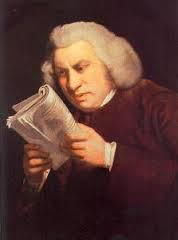
A Reminiscence of Dr. Samuel Johnson : The Complete Lovecraft #5

This is not our usual Lovecraftian fare. Indeed it is no more, and no less exactly what the title claims it to be, all be it a fictional account written by a narrator who claims to be over two hundred years old.
It is also, a rare and somewhat awkward piece of Lovecraftian comedy. Though much like its Shakespearean equivalent, it helps if you have read the background material if you wish to spot the jokes.
Written in 1917 and published in the same year under the pseudonym Humphrey Littlewit, Esq. It was written with no small wit intended. It pokes fun at both Lovecraft’s own style of writing, which had been referred to by contemporary’s as antiquated, and at the amateur press, which has a certain irony when you know that Lovecraft himself was a major player in the amateur press association, latterly is president for a short while.

0d743-download2b252832529

Its jokes are a little flat, however, though the observation of the wit of Dr Johnson, famous for creating the first dictionary as well as his rapier-like retorts is extremely well written. Though exactly why Lovecraft’s narrator doesn’t punch the good doctor on their first meeting but instead becomes firm friends, I am unsure.
It is clear that Lovecraft had a high degree of respect for Dr Johnson, as well as several literary lights which are mentioned in the story. I suspect he would not be enamoured at the portrayal of Johnson in series three of Black Adder, which is where I personally came across the doctor.

We do not expect comedy from Lovecraft, and he is not secretly a Terry Pratchett or Douglas Adams when he does try his hand at it.
In the end, this is a dull, even boring tale, but this may be only because it is not what I expect from a writer of horror and delver of the dark places of the human psyche.
As such I give it a woefully tentacle free 0 out of 6… only to read if you’re the kind of completist fool who would write a blog on every piece of Lovecraft fiction….
However as a work of pomposity, and some vague humour I give it 4 Johnsons of 6…


Posted in Lovecraft, retro book reviews, rites | Tagged , , | 2 Comments

Dagon : The Complete Lovecraft #4

H. P. Lovecraft was born, raised and spending the majority of his life in Providence, Rhode Island. It is perhaps therefore not a great surprise that the mysteries of the sea features so often in his fiction. Even now, a hundred years after Dagon was written, it remains a bizarre fact that humanity knows more about the universe beyond the thin shield of our atmosphere than we do about the depths of our own oceans. Back in 1917 when this tale was penned this was even more of a truism than it is today. What may lie in the ink black abyss beyond our shallow shores, caught the imagination of both the writer and his readers alike. It is, after all, the last great unknown on our own planet and stories of sea monsters have abounded since man first sailed upon the oceans.
Dagon‘ was one of the first stories Lovecraft wrote as an adult and was published only a couple of years later. (1919 in The Vagrant) It remains one of his best-known, and perhaps, still one of his most disturbing tales.

Dagon

I myself live close to the sea, My local beach, a short twenty-minute walk from the house, is a deserted stretch of sand, boarded by dunes and the eerie lights of the power station down the coast. The bay holds the remains of a primeval petrified forest that washes up like black ash on the sand. Walk along a deserted beach at midnight, as I have on occasion, the sound of the waves crashing against the shoreline. Alone in the still oppressive summer heat, The cold of the water at your feet, a still dead night air, strange noises you can’t account for, bearly audible above the sound of the surf and the sinister nature of the sea is not far from your consciousness. That then the ocean inspired Lovecraft to some of his darkest, and best love fiction is of only little surprise to me. It is, after all, a powerful question. If the shore is the medium between one world and another, the known world and the unknown abyss, then what may lay beyond, in the inky darkness no sun ever shines upon?

Dagon‘ is told to us by a former sailor. A man who is now addicted to opiates, in a vain attempt escape the horror he has experienced and the terror gnawing at his mind. Penniless, and soon to be drugless he has decided to end his torment permanently by taking his own life. First, however, he decides to write his story down. His last testament of the events that drove him towards oblivion.
His tale is one of a marina cast adrift in a lifeboat after the ship he worked on was taken by the german navy. He escaped alone in his small craft, somewhere in the mid-pacific. Spending his days ecking out his limited supplies and fighting off the effects of sunstroke. Until one day he awakens to find he is no longer adrift in the ocean but in the middle of a black slimy plain, a few hundred yards from his upturned boat, the stink of rotten fish in the air. So putrid that even gulls would not dine upon them.

Eventually, he starts to survey this strange land, coming to the conclusion it was until recently the ocean floor. A vast segment of it, which has been cast up by volcanic activity or some other unknown cause. Short of options he sets out to find out more, Faced, as he is, with the likelihood that his supplies will run out and he would join the rotting fish in a short time if he does not set out walking.

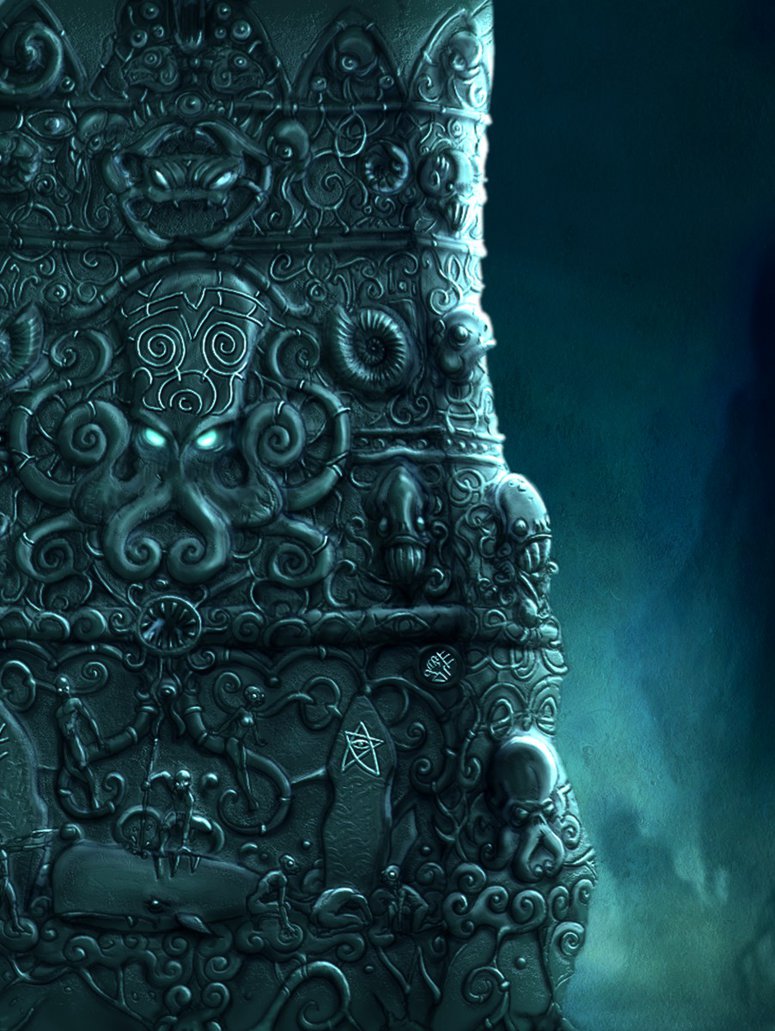
Eventually, he comes across a hillock in the flat plain, and heads towards it, beyond which he finds the land falls into a canyon, so vast and deep he can not see beyond the shadows of its walls. Yet what disturbs him most is a monolith, one carved by hands, which may or may not have been human, upon which are carvings of things that most certainly were not. A strange cyclopean relic of some long lost civilisation, or more disturbingly, one still in existence hidden from the eyes of men within the ocean depths.

7786e-cyclopean_monolith___dagon_by_disezno-d9sbqv0


Then out of the inky, darkness of the canyon, a hand appears, gigantic, webbed and inhuman. What follows that hand, haunts the marina’s nightmare ever after, driving him to the dulling effects of opiates.

Sometime after the man is found, adrift once more in an open boat, by a passing merchantman. Delirious from heat stroke, he is raving of things that could not be, and only finally comes to his sense weeks later in a hospital bed.

Is the land from the sea bottom some fever-induced delusion or did events happen as he describes? Does it matter either way? To the mariner, the truth is possibly somewhere in between, and as so often Lovecraft’s narrative invites us to draw our own conclusions.

Perhaps because I live by the shore, and the darkness below the waves has a strong resonance to me. Or perhaps simply because of all the tales, I have covered so far this inspires the most guttural reaction. But I adore, as do many others, this particular story. As such it would be wrong of me to offer it less than a full six tentacles out of six.
It is with this tale that for me Lovecraft comes of age in his writing, as it is perhaps the first truly Lovecraftian tale, and certainly the first in which he begins to explore his mythos.

Posted in Lovecraft, mythos, retro book reviews, rites | Tagged , , , , | 4 Comments

The Tomb : The Complete Lovecraft #3

Madness and the ravings of the mad are themes that Lovecraft visits time and time again in his work. It’s a subject that is close to his heart. He himself having suffered a nervous breakdown in his formative years, as well as suffering most of his life from both parasomnia and pareidolia (sleep paralysis seeing faces in dark shadows). Indeed, a fair degree of his later work can trace its inspiration back to these afflictions.
‘The Tomb’ is one of his earlier works, and in it he used the device of a narrator of questionable sanity. That narrator, Jervas Dudley, makes no bones about this in his tale, telling us repeatably that his word is questionable. All the while talking about dalliances with dryads in the woods and ghosts in spectral masons. As well as his own belief that he is privy to a more mysterious world than most, alluding to having some form of second sight and a touch of the fay about himself.
Written in 1917 when Lovecraft was at the very beginning of his publishing career, it was first published in ‘The Vagrant’  five years later. At a time when Lovecraft had begun to build a small but loyal following, at least in the pages of the small press pulp magazines.
The question of the narrator’s sanity is an open one, though Lovecraft certainly pushes the idea that what society believes to be the ravings of a madman could hold more than a seed of the truth behind it. In typical languid prose, the narrator vouches what Kipling summed up more succinctly with, ‘There are more things in heaven and earth than are dreamt of in your philosophy.‘ A concept at the heart of much of Lovecraft’s work.
This occasionally laboured prose is occasionally I find a problem with Lovecraft’s style. He will at times stretch a sentence around all kinds of strange geometry to say something in the least succinct way possible. Ironically this style is also something of the joy I find in reading Lovecraft, but it is easy to get lost in his sentences all the same. ‘The Tomb‘ is definitely a story of that kind, weaving long tracks through the woods, where shorter paths exist. There is, however, depth to that style which draws you in and gives voice to the narrator. Intentionally or not, these read like slightly deranged ramblings, wandering around his tale by strange roads and trails. It feels authentic the madness of the narrator, which is the real strength of the story.
In fairness, as I am no stranger to the odd bit of meandering prose (my novel Passing Place has more than a few wandering narratives within it), as such, I am hard pressed to criticise Lovecraft for doing so.


Comic book version of ‘The Tomb.’

There have been several comic book adaptations of the story, which follow the plot to a greater or lesser degree, certainly closer than a movie in 2007 called ‘The Tomb‘ which was publicised as ‘HP Lovecraft’s The Tomb‘. It went ignominiously straight to DVD and had no actual ties to the Lovecraft story at all. It was instead a low budget movie following the same basic plot of the ‘SAW‘ films. It was not an overwhelming success though has some following with the director Ulli Lommel’s fans, its interest to Lovecraft aficionado is limited.

Image result for lovecraft the tomb
‘NOT’ the film of the book

As a tale within itself, ‘The Tomb‘ draws you along, in mild bemusement at the narrator’s wanderings. The hints of madness mixed with the obsessive are all there. Jervas Dudley, on one of his long fanciful walks through the woodland, comes across a locked tomb hidden in a grove. Below the remains of the Hyde family mansion, long burned down after a lightning strike, (struck down for the decadence of its inhabitants by the Lord above, as the local folk law would have it.) His obsession with the tomb, the family interred there and how it may connect to himself becomes a central part of his life and the story.
When he later finds a porcelain figurine with the initials J.H upon it. in a box with a key he believes he has found the way into the tomb. Within he finds the coffins of the long dead, and one empty one, the right size and shape for himself. Whereupon he takes to sleeping within its dusty halls each night.
Eventually, Jervas is undone, his nightly wanderings discovered, though those who discover his strange obsession are convinced he sleeps outside the tomb, and the padlock on the door has never been touched.
Lovecraft leaves us with this. A story told by a man in an asylum, believed to be mentally unstable, telling us a tale that even by his own recounting of it leaves questions of its validity.
Yet one final twist remains…

This tale has long been a favourite, and one of the Lovecraft stories I have read before more than once. Its strength lays in its narrator, and the choice you are given to believe in all he says or believe instead this is merely a window into his insanity. It is in many ways the essence of a good Lovecraft short story, which explains the many ways it has bene re-envisioned by others since it was first published.
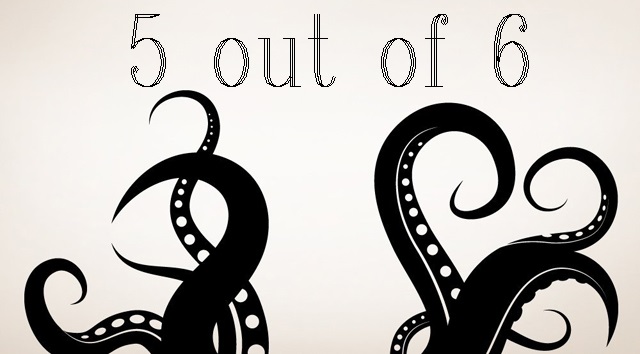
So I give it a madness inspired 5 out of 6 tentacles.


Posted in Lovecraft, retro book reviews, rites | Tagged , | 1 Comment

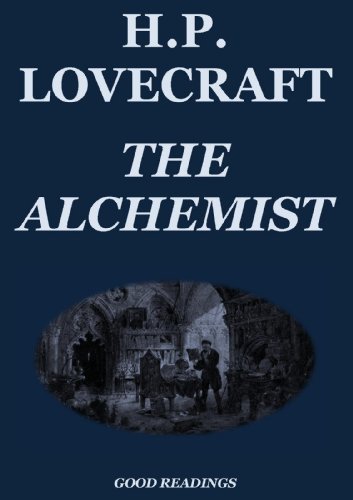
The Alchemist: the complete Lovecraft #2

‘The Alchemist’ is one of the better known early tales written by the H. P. Lovecraft. Like the first tale, I reviewed it is considered to be one of his Juvenilia works as Lovecraft wrote ‘The Alchemist’ when he was still only 17, in 1908. Also like ‘The Beast in the Cave‘, it was not published until several years later, in this case in 1916, two years before ‘Beast’  when it appeared in the November issue of the ‘United Amateur‘. Which as the name suggest was another small press magazine in the north-eastern US.

41aLS6LR8sL

Compared to the first tale I reviewed it is, however, a far more accomplished work, with a darker edge to it than ‘The Beast in the Cave‘.  Rather than a simple tale of a man in a singularly terrifying situation, this is a story with real depth to it. One which can be read on different levels, making it more the Lovecraft you expect, than the admirably well-written story of ‘Beast‘ which lacks maturity in comparison. This is no great surprise, as while it is only written by a man three years older, the three years between 14 and 17 are relatively big years in the development of anyone, not least a writer.

The scope of ‘The Alchemist’ is much more ambitious, as it is a tale spanning hundreds of years, but it starts with us being welcomed into the crumbling dust-laden world of Count Antoine de C-. It is through the eyes of the Count that Lovecraft envisions the dwindling fortunes of the de C- family, and the crumbling family pile which mirrors that demise.
(note. Lovecraft is fond of the device of hidden surnames. he uses it often in his fiction. This stems from the scandal sheets of his day often redacting names to avoid been sued. It seems odd to modern eyes, used to modern media’s less care approach to libel laws. As a literary device, it is unusual to see now but was designed to draw in a reader and encourage them to suspend their disbelief.)
The Count, with his family’s last loyal servant, reside in the last solitary tower among the ruins. And when the servant dies the count is alone with his brooding’s and the family histories of his sadly depleted line, it is there he first encounters knowledge of the family curse. A cruel and desperate one at that. Each son of the family is cursed to die before they reach the tender age of thirty-two. With this discovery, the Count dedicates the rest of his ever shortening life to discovering the secret behind the curse and evading its impending embrace.

This then is a tale of obsession, the kind of story that Lovecraft excels at telling. Told, as it is in the first person, the Count shows little perspective on his plight. But then the Count is the one obsessed, so his perspective is, by its nature, a grim one. Faced with a curse which gives his life the equivalent of an expiry date, rather than living the life he has to the full, he hides himself away in the ruins of his family fortunes seeking desperately an answer to the curse, while the tale explores it further.
One can not help thinking he would have been far better off taking what little fortune remained and living hard and fast in the streets of some of Europe’s capital cities. Paris, Vienna or Rome perhaps. After all, if you know, you’re going to die young, then living fast and leaving a good looking corpse is generally the raison d’etre.
His obsessions drive him to delve into the vaults of the family library, which hold an interesting collection of treatise on alchemy, dark arts, and oddities, as well as the family histories. A collection which suggests he is not the first Count de C- to seek an answer to the curse. While doing so he reveals the history of the house de C-, and the root of the curse in the murder of one of a pair of black magicians by a distant ancestor of the Counts.

It is here, viewing the world through the eyes of one in the grip of obsession that Lovecraft’s writing excels. Yet the Counts obsession is not the only obsession in the tale. Indeed there is a far darker obsession waiting to be revealed at the end. You can feel the crumbling remains of the castle around you, the layers of dust on the ground, the dark passageways and secret ways within the ruins which Antoine explores in his obsession as it turns into a madness, the clock of his life ticking slowly and relentlessly down.

Yet this could have been far more than it finally becomes, which is perhaps my one disappointment with the tale, much like the first story, the ending and big reveal is a little lacklustre. Though it is carefully crafted it is jaded with a predictability about it, which may be tempered by this been one of the tales I have read before (several years ago.) The ending I imagined was coming as I read had a sharper twist to it, which blunted the actual ending a degree.

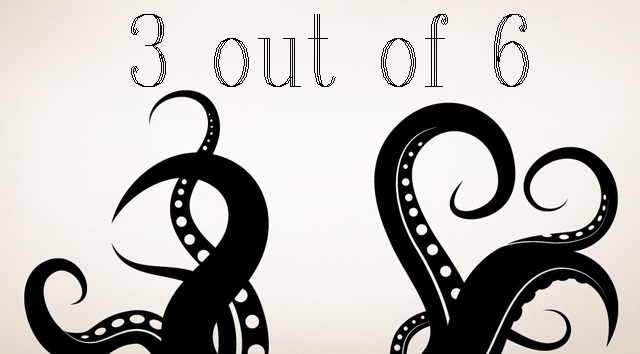
All the same, this is once more one of Lovecraft’s Juvenilia works. He was still finding his feet and his style. The darkness that was to come and the edge to his stories is not quite there yet. It is, however, a far more deeply engaging and troubling tale than the first. As such, I’ll give its a 3 out of 6 tentacles, for the promise of darker more disturbing things to come it contains within it.

db0d7-3out2b6

Further Lovecraftian witterings 

Posted in Lovecraft, retro book reviews, rites | Tagged , , | Leave a comment

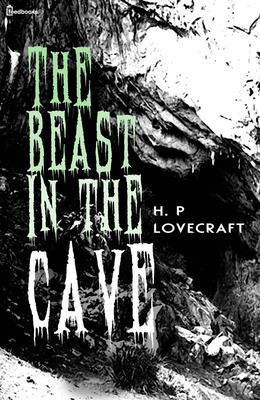
The Beast In The Cave. The complete Lovecraft #1

As you may be aware from the earlier post on the subject, I have decided to read/review the complete fiction works of H P Lovecraft as my reading/blogging challenge for 2017.
I have decided to do this in the order they appear in the collection I was given, rather than order of publication, or the order they were written. Both of which would I guess be acceptable chronologies, though they are wildly contradictory, as much of Lovecraft’s fiction was published several years after it was written, or after his untimely demise. The chronology is also of little concern as these pieces of fiction while part of an overall canon of work all stands independently of each other.
To give a little structure to these posts, I will include both the dates written and first publication dates of each piece and a little background here or there. Though I will focus on the stories themselves for the most part. Without further waffle then let us move on to doing just that.

97956-beats2bin2bthe2bcave

Lovecraft wrote ‘the beast in the cave’ when he was only 14, in 1905. It was not published until 1918 when it appeared in an amateur press journal ‘The Vagrant’.

The short story is a simple one, in the context of its synopsis, a man lost deep within a cave complex, his torch extinguishing, believing himself beyond rescue, faces a slow death by starvation alone in the darkness. Until he realises he is not alone, after all, something lurks in the darkness, something hungry.

In many ways, this is a good introduction to Lovecraft’s fiction, not just because it is some of his earliest work, but because it holds within it one of the themes that run through so much of his work. Isolation, within an unforgiving, uncaring cosmos, being alone in the darkness, and the things in that endless night you find yourself hoping will not notice your existence.
Like most Lovecraft, it is written from the point of view of a single voice recounting his tale, and looking inward towards their fears. The man ( he never names himself)  fears for his own sanity, in the face of a slow, torturous demise. Indeed fear of mortality, fear of the darkness, and fear of the unknown and the unknowable are central here. The feeling of fear, experienced through the characters emotions, grows steadily as you read the tale. Until the introduction of the beast itself. A dark presence the character encounters, blind as he is in the darkness of the cave. What the beast turns out to be is in many ways an anti-climax, if a predictable one, does not really matter in the context of the story. Indeed the reveal is almost clumsy, a last minute rescue and the light of his rescuer’s torches revealing the beast itself…
but before that reveal the beast could be anything, what matters more is how it makes the main character feel, and what he fears it could be. The end softens the story while resolving it for the reader.

This is very early Lovecraft, still finding his feet with a pen and paper. Unlike modern writers, Lovecraft did not have the luxury of a word processor, revision was a difficult exercise comparatively, and in all likely hood the final draft he wrote as a 14-year-old is what was published in 1918 to a large extent. He was still to develop his soul as a writer. I suspect that if this had been a later work the beast would never have been revealed at all and the tale would have ended a paragraph or so earlier. The real darkness in the tale holds to its course until that point.
As not to set too low a bar so early in all this I give it a miserly 2 out of 6. this is not to imply it’s a bad story, it is simply a little lacking compared to later tales.

2out 6.jpg

You can read ‘the beast In the cave’ yourself for free by downloading it here at Feedbooks

Further Lovecraftian witterings 

Posted in Lovecraft, mythos, retro book reviews, rites | Tagged , , | Leave a comment

Blog / Reading Challenge 2017

With the occasional exception, I have spoken to, notable only for their oddity, all writers are prolific readers. Indeed the notable exceptions were a couple of people who have told me they want to be writers while openly admitting they don’t read a lot. To whom my advice has always been, start reading more.
This is not because we are all driven to be derivative, or indeed have any desire to plagiarise, (though there are plenty of hacks out there who do, as witnessed by the amount of erotic Fifty Shades-esque fiction that flooded the market the moment a niche was found. Much of which was better than the original)
Reading is beyond enjoyable in of itself, a great way to fill your writing toolkit with new ideas and ways of communicating. Sometimes just by reading something which strikes you as inherently the wrong way to write a story. “I would not have written that, but the idea is interesting, perhaps if the stories told from that other characters perspective…”
You also get a steady stream of new words to play with. New idea’s to throw around. New perspectives to draw upon. And importantly new knowledge. Which is why none fiction is just as important, brewsters directory of phrase and fable, for example, is one of the finest reference books in the world for strange and exciting ideas.
With all this in mind, I decide to set myself a challenge most years, instead of a new years resolution. Generally
to read something different from my normal fodder, or to find out all I can on a particular subject.
Like all new years resolutions some work out better than others, and its bets to set a goal that other people can prod you about if you backslide.
This year I received the complete fiction works H. P Lovecraft as a present.  So this is my aim for the year, to read all Lovecraft’s fiction, and to keep myself in check I will blog a review of each story, novella and novel in the set over the course of the year. Awarding tentacles out of six for each.
I will also try and get hold of some of his many non-fiction works as well. His non-fiction essays etc dwarf his fiction output but are harder to get hold of.
This will be aside from the other blog posts which will be their regular sporadic and mildly eclectic mix.
All that aside, A Happy New year to all, may the stars not be quite right throughout 2017, as the last thing we need with Trump in the White House if a sudden incursion of old gods. It quite possibly going to bad enough without Azeroth showing up…  Or perhaps Natholoptep was behind the Trump election machine … now that would explain much


Whispers in the darkness
Posted in Lovecraft, retro book reviews, rites, writes | Tagged , , | Leave a comment

Year of the Dead

We have lost a lot of loved and respected famous people in the last year. Individuals who’s passing has affected us, brought tears, sadness and that strange form of grief we feel for people who we have never known personally but have been part indivisibly of our lives, Others have died in other years, but in 2016 there have been more than in any year I can remember. So many have passed in fact that it seems an endless list, that this year is out to get us all somehow.

Why we feel grief when those who are the icons of our life pass is no great mystery. I am 46, the icons of my generation, the ones who influence us and were part of our lives when we were children are only a few years older than us, but those years are enough that there passing is not actually unusual. A sad, but true fact, is people start to die of natural causes more often as they get older. Where once an accident or suicide was involved in the passing of such icons of my generation ( Kirk Cobain for example) now it is cancer, heart attacks, and just plain old age, which takes them from us.

We are the generation that television raised. Unlike our parents who were the generation of cinema. When I was a small child we had three channels, it may seem a weird concept today, but the launch of Channel 4 was a major event. For all its faults, however, television expanded our universe more than that of the generation before us, and as we grew the world grew too. Our icons are many, where the icons of the generation before us were fewer. We had a closer connection to them all than our parent’s generation, and now we feel that connection all the more.

With the internet, that web of wonder that has encircled us all, has come an interconnection with those icons that is all the stronger. A death is not an obituary in the paper, or a two-minute piece at the end of the evening news anymore. That was a segment of our lives which we allow for a little introspective and are prepared for. If you watch the news you are ready for bad news, after all, that’s what the evening news mostly consists of.  In turn, it makes taking the bad news of someone’s passing easier to process. But in the age of the internet it’s more immediate and more all-consuming, catching you on your blind side, unprepared and unready. I did not learn of the sad news of the passing of Carrie Fisher, George Micheal, Liz Smith, Rick Parfitt, (to name the most recent crop) on the evening news, I suspect no one did.

I learn of it on Facebook, That ‘happy’ place we go to in order to see what our friends are up to, look at pictures of cats, and complain about society. And these days it seems the place we express our collective grief at the passing of an icon.

Learning of the death of a loved icon on social media is intimidate and all consuming. We grieve as a collective, share that grief and in doing so we feel it all the more. Yet perhaps it also helps us come to terms with these sudden absences from our lives. Those of my generation, those forty/fifty somethings that grew up with television and the birth of the internet feel it all the more because it speaks to us of our own mortality. If our icons can die, so many of them and so often it seems, then so can we, they are not that much older than us after all.

My parents probably remember where they were when they heard Elvis had died, I can not remember where I was when Bowie died, only that the internet told me he had passed, and a wall of grief washed over it, as it had done only a few days before when Lemmy was taken from us to thrash metal heaven. Where we were when we learned of their passing does not matter. We heard it on the internet and grieved with the world. Perhaps fittingly for the icons which formed our world.

2017 does not promise to get any easier, I have no doubt that at some point in early January some other icon of my life and the Internets collective gestalt will pass. And I will hear about it on the internet, at my most unprepared. As a generation, we have reached an age where our heroes die. Carrie Fisher just the latest in the death list of 2016. That it seems to have been such a bad year for the demise of icons is just a sign of our times. That we do not become jaded and prosaic about the passing of our heroes, is a sign of our humanity, that at least gives me hope in a year so devoid of it in any other way.

         ,

Posted in music, opinion, rites | Leave a comment

All we are saying…

This post, like some others I have made, started out as a minor rant and attempt at light heartiness in response to a mild bout of despair at the human condition because if you can’t at least try to raise a smile, what is the point of it all…
It is not exactly faithful to the original, which I posted as the conflict in Syria drew in the west still further last year.
While it was a piece of gallows humour, laughing in the face of the ridiculous tragedy of humanity, I stand by its conclusion all the same. Yes I know it’s unrealistic, but I don’t make western democratic policy, so i don’t need to be realistic. I can instead idealise. And maybe, just maybe one day those who do make policy may try having some ideas as well.

It’s almost Christmas, in the ghetto of western civilisation, instead of singing about it lets try it. Peace on earth that is.

All we are saying……

So, we are at war AGAIN. (was there ever a time we were truly not at war as a species?)
The last war we stumbled into in the middle east, destabilised the region to the point where extremist militants could carve out there own empire across international borders. While for no reason that makes sense to me they have taken the same name as an Egyptian goddess of health, marriage and wisdom… Having carved out their new caliphate they have become a terrorist threat to the western world. Or at least the ones which we are blaming this time. Having killed off the leaders of the last lot, and then invaded Iraq on the grounds that their leader looked at us funny, had invisible weapons of mass destruction somewhere and lots of oil.
Invisible weapons of mass destruction proved to be invisible due to not existing.
The leader who looked at us funny had nothing to do with the terror attacks we had endured due to being as unpopular with the terrorists as we were.
But luckily there was plenty of oil.
But now ISIS, the one who was not a goddess, at any rate, has started grabbing territory and encouraging terror attacks… you know the ones we started the last war to end…  And they are remarkably good at it, and recruiting people to their cause, often those people who we bombed in the last war, no telling why they suddenly dislike the west. but drone strikes may have something to do with it.
So we are going to war, again, because that worked so well last time…

I know it’s a wild and wacky idea, but perhaps we could try not bombing innocent people and thus creating the reason for the next war. After all, we have done this particular dance on and off for about well, for the whole of human history.
Fight a war, punish the losers, instil resentment, fight another war.
Make the losers of the first world war pay reparations till we bankrupt their economy. That’s not going to cause us any problems later down the line.
Make up countries by drawing lines on maps of the world then leave them to it uniting disparate ethnic groups, worked so well in Yugoslavia, Rwanda, the entirety of Africa and most of Asia …
Fight another war or three.
Perhaps the reason the terrorists hate us, and hate our way of life is because we keep marching in with guns, shooting and bombing people, blowing up infrastructure, their hospitals and schools. Then we sod off and leaving them to patch their lives back together with grain field full of anti-personnel mines, that we sold them.
Just a thought that. Because in their position I think I would hate us too, just a little bit.

Perhaps we could, however, try a new approach.
I would like to suggest we give it some new name, to distinguish it from War. Perhaps, we should call it Peace
Under the new approach of Peace the people we don’t bomb this year will not become the people we then have to bomb in five or ten years time when they are frankly a bit pissed off with the west for its policy of bombing them.
Peace would instead mean that having not bombed them now, they will have no reason to attempt to bomb us in future.
Which will mean in turn we don’t have to go to war with them.
The billions and billions of pounds spent on the policy of War can be spent on the policy of Peace, for example, funding the NHS. not having food banks as a basic requirement of a bankrupt welfare state. free education at universities, proper state pensions, a decent standard of living for all, homes for the homeless. you know, nice peaceful things like those, things which are not in fact bombs.

We have tried this war thing time and again,
I know we are all a bit slow on the uptake at times, but frankly its past time we realised war doesn’t work. That is unless you’re trying to perpetuate a corrupt ruling class and industrial military block and breed a state of paranoid acceptance of increasingly intrusive state control designed to keep the rich in power and control of the state. All while the poor do as they’re told and accept that they are ruled by those who know better,,,, ( btw 1984 is a great read )

So let’s give this Peace idea a chance,, there possibly a song someone could write about it as well now I think of it,
Yes, let’s not kill people in a self-perpetuating state of war, followed by war followed by more war. Constantly breeding the next bunch of militant gun-wielding fanatics who want to exact some revenge because we keep bombing them.
Frankly, let’s face it if our country was bombed every day year on year, we would probably be a little tetchy ourselves,.
Peace .
It’s a new idea,
let’s give it a go …….

Posted in goodnews, humour, pointless things of wonderfulness, politics, rights | Tagged , , | Leave a comment