The Guest Runes…

Somehow I have ended up hosting a discussion panel on Runes, there relevance to dark age culture, what the Victorians did with them and the difference between New Age pseudo-mythology and actual historical facts and ancient cultures… This is fascinating stuff.

I personally have, an occasionally purple, beard that is long enough and scraggly enough to require some care and maintenance at times so I have some silver beads with runes on them. Beard runes… that is my level of expertise, runes on beads you put in your beard… Luckily my ‘Guests’ know a little more than me, by which I mean a lot more…

All this came about because I read, enjoyed and reviewed Kieth Hearings fascinating book Wyrd a week or so ago, and as is my want I put links to the blog up in a few places. It was at this point my friend and fellow writer Mat McCall piped up with a few thoughts of his own on the subject…

So welcome to my guest panel post on Runes…

Just an addition for those interested in Runes…. By Mat McCall

Just an addition for those interested in Runes…. Okay, let’s put my cards on the table first. As anyone who has read my book The Goddess of Sorrows will be aware, I have a lifelong interest in mythology, religion, and magical systems of the ancient Celtic, Anglo-Saxon, and Proto-Norse and Norse societies. My background is early British Medieval Archaeology and History, and I spent a long time teaching the history, social structures, religions, and mythologies of those cultures, to groups from community education to University level.

So, of course, the Futharks – to call them ‘Runic alphabets’ is like calling an iPad a ‘calculator’ – of peoples like the Vendel culture of Sweden right through the Ogham script of the western Celtic peoples, have been of great interest to me, both academically and spiritually.

I find myself rolling up my sleeves at this point.

In truth there was never one Futhark nor was it ever really used as an extensive writing system. To massively simplify; there is as modern scholars identify, the Elder Futhark and the various versions of the Younger Futhark, plus a lot of nonsense perpetrated by the ‘Melody Goldtwinkles’ of pop cod New Age pseudo-mythology.

The Elder Futhark, (EF) as a kind of alphabet, is not as old as you might think. EF has its earliest roots in the migration period, with some examples on stone carvings, from the 2nd Century. Ogham is almost as old. Making it less than two thousand years old. Of course, that would make it relatively young compared to Greek or Roman Latin, and a stripling babe compared to Sanskrit or Cuneiform. And it was not a ‘written language’ as you might imagine by reading this. One thing is that although current scholars list 24 runes in the EF, the use of some or all of them across the whole plethora of archaeological evidence of the period suggests that often some were highly limited in use. This suggests that some may have been local variations or additions and not all were widely used or accepted. Simply there was no ‘Dr Johnson’ of the EF. Not only was the use of the runes then open to local, cultural, and individual interpretation but so would have been their ‘supernatural,’ for want of a better word, use and meaning.

To imagine every early North-western Germanic could read or write in the Runic script is as ridiculous as suggesting that because Caxton invented the modern printing press every peasant in Europe could not only read but print. The existence of EF does not mean that those cultures were literate in a way we could comprehend by today’s standards. There are no books in EF, no love letters, no letters from sons to mothers thanking her for the cake and asking if she can send him some socks.

Imagine how difficult it would be to learn EF? Imagine that not only did every letter of what you are reading have its own vowel or consonant sound, and the changes it has when in conjunction with other letters, but each letter had complex spiritual and esoteric meanings, again both singularly and in conjunction with other letters. Dear God! Speaking as a dyslexic, English is hard enough to manage.

Now, this Elder Futhark would change over time, and diversify, somewhere in the 8th C into what some scholars call the Younger Futhark (YF) of the Scandinavians. But that too is a misnomer.

There were no such peoples as the ‘Scandinavians,’ like there were no such peoples as the Celts or Anglo-Saxons, they are ‘lump’ categories, modern broad generalisations and labels for people who shared some geographic and cultural similarities. It’s a shorthand that on close examination is meaningless and certainly utterly meaningless to the people themselves at the time. If you could pop back and ask Penda himself if he knew what an ‘Anglo-Saxon’ was, he would not even accept the concept let alone understand the term. Once you took the time to explain it, he probably would find it rather insulting.

So, no ‘Scandinavians’ then no Scandinavian shared Futhark. Here’s where things truly get diverse, even our modern ideas of Sweden, Norway, Denmark etc, were meaningless (and most had not even been conceived of) to the peoples of the age. Each culture, even regional group would have evolved a slightly different version and use of the so-called (YF), just as they evolved different regional accents and eventually different languages.

Then of course we have the so-called Anglo-Saxon Futhorc. Well now, there’s a lot of wishful thinking here. Firstly, its origins are massively confused. The suggestion that it originates from Frisia (That’s the Netherlands to you) is questionable, as there were numerous larger groups in the Anglo-Saxon model and their cultural dispersal and intermixture in the British isles is really hard to differentiate clearly. Remember Raedwald of the Wuffingas, Bretwalda and King of the East Angles (Angles, Saxons, Jutes, Frisians, a smattering of Franks, other Germanics and Romano-Celtic peoples,*), the guy with the cool helmet at Sutton Hoo, his family were probably of Swedish origin and that helm is Vendel culture.

Also, by the time this Futhorc was in extremely limited use from its archaeological examples, (I know I’ve actually seen and held most of them) the process of both Christianisation and Latinisation was well underway. Most of the wealthy and the powerful, like Raedwald, were nominally Christian and could read and write in Latin – the ‘lingua franca’ of the political and clerical ruling class.

There is a clear argument that what has been labelled by ‘scholars’ as a distinct subset of the YF, this ‘Futhorc,’ is not in reality anything more than a random collection of diverse examples originating from all over North-western Europe. As someone who studied and taught Anglo-Saxon and Norse history in these islands, I believe there was an Anglo-Saxon Futhorc in limited use, possibly by traditionalists trying to hang on to vestiges of their old cultures or by those who saw their Runic system as having far more potent power (especially mystical) than the Latin alphabet.

However, by that time it may have fallen into the position of little more than decoration, the kind of thing where we see young people with Chinese characters tattooed on themselves. They tell you it means “Health, Wealth and Prosperity” and in fact it reads “No.23, with dumplings.”

Yes, I know, before anyone screams, I have deliberately left out Iceland. That is another story.

*Angles from the area of Germany just below Denmark. Saxons from central Germany. Jutes from Denmark. Frisians from the Netherlands. Franks from France and Germany. Swedes. Romano Celtics being culturally Roman peoples (origins from all over the late Roman Empire) and Indigenous Latinised Celtic peoples. And lots of others. The predominate language of these people was some form of Germanic lingua franca and the predominate written form, for the few who were literate, would have been Latin, not runic.

I agree completely with everything By Kieth Healing

I agree completely with everything you have said. What I tried to do was write a simple little book that described, in very basic terms, what runes are and the importance of trying to look at original sources as much as possible. Many books follow on from Ralph Blum’s Book of Runes which introduced the Blank rune and ignored the traditional meanings as written in the rune poems.

Now, the poems themselves are not, of course, contemporary with the development of the futhark(s), but they give the best interpretation without having to try and understand them by learning ancient Scandinavian languages.

I make it clear that the runes are absolutely open to interpretation and are a fascinating way in to a spirituality that is sorely overlooked, what with the amount of books dedicated to “Celtic” ideas which were largely invented by the Victorians.

I actually spend most of the book discussing Wyrd and trying to get a sense of it.

Thank you to both Mat and Kieth for that wonderfully informed discussion, though frankly begining your reply with ‘I completely agree with everything you have said,’ lacks something in the good argument department…

As a side note from me, Annis: The Goddess of Sorrows is a marvellous proto-iron age mythological fantasy I reviewed at the back end of last year after my annual books of the year post, so it wasn’t listed in my books of the year in the year I reviewed it. Currently it is a strong contender for book of the year for this year and is certainly in the list. But don’t tell Mat that, it will go to his head.

Anyway read their books I have reviewed all of them previously, and of course read mine, because some people like them…

Posted in amreading, amwriting, book reviews, books, fantasy, fiction, indie, indie writers, opinion, pagan, reads, rites, writes, writing | Tagged , , , , , , , , , | 1 Comment

Return of the Revenge of the creature from the Friday Reviews

Ardent followers of this fine ongoing series of ever more obscure ramblings of the paranoid conglomerate of emotional baggage that collectively refers to itself as Mark Hayes, will be aware I have a regular feature on a Friday where I do a few quick reviews of several books all in one go. If your definition of regular is once in a blue moon, probably twice a year at best, and frankly not always on a Friday.

I am nothing if not consistent…

Regular readers will also be aware that my normal style with reviews is somewhat long winded, wanders a merry path, and eventually gets to the point and starts actually talking about whatever it is I have felt compelled to review after something in the region of five hundred to a thousand words of vague and occasionally mildly vulgar waffling on. However, as I have three reviews of four books to get through, I shall decline to waffle to my usual degree. Regular reader’s please accept this apology for the lack of popularist interpretations of Physics, references to obscure goth bands, wild wittering’s on subjects such as narrative structure and general waffle, but you know the kind of thing I mutter on about by now. Instead, I will do the whittering mid reviews. Such wittering should not be taken too seriously…

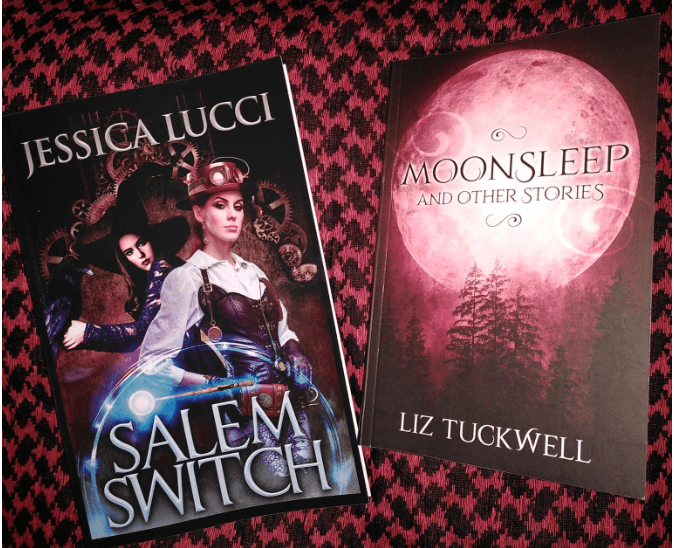
Moonsleep and Other Stories By Liz Tuckwell

Liz is a fellow Harvey Duckman writer, but one who has spread her short story wings far wider than I. As a member of the British Fantasy Society (who refused my membership on account of me never applying) she has also written for their monthly publications (which I was unaware existed) As well as a number of other publications, (which I have also never heard of), Elizabeth is therefore quite successful at getting people to publish her short stories. There is a reason for this…

The reason can be found bound within this book, which is regather collection of her short stories from all the various publications they first appeared in. The reason she is so successful is because her stories are witty, intelligent and brilliantly written, they also process a certain charm to them that many short stories writers fail to put into their work.

So, if you want to know how to write great short stores reading this book would be a great start. Or, if you just like stories, as I do.

Salam Switch by Jessica Lucci

One of the wonderful things about the modern world is the internet. I mean clearly it is also terrible and responsible for a lot of crap in the world. But it is good at one thing, bringing people into each other orbit who would otherwise never meet, figuratively speaking. Jessica Lucci is one such person I would never have heard of and her work but for the internet. Life would be poorer without coming into contact with such people I suspect as Jessica is one of those utterly adorable enthusiasts for life who seem determined to jolly up the world by sheer force of personality alone. (Oddly she reminds me of Henretta Clarkhurst, except Jessica isn’t fictional, or currently hurtling towards the moon with Elonis Musk)

Admittedly she is also American, which is cheating as they don’t have to cope with inbreed cynicism and sense of inferiority due to the class system that is the bane of the British. Damn treacherous colonials with their upbeat optimist view of the world…

Her novella Salem Switch is an extremely fast paced read and one I enjoyed for exactly what it is a rapid roller-coaster of a story not meant to be taken any more seriously than it was written but meant to be enjoyed for everything it is. It is just lots of fun. Well not lots, but plenty.

If there is a flaw, it’s that I felt there was a novel in this novella, but occasionally a tale is best told with exuberance, pace and this certainly works just as it is written. A joyous romp of magic, steampunk and the odd sapphic interlude.

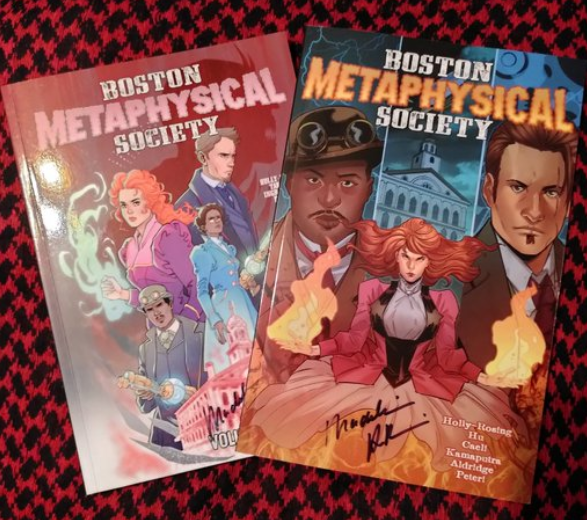
Boston Metaphysical Society Volume 1 and 2 by Holly Rosing et al

One of the wonderful things about the modern world is the internet. I mean clearly it is…. Arh, yes, I said all that in the last bit didn’t I, sorry. But anyway, another of those people I would never have interacted with and who’s work I would have probably never come across but for the internet is Madeleine Holly-Rosing. Who has written the odd guest post for this blog (and made my wittering’s seem pointless in comparison to her insightful post) Who’s prose novel A Storm of Secrets I reviewed way back in 2019. That novel is a prequal to her graphic novel series Boston Metaphysical Society, which I have been meaning to read ever since… Then Madeleine did a Kickstarter for volume two of the series in trade paperback, which was actually a collection of four shortish sequels to the original series published in volume one.

I hate Kickstarters, they hide on the edge of Facebook groups and twitter posts until I am feeling vulnerable but slightly flush with cash, then leap out at me and corner me when my will is weakest… This one was particularly sly, it told me I could get both volumes of a graphic novel series I have wanted to read for ages and some fridge magnets. I have no idea why anyone would think I needed fridge magnets. (The magnets are now on my fridge)

As for my signed copies of Boston Met, they have been a joyous read, Hollys writing and the collection of talented artists, colourists, letterer and other people needed to make a graphic novel have done an enviable job (what do I know, I do prose, so I don’t generally collaborate…) The art of all the artiest is fabulous. The story engaging, brilliantly written and constantly intriguing… I was not disappointed even after nearly four years of waiting to get my hands on these books…

There is a lot more to Holly-Rosing’s BMS universe, including an audio drama I mean to listen to at some point. She’ll probably have another Kickstarter lurking around to leap out at me at some point if I aren’t careful, I am sure. But sometimes being pounced on by great fiction is worth it… And always if Madeleine is involved as I love her writing.

Anyway, that’s all I have time for in this edition of the Friday reviews. Tune in next Friday, when I will forget to do them but hope springs eternal. To sum up, read these books, read more books in general is always my advice but these are a good start… Or, mine too I guess, they are rather good as well, so people tell me.

Now links to the books reviewed here with amazon preview things

Posted in amreading, book reviews, books, fantasy, fiction, grathic novels, indie, indie novels, indie writers, indiewriter, novels, reads, steampunk, supernatural | Tagged , , , , , , , , , | Leave a comment

Wyrd particles and Spooky Runes

A while ago, partly simply because the idea amused me, and partly because making a logical argument linking physics to ancient beliefs and magic is a bit of intellectual juggling I enjoy, I put foreword the argument that Physics could explain how a Voodoo doll could actually work. This was in a blog post cunning called Physic’s and the Voodoo Doll. I spent a lot of time on that title…

The blog was just a bit of intellectual tomfoolery on my part. It speculated that the quantum entanglement of spooky particles could be considered as a basis for sympathetic magic. According to quantum physics, entangled particles remain connected so that actions performed on one affect the other, even when separated by great distances. The phenomenon so riled Albert Einstein he called it “spooky action at a distance.”

Sympathetic magic is a basic school of magic in many ways. The Voodoo doll is the most well known example of this form of magic. An action on a doll , linked to the subject of the doll , will cause the subject to be effected in the same way. A link made all the more powerful with finger nail clippings or hairs etc from the subject infused with the doll.

It was a fun idea, I got a short blog post out of it that has been one of those that has retained a degree of popularity, as it was written 5 years ago and still gets regular hits. It is safe to say that the basic idea at least holds appeal beyond itinerant authors in the north of England who were bored on a Tuesday five years ago and started throwing ideas around. But it was no more than a blog post based on my workaday understanding of Quantum theory, and ritual magic. I don’t really know enough about either subject to go deeper into the subject than a short blog post… Which brings me to Wyrd by Kieth Healing or to give it its full title Wyrd: An Exploration of Connections and Handbook of the Runes.

In Wyrd, Kieth Healing explores both the concept of the Wyrd and the ancient Anglo Saxon Runic alphabet, its use in divination, as well as the runes connections to the Wyrd. All in of itself fascinating stuff. It is however a book of two half’s. The first half I will come back to in a monument, the latter is a list of runes, what they are call, what they mean and what can be derived from them thanks to the rune rhymes.

I found this latter section fascinating because of my beard runes. Yes I have beads with runes on them I wear in my beard, what of it? This I suspect was not the main driving force behind Kieth’s desire to write about runes, but still it is nice to know the name of the runes your putting in your beard…

The second half of the book fascinating though it is, wains in comparison to the first which is a truly fascinating read marrying Kieth’s broad knowledge of quantum theory with the more ancient concepts of the wyrd. Kieth managed to explain, theoretically at least, how the wyrd, can be understood better as a concept through the lens of modern thought in terms of string theory. It also goes into how this could be used to explain how some places feel different and are connected in different ways to the world in a web like weave of….

And I will stop there. Trying to sum up what Keith has to say on the subject of the Wyrd in a blog post is pointless. It is a fascinating read that is all I have to say. It is both thoughtful and thought provoking. You may end up reading bits of it twice as you’ll want to get your head around some of the complexity’s but that is because it is complex, not because of the way it is written. Keith manages to make all this accessible and entertaining at the same time.

Does it convince me of the power of runic divination? Or indeed that the wyrd exists as a thing other than a new-age mysticism concept? Well no, but it does leave me as open to the ideas and concepts as I was when I started reading and better versed in the ideas and concepts involved. As such I can recommend it to both sceptics of new-age thought and the faithful.

I also lover the idea of Ball of String Theory, but that’s just me

Posted in amreading, big questions, book reviews, books, druidry, goodreads, indie, indie writers, mental-health, pagan, publication, reads, rites | Tagged , , , , , , , , | 6 Comments

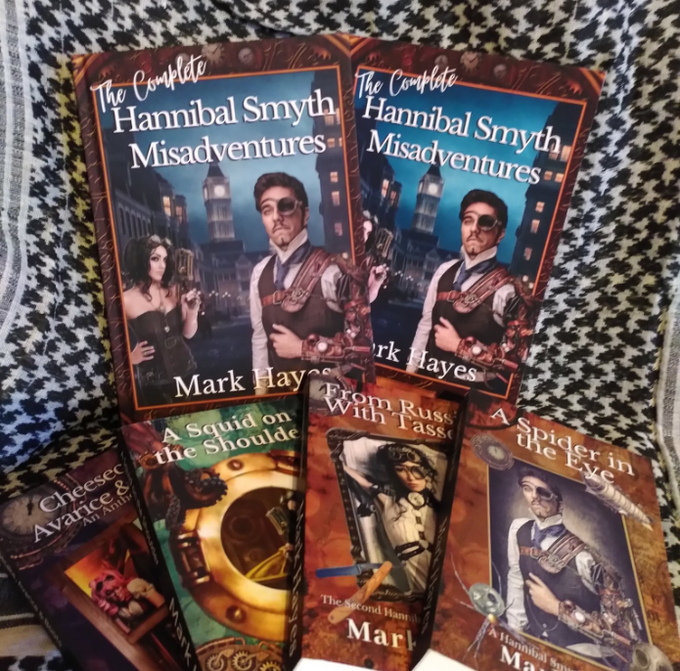
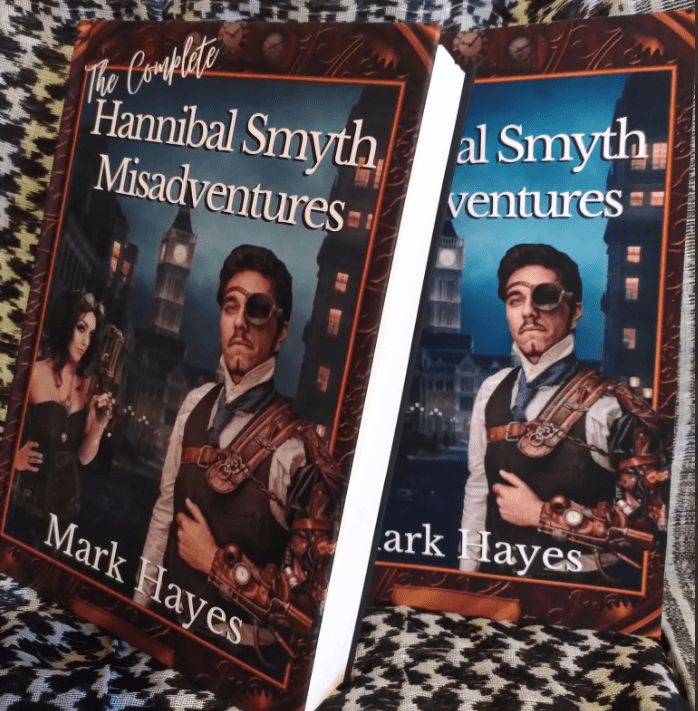
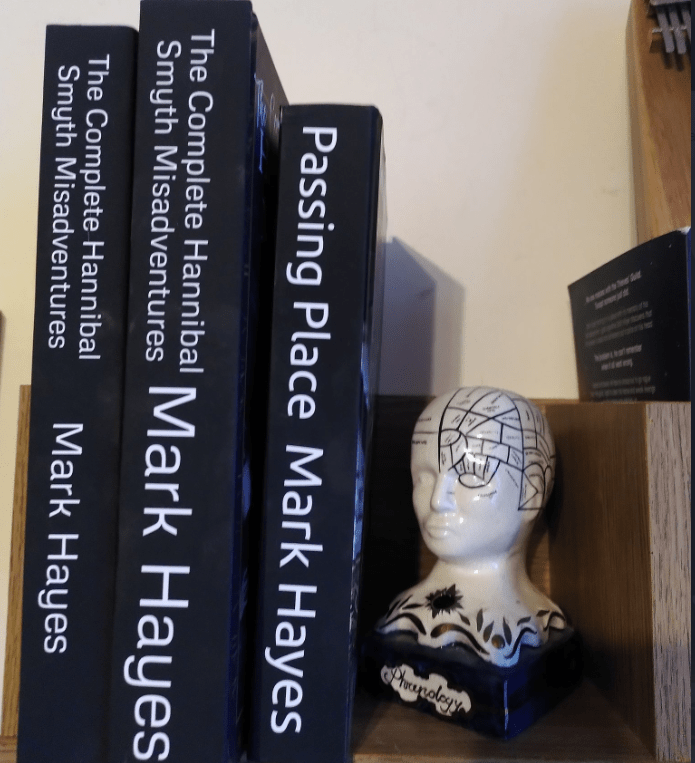
The Complete Misadventures of Hannibal Smyth

For reasons, not least of which was because I could, I have published the first three Hannibal Smyth novels in a single Hardback volume. Because I am entirely sane I have done so in E-book and paperback editions. It is entirely, however, possible the book only exists because of my desire to have the hardback on my bookshelf…

No one who ever dreamed of being a writer dreamed of the day their book was available on Kindle… E-books are a very fine thing, you can carry a library in your pocket, take it anywhere you go, and you seldom leave a half finished e-book on a train by mistake… But, as I say, no one ever dreams of writing an E-book. Want to be writers don’t even dream of holding their work in a paperback, though we might tell you different the first time we do.

When you have the writers dream, you dream of writing and then holding your work in hardback, and any writer who tells you different is a liar… (or it’s just me, how would I know)

In any regard as I seldom doing things by half this required completely reformatting the original three novels. I also added a short story and a novella into the mix because they all combine to tell the greater story of ‘The Misadventures Cycle’ which may sound pretentious (because it is) but both Hannibal and I are a pair of pretentious sods at times. It is also true that the three novels, the novella and the short story do form the basis of a redemption arc, of sorts. As much as you can redeem someone as irredeemably a cad as Hannibal Smyth…

The three novels combined also make for something of a weighty tome… I draft regular paperbacks in 5×8, (or the size of an average trade paperback) the last hardback I did for Passing Place is slightly bigger than the paperback at 6×9 (or the size of an average trade hardback). I intended to do the same with this one, however, due to imposed page limits, I had to move up a size to 7×10…

In any regard, I accept there is every chance there will only ever be one copy in Hardback, because most of my loyal readers, loyal though they are, already have the original books. And as most people are not quite a mad as I am I don’t really think any of them are going to by the collected edition in hardback, that’s the writers dream not theirs… However here is the blurb from the amazon listing anyway for any of you who have yet to become loyal readers 🙂 …

The year is a week last Tuesday and Queen Victoria has been on the throne for two hundred years or more thanks to her clockwork heart. William Gates is a mad scientist obsessed with spiders and windows. His rival Stephen Jobs is obsessed with optics, “It’s all eye this and eye that…” and what Elonis Musk is up to in the South Pacific is anyone’s guess, but that volcano looks a bit odd. There is a woman who definitely isn’t the maid who keeps turning up like a Bad Penny and something has gone wrong with time. those bounders HG Wells and Jules Verne are probably at the heart of it.
The Ministry need someone to sort it all out, unfortunately who they get is Hannibal Smyth, and he would rather they got someone else… Though the alternative was being hung as a murderous traitor, on the whole he’s not sure if that might have been the better option.

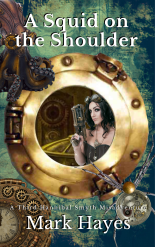
This collection contains the first three Hannibal Smyth Novels which between them comprise ‘The Misadventures Cycle’ a complete trilogy in the old-fashioned sense. That is to say, the Hannibal Smyth who emerges from the end of the final book in the trilogy ‘A Squid on the Shoulder’ is not the same man who started out in the first ‘A Spider in the Eye’. By the end of the trilogy, he has been on quite a journey both figuratively and emotionally. Some might say he is a better man for it.

Well, they might…

Of course, the narrator of Hannibal’s story is Hannibal himself. An older, if not wiser, Hannibal Smyth sat in a large leather armchair, by a smouldering fire, drinking his way through a particularly fine bottle of single malt scotch he may have paid for, and smoking rare, probably illegal, Cuban cigars.
From this nugget of knowledge, the reader can determine two important facts.
The first being that no matter what happens and no matter how many times people try to kill him, Hannibal survives…
The second being that the narrator is a tad drunk, which readers may feel explains a lot.

The Complete Misadventures contains: ~
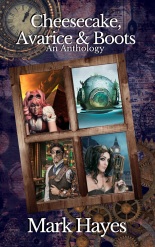
The short story: The Cheesecake Dichotomy
The Novella: A Scar of Avarice
And the Novels:
A Spider in the Eye,
From Russia with Tassels,
A Squid on the Shoulder

Almost all of stories here in are told by Hannibal himself, in his own idiomatic way, which is to say are quite possibly all lies, half-truths, and misdirection’s, or they are the complete and unabashed truth… Who knows.

As I said, its also available on Kindle… here is a handy link …

Finally… A small request. Many a lovely reader has read the Hannibal novels, loved them and been kind enough to leave a review. You are lovely people… Some of you reading this may have done just that with the original separate editions having read them on your Kindle Unlimited accounts…

IF so, and you still have kindle unlimited accounts and you are feeling generous you could always grab a copy of The Complete Hannibal Smyth Misadventures on your unlimited accounts .. Flick through to the end a day or so latter and leave a short review and give it some stars…

Yes of course asking you to do this is a tad caddish, but then so is Hannibal, and sometimes we need to ask ourselves, “What would Hannibal do?” (and normally I would advise, you to do the opposite at this point but hey there are exceptions to every rule…)

Of course if you hated the orginal and gave it a crap review and one star then please ignore this request:)

Love and happiness to all , not least because I have a hardback on my shelf and this makes me happy…

Posted in amreading, amwriting, book reviews, books, fantasy, goodreads, Hannibal Smyth, indie novels, indie writers, indiewriter, novels, opinion, Passing Place, pointless things of wonderfulness, publication, reads, sci-fi, steampunk, writes, writing | Tagged , , , , , , , , | 1 Comment

Another gimlet, please, Ivor. A Guest post from Will Nett

William Nettleton is a fine name. Still a ‘Sir’ in front of it and it brings up images of a big game hunter in the 1800’s with an elephant gun nestled under one arm , smoking a pipe of suspicious looking native tobacco while pontificating on how long he can avoid returning to his wife and young child William the younger, back in Britain by pretending to be lost in the Serengeti.

Sir Willian Nettleton, who fathered a string of mix race bastards over the course of his fifteen years of being ‘lost’ on safari finally returned to Cape Town when the gin ran out. Died of consumption in 1837 on the journey back to Teesside, so never met his his own namesake who had been born a few weeks after he first left for Africa, That William was to be the great great great grandfather of the current Willam Nettleton who for some reason shortens his professional name to appear cooler and writes as Will Nett…

Occasionally Will Nett sends me blog posts , they tend to be entertaining, well received and deceptively intelligent reads… he normally does this when he has a new book coming out. If he has a new one out he hasn’t bothered to tell me this time. He has never claimed to be ‘lost’ in the Serengeti, he did once spend a very long time getting some cakes from a shop in Amsterdam though…

Another gimlet, please, Ivor.

“Where do you get story ideas from, Will?” is probably the second most frequently asked question of me when it comes to writing, the first being something along the lines of “Ere, you should write about me, mate….are you gonna’ write about me? I’ll tell you some stories.”

I get that a lot, usually while nursing a gimlet at the bar of [REDACTED], as I’m doing now, or out with friends when someone pointedly announces what I do for a living. Someone will be over to have a look at me, for the novelty value, and give me a prod. It’s always in a pub, and is almost always men. Then they’ll mention the names of a few local mobsters they used to knock around with, and I’ll politely tell them that I’m not short of material, and then, more firmly, to beat it.

The man beside me at the bar now is gearing up to tell me his story. I can see him preparing his introduction from the corner of my eye, as he gazes into his Tom Collins. The amount of Teesside biographies I’ve almost started work on over the last decade is long and dreadful; the lottery winner, the counterfeiter, the bandit pharmacist- don’t ask. Actually, the latter of those suggestions is still on my ‘in consideration’ pile but this shortened list highlights the variety and abundance of material I’m presented with, and begs the question: where does it come from? 

“You’ve just got one of them faces that people want to tell things to,” a mate of mine said, “and a good ear,” as I described a recent encounter in a pub in Scarborough. A lone afternoon drinker made a bizarre comment about my t-shirt, and went on to explain in a surprisingly frank manner his knowledge of the 1970s UK adult entertainment scene. I was in his company for no more than 10 minutes, but in that time he managed to divulge all previous addresses, his entire employment history, and the contents of his DVD collection.

A few months earlier another perfect stranger, within moments of meeting me and with no knowledge of me being a writer, made a startling confession about how they managed to spend a quite obscene amount of money on something I’m not at liberty to reveal here.

Is it a northern thing? The natives, in North Yorkshire or Teesside, or wherever you think you live around that area, certainly aren’t backwards in coming forward.

The man beside me at the bar is a maths teachers, and looks like one; overworked, clinging to a perceived idea of former coolness- aren’t we all?- and at a loss as to what to do with himself over the weekend, which officially started around 7 minutes ago. 

“If I’m gonna write your story,” I say to him, “you’re gonna do me some maths, first.”

I summon the barman, Ivor, to fetch me a napkin. I could write on the pad that I’m writing this on but it feels cooler to do it on a napkin, as if we’re planning a bank heist, even though I’m not in that game anymore.

“Local area,” I said, “population?”

“Erm, local area…Boro? Durham?” says Numbers, as I’ve now christened him in my head, because that’s what writers do when they meet someone for the first time. A character has to be projected onto them.

“Durham?” I said, “do you teach maths cos you failed geography? We’ll do Boro,” making a note of it on the napkin as Ivor fetches more drinks.

The maths teacher muses for a short time and settles on 150,000 for the approximate population.

It sounds right. My last estimate would have put it at over 140,000.

Ivor slides the ever-lengthening receipt for the drinks under my nose.

“Christ, Ivor!” I said, “did you fly Tom Collins himself in to make that?”

There are approximately 80,000 registered authors in the UK, that is, people who make a liveable wage, however meagre, from some form of writing, be it scripts, copywriting, books etc. I’ve knocked 10,000 off straight away to get it down to 70,000 authors of primarily books, even though it’s likely less.

“A nice round number that can be divided neatly,” the maths teacher said.

“Aye,” I said, “get ready to be happy. The number of books published in the UK annually is about 180,000.”

“Righto,” he said, “nice and round.”

Everyone has a book in them, it is often said, whether they think it worthy of a being written or not. In fact it is my belief that everyone has three stories in them; an adventure, a romance, and a tragedy, but for the purposes of this barstool blustering, we’ll say there’s just the one.

I now suppose that there are around 100 published authors, of at least one fully-formed book, in the Middlesbrough area. It’s probably more but I’m rounding down so I can be in the Century Club, and it’ll be easier to calculate statistics when I edit this at home without Numbers sitting beside me.

At the top end then, of these 100 authors- many of whom don’t write non-fiction- working on the stories of 150,000 people, translates to 1,500 stories per author. Whittle again, to remove the stories of people who are just plain uninteresting- that’s not to say they don’t have a story, but there isn’t a market for complications relating to your Auntie Jan’s wheelie bin collection dates- and we can get it to 1000 stories.

“You can take out maths teacher stories from that lot,” I said, jokingly, “so we’re down to, what, 999?”

That works out at 10 stories- let’s say books- per author, which is more than enough to go around, and I’ve already written five, which leaves me with five more to go.

“And mine,” the maths teacher said.

Disregard Numbers’ biography for the time being.

I reckon I’ve got 5 books left in me. I’m looking at my slate, now, and there’s 5 books on it. An already-announced novel, Hogweed; a biography of an associate who’s had as colourful a life as you could ever imagine; a travelogue on whatever’s left of mainland Europe and the UK; an unsolved Teesside murder- not that one- and my autobiography, which of course will be pretentiously described as a memoir.

I’m fully-booked then, until 2039, or thereabouts, so, I guess what I’m trying to say is stop telling me to write about you, and get writing yourself. There’s enough stories to go around. Besides, I need to spend more time with my drinks.

Another gimlet, please, Ivor. *No maths teachers were harmed during the writing of this article, although one was stuck for a substantial bar tab.

Posted in amreading, amwriting, books, goodnews, humour, indie, indie novels, indie writers, opinion, reads | Tagged , , , , , , , , , , , | Leave a comment

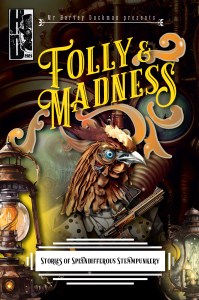
Drink Up Me Harveys, Yo-Ho – Harvey Duckman Presents Volume 11

I feel a thirst upon me, for rum to quench the taste of salt…
(also there are both 15 authors and 16 authors in this edition. One of them is a lie)

Ben Sawyer's avatarBen Sawyer

A classic edition of Harvey Duckman Presents is rising from the briny depths once more with a new look.

In the long-forgotten before times of 2020, a plan was hatched to concoct a pirates-themed special of Harvey in between the regular numbered editions, assembling 15 authors on a dead man’s chest to pen swashbuckling tales of fantasy, horror, sci-fi and steampunk.

This collection is now being re-released as Harvey Duckman Presents Volume 11, bringing it into line with the rest of the range, and boasting spooky new cover art blending the book’s fantastical and piratical sides.

In these dread pages lurks Dig, Says Doug, my story of shipwrecked mariners and cosmic horror, revealing what truly lies where X marks the spot.

The collection includes stories by Amy Wilson, Ben Sawyer, Kate Baucherel, Mark Hayes, Melissa Wuidart Phillips, C.G. Hatton, A.L. Buxton, Reino Tarihmen, Liz Tuckwell, R. Bruce Connelly…

View original post 41 more words

Posted in Uncategorized | Leave a comment

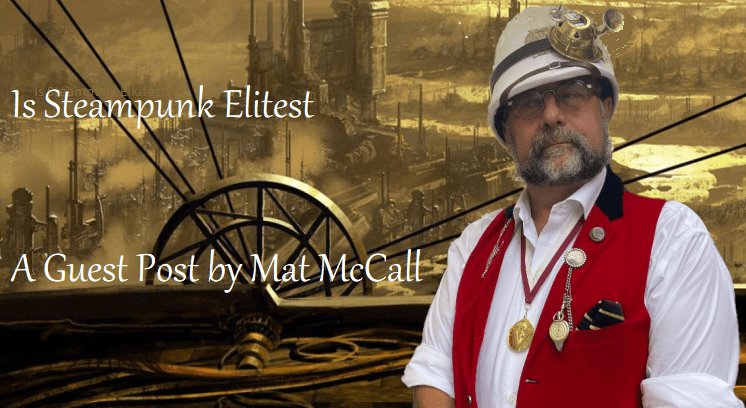
Is Steampunk Elitist? A guest Post by Mat McCall

Facebook is a strange place, mostly people post unimportant stuff, like what they are about to eat, where they are about to eat it, who they are eating it with, their daughter getting her Master’s in Education, and of course cats…

Once in a while however someone writes something on Facebook worth reading, other than my daughter getting her master’s degree. As my friend, fellow author and careful groomer of a fine muttonchop beard, Mat McCall had such a moment of profundity recently, I badgered him to let me reprint it as a guest post, because on occasion when people have something to say it is something worth listening to. This is such an occasion. So, I’ll shut up and let Mat take over for a while…

Is Steampunk elitist?

In my time involved in the Steampunk community, I have been asked one question several times. Sometimes in the form of observations and sometimes as straight-out questions. Basically, the question goes something like this; “Why do Steampunks always dress up as wealthy Neo-Victorians? What about the workers and the poor, why don’t Steamers dress up like them?” This question then is often followed up by something like; “Isn’t that just snobby?”

The assumption seems to be that Steampunks only view their fictional past, and their hobby, through the elitest eyes of the pseudo-upper middle class, and thus are not celebrating the fact that all the great strides in cultural achievement are wrought by the hands of the working class.

In fact, Isambard Kingdom Brunel never built a single bridge, he designed them, he engineered them, but he never built one. The workers did, poorly paid, ill-treated, undervalued and unrecognised, it was their blood, sweat and tears that built Brunel’s dreams. Why then don’t Steampunks celebrate them?

Or is it just about putting on your best frock coat and corset and getting your picture taken?

It seems a good question, and I can only really answer it for myself.

Firstly, there are actually a lot of Steampunks who explore the engineers, workers, and even chimney sweep roles of their Noe-Victorian imaginings. A lot explore the darker side of their worlds taking up personas of criminals and rogues. And of course, soldiers. None of these are affluent roles.

For me though, and I do not think I’m alone in this, it is both a matter of choice and inspiration. My inspiration comes from the novels of Verne, Wells, and others. Their characters were not the landed or industrial rich, but reporters, scientists, academics, and adventurers. In that, they were better off than the poor working class, but still often outsiders and oddballs. From Verne’s Professor Otto Lidenbrock to Wells’ Mr Cavor to Fleming’s Commander Caractacus Pott.

I admit, though I’m no inventor, but I identify strongly with them as outsiders, though I do not attempt to Cosplay them. Nor any of my own literary characters for that matter.

But the true reason I personally do not portray character personas of the poor working class of a pseudo-Victorian age is that Steampunk is escapism for me. Escapism from the real world.

In my real-world life, I have experienced poverty, both that of being virtually destitute to living the hand-to-mouth life of the working poor.

I was homeless at 7 years old; my mother went without meals on a regular basis to feed us. She wore the same coat and broken glasses for most of my childhood so we could eat and have shoes on our feet. I’ve worked in the factories, I’ve shovelled shite, and washed it off clothes, beds, and floors. I’ve cleaned the toilets.

I do not wish to ‘cosplay’ something that I have lived through. I don’t want to pretend to walk around in dirty, shabby clothes, broken shoes, and torn coats, because I once, in fact throughout my childhood and adolescence, had to. It was my reality.

And, I think, from what I know of so many of my friends within the Steampunk community, my experiences, as an outsider and knowing poverty, means that we probably do indeed shy away from those roles and characters. Not because we denigrate them, or devalue them, but because they would be too close to the brutal realities of our lives.

For most Steamers, Steampunk is pure escapism with a nod to a history that never happened and a genteel idealism beyond any reality.

And Thank you Mat.

Mat is far too humble a man to say this, but he is a fine writer of books, the third of his Steampunk Mars trilogy is eagerly awaited, as is the sequel to Annis the first book in his heroic fantasy series.

I have previously reviewed all three of Mats novels (links below) if you have not read them then you so do yourself a favour and read my reviews, then go and read his books, as they are frankly wonderful. He also has a short story appearing in the tenth Harvey Duckman Anthology, which pleases me greatly.

Posted in amreading, books, fiction, Harvey Duckman, indie, indie novels, opinion, quotes, rant, reads, sci-fi, steampunk, writes, writing | Tagged , , , , , , , , | Leave a comment

I’m not good, but who is.

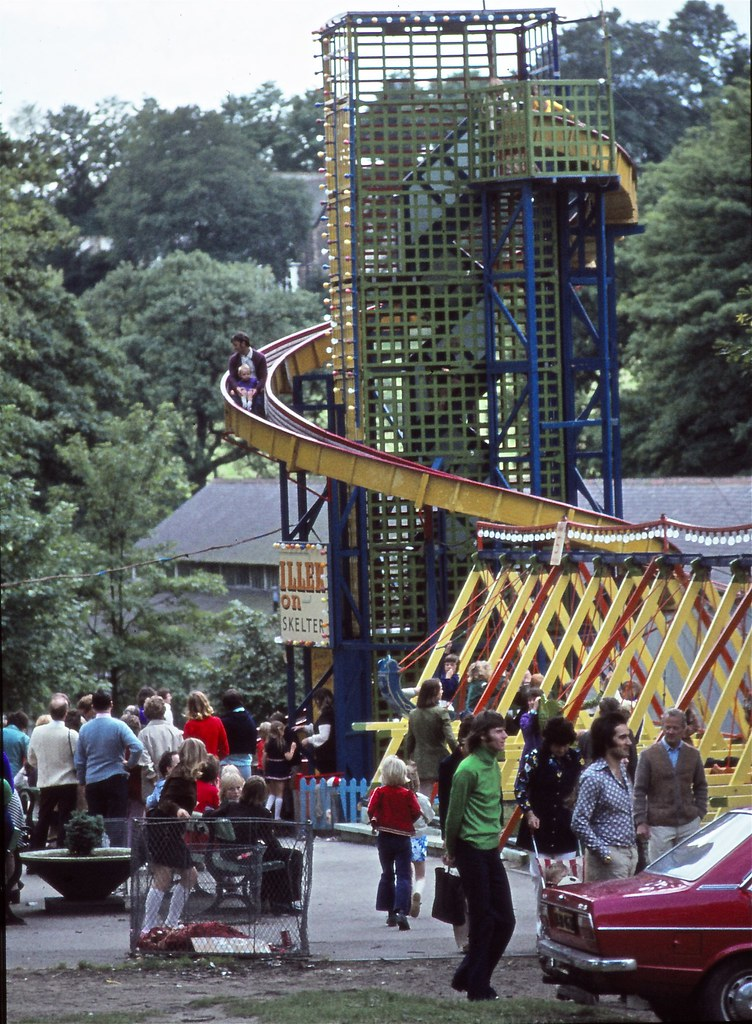
When I was a kid at Pudsey park on the outskirts of Leeds, just across from the abandoned Traction Engine steam roller, in the main play ground there was a Helter-Skelter.

It was a proper Helter-Skelter, a huge wooden construction. It was not dissimilar to the kind that normally toured with small fairs. The kind that required you to carry a mat up to the top and sit on a it to slide down. Also unlike the ones that went around with travelling fairs this one was a permanent fixture. An enormous construction if fact, taller than most of its ilk and the slide mats were even more worn than they were at fairgrounds. But that was okay as you didn’t need to pay to go on it, and once you had slide all the way down you just grabbed your mat and climbed back up to go again…Which in the golden summers of my childhood I would do again and again…

Except, this isn’t true.

There was no Helter-Skelter just across from the traction engine in Pudsey park. I had just convinced myself for years that there had been. It is an utterly false memory.

There was a Helter-Skelter at Roundhay Park over on the other side of Leeds, and it is this my memory has long since transplanted to Pudsey. But it was never free, and you couldn’t just keep going up and down on it.

I started this blog post in May. The title meant something at the time, but I never got further than the Pudsey Helter-Skelter. It spoke of my state of mind at the time and my general sense of self. I chose to stop writing the post back then because I was not in the right state of mind to share my frame of mind… Which is one of the problems with a certain frame of mind, certainly for me.

The title still means something… I am however in a better place than I was back in May and have been for some time I may add. This is in part due to a lot of people who are I suspect unaware of the part they have played in me getting to a better place. Suffice to say there are many of them and many reasons why they have helped, knowingly or otherwise.

The point in dragging out this half finished post, is just to say, that even when things look dark, there is always a dawn on some horizon that will come eventually. Even if the Helter-Skelter’s of our memories never existed…

Posted in big questions, depression, dystopia, insomnia, mental-health, opinion | Tagged , , | 1 Comment

Talking books…

“Are they available in audio…?” I get asked for the fifth time that day. At which point I start to explain, in my usual fluid, utterly self-confident, and in no way panic-stricken way that unfortunately they are not…

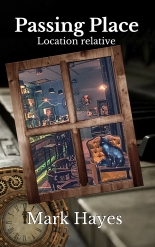
I’ll go on to explain this is because of the prohibitive cost involved in professionally recoding a novel. For an experienced but relatively cheap recording artist it would be a minimum of £15 an hour, for an average of 10 hours per 10000 words. For, in the case of Passing Place, a novel with 110000 words. Sure, the Hannibal books are shorter, and maybe rolls it at around 70k, but at around £150 per 10k words I’m not spending that kind of money for anything less than the novel I consider to be my best.

There is a degree of arrogance to my opinion of Passing Place which people occasionally pick up on. Which is to say I happily state it is greatest novel ever written (by me) which is not a very British thing to say about your own work. In my defence I specifically said it’s the greatest ‘written by me.’ That doesn’t necessarily mean a great deal, but its readers generally seem to have positive things to say about the book. At least the ones I manage to convince to give it a read, who then give me their opinion…

Some people have bought Passing Place and then never say anything about it to me afterwards. Either it got put on their to read pile and forgotten about, which is a horrendous fate. Or they read it and didn’t even find it interesting enough to venture an opinion. Or they just hated it and are too polite to tell me so… I could not honestly tell you which is the worst fate… Though it is always mildly worse when the readers concerned are people who’s opinions you suspect you would hold in great value…

But not to get distracted by my own inner neurosis’s….

The point about audio books is that in order to record an audio version of Passing Place I would have to outlay around £1650. This is a somewhat of a large outlay for the audio version of a book that despite being the greatest novel ever written by someone called Mark Hayes, at least one specific Yorkshire-man called Mark Hayes, specifically this one… has not exactly been a bestseller.

Passing Place has been in print for six or so years now. In that time it has made substantially less that £1650. About a fifth of that figure in fact, if I am being generous, in the whole six years… It is my least successful book by some margin in this regard. Indeed in every regard except the critical acclaim showered upon it by those few I have convinced to read it. In short, while I am clearly a little mad, I am not that mad…

So “No they are not available in audio…” I explain, and then, because I have started talking and starting talking is the single hardest thing in the world, I go on to explain all those details above, while whoever asked is clearly someone who doesn’t generally read as they prefer to consume their literature in audio fashion, so sin’t going to buy a book, or indeed maintain an interest in what I am saying.

They start giving me funny looks about this point…

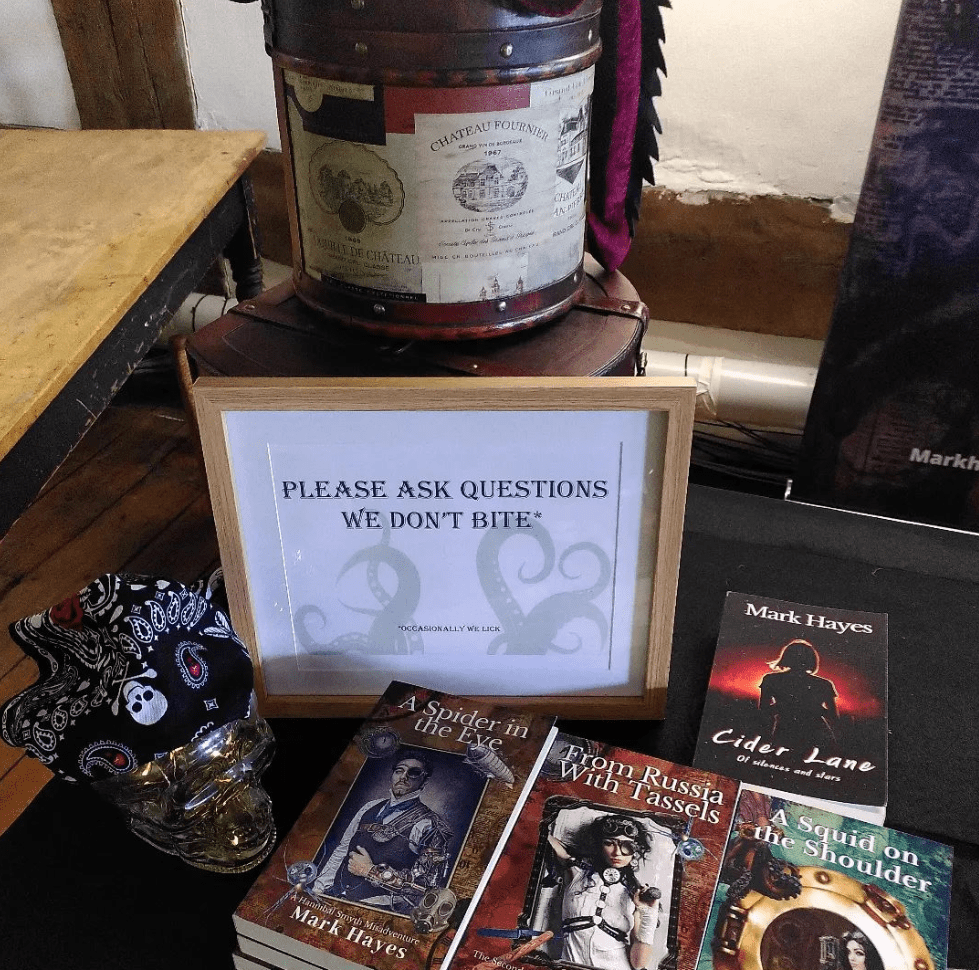
All of this isn’t in anyway what I intended to talk about when I started writing this post. It does however illustrate what I wished to talk about quite well. The point being I am in person, when stood behind a table with books upon it, far from the confident charming erudite intellectual you might otherwise expect. If, that is, you have never met me or read between the lines in these blogs.

I hide my shyness behind layers of fake confidence, occasional smuttiness, and attempts at friendliness that are so often misjudged as smug arrogance, because I am just not very good with people I don’t know. Or indeed people I do know… Just people in general in fact… And when I feel such interactions are going badly they start to go worse…

Occasionally, I fend off these demons even if I never defeat them. The weekend just passed was not one of those occasions. As much as I enjoyed everything else about the weekend, in terms of being a bloke stood behind a table talking about his books it wasn’t one of my better ones…

Though few questions were asked of me “Are they available in audio…?” was about the only question I managed not to feel like a fraud when answering. So about the only one I ever answered well…

The right answer to questions like “What are your books about?” and “Tell me about this book..” I know well. I just never give them at the time I am asked…

If your interest the correct answer’s are:-

The Hannibal novels are satires on both the modern world and colonialism, set in a steampunk universe moved forward to the modern age. They are full of strange technology, mad scientists, strong women and foolish men… Hannibal himself is a coward and a rogue, though neither as cowardly or as roguish as he proclaims himself to be. A man of contradictions who relates his tale, after telling you he’s a liar, while sat in a leather armchair drinking port and smoking a good cigar before a roaring fire in his dotage.

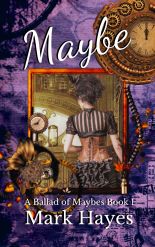
The Maybe books are straightforward steampunk novels set some 150 years before Hannibal’s time at the point where HG Wells is about to change everything and history will; diverge. They follow the adventures of Eliza TuPaKa a strong minded young woman and engineer of mixed race descent, attempting to solve her fathers murder, with the aid of Benjamin West and his former manservant Mr Gothe.

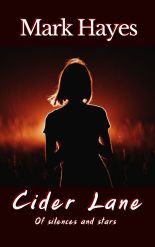
Cider lane is a contemporary if unconventional romance, between two people who have fallen off societies edge, coming to terms with old wounds and recent ones that have left them broken. It’s fucking complicated but is also about the importance of tin openers.

The Lovecrafts book is whatr happens when you write a blog and have too much time on your hands…

And Passing Place is…

Oh for the sake of the old gods and the wolf king of winter it’s just the best novel I will ever write, just read it please…

Posted in amreading, amwriting, books, fantasy, fiction, Hannibal Smyth, indie, indie novels, indie writers, novels, opinion, publication, rant, self-publishing, steampunk | Tagged , , , , , , , , , , , , | 6 Comments

A bit of genealogy and the Dutch

I don’t know what my paternal Granddad did for a living. I’ve never known. It never occurred to me to ask my dad what his dad did for a crust. Genealogy has never really been much of a thing for me. Though recently I did comes across a very old black and white picture of Edna Fields in a white frilly dress, aged 2, my maternal Grandmother, which brought a tear to my eye because of all my grandparents she is the only one I actually remember properly. A strong Leeds woman full of life who raised her daughters on her own after her husbands early passing, and used to slip 50p coins in my hand and give me a sip of sherry when my mum wasn’t looking…

My paternal grandfather had a stroke when I was little more than a toddler and though he lived on for several years all I really remember is a shuffling old man who couldn’t talk properly and scared me just a little. In fairness I very much doubt that image does any justice to Mathew Hayes, or that he would ever wish to scare his young grandson. But the image of an sick old man is all I really have of him, beyond that I really know nothing.

Just how little I know of my family can be summed up by an old brown suitcase, probably at least 80 years old, currently sat on my kitchen table. A suitcase I dug out of the loft at my parents old house a few weeks ago, along with several boxes of more recent photos and photo albums that cover the entirety of my parents lives together and mine and my siblings childhoods, as well as all their grandchildren…

Basically some idiot volunteered to digitise 60+ years of family photos. A task of near herculean proportions, and looking at many many murky pictures of landscapes, the sea, and figures that could be someone I know but may have just wondered through frame…

That suitcase though is a treasure trove of a different nature. A Fields family history in really old photo’s like the one of Edna aged 2, ration books, bomber crew manifests, pictures of war graves, and other oddities. Stuff I want to documents but don’t really know where to start with. For instance why was one of my maternal ancestors in the highland infantry? I aren’t aware of any Scottish blood in the family.

In short, I don’t know what either of my grandfathers did for a living, let alone my great grandfathers… Something I find myself feeling slightly sad about.

Anyway, on that slightly down note, I feel its time to take about something more cheery. But in keeping with the genealogy theme, because yes of cause there was a point to all that preamble, lets talk about the fascinating and slightly wonderful genealogy of Nils Visser… Writer of many things ( and several names)

The Flying Dutchman is one of those fabulous myths of the European cannon that sprung up from no where much, based on sailors tales, and took on a life of its own thanks to the core of the myth being leapt upon by writers, playwrights and an Opera.

The Opera genesis is a fun story all on it’s own. Wagnar adapted his ‘The Flying Dutchman’ from a chapter in a satirical novel by German writer Heinrich Heine ‘The memoirs of Mister Von Schnablewopski’ in which the lead character attend a performance of ‘The Flying Dutchman’ a play by the English playwright Edward Fitzball. A play which Hiene was believed to attended a performance of in London for many years, despite not arriving in London until seven days after the plays run at the Adelphi theatre ended.

So its a German opera, base on a chapter of German satire (who knew), based on an English play, that the author never saw…

As an aside, here is my favourite Wagnar fact you never really hear as everyone always says the one about him being Hitlers favourite composer. They always say this as if Wagnar’s is some how at fault for Hitler, which is harsh given he died six years before the goosestepping nazi twuddlefunk was even born… My favourite fact about Wagner is he was close friend of Nietzsche and had an affair with the old void starers sister. Though of course the same could be said of Nietzsche, theirs was a close family.

I read a fabulous book by a friend of mine about Nietzsche sister once, It’s why I know things…. (clink here to find out more)

That German opera, (which in fairness, given its Wagner, is really good if a tad Teutonic…) went on to inspire the writing of ‘Der Fliegende Hollander’ by German author Philipp Korber. Presumably in the 19th century equivalent of ‘The book of the movie’. Because cashing in on the popularity of a story in another medium ain’t even slightly new as a concept… Dutch publishing company Gebroders Kluitman then had it translated into Dutch, possibly just because the dutch and the Germans have such a friendly relationship… Then later, the translation being reasonably successful the publishers decided to pay a writer called Piet Visser to do a full rewrite.

Piet who, as it turns out, is the great-grand-uncle of Nils Visser a man who may or may not know what his granddad did for a living, but did stumble into his great-grand-uncle’s profession and become aware of Piet’s work. About this point he decided it would be an interesting idea to write his own version of the myth, however because its Nils and he’s incapable of doing anything by halves, that was four years ago, and his research notes at the end of book one would give Grandpapa Tolkien raise a smile.

(Nils once asked me to go through three chapters of another book he is still writing in order to fix the dialogue of one character so it was in an authentic 18th century Yorkshire dialect, Nils takes authenticity seriously as anyone who has read his Sussex Smugglepunk tales will testify, (and if you haven’t read them you should))

The result of years of arduous and meticulous research turned what was originally planned to be a single novel into a trilogy. The first of which was finally released last month. It’s extremely good and has only one flaw that I have noticed, and I ain’t telling anyone what that is… But anyway that, and the grand Hayes family photo history project are what got me Wondering what my granddad did for a living… But anyway I should probably do a review of the book don’t you think? Yes, that is the point of all this waffling on after all…

Bleak Future : The flying Dutchman book 1 ~ Nils Visser

Nils Visser is one of the finest writers of historical fiction I know. This novel, all be it leaning into fantasy, is no exception. Nils is not one to shirk his research, he must agonise about every detail because he gets those details right. Not just little things like the kind of boots people wear, but the big things that matter that so many writers of historical fiction get wrong. The world Nils creates, in this case the early Dutch Republic, feels as it should because the way people speak and think reflects the time period and the region. Social attitudes, political attitudes and peoples relative positions in society all just fit together. And then, having built this society, he tears it down from within.

Most writers writing a strong female character in a historical setting have them reflecting modern attitudes and virtues. Indeed the same can be said for those writers male characters. All of which is fine,if that is the intent in the first place. The Princess Bride is a fine example of modern characters in a ‘historical’ setting. The trouble is most writers doing this fail. What Nils does is something that requires far more talent and skill than most writers possess. He writes characters that fit the worlds they are in perfectly, and rail against it or double down. A trick he has pulled off perfectly with the POV characters in this novel, twins Liselotte and Andries Haelen. The first you will love for her ‘screw this’ rebellion and determined attitude. The latter you will slap some sense into, or just slap, because he is exactly what his father and society made him, with a few redeeming qualities, that even then require him taking a good hard slap somewhere along the way.

It says something about both characters and how well they are written, that when I read page 177 I punched the air and said ‘Yes, about bloody time you said that to the twat’ rather loudly, for one in the morning…

Andries grows up a little as the book goes on, which makes you less inclined to slap him silly. Lotte on the other hand just erupts from the page and from the confines of a society in which she should be seen and not be heard. Much to both the horror and the pride of her twin.

This is a novel of Character and detail. So many details that in the hands of a less charming, skilful writer would weigh down the text. Nils manages to do the opposite, all his details, his painstaking research, his careful attention to place and period, lift up the text. It gives it life, vigour and a sense of truth.

I honestly have no idea just how true to the 17th century Dutch world Nils’s novel is. But that’s not the point, it feels real and it feels like all the details are correct, so they just become the canvas upon with the story and characters are painted.

Its a fabulous, engrossing read, and I can not wait for the next two books in the trilogy.

It also has wonderful art work, both on the Tom/Nimue Brown cover and the internal illustrations (I love a novel with illustrations) by Julie Gorringe. which is just lushous.

Click on the book and you shall be transported to a place where you may purchase it

Anyway, you should invest in a copy of Bleak Future. As for me , I am off to message my uncle Denis last surviving member of a generation on my paternal side, and ask him what his dad did for a living. I feel its something I should know, after all we all need to know where we come from.

It helps us know where we are going.

Posted in amreading, big questions, book reviews, books, fantasy, fiction, goodreads, indie, indie novels, indie writers, indiewriter, novels, pirates, reads, steampunk, writes, writing | Tagged , , , , , , , , , , | 1 Comment