Creative Osmosis: Indie October Guest Post By Nils Nisse Visser

ind oct gp 9

Please don’t get me wrong on this. I receive short book reviews with fierce and joyous exclamations that will startle the cats into a sulk. I’m at the self-publishing Indie stage where reviews, rather than the occasional sale, are the measure of success.

From that perspective, the length and complexity of a review is irrelevant. “I liked this book” is enough. Some of my favourite reviews are thunderous in their brevity. “Insanely well-written” for Escape from Neverland, and – I suspect by the same reviewer – “KICKS ASS” for Dance into the Wyrd. What more do you need to know? Plus, it’s pretty clear to me that the reviewer has read the books. J

I probably risk undermining the message that ‘any sort of review will do’ by gushing over longer and more comprehensive ones, but those longer ones do something entirely different. In their own way they’re as priceless as “KICKS ASS” and “Insanely Well-Written.”

Apart from the sheer magic of realising that there’s someone out there who has demonstrably grasped the essence of a story, and their generous allocation of time in digesting a story comprehensively, it’s also awfully kind of them to formulate that essence in a manner which I could never do myself. I can write a book, but please – OH HORROR – don’t ask me to describe it.

I can get as far as saying, “Look, I did a thing, where before there was nothing, kinda neat, isn’t it?” If you respond, “Yeah, cool, what’s the story about?” (like a normal human being showing interest would), I withdraw back into my shell. “Erm…ah…nothing much…I dunno…you probably shouldn’t bother…”

Every now and then a reviewer manages to phrase what the story is about with such eloquence that it not only leaves me stunned, but also arms me with an answer to that “what’s the story about” question. I can now answer, “Well, so and so says…” Somehow that is easier.

 Every now and then, a review is so sirageously awesome, that the aftershocks of sheer jubilation transform into renewed inspiration for stories.

I have been fortunate enough to receive two of these reviews recently, for the novella Rottingdean Rhyme. One by Nimue Brown and one by Mark Hayes. I’m profoundly grateful for these reviews, more than they will ever know, so have no hesitation to gush wildly about these two reviewers, and their skills in unravelling aspects of Rottingdean Rhyme.

Through these reviews, both Nimue and Mark have, unwittingly, made a big mark on the two novellas which complete this mini-series regarding the childhood years of Alice Kittyhawk, protagonist of Time Flight Chronicles Book 1: Amster Damned.

Nimue for Them that Ask No Questions (just published), and Mark for Fair Weather for Foul Folk, still in progress.

I’m not entirely sure they’ll be pleased to have been allocated parental responsibility for the stories, so will have to turn to you, the jury, to demonstrate that their creative DNA, strands of their own writerliness as it were, have been woven into the stories about Alice.  I’ll do this in two parts (sharing this same introduction), covering Them that Ask No Questions on Nimue’s blog Druidlife, and Fair Weather for Foul Folk on Mark’s Passing Place blog.

(note the post on Druid life can be found here https://druidlife.wordpress.com/2019/10/10/creative-osmosis-a-guest-blog/   )
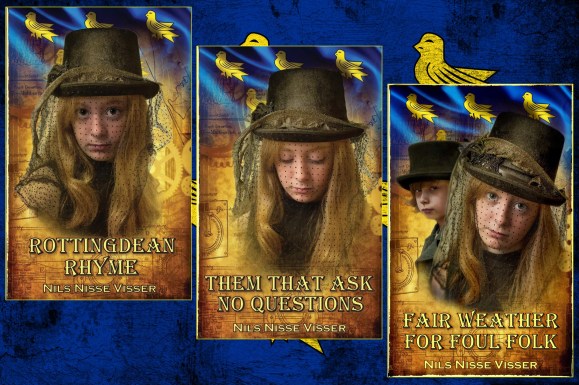
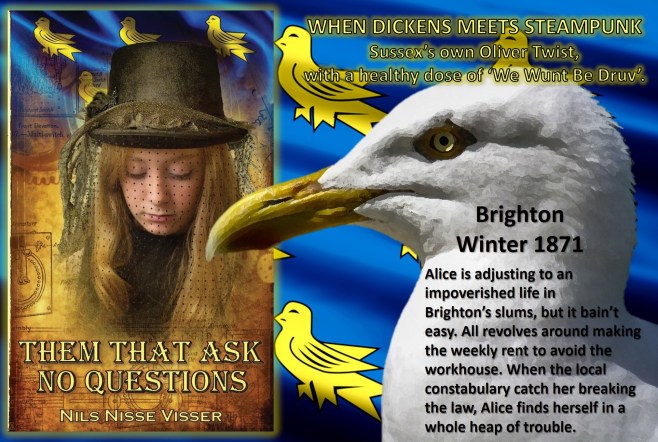
THREE COVERS ON SUSSEX FLAG

 FAIR WEATHER FOR FOUL FOLK

In his ‘Smugglers of Sussex’ blog (https://markhayesblog.com/2019/06/03/smugglers-of-sussex/) Mark reviews Rottingdean Rhyme, which he describes as a “wonderfully rich and vibrant novella,” as well as noting that my take on Steampunk has been to weave it into local Sussex smuggling lore.

He points out that smuggler’s tales can be found along most of Britain’s coastline, that local smugglers tend to be revered and/or romanticized by the natives, holding a special place in their hearts. Mark also rightly identifies that many of these smuggler’s tales have a lot of common denominators, storytelling traditions as it were. Whilst recognising these roots in Rottingdean Rhyme, he’s also kind enough to point out that I’ve taken old folk tales to fuse them into something new.

I had been thinking along similar lines for the third novella: Fair Weather for Foul Folk. None of the previous stories had an actual smuggling run in them, they were described from afar, because I was gambling that most people are familiar enough with smuggler’s tales to be able to fill in the blanks by themselves, leaving me to concentrate on the airships my Sussex smugglers employ for their business of Free Trading, and character development.

Yet…yet…I wanted a proper smuggler’s yarn for Alice, involve her in a run, bringing a crop from A to B, chased by Customs & Excise or the Royal Aero Fleet.

Mark’s review spurred me to make this wish a reality, to delve deeply into local traditions once again and steal everything that wasn’t nailed down be inspired by all I found.

I had already identified a setting. Until now the stories were set in Rottingdean and nearby Brighton. I wanted to expand farther along the Sussex Coast and knew exactly where.

I have spent many hours exploring the maze of Hasting’s Old Town, as well as the St Clements smugglers caves. One could not wish for more, but Hastings has another historical gem, one of those factual, historically accurate anomalies that sounds so far-fetched that readers will think I’ve gone mad expecting them to believe it. Well, believe it or not, there’s a small area of Hastings which declared de facto independence from the United Kingdom, back in the early nineteenth century. They build a palisade around their settlement, and raised the Stars and Stripes, as well as electing a governor. He read the American Declaration of Independence out loud and proclaimed the small stretch of shingle beach (1500 yards long, 500 yards wide) as a territorial component of the young United States of America. This within living memory of the American Revolution. What’s even more astonishing, is that records indicate this small corner of the United States, right on England’s doorstep, managed to sustain independence for a good 35 years, possibly longer. This stuff is just too good to ignore, so if I were to stretch that independence by another quarter of a century, I could have Alice pay a visit to the America Ground, as the place was called.

As for tales, I was lucky enough to get my grubby hands on a copy of a rare book written by a Hastings local who was a young lad when smugglers were still active (Reminiscences of Smugglers and Smuggling by John Banks, published in 1873).

I could simply incorporate some of these historical accounts and give them a little twist of my own.

Visiting the small town of Rye, further east along the Sussex Coast, was another eye-opener. There’s a small museum in Ypres Tower, the small castle overlooking Romney Marsh, which has devoted considerable attention to local smuggling history. To top my visit off, when I was by the old-lookout point, atop of the former city walls, I was approached by an old-timer, silver beard and all. I’d told no one about the reasons for my visit, and didn’t ask, but he went straight into yarning away about smuggling. He described how a fog would drift in over the marshes from the sea, and how that would intertwine with the mist rising from the gullies, ditches, and tide channels in the marsh, to form a thick blanket over the marsh, to which he added, “and folk would say: Tis fair weather for foul men.”

As you may imagine, I was in full Jake Blues ‘I have seen the Light!’ mode, furiously scribbling down notes, and you may recognise the origin of the title of this novella.

As for tales, Rye is rich in them. There are accounts of members of the notorious Hawkhurst gang drinking at the Mermaid Inn, guns and cutlasses openly on their tables and boasting of their exploits. Furthermore, the Inn itself has smuggler’s tunnels, priest holes, and many reputed ghosts (of smugglers!). Naturally, I went for a pint in the taproom (scribbling more notes all the while).

Rye was also home to John Ryan, the creator of Captain Pugwash, a popular children’s series about pirates. I didn’t know this when I arrived in town but was delighted, as I couldn’t get enough of Captain Pugwash when I was a kid. As a matter of fact, it was those stories that inspired my lifelong ambition to become a pirate when I grow up (some day). I also discovered a new story, Captain Pugwash and the Huge Reward. Set in the town of ‘Sinkport’ (which has exactly the same streets and buildings as Rye), it sees Captain Pugwash’s involvement in local smuggling. Obviously, I can’t steal Ryan’s characters and stick them in a Sussex Steampunk Tale, but I did want to reflect some of the sheer fun of Ryan’s stories in Fair Weather for Foul Folk.

As if that wasn’t enough, Rye identifies strongly with Russel Thorndyke’s Dr Syn stories, also made into movies, tv series, plays, audio adaptations, and comics. These stories are set in Dymchurch, Kent, but both Rye (in Sussex) and Dymchurch are part of Romney Marsh. Outsiders may draw a county border through the marsh, but marsh-folk are marsh-folk and will stick together.

The fictional Dr Syn was a vicar who doubled as a smuggler, known as “The Scarecrow” (and disguised as such), as well as leader of a smuggling gang called The Hell Riders of Romney Marsh. Unfortunately, Thorndyke sold the copyright to Disney, and Disney is a terrible foe to have if they perceive anyone to be meddling with their rights (is there anything they don’t own?). So, no Dr Syn, Scarecrow, or Hell Riders, and probably best to stay away from Dymchurch. That isn’t really a big problem, because the most fascinating feature of Dr Syn was the Dr Jekyll and Mr Hyde aspect of his dual personality. Syn was gentle, compassionate, intelligent, and well-mannered. The Scarecrow a rogue capable of being utterly ruthless.

Outsmarting the Queen’s Men is a universal theme in smuggler’s tales, so definitely not exclusively Dr Syn. Neither is the dual personality, as the reference to Jekyll and Hyde already suggests. So that will be the way to go, watch out for two characters, in Rye, Sussex (not Dymchurch, Kent) who may well be the same person.

Each setting will introduce new characters, semi-historical and some partially based on local Steampunks and Pyrates who have volunteered to crew despite the risks (I am disturbingly fond of killing characters off, especially if they are likeable). Those who survive, will accompany Alice to the next lot of books, novels this time, which deal with her teenage years.

So, there you have it, most of the ingredients required for a ripping yarn, like the ones they used to tell in taverns up and down the coast. Deeply rooted in folk traditions, but hopefully renewed for modern audiences, Steampunks or not. I’ve already progressed quite a bit and hope to publish before Christmas. If I pull it off, Mark can claim some credit. If I don’t, we’d best delete this guest-blog and nary a word will be spoken of it forever and longer.

The novellas are set up as stand-alone stories, so can be read in any order you please, but they also form a series. If I’ve whetted your appetite for Fair Weather for Foul Folk, and you don’t want to wait, do consider giving Rottingdean Rhyme or Them that Ask no Questions a try. The Kindle versions are cheaper than contraband brought ashore on a dark and moonless night.

Fair Winds!

Nils

About Nils Nisse Visser

nilNils is a free-lance writer, occasional poet, archer, Homelessness activist, who was born in Rotterdam in the Netherlands in 1970 (which was the best year ever to be born *Mark), he grew up in the Netherlands, Thailand, Nepal, Oklahoma, Tanzania, England, Egypt and France. Taught English at various Dutch secondary schools for 18 years, but his firm belief that education is most effective when it is fun raised a few eyebrows. Having been told too often that he lived in his imagination, he took the hint and moved there on a full-time basis. He currently lives in Brighton in the county of Sussex in England. 

Rather confusingly he sometimes writes as Nils Visser, Nisse Visser or Nils Nisse Visser. For which he apologies.

His latest Novella ‘Them That Ask No Questions was released a few days ago, clicking on the picture below might just take you to it, as if by magic…
kick off add VERSION TWO


Posted in amreading, amwriting, book reviews, books, Canadian steampunk, fantasy, fiction, indie, indie novels, indie writers, indieoctober, indiewriter, novels, reads, sci-fi, steampunk, writes, writing | Tagged , , , , , , , , , | 4 Comments

Writing Without Time: Indie October Guest Post by Meredith Debonnaire

indie october 7

WRITING WITHOUT TIME: Being a poor indie writer trying to write while juggling with two-and-a-half jobs and the electrified zombie of your social life.

I often see advice for writers along the lines of “Write every day” and “set aside two hours every day” and “have a writing room”, and while none of this is necessarily bad advice, it’s not precisely helpful to those of us who don’t have a lot of money or time. This kind of advice can be very pervasive, to the point I’ve seen big name authors say things along the lines of “if you don’t write every day then you aren’t a writer” and “you must have a dedicated writing space” and none of this takes into account that most of us are poor, okay? We’re poor. You might live with your family and not have your own room. You might be sleeping on a friend’s sofa. You might have children or be working a lot of jobs, and you probably can’t afford that super special Author’s Pen. And all the above can make it feel as though you are an imposter: I know it did me.

The only time I’ve managed to have time dedicated to writing every single day was when I was 17 and my dad was supporting me financially. I wrote a novel featuring nihilistic vampires who locked each other in volcanoes and werewolves who worked in the A and E department. Everything since then has been fitted in around all the stuff I have to do in order to support my “Being an alive and fed human being” habit. So here are some odds and ends of advice about writing without time, which may or may not be helpful. Hopefully they’ll at least give you a laugh.

Dedicated writing space is a shiny added extra, but sometimes your best work is going to happen on the aeroplane home from a funeral while sitting next to a screaming five-year-old.

Or in the launderette. I do good work in the launderette. It would be lovely to have a writing room, with a clear desk and a door and no interruptions. For a lot of us this is a dream that may never make it into reality. I’m here to say that you don’t need one. It’s harder, I won’t lie, but you can write on the bus, in the launderette, in bed, on your lunchbreak. It’s frustrating because it takes longer and it can feel like breathing in snatches, but it is possible and you are still a writer, I promise. Even without the special Author’s Pen and Mug. I wrote the beginning of The Life and Times of Angel Evans on loose paper ripped from the back of a diary. I wrote Tales From Tantamount while taking breaks from Tax Returns, in a doctor’s waiting room, and while off my face on out-of-date cough medicine on a friend’s sofa. You can do this, and, as long as you make sure you’ve got a pen and paper or a smartphone you can type notes on on your person, you can do this nearly anywhere.

You must suffer for your art, but only prettily!

This is a lie. You don’t have to suffer for your art. And not all of us can afford to have an aesthetically pleasing breakdown and retire to an attic studio in the countryside where we subsist on tea and biscuits and write our hallucinogenic memoir. That takes money. So, to reiterate, your mental health is important and you don’t have to suffer for your art. You have to work, yes, because writing is a skill that takes practice like any other skill, but you don’t need to suffer. Enjoy your art, celebrate your art, insist that you get paid for your art, and refuse to move into the haunted attic: that ghost isn’t going to split the bills with you.

Conversely, if you are suffering (for your art or otherwise) get help. Talk to friends. Talk to other writers. Talk to professionals if you can access them. Chat about your ideas and your writers block. It may cut into your preciously tiny amount of time for writing, but it will help. If you’re in a position where your livelihood is at stake, don’t feel guilty about putting your writing on hold while you deal with that. There will be no more art if you die. You can go back to writing once you’ve figured out how you’re living.

Write every day.

Look, I can see why this is popular, but personally all this one leads to is guilt. So for anyone who needs to hear it, you don’t need to write every day. Maybe today is the day you lost your job, your cat, your marbles. Maybe today the washing machine ate your knickers and you set the fire alarm off. Maybe today you did your accounts and all the bills are spread out on the floor and looking at them makes you want to cry or scream. You don’t have to write every day. You can take a day, a week, a month, and then come back to it knowing you’ll be fresher for the break. And very likely there are work/childcare/other logistical reasons that get in the way of writing every day, and that’s alright. You know your life best, and you’re going to know where the gaps are that writing will fit into best. And if that’s once a fortnight while you’re on the bus between work and picking up the kids, that’s okay. If that’s once a week when the insomnia really bites, that’s okay too. You’re still a writer.

You have to live alone with an insomniac cat and refuse social calls.

No. Remember the electrified zombie in the title? The one that is your social life? It’s very important. You need friends. You are a squishy mammal that needs other squishy mammals. Go outside and look at ducks on the canal. Go outside and sit in a park. Text a friend. Talk to people. You need to keep that zombie alive. For the sake of your mental health. And if that doesn’t work for you as a reason, frame it as gaining new stimulus for ideas for writing. Having a supportive network is really important for indie writers, because we are mostly  poor and we tend to be very busy and get caught up in ideas and forget to go foodshopping. We need people around who are going to gently check in on us and who we can tell our bonkers ideas to. Cultivate friends, because they are good. And get a cat if you actually want one.

So Meredith, tell us your writing techniques if you’re so wise!

I have a lot of writing techniques, but most of them boil down to desperately fitting in writing wherever I can around whatever part-time work I’m doing at the moment, and experimenting wildly. I write because I enjoy writing, and I think that’s the most important part. That you enjoy it, that even when you’re tearing your hair out because the characters have staged a rebellion and now the plot won’t work, you enjoy it. If you’re stuck, go back to what you love about it. If your current project just won’t fit in around your job, maybe put that project down for a bit and experiment with something else. If the short story is not progressing, give yourself a break and write a haiku instead. It doesn’t have to be good, just get it on the page and you can refine it later. Most of all, I think be compassionate to yourself. If other people are doing way better and you’re berating yourself about that, check in and see if they have access to resources you don’t. If someone else has a publicity team and inherited money and a partner with a stable income, they’re going to have more time and space than you. Go easy.

And most of all, keep that electrified zombie social life going! It’s very important.

About Meredith Debonnaire

merryMeredith Debonnaire is a writer of strange fantasy things(Tales From Tantamount and The Life and Times of Angel Evans being the big two). She also blogs book reviews and poetry, and is a professional proofreader.  She hoards shiny notebooks and writes stories on envelopes.


merry banner

Posted in amediting, amreading, amwriting, blogging, dreamlands, errol the bookcase dragon, fantasy, fiction, goodnews, goodreads, indie, indie novels, indie writers, indieoctober, indiewriter, mental-health, opinion, pointless things of wonderfulness, writes, writing | Tagged , , , , , , , , , , , , | 1 Comment

Steampunk and Clocks: Indie October guest post By M. Holly-Rosing

indie october 6

What is it about steampunk and clocks? Where ever you look you see time pieces and their requisite gears churning away reminding us of the inevitable march of time.  It is a curious thing really, to be able to see seconds slip away on a mechanical device.

The astrolabium is a wonderful example of literally watching seconds, days, and months pass by. Pre-dating this gorgeous mechanism, ancient Greek astronomers had developed a device to determine the position of the sun and stars. However, the astrolabium does more than simply count off hours, minutes, months, and dates.  It gives time beauty and substance in an existential kind of way. Designed by the famous clockmaker Philipp Matthaus Hahn (1739-1790), its origins and/or inspiration can be attributed to the tellurium clock, the Antikythera Mechanism of the 2nd century B.C. and possibly many others.  (Creativity and inspiration often seep across national boundaries and flourish in unexpected ways.)  Whatever its origins, the astrolabium uniquely reminds us of the passage of time with a miniature globe of the earth that rotates and revolves around a solid brass sun in this particular model.

astrolobe

Though it is beautiful, I find it rather annoying. I mean the part about watching your life slip away. But you see I have always liked clocks. Pocket watches, necklace watches, the old mantel piece clocks that once were so fashionable in days gone by.  I love to see the inner workings of clocks and watches for the simple reason I find the craftsmanship to be extraordinary.  And it’s just so damned pretty. If I had enough room in our house there would probably be clocks everywhere, but practicality won out and in their place are stacks of books.

So, what is it about steampunk which finds clocks so enticing and engaging?  And not just any type of clock, but ones where their inner workings are exposed for the world to see and dissect.  It is my belief that in steampunk clockworks are a representation of the human heart.

Its ticking is the equivalent of a heartbeat and its exposure a symbol of human frailty. Gears can falter, skip and even grind to a halt. The human condition all wrapped up in a mechanical device.

Steampunk has imbued clockworks with soul and a sense of purpose beyond the intention of their original makers.  You know the old saying, “you wear your heart on your sleeve?” In this case, it’s on the wall, in your pocket or in the palm of your hand.  And it can be crushed at a whim.

Clocks and time play a very large role in steampunk.  Loosely based on Victorian England sensibilities and technology, steampunk looks to the past for a new vision of the future.  For the uninitiated, you will see steam-based technology augmented with modern devices in steampunk fiction as well as fashion and home-built gadgets. Some make sense, others not so much. But that’s part of the fun.  Fashion is often ripped straight from Victorian styles, though more often than not the person wearing it has given it their own individual flair.

As the writer/creator of the graphic novel and companion novel for BOSTON METAPHYSICAL SOCIETY, I worked within the framework of a specific time and place, but since I was working in fiction I had the opportunity to take a more modern point-of-view towards science and social mores.  It was challenging and rewarding. The challenge being making sure my time line made sense. The reward was when it all worked out.

Though I do not have many visible clocks in the comic, there is however, a “ticking clock” which lurks in the background. A “ticking clock” in the writer’s world means your protagonist must accomplish something in a specific amount of time or something bad will happen. In this panel from the second chapter, Samuel has met with B.E.T.H. to discuss what to do about “The Shifter,” a trans- dimensional being who has been killing people at an ever growing rate. Their job is to stop it before it kills again.

mhr1

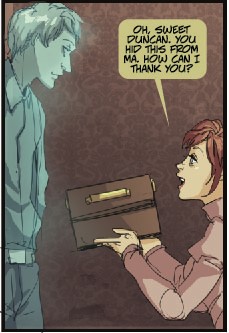
The theme of clockworks in steampunk not only suggests the inner workings of the human heart but as I mentioned before evokes another time and place.  And in some cases, those times and places cross over in the most unusual way. In this panel from the first chapter of the comic, Duncan, who is a ghost, had hidden a camera from Caitlin’s vengeful mother. He has crossed over from another time and place to help someone he cares for.

mhr2

Since clockworks and time are inexorably linked, steampunk does what it does best in demonstrating another vision of the past with influences of the future. In this panel from chapter two, the men of B.E.T.H. are on a hill overlooking Boston Harbor. It is an image of an alternate history where dirigibles are common place along with a modern looking steamship which cruises into harbor.

mhr 3

BOSTON METAPHYSICAL SOCIETY is my first venture into steampunk as a writer, but I have funny feeling I may have found my home.  It allows me to explore the issues and themes which are important to me in a way that appeals to my own personal aesthetic.  For when you strip away the gadgets and the fancy clothes you discover that in steampunk, time is always at the heart.

About M. Holly-Rosing

mhr twitterThe writer/creator of the Boston Metaphysical Society graphic novel series, companion novel, and short stories, Madeleine has also run six successful crowding campaigns and published the book, Kickstarter for the Independent Creator.  She was also the winner of the Sloan Fellowship for screenwriting, and the Gold Aurora and Bronze Telly for a PSA produced by Women In Film as well as having won numerous awards while completing the UCLA MFA Program in Screenwriting.  Source Point Press is set to publish the first six issues and the trade paperback of Boston Metaphysical Society original graphic novel in 2019/2020.
Other comic projects include the short story, The Scout which is part of The 4th Monkey anthology, The Sanctuary (The Edgar Allan Poe Chronicles anthology), The Marriage Counselor (The Cthulhu is Hard to Spell anthology) and the upcoming The Airship Pirate which will be part of  The Rum Row anthology.

The first novel in the series, Boston Metaphysical Society: A Storm of Secrets, was recently awarded a Silver Medal in the SciFi/Fantasy category as well as The Write Companion Award for Best Overall TOP PICK – Adult, Children’s and Young Adult categories in the Feathered Quill Book Awards.

Formerly a nationally ranked epee fencer, she has competed nationally and internationally. Madeleine is an avid reader of comics, steampunk, science fiction, fantasy, and historical military fiction.

Posted in amreading, amwriting, blogging, Canadian steampunk, fantasy, fiction, grathic novels, indie, indie novels, indie writers, indieoctober, indiewriter, opinion, reads, sci-fi, steampunk, supernatural, writes, writing | Tagged , , , , , , , , | 1 Comment

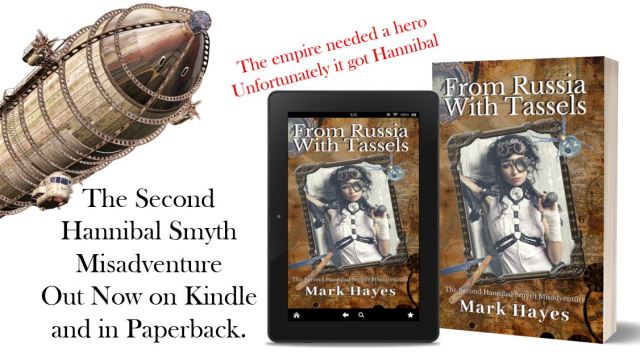
From Russia With Tassels

The Second Hannibal Smyth Misadventure has landed, taking up the story of that notable and somewhat ignoble gentleman’s adventures from the Himalayan cell he found himself imprisoned in at the end of ‘A Spider In The Eye’. Our ‘hero’ has been forged in adversity, but is he now a fine steel edge poised to save the British Empire from the foul assignations of HG Wells and his band of air-pirates? Or is he just a rusty piece of pig iron bound to shatter at the first blow…

russia flier 1

Told in Hannibal’s own meandering ‘honest’ style in, From Russia With Tassels, our reluctant hero is drawn deeper into the Wells conspiracy, faces new dangers, Russian Sky Captains, old foe’s, mad scientists, brass shoguns, The Ministry, the Sleepmen, a war-torn Japan, not to mention his own personal Bad Penny… Fighting not so much for honour, or the empire, or even whats right, but just to save the one thing he really gives a damn about, his own misbegotten skin… Because when the going gets tough, trying to find a good place to hide with a bottle of engine room vodka is always the right choice…

Available on Kindle and in paperback from all good multinationals named after South American rivers.

(note, and as always happens amazon have not quite yet managed to link the paperback and the kindle editions together so there are separate links for both… and the us and Canadian links for the paperback are not quite working yet, will update this list when they are.)

Within the Bounds of Britannia…

In the US and other places beyond Britannia’s shores…

And because it has its own links, in Canada

Posted in amreading, books, Canadian steampunk, goodnews, goodreads, Hannibal Smyth, indie, indie novels, indie writers, indieoctober, indiewriter, novels, pointless things of wonderfulness, publication, reads, sci-fi, self-publishing, steampunk, writes, writing | Tagged , , , , , , , | Leave a comment

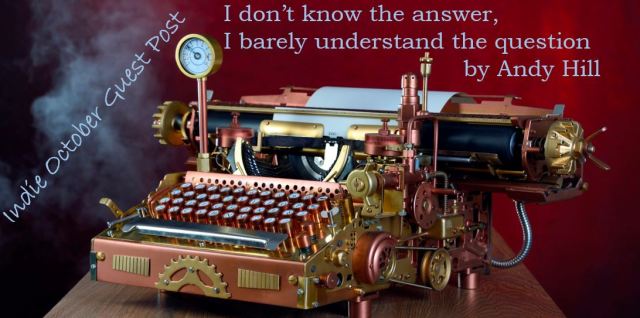
I don’t know the answer, I barely understand the question: Indie October guest post by Andy Hill

indie october guest post 3

Do you wander around a first world town centre, bemused at how the general population manages to exist even as a rudimentary civilisation? Ever stared out of an aeroplane at the houses, roads and train tracks below, knowing full well that if left to you to design or build either, the plane would be hurtling in flames towards buildings that had fallen over anyhow?

As I understand it, some guy called Darwin invented the opposable thumb, while on holiday in Madagascar. Now we have about sixteen billion of them of which half of them are holding chips (fries) at any one time and the other half look on in envy.

As species we have achieved so much and effectively wrangled control of the planet for our own ends. Regrettably we have done it in such a way that is based on resource exploitation which is finite and will impact climate and ecology,in ways we yet don’t fully understand. The problem is, as individuals we dislike and mistrust the type of central global planning needed to restore balance. Previous attempts at central planning have suffered from a combination of nefarious undertones, gross incompetence and personal enrichment. There’s no reason to expect that the next attempts would be any different.

We want change but are we ready for the sacrificial and radical changes that would likely need to be enforced? Would we accept population control, transport restrictions, high energy use food rationing and power consumption limits? Can first world expectations be reconfigured to expect less and third world ambition for a ‘better life’ suffer the crushing of long awaited dreams?

Human civilisation is organised chaos. Somehow, miraculously it more or less works. Chaos however tends to leave a mess.

Luckily for all, I failed to consider these questions and more through the medium of poetry. I urge you not to read any of it and spend these precious minutes of your life doing rewarding and fulfilling tasks. Argue with loved one over trivialities. Pluck nostril hairs till your eyes water.

Most importantly be nice to spiders, they will outlive us.

About Andy Hill

andyBased in North East England, Andy works as a freelance writer and capital market consultant. In other words, a hand to mouth existence scrabbling for paid work. These skills lend themselves with aplomb to the overcrowded world of direct publishing.

Andy’s first work “I Saw You” rocketed to number four, in the prestigious Kindle Love Poetry Top 100 Free chart. Bettered only by Shakespeare, Keats and Shelley in a flush of ego and hubris, Andy splashed out on a new fridge and fly crib, only for those fifteen minutes of fame to evaporate in sixteen minutes. He has also written for the Harvey Duckman Anthologies.

hd banner


Posted in amreading, amwriting, dystopia, fantasy, humour, indie writers, indieoctober, indiewriter, opinion, pointless things of wonderfulness, rant, writes, writing | Tagged , , , , , , , , , , , , , | Leave a comment

My Five Favourite Writing Rums: Indie October Guest Post By CG Hatton

indie october 4

CG Hatton, author of the wonderful Thieves Guild Series, who is busy slaving away with the eight novel and thus in need of more rum, presents her five favourite writing rums! This is because she has a wonderful way of turning Rum is to words, for which we, her readers, are ever grateful because they’re such fabulous words. Take note, supply writers with rum… (intro by mark)

rum

IMG_1321


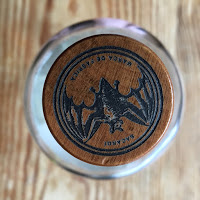
Bumbu: this is a strange one, tastes awesome and is good for times when a few unexpected twists, turns and shocking reveals are needed.


IMG_1320


Bacardi Gold and Bacardi Oakheart: always a good writing rum, Bacardi has a special place in the history of the Thieves’ Guild and its tradition of intrigue, pacts and secrets never to be told…


IMG_1322


Captain Morgan’s Spiced: this is a firm favourite for those everyday writing moments when the story is ticking along just fine and everyone is behaving… or not. Captain Morgan’s Black Spiced and Private Stock are special treats and saved for darker times when the ante needs to be upped and the drama intensifies.


IMG_1323


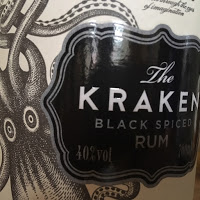
Kraken Black Spiced: this is the special stuff for special times when the stakes get serious, threat levels rise and the pace needs to be increased. Must admit, this is the one I go through the most…


IMG_1324


Dark Matter: I’ve not been able to touch Dark Matter since I finished Darkest Fears, but here it is, still at the number one spot and still there on the shelf… waiting… dark times are ahead.


About CG Hatton

gillieCG Hatton is the author of the fast-paced, military science fiction books set in the high-tech Thieves’ Guild universe of galactic war, knife-edge intrigue, alien invasion, thieves, assassins, bounty hunters and pirates.
She has a PhD in geology and a background in journalism. She loves meringue and football (supports Tottenham Hotspur), drinks spiced rum and listens to Linkin Park, has climbed active volcanoes, walked on the Great Wall of China, and been mugged in Brazil.

thieves guild

C G Hatton’s Thieves Guild novels: Fast-paced sci-fi that will leave you breathless and gasping for more.


Posted in amreading, amwriting, goodnews, Harvey Duckman, indie, indie novels, indie writers, indieoctober, indiewriter, opinion, pointless things of wonderfulness, sci-fi, writes, writing | Tagged , , , , , , , , | Leave a comment

It’s the little things that drive you crazy…

I’m currently working my way through a print proof copy of ‘From Russia With Tassels’, carefully trying to catch those last few little typo’s syntax errors and the very occasional misbegotten sentence that needs one final little polish. This is after four drafts , my editor, my beta readers, a final polish draft draft based on my editor and beta readers feed back. And it’f the little things that are, as ever, driving me crazy. The things no one will probably notice, though they would be aware of them in some vague way if I didn’t fix them.

Quite apart form the text there are things like this game of spot the difference…

Now I dare say that you can spot the changes, though you might not know why they’re there. Its all to do with bleeds. When you up load a cover you have to allow for bleeds which will crop about 7mm off the top, bottom and importantly the right hand side of your cover. Which of course I forgot, hence last night I spent an hour moving the title , subtitle and the name of the idiot who forgot about allowing for bleeds, about 7mm to the left, so on the print copies the title et-al is actually centred to the cover.

A task made slightly more difficult because there are actually two layers of text behind and slightly offset form the white text is a layer of black text, and I had to make them match up to get the slight embossing shadow effect I was after, so I was literally counting the number of spaces I moved the text, so I could move the text below it the same… Which is barely perceivable in the subtitle, But I know it’s there, so it has to be right…

So, all the words shifted to the left,, the subtitle and authors name moved up a little so after the bleeds they look the same distance up form the bottom as the title is down form the top. (and yes in vanity I made my name slightly more prominent, sue me for that).

Oh and I rotated the cutthroat through a whole 10 degrees clockwise.. and moved the eye-spider a tad anti clockwise because… well, just because I thought they needed it.

These are the reasons you get a printed proof copy before unleashing this stuff to the world. the things no one one notice. Its the same inside, a few minor changes to the lay out and so far 100 pages in to the 340 I need to go through, all of about 10 minor changes to the text and two typos that went past every other filter. Because while they may be little things no one but you would ever notice, they still need to be right. Which is also why I made this cog-wheel icon for the dedication page as well last night, because while no one would notice if it wasn’t there, despite the cog wheel motif used for chapter heads and in other places in the novel like the contents page, not having one for the dedication page bugged me when I saw it in print.

dedication

All I want to do with this novel is unleash it out into the world. But till I am utterly satisfied. So the little things are driving me crazy in little ways, and no one will even know I have spent days fixing them because they will never notice, least ways no one but me… But i would know if they weren’t fixed…

Why am I saying all this? well because in a couple of week (hopefully) when this is all done ‘From Russia With Tassels’ will join its fore-barer ‘A Spider In The Eye’ out in the world. And within a few days someone somewhere will point out the one thing I didn’t fix… and I may scream…

Beware of the self published, unless you have done it yourself, you have no idea just how much work beyond just writing goes into the book you hold in your hand. So be nice when you point out the minor flaw that slipped through everything…

Because its the little things that drive us crazy…

Posted in amediting, amwriting, books, editing, Hannibal Smyth, indie, indie novels, indie writers, indieoctober, indiewriter, novels, reads, self-publishing, steampunk, writes, writing | Tagged , , , , , , , , | Leave a comment

How to kill a hundred people: A Indie October guest post by Nimue Brown

indie october guest post 5

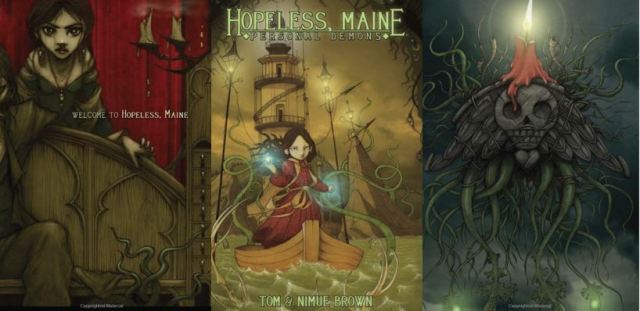
Let me begin by explaining Hopeless Maine. It started life as a graphic novel series set on an imaginary island off the coast of Maine. There’s now a role play game, prose books in the offing and other things in planning! For people who want to get involved, there’s www.hopelessvendetta.wordpress.com which is currently full of dead people…

Back in August, when we were figuring out the details for Hopeless Maine kickstarter, I suggested I could do obituaries for people as though they had died in the setting. Those became early bird bonuses, and “yes,” I blithely said, of course I can write a hundred of them.

Of course I didn’t think for a moment that 100 people would get in fast enough that I’d have to do it.

I find myself having to kill a hundred people. Those slots went very quickly, and the kickstarter itself went well over target. I’ve done the maths regarding the rate at which I have to kill people and there’s a fighting chance it will all be over by Christmas.

Technically this is no more difficult than writing a rather bitty novella. I can’t write them like proper obituaries for real dead people because that wouldn’t be in keeping with the setting. Most of what passes for reporting on the island is undertaken by a chap called Frampton Jones – it’s hard to tell with Frampton if he’s intentionally deeply ironic, or totally oblivious. I like that about him. I’ve tapped into other island voices along the way already, partly to keep things fresh, partly because there are some things Frampton would never say. So I’ve got Mithra Stubbs for gossip, scandal and slander, and Doc Willoughby for bigoted misinformation.

Some of the deaths have grouped quite nicely, and I’ve had a run that I’ve particularly enjoyed, featuring members of the Martian Expeditionary Force (a real life Steampunk group). I’ve juxtaposed them with some events that occurred back when I was first writing The Hopeless Vendetta as a news-site for residents of Hopeless Maine. I’ve had a few backers killed off by Mrs Beaten – resident collar fanatic and psychopath. I’m poised to use someone who backed the campaign but missed the early bird obituaries as a suspect in a few deaths as well.

It’s a bit nerve-wracking trying to kill people off in a way that makes sense and will also amuse them. People can be expected to be sensitive about their own deaths. Thankfully, most of the early backers know me and what I do, and have taken it well. Wanted it, even. At least in a written sense. As far as I know there’s only been one person so far who was upset about their death – I have no idea what they were expecting.

I’ve written custom fiction before (in a different genre) and it is a tricky thing. I’ve yet to come up with a system for it other than desperate hopefulness and trying to be psychic. I’ve had a few death stories go well on the doing-it-by-magic front, and clearly at least one that went down like the proverbial lead balloon. Which is not a method I’ve used for killing people, yet, although I’ve got a way to go.

The good thing about killing people is it allows me to show off many of the unique features of the island. There are obvious physical hazards – falling off cliffs for example. Drowning. Being eaten by sea-monsters. There are other dangerous creatures and demonically possessed items. Some of the islanders are both mad and a bit evil. A number of backers have existing relationships with the island – having loaned us their faces for characters, contributed art to the Hopeless Vendetta, or stories, or other things I could mess about with.  I’ve had a lot of fun with that.

I imagine there must be a fair few bemused onlookers, seeing fake obituaries for their friends turning up on Facebook walls and wondering what this is all about, and then perhaps reading said obituary and not being much the wiser! I hope it’s brought a few more people to our uncanny shores, and not traumatised the unsuspecting too much.

On the technical side, there’s quite the balance here to strike between inspiration and workishness. To write 100 obituaries in a timely way I have to crack on and do them. I have to actively seek out inspiration for each death, and put down the words and get it out there. I have to do that five days a week for months to come. I know I have the discipline to pull it off – I’m an every day blogger, so that’s given me the habits and the typing muscles. Hopefully, the inspiration will turn up as I go along. Mostly I’m depending on caffeine and fear to get me through.

I’m deeply grateful for all the support we’ve had during this campaign – it’s gone far better than I would have dared to imagine. And so, I must crack my knuckles and decide who to kill next…

About Nimue Brown (by Mark)

nimue

Nimue describes herself as a Bookblogger, wordherder, tree activist. Green chaos Druid Steampunk folk elf. Metaphorical tug boat. Ponderer, singer of songs, teller of stories. Hill walker, daydreamer, editor, marketing person, occasional press officer on demand, reviewer, Steampunk, Folky ,and Green activist… She also claims to have a lot of hats, one suspects this is a metaphor.

Tom Brown on the other hand describes her as ‘ A Bloody Genius’ and as he knows her better than anyone, who are we to argue…

She is one half of the creative force behind Hopeless Maine, and the entire creative force behind the druid life blog, and a creative out put of fiction and non-fiction that puts the rest of us to shame. She has so far killed 28 people by my reckoning, those waiting to be killed do so with rapt attention…

you can find more from Nimue at:

hopeless 4

You can read my own death on Hopeless Maine here: All i can say if I warned them, but they did not not listen…

Posted in amreading, amwriting, blogging, books, Canadian steampunk, errol the bookcase dragon, fantasy, Goth, grathic novels, indie, indie novels, indie writers, indieoctober, indiewriter, pointless things of wonderfulness, reads, sci-fi, steampunk, supernatural, writes, writing | Tagged , , , , , , , , , , , , | 1 Comment

Alternate History Fantasy and Historical Fantasy: Indie-October guest post from Liz Tuckwell

indie october guest post 2

Thanks to Mark Hayes for generously offering me the opportunity to write an article/have a rant about a topic on his blog. This one may be a little pedantic but is dear to my heart.

As well all know, fantasy now has many sub-genres. In fact it has so many sub-genres now that some have become blurred. Two good examples are alternate history fantasy and historical fantasy. These are two of my favourite fantasy sub-genres.

I think readers and critics often get confused about what alternate history fantasy is. If you were to take a look at www.bestfantasybooks.com (for example), you would find the following books listed under Alternate History Fantasy.

  • Wheel of Time, Robert Jordan,
  • Wizard’s First Rule, Terry Goodkind,
  • The Lord of the Rings, J R R Tolkien.
  • The Belgariad, David Eddings,
  • The Sword of Shannara, Terry Brooks.

I don’t know about you, but I would never have described any of those as alternate history fantasy. They’re all epic or heroic fantasy.

However, the description of Alternate History Fantasy on the website is:

“Alternate history is set in a place where actual history has deviated from current historical accounts. Think of it as a parallel history to our own, one where events may have been dramatically different. Alternate history can include fantastical elements. One can have alternate history where the rules of the universe follow that of our own or an alternate fantasy where magic works.”

I strongly disagree with the last sentence. Clearly, all the examples on the list above fall under “an alternate fantasy where magic works” but so do many other fantasy sub-genres.

There also seems to be confusion about what is historical fantasy.

Also on bestfantasybooks.com, you find the following books listed under historical fantasy:

  • Soldier of the Mist, Gene Wolfe
  • Tigana, Guy Gavriel Kay
  • Territory, Emma Bull
  • Jonathan Strange and Mr. Norrell, Susanna Clarke
  • The Temeraire Series, Naomi Novik
  • The Pendragon Cycle, Stephen R Lawhead
  • The Deverry Cycle, Katherine Kerr

The website defines “In the Historical Fantasy sub-genre a part of Earth’s history is the setting, but with added fantastical elements. This setting may be set on Earth and positing a question—how would the American Civil War have unfolded if there were vampires?–or set in another world that shares cultural and historical events with Earth.”

 And once again, I disagree with the last sentence. I don’t think that is the definition of historical fantasy. For it to be a historical fantasy, it needs to take place in earth’s history.

By the way, in my opinion, some of the novels listed above are not historical fantasy. Tigana takes place in a fictional world that resembles renaissance Italy but is not renaissance Italy. It’s actually another fantasy sub-genre altogether. Neither is the Deverry Cycle, which takes place in the world of Annwn, an earth-like planet in a parallel universe. So, yes, they are eligible under the website’s criteria, but I think the criteria is wrong.

I’m not having a dig at bestfantasybooks.com, it’s just a good example of the confusion about what particular sub-genres are.

In my opinion, historical fantasy and alternate history fantasy also often get confused.

Alternate history fantasy is the child of historical fantasy and alternate history. Alternate history is a science fiction sub-genre so alternate history fantasy is a sub-genre that crosses genres. Historical fantasy is the child of historical fiction and fantasy.

So, for example, I think that Susannah Clarke’s Jonathan Strange and Mr. Norrell is alternate historical fantasy but Naomi Novik’s Temeraire series is historical fantasy. Both are often mentioned as either historical fantasy or alternate history fantasy.

In Susannah Clarke’s wonderful novel about two rival sorcerers, magic exists in Regency society but crucially, there was a Raven King who used to rule over Northern England, a definite departure from English history. So, that makes it alternate history fantasy, in my book.

However, in Naomi Novik’s equally wonderful series, dragons exist but it has not altered history to any great extent. Elizabeth I still reigned, the House of Hanover is on the throne, etc. but the Napoleonic War is being fought (with dragons). So, for me, that’s historical fantasy.

So, which novels do I think are actually alternate history fantasy? I’m glad you asked.

  • Jonathan Strange and Mr. Norrell, Susanna Clarke
  • A Connecticut Yankee in the Court of King Arthur, Mark Twain
  • Lord Darcy Series, Randall Garrett
  • Thursday Next Series, Jasper Fforde
  • A Midsummer Tempest, Poul Anderson
  • The Tales of Alvin Maker, Orson Scott Card
  • Armor of Light, Melissa Scott and Lisa A Barnett

And you may be asking, so what? Does it really matter? Well, I think it does because as a reader of alternate history fantasy novels, I want a novel which is described as being an alternate history fantasy to be one. I hate reading a novel and then gradually realising it isn’t what I thought it was. I know this can happen with all sub-genres, but I think it’s particularly prevalent with these two. Hopefully, this article will help you to avoid the same experience.

About Liz Tuckwell

lizLiz Tuckwell is a British science fiction and fantasy writer, living in London. She’s recently had a short horror story “A Monster Met” published by Demain Publishing in their Short! Sharp! Shocks! Series and a short story in the anthology MCSI: Magical Crime Scene Investigations. Her flash fiction has been published on the 101 Fiction and Speculative 66 websites. She has a story in the forthcoming Harvey Duckman Presents Volume 3.

hd banner

Posted in amreading, amwriting, books, fantasy, fiction, Harvey Duckman, indie novels, indie writers, indieoctober, indiewriter, opinion, reads, retro book reviews, writes, writing | Tagged , , , , , , , | Leave a comment

The Joy of Thursday Nights: Indie-October guest post from Amy Wilson

indie october guest post 1


I was absolutely not looking for a writing group.
I had nothing against writing groups, I was sure that they were wonderful for some people. It’s just that I didn’t think I would be one of them. I had briefly been involved with a regional writers group, but very quickly decided that it wasn’t for me. I chalked it up to experience, unsubscribed from the mailing lists and moved on. Then, a couple of Christmases ago a good friend of mine mentioned that she was thinking of starting a writers group and asked if I would be interested.
I smiled, shrugged, and surprised myself by replying “Sounds like fun.”
What can I say? I’d been drinking.

I turned up to that first meeting with fairly low expectations. After all, I’d been to a writing group before so I was prepared for the fact that I probably wouldn’t enjoy it. Two hours later, after a whirlwind round of introductions, discussions of works-in-progress and probably a couple too many beers, I left thinking “Hmm. Maybe I’ll go back next week.” Turns out, I just needed the right group.

We don’t always talk about ‘writer’ stuff. Recent topics of conversation have included the space monkey mafia (unfortunately, not a thing), marionettes, and cannibalism. Occasionally someone will start a sentence – apologetically – with “Can we talk about writing for a minute?”

But when someone does have a question about writing, everyone is eager to help. Whether it’s purely technical (“How do I format my book for Kindle”) or more general (“Why the heck isn’t this scene working?”) you can bet that someone will offer their time, their experience and their advice. It’s a genuinely beautiful thing to see people who are so passionate about their interests and so invested in helping each other out.

There have been definite perks to this that I never saw coming. Without this group, I might never have got involved in the “Harvey Duckman Presents” anthologies. I would never have written this blog post. And every once in a while, we get the major perk of ‘the brown envelope’. Where someone has finished something and they’re feeling brave enough to print it out and give it to the group to have a look at. Getting to see the end product of someone’s hard work is one of my favourite things, especially when you recognise something in the story that the writer has talked about in the group. Mostly though I just enjoy hanging out with a bunch of inspired and inspiring lunatics for a couple of hours a week.

I would absolutely recommend looking for a Thursday Night Writers Group (other week nights are available) and giving it a go. I never expected to enjoy it as much as I have, but somehow, Thursday nights have become one of the highlights of my week. Even if we do spend an inordinate amount of time talking about cannibalism.

amy

About Amy Wilson

Amy Wilson is the author of the short stories ‘By Firelight’ and ‘Gosfeld’ for the Harvey Duckman Presents anthologies. In between taking archery lessons, learning German, and talking about herself in the third person, she is working on a fantasy trilogy – the first part of which is due out next year.

hd banner


Posted in amreading, amwriting, fantasy, Harvey Duckman, indie, indie writers, indieoctober, indiewriter, opinion, reads, sci-fi, writes, writing | Tagged , , , , , , | 1 Comment