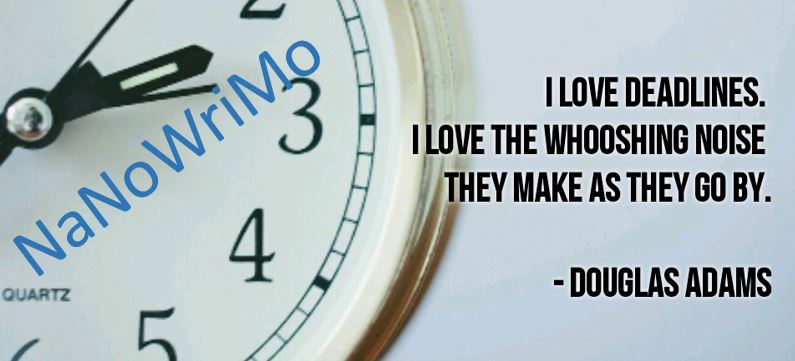
NaNoWriMo is looming on the horizon. As it is want to do. the dark nights are closing in and among other things there is the joy of daily 1664 word deadlines to look forward… Technically of course the term ‘deadline’ doesn’t mean quite what writers and more or less everyone else using the term for. Historically at least…
“Historically, the ‘deadline’ was the line around a prison beyond which prisoners were eligible for shooting. In keeping with shifts in the exercise of control, what one was delineated spatially over life is now enforced temporarily over labour.” ~ CrimethInc.
NaNoWriMo deadlines are not quite so brutally enforced. No one is going to shoot you for missing them. But they have a way of praying on the mind and views upon there effectiveness vary…
“A deadline is negative inspiration. Still, it’s better than no inspiration at all.” ~ Rita Mae Brown
“Are you aware that rushing toward a goal is a sublimated death wish? It’s no coincidence we call them ‘deadlines.” ~ Tom Robbins
“Dreams without deadlines are dead in the water. Deadlines are really lifelines to achieving our goals.” ~ Mark Batterson
But there is always a lighter perspective on those targets we set ourselves as often as they are set for us…
“Deadlines just aren’t real to me until I’m staring one in the face.” ~ Rick Riordan
“…a deadline should not prevent you from writing, but writing will help prevent you from missing your deadline. Then write a word. Then remind yourself of that again. And then write another and hey, look at you! You’re spitting in that deadline’s eye.” ~ Courtney Summers
“A deadline is a finish line. Don’t stop ’til the door shuts in your face!” ~ Raven Moore
“I had three days to screw over Nicodemus Archleone and his crew and get this thing out of my head, without getting myself or my friend killed while I did it.” ~ Jim Butcher
“A hammer made of deadlines is the surest tool for crushing writer’s block.” ~ Ryan Lilly
“If the novels are still being read in 50 years, no one is ever going to say: ‘What’s great about that sixth book is that he met his deadline!’ It will be about how the whole thing stands up.” ~ George R.R. Martin
Speaking of George, a final word from that most awaited of writers Pat Rothfuss, fans of whom have been waiting for the third novel in the Kingslayer trilogy for quite some time. They have also been complaining since the moment they finished reading the second instalment… Which led to Neil Gaiman once to say of both Pat and George (I paraphrase slightly), ‘Readers, they are not your bitch…’ But as promised a word from, Pat…
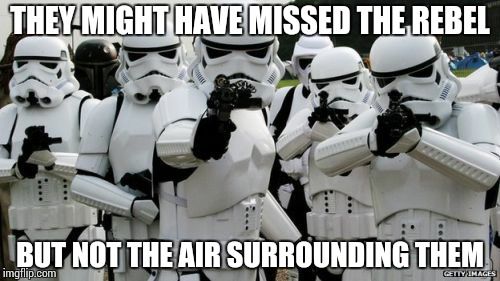
“Normally I miss deadlines like a stormtrooper misses Jedi.” ~ Patrick Rothfuss
Good luck to all the NaNoWriMo writers out there come November and have fun chasing those deadlines…
Over the course of the last four years I have somewhat inadvertently written a non-fiction book. This was a somewhat alarming thing to discover as it was never really my intention. I’m a writer of fiction god-damn-it. I don’t write non-fiction, that’s an entirely different discipline… I’ve been quoted in non-fiction before now, in fact I have even been quoted in a book on the Harvard Library reading list, which amuses the hell out of me, but I don’t write non-fiction… At least not on purpose…
So I’ve written a non-fiction book…
Regular reads of this blog may be able to guess what the subject matter of this non-fiction book is. Though it could be about the process of writing and self-publishing, because I’ve written plenty on that subject over the years. There are however more than enough fatuous books on self publishing out there, and I am sure the world can do without another. So no, its not a book on self-publishing, a subject I am well versed in, but instead its a book on the writings of Old tentacle hugger H P Lovecraft. A subject I have become well versed in almost in error.
I should perhaps explain. For Christmas, way back in 2016, my girlfriend bought me a beautiful Folio edition of the complete works of HP Lovecraft, which was a bit of an upgrade on my kindle edition of the complete works I had been browsing at for a couple of years. I love folio edition hard backs. I think of them as books the way books were meant to be. Cloth covers over hard board, those silk bookmark strings, the high quality paper and print. I own a few, generally the classics which I seldom read as I tend to have paperback editions. I buy them just to have them and satisfy my bibliophilic soul. But there it was on Christmas morning, a folio edition of Lovecraft’s complete works, which I felt a certain moral obligation to read. Which was why I decided I would set myself a little project of reading every story in order, which was the order they were written rather than the order of publication, and for fun write a little blog post,2/300 words or so, about each of them. It seemed a nice little idea, would give me something to blog about other than my usual stuff and wasn’t going to take over my life or anything…
I expected this little project to take me a year, at the most, instead its taken closer to four, and those short 300 word blogs when out of the window early doors, I found I had a lot to say, and not all of it good, about dear old tentacle hugger’s fiction, and on occasion I really couldn’t face reading any more of it for a while, there was also a whole lot of life being lived, books written, and just stuff getting in the way. So one year became four and as of this moment I am finally at the point where I only have two stories left to do.
So what do you do when your nearing the end of a project like this? Well if your me, more out of a sense of curiosity than anything else, you open a word file and dump all those Lovecraft blog posts into it and find out just how much you have ended up writing about Old Tentacle Hugger. So I did… and to my surprise, I’ve written a book. Well a first draft at any rate. A nice roundish figure just shy of 70k. On the face of it it would seem a bit of a shame not to do anything with it…
Of course there is rather a lot involved in turning a bunch of blog posts into a book. All I have is a rough first draft, and a series of blog posts written over four years has a way of changing in tone and scope. What made for a Lovecraft post at the start of this project is a lot different from the later posts. Also a blog post tends to have a certain style which isn’t want you want in a book. You tube links to bizarre student made movie’s of a particular story don’t really work on a printed page, no matter how hard you press them. The frame work needs to be right, and change quite a bit. So before I went any further with this idea I needed to start a second draft, make some decisions, and revise the style of those early, some what stuffy serious posts, to something more in line with the irreverence of the later posts. Tone is important, and a consistency of tone.
So this weekend I started a second draft starting from those original posts, which went well I think. I like second drafts, they are among my favorite things to do when writing fiction because you know where your going. While I have only worked my way through the first three stories so far I can feel it coming together. My accidental book is going to work, and be an informative, fun and entertaining read. At least I hope that’s the case…
How long it’s going to take me to get through all of them and a complete redraft, well that’s a piece of string question. How much the final book ( which will go through at least one more draft after this one I am sure) will reflect those original posts is also another open question. But it may be out for spring next year, if I get it all complete by then. And who knows, some one may even be interested enough to read it…
Still nothing ventured…. and besides its a fun project at the moment, and hopefully will remain so.
There was one other thing of course, which people may have seen on social media over the weekend. On Friday night was in the day job till the early hours, sat on a call while waiting for people to ask me to do technical things. There was much sitting around and waiting so I had time to kill, and I decided if I had indeed written a non-fiction book on Lovecraft I needed a title and a cover. I like building book covers, its an only soothing thing to do while stuck waiting for a guy on the other end of a call to finish testing a bunch of servers so you can go move a few cables… So a cover was created and played with and unexpected I am a little proud of the results… So while its very early , here a little cover reveal…
‘The complete Lovecraft, I’ve read it, so you don’t have to…’
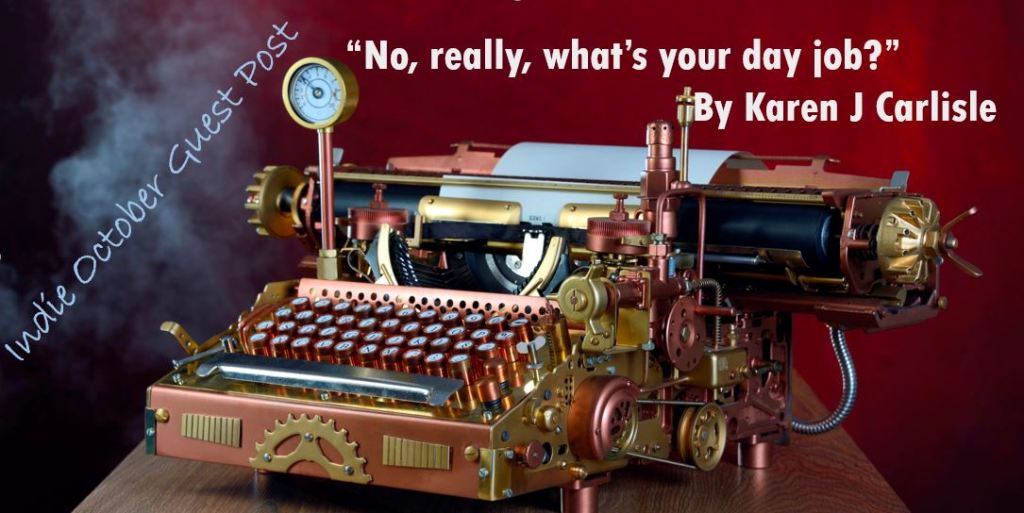
Its October, the leaves are falling, the witches are abroad, and I’ve opened the blog up to guest writers again. Yes its Indie October. Throughout October some old favorites among my guests will be returning along with some new voices. Today’s Guest Post is from the antipodes, in the shape of my favorite antipodean author Karen J Carlisle…
First, let me tell you I’m an ‘extroverted’ introvert (with major emphasis on the introvert). And that’s on a good day. On a bad day I have at least one panic attack before having to attend an event or do a talk. Socialising is mentally exhausting. As an indie author, who has to do their own marketing, this isn’t always a good thing. (That’s another blog post or two right there.)
Scenario: I’m attending an event. (I’m the one staring into their drink, listing the environmental impacts of the host’s choice to use disposable cups – at least they aren’t made of foam). Someone drifts in my direction. The silence is awkward.
As an introvert, I dread that ‘ice-breaker’ question. You know the one. I dare not ask it myself, because I know it means I’ll have to fend off the list of follow up comments: “I’ve always wanted to write a book!”, or “oh, it must be nice to work from home.” (This is obviously a pre-Covid comment.) Then there’s the questions: “Have I heard of you?”, “What do you write?”, or “Where do you get your ideas?”
These are the easy ones to answer:
Go for it. (Just don’t forget to get an editor.)
Some days it’s great; some days, not. It can be difficult to delineate work and leisure time. The edges can get blurry, especially when you have family commitments. It requires discipline. If I don’t set aside work time, my book doesn’t get finished. (I think more people understand this after 2020)
Obviously not, if you have to ask.
Where don’t I get ideas? Anything. Everything. I’m always asking ‘what if?’ I use my imagination. I have an endlessly growing list of ideas. The problem is creating an interesting story about them, and finding the time to use them all!
Back to the original silence…
I introduce myself. Phew. Made it so far. I can do this… I sip my drink, and congratulate myself on successfully socialising (not panicking and fleeing the scene, or shrinking into a dark corner.)
Then, it comes; it’s inevitable. That question: “What do you do?” Or the other, more dreaded, version: “What do you do for a living?”
(Firstly, very few authors, especially indie author actually make a living from their writing. The average author’s income in Australia is AUS$12,000. It’s less for Indie authors, and even worse now the government has axed its budget supporting the Arts… yet another blog post there.)
The reality is some authors are fortunate enough to work full time, find time to write. I stand in awe of their stamina, and capacity for functioning with chronic sleep deprivation. In 2014, after twenty-eight years of working to work-imposed appointments, looking after others, I made a tough decision. I changed my career. I now look after my readers, not patients. In terms of mental and physical health, this was the best decision I ever made. In terms of income, not so much.
So, I smile, tell them I’m an author, then take a deep breath and steel myself for a long debate, often defending my life choices.
You can tell a lot about someone, depending on how the conversation progresses (often with the comments above). Often I feel like I’m suddenly dumped in the middle of a job interview (but usually interviews aren’t a spectator sport). Ideally, the ‘interviewer’ will show interest, or at least feign it. Questions like “what made you want to be a writer?” or “Tell me about your books” – you know, things you would expect when asked about a vocation – would be welcomed. I hold my breath. Perhaps, they understand creatives? Perhaps they understand Indie authors – by virtue of the definition – do the work of writer, project manager and marketing themselves? Perhaps they will acknowledge the hours of work spent researching, outlining, writing, rewriting, editing (rinse and repeat), sourcing beta-readers, rewriting after feedback, sorting out cover designs, publishing, marketing, creating a presence on social media, and attending events?
And then, even after discussing all of the above, they ask: “No, really, what’s your day job?” That is the worst day.
About Karen J Carlisle
Karen J Carlisle is a writer and illustrator of steampunk, Victorian mysteries and fantasy. She was short-listed in Australian Literature Review’s 2013 Murder/Mystery Short Story Competition. She is currently writing a cosy fantasy mystery set in Adelaide. Her short stories have featured in the 2016 Adelaide Fringe exhibition, ‘A Trail of Tales’, and the ‘Where’s Holmes’ and ‘Deadsteam’ anthologies.
Karen lives in Adelaide with her family and the ghost of her ancient Devon Rex cat.
She’s always loved dark chocolate and rarely refuses a cup of tea.
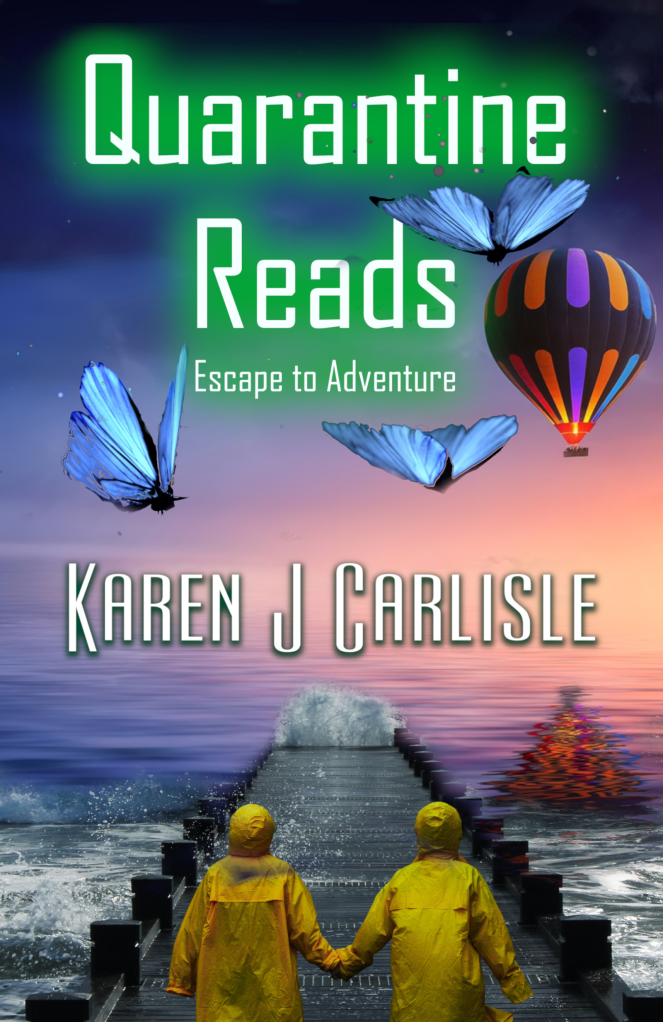
Quarantine Reads – a collection of speculative fiction short stories of a lighter note, to inspire and transport you beyond four walls. https://books2read.com/Quarantine-Reads
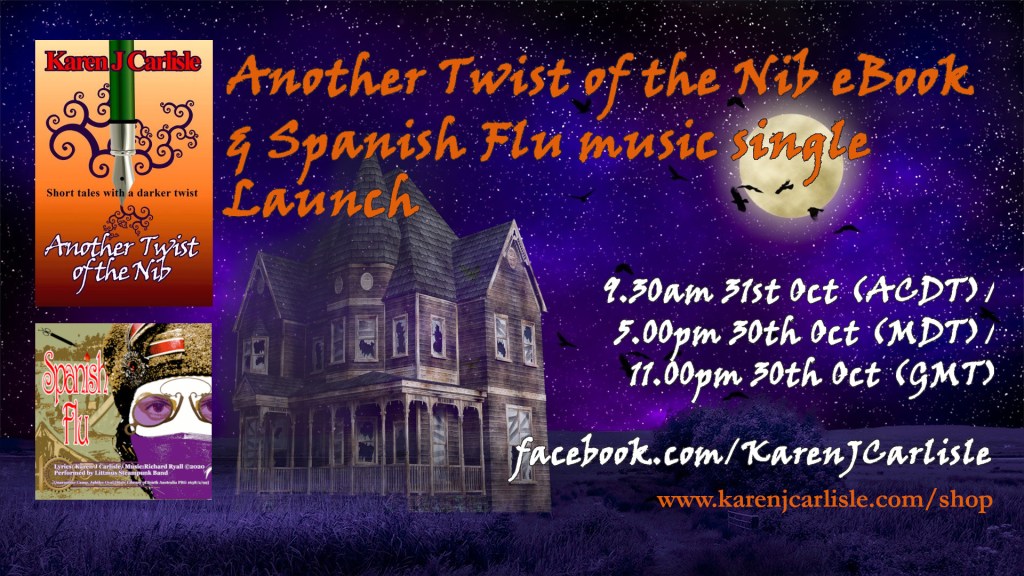
Karen will also be launching a secret projects – just in time for Halloween. ‘Another Twist of the Nib: short stories with a darker twist’ – AND -my second digital music single, ‘Spanish Flu’. Join me for a chat, info about my stories, a live interview with Richard Ryall – co-writer of Spanish Flu (approx 10.30am). There will also be an eBook of ‘Another Twist of the Nib’
Its October, the leaves are falling, the witches are abroad, and I’ve opened the blog up to guest writers again. Yes its Indie October. Throughout October some old favourites among my guests will be returning along with some new voices. Today’s Guest Post is from Teesside travel author Will Nett, who has, it’s fair to say, a bit of a bee in his bonnet…
That is ENOUGH. I am demanding a moratorium on celebrities writing books. Initially, I was going to limit it to them writing children’s books, but the news that Richard Osman, as nice a chap as he seems, although that’s hardly relevant, has a seven figure publishing deal with Penguin Books and the attendant film rights for T******* M***** C*** opted to Steve Spielberg, have pushed me over the edge. I’ve asterisked the book title. It’s had enough publicity as it is.
And, no; I haven’t read it. I don’t imagine that you’ve read it either. I bet Harlan Coben hasn’t read it. I only mention Coben as he’s provided a generic quote for the cover, along with a host of other notaries. Maybe it is ‘Coben worthy,’ a term I’ve just made up, if it means anything. I don’t suggest that the book is particularly good, or especially bad, or, worse still, when it comes to ‘art’ decidedly average.
I used to bite my lip when some TV personality or other wrote a kid’s book, especially when they sold about 50,000 in the time it takes me to drive to work. It was good that readers were engaged at a young age. Then everyone started doing it and you couldn’t turn around in a bookshop without knocking over a stack of junk that had been churned out by a ghost writer and emblazoned with the name of whoever was flavour of that particular month. When I was a kid celebrities didn’t really write books, and certainly not children’s ones.
Looking back, it’s as well they didn’t. I grew up in the 80s so most of them are in jail now.
I’m calling for a year-long ban on celebrity books. If you’re wondering how I’m classifying a celebrity, we can start with anyone who has appeared on ITV, or any of its shit-spewing sister channels, in any way, shape or form over the past 12 months. Specifically, then, muck-raking memoirs, ‘one-pot’ recipe books by dreary chefs, and ‘talent’ show judges who have suddenly developed a ‘passion’ for reading now that they haven’t got a proper day job. The BBC’s obsession with ‘the book accompanying the series’ can be added to the list, also.
There’s a good reason why no-one ever promotes a book with the line ‘the TV series accompanying the book is now available.’ It’s because most people wouldn’t buy a book without watching a TV adaptation of it first. That’s why charity shops are always clogged up with books by Sally Rooney and David Nicholls.
“I’ve always loved reading” these celebrities always say.
So have I. Where’s my publishing deal?
Don’t worry about the effect it would have on high street bookshops. You can buy my books instead.
I have one concession to this ban. I will allow as many celebrities as want to, to submit manuscripts to publishers under an assumed name. Try using my mine. See where that gets you.
About Will Nett
Will Nett is about 40, from Middlesbrough and the author of My Only Boro, the book that was a bestseller in the town for three Christmases in a row. Will is one of the most affable writers in the Tees area, and his global appeal and general popularity have seen his writing career straddle two millennia. He is an incurable backpacker, occasional banjo picker and habitual note-maker/taker, most of which have found their way into his Gonzo-steeped books, which also include Local Author Writes Book, and his riotous travelogue, Billy No Maps. He has been a Sudoku salesman, snooker table repair man, model, cinema usher and unprofessional gambler. His latest book, The Golfer’s Lament, was submitted for the William Hill Sports Book Of The Year Award 2020.
NaNoWriMo is almost upon us, and if you are planning to participate this year, you may be plotting already, even if your plotting to take the fly by the seat of your pants route, you’re probably scribbling down a few idea’s to set yourself up for the annual festival of writing. Of course it’s always possible you have no idea what I am talking about. Or you know what I am talking about and are planning to flee for the hills. For some of us November means National Novel Writing Month, or to be more exact as this month long festival of writing is some what ubiquitous, International Novel Writing Month. Though InNoWriMo has never caught on as a hash-tag…
If parts of this post seems familiar to regular readers BTW, they are, as mostly it is the post from last year ( yes its cheating but the next few paragraphs are explaining what NaNoWriMo is and there are only so many times I am going to type that lot out… After that I’ll be talking about how last year went and my plans for this year, so you may want to leap ahead a little…
But first the annual NaNoWriMo calendar…
For the uninitiated, NaNoWriMo is based on a simple premise. The challenge is to write a 50000 word first draft novel over the course of November. Which works out at around 1667 words a day. The focus is not on creating a finely crafted work of art, but on getting words down on a page. The theory been that the first draft is the hardest part, and its in a way a collective effort, the NaNoWriMo organisation will point you in the direction of local groups of writers and forums with whom you can chat, and encourage each other and on occasion have someone to vent to about how your main character is utterly ignoring the plot you scribbled down on the back of a fag packet… For what is always an ostensibly introvert activity, the NaNoWriMo community is very supportive and inclusive and often just plain fun.
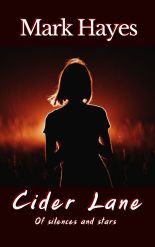
To be clear, no one is going to judge your work, its not a competition. There is a participation trophy is you register with the NaNoWriMo website, and manage to hit the target. But ultimately the quality of the work is not a matter of question, or indeed the point. To paraphrase Stephen King , ‘To be a writer you need to write’ and that is the point. NaNoWriMo encourages writing. Many NaNoWriMo writers never publish their work, or ever intend to. Some will put out their completed novels to the community via websites. And some will take what they wrote in the mad festival of literary insanity and polish those first drafts, complete them and eventually they may well become published novels. Certainly that is what happened with my first novel ‘Cider Lane’ for which the first draft was a NaNoWriMo project (sort of, for reasons I did it in June). And while none of my other novels started out as NaNoWriMo projects as such, there have been ideas, characters and whole sections of my NaNoWriMo projects which have found there way into novels. Mainly though, I start this every year for nothing more than fun. Though I tend to use it to work out some ideas or perhaps string out a first draft of something.
I have talked about NaNoWriMo before in far more detail in previous years, with plenty of bits of advice and suggestions, hence all the links below, I also attempted to blog about the whole thing on a day by day basis a couple of year ago which went really well… Until it didn’t, because writing a blog each day as well as trying to hit word targets was frankly an insane proposition…
Last year I decided to use NaNoWriMo to finish off the first draft of a novel which at the time had a working title of Maybe’s Daughter. My main reason for doing this was simply because I needed a project, I needed a break from Hannibal having published From Russia With Tassels, and Maybe’s Daughter had sat on my hard drive in a folder for a couple of years gathering dust at around the 30k words mark. I suspected I needed another 50k to finish the story I had in mind so as that’s the wordcount target for NaNoWriMo it all sort of nicely fit together as a challenge.
There are those who might say that finishing off a novel I’d already started is outside the spirit of NaNoWriMo. They’re entitled to that opinion, but at the same time screw their opinion. The whole idea of NaNoWriMo as far as I am concerned is to encourage people to write. Besides while there are rules, the rules are mere guide lines and winning and losing at NaNoWriMo is a matter of perspective.
The point being, I was going to use NaNoWriMo to try and complete a first draft of a book that I had been sat on for a couple of years while writing Hannibal. While I had the plot vaguely worked out in my head and a reasonable idea where it was all going it was still a blank slate (I don’t over plot a novel when writing a first draft.)
To cut an otherwise long story short, I didn’t manage 50k last November, for the third year running I ‘failed’ at NaNoWriMo, at least in terms of hitting the target… Oddly working on a novel you already have plotted and planned does slow you down a little in my experience, because the wilder flights of fancy you could go down get curtailed, you can’t kill someone off you know you need a few chapters down the line for example. However what I did manage to write in November was around 35k and by mid December, as I kept on going, I had a first draft of Maybes Daughter complete.
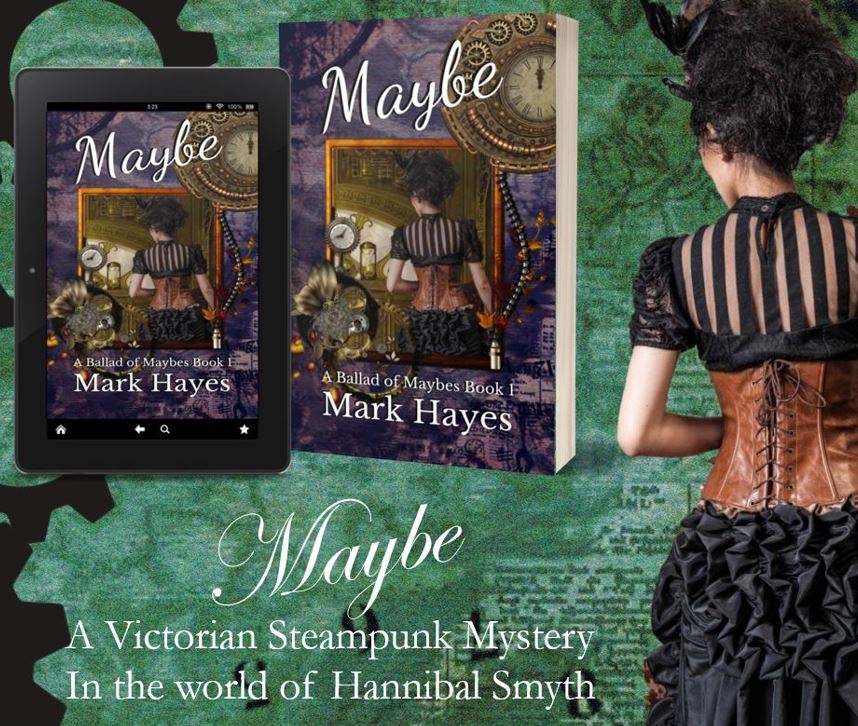
The title got shortened to Maybe, for reasons, and I did a second draft, then a third, then sometime in early February complete novel off to beta readers and editors and by mid march, just in time for my 50th birthday I had a new book to release, which was frankly an unexpected out come. So yes, I failed my NaNoWriMo challenge last year, but I did actually get the novel out of it I was looking for. A rather good novel people like a great deal if the some what less than gentle urgings to get on with the sequel I promised would be out this year are anything to go by.
(spoiler alert, the second Maybe novel is not going to be out this year.)
Which brings me to this year, where I intend to go for the same trick. The third Hannibal novel A Squid on the Shoulder has been stalled a while for reasons beyond writing. While it may not need a full 50k words to complete (its about 45k at the moment) I suspect it will end up around the 90k mark and I can almost guarantee the first draft will need another 50k that will end up being trimmed back a little in the following drafts as that’s what normally happens.
If I manage NaNoWriMo or not this year remains an open question, I suspect I will fail again, but not for want of trying. The point here is that I always look upon NaNoWriMo as an opportunity to get something written, be it a first draft from scratch or to finish a work in progress.
I’ve always written better, or at least more productively in the autumn and winter months and so it comes at the right time for me every year. Last year finally gave the world Eliza TuPaKa, Benjamin West and Gothe. This year with a little luck and a lot of hard work will hopefully give the world Hannibal and Hettie aboard Jules Verne’s submarine, Doctor Musk’s Island, the biggest howitzer ever conceived for the most literal of moonshots, and it may even get me to the bowels of the Kremlin to free H G Wells form the clutches of….. Ahem, I’m saying too much here…
In essence though, I am saying all this in the hope it may convince some of you to give NaNoWriMo a go. Remember its not the succeeding so much as the taking part. Its not about writing a Booker prize winner but some kind of first draft, and ultimately its about having fu. So to anyone else already planning for NaNoWriMo I wish you luck and good writing… To anyone inspired to give it a go for the first time , ‘welcome to the party punk’ enjoy….
I frequent my fair share of authors forums, both live chat get togethers and on things like twitter and Facebook. In these forums a question that comes up fairly often from newer authors is whether or not it is worth putting there books on Kindle Unlimited. There is a certain degree or reticence in this regard from some authors, others have had bad or middle experiences with it, and often it is purely a case of authors not knowing if this going to be good for them or not, and also not understanding the restrictions doing so places upon the self published author.
As I fine myself answering this question, or at least expressing my own opinion while explaining the mechanics a lot it’s clear it is a subject on which people want advice. As I have not done a ‘how to’ post for writers/self publishers in a while I thought I would try to address the subject in this post. But first to explain what it is, and the restrictions placing your book on Kindle Unlimited.
Netflicks for Books…
The netflicks for books analogy is probably the most used to explain what Kindle Unlimited is. While not entirely accurate its not far off. there are two ways a reader can access Kindle Unlimited books.
The first is by subscribing to Kindle Unlimited, which allows them to borrow books for ‘free’ from the library of eligible books. They pay a flat fee each month and download as many or as few books as they like.
The second is through Amazon Prime. If you have an Amazon prime account you can download one book for free each month, provided you ‘return’ the book you lent last.
How do you, the author, get paid?
Amazon have a monthly fund, this is made up of a portion of subscriptions and a small portion of money from Amazon Prime. This is set aside after the month ‘prize’ awards (which go to the biggest sellers) the fund is divided between all authors based on a small amount per page read. So if someone borrows you book and flicks through the first 25 pages on kindle unlimited you get paid for 25 pages, if they read the whole book you get paid for whatever the page count is (this is not your actual page count in a paperback version , it is generally a little higher than the paperback page count, they work on a set value of words per page, generally is is also higher than the page count the kindle version of your book will say it has on its amazon listing)
The actual amount a page is worth varies every month, depending on how many pages in total are read across the whole of kindle unlimited, and the size of the monthly fund. It is generally around 0.003 pp meaning a book worth 400 pages is worth around £1.20. The dollar rate for US reads (and likewise every other territory) is different but the same principal applies.
Longer books are therefore worth more than short books in this model, but there is a cap to that. I’ll come back to that in a minute.
The Downside?
The downside to listing your books on kindle unlimited ( which you can do for 90 periods at a time though it will self renew unless you say otherwise) is if you list your books on Kindle Unlimited you are not allowed by the contract to list those same books anywhere other than Kindle. That may seem restrictive, and it is. the rights and wrongs of this you can debate with Amazon by all means. They will say that having exclusive eBooks rights on books on Kindle Unlimited they bolster the platform, which is true, but you may decide you don’t want to bolster Amazons grip on the marketplace, and fair enough if that’s a stance you wish to take.
The 1200 page limit
In order to avoid fatuously long books trying to game the system there is a high end on page reads where the payment per page stops at the cap. This is to stop people putting a whole series together on kindle unlimited with hyper links to the last book trying to clock up enormous reads (the system only remembers the highest page the reader was on for accounting purposes). As such do not put all your books together in a single volume ( a popular approach to book marketing). While you may not be doing so to game the system other have done just that which is why the cap is there. So put series together by all means but separate them into small groups to avoid the cap if you need to…
The Flip Side
The flipside’s are the other benefits you get by listing a book on Kindle Unlimited is you can use there promotion. You can run free books for up to five days ( don’t is my advise but opinions vary here) Or put you book on a 7 day sales price (which is generally a better plan) So while you are signing an exclusive agreement for 90 days you do get promotional tools as well.
Is it worth it?
Well that’s the big question isn’t it… The simple truth is that comes down to this; Amazon won the Kindle, Nook, Ibook wars. Much like Blueray vs HDDVD or if you old enough Betamax v’s VHS, Kindle became the popular choice of the masses as far as ebook platforms are concerned. They did this by loss leading Kindle Fires so they were much cheaper than the alternatives, and once Apple held up the white flag and allowed a Kindle app on to there Ipad/Iphone platform the writing was on the wall for Nook. There are other Ebook platforms, smashwords for example but even if you have listings with all the competitors the chances are the majority of readers for ebooks will come via Kindle. You could sell a reasonable amount on other platforms, but finding readers as an independent is hard enough on Kindle.
In simple terms you are more likely to get more readers on Kindle Unlimited than you will gain by having your books listed on other platforms. And yes that whole exclusive release thing is the very tool Amazon used to win the war, but the war is won and its too late to side against the victors…
While readers, not money, has always been my own personal driving force in these matters, the results are much the same. If you want an example of why I say this see the graph below.
This is the revenue split this month as of yesterday, (as it was the easiest to grab), on an average month the revenue split between eBook sales and Kindle Unlimited reads can vary from about this much to anything you to 45% or even 50+% Kindle Unlimited.
Personally I care more about how that splits out into books, and over the last 5 years about 30% of all my book sales have been Kindle Unlimited, with about 15% paperbacks and 55% kindle downloads, though those are rough percentages, as equating page reads to books sales is complicated. In the last five years I’ve clocked up 118624 page reads, which as the average across all my books is around 400pp to a book equates to around 296 books.
As I say these are rough figures, Scar of Avarice is only 105pp while Passing Place is 556pp but the average across all my books is around 400pp give or take and while I could figure it out more exactly 296 books in total is about right.
That 30% Kindle Unlimited books as you may guess is equal to about 30% all revenue, sure I make more on a kindle download of A Spider In The Eye than I do in page reads, in page reads its worth around £1.20 on a sale its worth £1.60. But as from Russia With Tassels is a longer book the margin between a kindle unlimited read and a straight download is negligible, while Passing Place actually pays more though Kindle Unlimited because its has a high page count.
So the question becomes would I sell that 30% of all sales on other platforms if I went none exclusive and left Kindle Unlimited. The simple answer is no, I just wouldn’t. They won the platform war and that’s all there is to it.
The Other Advantages
There is one more set of advantages in going on Kindle Unlimited. On the off chance your not swayed by simple access to a larger market of potential readers. Anyone reading at least 10%of a book on Kindle Unlimited registers as a sale, and counts towards amazon best seller ratings. And kindle Unlimited counts as proof of purchase allowing the reader to review on Amazon. Books sold in other marketplaces do not.
Amazon is the big bad, plenty of people dislike Amazons business practices, or want to make a stand against them. Frankly all power to you if that’s you. But while I may deplore Amazons business practices at times, it is the market place and Kindle Unlimited is part of that marketplace, and a large part, certainly a bigger opportunity to find new readers than the none exclusive alterative presents these days.
Summing up
Hopefully that answers a few questions for some of you, or opens the eyes of others. this is by no means comprehensive but it is the bare bones of the reasons I go with Kindle Unlimited, which comes down to more readers at the end of the day. I like readers and I get more this way.
Its October, the leaves are falling, the witches are abroad, and I’ve opened the blog up to guest writers again. Yes its Indie October. Throughout October some old favourites among my guests will be returning along with some new voices. Today’s Guest Post comes to you the the writer and publisher behind behind 6E Publishing, the Harvey Duckman series, and the utterly engaging Thieves Guild universe; the awesomeness that is CG Hatton.
Every time Mark opens up his blog to fellow indie authors, there’s always a moment of ‘Yay, I want to be in it’ (as it’s becoming a much sought-after blog to be in) followed by ‘Oh no, what to write about’. I must admit, I find blogging hard, and when nudged I usually revert to writing publishing ‘how to’ articles or the fun and trivial often rum-inspired ‘let’s write’ pieces.
But this year, for some reason, it feels like the right time to bare my soul slightly, so here goes…
Linkin Park, the Thieves’ Guild and why I was so angry in 2007
(Music and writing, miscarriage and loss…)
It’s been thirteen years since Hil took me by the scruff of the neck and told me that we were going to write these books… twenty eight years, almost to the day, since Mr H and me, on our second wedding anniversary, sat in a hotel in North Yorkshire and drafted out five characters (LC, Sean, Gallagher, Hal Duncan, and a yet to be named drunk pilot) who’d been thrown together on a deep space freighter called El Pato Loco…
We knew LC was a thief who’d stolen… (won’t say what coz, y’know, spoilers). We knew Sean was the bounty hunter who was chasing him. And we knew Gallagher had lost his previous ship because it was shot down by aliens.
And for fifteen years I wrote heap loads of stuff, fluff stuff, nothing ever happens stuff, random scenes (NG appeared soon after, with no name, hence he became the FNG), short stories and nonsense, and none of it really came together or worked, until 2007…
To go back a step, in 2001 Mikey Hollifield (the infamous Mikey ‘Merlin’ Hollifield) gave me a CD of music at a paintball event of all things, and I drove everyone insane by playing it non-stop over the PA system for the whole weekend. It was Hybrid Theory and it instantly became the backdrop to everything I was writing. But my big story was still not quite working, not quite there, not ‘it’ yet.
And then 2007 happened.
There are two camps on writing… one is write what you know, one is write what you can imagine… I love writing science fiction because I love to imagine whole galaxies. But pain is a strange thing. I don’t think you can really write it until you have experienced it. I know I couldn’t until I had.
So in 2007 I experienced pain like no other. I’d experienced loss, and grief… but pain, deep down, never to get over it pain…?
I had a miscarriage. Our first. Our longed for, yearned for child died.
And it threw me.
It threw me into a dark and angry place at the same time that Linkin Park, my go to writing guys, released Minutes to Midnight.
No More Sorrow became my loud and angry, fiercely belligerent soundtrack, everywhere I drove, too fast, too loud. And Hil turned up with his angry, belligerent hurt and confusion.
If you know me, you also know that I’m intimidated by LC. I love writing LC, I love being with him… but there is something awesomely intimidating about him (not least that he’s based and inspired by a real person, as is Hal Duncan, both of whom died way too young). So trying to write LC’s story was hard. When Hil turned up in 2007 amidst all that pain and anger, it all fell into place.
As loud as Linkin Park was in my car, so too were the characters and the scenes in my head, and the hurt and pain of more and more miscarriages each year were written into them. And working through it all, eventually, after a long time, the belligerence became residual…
But never really went away.
Until we met a parrot called Chester and a sequence of events led us to 2012 when the munchkins came into our lives, and everything changed again. They’d had enough hurt and pain of their own and we are all still helping each other to heal. By then I’d written Blatant Disregard and most of Harsh Realities (yes, the titles echo my frame of mind at the time), both of which had their own signature songs, but always accompanied by my go to soundtrack – Hybrid Theory, Meteora and Minutes to Midnight, joined by various tracks from Living Things.
In 2014, when I started writing Wilful Defiance, I was willing Linkin Park to come out with something new, something that was more like those first three albums, and they delivered with amazing timing the brilliantly energetic Hunting Party with Wastelands that became my soundtrack for the opening scene when NG is walking through the riot. It was perfect.
And when I went on to write Kheris Burning, A Line in The Sand became LC’s absolute go to. If I ever want to drop into LC, I can play that track and I’m right there on the wall of the garrison on Kheris with him.
After that, Redemption had its own tracks and then in the summer of 2017 as I was struggling to write Darkest Fears, Linkin Park released One More Light… and I hated it.
I hated the electro-chipmunk nonsense and female guest vocals… this wasn’t the Linkin Park I knew and loved… what were they doing? I was writing a really dark, tough place to be and I had no soundtrack…
And then Chester Bennington died.
In desperation, I found an acoustic piano version of One More Light that I love, stripped bare vocals and raw emotion, and it became LC’s song as he fought for his own survival. I cried in the kitchen as I wrote that book, and I still cry every time I hear it.
So what now…? Hil had his own soundtrack for Convergence, and I can always ditch back to No More Sorrow and the pain of 2007 to get back to him if I need. Writing LC’s third story, I have plenty of tracks to dip back into that are and always will be LC. And for the next big book, NG has tracks of his own that throw me right back to Devon, and Erica, and Leigh in an instant.
There will never be another new Linkin Park album… but I know I’m one of millions who can thank them for helping me get through the hard times.
About CG Hatton (by mark)
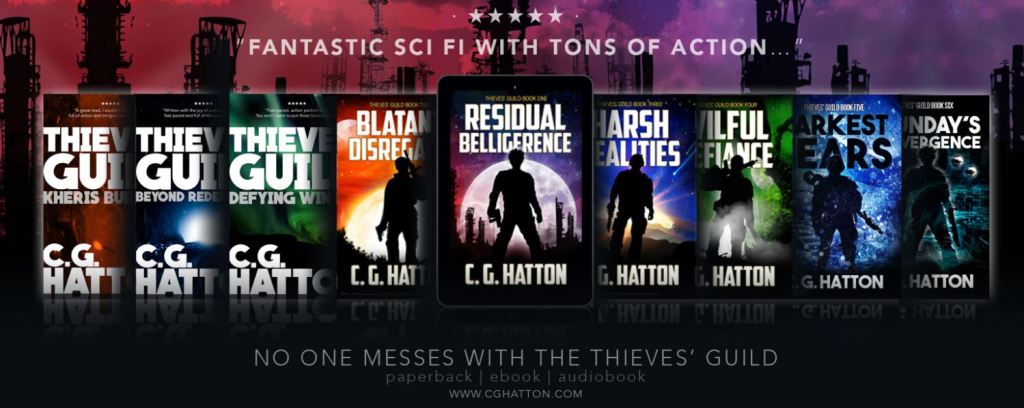
CG Hatton is the author of the fast-paced, military science fiction books set in the high-tech Thieves’ Guild universe of galactic war, knife-edge intrigue, alien invasion, thieves, assassins, bounty hunters and pirates. She has a PhD in geology and a background in journalism. She loves meringue and football (supports Tottenham Hotspur), drinks spiced rum and listens to Linkin Park, has climbed active volcanoes, walked on the Great Wall of China, and been mugged in Brazil. She also for reasons know only to her decided to name a planet after me in one of the Thieves Guild novels. Its probably a grubby little world devoid of intelligent life, I’d be almost disappointed if this wasn’t the case…
And read a hell of a lot more about her books on here, as I have reviewed several of them over the years by clicking on the indieomacon
Finally because she has said so much about the music of Linkin Park, here is a playlist I’ve put together of all the songs she mentioned. Its really quite good…
Its October, the leaves are falling, the witches are abroad, and I’ve opened the blog up to guest writers again. Yes its Indie October. Throughout October some old favourites among my guests will be returning along with some new voices. Today’s Guest Post comes to you from Teesside’s own Nostradamus, futurist, and terrifyingly smart queen of Crypto currency Kate Baucherel
Writing near-future science fiction can be a challenge in more ways than one. I grew up steeped in scifi, dreaming of far future and fantasy worlds from Earth and Mars to the Culture, the Uplift universe, Middle Earth, and the Discworld. When I started to build the world of the SimCavalier, however, the timing of the first tale was dictated by the subject matter and the plot. I had to make it familiar enough to readers that the message of good cybersecurity practice hit home. I had an idea about criminals playing the financial markets as cryptocurrencies came to equal the power of sterling, and my gut feeling was that it had to be placed no later than 2050. I wanted to let loose all the automated tools which are lurking on the edge of our vision right now. I ended up in the mid-2040s, and ran with it.
Soon after publishing the first book, strange things began to happen. Innovations which I had pitched twenty years hence started to appear in real life. Delivery robots were pictured falling off kerbs in the snow in Milton Keynes. Bitcoin, which had been quite niche when the tale was titled, suddenly exploded into public consciousness. Cybercriminals pushed malware out with legitimate software updates. I took note of all this for the second adventure, Hacked Future, and made a greater effort to extrapolate and invent less plausible scenarios. The destruction of Notre Dame cathedral, for instance, or a backstory of a global pandemic.
Oops.
The third adventure of Cameron and the team, Tangled Fortunes, is deep in final edits and is available for pre-order now. I have already seen whispers about some of the imagined scenarios making their way into real life – mining landfill sites for precious metals, for example (no spoilers!). It has been suggested that in another era I might have been burned as a witch, evoking shades of Agnes Nutter.
Where does all this come from? One thing that most writers quickly discover is that their style is buried deep inside them and they have little choice over how they present their stories. It seems that the writing voice I had as a child has resurfaced as an adult. I remember spending hours at an old typewriter creating my own derivative stories in the worlds of Dr Who, the Tomorrow People, and Star Wars, including one memorable attempt at a script with some willing chums who acted it out in the park. I simply played complete scenes in my head and wrote down what I saw. A black and white TV with three channels was enough at that time to inspire my visual imagination. Now, I’m working in technicolour.
“I can almost see the director just out of shot,” said editor Gillie Hatton, her red pen working overtime on Tangled Fortunes. She’s hit the nail on the head: everything I write I see in my mind’s eye and describe for the reader. I couldn’t write any other way, and it’s important for all writers to realise that their own voices are distinctive and unique. When I open any of the Harvey Duckman anthologies, I know the individual tones of my fellow authors and I embrace the familiarity. For those I’ve met, I can almost hear them narrating their stories. There is such a spectrum of storytelling, of styles, of points of view, and it is all down to the voice of the individual.
I’m still chasing the future and writing down the scenes which flash through my mind. For now, though, I invite you enjoy the third SimCavalier novel, Tangled Fortunes, which is released on Halloween and can be pre-ordered on Kindle.
About Kate Baucherel (by Mark)
Kate Baucherel is a digital strategist, a writer of both non-fiction books that explain technology while making you laugh, cyber-crime sci-fi (her third SimCaviler novel is much anticipated this year), and short stories for the Harvey Duckman Presents series (her Christmas tale was particularity compelling). She is also an internationally renown expert on Blockchain, an occasional guest lecturer at universities, as well as a panellist and speaker at technology conferences around the world. More importantly Jackie Carlton once bought her a drink and she has been known to dress up as Han Solo at Halloween (or whenever else she can get away with it probably). If that is not intimidating enough, she is also is a black-belt in several martial arts including Karate, octopus catapults, parenting and the internet …
As it is that most wonderful time of the year again, and the ghost and ghouls are gathering in the shadows… Thoughts turn once more to the coming November. So here is the annual pre-NaNoWriMo post
With November less than a month away, and in the mildly self-aggrandizing of attempting to offer some advice to budding writers… This is the story of how I managed to write my first novel. It is also the story of how I managed to write my nineteenth novel. They just happen to be the same book. The other eighteen are still sat on hard drives, in paper copies or in one case on an old Amiga floppy disc I can not access. You see, in case you have failed to guess, the only reason Cider lane became my first novel was because I actually finish writing it. More importantly, perhaps, I actually finished the first draft.
Like most writers I suspect, I have started a lot of projects over the years, far more than nineteen technically, as I have endless notebooks and scrap ends, one-off chapters of unwritten masterpieces (or utter drivel in all likelihood). That nineteen…
Its October, the leaves are falling, the witches are abroad, and I’ve opened the blog up to guest writers again. Yes its Indie October. Throughout October some old favourites among my guests will be returning along with some new voices. Today’s Guest Post comes to you from the shores of Sussex, and the finest Dutchman I know, he’s also the only one I know but that does not detract from how lovely he is, Nils Nisse Visser .
Images licensed by Dreamstime, contributing artists Bram Janssens & Grandfailure
The author behind A Passing Place takes mischievous pride in going off on tangents before getting to the point of any given blog. Well, hold me grog, sailor, because I intend to surpass him in this. Bear with me long enough, and in due time the relevance will become clear, but first:
Once upon a time the Dutch had a mighty fine legend concerning the folly of a sea captain who dared defy the elements and was subsequently doomed to roam the Seven Seas forever, striking fear in the hearts of sailors to this very day.
The story of The Flying Dutchman probably originated at the Cape of Good Hope in South Africa in the 17th century. Cape Town was then Kaapstad, founded by the Dutch East Indies Company (VOC) to provision their ships. The Cape is notorious for ill-tempered storms. It’s likely that the story of The Flying Dutchman followed the defiance of one captain who refused to be cowed by a tempest and sailed into it, to never be seen alive again. It’s possible that the early stories were also connected to VOC Captain Barend Fokke, whose incredible speed in completing the journeys to and from the East were regarded with suspicion – it was rumoured by envious colleagues that the Devil himself must be involved in such feats.
Although reported sightings of The Flying Dutchman occur all over the world, the waves surrounding the Cape of Good Hope prevail above all other waters. There was a spate of sightings during World War Two, many witnessed by scores of people, including the military. Admiral Dönitz of the German Kriegsmarine noted U-Boat reports about a mysterious schooner under sail in the area. Lieutenant Commander Nicholas Monsarrat (author of The Cruel Sea (1951)) claimed to have seen The Flying Dutchman near to the location where King George V had seen the ghostly ship in 1881 as a young boy, and a small Australian warship on its way to Cape Town is reputed to have radioed a distress call consisting of two words before disappearing without a trace: Flying Dutchman.
Image ‘The Gust’ by Willem van de Velde, 1680. Artwork in the public domain, photo Rijksmuseum, Amsterdam.
By this time stories of the ghostly ship had long been hijacked by the English and changed somewhat in nature. For example, they placed the captain (who they named as Hendrik van der Dekken/Decken) and ship in Terneuzen, which had a harbour the size of a toddler’s paddling pool at the time. A sailor would have been hard-pressed to turn a jolly boat around in it, let alone squeeze in a three-masted East Indiaman of considerable tonnage. Tut-tut. Do you research peeps.
What remained was the defiance of nature/God, and subsequent punishment to roam the oceans until Doomsday. Added was the notion that captain and crew were allowed on land once every so many years, and/or attempts to hail other ships to hand over letters to family members long dead and gone – a poignant touch. Needless to say, accepting the letters was a fatal mistake.
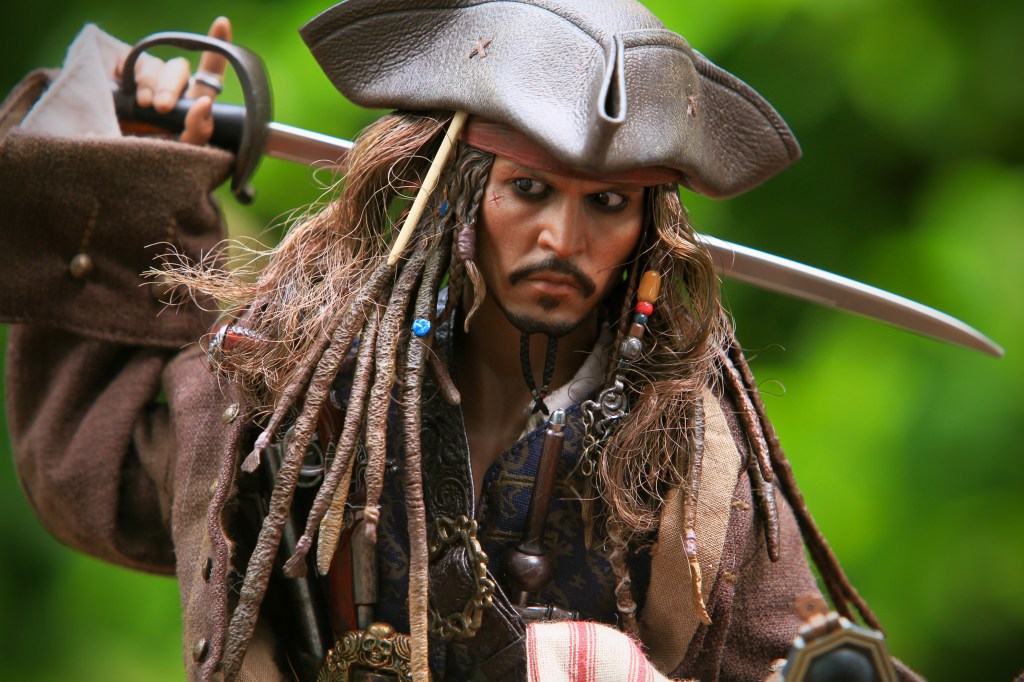
Since then Hollywood got its hands on the tale, changing it again to have the ship captained by Davy Jones, as tentacled opposition for Cap’n Jack Sparrow and company, though there’s a nod to possible earlier captains and crews because Davy Jones hadn’t always been captain and others could follow him: “The Dutchman must have a captain”. The romantic entanglement between Davy Jones and sea-goddess Calypso has echoes of Wagner’s Der Fliegende Holländer opera (1843), as Wagner added a redemption-through-love theme to the saga. Until Pirates of the Caribbean hit the screens, Wagner’s interpretation did more than any other to ensure a lasting cultural legacy for The Flying Dutchman.
Image of Captain Jack Sparrow licensed by Dreamstime, contributing artist Pholtana Wongsuchart
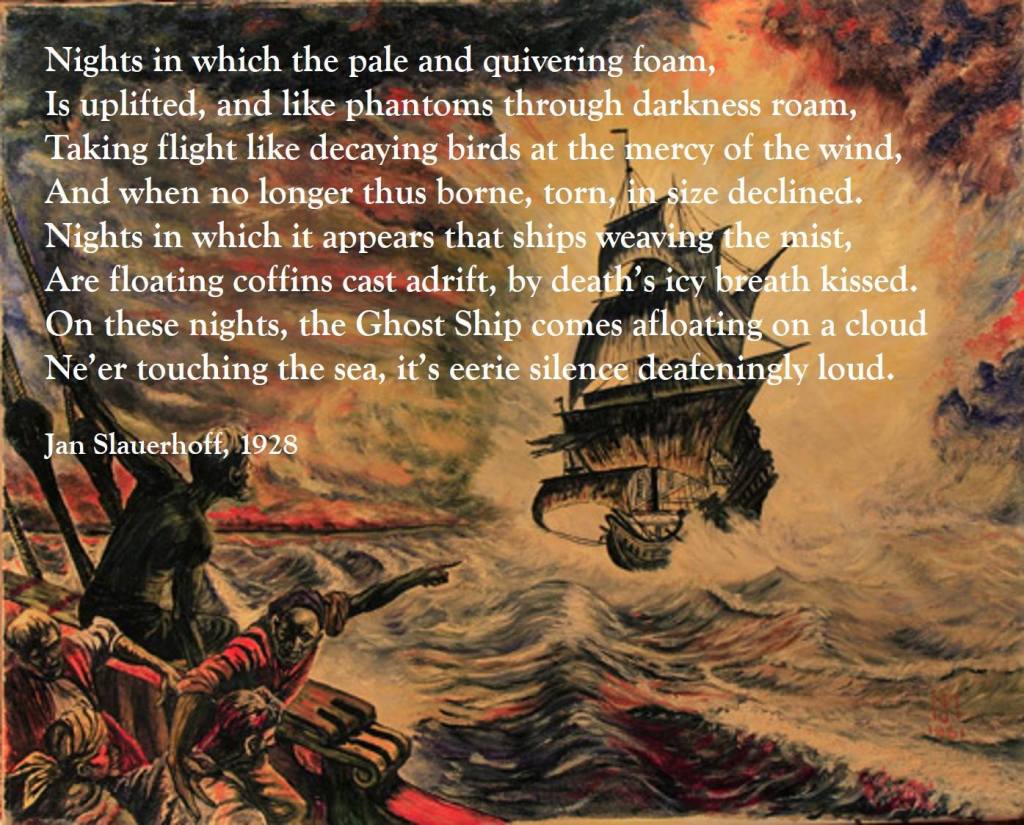
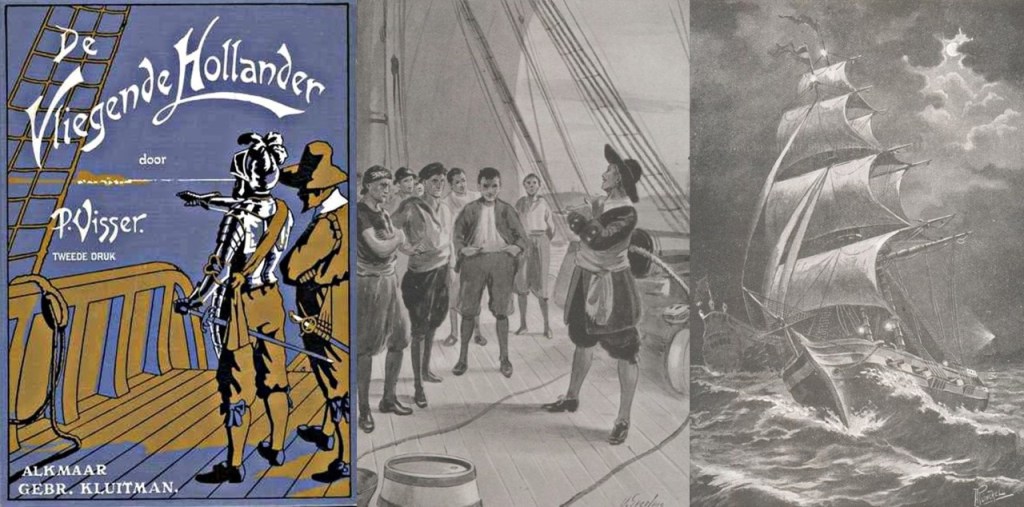
In the meantime, there were Dutch attempts to steal the story back. Piet Visser’s De Vliegende Hollander (The Flying Dutchman) was moderately successful in the Netherlands, seeing a first edition in 1901, a second in 1910, and a third in 1918. Jan Slauerhoff, possibly the most influential poet in Dutch literature and a seaman himself, added to the Dutch oeuvre in his 1928 Eldorado bundle, with no less than three poems about The Flying Dutchman (‘The Eternal Ship’, ‘The Ghost Ship’, and ‘The Flying Dutchman’).
None of this work was ever translated to English, so the book and poems never gained much traction outside of the Netherlands. Both Visser and Slauerhoff rejected the traditional Puritan theme of offending God (nature) and subsequent divine punishment.
Slauerhoff was influenced by French romanticism and preferred to dwell on the notions of death and decay as a natural state of affairs, rather than the consequence of offending a deity. For English reference, Slauerhoff’s approach was somewhat akin to Rime of the Ancient Mariner, minus the punitive aspect in Coleridge’s epic ballad. The title of Slauerhoff’s bundle, Eldorado, was a homage to Edgar Allan Poe as Slauerhoff felt a great deal of kinship with Poe’s inner struggles and admired Poe’s oeuvre.
With kind permission of Corin Spinks, CorinographyPainting “The Flying Dutchman” by Louis M. Eilshemius, 1908.Painting by Jan van der Mee, 1961. For the clever clogs who noted the earlier statement that this stuff hadn’t been translated: This is my own translation.
It’s not known where Visser got his inspiration from. Although there’s much justifiable criticism about his writing, his interpretation is refreshing, if not ingenious. His take on The Flying Dutchman is an origins story of the cursed ship, rather than the consequence (Scary McScaryboatface scaring scared seafolk). Like the original Dutch and English versions, the curse is a punishment, but there is no tug of war between Heaven and Hell, nor divine retribution. Instead, Visser allows for the remarkable human ability to walk a path of self-destruction – and in this case a trajectory into madness. Interestingly enough, the final demise of sanity takes place in the company of historic pirates of the Caribbean, rather than merchant sailors at Cape Town.
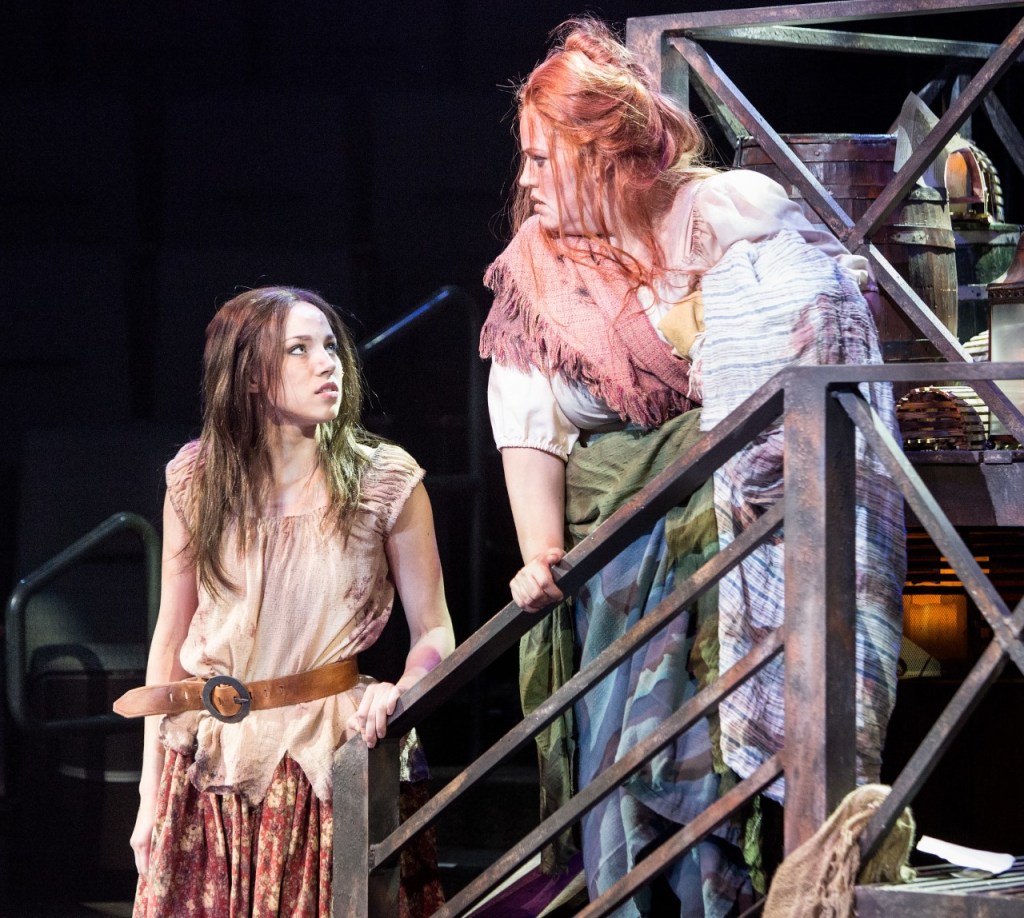
Visser’s weakness is his writing, although it must be said that in his day (early twentieth century) he received praise for innovate storytelling and it was said he thoroughly modernised the type of stories he excelled at. Unfortunately, that praise doesn’t withstand the eye of a modern reader. The entire first chapter of De Vliegende Hollander is basically one long info-dump. When he gets around to actual storytelling, there are a few genuinely entertaining gems to be found, such as the character of Griet Kals, an innkeeper who has much in common with Victor Hugo’s Madame Thénardier (Everybody raise a glass to the master of the house!).
2.0 Generic (CC BY-NC-ND 2.0), Hale Centre Theatre, Anna Daines Rennaker as Eponine and Camille Van Wagoner as Madame Thenardier, Les Misérables, Victor Hugo.
Unfortunately, Griet Kals and the protagonist’s cousin Lottie are the only female characters in the book. Amusing as Griet Kals is, she remains a caricature, and Lottie gets all of two sentences in, exclaiming how fortunate she is that a dashing manly hero has appeared to save a damsel in distress.
Equally unfortunate, Piet Visser lived and wrote at a time in which boys and men were taught to be devoid of emotion. Therefore, the most interesting aspect of his story – the psychological process of impending and then full insanity, is dealt with in one single brief sentence: He went completely insane. For a modern audience, with a preference for show-not-tell and with an almost insatiable appetite for psychological motives and processes, this tends to be a disappointment.
The cover of the second edition of Piet Visser’s De Vliegende Hollander, and two internal illustrations by O. Geerling featuring Captain Peter van Haelen addressing his crew and The Swift Christina, afore she became The Flying Dutchman. Source: Project Gutenberg.
At long last the relevance of this long rant, in which I’ve hoped innate fascination with The Flying Dutchman has kept you going. To reward your patience, the relevance is twofold.
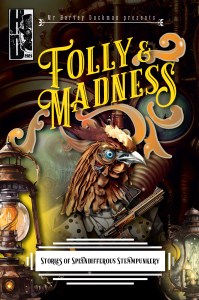
First-of-all, it can be said that the Harvey Duckman Pirate Special which was recently published (and which y’all ought to be reading by now), sustains the enduring legacy of The Flying Dutchman, containing no less than two stories on the topic: Peter James Martin’s ‘The Rat Who Served on The Flying Dutchman’ (A Brennan and Riz Story), and my own ‘Learning the Ropes’ (A Smugglepunk Tale).
Secondly, Piet Visser was my great grand uncle. I don’t mind admitting that my mind is a rather peculiar place which I barely understand myself – what I do know is that my set of thought processes have made much of this family connection to Piet Visser, and hence The Flying Dutchman. It probably wouldn’t stand in a court (and doesn’t need to be as the pre-1923 copyright rule applies), but as far as my noddle is concerned Piet’s literary legacy is a family inheritance to treasure…and fiddle with.
Arr, me hearties, I’ve been fiddling the tune of The Flying Dutchman in a great many ways, but seeing that I’ve run out of space, you’ll have to wait for part two of this yarn to find out how…till then, Fair Winds to ye.
With kind permission of Corin Spinks, Corinography. Author Nils Nisse Visser, self-proclaimed guardian of Piet Visser’s The Flying Dutchman, looking pretty at Rye Bay, Sussex.
About Nils Nisse Visser
Nils is a free-lance writer, occasional poet, archer, Homelessness activist, who was born in Rotterdam in the Netherlands in 1970 (which was the best year ever to be born *Mark), he grew up in the Netherlands, Thailand, Nepal, Oklahoma, Tanzania, England, Egypt and France. Taught English at various Dutch secondary schools for 18 years, but his firm belief that education is most effective when it is fun raised a few eyebrows. Having been told too often that he lived in his imagination, he took the hint and moved there on a full-time basis. He currently lives in Brighton in the county of Sussex in England.
Rather confusingly he sometimes writes as Nils Visser, Nisse Visser or Nils Nisse Visser. For which he apologies.
























 The Passing Place